

Adding Schema Doesn't Boost AI Citations - Results from Ahrefs 2026 Study
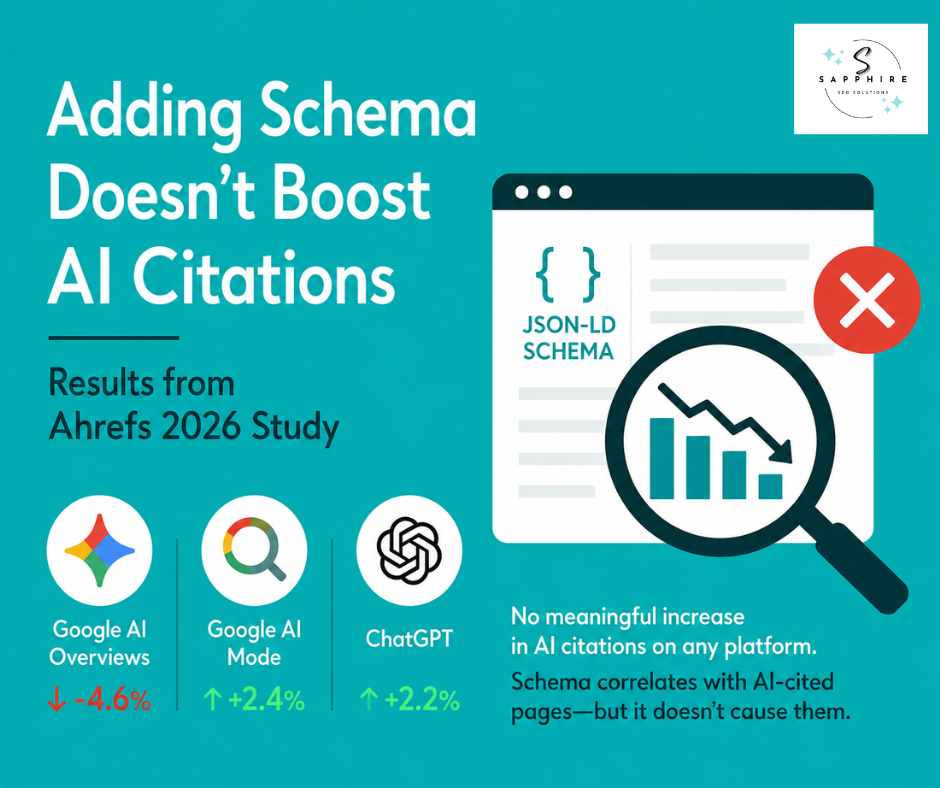
A 2026 Ahrefs study tracked 1,885 pages that added JSON-LD schema markup and measured citation changes across Google AI Overviews, Google AI Mode, and ChatGPT. The result: adding schema produced no meaningful increase in AI citations on any platform. Google AI Mode showed +2.4% and ChatGPT +2.2%, both statistically indistinguishable from random variation. Google AI Overviews showed a small −4.6% decline relative to control pages. The study found that schema correlates with AI-cited pages because high-quality sites implement it alongside authoritative content, strong backlinks, and technical SEO, not because schema itself drives citations. For pages already visible to AI systems, adding JSON-LD is not a reliable tactic for increasing citation frequency.
Key Takeaways
Schema doesn't boost AI citations. Ahrefs tracked 1,885 pages and found no meaningful citation increase on any platform.
The correlation is real; the causation isn't. AI-cited pages over-index on schema because high-quality sites do everything well, not because schema drives citations.
AI systems ignore schema during direct retrieval. ChatGPT, Claude, Gemini, Perplexity, and Google AI Mode extracted only visible HTML content.
Authority, content quality, and backlinks are the real drivers. These signals determine whether pages enter AI citation pools in the first place.
Schema still earns its place. Rich results, Knowledge Graph associations, and entity recognition remain valid reasons to implement structured data.

For a while now, a working assumption has been spreading through the SEO community: add schema markup to your pages, and your AI visibility improves. The logic seemed straightforward. If you want your content cited in AI search results, structured data is the lever to pull.
JSON-LD schema, in particular, became a go-to recommendation for brands and publishers chasing AI citations. The belief was simple: better-structured pages get picked up more often by AI systems. It made intuitive sense, and the data appeared to back it up.
But a new large-scale study from Ahrefs challenges that assumption directly. After tracking nearly 1,900 pages across Google AI Overviews, Google AI Mode, and ChatGPT, the findings are clear: adding schema doesn't boost AI citations in any meaningful way. For SEO professionals, content publishers, and brands investing heavily in AI visibility, that's a finding worth understanding.
At Sapphire SEO Solutions, our certified SEO experts stay ahead of the latest developments in the industry so that the brands we work with can compete with larger competitors. Our AI SEO services help your business appear in AI citations, future-proofing your SEO online growth strategy.
In this comprehensive guide, we will go over the detailed study conducted by Ahrefs to determine whether schema markup helps boost AI citations. Keep reading until the end, as we will also cover some of the best SEO practices to follow to dominate AI search results.
Let's get started!
Why SEO Professionals Believed Schema Improved AI Citations
The idea that schema markup could drive more AI citations didn't come from nowhere. It was built on real data. Here's what you need to know:
The Correlation That Sparked the Theory
When Ahrefs analyzed 6 million URLs, the numbers looked compelling. Pages cited by AI were far more likely to carry JSON-LD schema than non-cited pages. Only 18.5% of non-cited pages had schema. Among AI-cited pages, that figure jumped to 53.6% for reference citations and 71.7% for inline citations.
Cited pages over-indexed on schema by nearly three to one. The stat showed that sites that add structured data get cited more. The same logic that had applied to rich results in traditional search appeared to be carrying over into AI search.
Correlation vs. Causation in AI SEO
The problem is that technically sophisticated sites do a lot of things at once. The same sites that implement schema markup also publish authoritative content, build more links, maintain their pages consistently, and invest deeply in technical SEO. Content quality, authority, and backlinks all tend to travel together on well-run websites.
So when sites publish stronger content and also happen to use structured data, it becomes very difficult to know which signal is actually doing the work. Schema may simply be one habit among many on high-performing sites, present on cited pages, but not the reason those pages are being cited.
Inside the Ahrefs AI Citation Experiment
To move past correlation, Ahrefs designed a controlled experiment. The goal was straightforward: measure citation changes after the schema was added, against pages where nothing changed. Ahrefs tracked 1,885 web pages to find out.
How the Research Was Conducted
Ahrefs tracked 1,885 pages that had added JSON-LD schema between August 2025 and March 2026. Each of these pages that added JSON-LD schema was then matched against 4,000 control pages from different domains with similar citation histories that never added schema during the same window.
Measured citation changes were recorded for each page across Google AI Overviews, AI Mode, and ChatGPT in the 30 days before and after the schema was added. The analysis was carried out using Ahrefs' Brand Radar tool and Agent A, their AI marketing agent.
How Ahrefs Identified Schema Implementation Dates
Pinpointing exactly when JSON-LD schema went live on each page was central to the study's reliability. Ahrefs used historical crawl data to detect the precise moment each page transitioned from having no JSON-LD to having a JSON-LD schema present. This gave researchers a clean treatment date for every page — the specific point from which citation changes could be measured forward and backward.
Why Control Groups Were Necessary
AI search was moving in multiple directions during the study period. AI Overview visibility was contracting while AI Mode was growing rapidly. A simple before-and-after comparison on treated pages alone would have absorbed those platform-wide swings, making it impossible to know whether any citation change came from schema or just from the environment shifting.
Matched control pages solved that problem. By comparing treated and control pages that started from the same citation baseline, with the only meaningful difference being that one group added schema, Ahrefs could strip out background noise. Control pages and measured outcomes from treated pages could then be compared directly, isolating what schema specifically contributed or didn't.
The Core Findings: Adding Schema Doesn’t Boost AI Citations
When the results came in, they were consistent across every platform. Adding schema produced no meaningful change. AI citations barely moved, and where they did, the movement was too small to act on. The schema produced no major uplift, and there were no exceptions.
Results Across Google AI Overviews, AI Mode, and ChatGPT
The numbers from the difference-in-differences analysis broke down as follows:
Google AI Overviews: −4.6% relative to control pages
Google AI Mode: +2.4% relative to control pages
ChatGPT: approximately +2.2% relative to control pages
AI Overview citations on treated pages fell slightly. On AI Mode and ChatGPT, treated pages edged marginally higher, but those gains tell a misleading story at first glance.
Google AI Mode was expanding rapidly during the study period, and AI Overview visibility was contracting. Raw citation growth across Google AI Overviews, AI Mode, and ChatGPT was being driven by platform-wide trends, not by anything pages were doing differently. Once those trends were stripped out, the positive numbers shrank to near zero.
What "Statistically Insignificant" Actually Means
The +2.4% on AI Mode and +2.2% on ChatGPT are what researchers describe as statistically insignificant. These are results that fall well within the range of random noise. In other words, fluctuations of that size can occur naturally across thousands of pages without any intervention at all.
There is an important distinction here. A number being measurable does not make it meaningful. A statistically significant decline relative to a control group means the result is unlikely to be accidental. A result that is statistically significant relative to nothing because it isn't means the opposite. The AI Mode and ChatGPT figures cannot be separated from normal platform variation, which means they offer no reliable signal that the schema helped.
The One Unexpected Result: AI Overview Citation Declines
The AI Overview decline is the one finding that stands apart. A 4.6% drop is statistically significant relative to matched control pages, meaning the odds of that gap appearing by chance alone are extremely low. In practical terms, it translated to roughly 12 fewer daily citations per page, on pages that were already receiving hundreds.
That said, the small AI Overview decline does not lead to a clean conclusion. Both treated and control pages were already trending downward before the schema was added. Both groups were moving in the same direction, declining together. Treated pages simply fell slightly faster. Researchers could not confidently pin that gap on the schema itself.
Several factors may have contributed. A Google update changing what content surfaces in AI Overviews, pages becoming stale, AI Overview retraining or refinement, or a re-evaluation triggered by changes to the page are all plausible explanations. Every test in the study pointed in the same direction: no citation growth, and a minor decline in AI Overviews that remains unexplained.
Four Statistical Tests That Reached the Same Conclusion
To make sure the findings weren't a fluke, Ahrefs didn't stop at one method of analysis. The matched difference-in-differences approach was the primary test, but three additional methods were run alongside it, each asking the same question from a slightly different angle.
Test 1: Average Citation Change Comparison
The first test compared measured citation changes between treated pages and untreated control pages using a basic two-sample comparison. On the surface, a handful of outliers pulled the treated group's average negative; some pages lost hundreds of daily citations, while others gained significantly. Once those outliers were accounted for, however, the treated and control pages looked broadly similar. No clear pattern emerged favoring schema.
Test 2: Difference-in-Differences Analysis
Ahrefs considered this the most reliable of the four methods, and it's the source of the headline figures in this article. The difference-in-differences analysis works by removing platform-wide trends from the equation before comparing groups. This step mattered enormously.
AI Mode's raw citation growth during the study period came in at +43%, a number that looks significant until you realize control pages gained nearly as much. Strip out that platform-wide surge, and the data suggests a gain of just +2.4%, pointing in the same direction as the other tests: essentially nothing.
Test 3: Week-by-Week Trend Analysis
The third test plotted citations week by week, anchoring both groups to the same point before schema was added, then tracking how treated and control pages moved over time. The pattern was consistent. Both groups tracked closely before the schema went live and continued moving together afterward. There was no visible divergence at the point of schema implementation, which points to platform-wide behavior rather than any schema-driven effect.
Test 4: Symmetrical Window Validation
The final test adjusted how "before" and "after" were defined, using a symmetrical measurement window to confirm the results weren't sensitive to timing choices. Across every variation, matched control pages and treated pages continued to produce results that were statistically significant relative to nothing, meaning the outcome held regardless of how the window was drawn. All four tests landed in the same place.
What the Study Did Not Prove
The Ahrefs findings are specific, and that specificity matters. Before drawing broad conclusions, it's worth being precise about what the study actually tested and what it didn't. Pages cited heavily by AI before the study began are a very different group from pages that schema helps get discovered in the first place.
The Research Focused Only on Already-Visible Pages
Every page in the dataset already had 100 or more AI visibility touchpoints before any schema was added. These were pages cited regularly by AI systems, already inside the consideration set, already being crawled and surfaced. The study tested whether schema pushed those pages higher. It did not test what happens to pages that have never been cited at all.
In other words, the findings apply specifically to pages already operating within AI retrieval systems. For that group, adding schema didn't move the needle. What happens to pages outside that group is a different question entirely, and one this study was not designed to answer.
Can Schema Help Pages Get Discovered Initially?
For pages with no existing AI presence, the role of schema remains genuinely open. Whether AI crawlers use structured data to better understand a page during the crawl, whether AI systems rely on it during indexing, and whether it contributes to entity recognition and AI discoverability are all questions the Ahrefs study leaves untouched. It's possible that schema plays a meaningful role earlier in the pipeline, helping a page get parsed, categorized, or surfaced for the first time. Further research focused specifically on previously uncited pages is still needed before any conclusions can be drawn there.
Other Limitations Mentioned in the Study
The researchers were transparent about several additional constraints worth noting:
Pages adding JSON-LD often made other changes at the same time, making it difficult to fully isolate the schema as the sole variable
All schema types were grouped together (Article, FAQ, Product, HowTo, and Organization), meaning some individual types may behave differently than the pooled results suggest
The 30-day measurement window may have been too short to capture any slower-acting effects
The study only examined the schema present in the page's HTML. The schema injected via JavaScript was not analyzed, and AI crawlers appear to handle the two differently
Do AI Systems Even Read Schema Markup?
A separate question runs underneath the citation debate entirely. Even if schema were correlated with better AI visibility, it's worth asking whether AI assistants and major AI systems actually read structured data at all. A separate experiment by searchVIU looked at exactly that, and the findings add important context to the Ahrefs results.
Findings from the SearchVIU Experiment
SearchVIU tested five major AI systems, including ChatGPT, Claude, Gemini, Perplexity, and Google AI Mode, to determine whether they used schema markup when fetching a page directly. The results were consistent across every platform tested.
During direct retrieval, all five systems ignored JSON-LD entirely. Hidden Microdata and RDFa were also disregarded. What AI systems actually extracted was only visible HTML content, the text and structure a human reader would see on the page. Structured data sitting in the background, invisible to the user, was not used.
Why This Matters for AI Search Optimization
The distinction between retrieval-time behavior and earlier pipeline stages is important here. The searchVIU experiment tested what happens at the moment an AI system fetches a page to compose a response. At that specific point, direct retrieval relies entirely on visible content.
But the pipeline doesn't begin at retrieval. Schema could still influence how a page is crawled, how it's indexed, or how it's used in training data.
Downstream entity recognition, for example, may draw on structured data to establish what a page is about before it ever enters a retrieval system. Those questions remain open. What the searchVIU experiment confirms is that by the time an AI system is actively pulling content to cite, the markup in the background is not what it's reading.
What Actually Appears to Influence AI Citations
If schema isn't the driver, what is? The Ahrefs data doesn't just close a door; it points toward one. AI cited pages share a common profile, and structured data is only one small piece of it.
Strong Content and Authority Signals Matter More
The pages that consistently earn AI citations tend to come from technically sophisticated sites that do many things well simultaneously. They publish authoritative content, build more links through backlinks and digital PR, invest in technical SEO, and maintain their pages consistently over time. These signals, taken together, establish the kind of authority and trustworthiness that AI systems appear to favor when deciding which sources to surface.
In other words, AI systems likely don't evaluate pages in isolation. An established, high-quality website with a strong backlink profile and consistently maintained content is simply more likely to be trusted, and therefore more likely to be cited.
How Traditional SEO Still Shapes AI Visibility
The relationship between search rankings and AI search is closer than it might appear. Pages that rank well in traditional search tend to come from domains with strong authority signals, and those same domains are more likely to enter AI citation pools.
Efforts to boost citations in AI-generated answers and efforts to rank in conventional search are, for the most part, pointing in the same direction. Trusted domains get retrieved. That trust is built through the same fundamentals that have always underpinned good SEO.
Why Schema Still Correlates With AI Visibility
None of this means the schema is meaningless. It means that the schema is a marker. The same sites that earn heavy AI citations are generally the same sites that have invested in every layer of their SEO, structured data included.
Sites that add structured data tend to be sites already operating at a high level of technical maturity. Schema correlates with AI visibility because it travels alongside everything else those sites are doing, not because it causes the citations on its own.
The SEO Value of Schema Beyond AI Citations
The finding that schema markup doesn't boost AI citations is not an argument for removing it. Structured data still serves real, documented purposes in search, and those purposes haven't changed.
Structured Data Still Supports Important Search Features
Outside of AI citation growth, schema continues to do meaningful work across several areas:
Rich results in traditional search, including star ratings, FAQs, and product information, still depend on structured data
Knowledge graphs use schema to build associations between entities, helping search engines understand what a page, brand, or person represents
AI assistants and voice search surfaces draw on structured data to deliver direct answers
Downstream entity recognition systems rely on a schema to categorize and connect content at the indexing stage, long before any retrieval happens
These use cases exist independently of AI citation counts, and they represent genuine value for any site invested in long-term search visibility.
Why Removing Schema Would Be the Wrong Takeaway
The Ahrefs study tested one specific question: Does adding JSON-LD increase citations on pages already visible to AI? The answer was no. That is not the same as saying schema helps pages in no way at all. Structured data remains part of a healthy technical SEO foundation, and its value to search engines operating outside the AI citation context is well established.
Treating schema purely as an AI visibility lever was always a narrow interpretation of what it does. The study corrects that framing — it doesn't dismantle the case for structured data altogether.
Practical SEO Recommendations After the Study
The question is no longer whether adding schema will lift AI citations. The question is where schema markup still earns its place.
When Schema Is Still Worth Implementing
There are several contexts where structured data continues to deliver clear value, including:
E-commerce pages benefit from product schema for rich snippets, pricing visibility, and availability data in search results
Local SEO relies on organization and location schema to surface business information accurately across search and maps
Rich snippets for reviews, FAQs, and how-to content still improve click-through rates in traditional search
Product visibility in shopping surfaces depends on well-structured markup
Knowledge graphs and entity clarity for brands and organizations are built partly through schema, helping search engines understand what a business is and how it relates to other entities
These use cases stand on their own merits, independent of AI citation counts.
Why Brands Should Avoid Treating Schema as an AI Citation Shortcut
Adding schema doesn't boost AI citations, and the Ahrefs data makes that position difficult to argue against. There is no evidence from this study that adding JSON-LD alone increases AI mentions on citations on any platform, whether Google AI Overviews, AI Mode, or ChatGPT.
Brands that have been investing in schema primarily to grow AI visibility are directing effort at a signal that doesn't appear to move the outcome they're after. Content quality, authority building, backlinks, and technical SEO fundamentals are the investments that shape whether a page enters the AI citation pool in the first place.
How to Run Your Own AI Citation Test
For brands that want to verify the findings against their own pages, Ahrefs outlines a straightforward approach. Here is what you should do:
Select 5 to 10 test pages already receiving some AI citations to establish a measured citation baseline.
Pair them with matched control pages at similar citation levels that won't receive any changes.
Add schema to the test pages only, note the exact date, and avoid making any other modifications to those pages during the testing window.
Monitor citation changes across both groups for at least 30 days. If treated pages outperform controls, the schema may be having a positive effect on that specific site. If both groups move together, the platform trend is likely the explanation.
What This Study Means for the Future of AI SEO
The Ahrefs findings land at a moment when AI search is still taking shape, and the strategies around AI visibility are still being written.
The Shift Away from "SEO Hacks" Toward Real Authority
The schema-as-AI-lever theory was, in many ways, a search for a shortcut. A single technical implementation that could boost citations without the harder work of building genuine authority. The data suggests AI systems don't reward that approach. What they appear to reward is trustworthiness, the kind that comes from sites that consistently publish authoritative content, earn credible backlinks, and maintain quality over time. Isolated technical tweaks, applied without the underlying substance, don't appear to move the needle.
The Growing Need for Deeper AI Search Research
At the same time, this study opens more questions than it closes. Several areas still need answers, including:
Schema types were pooled together in this research — whether Article, FAQ, HowTo, or Product schema behaves differently from one another remains untested
How AI crawlers handle structured data during the indexing phase, as opposed to the retrieval phase, is still not fully understood
The long-term citation impact of schema beyond a 30-day window hasn't been measured
Whether schema aids discoverability for pages with no existing AI presence is perhaps the most important open question of all
AI search is evolving quickly, and the research is still catching up. What works today may shift as these systems develop, which is exactly why strategies built on durable fundamentals are likely to outlast strategies built on single signals.
Partner with Sapphire SEO Solutions for Effective SEO Strategies That Work!
Schema markup has a place in a well-built SEO strategy, but the data is clear that it isn't a proven path to AI visibility growth on its own. The strongest drivers of AI citations appear to be the same signals that have always mattered in search: authority, relevance, trust, and the ability to consistently publish authoritative content that earns recognition from credible sources.
Chasing single-signal shortcuts has never been a reliable long-term strategy, and the Ahrefs findings reinforce why. Foundational SEO, including strong content, authoritative backlinks, technical precision, and consistent site maintenance, is what puts pages inside the consideration set that AI systems draw from. That's where the real work happens.
Sapphire SEO Solutions has been doing that real work for more than a decade. With deep expertise across technical SEO, content strategy, and authority building, the team understands how to not only attract traditional search but also succeed in the AI-driven search landscape.
Ready to build an SEO strategy that holds up? Contact us today and put more than ten years of proven expertise to work for your brand.

Frequently Asked Questions
Does adding schema markup increase AI citations?
No. According to a 2026 Ahrefs study tracking 1,885 pages across Google AI Overviews, Google AI Mode, and ChatGPT, adding JSON-LD schema produced no meaningful increase in AI citations on any platform. Google AI Mode showed a +2.4% change, and ChatGPT +2.2%. Google AI Overviews showed a small −4.6% decline relative to control pages. For pages already visible to AI systems, adding schema is not a reliable tactic for increasing citation frequency.
Why are so many AI-cited pages using schema if it doesn't boost citations?
Pages cited by AI tend to come from technically sophisticated, well-maintained websites that invest in content quality, backlink building, and technical SEO, all at the same time. Schema is one habit among many on those high-performing sites. The correlation exists because strong sites implement structured data alongside everything else that earns citations. Strip schema out, and those other signals, such as authority, relevance, and content quality, would likely carry the page into AI citation pools regardless.
Do AI systems like ChatGPT and Google actually read schema markup?
Not during direct retrieval. A searchVIU experiment tested five major AI systems, including ChatGPT, Claude, Gemini, Perplexity, and Google AI Mode, and found that all five ignored JSON-LD, hidden Microdata, and RDFa when fetching a page in real time. Every system extracted only visible HTML content. Schema may still play a role earlier in the pipeline, during crawling, indexing, or entity recognition, but at the moment an AI system pulls content to compose a response, visible page content is what it reads.
Should I remove schema markup from my website after these findings?
No. The Ahrefs study found that adding schema doesn't boost AI citations for already-visible pages. It did not find that the schema is harmful or worthless. Structured data continues to support rich results in traditional search, Knowledge Graph associations, voice assistant compatibility, and entity recognition. These use cases remain valid independent of AI citation counts. Schema is still part of a sound technical SEO foundation. The finding simply means it should not be positioned as a standalone AI visibility tactic.
What actually drives AI citations if the schema doesn't?
The strongest drivers of AI citations appear to be authoritative content, strong backlink profiles, digital PR, consistent site maintenance, and overall technical SEO health. AI systems are more likely to retrieve and cite pages from established, trusted domains that rank well in traditional search. Building the kind of authority and relevance that earns citations across conventional search is, at present, the most reliable path into AI citation pools as well.