

How Often Should You Blog? | Insights from an Expert Blogger
Most businesses should publish 1–2 blog posts per week to build topical authority, improve crawl frequency, and expand keyword coverage. Consistency matters more than volume, with even 2–4 high-quality posts per month being effective for smaller teams. Higher output (16+ posts/month) can generate significantly more traffic, but only when quality and search intent are maintained. New blogs typically begin seeing ranking movement within 3–6 months, with stronger traffic growth appearing after 6–12 months of consistent publishing.
Key Takeaways
1 to 2 posts per week is the sweet spot for most businesses, balancing growth with content quality.
Consistency beats frequency. A reliable schedule compounds SEO value; sporadic publishing stalls rankings and crawl signals.
Sapphire SEO Solutions has tested blogging strategies across every business size since 2007, so these recommendations are proven, not theoretical.
Start with a frequency your team can sustain, then scale up only when quality and process can support it.
Refreshing old content counts. Auditing and updating existing posts every six months recovers lost rankings faster than new posts alone.

For most businesses, knowing how often you should blog is one of the first questions that comes up when building a content strategy. The honest answer is that it depends on your goals, your resources, and the competitive landscape of your industry. But there is a baseline: blogs published consistently, with genuine depth and relevance, outperform those published sporadically every single time.
Sapphire SEO Solutions has been helping small businesses rise to the top of search results with premier blogging services since 2007. As pioneers in SEO-driven content, we have spent nearly two decades testing what works, what doesn't, and what actually moves the needle for businesses of every size. We know what is best for you — because we have seen it all.
In this comprehensive guide, we will cover:
What the ideal blogging frequency looks like for most businesses
How blogging frequency impacts your search engine rankings
The real relationship between content quality and quantity
How to choose the right posting schedule based on your goals and resources
Common blogging mistakes to avoid
And much more
How Often Should You Blog?
Blogs/blogging can help build your brand, boost credibility, and improve your site’s ranking when done right. 99firms reveal that 61% of consumers make a purchase after a recommendation they read in a blog. It’s that powerful. That said, you can post as much as you want, as long as you’re posting quality content.
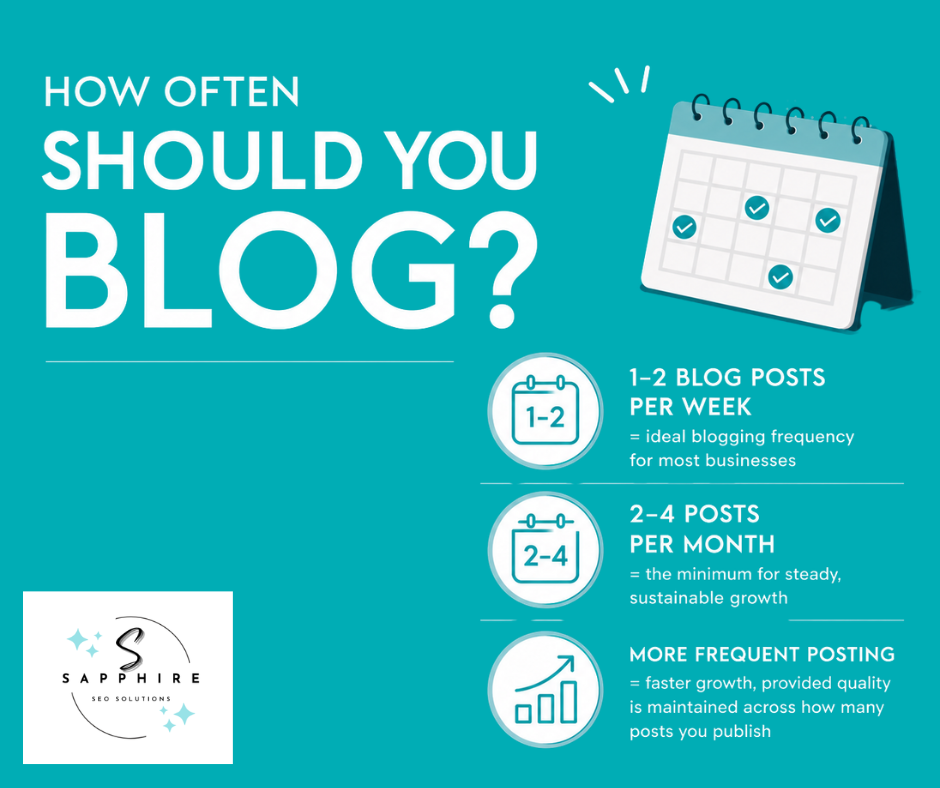
Blogging frequency is not a fixed number. It shifts based on your industry, your team, and what you are trying to achieve. That said, there is a general benchmark that holds true for most businesses.
1–2 blog posts per week = ideal blogging frequency for most businesses
2–4 posts per month = the minimum for steady, sustainable growth
More frequent posting = faster growth, provided quality is maintained across how many posts you publish
The key takeaway here is that there is no one-size-fits-all answer when it comes to how many blog posts you should be publishing. A local service business and a SaaS company targeting a national audience have completely different content needs. What matters most is that your chosen frequency is one you can maintain consistently, without sacrificing the depth and relevance your readers expect.
Keep reading to find out what the right number actually looks like for your specific situation.
Why Blogging Frequency Matters for SEO
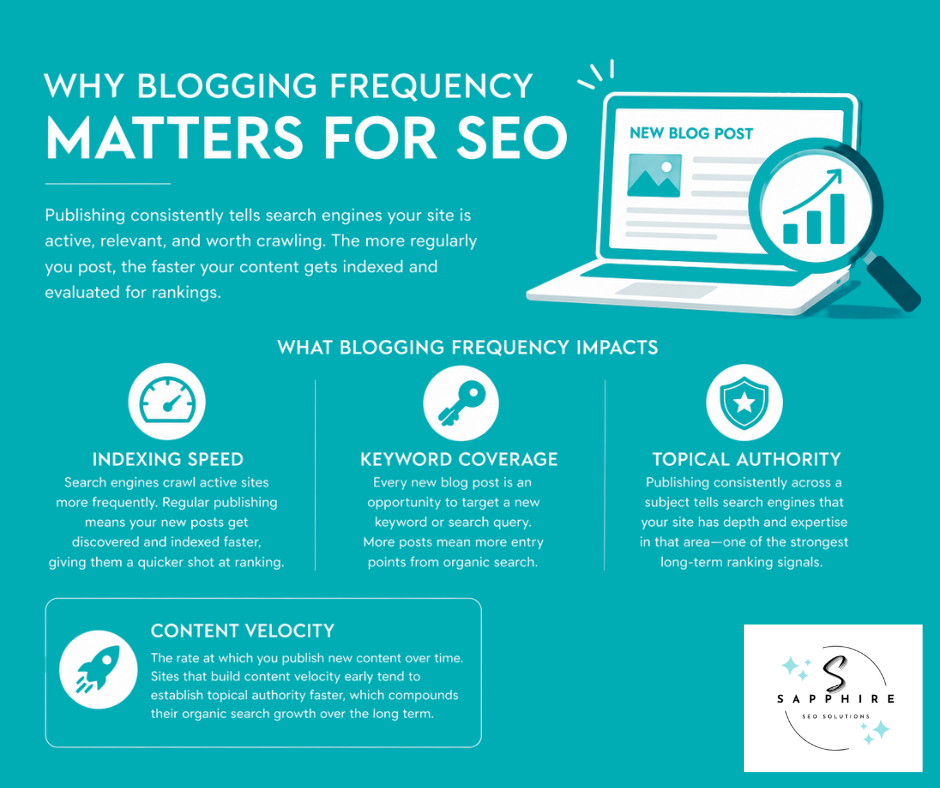
In search engine optimization (SEO), content is one of the most direct signals you can send to Google. When you publish consistently, search engines interpret that activity as a sign that your website is active, relevant, and worth crawling more often. In other words, the more regularly you post, the faster your new content gets indexed and evaluated for search engine rankings.
Here is what blogging frequency actually impacts:
Indexing speed: Search engines crawl active sites more frequently. Regular publishing means your new posts get discovered and indexed faster, giving them a quicker shot at ranking.
Keyword coverage: Every new blog post is an opportunity to target a new keyword or search query. More posts mean more entry points from organic search.
Topical authority: Publishing consistently across a subject tells search engines that your site has depth and expertise in that area. This is one of the stronger long-term ranking signals available to content-driven websites.
This brings up the concept of content velocity, which refers to the rate at which you publish new content over time. Sites that build content velocity early tend to establish topical authority faster, which compounds their organic search growth over the long term.
That said, a common myth worth addressing: frequency alone does not equal search engine rankings. Publishing thin, repetitive, or poorly researched posts at a high rate will not move the needle. Fresh content only works when it is genuinely useful (E-E-A-T) and relevant to the reader. Search engines have gotten very good at telling the difference.
Is Blog Quantity More Important Than Blog Quality?
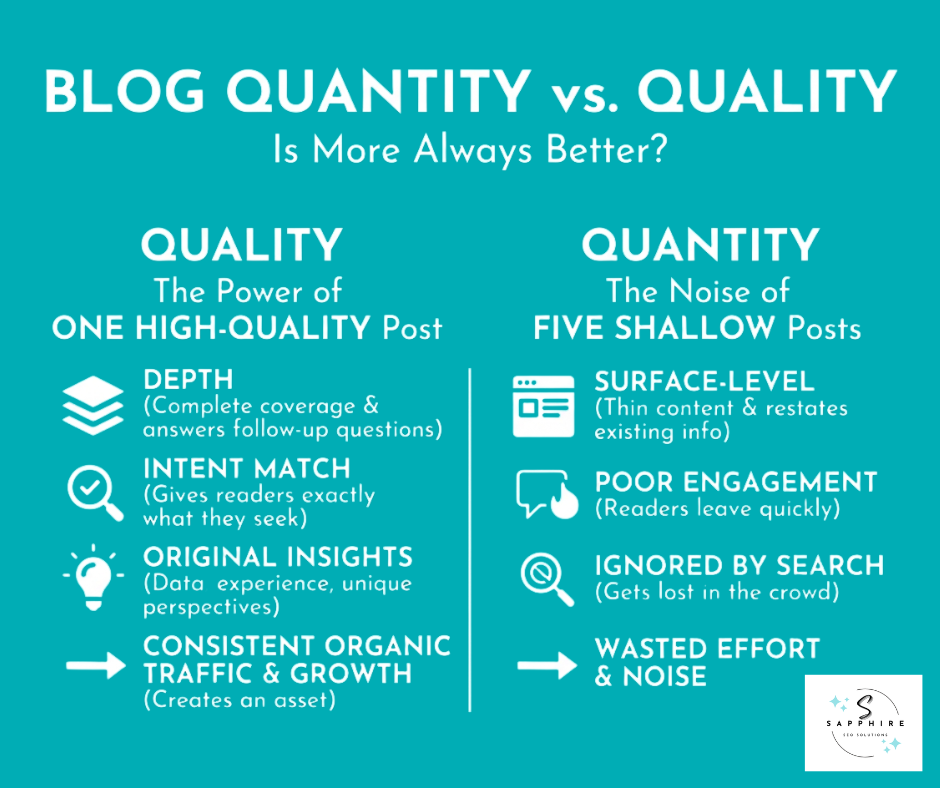
When it comes to blogging, more is not always better. One high-quality blog post that thoroughly answers a search query will consistently outperform five shallow posts targeting the same topic. Search engines are designed to surface the most useful, relevant results, and content quality is one of the clearest signals they use to make that determination.
So what actually defines high-quality content? It comes down to three things:
Depth: The post covers the topic completely. It anticipates follow-up questions, addresses nuance, and gives the reader everything they need in one place.
Search intent match: The content is built around what the reader is actually looking for, not just the keyword itself. A post that matches search intent keeps readers on the page longer, which reinforces its ranking position.
Original insights: Valuable content brings something new to the table. In other words, it goes beyond restating what every other article already says. Data, experience, unique perspectives, and real examples are what separate forgettable posts from ones that earn links and traffic over time.
A single well-researched, intent-matched post can generate consistent organic search traffic for years. Five thin posts with surface-level information may get indexed and then quietly ignored. High-quality blog posts are an asset. Weak ones are just noise.
What Is the Ideal Blogging Frequency?
Blogging success is not accidental. The businesses that see consistent organic growth are the ones that match their publishing cadence to their capacity and goals from the start. Real data on successful blogging points to a clear pattern: frequency matters, but only when it is sustainable and backed by quality.
Here is how each tier breaks down as your blog maturity grows:
1–2 Blog Posts Per Week (Best for Most Websites)
This is the sweet spot for most businesses. A balanced approach of 1–2 posts per week delivers steady keyword coverage, consistent crawl signals, and enough volume to build topical authority without overwhelming your team. It is the ideal cadence for SMBs, SaaS companies, and SEO agencies that want to post regularly without sacrificing content depth. In most cases, this frequency is where the best ratio of effort to results lives.
3–5 Blog Posts Per Week (Aggressive Growth)
This tier is for businesses with the content production infrastructure to support it. Publishing more articles at this pace makes sense when you are operating in a highly competitive niche and need to close a significant content gap quickly, or when you have a dedicated content team with the capacity to maintain quality at scale. Without that infrastructure, publishing daily or near-daily leads to thin content and diminishing returns fast.
2–4 Blog Posts Per Month (Lean Strategy)
For small teams, solo founders, and individual bloggers, this is a realistic and perfectly viable strategy. The trade-off for lower volume is depth. At this cadence, every post published needs to count, which means focusing on pillar content that targets high-value keywords, covers topics comprehensively, and earns traffic over the long term. Writing fewer but stronger posts is a legitimate path to growth, just a slower one.
Daily Blogging (When It Makes Sense)
Publishing new posts daily is not a strategy built for most businesses. It makes sense for news sites, large editorial teams, and media publishers whose entire model depends on a constant stream of fresh content. For everyone else, the publish blogs daily approach almost always results in quality dropping faster than rankings rise. Unless you have the team, the budget, and the content infrastructure to sustain it, daily blogging is more burden than benefit.
That said, if you can blog daily while maintaining high quality, you may see quicker results. 57% of bloggers, according to Hostinger, see better results when they publish a blog every day.
Frequency shouldn’t be the only thing on your mind. You should always do your research into the length of each blog post before writing it. To learn more about that, make sure to read our comprehensive guide on “How Long Should a Blog Post Be?”
Blogging Frequency Strategy
| Frequency | Ideal Target | Strategic Benefit |
|---|---|---|
|
The Sweet Spot
1–2 Posts / Week
Recommended
|
SMBs, SaaS, and SEO Agencies looking for sustainable growth. | Builds topical authority and steady crawl signals without sacrificing depth. The best ROI for effort. |
| Aggressive Growth 3–5 Posts / Week | High-competition niches with dedicated content infrastructures. | Closes content gaps rapidly. Effective only if high quality is maintained at scale. |
| Lean & Deep 2–4 Posts / Month | Solo founders, small teams, and individual niche bloggers. | Focuses on high-value "pillar" content. Slower growth, but creates long-term organic assets. |
| High-Volume Media Daily Blogging | News outlets, publishers, and large editorial teams. | Essential for news-driven models. For others, it often leads to "noise" and quality decay. |
How to Decide Your Ideal Blogging Frequency (Framework)
There is no universal posting schedule that works for every business. The right content plan depends on several factors that are unique to your situation.
Here is a practical framework to help you figure out exactly where to start:
Factor 1: Your Business Goals
The first question to ask is: what are you actually trying to achieve?
Drive traffic: If your primary goal is to generate website traffic, you need volume. More posts mean more keyword coverage and more entry points from search.
Generate leads: If leads matter more than raw traffic, fewer but deeper posts targeting high-intent keywords will serve you better.
Build authority: If credibility and thought leadership are the goals, consistency and depth matter far more than frequency.
Your posting schedule should follow your goal, not the other way around.
Factor 2: Your Resources
Be honest about what you have available before setting a schedule you cannot sustain.
Team size: A solo founder and a company with a dedicated content creation team are not operating under the same constraints.
Budget: Outsourcing blog writing is a viable way to save time, but it requires financial investment. Know what you can realistically spend.
Time: Even with a team, editing, publishing, and promoting posts takes time. Factor that into your schedule, not just the writing itself.
Overcommitting to a frequency your available resources cannot support is one of the most common blogging mistakes businesses make.
Factor 3: Your Industry and Competition
Your niche determines how hard you have to work to rank high and reach the first page of search results.
High competition niches (finance, legal, marketing, healthcare) require more content, more depth, and more consistency to break through.
Low competition niches give you more room to rank with a leaner publishing schedule, provided the content itself is strong.
Research what your top-ranking competitors are publishing and how often. That gives you a realistic baseline to work from.
Factor 4: Content Depth Required
Not all industries call for the same word count or content depth. Here’s what we mean by that:
B2B content typically requires longer, more technical posts that address complex buyer decisions. Fewer, deeper posts are often the right approach.
B2C content can be shorter and more frequent, especially when the buying decision is simpler, and the audience is broader.
Matching depth to your audience's expectations is just as important as hitting a posting frequency target.
Factor 5: Your Content Strategy
How you structure your content strategy shapes how often you need to publish.
Topic clusters: If you are building topical authority through pillar pages and supporting cluster content, you need a steady stream of posts that interlink and reinforce each other. This approach requires more volume upfront to build topical authority effectively.
Evergreen vs trending: Evergreen content holds its value over time and requires less frequent publishing to stay relevant. Trending content has a shorter shelf life and demands a faster publishing pace to capitalize on search interest while it exists.
In most cases, a hybrid approach works best: a foundation of evergreen pillar content supported by timely, trend-responsive posts published at a pace your team can sustain.
Consistency vs Frequency: What Matters More?
If you had to choose between publishing ten posts one month and zero the next, or publishing two posts every single week without fail, choose the latter every time. Consistency beats frequency. A steady posting schedule builds more long-term SEO value than bursts of content followed by long silences.
This is especially true in the early days of a blog. Search engines need time to recognize your site as an active, reliable source. Erratic publishing disrupts that process in two specific ways:
Lost momentum: Content that gains early traction through shares, backlinks, or engagement loses that momentum when there is nothing new to follow up.
Reduced crawl signals: Search engines adjust how often they crawl your site based on how frequently it is updated. Going quiet for a few weeks tells crawlers there is no urgency to revisit your site, which slows down the indexing of future posts.
The difference between a good and bad schedule becomes clear when you see it side by side:
The Impact of Consistency
| Schedule Type | Example Pattern | Long-Term Result |
|---|---|---|
| Inconsistent | 10 posts → 0 posts → 8 posts → 0 posts | Confused crawl signals, uneven traffic, and no compounding organic growth. |
|
Consistent
Ideal Path
|
2 posts per week, every week | Steady indexing, predictable traffic growth, and stronger authority over time. |
A modest but reliable posting schedule will outperform an aggressive but erratic one every time. Start with a frequency you can commit to, and scale up only when your process can support it without dropping the ball.
Does Business Type Impact Blogging Frequency?
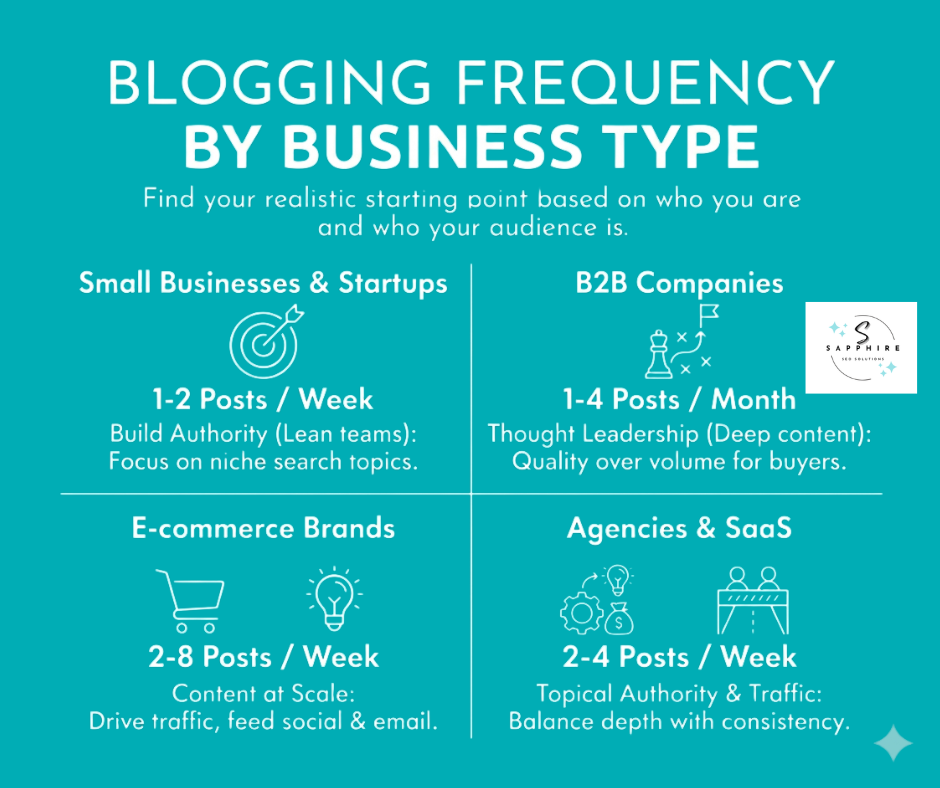
The right blog content strategy looks different depending on who you are and who your target audience is. Here is a practical breakdown by business type to give you a realistic starting point.
Small Businesses and Startups
For small businesses building their online presence from the ground up, 1–2 posts per week is the sweet spot. It is frequent enough to grow your website authority steadily without stretching a lean team too thin. Focus on topics your local or niche audience is actively searching for, and build from there.
B2B Companies
B2B buyers do their research before making any decision. That makes thought leadership the priority, not volume. Thought leaders in the B2B space typically publish 1–4 posts per month, with each post going deep on a topic that matters to their buyers. One thorough, well-researched post will do more for a B2B brand than four generic ones.
E-Commerce Brands
E-commerce blog content serves multiple purposes: it drives search traffic, supports social platforms, and feeds email marketing campaigns with fresh material. Because product-adjacent content can be produced at scale, e-commerce brands can reasonably publish anywhere from 2–8 posts per week, depending on their catalog size and content team capacity.
Agencies and SaaS
For agencies and SaaS companies, blogging is primarily an organic traffic and authority-building tool. A publishing cadence of 2–4 posts per week strikes the right balance between building blog traffic and maintaining the content depth these audiences expect. The goal is topical authority, and that requires both consistency and substance.
Blogging Frequency and Its Timeline - What to Expect
One of the most important things to understand about blogging is that results do not happen overnight. Regardless of how often you publish, there is a natural progression that every blog goes through. Tracking your progress in Google Search Console will help you understand where you are in that journey and what to expect next.
The SEO Growth Timeline
| Phase | Timeframe | What's Happening |
|---|---|---|
| Indexing Phase | Month 1–2 | Posts are being discovered and indexed by search engines. Little to no traffic yet. Higher publishing frequency speeds this phase up. |
| Ranking Begins | Month 3–4 | Indexed posts start appearing in search results. Google Search Console will show early impressions and keyword data. Rankings fluctuate as Google evaluates your content. |
|
Traffic Growth Compounds
Peak ROI
|
Month 5–6+ | Consistent publishing starts to pay off. Traffic builds on itself as more posts rank, internal links strengthen your site structure, and topical authority grows. |
The businesses that see the strongest results at the six-month mark are almost always the ones that published consistently from day one, without waiting to see results before committing to a schedule. Patience and consistency in the early phases are what make the compounding effect possible later.
Signs You're Blogging Too Much (or Too Little)
Sometimes all you need is a little helpful advice and a little push in the right direction to recalibrate your blogging strategy. If your results have plateaued or never taken off, your publishing frequency may be the problem. Here is how to tell which direction you need to adjust.
You're Blogging Too Much If:
Scaling content production beyond what your team can handle well will show up in your results quickly. Watch for these signs:
Quality drops: Posts feel rushed, thin, or repetitive. You are covering the same ground in slightly different ways just to hit a number.
Low engagement: Readers are not staying on the page, sharing the content, or converting. The posts are not delivering enough value to hold attention.
No ranking improvements: Despite publishing frequently, your search rankings are stagnant or declining. In other words, volume is not compensating for a lack of depth or relevance.
You're Not Blogging Enough If:
On the other side, publishing too infrequently limits how much ground your site can cover in organic search. These are the signs to look for:
Slow keyword growth: Your site is ranking for very few terms, and new keywords are not being added over time.
Competitors outpacing you: Other sites in your niche are expanding their organic traffic while yours stays flat. They are covering topics you have not touched yet.
Limited topical authority: Your blog does not have enough depth across your subject area for search engines to recognize your site as a reliable, authoritative source.
Is Your Strategy Off-Balance?
| Signs You’re Blogging Too Much | Signs You’re Not Blogging Enough |
|---|---|
|
Quality is Dropping
Posts feel rushed, thin, or repetitive. You're recycling content just to hit a specific number. |
Slow Keyword Growth
Your site ranks for very few terms, and new keywords aren't being added over time. |
|
Low Engagement
Readers aren't staying on the page or converting. The posts lack the value needed to hold attention. |
Competitors Outpacing You
Other sites in your niche are expanding their traffic while your growth remains flat. |
|
Stagnant Rankings
Despite high volume, search rankings are declining because volume can't replace depth. |
Limited Topical Authority
Search engines don't see you as an authority because you haven't covered enough ground. |
Should You Update Old Content Instead of Publishing New Posts?
Not every item on your content calendar needs to be a brand-new post. Revisiting and refreshing existing content (content refresh services) is a legitimate and often underutilized SEO strategy. The question is knowing when to publish something new and when to bring an existing piece up to date.
When new content is the right call:
You are targeting a keyword or topic you have not covered yet
You are building out a topic cluster that needs additional supporting posts
Your site is still in its early growth phase and needs more volume to expand keyword coverage
When a content refresh makes more sense:
An older post is ranking on page two or three and needs improvement to break into the top results
Existing pieces contain outdated statistics, broken links, or information that no longer reflects current best practices
A post has strong impressions in Google Search Console but a low click-through rate, signaling that the title or meta description needs work
Blog updates to a high-performing post can recover lost rankings faster than writing a new post from scratch
The smartest approach for most businesses is a hybrid strategy. In other words, keep publishing new posts to expand your reach while scheduling regular blog updates to keep your best existing content accurate, competitive, and up to date. A simple rule of thumb: audit your older posts every six months and prioritize refreshing anything that was once ranking but has since slipped.
Content refresh is super important for rankings. However, you also need to add fresh content to your site frequently. If you’re struggling to gain topic inspiration, make sure to go through our comprehensive guide on “How to Choose the Right SEO Blog Topics in 2026” to get started.
What Is Content Velocity, and How to Implement It?
Content velocity is not just about publishing frequently. It is a deliberate, phased approach to how you create content over the life of your blog. Used correctly, it is one of the most effective ways to build topical authority and compound your SEO results faster than a steady, uniform publishing pace ever could.
The strategy works in two distinct phases:
Phase 1: Publish Fast, Cover Ground
In the early stages of a blog, the priority is breadth. Publish fresh content at an accelerated pace to cover as many relevant topics and keywords in your niche as possible. This signals to search engines that your site has depth, earns your first rankings, and establishes the topical foundation on which everything else will build. The goal here is to create content quickly without sacrificing quality.
Phase 2: Slow Down and Strengthen
Once your topical foundation is in place, shift your focus from volume to optimization. At this stage, publishing less frequently is not a setback. It is the plan. Direct your energy toward:
Updates: Refresh older posts with new information, improved structure, and updated keywords to recover or improve their rankings.
Internal linking: Connect your existing posts to each other strategically (on-page SEO). This strengthens your site architecture and passes authority between pages.
Optimization: Improve on-page elements like titles, meta descriptions, headers, and fresh content additions to posts that are close to ranking but have not broken through yet.
In other words, phase one builds the library. Phase two makes every book in it worth reading.
Common Blogging Frequency Mistakes to Avoid
Getting your posting schedule right is only half the battle. How you approach the content itself determines whether that schedule actually delivers results in search results. These are the most common blogging frequency mistakes businesses make, and what to do instead.
Chasing arbitrary numbers: Publishing ten posts a week because a competitor does, or because a generic guide told you to, is not a strategy. Your frequency should be driven by your goals, resources, and keyword research, not someone else's benchmark.
Publishing thin content: Hitting a posting target by churning out short, surface-level posts is counterproductive. Search engines have little reason to rank content that does not fully address what a searcher is looking for. Depth always wins over volume.
Ignoring search intent:Keyword research tells you what people are searching for. Search intent tells you why. Publishing posts that target the right keywords but answer the wrong question will not rank, regardless of how often you post.
Inconsistent posting: Publishing aggressively for a few weeks and then going quiet confuses crawlers and stalls momentum. A modest, reliable schedule outperforms an erratic one every time.
Not tracking performance: If you are not monitoring how your posts perform in search results, you have no way of knowing what is working. Track rankings, impressions, and traffic regularly, then use that data to refine your approach before you start promoting content that has not been validated.
How to Create a Sustainable Blogging Schedule
The best posting schedule is one you can actually stick to. A content plan that looks ambitious on paper but falls apart after three weeks does more damage than a modest one executed consistently.
Here is how to build a blogging schedule that holds up over time:
Content Calendar Basics
Start with a simple content calendar that maps out your topics, target keywords, publish dates, and assigned writers at least four weeks in advance. This removes the guesswork from week to week and ensures your content plan stays on track even when things get busy. Tools like Trello, Notion, or a basic spreadsheet work perfectly well for this.
Batch Writing
Rather than writing one post at a time as deadlines approach, batch your content production. Set aside dedicated writing blocks to draft multiple posts in a single session. This keeps you consistently ahead of your posting schedule and reduces the pressure that leads to rushed, thin content.
Outsourcing vs In-House
Be honest about your team's capacity. If producing consistent, quality content in-house is not realistic, outsourcing to freelance writers or an SEO content agency is a legitimate and scalable solution. The priority is maintaining output quality and consistency, regardless of who is doing the writing.
Read our detailed guide on “DIY Blogging vs Blogging Services for Small Business Owners“ to learn more about when you should DIY or get expert help.
Realistic Planning
Whether you are running a personal blog or managing content for a growing business, start with a frequency your current resources can support without strain. Build in time for evergreen content that will not expire quickly, reducing the pressure to constantly produce new material. A well-maintained library of evergreen posts can carry a significant portion of your organic traffic on its own.
How Top SEO Agencies Actually Approach Blogging Frequency
The best search engine optimization agencies do not lead with volume. They lead with strategy. When a business comes to a top agency asking how often they should blog, the answer is never a number pulled from thin air. It starts with an SEO site audit, a competitive analysis, and a clear understanding of what the business is actually trying to achieve.
Here is what a strategy-first approach to blogging frequency actually looks like in practice:
Goals before calendars: Before any posting schedule is built, the business goal is defined. Is the priority search engine optimization for local visibility, national reach, lead generation, or brand authority? The answer shapes everything that follows.
ROI over output: A volume-obsessed approach measures success by how many posts go live. A results-driven approach measures success by rankings gained, traffic earned, and leads generated. Every post published should have a clear purpose and a measurable outcome attached to it.
Data drives decisions: Frequency recommendations are based on keyword opportunity, competitive gap analysis, and the client's available resources.
Sustainability is non-negotiable: A posting schedule that burns out a team or compromises content quality is not a strategy. It is a short-term sprint with long-term consequences.
Top agencies understand that ten well-researched, intent-matched posts will outperform fifty thin ones every time. The goal is never to flood a blog with content. The goal is to build a content asset that compounds in value over time and delivers measurable return on investment.
Build a Brand and Establish Credibility with Affordable SEO Blogging Services!
By now, the answer to how often you should blog is clear. Most businesses should aim for 1–2 posts per week. If resources are limited, 2–4 posts per month is the minimum to maintain steady growth. Beyond that, three principles hold true regardless of your industry or business size:
Quality beats quantity.
Consistency beats bursts.
Strategy beats frequency.
Putting all of this into practice takes time, expertise, and a process that most businesses do not have the bandwidth to build on their own. That is where Sapphire SEO Solutions comes in.
Since 2007, Sapphire SEO Solutions has helped small businesses and growing brands write blog posts that do more than fill a content calendar. Our SEO blogging services are built around strategy, topical authority, and measurable return on investment.
If you are ready to turn your blog into a genuine business asset, Sapphire SEO Solutions is ready to help. Contact us today to get started.
Alternatively, you can get started with blogging by placing an online order today!

Frequently Asked Questions
Is it better to blog weekly or monthly?
Weekly blogging is better for most businesses. Bloggers who publish weekly are 2.5 times more likely to report strong results than those publishing monthly or less. Monthly blogging can work if every post is a long-form, evergreen pillar piece designed to attract backlinks, but the downside is that your site can feel quiet, causing readers to check in less often and engagement to drop between posts.
Does blogging more improve SEO?
Yes, blogging more frequently does improve SEO, up to a point. Businesses that publish 16 or more blog posts monthly generate 3.5 times more traffic than those that post only four times monthly. However, quality must not be sacrificed for volume. Businesses that post one high-quality blog per week may see better results than those posting short, superficial posts every day, because consistency is critical for both readers and search engines.
Can you blog too much?
Yes, you can blog too much if quality suffers as a result. Most websites begin to experience diminishing marginal returns after around 30 posts per month, and without a disciplined content strategy, posting too frequently may actually create keyword cannibalization issues. Google's own Search Advocate John Mueller has warned that forcing a high frequency can lead to "mediocre, fluffy content," and thin content can hurt search rankings.
How long should a blog post be?
The ideal blog post length depends on your goal, but most SEO-focused content performs best in a specific range. The most effective blog posts in 2025 were between 1,500 and 2,500 words, with the average top-ranking blog post sitting at around 2,450 words. That said, length should match intent: mid-length content of 700 to 1,400 words works well for how-to guides and product reviews, while long-form content of 1,500 or more words excels for ultimate guides and pillar pages that need to cover a topic comprehensively.
How long does blogging take to show results?
Blogging typically takes 6 to 12 months to show measurable SEO results. For most businesses, SEO starts showing early signs of progress within 3 to 6 months, while stronger ranking and traffic gains usually take 6 to 12 months or longer. Timelines vary by competition level: local businesses may see initial results within 3 to 4 months, medium-competitive niches like law firms and specialized e-commerce stores typically take 6 to 12 months, and highly competitive industries may require 16 to 24 months to achieve significant results.
How often should a small business blog to maximize online exposure?
Small businesses should aim for at least 1 post per week, scaling up when resources allow. Small businesses that blog generate 126% more leads compared to those that do not blog. For newer sites, if your blog is less than a year old, you should aim to publish 6 to 8 posts per month around a few important topic clusters aligned with your brand. For resource-limited teams, it is better to publish one high-quality 2,500-word article per week than five 300-word posts, because consistency beats raw volume over time.
What is the recommended blogging frequency for marketing agencies?
Marketing agencies should aim for multiple posts per week. According to Stratabeat's 2025 data, websites that published 9 or more blog posts per month saw a 20.1% increase in monthly organic traffic, which is 3.6 times the growth rate of those publishing just 1 to 4 posts monthly. For agencies managing their own blogs, content marketers who publish more frequently, meaning multiple times per week, are more likely to report strong results from their blogging program compared with marketers who publish less frequently.
How often do top e-commerce brands publish blog posts?
Top e-commerce brands typically publish 4 or more posts per week when competing in high-volume niches. B2C organizations that blogged 11 or more times per month received more than four times the number of leads compared to those that blogged just 4 to 5 times per month. For e-commerce brands still building authority, the recommendation is to publish original posts with unique insights or data that demonstrate expertise and brand authority, using monthly performance data as a guide to adjust cadence over time.
How does blogging frequency affect lead generation for small businesses?
Higher blogging frequency directly increases leads for small businesses. For companies with 26 to 200 employees, blogging at least 11 times per month produced about 2.5 times more leads than those publishing three or fewer blogs per month. The data also shows a clear size-based pattern: publishing 16 or more blogs per month can generate up to 4.5 times more leads than publishing only once a week, and for smaller businesses with up to 25 employees, publishing more than 10 blogs monthly can double leads compared to publishing less regularly.
What is the optimal blog post frequency for organic search visibility?
The optimal frequency for organic search visibility is 2 to 4 posts per week. Publishing 2 to 4 times per week provides the best content marketing results in terms of both traffic and conversions, based on data from multiple studies across B2B, B2C, and e-commerce businesses. For newer sites specifically, publishing at least one post per week is the baseline recommendation, while managing 2 to 4 posts per week is likely to produce faster results in terms of traffic and rankings.