

What Is E-E-A-T? Ultimate Guide for Business Owners
Last Updated: August 4th, 2026
Search doesn't work the way it used to. AI Overviews and AI-powered search are changing what shows up when someone types in a question, and a lot of business owners are noticing. Rankings used to feel like a numbers game: stuff in the right keywords, build some links, and hope for the best. That's not enough anymore.
So what changed? Google got a lot better at figuring out which businesses are actually trustworthy. And that's where EEAT comes in.
What is EEAT, exactly? It stands for Experience, Expertise, Authoritativeness, and Trustworthiness. Google uses it to help decide whether a website deserves to be seen. Here's the part most guides get wrong, though: EEAT isn't a ranking factor by itself. Google has said as much. Instead, it shapes how Google's systems judge quality across the board.
This matters even more if you're in an industry tied to money, health, legal advice, or anything where a bad decision could really hurt someone. But don't tune out if you run a local business. You benefit too.
By the end of this guide, you'll know exactly what expertise, authoritativeness, and trustworthiness mean for your website, why they matter, how Google actually evaluates them, what you can do to improve yours, and how AI search is changing the rules for everyone.
Key Takeaways
EEAT isn't a ranking factor. It's a framework guiding how Google evaluates trust and overall quality.
Trustworthiness carries the most weight. Clear contact info, HTTPS, and honest claims build credibility fastest.
AI content only hurts EEAT when it's unedited. Expert review and real experience make it work fine.
Prove experience instead of claiming it. Use real photos, case studies, and author bios as evidence.
Fix the fundamentals first. About page, Contact page, and reviews matter more than chasing backlinks.
What Is E-E-A-T in SEO?
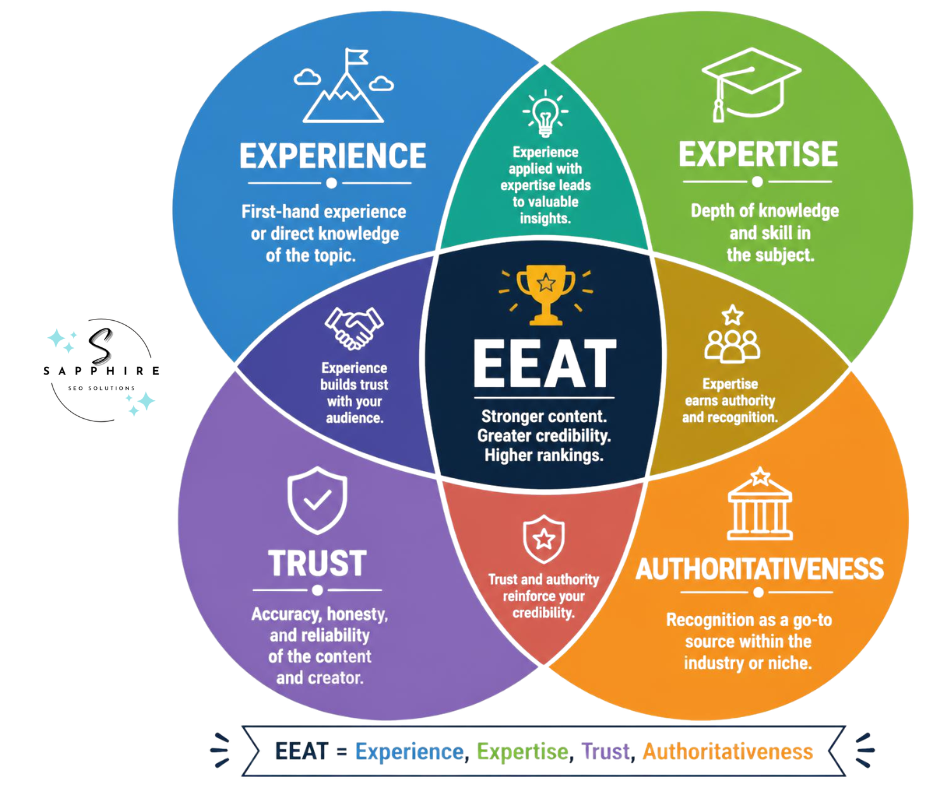
In search engine optimization, E-E-A-T stands for Experience, Expertise, Authoritativeness, and Trustworthiness. It's Google's shorthand for judging whether content is worth showing people.
The framework started as just "E-A-T" back in 2014. Google added the second E, for Experience, in December 2022. Why? Because knowing a topic isn't the same as living it. A dermatologist can explain eczema. Someone who's actually had it for twenty years can tell you what it feels like at 3 a.m. when the itching won't stop. Google wanted both kinds of knowledge to count.
Here's where a lot of business owners get confused. E-E-A-T is not a direct ranking factor. It's not even a specific ranking factor. There's no hidden score sitting in Google's system that gets added up and plugged into your rankings. Google's own search liaison has said this outright.
So what is it, then? E-E-A-T comes from Google's Search Quality Rater Guidelines, a set of internal quality guidelines used to train and test Google's algorithms. Real people, called search quality raters, read pages and rate them using these guidelines. But their ratings don't touch your rankings directly. Instead, Google uses that feedback to build and refine automated systems designed around those same quality guidelines.
In plain terms, this means quality raters help Google check its own homework. And E-E-A-T is really Google asking a set of three questions about your site:
Can I trust this website?
Does this business know what it's talking about?
Is this information reliable?
Why Business Owners Should Care About E-E-A-T
Let's skip the theory for a second. Why should you, running a real business with real bills to pay, care about any of this?
Because E-E-A-T touches almost everything that determines whether your phone rings. It affects your visibility on Google search, the leads that come from it, how much people trust you before they even call, whether they actually convert once they land on your site, and now, whether AI tools mention your business at all.
Here's how it plays out in practice. Sites with stronger E-E-A-T tend to see higher search engine rankings. Higher rankings mean better search visibility, which means more people clicking through from search results. More clicks, done right, lead to better conversion rates. And over time, something else happens too: people start searching for your business by name. More branded searches. More customers who already trust you before they've even looked at your website.
That last part matters more than most business owners realize. Trust isn't just a Google thing. It's a human thing.
Think about the last time you searched for a plumber, an accountant, or a lawyer online. You probably asked yourself a few questions without even meaning to:
Who wrote this?
Is this company even real?
Can I trust them with my money, my house, my case?
Turns out, Google's asking almost the exact same questions. It's just doing it at scale, across billions of pages, trying to figure out which businesses actually deserve to show up when someone has a problem and a user intent behind their search.
Get this right, and your search performance improves in ways that compound. Your pages rank better. Your organic traffic grows without you having to pay for every single click. And your site starts building the kind of reputation that sticks.
Now add AI search into the mix. Tools like ChatGPT, Gemini, and AI Overviews don't work the same way traditional search does. They evaluate information and decide who to cite. And they lean toward businesses that show real expertise, back up their claims with evidence, have an actual reputation behind them, and make it obvious who's running the show.
So if you've been treating E-E-A-T as a technical checkbox, it's worth rethinking that. It's not just about search anymore. It's about whether you get chosen at all.

What Does E-E-A-T Stand For?
Four letters, four ideas. Let's break each one down.
Experience
This is the newest piece of the framework, and it's about real-world experience, not textbook knowledge. Has this business actually done the thing they're writing about? Have they lived it?
Think about the difference between reading a manual on landscaping and spending fifteen years with your hands in the dirt. Both might teach you something. Only one gives you personal knowledge you can't fake.
Experience shows up in specific ways:
First-hand knowledge of a topic
Photos and documentation from real projects
Case studies from actual customer work
Personal insights that only come from doing the work
Lessons learned, including the ones that came from mistakes
Here's the good news. Experience doesn't require a degree or a certification hanging on the wall. A content creator with practical knowledge can build this just by showing their work. Take a landscaper who posts before-and-after photos of real jobs, writes about a drainage problem they fixed last spring, and explains what went wrong the first time they tried. That's experience, on full display.
Expertise
Where experience is about doing, expertise is about knowing. It's built on knowledge, training, and real industry understanding.
Subject matter expertise looks different depending on who's showing it. An architect demonstrates it through design credentials and completed projects. A CPA shows it through certifications and tax knowledge that actually holds up. An electrician proves it through licensing and code compliance. A lawyer needs bar admission and case history. A marketing agency needs results they can point to.
Relevant qualifications matter here, but so does the quality of the professional advice being given. Google isn't looking for a diploma. It's looking for genuine expertise that shows up in how someone explains their field.
And expertise isn't one-size-fits-all. What counts as adequate expertise for a landscaping blog looks nothing like what's expected from a medical website. The bar moves depending on the industry, and how much is riding on the information being right.
Authoritativeness
This is about reputation. Not just what a business says about itself, but what everyone else says too.
Authoritativeness builds through:
Recognition within an industry
Brand mentions across the web
Customer reviews
Awards and speaking engagements
Links from trusted, reputable sites
Mentions in respected publications
A track record of thought leadership
An authoritative or trustworthy source rarely gets that way overnight. It's earned through consistency, showing up, and being the business other people point to when they're asked who's good at this. Brand authority and positive reputation go hand in hand. One feeds the other.
Trustworthiness
Out of all four, this one carries the most weight. Google has said as much more than once.
Trustworthy content starts with accuracy. But trust is bigger than the words on a page. It includes:
A secure website (HTTPS)
Clear contact details and a real business address
A visible privacy policy
Honest refund policies
Genuine customer reviews
Transparency about who wrote the content and who runs the company
Claims that hold up, backed by honest financial stability
A site with minimal customer service information sends the wrong signal, even if the content itself is well written. No phone number, no address, no way to reach a real person. That's the kind of thing that makes visitors and Google hesitate.
How Google Uses E-E-A-T Today
So what actually happens behind the scenes? Let's get specific.
Google doesn't look at a single page in isolation. It evaluates pages, entire websites, the businesses behind them, and increasingly, the individual authors writing the content. All four get weighed together.
Here's how the pieces fit. The Search Quality Evaluator Guidelines train human raters to judge search results using E-E-A-T principles. Their ratings don't set your rankings directly. But that quality rater feedback gets used to test and refine Google's actual ranking algorithms, the automated systems doing the real work at scale.
One of those systems is the Helpful Content System. It looks at an entire site, not just one page, to judge overall quality. That matters for site owners because a handful of thin, low-value pages can drag down the whole domain. It's not a page-by-page penalty. It's site-wide.
Then there's the spam side. Google runs machine-learning spam systems built to catch manipulation before it ever reaches a user. These systems work to identify content that's mass-produced, hollow, or built purely to game rankings rather than help anyone.
Google also leans on something called the Knowledge Graph. Think of it as Google's map of real-world facts: businesses, people, places, and how they connect. This helps Google build what's called entity understanding. In plain terms, Google is trying to figure out if your business is a real, consistent thing in the world, not just a website. That means it looks at brand signals, reviews, reputation across the web, and whether your information stays consistent from one place to the next.
Here's the thing worth repeating. Google aims to evaluate quality through all of this combined, not through one clean scorecard. There is no E-E-A-T number sitting in a spreadsheet somewhere. Google has said this directly, more than once. Instead, dozens of signals get weighed together, and they point toward the same general idea: does this business deserve to be trusted with this topic?
And that bar isn't fixed. It moves depending on what's at stake. A blog post about pruning rose bushes doesn't need the same level of scrutiny as an article about chemotherapy side effects. Medical advice, financial guidance, and legal information all get held to a much higher standard, because getting it wrong could actually hurt someone.
How Google Evaluates E-E-A-T
Google doesn't pull E-E-A-T out of thin air. It reads a wide range of signals scattered across your website, your content, your authors, your reputation, and the rest of the web. Here's what it's actually looking at.
Website Signals
This is the foundation. Before Google even gets to your content, it's forming an impression of your site as a whole. That means the basics of technical SEO: a working About page that explains who you are, a Contact page with real details, HTTPS keeping the connection secure, and clear policies covering things like privacy and refunds.
Business information matters here too. Address, phone number, hours, all the stuff that proves a real company sits behind the website. If you're paying attention to SEO Google signals at this level, tools like Google Search Console can show you how your site is actually performing in search, which pages are getting found, and where things might be breaking down behind the scenes.

Content Signals
This is where most of the weight sits. Google wants helpful, high-quality content (check out Google’s creating people-first content guide), and it has specific ways of checking for it.
Accuracy comes first. Is the information actually correct? Freshness matters too. A page that hasn't been touched in four years, covering something that changes often, sends the wrong signal. Beyond that, Google looks for real depth on a particular topic, not a shallow overview that could've been written by anyone.
Well-researched content stands out. So does original research, the kind that adds substantial value because nobody else has published it. And here's something worth noting: content created with genuine experience behind it tends to read differently than content assembled from other people's work. Google can tell the difference between content built from real knowledge and generic web content stitched together to hit a word count. Sources matter too. Citing where information comes from builds credibility instead of asking readers to just take your word for it.
Interested in website copywriting? Our affordable website copywriting services can help communicate your brand message, build trust, and guide users to take action.

Author Signals
Who actually wrote this? Google increasingly wants to know.
Strong author bios, listed credentials, and real experience all feed into what's often called E-A-T signals, the piece of the framework tied specifically to a person rather than a whole business. Industry recognition helps here too. If an author has a track record other people in the field would recognize, that carries weight. A page with a strong E for experience, paired with a credible author, tends to earn more trust than one with no name attached at all.
Check out our About Us page and see how we’ve mentioned each member of the team with their credentials and expertise. All of this is reflected in the author schema we use for important pages. That’s a combination that Google loves!
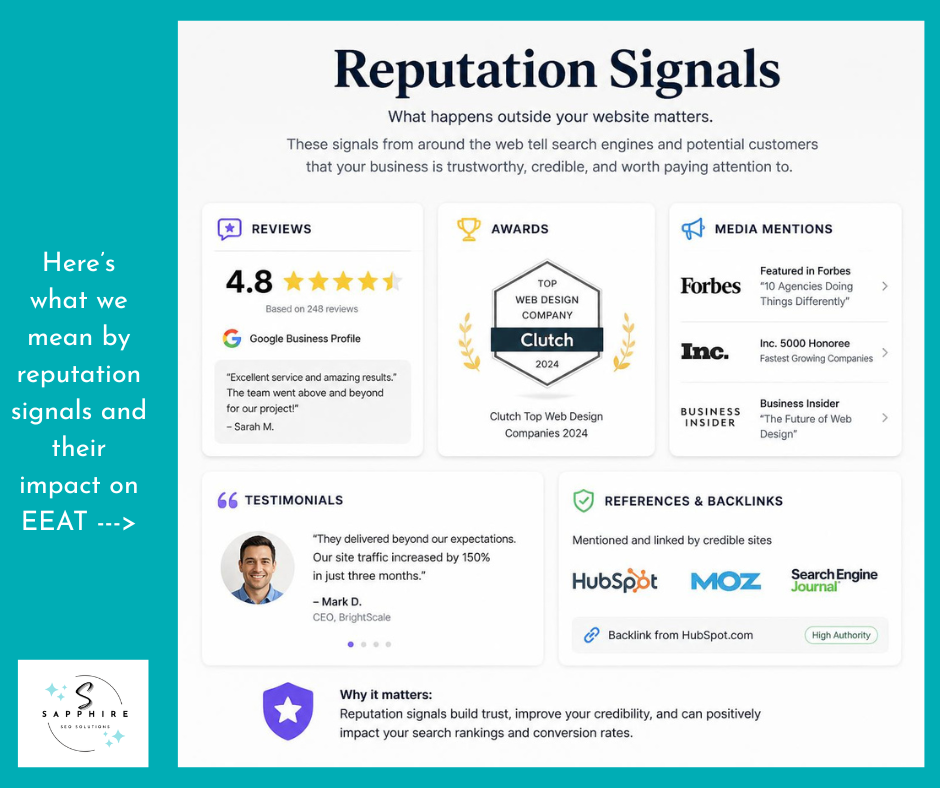
Reputation Signals
This is about what happens outside your own website. Reviews. Awards. Mentions from other credible sources. News coverage, when it's earned rather than paid for. References that back up your claims. Testimonials from real customers.
Original research reports carry particular weight here, since they position a business as a source other people cite, rather than just another site repeating what's already out there.
External Signals
Finally, Google looks at how the rest of the internet treats you. This isn't about volume. It's about quality.
Quality backlinks from reputable sites, brand mentions across the web, listings in respected industry directories, and recognition from professional organizations all send a signal that other trusted sources vouch for you. Earning high-quality backlinks takes real work, usually because you've published something worth linking to, not because you bought a placement somewhere. Citations from credible, relevant sources round this out.
Here's the thing to remember through all of this. No single signal, on its own, determines your E-E-A-T. Not one glowing review. Not one backlink. Not one well-written bio. Google combines hundreds of signals across your site, your content, your authors, and your reputation, and it's the pattern across all of them that shapes how much trust you've earned.

Why E-E-A-T Matters for Rankings and AI Search
E-E-A-T plays out differently depending on where your customers are searching. Let's look at both.
Traditional Google Search
This is the world most business owners already know. Google reads your site for trust, checks whether your content is genuinely helpful, and weighs the overall quality of what you've published. Sites that do this well tend to see real SEO success: better trust with both Google and readers, content that actually helps people instead of just filling space, and rankings that hold up in more competitive search results, the kind where a dozen other businesses in your area are chasing the same customers.
None of this happens overnight, and none of it works as a shortcut. But it compounds. A site that consistently shows better trust, better content, and better quality tends to keep climbing, even while competitors are still stuck running the old keyword playbook.
AI Search
This is the newer, faster-moving piece, and it works differently than most people assume.
AI search tools like ChatGPT, Gemini, Claude, and Perplexity don't rank pages the way Google does. There's no list of ten blue links. Instead, these AI tools read across the web and decide, on the spot, which sources deserve to be cited in the answer they give someone.
That's a different kind of competition. You're not fighting for position three on a results page. You're fighting to be one of the handful of sources an AI decides is worth quoting at all.
Businesses with stronger authority and clearer expertise tend to get picked more often. That's not a guess; it shows up consistently across how these systems work. A few things seem to matter across the board:
Structured information (schema markup) that's easy for AI systems to read and pull from
Clear entity recognition, meaning it's obvious who you are and what you do
Consistent branding across your website and every other place you show up online
Original insights that can't be found copied elsewhere
Real experience baked into the content, not just surface-level information
Here's an important distinction, though. There's no solid evidence that E-E-A-T is a direct ranking factor inside these AI tools the way some marketers claim. What the pattern actually shows is simpler: the same qualities that build strong E-E-A-T for Google (clear expertise, consistency, a real reputation) also happen to be the qualities AI systems lean toward when deciding who to trust. It's less that AI search uses E-E-A-T as a rulebook, and more that good E-E-A-T and AI visibility tend to grow from the same roots.
Learn more about getting mentioned in AI search by visiting our AI SEO page.
How to Improve E-E-A-T on Your Website
This is the part you can actually act on. Here's what to do, broken down by area.
Demonstrate Real Experience
Nothing proves experience like showing your actual work. If you're creating quality content but it's all theory and no proof, readers (and Google) notice the gap.
Start posting real photos from real jobs. Add videos walking through a project from start to finish. Write up case studies that show what a client's problem looked like and how you solved it. Pull back the curtain with behind-the-scenes content, the kind that shows how work actually gets done, not the polished version. And don't skip the lessons learned. A story about something that went wrong, and how you fixed it, often builds more trust than one where everything went perfectly.
A roofer who posts drone footage of a finished job and explains why they chose a particular material is doing this exactly right.
Showcase Expertise
Experience shows you've done the work. Expertise shows you understand it.
This starts with your content strategy. Instead of publishing shallow, surface-level posts, aim for detailed content that actually answers the question someone came to your site with. Go deep enough that a reader walks away knowing something they didn't before.
Author bios matter more than most business owners think. If someone on your team is writing content, give them a real bio. List credentials. Mention industry certifications. Note any professional associations they belong to. These small details tell both readers and Google that a real, qualified person is behind the words.
Build Authority
Authority isn't something you claim. It's something other people give you, based on what you've done.
Earning mentions from respected sites in your industry is one of the strongest signals you can build. Publishing original research, even something small like a survey of your own customers, gives other people a reason to reference you. Guest articles on relevant, reputable publications extend your reach beyond your own site. Speaking at industry events, even local ones, adds another layer of recognition.
All of this fits under content marketing, but it works best when the goal is genuinely helping people, not just getting your name out there. Create resources that are actually useful. The mentions and links tend to follow naturally after that.
Increase Trust
Out of everything on this list, trust probably has the most immediate impact, and it's also the easiest to get wrong by accident.
Start with the fundamentals. Make sure your policies, refunds, privacy, and terms are clear and easy to find. Your Contact page should have real business details: address, phone number, a way to actually reach a person. Reviews matter here too, and not just having them, but responding to them, especially the negative ones.
Every claim on your site should hold up. Accurate information, without exaggeration, builds more trust over time than bold claims that don't survive a closer look. Keep your website secure. And be upfront about pricing. Vague or hidden costs are one of the fastest ways to lose trust before a customer even calls.
These aren't advanced tactics. They're the basic E-A-T principles most sites get wrong simply by neglecting them.
Keep Content Updated
A blog post from three years ago, sitting untouched, tells Google (and readers) that nobody's paying attention anymore.
Set a rhythm for reviewing older content. Refresh anything that's gone stale. Expand thin pages that never quite answered the question properly. And correct outdated information right away, especially if it's the kind of mistake that could mislead someone. This matters even more for topics tied to money, health, or legal decisions, where old information can actually cause harm.
Strengthen Your Brand
Last piece: make sure your brand looks and feels consistent everywhere someone might run into it.
Consistent branding across your website and your social profiles tells Google and customers that they're dealing with one real, cohesive business, not a scattered collection of half-updated profiles. Build out your local presence too, especially if you serve a specific area. Google Business Profile, local directories, and location-specific pages all help here.
And keep an eye on your brand searches, the number of people typing your business name directly into Google. That number tends to climb naturally once people start recognizing and trusting you. It's one of the clearest signs that your E-E-A-T work is actually paying off.
Real Examples of Good E-E-A-T
Theory only goes so far. Let's look at what weak and strong E-E-A-T actually look like, side by side, across a few different industries.
Landscaper
Weak page: A generic "Our Services" page listing lawn care, mulching, and tree trimming. No photos of real work. No name attached to the business beyond a logo. The About page is two sentences long and doesn't say how long the company has been operating or who runs it.
Strong E-E-A-T page: The same services, but backed up with proof. Before-and-after photos from actual jobs in the area. A short case study about a drainage problem on a specific property, what caused it, and how the crew fixed it. An owner bio mentioning years in the trade and any relevant certifications, like a pesticide applicator license. Customer reviews embedded directly on the page, not just linked off to a third-party site.
Why it works: the strong version proves real-world experience instead of just claiming it. Google, and the homeowner reading the page, can see the work instead of taking a company's word for it.
Dentist
Weak page: A stock photo of a smiling model, a paragraph about "quality dental care," and a list of services with no further detail. No dentist is named anywhere on the page.
Strong E-E-A-T page: A real photo of the actual dentist, with a bio listing where they went to dental school, how long they've practiced, and any specializations, like cosmetic dentistry or pediatric care. The page explains procedures in plain language a nervous patient could actually understand. Patient reviews are visible and recent. There's a clear address, office hours, and insurance information.
Why it works: dental care sits in YMYL territory, meaning it can seriously affect someone's health. Google holds these pages to a much higher standard, and so do patients. A named, credentialed dentist with real reviews signals something a stock photo never could.
Lawyer
Weak page: A page full of vague promises like "aggressive representation" and "proven results," with no bar admission listed, no case history, and no author on any of the site's articles.
Strong E-E-A-T page: A detailed attorney bio listing bar admissions, years practicing, and areas of focus, say, personal injury or family law. Blog content written under the attorney's name, addressing real questions clients actually ask, without offering specific legal advice that could backfire. Case results described honestly, without overselling outcomes. Clear disclaimers where needed, along with genuine client testimonials.
Why it works: legal advice is another high-stakes category. A visitor deciding whether to trust a lawyer with their case is asking the same questions Google is: is this person actually qualified, and do they have a track record that backs it up?
Plumber
Weak page: A single page cramming in every service the company offers, written in the same generic tone you'd find on a hundred other plumbing sites. No mention of licensing. No photos. No way to tell if this is a two-person operation or a large company.
Strong E-E-A-T page: Separate pages for major services, like water heater repair or drain cleaning, each with real detail instead of a one-line description. Licensing and insurance information stated clearly. Photos or short videos from actual jobs. A blog post walking through a common issue, say, why a water heater keeps tripping its breaker, written with the kind of specific detail that only comes from doing the work.
Why it works: depth and specificity signal real expertise. Anyone can write "we fix water heaters." Explaining exactly why a breaker keeps tripping, and what that usually means, is a lot harder to fake.
What Ties These Together
Notice what's consistent across every strong example here. A real name attached to the work. Specific detail instead of vague claims. Visible proof, whether that's photos, credentials, or reviews. And information written for the person reading it, not just for a search algorithm.
None of this requires a big budget or a redesign. It requires being specific, being honest about who's behind the business, and showing the work instead of just describing it. That's the difference between a page that quietly blends in and one that actually earns trust, from readers and from Google.
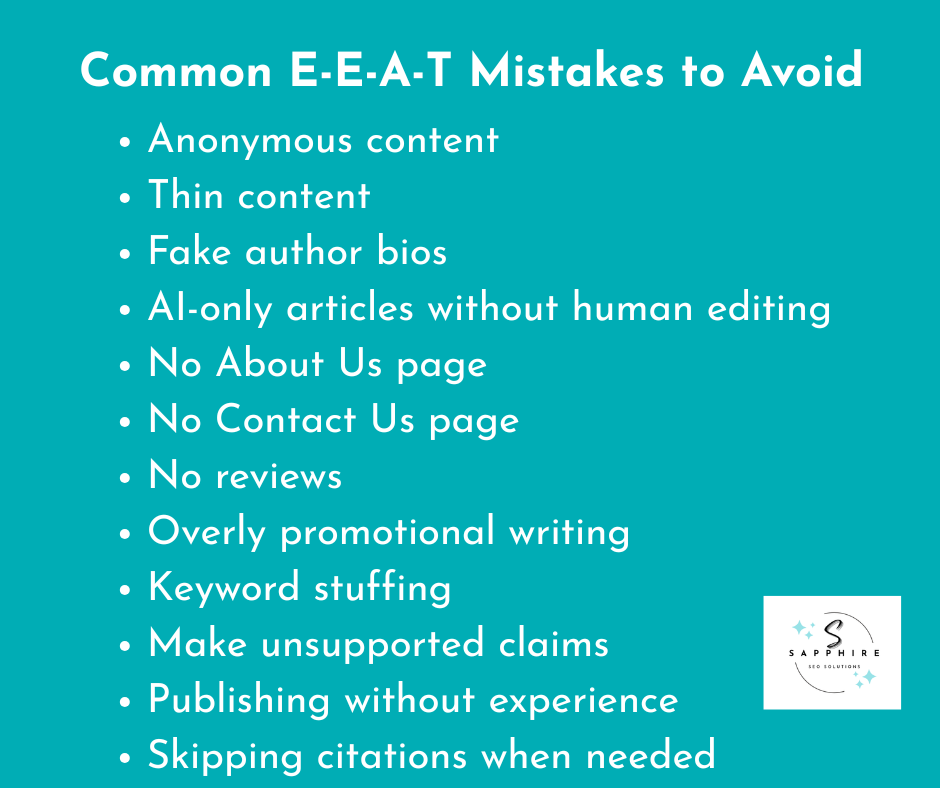
Common E-E-A-T Mistakes to Avoid
Building strong E-E-A-T matters. But avoiding the mistakes that quietly undermine it matters just as much. Here's what to watch for:
Anonymous content: Publishing articles with no author listed anywhere makes it impossible for readers, or Google, to know who's actually behind the information. Even a simple byline helps.
Thin content: Pages that barely scratch the surface of a topic don't demonstrate expertise. They just take up space. If a competitor's page answers the question in more depth, that's the one earning the trust.
Fake author bios: Inventing credentials, or attaching a real person's name to content they never wrote or reviewed, does more damage than having no bio at all. If it's ever discovered, and it usually is, it undoes trust that took years to build.
AI-only articles: This isn't about avoiding AI. It's about avoiding AI content that's published without a real person reviewing it, fact-checking it, or adding actual experience to it. Unedited, ungrounded content tends to read as generic, and readers can usually tell.
No About page: Skipping this leaves visitors with no way to learn who runs the business, how long it's been around, or why it should be trusted.
No Contact page: A missing phone number, address, or way to reach a real human is one of the fastest ways to raise doubt, especially for anyone weighing whether to spend money with a company.
No reviews: Silence here reads as absence, even if a business has plenty of happy customers who just haven't been asked to leave one.
Overly promotional writing: Content that reads like an ad, packed with superlatives and sales language, rarely earns trust. People can tell when they're being sold to instead of helped.
Keyword stuffing: Cramming the same phrase into a page over and over doesn't fool anyone anymore, readers or Google. It just makes the writing harder to read.
Making unsupported claims: Statements like "the best in the state" or "proven results" mean nothing without something backing them up, whether that's data, case studies, or third-party recognition.
Publishing without experience: Writing confidently about a topic nobody on the team has actually lived or worked in shows, even when the writing itself is polished. Readers and Google both pick up on content that feels secondhand.
Skipping citations when they're needed: Making factual claims, especially in health, legal, or financial content, without pointing to where that information came from leaves readers with no way to verify it.
None of these mistakes are complicated to fix. Most come down to the same root issue: leaving out the proof, the person, or the context that makes content trustworthy in the first place.
Does AI Content Hurt E-E-A-T?
This question comes up more than almost any other, so let's answer it straight.
Google doesn't ban AI content. It never has. What Google has said, consistently, is that it cares about the quality of content, not the tool used to produce it. That's a meaningful difference, and it's worth sitting with for a second.
So the real question isn't "did AI touch this?" It's "does this actually hold up?"
What Good AI Content Looks Like
AI can be part of a solid workflow when it's treated as a starting point, not a finished product. Good AI content gets reviewed by someone who actually knows the topic. It gets edited, not just skimmed. It gets improved with details a machine couldn't know on its own. It gets fact-checked before it goes live. And real experience gets added in, the kind that comes from someone who's actually done the work the blog post is describing.
Original examples matter here too. A page that mixes AI-assisted drafting with a genuine story, a real case, a specific detail from an actual job, reads completely differently than one that doesn't.
What Bad AI Content Looks Like
The problems show up when none of that happens. Bad AI content tends to be generic, saying nothing that couldn't apply to any business in any city. It sometimes includes hallucinations, confident statements that simply aren't true. It offers no real insight, nothing a reader couldn't already guess. It gets mass-produced, dozens or hundreds of pages published with no real thought behind any of them. And it skips editing entirely, going live exactly as a machine wrote it.
This is the kind of content that damages E-E-A-T. Not because AI was involved, but because nobody added the experience, expertise, or accuracy that makes content worth trusting in the first place.
Using AI Responsibly
The businesses getting this right treat AI as a tool that assists their experts, not a replacement for them. A landscaper with fifteen years of hands-on knowledge can use AI to draft faster, then layer in the details only they would know. A lawyer can use it to organize research, then apply their own judgment to what actually gets published under their name.
What doesn't work is publishing AI output with nobody checking it, hoping quantity makes up for depth. Experts shouldn't be replaced. They should be freed up to spend their time on the parts only they can do: adding the real experience, catching the mistakes, and making sure what goes live actually reflects what they know.
Used this way, AI doesn't threaten E-E-A-T at all. It can actually help build it, as long as a real person with real knowledge stays in the loop from start to finish.
E-E-A-T Checklist for Business Owners
No long explanations here, just a practical list you can actually run through.
EEAT Checklist for Business Owners
| Category | Checklist |
|---|---|
| Website |
|
| Content |
|
| Authors |
|
| Business |
|
| Trust |
|
| Authority |
|
| Reviews |
|
| Security |
|
| Policies |
|
| Content Updates |
|
| Brand Reputation |
|
How Sapphire SEO Solutions Helps Businesses Build E-E-A-T
Everything in this guide is doable on your own. It just takes time, and most business owners don't have a lot of that to spare. That's where we come in.
At Sapphire SEO Solutions, our work centers on turning the ideas covered here into something your website actually does, not just something you know about. We build a content strategy around your real expertise, then create expert-led content that reflects it, instead of generic pages that could belong to anyone.
Author optimization is part of that process. We help make sure the people behind your content, whether that's you or your team, get proper bios, credentials, and recognition on the page. We also develop case studies from your actual project history, the kind of proof that shows real experience instead of just claiming it.
On the technical side, we implement schema markup so Google can better understand who you are and what you offer. We run regular content refreshes so older pages stay accurate and useful instead of quietly going stale.
Authority building is ongoing work, and we treat it that way. That includes original research when it makes sense for your industry, along with review optimization to help you collect and showcase feedback from real customers. We also focus on brand consistency across your website, listings, and social profiles, so everything lines up the way it should.
And because search itself is changing, we factor in AI search optimization too, helping your business show up as a source AI tools are willing to cite, not just a page Google ranks.
None of this is about shortcuts. It's about applying the same fundamentals covered throughout this guide consistently, so the results have room to build over time.
Here at Sapphire SEO Solutions, our content writing team does the following for every piece of online content we create, from product descriptions and blog posts to website content and articles:
How We Demonstrate Experience at Sapphire SEO Solutions
Our writers produce content that shows your direct, firsthand experience with the topic. We might do this with author credentials, "behind the scenes" content, or referencing your personal experience or involvement within the content.
How We Demonstrate Expertise at Sapphire SEO Solutions
We also need to show that you are an expert to your target audience. To do this, we will add internal links to other pages on your site, we will cite studies and other reputable sources to support written claims, and position your site as an expert in the topic at hand.
How We Demonstrate Authoritativeness at Sapphire SEO Solutions
Our writers also help your site build authority by creating a content marketing plan that will include publishing and sharing high-quality content on other reputable sites. This helps to grow your reputation within your industry.
How We Demonstrate Trustworthiness at Sapphire SEO Solutions
Finally, we will create the content in a way that shows you and your business can be trusted. We will publish content that will maintain your reputation, and of course, we always follow ethical practices when creating content.
Partner with Sapphire SEO Solutions and Improve Your Bottom Line!
At Sapphire SEO Solutions, our experienced, certified SEO experts have helped businesses improve their search rankings by demonstrating real experience and expertise while building trust and authority since 2007. We know what works and what doesn't. Contact us today to schedule a free consultation with an experienced, certified SEO strategist and find out what we can do for you.
Ready to order EEAT-optimized content? Check out the content tiers we offer before placing an order online!

Frequently Asked Questions
Is EEAT a ranking factor?
No. Google E-E-A-T isn't a direct or specific ranking factor. It's a framework Google uses to guide quality evaluation across its systems, not a score that plugs into your rankings.
What is the difference between EAT and EEAT?
EAT stood for Expertise, Authoritativeness, and Trustworthiness. Google added the second E, for Experience, in December 2022, recognizing that first-hand knowledge matters too, not just formal credentials.
Can small businesses improve EEAT?
Yes, and often faster than larger companies. Small businesses can show real experience easily: photos from actual jobs, an honest About page, genuine reviews. That kind of proof is harder for a big, impersonal brand to fake.
Does EEAT affect local SEO?
It does. Consistent business information, real reviews, and a strong local reputation all feed into how Google evaluates a local business, alongside standard search ranking signals.
Does AI content hurt EEAT?
Not by itself. AI-generated content becomes a problem when it's published without review, fact-checking, or real experience added in. Edited, expert-reviewed AI content can support strong content quality just fine.
How long does it take to improve EEAT?
There's no fixed timeline. Most businesses start seeing movement over several months, as content, reviews, and reputation signals build up together rather than all at once.
Does every page need an author?
Not every single page, but any content involving advice, opinion, or expertise should list a real author. Basic pages like a contact page or a simple service listing don't need one.
What industries need EEAT the most?
Industries tied to money, health, legal decisions, and safety need it most, since Google holds these YMYL topics to a higher standard. That said, every business benefits from stronger E-E-A-T.
Can backlinks improve EEAT?
They can help, but only when they come from reputable sources. A handful of relevant, earned backlinks does more than a large pile of low-quality ones.
How does Google measure trust?
There's no single trust score. Google looks at a mix of signals: accurate information, secure browsing, clear business details, genuine reviews, and consistency across the web.
Does EEAT matter for ecommerce websites?
Yes. Product pages, reviews, clear return policies, and transparent pricing all play into how trustworthy an online store appears, both to shoppers and to Google.
Does EEAT matter for AI search engines?
Indirectly, yes. AI tools tend to favor sources that show clear expertise and consistent reputation, the same qualities that support strong E-E-A-T in traditional search.
What is the most important part of EEAT?
Trustworthiness. Google has emphasized it repeatedly as the piece everything else builds toward.
Can new websites build EEAT quickly?
New sites can move faster by focusing early on creating content that's genuinely useful, being transparent about who's behind the business, and collecting real reviews from day one.
How often should I update content to maintain EEAT?
There's no strict schedule, but reviewing key pages every few months and updating anything outdated right away helps keep content accurate and valuable; content doesn't quietly go stale.