

How to Choose the Right SEO Blog Topics in 2026
Choosing SEO blog topics starts with understanding your target audience's pain points, then validating those ideas against real search data. Start by identifying the specific questions and problems your audience is already searching for. Match each topic to a clear search intent, and use keyword research to confirm there is real search volume behind the idea. Prioritize long-tail phrases with manageable competition. Organize your topics into content clusters built around a central pillar page to build topical authority over time. Before committing to any topic, verify it using Google Trends and Google Search Console to ensure the interest is current and the topic connects logically to your services.
Key Takeaways
Search intent drives rankings. Matching your topic to why someone is searching matters more than keyword volume alone.
Audience pain points are your best topic source. Client questions and support tickets reveal what readers actually search for.
Content clusters build authority. Organizing posts around a pillar page signals expertise to Google across an entire niche.
Validate before you write. Google Trends and Search Console confirm whether a topic is worth pursuing before investing time.
One high-intent topic outperforms ten generic ones. Quality and relevance consistently beat volume in 2026 SEO.

For any business with a website, blog content is one of the most powerful tools available. But creating content without a clear content strategy wastes time, misses readers, and does nothing for your rankings. The right ones bring in the exact users your business is trying to reach.
Search engine optimization (SEO) has changed significantly heading into 2026. Search engines, including AI-driven systems like Google's Search Generative Experience, are no longer rewarding pages that simply repeat a keyword. They are prioritizing content that is genuinely helpful. Blog post ideas that answer real questions, solve specific problems, and serve a clear niche are what rise to the top. That includes results surfaced through voice search, where natural, conversational answers matter more than ever.
And this is where we come in. Sapphire SEO Solutions provides affordable blog writing services to small businesses, helping cover everything important, from content strategy to keyword research to content creation. Our SEO certified writers do all of the heavy lifting so that your business grows online.
In this guide, we will cover exactly how to find topics that satisfy not only search engines but also your audience. From understanding search intent and using resources like keyword tools to building a sustainable content strategy, these tips walk through the full process of how to choose blog topics that rank, convert, and grow your site over time. Keep reading to find out.
How to Choose the Right SEO Blog Topics
One well-chosen post written for high intent outperforms ten generic ones. A single piece of E-E-A-T blog content that directly addresses what your readers are searching for will drive more organic traffic than a dozen loosely related articles written just to fill a calendar. The popular topics are not always the right ones. The right ones are the ones your specific audience is actively looking for.
Here are the key steps involved in choosing the right SEO blog post topic:
Step #1: Understand Your Target Audience’s Pain Points
Before you open a single keyword tool, you need to know who you are writing for. The most relevant blog topics come from listening to your readers. They're already telling you what they need, and your job is to pay attention.
Here are a few ways you can build content for your target audience:
Look to Your Readers
The best inspiration for blog content is hiding in plain sight. Client emails, support tickets, and common sales questions are a goldmine. When a potential customer asks, "Why isn't my website showing up on Google?" or "How do I know if my SEO is working?", that is a blog post.
Go through your inbox. Look at your chat logs. Talk to your sales team. The language your clients use to describe their problems is the same language they type into search engines.
Adopt the "Problem-First" Approach
Most businesses make the mistake of starting with a product or service, then working backward to find content ideas. A stronger approach is the opposite. Start with the problem.
Ask yourself: what specific struggle does your audience have before they even realize they need SEO? Maybe they know their website traffic is low, but do not know why. Maybe they are publishing blog posts with no results and cannot figure out what they are doing wrong. Those pain points should be the main focus of your content.
A specific topic rooted in a real problem will always outperform a broad one rooted in an assumption.
Building Your Persona
A business owner who has never heard of SEO needs different content than one who is comparing agencies before making a decision. Mapping your topics to the buyer's journey helps ensure you are creating content that is relevant at every stage.
There are two key stages to keep in mind:
Awareness: The reader knows they have a problem, but does not yet know the solution. Topics here are educational, for example, "what is domain authority," or "why is my website traffic dropping?"
Decision: The reader is evaluating options and getting close to taking action. Topics here are comparative or service-focused, for example, "what to look for in an SEO agency" or "how much does SEO cost."
Awareness posts build trust, while the decision posts convert. And a well-rounded content strategy covers both.

Step #2: Master Search Intent
Knowing your audience is the first step. Understanding why they are searching is what separates content that ranks from content that disappears. Every one of the search queries typed into Google carries an intent behind it. Match your content to that intent, and Google search results will reward you for it.
Different Types of Search Intent
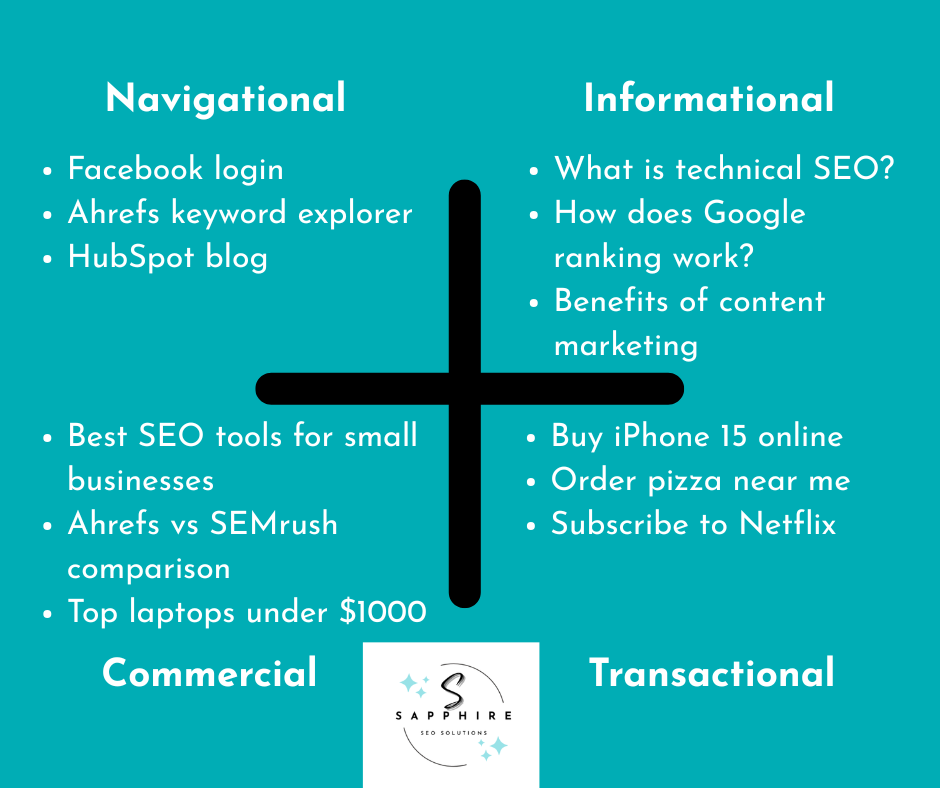
There are four types of search intent, and each one calls for a different kind of content. They include the following:
Informational: The user wants to learn something. "How-to" and "what is" posts fall here. This is where trust is built. A few examples: "how to improve website traffic" or "what is a meta description."
Commercial: The user is researching before making a decision. Comparisons and "best of" posts serve this intent well. Examples: "best SEO tools for small businesses" or "agency vs. in-house SEO."
Transactional: The user is ready to act. These search queries include words like "buy," "hire," or "cost." A post targeting "SEO service costs" speaks directly to someone close to making a purchase.
Navigational: The user is looking for a specific brand or website. This intent is less about blogging and more about brand presence.
Analyze and Follow the SERP
Before writing a single word, look at the current Google search results for your target topic. The pages already ranking tell you exactly what type of content Google wants to show for that query. If the top results are all listicles, Google has decided that listicles serve that intent best. If they are all long-form guides, that is your signal too. You must follow the signals that the SERPs give you.
Step #3: Conduct Smart Keyword Research
Choosing the right topic is one thing. Making sure people are actually searching for it is another. Keyword research is how you confirm that your content idea has a real audience behind it. The good news is that you do not need expensive software to do it well.
Every keyword has two key metrics: search volume and keyword difficulty. Search volume tells you how many people are searching for a term each month. Keyword difficulty tells you how hard it will be to rank for it. The goal is to find keywords that sit in the middle.
Chasing high-volume, high-competition terms is a losing strategy for most businesses. The sweet spot is where opportunity actually lives.
Long-tail keywords are specific phrases, usually four to six words long. They have lower search volume individually, but they attract users who know exactly what they are looking for. Because of this, they tend to convert at a higher rate.
Related keywords cluster naturally around long-tail phrases, which means one well-written post can rank for multiple terms at once. Free keyword research tools like Google Keyword Planner, Ubersuggest, and Ahrefs' free tier are all capable of surfacing these phrases quickly.
Make sure to read our detailed guide on "The Top Keyword Research Tool for SEO" to learn more about the free and paid keyword research tools before getting started with blogging.
Some of the best topic ideas never show up in a keyword tool. Reddit threads, Quora answers, and Google's "People Also Ask" boxes surface real questions from real users. These are the raw, unfiltered pain points your audience is typing when they do not know the formal terminology yet. That kind of language makes for highly relatable, highly searchable content.
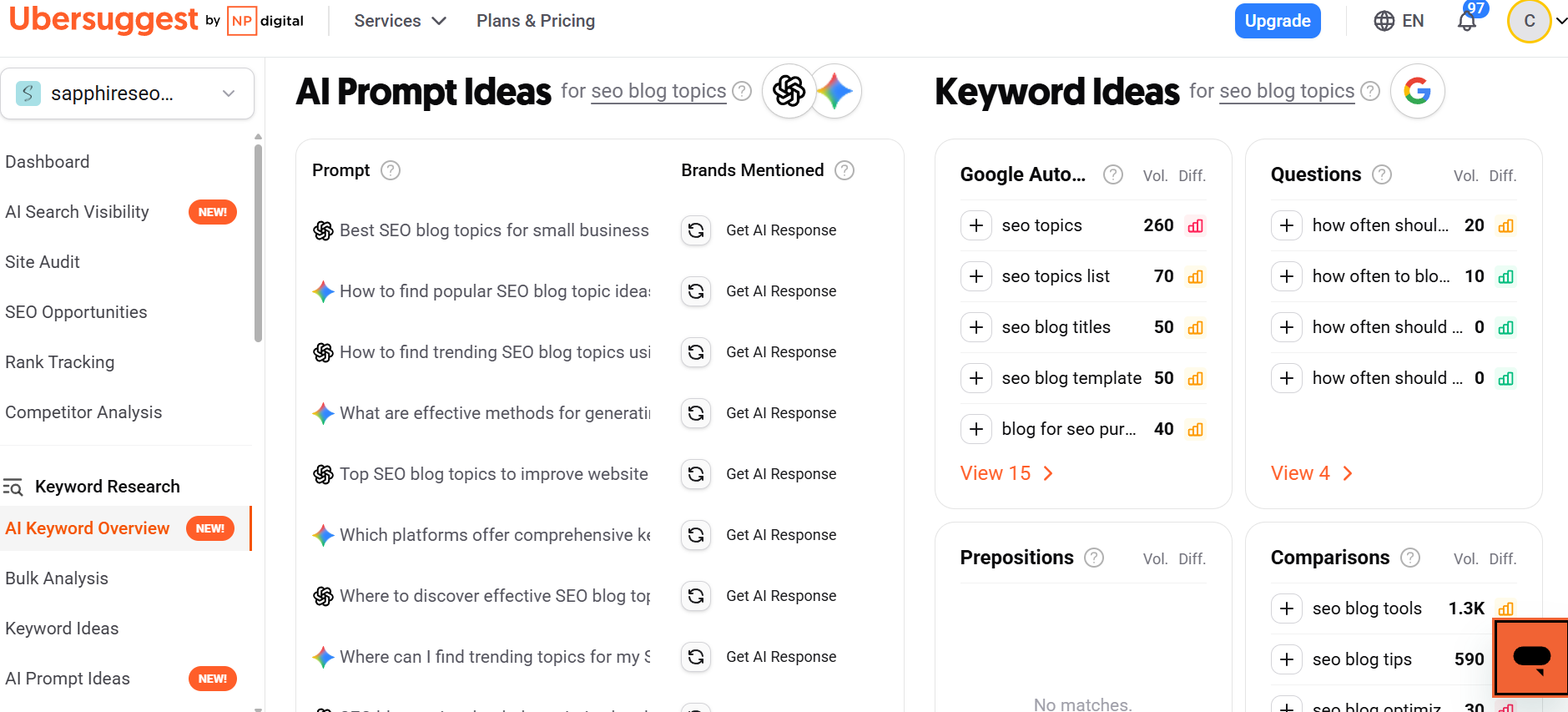
The following is a screenshot of the UberSuggest dashboard, showing AI prompt ideas and keyword ideas based on a primary keyword:
Step #4: Build Topical Authority with Content Clusters
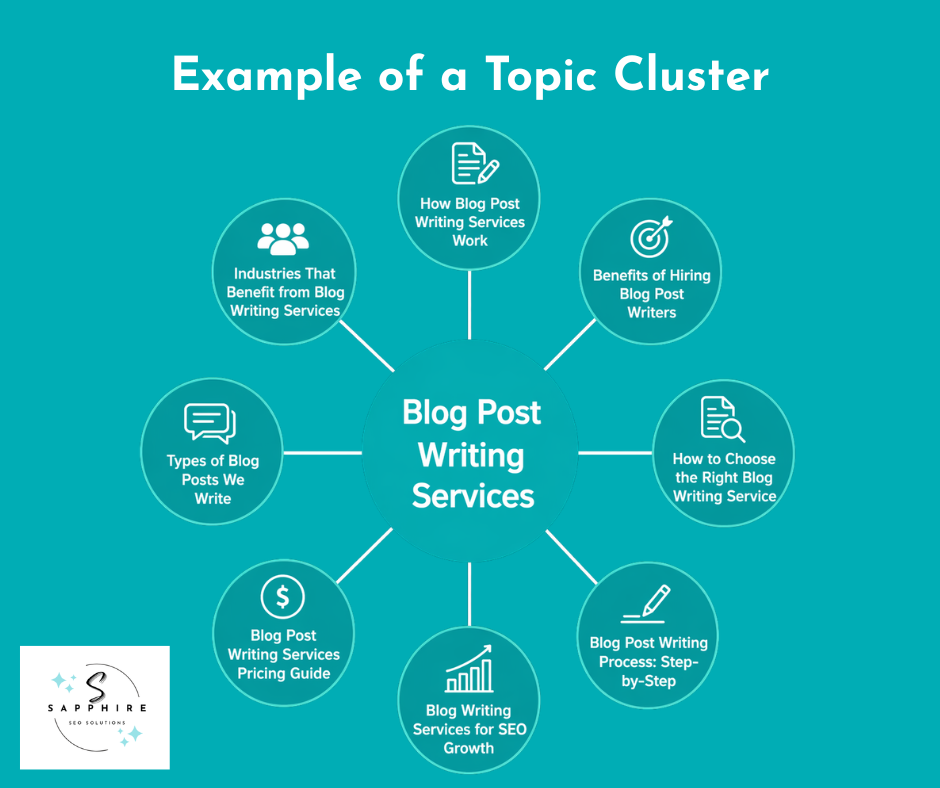
Publishing one strong blog post is a start. Building a connected body of content around a subject is what signals to Google that your site is a genuine authority on a topic. This approach is called topical authority, and it is one of the most effective long-term SEO strategies available.
Pillar Pages vs. Cluster Posts - Which One Is Better?
A pillar page is a comprehensive, high-level piece of content that covers a broad topic. For example: The Complete Guide to SEO for Small Businesses.
Cluster posts are narrower articles that go deep on specific subtopics within that broader theme.
Together, they form a content cluster. All the URLs within a cluster are connected, and that connection tells Google your site has depth and breadth on the subject. The result is stronger domain authority and a better chance to rank across multiple related queries.
Build a Solid Interlinking Strategy
Internal links are what tie a content cluster together. Every cluster post should link back to its pillar page, and the pillar page should link out to each cluster post. Also, your blog topics should connect to your main service pages wherever it is natural to do so. This passes relevance and authority through your site, helping your service pages rank alongside your blog content.
Avoid Content Cannibalization
Content cannibalization happens when two posts on the same site target the same keyword. Instead of one page ranking well, both pages compete against each other, and neither wins. Before publishing a new topic, check your existing content. If you already have a post covering similar ground, consider updating that post rather than creating a new one.
Step #5: Analyze the Competition
Your competitors have already done a lot of research. The topics they are covering, the questions they are answering, and the angles they are taking all reflect real audience demand. The goal is to find what they are missing.
Here's how you should analyze the competition:
Find Content Gaps
Content gaps are topics your competitors have overlooked or underserved. By reviewing other sites' ranking in your niche, you can identify related topics they have not covered thoroughly, questions they have not answered, or angles they have not taken. Those gaps are worth pursuing. They represent real search demand with less competition standing in your way.
For example, if every competitor has written broadly about "SEO for small businesses" but none have addressed "SEO for local service businesses specifically," that specificity is your opening.
Use the "Skyscraper" Technique
The Skyscraper Technique is straightforward. Find a similar topic that is already performing well for a competitor. Then make your version significantly better, more thorough, more current, better organized, or more visual. It is about doing the same thing in a way that gives readers a clear reason to choose your content over what already exists.

Step #6: Validate Your Topics Before Writing
A topic can seem strong on paper and still fail to deliver results. Validation is the step most content creators skip, and it is often the reason their posts attract visitors who never convert. Before you commit time to writing, run every topic through a short checklist.
Ask one simple question: Does this topic lead the reader closer to your services? A post that attracts organic traffic but has no logical connection to what you sell is a dead end. The best blog topics educate and guide. They bring more eyes to your website while naturally moving the reader toward the next step, which could be a service page, a contact form, or a consultation. If you cannot draw a straight line between the topic and your business offering, reconsider it.
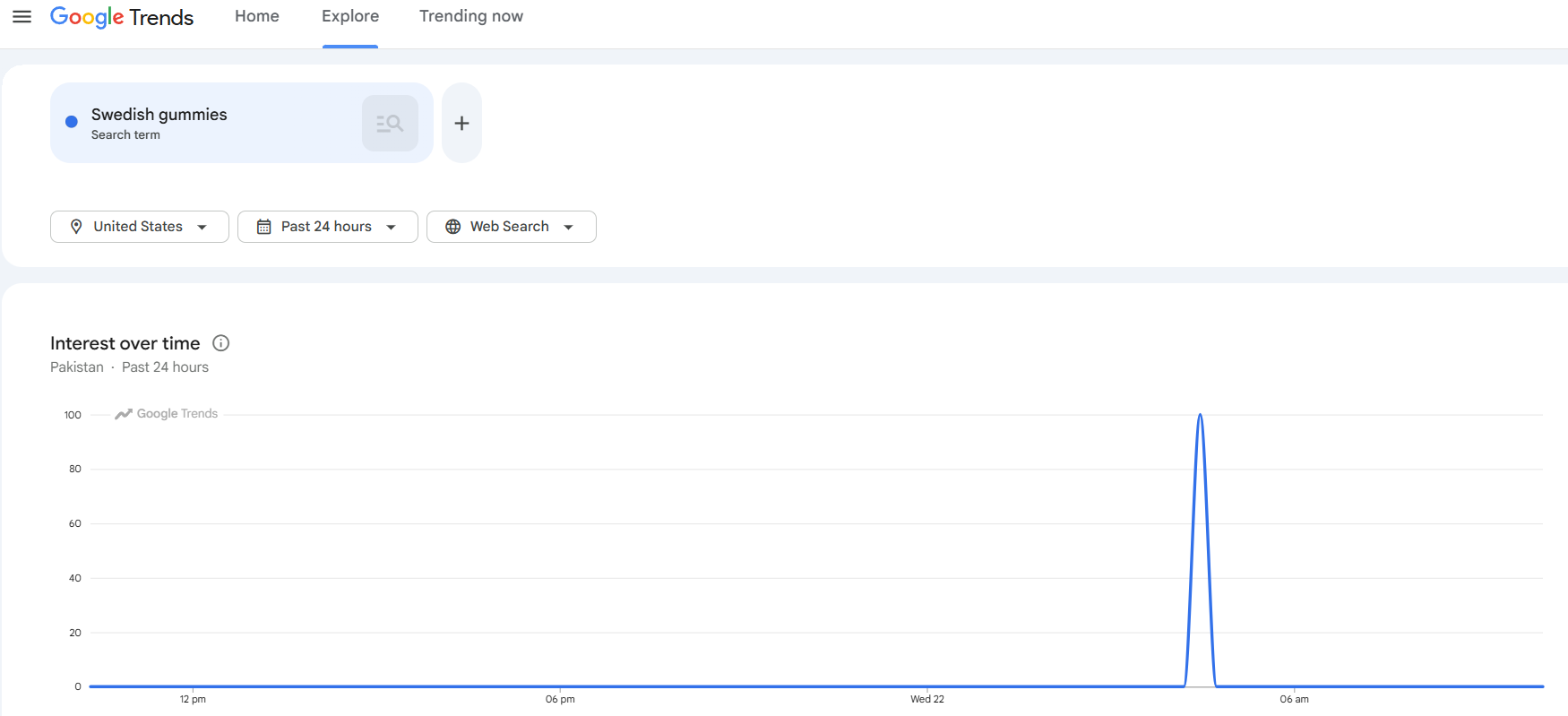
Google Trends shows you whether interest in a topic is growing, stable, or declining. Publishing a post on a trending topic that is on its way up is a strong move. Publishing on a rising topic in your niche before it peaks is even better. What you want to avoid is investing in a topic whose search interest has already collapsed. A quick check takes less than two minutes and can save hours of wasted effort.
Google Search Console is one of the most underused tools in content strategy. It shows you the exact queries your website is already appearing for, even if you are not ranking on page one yet. These are your low-hanging fruit. You are already on Google's radar for these terms. A focused, well-written post targeting one of these queries can move you from page three to page one with far less effort than starting from scratch. That means more organic traffic, more visibility, and more opportunities to drive traffic toward the services you offer.
The following is a screenshot of Google Trends for the search term “Swedish Gummies” to show how business owners can use this data to guide their SEO content strategy:
Choose the Right SEO Blog Topic and Start Blogging Today with Sapphire SEO Solutions!
Topic research is time-consuming when you are doing it alone and without a framework. Building out content clusters, analyzing the SERP, checking Google Trends, and mapping everything to the buyer's journey takes real time. And time is what most business owners do not have.
That is where Sapphire SEO Solutions comes in. Whether you need help identifying your first set of topics, want a full content strategy built out, or are ready to order blog posts written and optimized from the ground up, Sapphire SEO Solutions handles it all. Contact us today to start your first topic audit and start publishing content that actually works!

Frequently Asked Questions - SEO Blog Topics
How do I know if a blog topic is worth writing about for my business?
A blog topic is worth writing about if it meets three criteria: there is measurable search volume behind it, it matches a clear search intent, and it connects logically to your services. Use a free keyword tool to confirm people are searching for it, check Google Trends to ensure interest is stable or growing, and ask whether the topic naturally leads a reader toward what your business offers. If it does all three, it is worth pursuing.
Do I need expensive SEO tools to find blog topics that rank?
No. Free tools are sufficient for most small businesses starting out. Google Keyword Planner, Ubersuggest, and Google Search Console provide search volume, keyword difficulty, and existing ranking data at no cost. Google's "People Also Ask" boxes and Reddit threads surface real audience questions without any tool at all. Expensive platforms add efficiency at scale, but they are not a requirement for finding strong blog topics.
What is the difference between informational intent and commercial intent in blog topics?
Informational intent means the user wants to learn something, and that they are not ready to buy yet. Topics like "what is domain authority" or "how does SEO work" serve informational intent. Commercial intent means the user is evaluating options before making a decision. Topics like "best SEO agencies for small businesses" or "SEO pricing compared" serve commercial intent. Informational posts build trust. Commercial posts nurture readers who are closer to converting.
How many blog posts should a small business publish per month for SEO?
For most small businesses, two to four well-researched posts per month is a realistic and effective starting point. Consistency matters more than volume. One thoroughly researched, intent-matched post published every week will outperform four rushed, generic ones. As your content library grows and your topical authority builds, the cumulative effect of consistent publishing compounds, delivering more organic traffic over time with each post added.
How do I find "long-tail" keywords if my industry is very niche?
Start with your customers. The specific language they use to describe their problems, in emails, calls, and support requests, is often the exact phrasing they type into Google. From there, use Google's autocomplete, "People Also Ask," and platforms like Reddit or Quora to find real questions being asked in your space. Even in highly niche industries, these sources surface specific, low-competition phrases that broader keyword tools frequently miss.
Can my blog still rank on Google if I use AI to help generate the topics?
Yes, provided the final content is accurate, helpful, and written for a real audience. Google's ranking systems evaluate content quality and search intent match, not the process used to create it. AI can be a useful starting point for topic ideation, but the topics still need to be validated against real search data and refined to reflect genuine expertise. AI-generated topics that skip research and intent analysis will underperform regardless of how they were produced.
How do I turn a common customer question into a blog post that actually converts?
Start by writing the question down exactly as your customer asked it. That is likely close to what they type into Google. Build the post around a direct, thorough answer to that question. Within the post, connect the answer naturally to your service by showing how your business solves the problem being described. Close with a clear next step (a consultation, a contact form, or a relevant service page).