

The Top Keyword Research Tool for SEO: Boost Your Rankings in 2026
While keyword research tools are important for discovering search demand, evaluating keyword competition, and building SEO strategies, it's crucial for business owners to understand that these tools alone don't guarantee rankings. This guide explains what keyword research is, why keyword research tools matter for SEO, when to use free keyword research tools versus paid tools, and how professionals evaluate search volume and keyword difficulty in real-world scenarios. It also explores why SEO expertise, topic clusters, content quality, and seo strategy are essential for turning keyword data into sustainable organic growth.
Key Takeaways
Keyword research tools provide data, but SEO success depends on strategy, intent, and execution.
Free keyword research tools and paid tools serve different needs based on business size, competition, and growth goals.
Search volume and keyword difficulty must be evaluated in context, not treated as ranking guarantees.
Topic clusters and content strategy maximize the impact of keyword research.
Working with an SEO expert turns keyword insights into sustainable, conversion-driven growth.

Want to improve your website's performance in search results? One of the important SEO strategies that you can use is choosing the right keywords through the best keyword research tool for SEO. As search engines evolve and the business landscape becomes more competitive in 2026, business owners need more than guesswork to decide which search terms are best for them. The right tools can help find these keyword opportunities.
Sapphire SEO Solutions is an affordable SEO agency that has been helping small businesses grow online since 2007. From strategic keyword research and content writing to full-scale SEO campaigns, our team focuses on aligning search visibility with real business goals. We understand what works, what does not, and how to adapt seo strategy for long-term success.
In this comprehensive guide, we will cover:
What keyword research is and why keyword research tools matter for SEO
The best keyword research tools for 2026 and how to use them correctly
Why keyword research alone does not guarantee success and how SEO experts maximize results
What Is Keyword Research?
You know that keyword research is important for your business. But what is it?
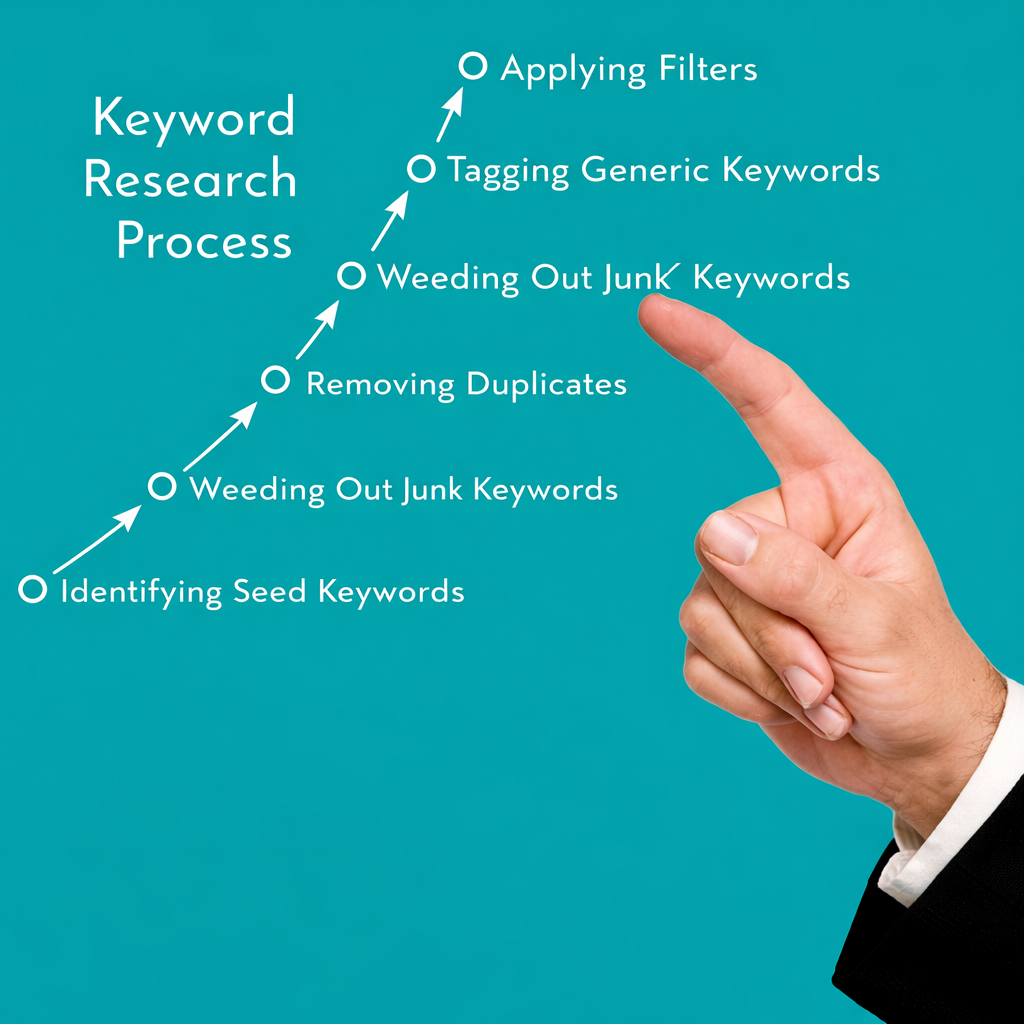
Simply put, the keyword research process involves finding the words and phrases that people relevant to your niche use in search engine queries when looking for:
Information
Products
Services
Why do keywords matter? Keywords serve many purposes, but the most important is to help businesses understand what their target audience is searching for and how competitive those searches are.
Keyword research goes beyond finding popular keywords. The process is a bit technical, involving the analysis of search intent, competition, relevance to business goals, and the likelihood of conversion.
That said, effective keyword research can shape your site's content, blog strategies, landing pages, and SEO planning.
Why Are Keyword Research Tools Important for SEO?
While you can do keyword research manually, it's not recommended, as you'll end up spending way too much time and energy finding search terms for your website.
To make this process easier, there are many different keyword research tools that you can use. They help you understand:
Search volume data, or how often a keyword is searched
Keyword difficulty, or how competitive it is to rank
Related keywords and variations
Search trends over time
Search intent behind queries
With the abovementioned insights, you can prioritize keywords that can make a difference to your business (traffic generation, brand building, and revenue creation).
Most keyword research tools help filter out keywords that may look attractive at first glance but are unlikely to produce results due to intense competition or mismatched intent.
However, it's important to remember that such tools only provide data. For interpretation and effective usage of keywords, you need to have SEO expertise, knowledge, and skills.
The Best Free Keyword Research Tool for SEO
For small businesses that are starting out with keyword research, free tools might be the best option. However, they may not provide the breadth of capabilities that paid keyword research tools offer. Plus, not all of them can help you grow your digital presence.
Want to learn more about the best free keyword research tools? Here are some of the options you can choose from:
1. Google Keyword Planner
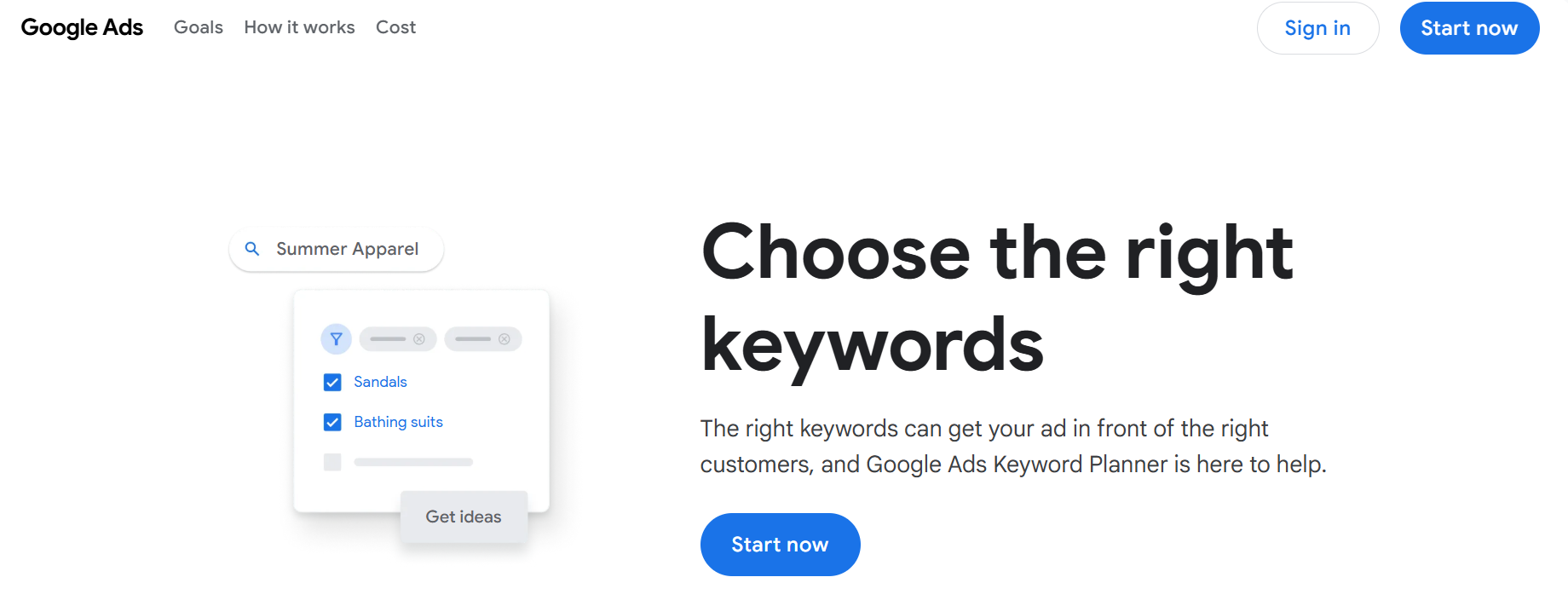
Any business owner who's serious about understanding search behaviour needs to start using Google Keyword Planner. This is the best free keyword research tool on the market, directly taking data from Google search while offering unmatched accuracy. Here are some of its key features:
Access to Google's real-time search database across 142 geographic locations
Two primary research modes: discovering new keywords and analyzing existing ones
Enhanced 2025 forecasting capabilities with city-level and device-specific breakdowns
Filter options for search volume, competition levels, and cost-per-click estimates
Ability to input competitor URLs for keyword extraction
Export functionality for campaign planning and content strategy
Business owners need to integrate Google Keyword Planner with Google Ads to get started. Doing so provides access to features that can help predict clicks, impressions, and costs based on your budget and targeting.
Recent 2025 updates introduced granular location targeting at the municipality and DMA level, plus platform-specific insights across mobile, desktop, and tablet devices.
So, who is the Google keyword tool for? Anyone can start using this tool, but it's perfect for PPC advertisers and content marketers, as this tool offers forecasting features and helps identify search volume ranges and seasonal trends. The tool excels at revealing what your audience searches for without costing you anything.
While Google Keyword Planner is one of the best free tools available for SEO, it has certain limitations.
For example, the keyword search volume ranges can be broad rather than precise, and the competition data metrics reflect advertising competition instead of organic search difficulty. Plus, without a Google Ads account, you can't get this tool to work.
That said, it's completely free, and there are no limitations on the number of searches you can do on a daily basis.
2. Semrush Free Tools
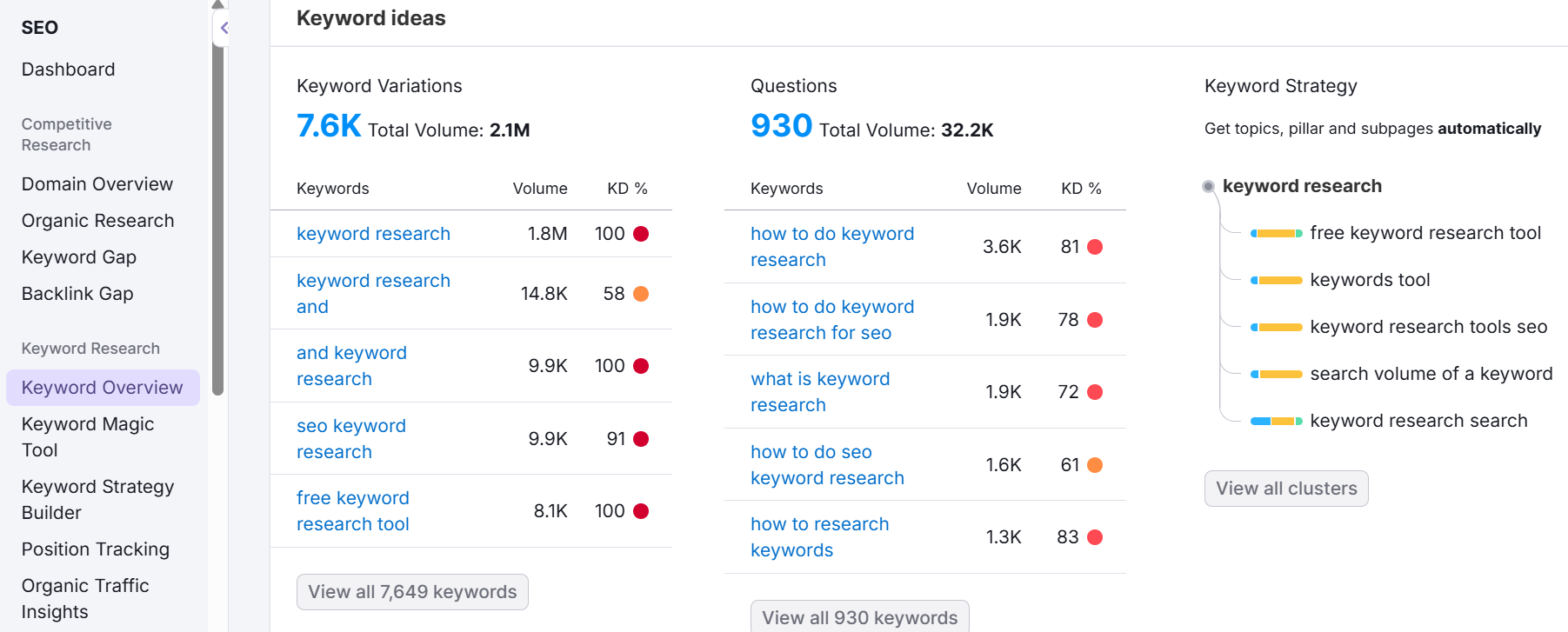
Every SEO professional knows about Semrush, and most of them may have used it or may still be using it for their SEO campaigns. This is because Semrush offers the most comprehensive keyword databases right now.
While Semrush isn’t completely free, it does offer limited free access, which is great for valuable insights for budget-conscious marketers.
Here are some of the features this keyword analysis tool provides:
Access to portions of a 26.8 billion keyword database
10 free searches per day with relevant keyword metrics displayed
Keyword difficulty scores and search intent classification
SERP feature identification (featured snippets, image packs, etc.)
Related keyword suggestions and question-based queries
Basic competitor keyword visibility
So, what makes Semrush stand out? It's one of the free SEO tools that pulls information from a huge database, which includes more than 43 trillion backlinks and 808 million domain profiles. The platform goes beyond Google search when it comes to finding keyword data, allowing for robust estimates of search behavior.
In 2025, Semrush added AI-enhanced features like Copilot suggestions and AI Visibility Toolkit integration.
Who should use Semrush? If you're looking for professional-grade keyword research without the financial commitment, Semrush offers limited free access.
You can use it for spot-checking keyword metrics or conducting preliminary research before diving deeper with other keyword research tools.
Where does Semrush lack? While Semrush offers free access, it's only limited to 10-searches a day. This may not be enough, especially for businesses that constantly produce content every day.
Plus, many advanced features, such as keyword clustering, historical data, and comprehensive competitor analysis, are behind paid walls.
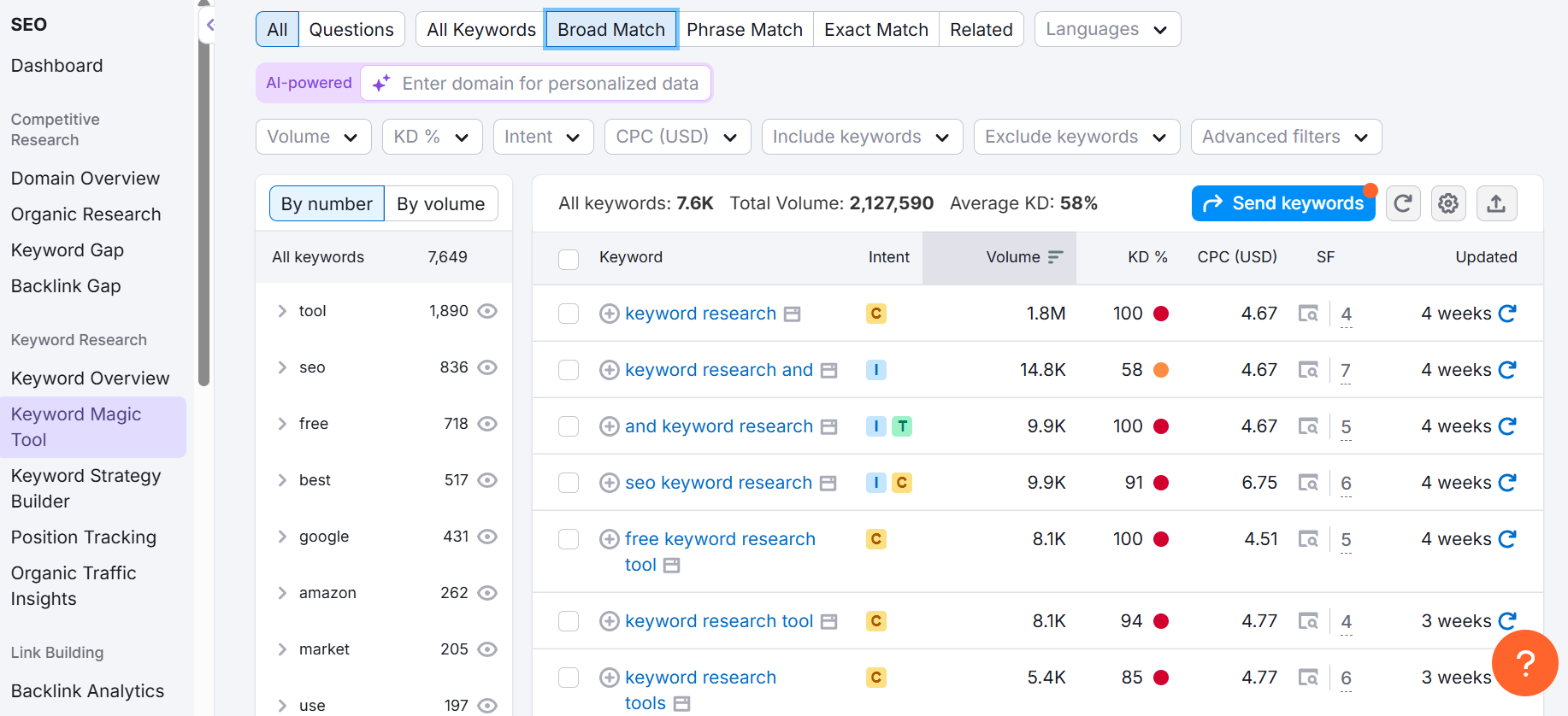
Free users also miss out on the Keyword Magic Tool's full capabilities, which generate keyword ideas from seed keywords.
Paid subscription starts from $165.17 per month (billed annually).
3. Answer Socrates
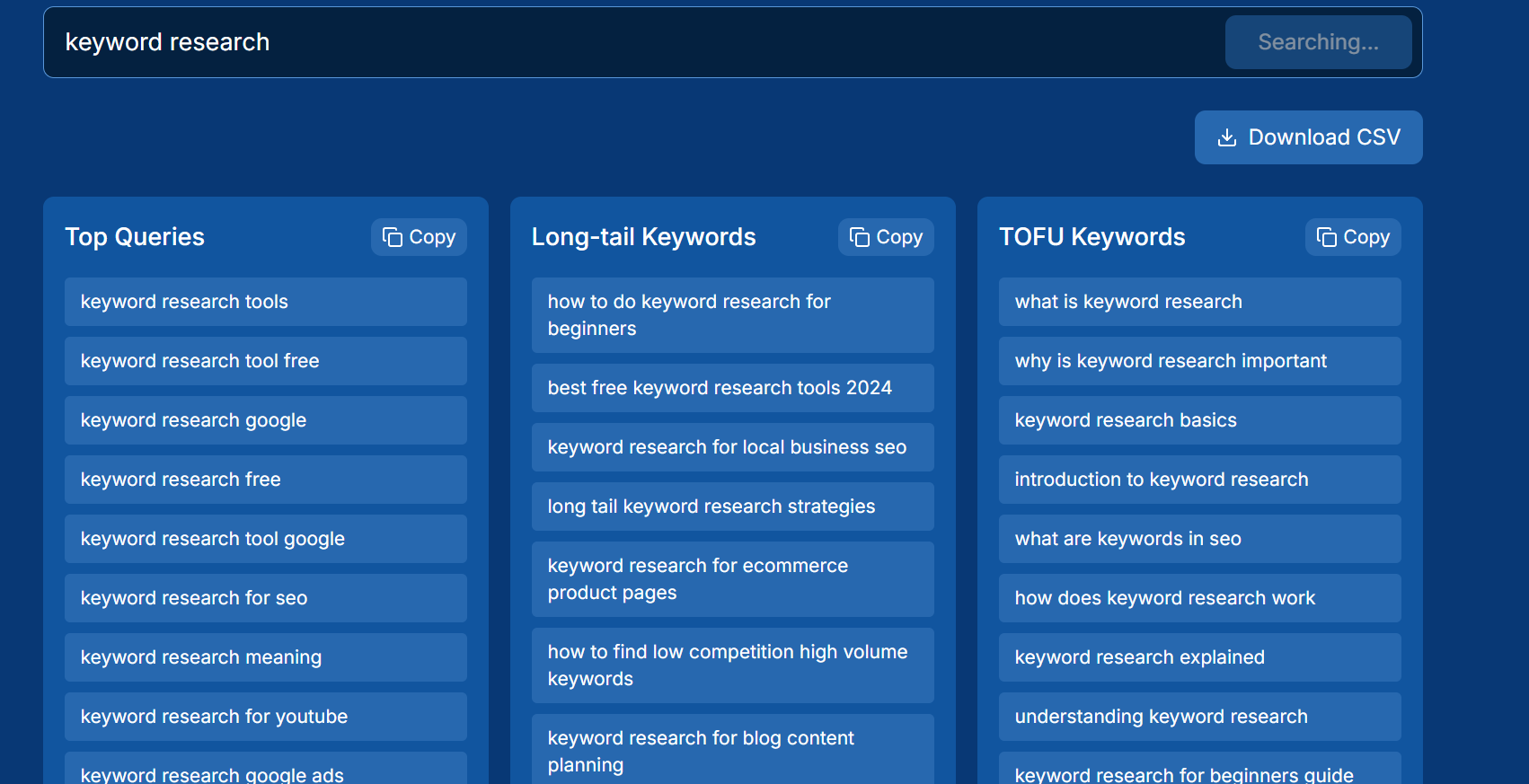
Considered to be the most generous free keyword research tool on the market, Answer Socrates is a platform that specializes in question-based keyword discovery. While most of the features are behind a paid wall, you can access some of the following key features:
3 free daily searches with full functionality
Generates 1,000+ question-based keywords per search
Automatic keyword clustering into topical groups (1,500 monthly credits free)
Search volume, CPC, and competition metrics included
Recursive search capabilities for deeper keyword exploration
Funnel-stage labeling (TOFU, MOFU, BOFU) for content strategy planning
CSV export functionality on the free plan
Integration with 24+ AI tools, including content humanizers
What does Answer Socrates do differently? Unlike other tools, Answer Socrates provides clustering in its free platform. The tool also pulls data from multiple sources, including Google Suggest, People Also Ask, and Google Trends. This ensures that you find the most valuable long-tail keywords, which other tools may not even have access to.
Answer Socrates is perfect for content creators and bloggers who need help with topic research and organizational structure. With automatic clustering, this tool helps you save hours of manual keyword list grouping, while the funnel-stage labels help align keywords with appropriate content types.
While Answer Socrates is a great free tool, the three daily searches may feel restrictive. Plus, the tool focuses specifically on question-based and long tail keywords rather than broad competitive analysis. It also lacks the backlink analysis and rank tracking features, which are often available in all-in-one platforms.
Pricing starts from $15 per month for paid plans.
The Best Paid Keyword Research Tool for SEO
Free keyword research tools are great if you're just getting started with SEO for your website, but if you want to take your site's SEO performance to the next level, you need a lot of features in addition to keyword research. They are often available to paid users.
Want to learn more about the best paid keyword research tools for SEO? Here are the top three options:
1. Ahrefs
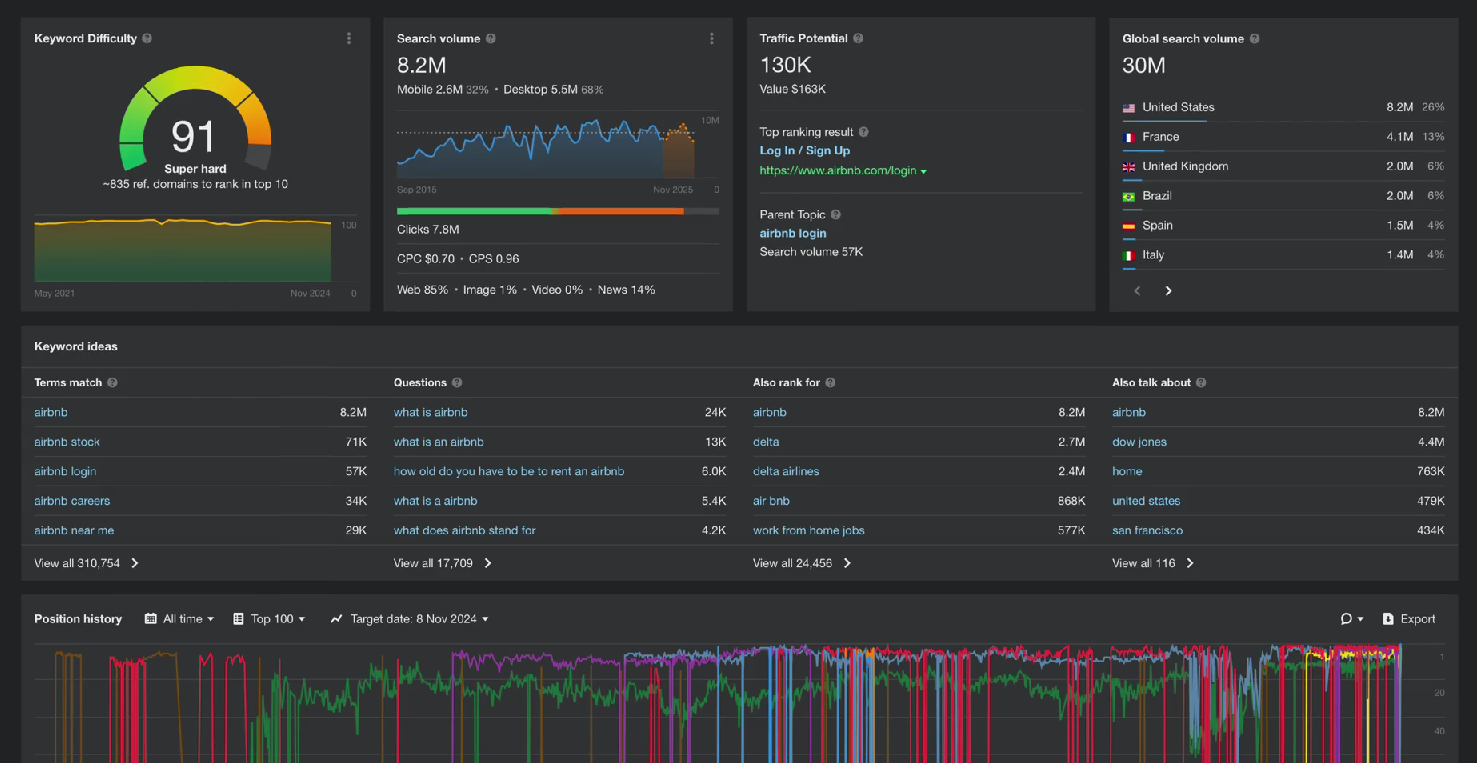
Known for its expertise in technical SEO and competitive research, Ahrefs provides unmatched depth for serious SEO professionals willing to invest in comprehensive data. Some of its key features include the following:
Keyword explorer tool with access to 28.7 billion topics across 10+ search engines
Instant keyword clustering that processes thousands of terms in seconds
Keyword difficulty scores based on backlink profiles of top-ranking pages
Click-through rate estimates and return rate data
Content Gap Analysis to identify competitor keyword opportunities
Anonymous queries report revealing hidden long tail keywords
Global keyword metrics with country-specific search volume metrics
Integration with Site Explorer for comprehensive keyword analysis
So, what makes Ahrefs stand out from the rest? This keyword analysis tool calculates keyword difficulty using backlink data, providing a transparent metric for ranking potential.
The May 2025 update added anonymous queries reporting, which surfaces hidden long tail keywords by matching Google Search Console data with Ahrefs' database.
This platform also offers global keyword metrics, allowing you to see search volume across all countries where your site ranks.
Ahrefs is the perfect tool for SEO professionals and agencies that are looking for a reliable backlink analysis with comprehensive keyword research. Its competitive analysis helps you reverse-engineer competitors' strategies by viewing their top-ranking keywords and the content that earned those positions.
However, Ahrefs comes with a steep learning curve, especially for beginners. Plus, you might need to manually refresh keyword data, which can cost you extra.
Since most marketers use Ahrefs, you'll often be looking at the same opportunities as your competitors.
Pricing starts from $129 per month or $108 per month (billed annually).
2. Semrush
Semrush, as mentioned before, is a comprehensive digital marketing platform that handles SEO, paid search, content marketing, and competitive intelligence under one roof. It's an all-in-one solution for teams managing multiple marketing channels.
While we've discussed more about its free features above, here we will closely look at the paid features and why it stands out. Semrush uses breadth with depth, integrating seo tool capabilities with PPC intelligence, social media management, and content marketing features.
The 2025 AI features set it apart, including automatic performance alerts, low competition keywords identification, and tracking across emerging AI search platforms. The platform's massive database spans both organic and paid search, with clickstream data from 200+ million anonymized users.
So, who should be paying for Semrush? It's the perfect keyword research tool for marketing teams and agencies that need centralized reporting across multiple channels.
The platform shines when you're managing SEO alongside paid search campaigns, requiring comprehensive competitor analysis, or coordinating content strategy with technical seo audits.
That said, Semrush does have certain limitations, including the following:
Restrictions on some plans can make it challenging for teams to work.
The sheer volume of features can overwhelm users.
The interface requires time investment to master.
Data depth doesn't quite match Ahrefs for pure SEO focus.
The keyword research workflow involves more navigation between modules.
3. KeySearch
Carving out its niche as a budget-friendly alternative, KeySearch offers much to users without sacrificing essential functionality. It's a keyword tool that targets bloggers, content creators, and small businesses who need reliable keyword research without enterprise pricing. Some of its key features include the following:
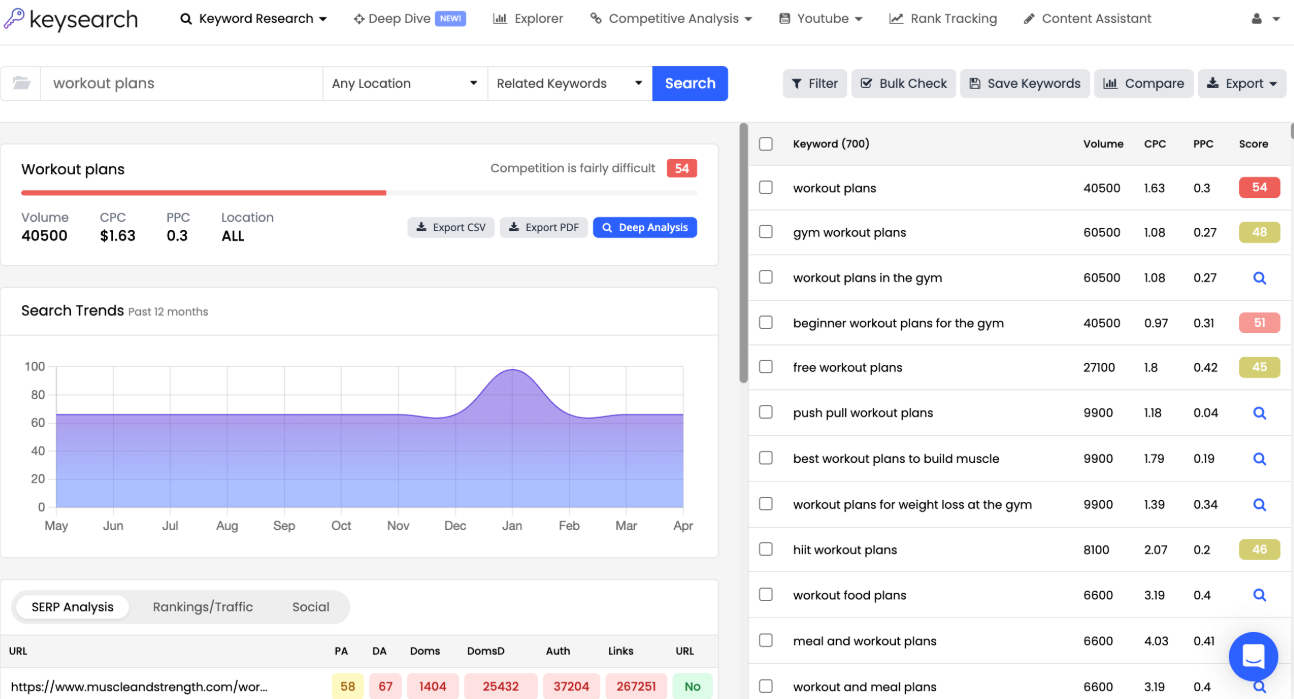
Up to 700 related keywords per search with color-coded difficulty scores
12-month trend data showing seasonal search patterns
SERP analysis displaying top-ranking pages for any given keyword
Brainstorm feature with unbiased Google Autocomplete from multiple search engines
Content Assistant providing optimization recommendations and keyword suggestions
Rank tracking for monitoring keyword performance over time
Site audit functionality identifying technical seo issues
Competitor analysis revealing organic traffic keywords and top pages
YouTube keyword research for video content optimization
KeySearch prioritizes usability over complexity. The Brainstorm feature pulls autocomplete suggestions without the personalization bias that affects regular Google search, revealing truly neutral keyword opportunities.
The Content Assistant analyzes keywords in top-ranking pages to suggest must-use keywords and common questions, taking the guesswork out of content optimization.
Who should use KeySearch? This tool is great for solo bloggers and small businesses that need straightforward keyword research without overwhelming features. It works particularly well for finding low competition keywords and long tail keywords that can rank quickly without extensive backlink profiles.
However, we really don't like the interface. It feels outdated, and the data takes some time to load. Plus, it only has one billion keyword database, which is significantly less than the other alternatives.
Another thing worth mentioning is that search volume data comes from Moz's API, which some users find less accurate than direct Google data.
Pricing starts from $24 per month or $20 per month (billed annually).
When Should I Upgrade to a Paid Keyword Research Tool for SEO?
Free keyword research tools are useful for beginners or small websites just starting out. They often provide limited data, capped searches, or broad estimates.
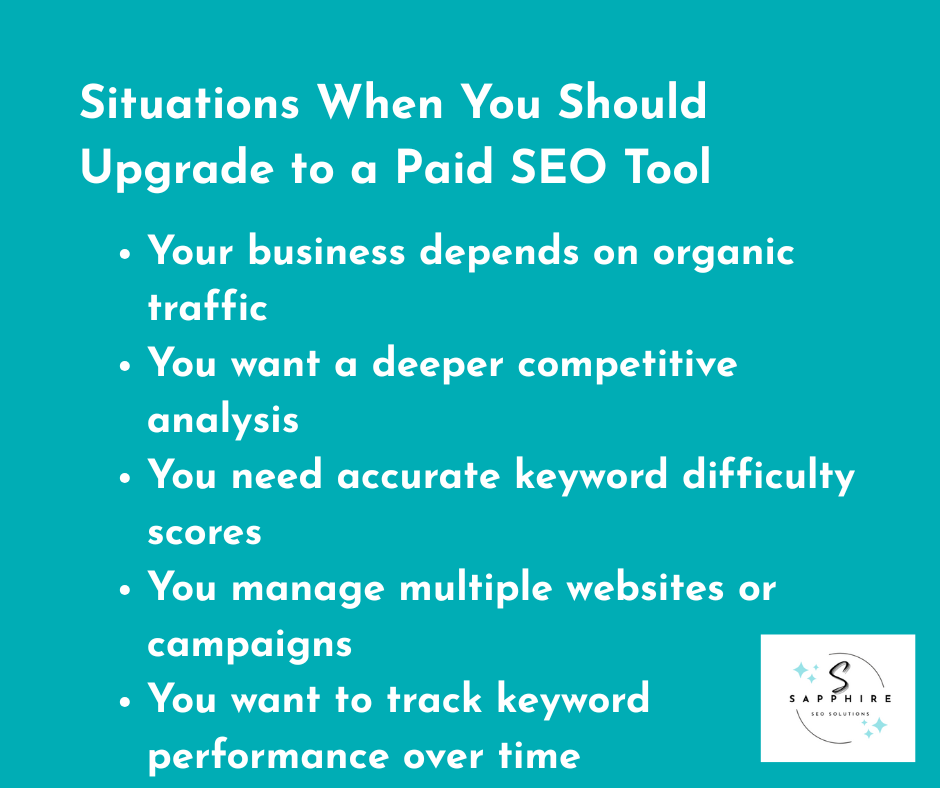
Here are a few situations where it makes sense to upgrade to a paid keyword research tool:
Your business depends on organic traffic
You want a deeper competitive analysis
You need accurate keyword difficulty scores
You manage multiple websites or campaigns
You want to track keyword performance over time (check out our detailed guide on “How to Track SEO ROI from SEO Campaigns” to learn more about tracking and monitoring SEO ROI).
Paid tools offer more precise data, advanced filtering, and competitive insights. Still, having access to premium tools does not automatically lead to better rankings. Strategy matters more than software.
Can I Use ChatGPT for Keyword Research?
While you can use ChatGPT for keyword research, it's important to understand that AI LLMs cannot replace specialized keyword research tools. That said, ChatGPT is great for:
Brainstorming keyword ideas
Understanding search intent
Creating topic ideas and content outlines
Expanding the seed keyword into related concepts
Why don't we recommend solely using ChatGPT for keyword research? This AI tool doesn't have access to real-time information, such as search volume, keyword difficulty, or competition data. Pairing ChatGPT with SEO tools and professional judgment is the right way to use AI LLMs for keyword research.
An SEO expert may use ChatGPT to speed up ideation, but decisions are always validated using actual keyword data and market analysis.
Do Keyword Research Tools Guarantee Success?
No. Keyword research tools do not guarantee SEO success. They only provide numbers, not strategy. Your website's success depends on many different factors, including:
How keywords are selected
How keywords are implemented
How keywords are supported by content quality, site structure, backlinks, technical seo, and user experience
You need more than a keyword research tool to expand your digital presence. This is why SEO expertise matters a lot. An SEO expert understands that keyword metrics must be evaluated in context.
Below are the four most common keyword scenarios and how many keywords in each category can work for a business.
Low Search Volume, High Keyword Difficulty
A low search volume with a high keyword difficulty in most cases is a big no-no. But SEO professionals know that these keywords often exist in niche or specialized industries. Even with low volume, competition can be high due to authoritative brands dominating the space.
This can still work if:
The keyword has a strong commercial or transactional intent
The business offers a highly specialized solution
Ranking even for a small audience delivers high-value leads
Example: A legal compliance service or enterprise software solution where one lead can be worth thousands of dollars.
High Search Volume, Low Keyword Difficulty
This is the ideal scenario, but it is rare. It goes without saying that you should always use these types of search terms if they align with the right user intent.
These keywords often appear due to:
Emerging trends
New industries
Underserved topics
SEO professionals move quickly when identifying these opportunities. Even then, they ensure the keyword aligns with business goals and intent, not just traffic potential.
High Search Volume, High Keyword Difficulty
These are competitive keywords dominated by large brands and authoritative websites. You may not want to choose these keywords, but in some cases, it makes sense to explore such opportunities. They include the following:
The business has a strong domain authority
Content quality is exceptional
The keyword fits into a long-term seo strategy
Topic clusters and supporting content are in place
SEO experts may target these keywords gradually while building authority through related lower-difficulty terms.
Low Search Volume, Low Keyword Difficulty
Many businesses overlook these keywords, but they can be highly valuable.
These keywords often:
Reflect strong buyer intent
Serve niche audiences
Convert better than broad keywords
Example: A service-based business targeting location-specific or problem-specific searches. Even with low volume, conversions can be high, making these keywords profitable.
SEO professionals recognize that traffic volume alone does not determine success.
Keyword Research Is Only One Piece of the SEO Puzzle
Keyword research alone does not drive rankings or revenue.
An SEO expert evaluates:
Business goals
Target audience
Market competition
Search intent
Customer journey stages
Only after understanding these factors does keyword selection happen. This ensures SEO efforts support real business outcomes, not just rankings.
Maximizing Impact With Topic Clusters
Even with the best keyword research tool, results depend on execution.
SEO professionals use topic clusters to maximize impact. A topic cluster includes:
One main pillar page targeting a broad target keyword
Multiple supporting pages targeting related keywords and subtopics
Internal linking that reinforces topical authority
This approach helps search engine algorithms understand content depth and relevance. It also improves user experience by guiding visitors through related information.
Keyword research informs topic clusters, but strategy determines how they are built and maintained. Check out the case study on how our SEO strategist used keyword research tools and his topic cluster skills and on-page SEO expertise to drive 158% increase in organic traffic in just one month!
Why Keyword Research Does Not Guarantee SEO Success
There are several factors, beyond keyword research, that can affect SEO performance, and they include the following:
Content quality and originality
Website technical health
Page speed and mobile usability
Backlink quality (off-page SEO)
Search intent alignment
Ongoing optimization and updates
This is why businesses benefit from working with SEO professionals who understand how all these elements connect.
How Sapphire SEO Solutions Can Help
Sapphire SEO Solutions helps businesses turn keyword research into measurable results through proven SEO strategies. Here are a few reasons why you should partner with us:
SEO-certified professionals with hands-on experience
Ongoing training and webinars to stay current with algorithm changes
Years of expertise since 2007, understanding businesses, markets, and user behavior
Data-driven keyword strategies aligned with business goals
Content strategy planning using topic clusters and search intent analysis
Transparent reporting and continuous optimization (read our blog on “Why Most SEO Reports Are Useless” to learn how our reporting is different from the others)
Ethical, long-term SEO practices that focus on sustainable growth
Schedule a Free Consultation with an SEO Expert Today!
Keyword research tools are essential for SEO, but they do not guarantee success. Tools provide data, not decisions.
Real success comes from understanding intent, competition, content strategy, and how keywords fit into a larger SEO framework. Without expertise, even the best keyword research tools can lead to poor outcomes.
Sapphire SEO Solutions partners with businesses to build strong, sustainable SEO strategies. By combining professional expertise, advanced tools, and real-world experience, we help businesses attract qualified traffic and turn visibility into growth.
If you want keyword research that supports real business goals, not just rankings, contact us to schedule a free consultation with an SEO expert today!

Frequently Asked Questions - Keyword Research Tool for SEO
Can a free keyword research tool for SEO provide enough data for a small business?
A free keyword research tool for SEO, like Google Keyword Planner, is often sufficient for small businesses and new bloggers who need to understand broad search demand and identify basic seed keywords. These tools offer reliable data directly from search engine sources to help you find relevant terms and seasonal trends without an initial financial commitment. However, while they are excellent for starting out, they usually lack the granular competitive intelligence and advanced difficulty metrics that growing brands need to outperform established rivals in crowded markets.
Is keyword volume or keyword difficulty more important when choosing search terms?
Both metrics are essential, but must be evaluated together because a high-volume keyword is useless if the difficulty is so high that your site can never realistically rank on the first page. For most small to medium businesses, the "sweet spot" involves targeting long tail keywords with moderate search volume and low difficulty to build initial authority and steady traffic. A professional SEO strategy prioritizes keywords where your current domain authority matches the ranking requirements, ensuring you invest resources into terms that actually have the potential to drive conversions.
Will AI tools like ChatGPT eventually replace traditional keyword research software?
While AI is a powerful assistant for brainstorming and clustering topics, it cannot replace traditional keyword research tools because it lacks access to live search volume, real-time competition levels, and accurate backlink data. In 2026, the most effective marketers use a hybrid approach where they leverage AI for creative ideation and intent analysis while validating every decision with hard data from platforms like Semrush or Ahrefs. AI is an accelerator for the research process rather than a standalone solution for data accuracy.
Why is search intent more critical than search volume in modern SEO?
Search intent is the most critical factor because it defines why a user is searching and what type of content they expect to see. Ranking a detailed informational blog post for a transactional keyword where users want to buy a product will likely lead to a high bounce rate and poor conversions. By aligning your chosen keywords with the correct intent, you ensure that the traffic coming to your site is actually looking for the specific solutions or information you provide.
How often should a business perform new keyword research for its website?
Keyword research is not a one-time task and should be revisited at least quarterly to keep up with shifting search trends, new competitor entries, and changing consumer behavior. Regular audits allow you to identify emerging long tail opportunities and adjust your content strategy to protect rankings that may be slipping due to increased competition. Maintaining a fresh keyword strategy ensures your website stays relevant and continues to attract qualified leads as your industry evolves over time.