

How long should a blog post be? The ideal blog post length depends on content type and search intent, not a fixed word count. Deep-dive guides and pillar pages perform best at 2,500 or more words. Standard educational posts and how-tos work well between 1,200 and 1,800 words. Case studies and opinion pieces fit within 800 to 1,200 words. News and industry updates need only 300 to 600 words. In 2026, Google and AI search engines reward content depth, original information, and answer-first structure over raw word count.
Key Takeaways
There is no universal ideal word count. Blog post length should always match content type and search intent.
Top-ranking Google results average 1,500–2,200 words, but depth and originality matter more than hitting that number.
Long-form content earns 3.5x more backlinks than short posts, but only when it adds genuine informational value.
Structure your posts with question-based H2s and direct answer blocks. This is how AI Overviews find and cite your content.
Google's 2026 updates reward information gain. Original data and first-hand experience now outrank word count alone.
For business owners and marketers, figuring out the ideal blog post length can feel like chasing a moving target. Ask five SEO professionals how long a blog post should be, and you will likely get five different answers.
The truth is that there is no single optimal blog post length that works for every topic, every industry, or every goal. The ideal word count depends on what your reader is searching for, how competitive the keyword is, and what your content is actually trying to accomplish. In other words, the right length is whatever length it takes to fully answer the question, and nothing more.
At Sapphire SEO Solutions, our certified SEO experts conduct detailed analysis, whether it's evaluating the search intent or assessing competitors, before determining the ideal blog post length. We even provide keyword research with our SEO blog writing services, ensuring a complete solution.
This guide breaks down the perfect length for every type of blog post, the factors that should influence your word count decisions, and how AI is reshaping the rules of blog length in 2026. Keep reading to find out.
Does Blog Post Length Still Matter for Search Engine Optimization in 2026?
A blog is a corner on your site where readers can find relevant information regarding your brand. Blogging refers to the practice of publishing relevant information in the blog section of your site. To learn more about blogs and blogging, make sure to read our detailed guide on "What Is Blog and Blogging?"
For years, marketers chased word counts the way they chased keyword density, treating 2,000 words as a universal finish line. Google's algorithm, however, has moved well past that kind of thinking.
It's time to stop asking "how many words...?", as content length is no longer the primary variable. Content depth is. In other words, what matters is not how much you write, but how thoroughly you address the reader's question.
Google does not rank pages based on word count. A well-structured 900-word post that fully answers a specific query will outperform a bloated 3,000-word article that repeats the same points in different sentences. The shift is that direct.
The Correlation Between Length and Ranking
There is a real relationship between longer posts and stronger search results, but it is important to understand why that relationship exists. An original research by Jasper reveals that the average blog post length is between 1,500 and 2,500 words, but what matters more is that these posts comprehensively answer user queries, cover related subtopics, and provide actionable value.
That said, that range is not a target to hit. It is a reflection of what comprehensive answers typically require. Comprehensiveness is a ranking factor; word count is not. And sometimes, to be comprehensive, you have to have a lot of words.
Let's simplify all of this into practical steps. Here's what you should do: analyze the top 3 to 5 results for your target keyword. Note how deeply they cover the topic, not just how long they are. Then match or exceed that level of content depth with something more useful. That is the standard Google is measuring against.
Don't Forget About the Dwell Time Metric
Here is where content length and rankings actually connect. Longer posts do not rank better simply because they are long. They rank better because they keep readers on the page. That behavior is called dwell time, which refers to how long a user stays on your page after clicking from a search result before returning to Google.
Dwell time indicates user engagement and content relevance. Longer dwell times suggest the content effectively meets the user's search intent, and since the Google Search API leak highlighted the importance of user engagement metrics, optimizing for dwell time is now more crucial than ever.
While Google has never officially confirmed dwell time as a direct ranking factor, there is strong evidence that user engagement signals play a role. RankBrain and other systems are designed to evaluate how well a result satisfies user intent, and dwell time contributes to that evaluation indirectly.
A longer post earns dwell time only when it is well-structured, easy to scan, and genuinely useful throughout. A poorly organized 2,500-word post will bleed readers just as fast as a thin 400-word one. An engaging, well-formatted, and valuable long article naturally encourages a longer dwell time. The reader spends more time reading, scrolling, and interacting with the content, indicating high satisfaction, and this positive signal directly contributes to higher rankings.
Long Blog Posts Vs Short Form Content - Which One Is Better?
For business owners and marketers, choosing between longer posts and shorter blog posts is one of the most common content strategy debates.
As a general rule, short content falls in the 300–800-word range. It is fast to produce, easy to read, and works well for timely topics. Longer content, on the other hand, typically runs from 1,500 words to well over 3,000. It covers topics in depth, targets competitive keywords, and is built to earn authority over time.
Benefits of Long Blog Posts
Long-form blog posts carry several advantages for businesses focused on search visibility and topical authority. Here are the key benefits of writing long-form content:
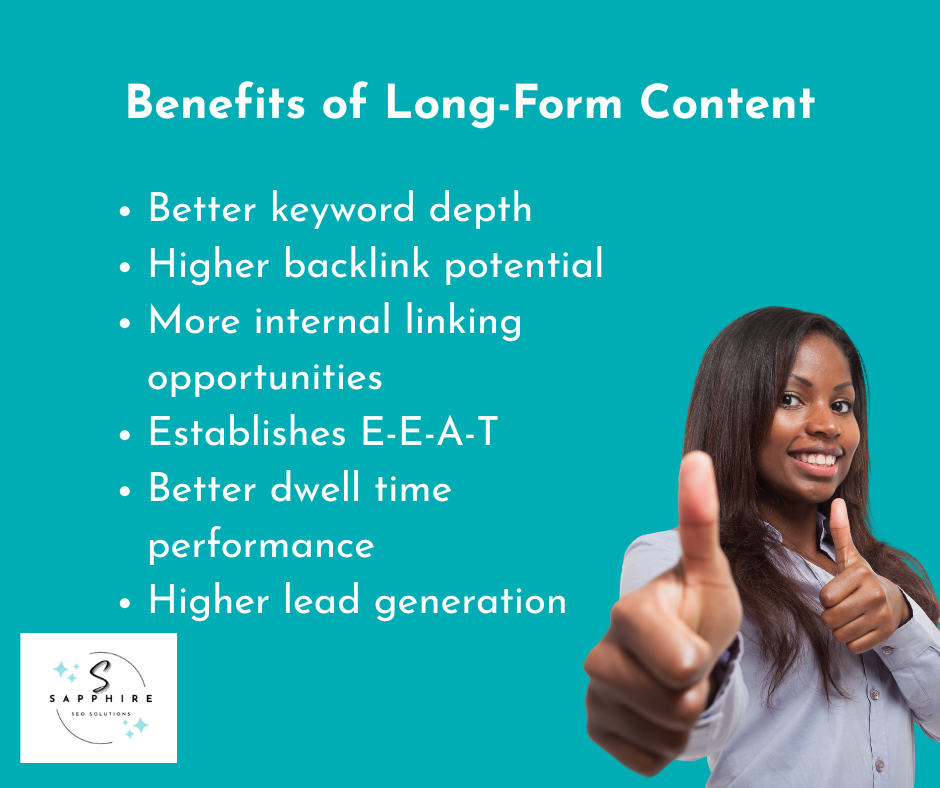
Better Keyword Depth: Longer posts naturally accommodate more LSI (Latent Semantic Indexing) keywords and long-tail variations. More words allow you to cover a topic from multiple angles without forcing keywords into places they do not belong. This helps Google understand the full scope of your content without triggering keyword stuffing penalties.
Higher Backlink Potential: More details attract more references from other sites. Posts exceeding 3,000 words, according to DemandSage, receive 3.5x more backlinks and 2.4x more social shares than posts under 1,000 words. In most cases, longer resources get cited because they function as reference material. A 500-word post rarely does.
More Internal Linking Opportunities: Longer posts create natural places to link to related content on your site. This strengthens site structure, improves crawlability, and keeps readers moving through your content ecosystem rather than leaving after one page.
Establishes E-E-A-T: Comprehensive guides signal E-E-A-T (Expertise, Experience, Authoritativeness, and Trustworthiness) to both readers and Google. Analysis of over 250,000 search results found that topical authority is now the strongest on-page ranking factor, even surpassing domain traffic. In-depth information is one of the clearest ways to demonstrate that authority.
Better Dwell Time Performance: When well-structured, in-depth posts keep readers on the page significantly longer. That extended session signals user satisfaction to Google, which in turn supports stronger rankings over time.
Higher Lead Generation: Wix reveals that long-form posts at 3,000 or more words generate over 75% more backlinks and 9x more leads than short-form posts of 500 words or fewer. For businesses using their blog as a lead generation channel, length and depth directly affect the bottom line.
Drawbacks of Long Blog Posts
Long-form blog posts are not without their trade-offs. Here are some drawbacks to consider when determining your overall length strategy:
Higher Bounce Rates on Mobile: Long walls of text without proper formatting drive mobile readers away quickly. 73% of readers, according to Wix, skim rather than fully read blog posts. On mobile, a post with no subheadings, no bullets, and no white space becomes difficult to consume, regardless of how good the writing is.
Resource Intensive: The average blog post takes three hours and 48 minutes to write. Posts targeting 2,500 words or specific lengths beyond that take considerably longer. For small teams or solo operators, the production cost of consistent long-form content is real.
Risk of "Fluff": Padding a post to hit an arbitrary word count is one of the most damaging things a blogger can do in 2026. Google tracks how long people stay on a page after clicking from search results. If users bounce back to search immediately, that signals the content did not answer their query, and if that pattern repeats across enough pages, the site's overall quality score drops. Writing more articles at a manageable length often produces better results than forcing one inflated piece.
Benefits of Short Blog Posts
Shorter posts fill a genuine and underserved role in a well-rounded content strategy. Here is where shorter blog posts excel:
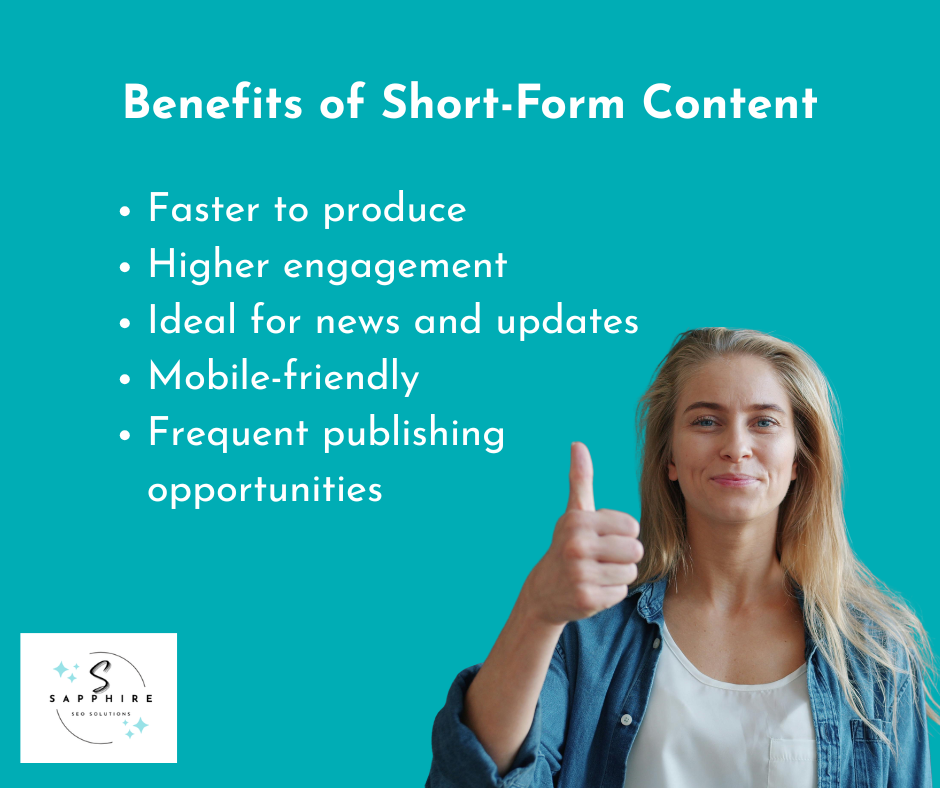
Faster to Produce: Short blog articles can be researched, drafted, and published in a fraction of the time of a long-form piece. For small businesses managing their own content, this matters. Consistent publishing at a shorter length beats irregular publishing at a longer one.
Higher Engagement and Comments: Concise written content often invites more reader interaction. Posts under 600 words tend to see higher comment-to-view ratios because the barrier to finishing the piece is low, and readers who finish are more likely to respond.
Ideal for News and Updates: Timely topics do not benefit from extra length. A product announcement, an industry update, or a quick how-to does not need 2,000 words. Short, focused posts serve that content type well without padding the topic beyond what it requires.
Mobile-Friendly: Shorter posts are simply easier to consume on a phone. With 63% of consumers preferring to find information about brands and products on mobile devices, according to HubSpot, readers engaged on the go are more likely to finish a shorter piece than scroll endlessly through a long one.
Keeps the Publishing Cadence Consistent: For newer websites building their content library, shorter posts allow for more frequent publishing. More indexed pages signal an active, growing site, which supports overall SEO momentum even if no single post is especially long.
Drawbacks of Short Blog Posts
Short blog posts come with real limitations, particularly for businesses competing in crowded search markets. Here is where they fall short when it comes to producing helpful content:
Low Information Gain: When it comes to securing AI citations, content depth and word count matter most, while traditional SEO metrics like traffic and backlinks have little impact. A short post rarely goes deep enough to provide the kind of unique, valuable content that an AI Overview has not already summarized for the user. If Google can answer the question in a two-sentence snippet, a 400-word post offers very little additional reason to click.
Poor Ranking for Competitive Keywords: High-quality content on competitive, high-volume topics almost always requires depth. Short posts rarely accumulate the topical coverage, internal links, or backlink potential needed to rank for evergreen terms. In most cases, a 500-word post on a competitive keyword is invisible in search results.
Limited E-E-A-T Signals: Thin posts struggle to demonstrate expertise. Google's quality systems are designed to evaluate whether a page provides genuine informative content, and a short treatment of a complex topic does not clear that bar. Without demonstrated depth, trust is harder to earn, from both readers and search engines.
Shorter Shelf Life: Short, topical posts can drive a spike of traffic around a news cycle or trend, then go quiet. Valuable content that ranks over the long term tends to be comprehensive enough to stay relevant as a reference resource, something a short post rarely becomes.
How Long Should a Blog Post Be?
There is no single average word count that works for every post, every topic, or every business. The average blog post today, according to several reliable sources, sits around 1,400 words, but that number reflects what people are publishing, not necessarily what is ranking. Posts ranking in Google's top 10 average around 2,400 words, but what matters more is that these posts comprehensively answer user queries, cover related subtopics, and provide actionable value.
In other words, article length is determined by content type first, and word count second. A news update and a pillar page are two completely different tools. Using the same length for both is like using the same format for a press release and an annual report.
Here is how to match the length of a blog to the job it is actually doing:
Deep-Dive Guides and Pillar Pages (2,500+ Words)
Pillar pages are the cornerstone of a topic cluster strategy. Their purpose is to explain concepts broadly and authoritatively across an entire subject, then link out to more focused pieces that go deeper on individual subtopics. In digital marketing, these are sometimes called "ultimate guides" or "complete resources," and they are the posts that tend to anchor an entire content strategy.
Pillar pages and ultimate guides work best at 3,000 to 5,000 words or more, as these cornerstone pieces establish topical authority and compete for high-volume keywords. That length reflects the scope of work these posts are designed to do.
A pillar page on "SEO for small businesses," for example, needs to cover keyword research, on-page optimization, technical basics, link building, and content strategy to actually deserve the ranking position it is targeting.
Longer articles of this type also attract the most backlinks, earn the strongest dwell time signals, and serve as the primary destination for readers who are early in their research journey. They create content that functions as a reference, not just an answer. For any business that wants to build topical authority in its niche, this format is not optional. It is the foundation.
The trade-off is time and effort. A well-researched pillar page takes much longer to produce than a standard post, and it requires more careful internal linking, formatting, and ongoing updates to remain competitive.
Standard Educational Posts (1,200 – 1,800 Words)
Standard educational posts, including how-to guides, listicles, and explainer articles, perform best in the 1,200 to 1,800-word range. They explain concepts clearly without trying to cover every possible angle, and they are long enough to demonstrate genuine value without crossing into pillar-page territory.
For most evergreen, search-driven topics, the 1,500 to 2,500-word range remains the most reliable sweet spot. This length allows for comprehensive coverage while maintaining reader interest and supporting keyword optimization.
For standard educational posts sitting in the lower half of that range, 1,200 to 1,800 words is enough to rank for mid-competition keywords, incorporate relevant internal links, and satisfy user intent without padding the topic beyond what it requires.
This format works particularly well for seo analysis posts, step-by-step tutorials, and industry how-tos where the reader wants clear direction, not an exhaustive reference guide. The goal is to create content that answers the question completely and then stops. No filler. No repeated points dressed up as new sections.
For businesses producing more articles on a consistent publishing schedule, this range is also the most sustainable. It delivers real SEO value without the production cost of a full pillar post every time.
Case Studies and Professional Opinions (800 – 1,200 Words)
Case studies and opinion pieces operate differently from educational or pillar content. They are focused, data-driven, and built around a specific argument, result, or point of view. Professional journalism standards apply here: tight writing, clear structure, and evidence that supports the central claim without padding around it.
When writing case studies or original research, the goal is to present data, insights, and takeaways in a format that supports professional standards and performs well in competitive search results. These longer posts increase backlinks, authority, and user trust, especially when cited by top-ranking posts. In most cases, 800 to 1,200 words is enough to make that case cleanly. Going longer risks diluting the focus that makes this format effective in the first place.
For digital marketing agencies and B2B businesses, case studies in this range perform particularly well at the bottom of the funnel. The reader has already decided they need a solution. They want proof, not a tutorial. A tight, data-backed post that gets to the point earns more trust than a sprawling one that buries the results.
Opinion pieces and thought leadership posts follow the same logic. A strong perspective does not need 2,500 words to land. It needs clarity, a credible point of view, and enough supporting evidence to hold up under scrutiny.
News and Industry Updates (300 – 600 Words)
Timely content has its own rules. News posts, product announcements, platform updates, and industry developments do not benefit from extra length. In fact, padding them hurts, as the reader already knows the context.
News updates rank effectively at 400 to 800 words. Quick-answer queries perform well at 300 to 500 words. Matching length to intent beats chasing word count targets every time.
For average post length in this category, 300 to 600 words is the right target. It's enough to provide context, cover the key facts, and include a clear takeaway for the reader.
This format also supports publishing cadence. More articles at this length, published consistently around relevant news cycles, build topical relevance and keep a site active in Google's eyes. Together, the two formats signal to search engines that a site covers its niche at multiple levels of depth, which is exactly what a strong content strategy looks like in 2026.
| Content Type | Recommended Word Count |
|---|---|
| Deep-Dive Guides & Pillar Pages | 2,500 – 5,000+ words |
| Standard Educational Posts | 1,200 – 1,800 words |
| Case Studies & Professional Opinions | 800 – 1,200 words |
| News & Industry Updates | 300 – 600 words |
What Are the Factors Influencing the Length of a Blog?
User intent, target audience, industry, goal, and media all pull the final word count in different directions. For anyone managing their own blog or building a content strategy, understanding these factors is more valuable than chasing an average word count benchmark.
Here is a breakdown of the five factors that should shape how long your next post actually is:
#1: Search Intent
Search intent is the single most important variable in any content length decision. It refers to what the user actually wants when they type a query into Google. In other words, are they looking for a quick answer, a comparison, a step-by-step tutorial, or a complete guide on a subject?
Consider two queries: "What is ROI?" versus "How to calculate ROI for marketing campaigns." The first can be satisfied with a concise definition plus a brief example. The second demands a step-by-step walkthrough, formulas, scenarios, and tips for different channels, which naturally requires a longer article. The depth required by the intent should guide your target range.
Google categorizes search intent into four main buckets:
Informational queries, where someone is learning, typically call for 1,200 to 2,500 words, depending on complexity.
Navigational intent, where users are looking for a specific brand or website, often works with shorter content of 500 to 800 words.
Commercial intent, where users are researching before a purchase, benefits from detailed content in the 1,500 to 2,500-word range.
Transactional intent, where users are ready to act, works well with 1,000 to 1,500 words that drive conversion without overwhelming the reader.
Getting this wrong is costly. A 3,000-word guide written to answer a navigational query will confuse the reader and signal to Google that the content does not match what was searched.
Matching search intent before setting a word count is not optional. It is the foundation of the entire decision. Read our comprehensive guide on "How to Choose the Right SEO Blog Topics in 2026" to learn more about search intent and choosing the right topics.
There are many free tools you can use to determine the right search intent before crafting a content strategy around it. Some notable ones include Ubersuggest, Semrush, SE Ranking, and Answer Socrates.
| Search Intent | Recommended Word Count |
|---|---|
| Informational | 1,200 – 2,500 words |
| Navigational | 500 – 800 words |
| Commercial | 1,500 – 2,500 words |
| Transactional | 1,000 – 1,500 words |
#2: Competitor Benchmarking
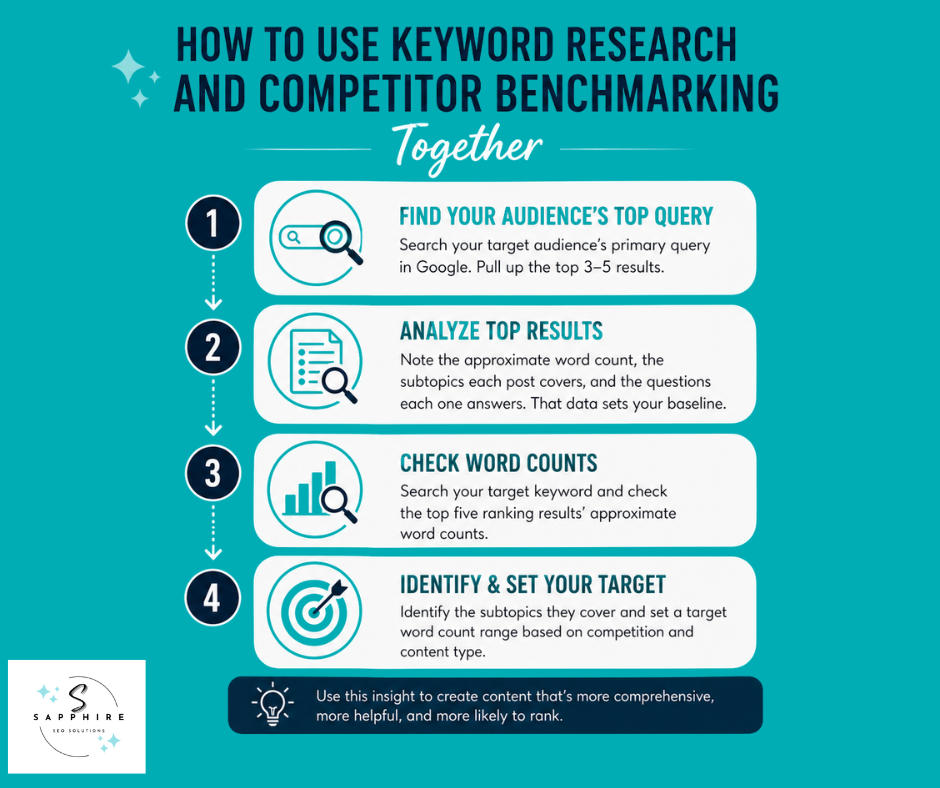
Before deciding how long a post should be, the most practical step is to look at what is already ranking. Keyword research tells you what to write about. Competitor benchmarking tells you how deeply you need to cover it. Here's how you do both of them together:
Search your target audience's primary query in Google. Pull up the top three to five results.
Note the approximate word count, the subtopics each post covers, and the questions each one answers. That data sets your baseline.
Search your target keyword and check the top five ranking results' approximate word counts.
Identify the subtopics they cover and set a target word count range based on competition and content type.
The goal is not to copy competitors in terms of length, but to match their level of depth and then find what they missed. If the top three results for your keyword all sit around 1,800 words and cover similar ground, a 1,600-word post that covers the same ground offers no differentiation. A 2,000-word post that adds a section none of them addressed does. This is where keyword research and competitive analysis work together to set an informed word count target rather than an arbitrary one.
It is also worth noting which content format dominates the results. If the top posts are listicles, writing a pillar page for that query may be the wrong format, regardless of length.
#3: Industry Complexity
Not all industries carry the same content requirements. A recipe blog and a medical information site are both creating content, but the standards Google holds them to are completely different.
Google classifies certain topics under a category called YMYL, which stands for "Your Money or Your Life." YMYL refers specifically to content that can impact a person's health, finances, safety, or well-being. Content in this space is held to a much tougher standard by Google's evaluation systems. Medical, legal, and financial content falls squarely in this category. These topics require more cited sources, more nuanced explanations, and more demonstrated expertise before they can earn trust in search results.
For complex legal topics, content often needs to exceed 1,500 words to earn authority, as long as it provides unique value. The same applies to healthcare and financial planning content.
Healthcare, legal, and financial sectors often demand longer, more detailed content in the 2,000 to 3,000-word range due to the complexity of topics and the need to establish authority and trustworthiness. Conversely, entertainment, news, and lifestyle niches may perform well with shorter, punchier content of 800 to 1,500 words that delivers quick value and maintains reader engagement.
In other words, search engines understand that the stakes of getting something wrong in a medical or legal post are higher than in a lifestyle one. The content length requirement in these industries is a reflection of that standard, not an arbitrary rule.
#4: Conversion Goals
Where a post sits in the buyer's journey is just as important as what it covers. Create content with a top-of-funnel goal in mind, and the reader is probably in research mode. Bottom-of-funnel content serves someone who has already decided they want a solution and is now evaluating options.
A short post can fulfill user intent when a buyer is at the top of the funnel, whereas longer, more informative posts can be more helpful to buyers in the decision-making phase.
Top-of-funnel posts, those designed to build awareness and introduce a topic, typically benefit from the depth of a long-form guide. They need to explain concepts broadly, answer multiple related questions, and give the reader enough to start forming an informed opinion. A word count in the 1,500 to 2,500 range is common here.
Bottom-of-funnel posts work differently. Someone comparing two software tools or looking for a service provider does not need a complete education on the topic. They need a tight, focused post that answers their specific question and points them toward a decision. Padding that kind of post with extra background information introduces friction. In most cases, 800 to 1,200 focused words outperform a 2,500-word post that loses the reader before reaching the call to action.
Knowing the conversion goal before writing is the single fastest way to set an appropriate word count and avoid producing content that is either too shallow for awareness or too dense for action.
#5: Media Density
A post that relies entirely on text to explain concepts needs more words than one that uses images, videos, tables, and infographics to do some of the heavy lifting. This is what media density refers to, and it is a factor most content teams underestimate.
Multimedia, including images, videos, and infographics, can reduce the effective word count needed to convey a concept, but they do not eliminate the need for comprehensive text. A video or infographic is an excellent way to explain a complex topic visually. However, the text surrounding it is still necessary for search engines to fully understand the context, for accessibility, and for users who prefer reading over watching. Image SEO is crucial.
A 1,500-word article with strategic visual elements often outperforms a 2,500-word text-only piece. A comparison table can replace three or four paragraphs of explanation. A labeled diagram can communicate what 500 words of description might struggle to. An embedded video can extend dwell time and reduce the amount of text required to keep a reader engaged.
This means that when you plan internal links, visual assets, and embedded media into a post before writing it, the target word count shifts. A text-heavy draft of 2,000 words might achieve the same informational depth in 1,400 words once a table, a diagram, and an embedded video are factored in. The goal is always information density per word, and media is one of the most effective tools for improving that ratio without inflating the post.
With all of this information to keep in mind, DIY blogging might seem like a far-fetched idea. However, in some cases, it may make sense. Read our detailed guide on "DIY Blogging vs Blogging Services for Small Business Owners" to find out the differences between the two and the better option for your brand.
Is AI Reshaping Blog Post Length in 2026?
AI tools like Google's Gemini, ChatGPT, and Perplexity are now summarizing web content directly in search results, often before a user ever clicks a link. AI Overviews, according to Search Engine Journal, now appear on approximately 48% of all tracked queries as of February 2026, up from roughly 31% a year earlier, a 58% increase year over year. That number is only growing.
The implication for bloggers and content teams is direct. If a 2,000-word post can be condensed into two sentences by Gemini, the reader has no reason to click through. Helpful content that says nothing new gets summarized and bypassed. Quality content that adds something genuinely original still earns the click. In other words, AI has killed writing that exists purely to fill a page.
Creating valuable content in 2026 means writing something that an AI cannot fully replicate from existing sources. Here is how that changes the way blog posts should be built:
It's All About Information Gain
"Information Gain" is the concept at the center of how Google evaluates content value in 2026. It refers to how much genuinely new knowledge a piece of content contributes compared to what already exists on the web for the same query. Simply put, a post that rephrases five top-ranking articles without adding anything original scores low on information gain, regardless of how long it is.
Google's March 2026 core update re-weighted information gain as a ranking signal that measures how much genuinely new knowledge a piece of content adds relative to what already ranks for the same query. What this update favors is original research, proprietary data, first-hand testing, case studies built from real client outcomes, and analysis that requires access or expertise the reader does not already have.
Pages that simply rephrase existing top results without adding original data, first-hand experience, proprietary insights, or unique perspectives are losing ground to content that demonstrates genuine expertise. This is not a theoretical concern. Sites that published high volumes of content without adding net-new information saw significant ranking declines following Google's 2025 and 2026 core updates.
For businesses running their own blog, the practical shift is this: a 1,200-word post built around original survey data, a real client case study, or a first-person account of a tested strategy is more defensible than a 3,000-word post that restates what everyone else has already written. More organic traffic now follows content that AI systems must cite because it contains information they cannot find anywhere else. Unique data is the new word count.
Formatting for AI Citations
AI tools do not read blog posts the way humans do. They extract, scan headings, pull concise definitions, and lift structured answers to surface in AI Overviews, ChatGPT responses, and Perplexity summaries. A post built as a wall of prose with vague H2s and no clear answer blocks is effectively invisible to these systems, even if it ranks in traditional search.
Pages that consistently appear in AI Overviews typically use question-based headings, provide concise answers at the beginning of each section, and follow a logical, scannable format. This structure helps AI systems extract meaning efficiently and with high confidence.
The structural decisions that help AI citation are the same ones that help human readers. Question-led headings mirror how users prompt AI tools. Direct definitions near the top of sections allow models to lift concise explanations more easily. Clean hierarchy through H2 and H3 labels helps systems identify topical boundaries.
In other words, a heading that reads "How Long Should a Blog Post Be for SEO?" performs better in AI search than one that reads "Length Considerations."
Placing a 50-word direct answer under every H2, written simply and in an active voice, allows AI search engines to cite your text without changing it. It reduces the chance of a hallucination and essentially does the AI's job for it. This is the practical application of answer-engine optimization, and it costs nothing to implement. It is a formatting decision, not a word count one. A well-structured 1,500-word post earns more AI citations than a poorly formatted 3,000-word one.
Make sure to read our comprehensive guide on "Do AI SEO Services Maximize AI Search Visibility?" to learn more about attracting AI search engines and how AI SEO services can help.
Google's 2026 Updates Favor Answer-First Structures
Google's March 2026 core update penalized content produced at scale without meaningful human editorial oversight and with no genuine information gain, regardless of whether that content was written by AI or humans. The shared characteristic of penalized content was not length. It was the absence of distinct value. Padding a post to hit a word count target produces exactly the kind of content Google's systems are now trained to deprioritize.
A strong page should not force readers to hunt for basic facts. It should state what happened, provide clear definitions, and offer practical next steps. Then it should expand into nuance. Answer engines often rely on pages that are easy to segment into clean information units, and the same structural decisions that help people also help machines understand what the page is saying.
The answer-first structure means leading each section with the direct response to the question being asked, then supporting it with context, data, and depth. It is the inverse of the traditional essay format, which builds to a conclusion. For blog content in 2026, the conclusion comes first. The supporting material follows for readers who want more. This approach serves human readers who skim, AI systems that extract, and Google's quality evaluators who are looking for content that gets to the point.
Though the 3,000-word post is not dead, the 3,000-word post that earns its length through genuine depth is a very different document from one that reaches that count through repetition and filler. The former earns citations. The latter gets summarized away.
Let Certified SEO Writers Handle Blogging for Your Small Business!
Blog post length is not a fixed number. But what does remain constant across every format and every topic is the goal: value. Google's 2026 updates, the rise of AI Overviews, and the growing importance of information gain all point in the same direction. Create content that adds something genuinely new, structure it so both readers and AI systems can extract it cleanly, and match the length to the job the post is actually doing.
Since 2007, Sapphire SEO Solutions has been helping small businesses produce engaging content to build an online presence and establish a brand. We match every piece of content to the intent behind the keyword, the depth the competition demands, and the goal your business is trying to reach.
Whether you are building your own blog from scratch or fixing a content library that has stopped performing, our certified SEO writers produce content that is built to rank, built to be cited, and built to convert. Contact us to build a data-driven content strategy that ranks and converts.
If you already have a content strategy and need help writing articles for your site, place an online order to get started today!

Frequently Asked Questions
How often should a small business blog post to drive traffic?
Small businesses should publish at least one high-quality blog post per week to drive consistent organic traffic. Publishing 4 well-connected articles per month may outperform 12 unrelated posts, as topic depth and structured clusters drive stronger rankings than random content volume. Consistency and relevance matter more than volume.
What is the recommended blog posting frequency for new websites?
New websites should publish 4 to 8 blog posts per month, focused on tightly related topic clusters. If your blog isn't at least a year old, aim to publish 6 to 8 posts a month around a few important topic clusters aligned with your brand. Quality must remain consistent at every publishing cadence.
Does posting more often improve search engine ranking?
Posting more often does not directly improve rankings, but consistent publishing of high-quality content does. Publishing frequency is not a direct ranking factor, but consistent posting signals to Google that your site is active, encourages more frequent crawling, and gives you more chances to target different keywords. High-value articles published weekly consistently outperform rushed daily posts.
Which blogging tools help schedule posts based on optimal frequency?
The best tools for scheduling blog posts based on optimal frequency are CoSchedule, WordPress, Planable, RightBlogger, and Notion. CoSchedule consolidates editorial and social content in one interface, with detailed performance reports that tie content directly back to traffic results. Planable offers a visual drag-and-drop content calendar where you can plan, schedule, and track all blog and social content in one place.
Should I update and expand my existing short blog posts rather than writing new ones from scratch?
Yes. Updating and expanding existing blog posts typically delivers faster SEO results than writing new ones from scratch. Backlinko reports that updating and relaunching old posts can drive up to a 106% increase in organic traffic, and HubSpot found that 76% of monthly blog views came from existing posts. Prioritize posts that already have some traffic or backlinks but are not yet ranking on page one.
Does it still make sense to write long blog posts if AI Overviews are already summarizing my content and reducing click-through rates?
Yes. Long blog posts still make sense in 2026, but they must be structured to earn AI citations, not just clicks. Brands cited in AI Overviews earn 35% more organic clicks than those that are not, making citation and authority more valuable than ever despite falling traditional click-through rates. Blogs focused on depth, original experience, and niche authority still perform well and are more frequently cited by generative AI systems.
Is it better to publish shorter blog posts more frequently, or longer posts less often?
It is better to publish longer, high-quality posts less frequently than short, shallow posts more often. Publishing 1 to 2 strong, well-researched articles per week that genuinely solve a problem delivers better long-term rankings than publishing daily low-value posts. A consistent schedule you can sustain for 6 to 12 months will always outperform a burst of high-volume, low-quality publishing.
Can a short blog post (under 800 words) ever rank on the first page of Google for a competitive keyword?
A short blog post under 800 words can rank on page one, but only for low-competition or simple-intent queries, not competitive keywords. Posts under 1,000 words rarely rank for competitive keywords, though shorter posts can rank easily for niche long-tail phrases with little competition if they answer the query well. Always analyze the word count and depth of what is already ranking before deciding on your target length.
How do I know if my blog post is long enough without padding it with unnecessary filler content?
Your blog post is long enough when it fully answers the target query and matches the depth of what is already ranking. Intent satisfaction and helpfulness matter more than hitting a specific word count. Quality content finds its natural length, whether that is 800 words or 2,500. A simple test: if every section adds something the reader cannot find summarized elsewhere, the length is justified. If you are repeating points or adding unnecessary background, that is filler.