

How Many Keywords Per Blog Post? (2026 Detailed Guide)
For blog posts, the ideal keyword structure is one primary keyword, three to five secondary keywords, and several semantic variations woven naturally throughout the content. Modern SEO prioritizes search intent and topical relevance over keyword repetition. Keyword density should stay between 0.5% and 2%, with primary keywords placed in the title tag, H1, first paragraph, meta description, URL slug, and image alt text. Keyword stuffing is penalized by Google and actively harms rankings. The most effective SEO content strategy focuses on satisfying user intent completely, building topical authority, and using keywords as directional signals rather than ranking shortcuts.
Key Takeaways
One primary keyword per post. Use one main keyword, three to five secondary keywords, and natural semantic variations.
Keyword density matters less than intent. Write for readers first. Aim for 0.5% to 2%, but prioritize clarity over hitting a number.
Placement beats repetition. Your primary keyword belongs in the title tag, H1, first paragraph, URL, and meta description.
Keyword stuffing actively hurts rankings. Overusing keywords damages readability, engagement, and your position in search results.
Topical authority drives long-term SEO success. One strong keyword cluster, covered with depth and intent, outperforms scattered keyword targeting every time.

How many keywords per blog post is one of the most common questions in SEO, and the answer is less complicated than most people expect. There is no exact "perfect" number. Modern SEO is built around search intent and topical relevance, not keyword repetition. In other words, it is less about how many times a word appears and more about whether your content genuinely answers what the reader is looking for.
The general recommendation from SEO professionals is straightforward: one main keyword, three to five secondary keywords, and natural semantic variations woven throughout. Keyword density is still worth understanding, but it is no longer the metric that drives rankings. Stuffing a blog post with the same phrase over and over is outdated, and it can actively hurt your visibility.
Sapphire SEO Solutions and our experienced content writers know the importance of keywords and follow the best practices, but we also know how important it is to focus on search intent. Our affordable SEO blog writing services provide brands and small businesses with high-quality content that not only satisfies traditional search engines but also attracts AI search engines.
This article covers everything keywords should help you accomplish in a single blog post, including how to choose them, where to place them, and how many is actually enough.
Why Keywords Still Matter in SEO
For homeowners and business owners new to digital marketing, it may seem like SEO keywords have lost their importance. That is not quite accurate. Search engines still rely on keywords to understand what a page is about and match it to the right search results. What has changed is how they interpret those keywords.
Modern SEO evaluates far more than exact-match phrases. Google now assesses relevance, context, entities, and semantic relationships between ideas on a page. In other words, it reads content the way a knowledgeable person would, looking for meaning, not just matching words to queries.
This is where user intent comes in. Search intent refers to the actual goal behind a search query. A reader typing "how many keywords per blog post" wants a clear, practical answer, not a page stuffed with that phrase repeated endlessly. Matching search intent is now the foundation of search visibility.
SEO keywords also help establish topical authority. When content covers a subject with depth and semantic relevance, search engine optimization rewards it with stronger rankings across multiple related queries. Keywords are still the starting point. They are just no longer the finish line.
Are Keywords Losing Relevance in Modern SEO?
This is a good question to ask. With AI-powered search reshaping how results are generated and ranked, many content creators wonder whether traditional keyword research still holds any weight. The short answer is yes, but the role keywords play have changed significantly.
Modern SEO no longer rewards content that repeats a target phrase as many times as possible. Google now evaluates search intent, topical relevance, semantic understanding, and user satisfaction together. Exact-match repetition has become far less important than answering a reader's question completely and clearly. Smart SEO today means understanding what the reader actually wants, then building content that delivers it. Using keywords naturally within well-structured, helpful writing is the goal. Forcing them in is not.
A sound SEO strategy treats keywords as the starting point for a broader conversation.
What Matters More Than Keyword Density Today?
For most content, keyword density is no longer the primary measure of SEO success. What actually drives SEO success in today's environment is a different set of factors entirely.
Here are the signals that matter most to your target audience and to search engines:
Search intent alignment: Does your content answer what the reader was actually looking for?
Helpful content: Is the information genuinely useful, accurate, and complete?
Topic depth: Does the article cover the subject thoroughly, or only at a surface level?
Semantic coverage: Are related phrases and contextually relevant terms woven in naturally?
User experience signals: Do readers stay, engage, and find what they need?
Topical authority is built through this combination. User intent and modern SEO point in the same direction: content that serves the reader first will consistently outperform content built around keyword counts alone.
The Ideal Number of Keywords Per Blog Post
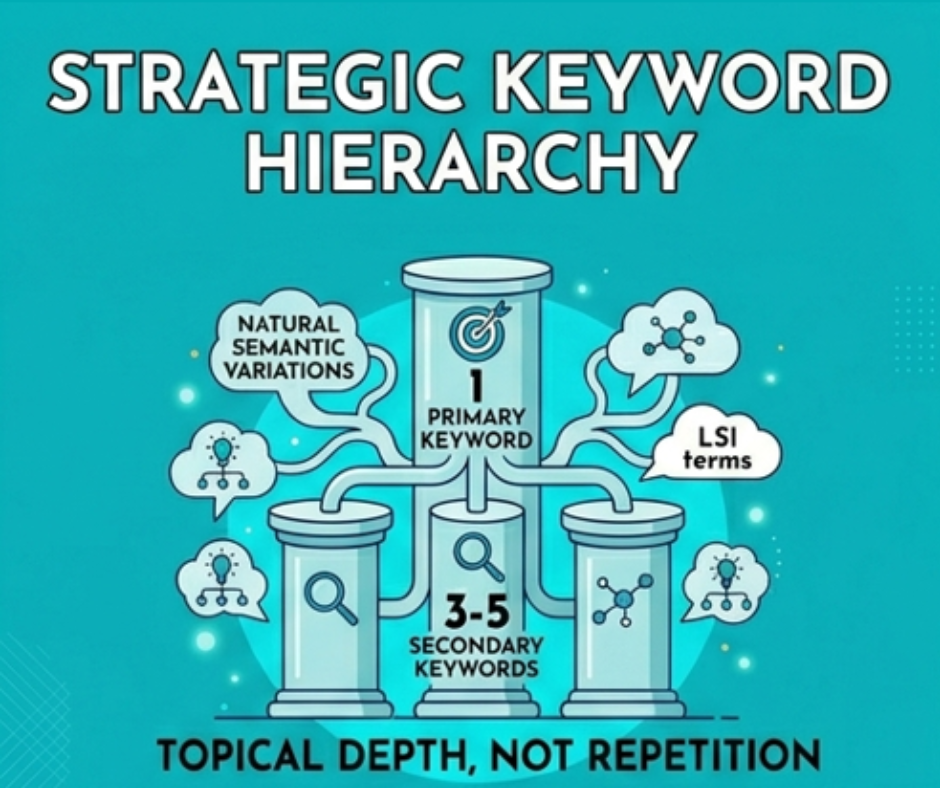
So, how many keywords per blog post should you actually target? Most SEO professionals agree on a clear and practical structure: one primary keyword, three to five secondary keywords, and several semantic or LSI variations woven naturally throughout the content.
That is the recommended starting point for most blog posts. It is not a rigid formula, but it reflects how search engines evaluate content today.
Here is why this structure works:
Ahrefs says to choose only one primary keyword, as it keeps your content focused and signals clearly to search engines what the page is about.
Secondary keywords add topical depth and help your post appear in multiple keyword searches without competing against itself.
Semantic variations cover related language your audience actually uses, broadening your reach without sacrificing coherence.
This structure prevents keyword cannibalization, which happens when multiple pages on the same site compete for the same term.
To make this concrete, here is a practical example using this very article:
Primary keyword: How many keywords per blog post
Secondary keywords: Keyword density, keyword placement, SEO writing tips, blog optimization
Notice that the secondary keywords all support the same topic. None of them pulls the article in a different direction. That focus is intentional, and it is what makes the structure effective.
A single keyword alone is rarely enough to capture the full range of relevant keywords your audience uses. But targeting too many unrelated terms dilutes focus and reduces overall effectiveness. The right keyword count sits in the middle: one clear, primary keyword anchoring the piece, with a small cluster of supporting terms building around it.
Can One Blog Post Rank for Multiple Keywords?
Yes, and this is one of the most practical advantages of a well-structured keyword strategy. A single blog post can absolutely appear in multiple search queries, provided those keywords share the same search intent.
For example, a post targeting "how many keywords per blog post" can also rank for closely related search queries like "long tail keywords for blog posts" or "keyword count for SEO." These terms describe slightly different angles of the same question, so targeting long tail keywords alongside your primary term makes strong sense within one blog post.
The key is alignment. If the search intent behind each keyword points toward the same reader need, combining them in a single article improves your chances of appearing in more search results without creating confusion. In other words, long tail variations of your primary keyword are natural candidates for secondary keyword slots.
Where SEO success breaks down is when writers try to cover unrelated topics in a single post to capture more traffic. That approach fragments the article's focus and signals inconsistency to search engines. One topic, one intent, multiple supporting keywords. That is the formula that works.
What Is the Ideal Keyword Density?
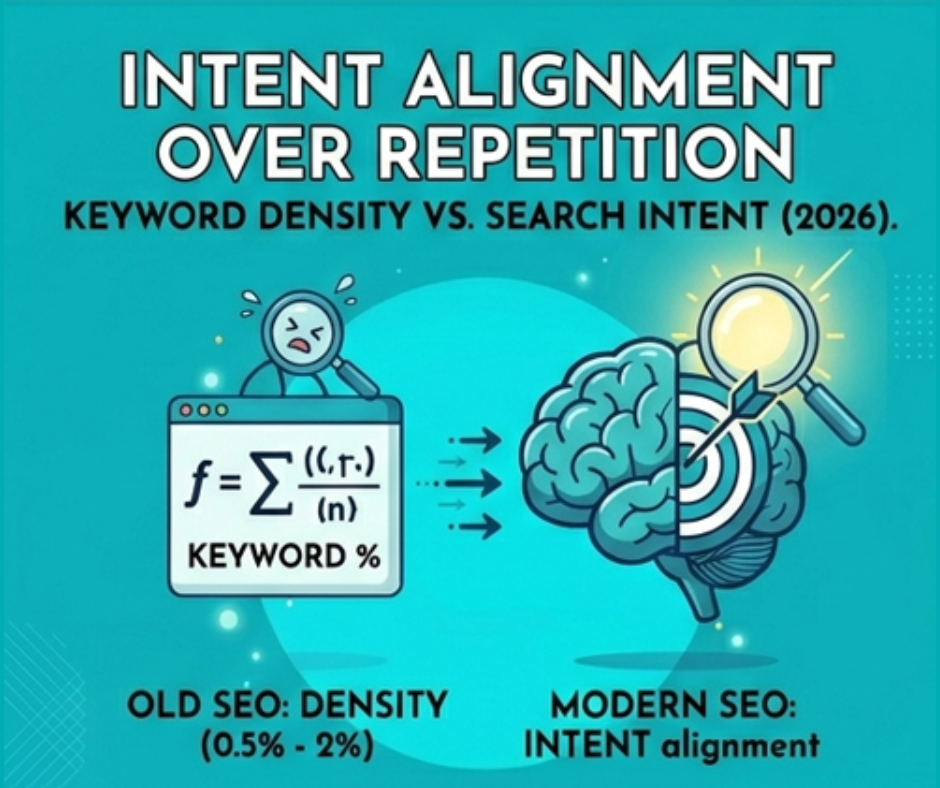
Keyword density refers to how often a target keyword appears in a piece of content relative to its total word count. It is expressed as a percentage, calculated using a straightforward formula:
(Keyword Uses ÷ Total Words) × 100
So if your primary keyword appears 10 times in a 1,000-word blog post, your primary keyword density is 1%.
The generally accepted range sits between 0.5% and 2%. That gives you a practical benchmark without tipping into over-optimization. For a 1,500-word article, that means your target term appears roughly 8 to 30 times, though staying closer to the lower end typically produces more natural, readable writing.
That said, keyword density matters far less than it once did. Modern SEO strategy does not reward content for hitting a specific percentage. What it rewards is content that uses keywords naturally, covers the topic thoroughly, and satisfies what the reader actually came to find. Chasing a number often produces stiff, repetitive writing that hurts the reader's experience and, in turn, your rankings.
Natural keyword placement is the goal. If a term fits in context, use it. If it does not, leave it out.
What Happens If You Overuse Keywords?
Too many keywords crammed into a single page is called keyword stuffing, and it is one of the most reliable ways to undermine your search engine optimization efforts.
Here is what happens when keyword stuffing creeps into your content:
Poor readability: The writing sounds unnatural and repetitive, which drives readers away quickly.
Possible ranking drops: Google actively penalizes pages that appear to manipulate search rankings through excessive keyword use.
Lower engagement metrics: Readers who leave quickly signal to search engines that the content did not deliver value.
Reduced SEO success: Pages that sacrifice quality for keyword frequency rarely sustain strong positions in search results.
Using keywords naturally within well-written, helpful content is always the right approach. Density is a byproduct of good writing, not a target to aim for.
Where Should You Place Keywords in a Blog Post?
Knowing how many keywords to use is only part of the equation. Where you place them matters just as much. Strategic keyword placement sends clear relevance signals to search engines without requiring you to repeat a phrase over and over throughout your blog post.
Keyword optimization is most effective when your primary term appears in the locations search engines weight most heavily. Here are the key placements to prioritize:
SEO title/title tag: Your title tag is the single most important placement. Include your primary keyword as close to the beginning as possible.
H1 heading: The page title visible to readers should include your primary keyword naturally.
First paragraph: Place your primary keyword within the first 100 words to establish topic relevance immediately.
H2 and H3 subheadings: Use primary and secondary keywords in subheadings where they fit contextually. Do not force them into every heading.
URL slug: A clean, keyword-inclusive URL helps both search engines and readers understand the page topic at a glance.
Meta description: Your meta description will not directly influence rankings, but it does affect click-through rates. Include your primary keyword naturally within a compelling summary.
Image alt text: Descriptive image alt text that incorporates relevant keywords improves image search visibility and overall page context.
Conclusion: Reinforcing your primary keyword near the end of the article signals topical consistency throughout the piece.
The best practice is to use exact-match keywords sparingly and add variations naturally everywhere else. Forcing the same phrase into every section produces writing that reads awkwardly and serves neither the reader nor the search engine.
How Often Should You Use Your Primary Keyword?
A useful rough guideline for keyword usage is once every 150 to 200 words. For a 1,500-word blog post, that puts your keyword count at roughly 8 to 10 appearances of the primary keyword, which typically keeps keyword presence strong without tipping into over-optimization.
That said, readability always comes first. If the primary keyword fits naturally in a sentence, use it. If it creates an awkward construction, swap in a variation or rephrase entirely. Keywords naturally embedded in clear, well-structured writing will always outperform content that hits a count at the expense of flow. The goal is to satisfy search intent, not to match a number.
Primary Keywords vs Secondary Keywords vs Semantic Keywords
For homeowners and business owners new to SEO keywords, the terminology around keyword types can be a bit confusing. Understanding the difference between a primary keyword, secondary keywords, and semantic keywords makes it significantly easier to build a focused, effective content strategy.
Primary Keyword
The primary keyword is the main ranking target for your content. It is the single keyword phrase your page is most directly optimized for, and it carries the highest search volume within your topic. Everything else in your content supports it. In other words, your primary keyword tells search engines exactly what your page is about.
Secondary Keywords
Secondary keywords are supporting search terms closely related to the primary focus. They are not competing with your primary keyword. They are expanding it. Secondary keywords help your content address related search queries that readers might use to find the same information, broadening your reach without changing your topic.
Semantic Keywords
Semantic keywords are related concepts and contextual terms that enrich your content's meaning. They are not necessarily phrases readers search for directly, but they signal topical depth and authority to search engines. Keyword clustering groups all three types around a single topic, which is a cornerstone of modern SEO.
Practical Keyword Clustering Example
Here is what a practical cluster looks like:
Primary keyword: How many keywords per blog post
Secondary keywords: keyword density, SEO keyword strategy
Semantic keywords: topical authority, search intent, content optimization
Related keywords across all three categories work together. Though the distinctions may seem small, they play a very big role in how thoroughly search engines understand and rank your content.
Common Keyword Mistakes That Hurt Rankings
Even a well-intentioned SEO strategy can backfire when certain keyword habits creep into the writing process. These are the mistakes that consistently hold content back from performing well in search engine optimization.
Keyword stuffing: Overloading a page with the same keywords repeated unnaturally is one of the oldest and most damaging mistakes in SEO keywords. It disrupts readability, signals manipulation to search engines, and actively works against your rankings.
Targeting too many unrelated keywords: Trying to rank for topics that do not share the same search intent dilutes your content's focus. Each page should serve one clear purpose, not several competing ones.
Ignoring search intent: Technically optimized content still fails when it does not actually answer what the reader came to find. Matching intent matters far more than matching phrases.
Writing for algorithms instead of humans: Content built around keyword counts rather than genuine usefulness reads exactly like what it is. Google's Helpful Content system is designed to reward reader-first writing and filter out the rest.
Using exact-match keywords unnaturally: Forcing a keyword phrase into a sentence where it does not belong is immediately noticeable to readers and to search engines.
Keyword cannibalization: This happens when multiple pages on the same site target the same keywords, causing your own content to compete against itself. The fix is straightforward: give separate pages their own distinct keyword focus.
Ignoring internal linking: Keywords alone do not build topical authority. Internal links connect related content and help search engines understand the full depth of your coverage.
Avoiding these mistakes is not complicated. It goes beyond just careful writing. It requires a deliberate seo strategy built around the reader's actual needs.
A Simple SEO Keyword Strategy for Blog Posts
Good keyword research does not have to be complicated. For most blog posts, a straightforward five-step framework is enough to build a focused, well-optimized piece of content that both readers and search engines can follow clearly.
Step 1: Choose one primary keyword. Use SEO tools like Google Search Console, Ahrefs, or SEMrush to identify a term with a realistic search volume and manageable keyword difficulty. This becomes the anchor for everything that follows.
Step 2: Find 3 to 5 related secondary keywords. Look for supporting terms that share the same search intent as your primary keyword. These keyword insights help your content cover the topic from multiple angles without losing focus.
Step 3: Add semantic variations naturally. Build your keyword list to include contextually related phrases. Weave them into the writing where they fit, without forcing them.
Step 4: Optimize headings and metadata. Place your primary keyword in the title tag, H1, meta description, and URL slug. Use secondary terms in subheadings where appropriate.
Step 5: Satisfy search intent completely. Before publishing, ask whether the content fully answers what a reader searching your primary keyword actually needs. This is the step that separates content that ranks from content that does not. When you create content with intent alignment as the goal, a strong SEO strategy follows naturally.
Focus on Topics, Not Just Keywords
The question of how many keywords per blog post ultimately points toward a larger shift in how search engine optimization works today. Modern SEO is topic-driven. Search engines no longer evaluate a page in isolation based on keyword counts. They assess whether the content demonstrates genuine depth and expertise across an entire subject area.
Topical authority is built across your entire website over time, not within a single post. Every well-researched, intent-aligned article you publish contributes to how search engines perceive your credibility on a given topic. In other words, one strong keyword cluster, executed with clarity and depth, does more for your SEO success than ten scattered posts chasing loosely related terms.
Domain authority still matters, but it is topical authority that increasingly determines which pages earn strong, sustained rankings. User intent and search intent are the filters through which every content decision should pass. If a piece of content genuinely helps the reader and covers the topic thoroughly, the keyword strategy behind it will consistently perform.
Helpful content beats keyword repetition. It always has, and in modern SEO, that principle has never been truer.
Need SEO Blog Content That Actually Ranks? Sapphire SEO Solutions Can Help!
Understanding SEO strategy is one thing. Executing it consistently is another. For businesses focused on growth, producing well-researched, intent-driven blog content at scale requires both seo tools and a disciplined content process working together.
That is exactly where a dedicated content partner makes a measurable difference. The right partner does not just fill a page with words. They build content around your target audience, match every article to genuine search visibility goals, and treat keyword research as the foundation of a broader topic strategy, not an afterthought.
Strong blog content sits at the intersection of digital marketing and reader trust. It is not paid search or Google ads. It does not disappear when the budget runs out. It compounds. Every well-optimized post contributes to topical authority, drives qualified traffic, and supports seo success across your entire site over time.
Sapphire SEO Solutions creates SEO-focused blog content backed by keyword research, search intent analysis, and modern content strategy. Whether you need one article or a full-scale content campaign, we help businesses grow with content built for both Google and real people.
Looking for SEO-optimized blogs for your business? Place an online order today!
Frequently Asked Questions
How many keywords should I use per blog post for optimal SEO?
The widely accepted recommendation is one primary keyword, three to five secondary keywords, and several semantic variations woven naturally throughout the content. This structure keeps your post focused on a single topic while giving it enough depth to appear in multiple related searches. Targeting too many unrelated keywords in one post dilutes focus and reduces overall effectiveness.
What is the recommended keyword density in blog posts according to top SEO tools?
Most leading SEO tools recommend keeping keyword density between 0.5% and 2%. Yoast SEO, one of the most widely used optimization plugins, suggests a range of 0.5% to 3%, with 1% to 2% considered the practical sweet spot for natural, readable copy. That said, no tool treats density as a hard ranking signal. It is a sanity check, not a target to chase.
What are the best practices for keyword density in blog content?
The most important best practice is to write naturally and let keyword placement follow from clear, well-structured content. Place your primary keyword in high-impact locations, including the title tag, H1, first paragraph, meta description, and URL slug. Use secondary and semantic keywords in subheadings and body copy where they fit contextually. Avoid repeating exact-match phrases unnaturally, and always prioritize readability over hitting a specific percentage.
Should I use one main keyword or several for a blog post?
You should use one primary keyword as your main ranking target, supported by three to five secondary keywords that share the same search intent. Using just one keyword alone leaves topical depth on the table, while targeting too many unrelated terms fragments your content's focus. The most effective approach is one clear primary keyword anchoring the piece, with a small supporting cluster built around it.
Can you rank for multiple keywords in one blog post?
Yes, and it is one of the core advantages of a well-structured keyword strategy. A single blog post can rank for multiple search queries provided those keywords share the same search intent. Long-tail variations of your primary keyword are natural candidates for secondary keyword slots. Where this breaks down is when writers try to cover unrelated topics in one post, which signals inconsistency to search engines and weakens the overall ranking potential of the page.
Is keyword stuffing bad for rankings?
Yes, definitely. Keyword stuffing, which is the practice of overloading a page with the same phrase repeated unnaturally, is penalized by Google and actively harms your rankings. It produces content that is difficult to read, increases bounce rates, and signals manipulation to search algorithms. Google's systems are designed to detect and demote over-optimized content, making keyword stuffing one of the most reliable ways to undermine an otherwise strong piece of writing.
How many times should a keyword appear in 1,500 words?
Using a 1% keyword density as a practical guideline, a primary keyword would appear roughly 15 times in a 1,500-word post. In practice, most SEO professionals recommend staying closer to the lower end of the 0.5% to 2% range, which puts the count between 8 and 12 appearances for a post of that length. More important than the number is whether each use feels natural within the surrounding sentence. If it does not, a variation or synonym serves the reader better.
Do semantic keywords help SEO?
Yes, significantly. Semantic keywords are related concepts and contextually relevant terms that help search engines understand the full depth and meaning of your content. Google's natural language processing systems, including BERT and MUM, evaluate content based on topic coverage and contextual relationships, not just exact-match phrases. Using semantic keywords allows a single page to appear in a broader range of related searches, strengthens topical authority, and signals to search engines that your content covers a subject comprehensively rather than superficially.