

Is SEO Dead with the Rise of AI Search? (Is SEO Dead in 2026?)
Is SEO Dead with the Rise of AI Search? No, search engine optimization is not dead in 2026, but it has fundamentally evolved into Generative Engine Optimization (GEO). While traditional keyword-driven organic traffic is declining due to a 34.5% drop in clicks from AI Overviews, SEO has shifted toward building brand authority, entity trust, and cross-platform visibility. Success in 2026 requires a hybrid strategy that combines traditional technical SEO with AI-specific tactics like query fan-out optimization, comprehensive schema markup, and securing mentions in authoritative "source of truth" platforms like Reddit and industry listicles. Ultimately, SEO has transitioned from merely ranking for keywords to ensuring a brand is recognized and cited as a trusted authority by AI models across the entire digital ecosystem.
Key Takeaways
Master GEO to win. Transition from keyword tracking to Generative Engine Optimization to secure citations in AI-generated answers.
SEO is not dead. Search is evolving into a hybrid model where AI Overviews complement traditional organic search results.
Build brand authority. AI models prioritize trusted entities mentioned frequently across Reddit, Wikipedia, and authoritative industry listicles.
Optimize for long-tail queries. Use structured headings and FAQs to capture conversational traffic and satisfy AI query fan-out.
Maintain NAP consistency. Ensure uniform business data across all directories to boost local visibility in AI-driven voice searches.
No, search engine optimization isn't dead. But AI search has shaken up the SEO world, especially as we enter 2026.
Nearly 35% of Gen Z in the United States use AI chatbots like ChatGPT and perplexity to search for information. While traditional SEO still drives most traffic, good SEO in 2026 is a combination of SEO and AI SEO, as organic traffic patterns are shifting.
Search rankings work differently, and experienced SEO professionals are expanding their strategies to incorporate the latest trends.
At Sapphire SEO Solutions, we are a reliable SEO agency that helps small businesses attract traffic and build an online presence. Our SEO experts are AI search optimization certified, giving us the skills and knowledge to offer affordable AI SEO services to beat your competitors.
We use advanced AI tools to develop a comprehensive SEO strategy while conducting thorough keyword research to optimize content for both traditional search engines and AI platforms, ensuring your brand gets discovered wherever customers search.
In this guide, we will cover:
Eye-opening statistics about AI and traditional search
How AI search is reshaping SEO and user behavior
The main differences between traditional searches and ChatGPT searches
Proven strategies to increase your AI search visibility
Why SEO matters for small businesses in 2026
How to build an SEO strategy with AI search in mind
8 Eye-Opening Statistics About AI and Search
There are many statistics you'll find across the internet about AI searches. But for small businesses, here are the ones that matter the most:
15 million people used generative artificial intelligence (AI) for online search in 2024. This figure is expected to rise to 36 million by 2028. (Statista)
Google dominates 90% of the search engine market while handling 60% of all search queries in the United States. That said, ChatGPT is slowly gaining traction. (Statista)
Zero-click search is redefining marketing. Around 80% of users rely on AI-generated summaries atleast 40% of the time. (Bain & Company)
28% of the adults in the United States do not trust AI-generated search results. (Statista)
AI Overviews often appear for longer searches. In fact, it appears five times more for 10-word queries. (SE Ranking)
In the age of AI search, AI Overviews have resulted in a 34.5% decrease in clicks. (Ahrefs)
While AI traffic is much lower than traditional organic traffic, it has increased 8 times in the past year. (SE Ranking)
The top three sources of AI traffic include Chat GPT (77.97%), Perplexity (15.10%), and Gemini (6.40%). (SE Ranking)
Is SEO Dead with the Rise of AI Search?
SEO isn't dead, but search behavior is evolving. The internet is shifting beneath our feet, and traditional search engines are no longer the only game in town.
Zero-click searches now account for the majority of Google searches, which means that most users get their answers without clicking through to any website.
When AI Overviews appear for target keywords, websites experience an average click-through rate drop of 34.5%. While AI-generated responses by Google are great for users, they're creating a serious challenge for businesses relying on organic traffic.
Let's explain this in a much simpler way.
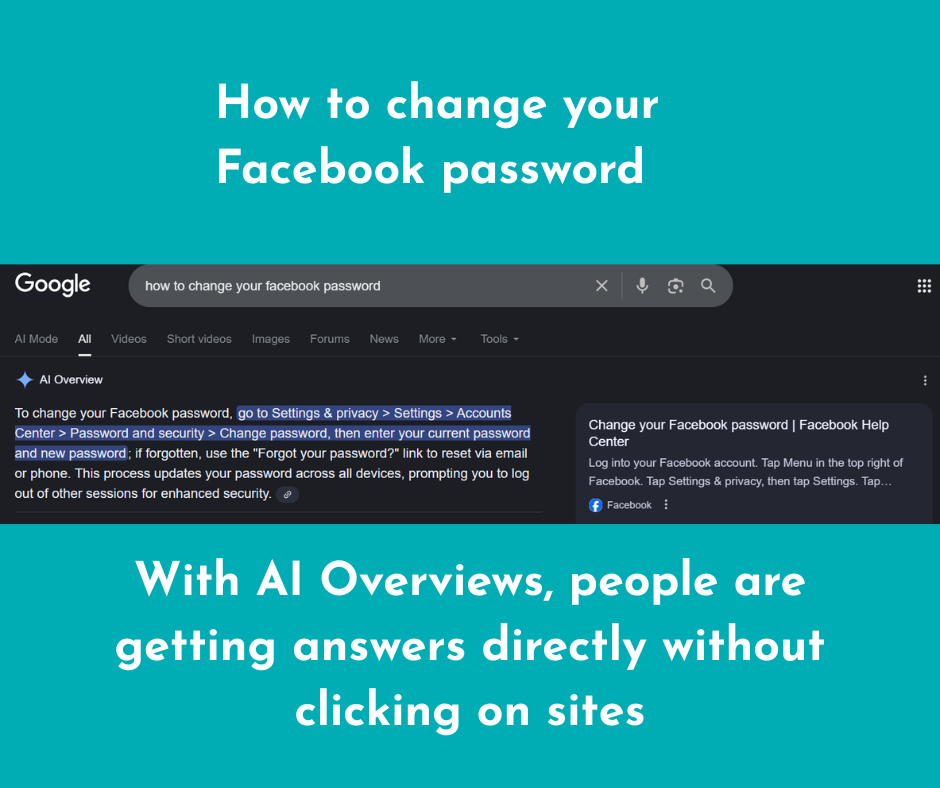
When someone searches "how to change your Facebook password," Google's AI Overview displays step-by-step instructions directly in the results. The user gets their answer instantly. Your comprehensive guide becomes unnecessary overnight.
Here’s a screenshot of AI Overviews when you search “how to change your Facebook password”:
Tools like ChatGPT, Perplexity, and Claude have transformed into alternative search platforms. People now ask AI directly instead of typing queries into Google. These tools summarize information instantly, and users often never visit the original sources.
ChatGPT's conversational depth and reasoning capabilities make it especially appealing for complex queries.
On the other hand, Perplexity focuses on accuracy and citation-backed answers, making it ideal for research tasks. With so much power in a user's hands, it becomes easier to think that SEO is dead.
In addition to that, search behavior has fragmented across platforms. People don't just "Google" things anymore. They check:
TikTok for tutorials
Reddit for honest opinions
YouTube for learning
Amazon for reviews
Pinterest for visuals
Don't just take our word for it. According to Forbes, nearly 40% of young people now use TikTok or Instagram instead of Google Maps or Search when looking for a place for lunch.
Search is everywhere now. Different platforms serve different intents. With all of this happening simultaneously, it's easy to see why some believe SEO must be dead.
However, the reality is much different. In 2026, SEO means understanding how people look for information across multiple platforms, creating content worth citing, and building a brand that AI platforms recognize and trust. The fundamentals that were there years ago remain the same, but they've expanded.
What Is the Main Difference Between Traditional Searches and ChatGPT Searches?
Understanding how people search on large language models versus traditional search engines is important for your SEO strategy. The differences in search behavior and user intent shape what content you need to create.
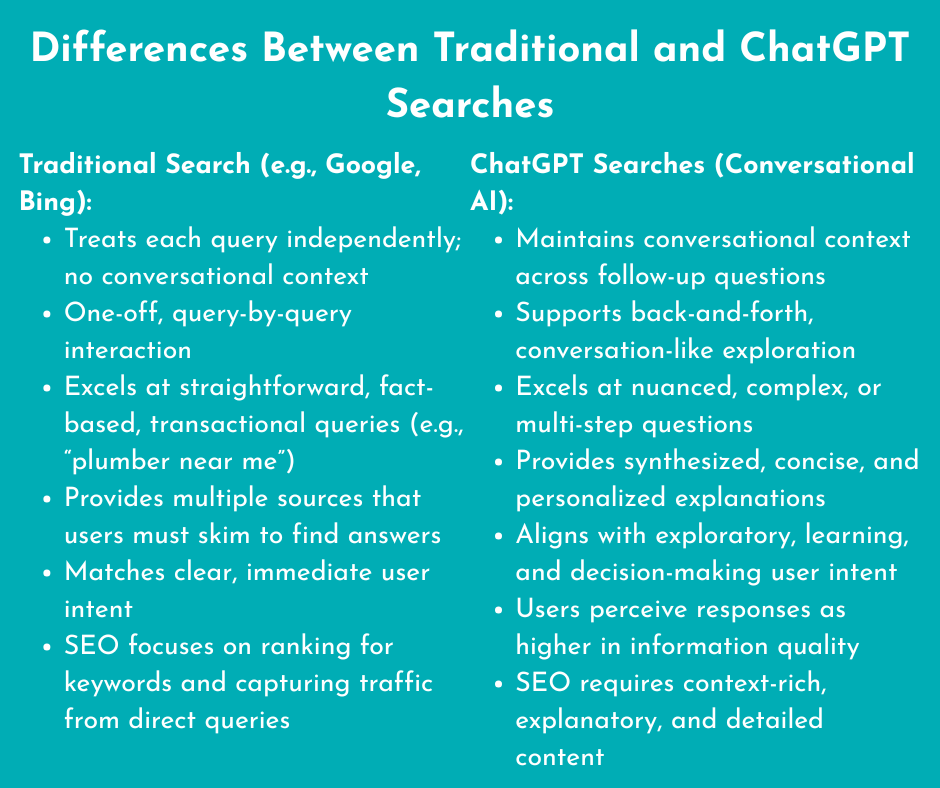
Traditional search engines like Google treat each question independently without maintaining conversational context. On the other hand, ChatGPT's conversational AI approach maintains context far better during follow-up questions that dive into a specific topic.
So, what does this mean?
ChatGPT Search allows you to ask follow-up questions that feel like a real conversation, while Google Search treats each question on its own and can't keep a conversation going.
Traditional search engines excel at straightforward, fact-based queries. Someone searching "plumber near me" or "best hiking boots 2026" typically uses Google or Bing. These queries have clear intent and need quick, direct answers with multiple options to choose from.
Research shows that users perceive ChatGPT's responses as having higher information quality compared to Google Search, despite displaying a similar level of trust in both tools. The ChatGPT and Perplexity platforms shine for queries requiring nuanced understanding, detailed explanations, or conversational responses.
AI models handle complex, multi-step queries differently. Consider these examples:
"Explain search engine optimization to a beginner in three sentences."
"Act as the customer and describe three pain points of working with my e-commerce business."
"Create a decision tree and help me choose which email marketing platform I should use based on my budget and subscribers."
These queries demand context, reasoning, and personalized responses. When evaluating 500 search queries, researchers found ChatGPT particularly excelled at providing concise, simplified answers to technical questions.
On the other hand, Google often returned verbose results requiring users to skim multiple articles.
Since user intent has evolved, it's important to adopt the right approach. People now expect different things from different platforms.
Your SEO strategy must account for both types of searches to capture traffic wherever your customers look for answers.
Increase AI Search Visibility with These Tips
PR News reveals that 63% of marketers reported prioritizing generative search optimization (GEO) in their 2024-25 content strategies, and brand visibility has become crucial because AI search engines consult multiple trusted sources and look for consistent brand mentions across third-party websites, social media, and publications.
It's all about making your brand discoverable, citeable, and trustworthy across AI platforms where your customers ask questions.
Brand visibility in the age of AI search is about trust, with earned media such as social mentions, reviews, and quality backlinks shaping how AI models and users perceive your brand.
AI search visibility requires a fundamentally different approach than traditional SEO. Keywords are important, but they're not crucial for visibility, as that depends on trust, context, and authority interpreted and delivered by AI.
Let's simplify this for you further. When searching for products, consumers don't rely on a single source. In fact, they check multiple third-party resources for objective opinions before making decisions. AI models behave the same way.
While traditional SEO remains important, businesses also need to focus on AI visibility, which requires different content strategies where:
Conversational query coverage matters more than head-term rankings
External validation matters more than owned content
Structure matters more than keyword density
Want to start appearing in AI-generated responses? Here are proven strategies to boost your brand visibility in AI-generated answers:
Focus on Long-Tail Queries
Optimizing for a single keyword is an old SEO tactic, and the query fan-out process has grown in importance, especially in 2026. But what is it?
Query fan-out is an AI search system process that splits a user query into multiple sub-queries, collects information for each sub-query, and then merges relevant information into a single response.
Google AI Mode's query fan-out technique deconstructs queries into core intents and related sub-questions, meaning SEOs need to move beyond optimizing for single keywords and instead focus on understanding the entire user journey.
This process, popularized through conversational voice search in 2015 and now amplified by AI Search in 2025, has become critical for brands during the research phase of the buyer's journey.
Search Engine Land reveals that queries showing an AI Overview with 8+ words have grown 7x since AI Overviews launched in May 2024.
People tend to engage with AI systems conversationally by inputting highly specific queries, making long-tail keyword optimization crucial for AI search visibility.
Pages ranking for many long-tail and question-based variations have higher citation probability, with pages in the top 10 showing a strong correlation with LLM mentions.
The query fan-out process changes how you need to think about content optimization. While long-tail keywords are becoming more important, many businesses still optimize primarily for short-tail terms.
Individual long-tail queries may have modest search volume, but their cumulative effect drives substantial traffic and conversions.
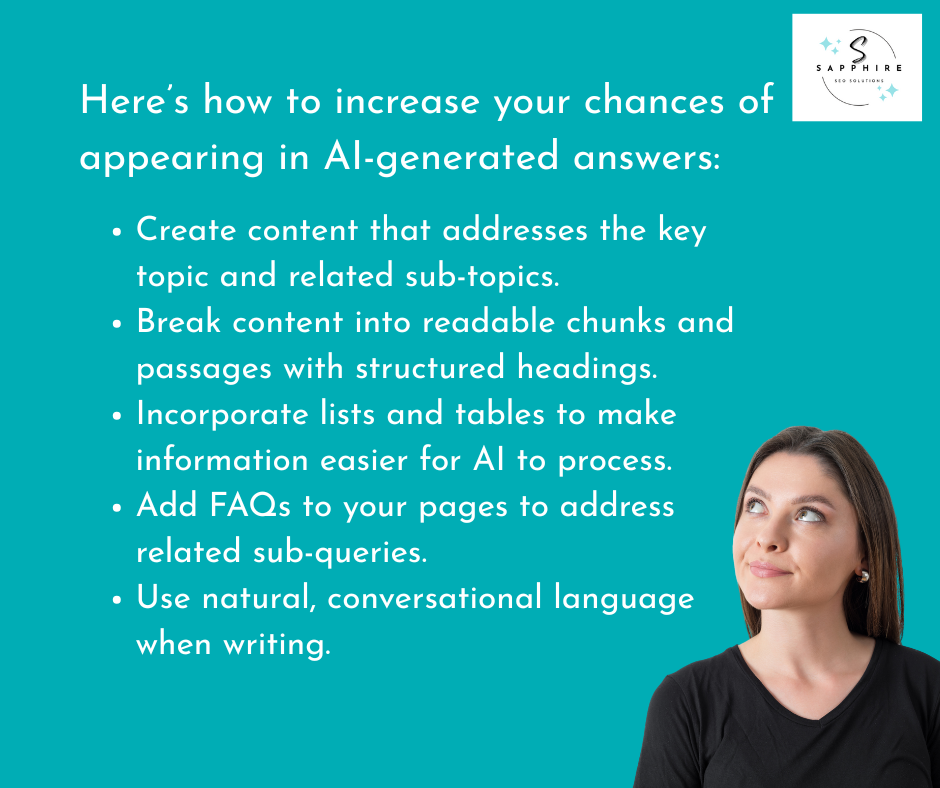
To optimize for query fan-out and increase your chances of appearing in AI-generated answers, create content using these approaches:
Create content that addresses the key topic and related sub-topics. When content only targets a single keyword instead of the full set of sub-questions generated through fan-out, AI systems often skip it entirely. Your pages need comprehensive coverage that answers multiple angles of a query, not just one narrow question.
Break content into readable chunks and passages with structured headings. Clear organization helps AI systems extract the exact information they need. Content should naturally lead users to their next questions and provide those answers, even if they're not explicitly asked in the initial query. Use H2 and H3 tags to create distinct sections that each address specific sub-intents.
Incorporate lists and tables to make information easier for AI to process. Structured formats allow AI platforms to quickly parse and cite your content. Schema markup clearly defines what each aspect of your content represents, making it easy for LLMs to parse and cite your content.
Add FAQs to your pages to address related sub-queries. FAQ formats align with how users query LLMs with phrases like "How do I..." and "What's the difference between...", increasing citation likelihood. Check Google's People Also Ask section for inspiration on what questions people actually ask around your topic.
Use natural, conversational language when writing. Avoid complex jargon and run-on sentences. AI Overviews reward human-like phrasing, so write content as if you're answering a question for a colleague, not just a robot. This approach helps your content match how real users phrase their queries in AI platforms.
Create Cross-Platform Visibility
Very few domains are currently cited by both ChatGPT and Perplexity, revealing that each AI platform evaluates sources differently.
Brands appearing on 4+ platforms are 2.8x more likely to appear in ChatGPT responses than single-platform brands. Why is that?
Large language models reference sources that appear consistently across multiple platforms, including data sources, forums, and user-generated content sites.
Brand visibility is crucial because AI search engines consult multiple trusted sources and look for consistent brand mentions across third-party websites, social media, and publications. This is similar to how consumers research products by checking various objective sources before making decisions.
Search Engine Journal reveals approximately 34% of AI citations come from PR-driven coverage, with another 10% from social channels. Wikipedia and Reddit collectively command the largest share of LLM citations, acting as foundational authority layers. Reddit leads LLM citations at 40.1%, making community engagement crucial for citation visibility.
If you want to appear in AI-generated responses, you must focus on cross-platform visibility through these methods:
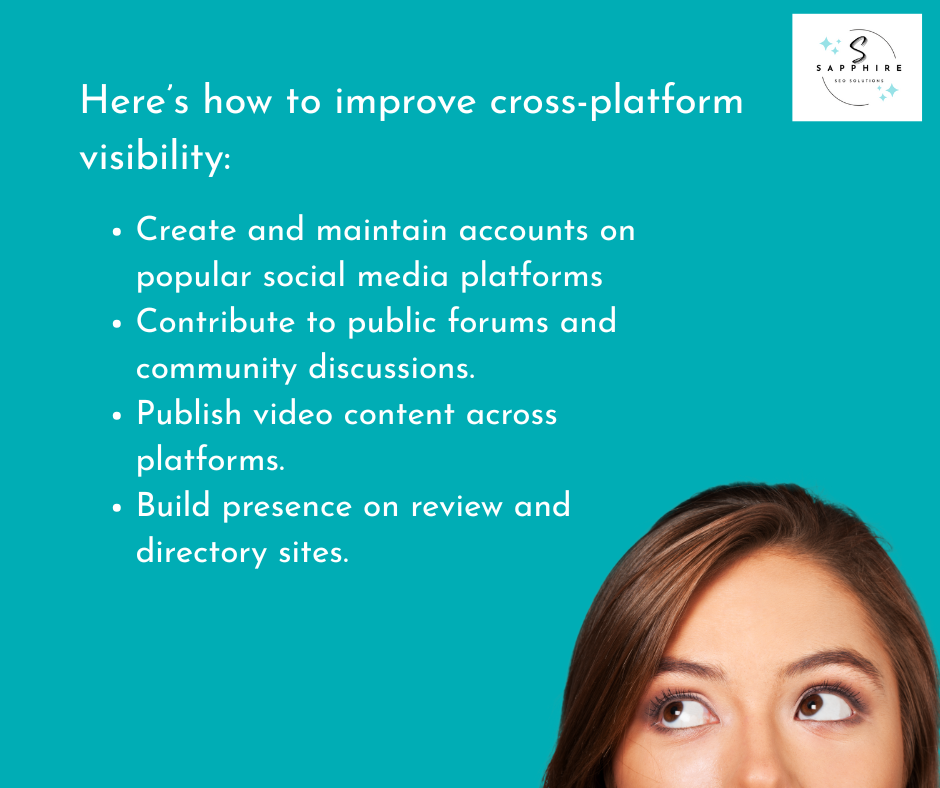
Create and maintain accounts on popular social media platforms. According to HubSpot, nearly one in three consumers skip Google altogether, instead starting their search journey on networks like TikTok, Instagram, or YouTube. Consistently post valuable content on TikTok, Instagram, LinkedIn, and Facebook. Social content often satisfies search engines' E-E-A-T criteria through high levels of virality and engagement, with these metrics signaling authority and helping boost brand visibility.
Contribute to public forums and community discussions. Post genuinely helpful responses on Reddit, Quora, and industry-specific forums. Success requires genuine value contribution rather than promotional posting, with a focus on educational posts, detailed implementation guides, and helpful responses to technical questions. These platforms matter a lot for AI citation algorithms.
Publish video content across platforms. Wix states that 78% of people prefer to learn about new products through short-form video, making formats like Reels, Shorts, and TikTok clips essential. Create YouTube videos that demonstrate expertise and solve specific problems. Video content performs exceptionally well for tutorial-based queries and how-to searches.
Build presence on review and directory sites. Review aggregators like G2, Clutch, and TripAdvisor substantially amplify authority in vertical-specific AI queries. Maintain complete, accurate profiles on platforms relevant to your industry. These third-party endorsements signal credibility to AI systems.
Cross-platform optimization is essential due to minimal citation overlap between engines, with different platforms like ChatGPT, Perplexity, and Google AI Overviews each favoring different source types.
Your strategy should cover multiple channels simultaneously to maximize AI visibility across all platforms where your customers search.
Emphasize Local Search and NAP Consistency
Over 95 million Americans use smart speakers daily, with 58% of voice search queries focused on "near me" searches.
AI-driven algorithms favor businesses with verified, corroborated NAP because it reduces uncertainty, with uniform citations and data consistency sending strong relevance, prominence, and proximity signals that remain core to local SEO in 2026.
The introduction of AI search has made local SEO more important than ever for small businesses competing in their markets.
Businesses with 3+ inconsistent citations can see a drop in local visibility. Your business name, address, and phone number must match exactly across your website and all other online listings, as Google uses these citations to verify accuracy. When data becomes inconsistent, trust drops.
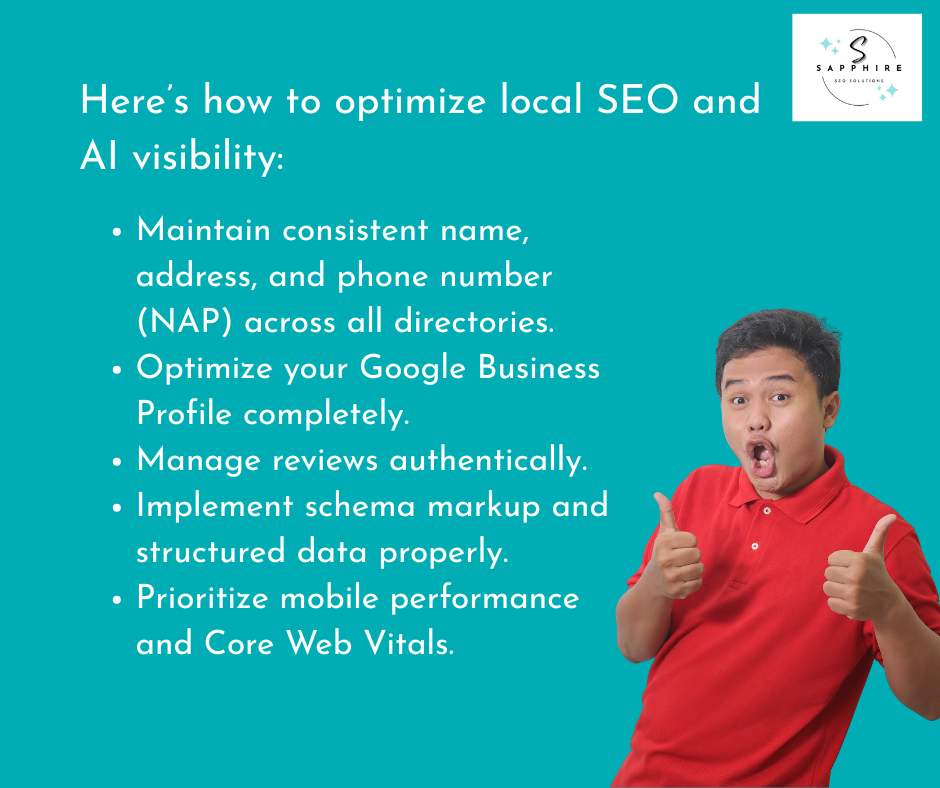
Staying on top of your local search listings is essential. Here are some tactics that you should incorporate into your strategy to optimize local SEO and AI visibility:
Maintain consistent name, address, and phone number (NAP) across all directories. Search engines use NAP data to verify business legitimacy and determine ranking positions in local results. Inconsistent information creates confusion and diminishes trust signals. Submit your business to local directories like Yelp, Yellow Pages, industry-specific platforms, and review aggregators. Every listing must match exactly.
Optimize your Google Business Profile completely. A fully completed Google Business Profile with the correct primary category selected, regular photo updates, and consistent NAP across directories signals activity to Google. When optimizing your GBP, make sure to include up-to-date business information, high-quality images and videos, detailed service descriptions, and business hours. Also, post regularly about promotions, events, updates, and offers, as GBP post signal to Google that your business actively serves customers.
Manage reviews authentically. Reviews are both a ranking and a trust factor, with Google prioritizing businesses with high review volume and positive ratings. Respond to both positive and negative postings promptly and professionally. Businesses with higher review volumes, better ratings, and consistent recent reviews typically outperform competitors in local search results. Reviews directly influence both Google Maps rankings and consumer purchasing decisions. Make sure to read our detailed guide on "The Role of Online Reviews in Local SEO Rankings" to learn more about the importance of online reviews and reputation management.
Implement schema markup and structured data properly. Schema markup provides search engines with explicit information about your business, services, location, hours, and other critical details. This structured format allows search engines and AI systems to understand and present information more accurately. Popular schema types for local businesses include Organization, LocalBusiness, Article, and Product. FAQ Schema and HowTo Schema help machine learning models parse content effectively. To learn more about structured data, make sure to read our comprehensive guide on "Why Is Schema Markup Important?"
Prioritize mobile performance and Core Web Vitals. Google uses mobile-first indexing, so your mobile scores are what count for rankings. With mobile-first indexing now the default, a slow-loading mobile site could see rankings plummet. Google's focus on mobile-first indexing means that Core Web Vitals have a direct impact on mobile SEO, with websites that score well on mobile Core Web Vitals ranking higher in mobile search results. Mobile-first indexing makes speed non-negotiable. Optimize images, reduce JavaScript execution time, and ensure your site loads quickly on smartphones. Core Web Vitals like Largest Contentful Paint (LCP), Interaction to Next Paint (INP), and Cumulative Layout Shift (CLS) directly affect local rankings.
The majority of mobile searches have local intent, which means when local consumers are searching for nearby businesses, it's imperative that websites load lightning-fast.
Voice search and "near me" queries happen predominantly on mobile devices. Your local SEO strategy must prioritize the mobile experience to capture this high-intent traffic effectively.
Make Sure to Use Schema Markup and Structured Data Properly
Microsoft's Fabrice Canel confirmed that schema markup helps Microsoft's LLMs understand content, while Google's John Mueller recommends using structured data because it gives models clearer signals about intent and structure.
Incorporating structured data onto your website helps large language models better understand your content and increases your chances of appearing in AI-generated responses.
In 2026, schema acts as the definitive data layer for Large Language Models, with AI platforms looking for structured data to verify facts and entities when crawling the web.
Without schema markup, your site appears as just a collection of pixels to AI systems. With schema markup, your site becomes a reliable database.
While it's not entirely clear how much structured data matters for AI visibility across all platforms, configuring it properly helps boost click-through rates and generate the richest results for consumers.
Search Engine Journal reveals that rich results generate more than 58% more clicks than standard listings, which have a 41% click-through rate.
According to Search Engine Land, featured snippets received 35.1% of the total click share in one study. These enhanced Google results with additional information like star ratings, prices, or event details make your listings more attractive to users. Featured snippets and rich results drive significantly higher engagement than standard blue links.
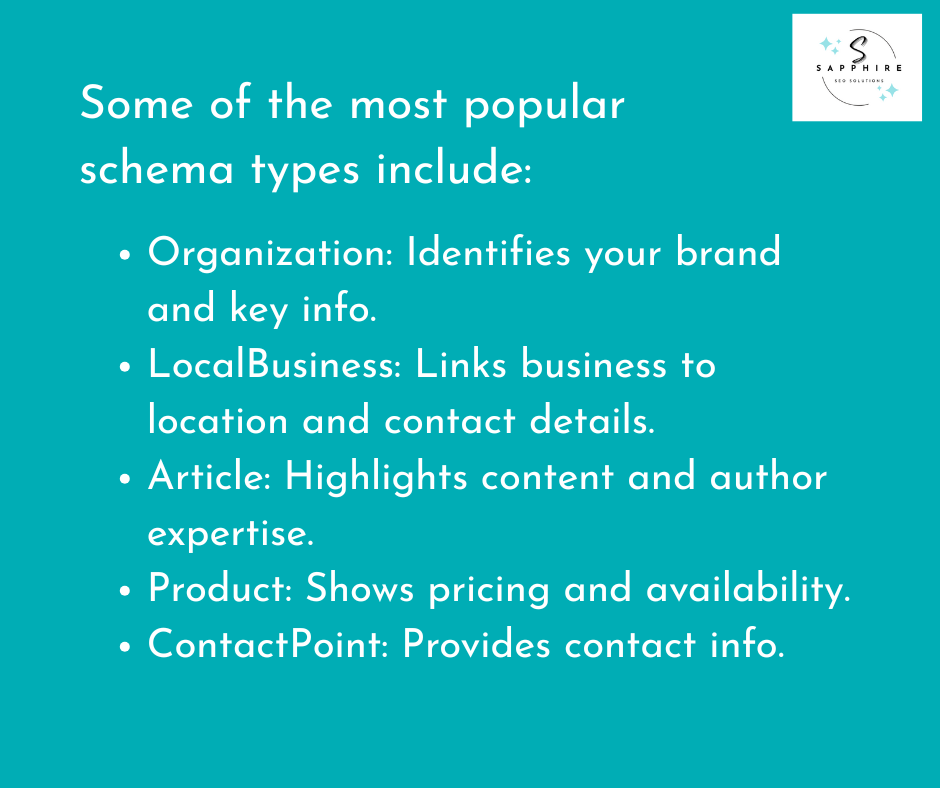
Along with structured data, incorporate schema markup on key pages of your website. Popular schema types include the following:
Organization schema defines your brand identity across the web. It creates your "content knowledge graph," telling AI systems who you are, what you do, and how you're connected, and is typically used on homepages or "About" pages. This schema links your brand to its name, logo, social accounts, and website, establishing foundational credibility with AI platforms.
LocalBusiness schema is essential for location-based businesses. It helps link your brand to specific location data, business hours, service areas, and contact information that AI systems can parse and recommend. Local businesses competing for "near me" searches need this schema to appear in AI-generated local recommendations.
Article schema signals content type and author expertise. When your article's author is linked to a verified "Person" schema with a professional profile, AI is much more likely to cite your content as an expert source. Make sure to include structured data on the author, article headline, featured image, and publication date to maximize visibility.
Product schema displays pricing, availability, and ratings directly in search results. You should offer a schema that works well alongside the Product schema when showing free trials, discounts, or pricing tiers, telling LLMs "this is something the user can actually buy or sign up for." E-commerce sites benefit tremendously from proper product markup.
ContactPoint schema is great for "Contact Us" or "Support" pages, telling AI tools and search engines how people can get in touch with your team through email, phone, chat, and other channels. This structured information helps AI platforms provide accurate contact details when users ask how to reach your business.
Google has confirmed that schema markup isn't going anywhere, with John Mueller clarifying that structured data "comes and goes" but core elements remain critical for AI search, entity understanding, and contextual indexing.
The company regularly retires old or redundant markup types while keeping essential ones that help search systems understand, categorize, and display web content.
Focus on implementing the most relevant schema types for your business rather than trying to add every available option.
Adopt AI Search Tools to Identify Opportunities
Brands get excited when they see their first site visitors from ChatGPT, Perplexity, and Gemini. But this excitement quickly leads to an important question: how do I get more AI search traffic?
AI visibility tracking has become essential for brands. Success in 2026 won't be defined solely by organic traffic or rankings but will hinge on how effectively a brand appears inside:
AI answers
AI Overviews
LLM-powered recommendations
Dozens of software tools have emerged to help brands identify opportunities where they can increase visibility in large language models and earn more high-converting traffic.
Success in AI search is binary. Either you're mentioned in the answer, or you're completely invisible. When answer engines provide recommendations, appearing in those top three spots dominates awareness, trust, and conversions.
AI search tools track how your brand appears across platforms like ChatGPT, Perplexity, Gemini, and Google AI Overviews. Profound is a GEO and AI visibility platform designed to help teams understand where their brand appears in AI-generated answers, which sources get cited, and how that visibility changes over time.
Profound recently secured funding and is evolving into a larger SEO analytics tool that is GEO-first, demonstrating strong investor confidence in the AI visibility market.
Tools like Profound, OtterlyAI, and Superlines help marketers identify where they can influence AI answers by tracking customer-style prompts in large language models and monitoring responses over time.
OtterlyAI monitors when your brand appears in AI-generated answers and compares your brand visibility against competitors, showing which AI engines mention you most often and how those brand mentions shift over time.
Since these answers are built by scraping and summarizing content from the web, brands that appear on frequently cited pages are more likely to be recommended.
Superlines uses real answer data from live AI interfaces across 10 major AI engines and exposes structured datasets through an MCP server so teams can work with the data inside their existing workflows.
The challenge becomes creating content that AI systems want to cite or securing mentions on the high-authority pages they already trust.
When evaluating AI search tools, consider these key factors:
AI engine coverage showing how many platforms it tracks (ChatGPT, Perplexity, Gemini, Claude, etc.)
Data depth offering visibility metrics plus citation sources and sentiment analysis
Actionability providing content optimization tools beyond just reporting
Enterprise readiness with proper security certifications
HubSpot's AEO Grader is a free tool that reveals how ChatGPT, Perplexity, and Gemini describe your brand, how often you appear, and what sentiment those answers carry, producing an AEO score and competitor comparison.
Free tools provide a starting point for small businesses to understand their current AI visibility. That said, comprehensive tracking requires dedicated platforms.
The window to secure top spots in AI-generated answers is closing fast. Brands that claim those positions early will dominate customer awareness and conversions in this new search landscape.
Work with Authoritative Publishers for Brand Mentions (Similar to Backlinks!)
This is where the new generative engine optimization (GEO) begins to look a lot like the old SEO.
Brand mentions have moved from a nice-to-have tactic to core infrastructure in an AI search environment, with LLMs looking beyond links to evaluate mentions, context, and repeated co-occurrence between your brand and the topics you want to rank for.
Brand mentions, even without links, act as implied backlinks, with Google recognizing when reputable websites reference a brand, product, or expert.
The key takeaway for 2026 is to focus on earning authentic editorial mentions and co-citations rather than chasing link metrics.
Earned media such as social mentions, reviews, and quality backlinks shape how AI models and users perceive your brand, with LLMs prioritizing content from trusted, credible sources.
The brands that consistently appear in high-quality editorial coverage, expert roundups, and authoritative reviews will be the ones AI systems learn to trust and recommend.
When consumers turn to large language models like ChatGPT for real-time information about where to buy products, such as "best organic shampoo for dandruff in 2026," the LLMs often get their information by scraping listicles from authoritative publishers.
Affiliate citations and listicles matter, with sites like PCMag, Capterra, TechRadar, and G2 regularly appearing across model outputs.
Generative models cite listicle articles more often than other formats because they are clear, structured, and often contain comparisons of multiple products or services.
Tech publishers and review outlets like TechRadar and CNET have the kind of authoritative, comprehensive articles that ChatGPT loves to cite.
Brands that appear at the top of these listicles often enjoy increased AI visibility in ChatGPT responses. This has reignited demand from brands to earn the favor of authoritative publishers in their niche.
With limited supply and virtually endless demand, brands and marketers have begun searching for ways to gain search visibility in LLMs that don't rely solely on third-party publishers.
Digital PR strategies directly impact how search engines and AI platforms evaluate brand authority. Unlinked brand mentions now influence rankings as much as traditional backlinks, with brand citations quickly becoming a ranking multiplier because they help AI systems build confidence that your organization is real, relevant, credible, and widely referenced.
LLMs don't weigh backlinks as heavily when generating responses, instead focusing on how often a brand or product is mentioned in relevant contexts, meaning reputation, context, and frequency of mention carry significant weight.
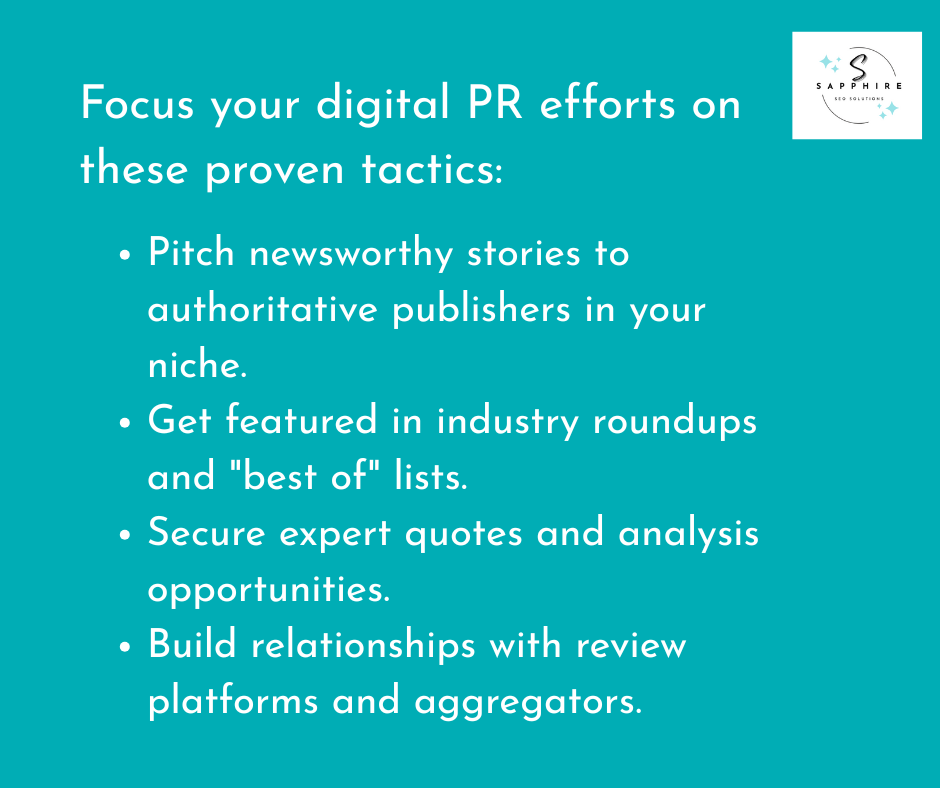
AI citations work differently from traditional backlinks. A single mention from a respected financial journal can outweigh 50 irrelevant links, requiring a strategic rethink where the backlink strategy must be built around topic clusters, not volume. Focus your digital PR efforts on these proven tactics:
Pitch newsworthy stories to authoritative publishers in your niche. Digital PR backlinks generated through PR and storytelling are highly effective because they deliver high-value, naturally earned editorial links, with content that offers trending angles that journalists genuinely respond to. Create data-driven studies, expert commentary, or unique insights that journalists want to cite. Original research, annual reports, or proprietary trends fill gaps in the broader information ecosystem and stand out from generic web content.
Get featured in industry roundups and "best of" lists. Listicle and comparative content dominate AI citations, representing 25.37% of all AI citations across 2.6 billion analyzed citations. Reach out to editors of popular blogs and publications to include your solution in their comparison articles. Position your brand objectively among competitors rather than as a promotional placement.
Secure expert quotes and analysis opportunities. By 2026, visibility alone won't save you, with the new PR currency being citations by machines rather than impressions, backlinks, or earned mentions. You should offer expert commentary to journalists covering your industry. These mentions strengthen your entity signals and help AI platforms recognize your brand as an authority.
Build relationships with review platforms and aggregators. Review aggregators like G2, Clutch, and TripAdvisor substantially amplify authority in vertical-specific AI queries. Social proof from forums like Reddit, Wikipedia, and high-value review sites is being pulled by LLMs as authoritative evidence. Make sure to maintain complete, accurate profiles on platforms relevant to your industry.
Brand signals have officially overtaken technical SEO as the primary ranking factor. The era of tricks and hacks is over, and brand-building is becoming SEO itself through PR, press releases, podcast appearances, and social mentions, directly influencing search rankings through brand signal amplification.
Some marketers believe the answer to sustainable AI visibility lies in creating content for long-tail queries that AI platforms already trust.
Learn How Consumers Ask LLM Questions and Build Content Around Them
Consumer search habits on ChatGPT differ dramatically from traditional Google searches. According to Search Engine Land, ChatGPT users enter prompts averaging 80 words in length, compared to just 3.4 words for Google searches, making ChatGPT queries roughly 24 times longer.
While Google remains the longstanding leader in information retrieval, the meteoric rise of ChatGPT has introduced new use cases for search, particularly around long-form conversational queries and creative tasks.
People phrase their searches in large language models as questions. They don't restrict queries to short, punchy keywords like they would on Google.
ChatGPT and other AI platforms naturally encourage long-form, conversational questions, with someone typing "breast augmentation" into Google but asking ChatGPT, "What's recovery like after a breast augmentation with silicone implants?"
While Google searches are typically brief, keyword-focused queries like "weather today" or "pizza near me," ChatGPT users craft detailed, conversational prompts.
This behavioral shift creates opportunities for answer engine optimization and generative engine optimization strategies. Instead of searching "best organic shampoo" on Google, someone using ChatGPT might ask, "What is the best organic sulfate-free shampoo to use if I have a dry scalp?"
The more specific the query, the higher the conversion rate!
Demonstrate E-E-A-T in Your Content (Google Loves Original Content)
Google's ranking systems aim to reward original, high-quality content that demonstrates qualities of what we call E-E-A-T, which stands for:
Expertise
Experience
Authoritativeness
Trustworthiness
With AI capable of generating infinite content, quality has become the primary differentiator, with Google explicitly prioritizing content demonstrating expertise, experience, authoritativeness, and trustworthiness.
Google and AI systems now look for signals that you've done the thing you're talking about, including original insights, data, screenshots, real workflows, or firsthand expertise.
Content quality determines citations, with AI Mode rewarding content that shows lived expertise, like case studies, tutorials, and frameworks.
Trust is the most important member of the E-E-A-T family because untrustworthy pages have low E-E-A-T, no matter how Experienced, Expert, or Authoritative they may seem.
AI content is acceptable, but only if it adds real value. On the other hand, keyword-stuffed, low-quality AI content doesn't rank well. AI should assist, not replace, human expertise and originality.
Demonstrate E-E-A-T on your pages with first-hand insights and case studies. You can use AI to create an evaluation criterion by uploading Google's guidelines and asking ChatGPT to review and rate your content using these standards. This isn't a way to decipher Google's algorithm, but ChatGPT can act as an editor to help improve your content quality based on a provided framework. If you have a premium subscription, create a custom GPT for content evaluation.
AI has eliminated the value of generic content. Experience signals have become increasingly important as AI-generated content proliferates.
Google values content that reflects first-hand experience, whether that's product reviews from actual users, case studies from practitioners, or guides from people who've done what they're teaching.
If your content simply explains "what something is" or provides a basic how-to, large language models can now do that instantly and often more clearly. These queries no longer drive reliable traffic.
Create original research, case studies, and customer usage data to give LLMs and search engines a reason to cite you. Authority-building content demonstrates firsthand experience, original research, or unique insights unavailable elsewhere, transforming standard articles into citation-worthy resources. With most content not adding much value, adding unique data and insights helps you stand out.
When ChatGPT or Perplexity needs to name a source, it prefers brands with strong entity signals, real experts, and proprietary insights.
Google's algorithm can't independently verify if information is accurate, so it must use proxy signals indicating content comes from knowledgeable sources. The bar for trust is higher than it's ever been.
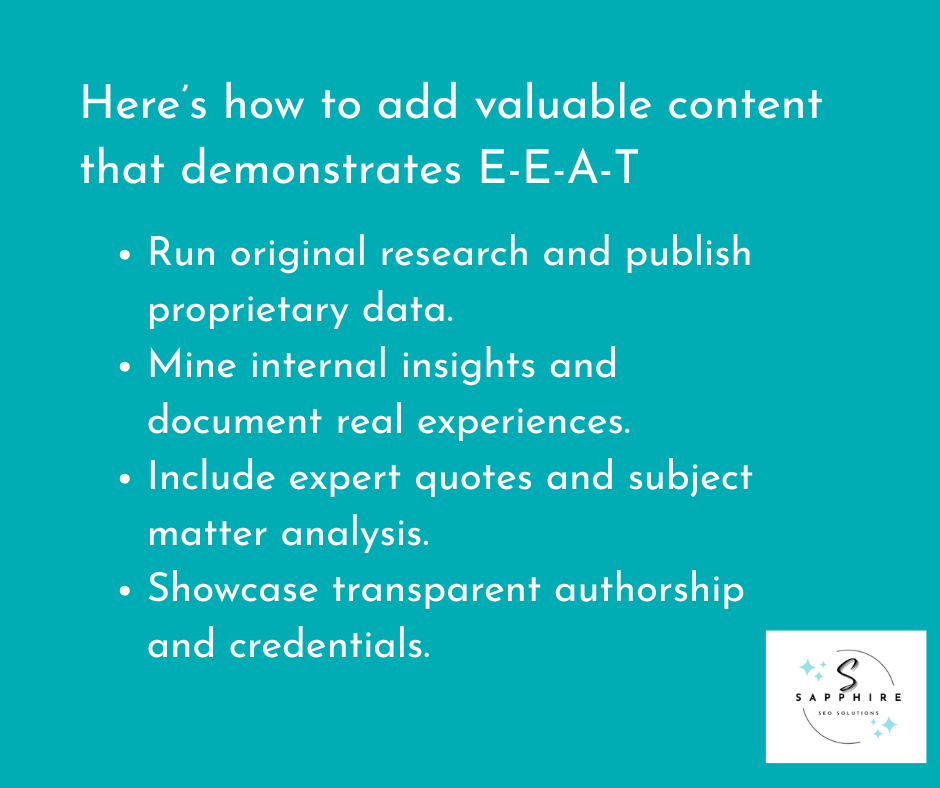
Here are proven ways to add valuable content that demonstrates E-E-A-T:
Run original research and publish proprietary data. Run surveys, analyze anonymized user behavior, surface product patterns, or publish performance benchmarks for your industry. Search engines reward comprehensive, expertly written content that demonstrates E-E-A-T principles over thin, frequent posts. One authoritative guide builds greater topical authority and earns more natural backlinks than twenty superficial articles combined.
Mine internal insights and document real experiences. Use sales calls, support tickets, customer onboarding issues, and internal experiments as material. Personal anecdotes, specific examples, original research, and unique perspectives signal genuine experience that AI cannot easily replicate. These contain firsthand insights that position you as a credible leader. Document A/B tests, optimization attempts, failed strategies, and unexpected outcomes that humanize your brand and provide human users with actionable takeaways.
Include expert quotes and subject matter analysis. 2026 content must show who created it and why they're credible, meaning adding expert quotes, citing sources, and publishing under real authors. Bring in subject-matter experts to interpret what the numbers mean, not just what they are. Strong E-E-A-T signals to both Google and LLMs make your content easier to trust, cite, and surface in AI search results.
Showcase transparent authorship and credentials. AI Overviews and other AI-powered summaries look for clear, structured, and fact-based answers with visible author credentials, including name, photo, position, short bio with qualifications and experience, and links to social profiles or other publications.
Content SEO in 2026 requires genuine value creation, not optimization tricks. Focus on creating content that serves human users first, and search visibility will follow naturally.
Is SEO Still Important in 2026?
AI hasn't killed SEO, but it has fundamentally changed how people search. More users now turn to AI engines for quick, direct answers, with ChatGPT offering conversation, follow-up questions, and specific task instructions.
On the other hand, traditional search remains linear, where you search for a keyword, look at the results, and investigate yourself. That said, it's important to remember that traditional organic search remains the primary traffic source for most websites, and SEO fundamentals still deliver when executed well.
More people rely on AI tools like ChatGPT and social media platforms to answer their queries. Search Engine Land reveals that organic click-through rates for queries featuring Google's AI Overviews have plummeted by 61% since mid-2024, dropping from 1.76% to just 0.61%.
Since Google has prioritized AI-generated summaries in search results, websites are seeing significantly lower traffic.
Today, search isn't a traffic channel but an AI-mediated decision layer where clicks fade. AI systems draw from a wider contextual field than any individual query can signal, and ranking well in one environment does not guarantee visibility in another. Like ChatGPT, Gemini, and other answer engines, Google's AI Mode doesn't have 10 blue links: you either get cited, or you don't.
So no, SEO isn't dead. SEO is now about content optimization across multiple channels, not just Google. SEO in the AI era is making your expertise, data, and brand discoverable across every platform where people ask questions.
Yes, SEO is still important in 2026, even if you hear people say "SEO is dead." Nevertheless, SEO as you know it has definitely changed. If your content strategy consists of finding low-difficulty keywords and writing blog content to hit a word count, you need to update your strategies.
What Should Small Businesses Do in 2026? - Build a Solid SEO Strategy with AI Search in Mind
GEO will grow, but traditional SEO will remain the primary source of high-intent traffic, making a balanced strategy essential. The organizations that win are those that optimize for both systems simultaneously.
SEO foundations are the prerequisite for AI visibility: without clean technicals, strong information architecture, and quality content, generative and answer-based efforts simply have nothing reliable for AI systems to ingest, understand, or cite.
Start by auditing your technical fundamentals. Fix site speed issues, implement proper structured data, and ensure mobile performance meets Core Web Vitals standards.
One of the most powerful E-E-A-T strategies is conducting original research, with businesses that become the source of information and data in their market gaining immense power and credibility. These technical foundations support both traditional rankings and AI citations.
To take advantage of zero-click searches, businesses should focus on brand recognition, consistent messaging, and experience-driven content, all of which appeal to both humans and AI. Small businesses must think beyond rankings.
Build comprehensive topic clusters that demonstrate expertise across your niche. Brands will win by owning topics comprehensively, connecting subtopics with internal links, and presenting clear, authoritative relationships around their expertise. Create content that answers complete questions, not just individual keywords.
While AI might drive less traffic (often less than 1%), it drives significantly higher conversions, with B2B companies seeing AI-driven traffic responsible for nearly 10% of revenue. Don't obsess over traffic volume alone.
Track AI visibility by monitoring how often you're cited in AI summaries, making this your new key performance indicator. Test your content by pasting blog posts into ChatGPT and asking it to summarize. If it misses your key points, rewrite until the AI gets it right.
The biggest mistake is treating AI SEO as a separate activity from regular SEO rather than an integrated evolution, leading to siloed efforts, conflicting optimizations, and missed synergies.
Small businesses need comprehensive strategies that work across Google, ChatGPT, Perplexity, and emerging platforms. Focus on building genuine entity authority through consistent NAP information, active social media presence, review management, and digital PR efforts that earn brand mentions across multiple platforms.
Work with Experts in AI Search Optimization and SEO to Boost Your Online Presence!
The SEO industry is evolving rapidly, and answer engine optimization is quickly overtaking traditional search in importance. Users are relying on platforms, such as ChatGPT, Perplexity, Google AI Overviews, Claude, and Gemini, to provide direct answers to user queries.
While foundational components such as strong technical SEO, backlinks, and quality content remain important, winning in AI search requires a distinct focus on answer engine readiness. You need optimized content that's structured, concise, semantically understandable, and mapped directly to user intent.
At Sapphire SEO Solutions, our SEO experts are certified in AI search optimization and search engine optimization, giving us the comprehensive skill set required to boost your online presence across all platforms where customers discover brands.
We offer affordable AI SEO services designed specifically for small businesses looking to compete effectively against larger competitors. Our team knows how to identify the right target keywords, build content strategies that earn AI citations, and implement technical optimizations that improve visibility in both traditional search engines and AI platforms.
Contact us and schedule a free consultation with an experienced SEO strategist to learn more about your shortfalls and identify opportunities in this age of AI search.
Want to order AI SEO-optimized content to start getting brand mentions? Check out the different content writing tiers we offer before placing an order online.

Frequently Asked Questions - SEO in the Age of AI Search
How do I get my brand cited as a primary source in ChatGPT and Perplexity answers?
To be cited as a primary source in generative answers, your brand needs to be consistently recognized as an authoritative, original source of information across the open web. This means publishing first-party data, proprietary research, expert commentary, and clearly attributable insights that are not easily replicated. Large language models and AI search engines heavily rely on high-trust signals such as editorial backlinks, mentions from reputable publishers, structured data, clear authorship, and alignment with E-E-A-T principles. Getting cited by journalists, industry reports, academic sources, and high-quality blogs significantly increases the chance that AI systems ingest and reuse your content. Additionally, formatting content in clear, factual, and quotable ways, such as definitions, statistics, frameworks, and FAQs, improves extractability for AI systems like Perplexity that explicitly surface sources.
What is the difference between traditional SEO and GEO (Generative Engine Optimization)?
Traditional SEO focuses on ranking individual web pages in search engine results pages through keywords, backlinks, and technical optimization, while GEO focuses on influencing how AI systems understand, summarize, and cite information across many sources. Instead of optimizing for a single query, GEO optimizes for topical authority, semantic clarity, and machine readability so that generative models can confidently reuse your content in synthesized answers. GEO emphasizes entity recognition, factual consistency, original insights, and cross-platform credibility rather than exact-match keywords or blue-link rankings. In short, SEO optimizes pages for humans clicking results, while GEO optimizes knowledge for machines generating answers.
Does AI search traffic actually convert as well as traditional organic search traffic?
Early data from platforms like Perplexity, Bing Copilot, and Google AI Overviews suggests that AI search traffic often converts as well or better than traditional organic traffic, especially for high-intent queries. Users who arrive from AI answers tend to be further along in the decision journey because the AI has already filtered options, summarized tradeoffs, and established trust. While total traffic volumes are currently lower, engagement metrics such as time on site, conversion rate, and lead quality are often higher. However, performance varies by industry, with SaaS, B2B, finance, and healthcare seeing stronger results than purely informational or entertainment content.
Can small businesses still compete with high-authority sites like Reddit and Wikipedia in AI Overviews?
Yes, small businesses can compete, but the strategy shifts from general visibility to niche authority. AI systems often prefer the most specific, experience-driven, and contextually relevant source rather than the largest domain. A small business that publishes detailed how-tos, local insights, original data, or practitioner-level expertise can outperform broad platforms when the query is specialized. Reddit and Wikipedia dominate generic explanations, but they are weaker in hands-on guidance, proprietary benchmarks, and real-world case studies. Focusing on narrow topics, clear expertise, and unique perspectives allows smaller brands to be selected alongside or instead of large aggregators.
How do I track and measure my "AI Visibility" if I can't see the prompts users are typing?
AI visibility is measured indirectly by monitoring outcomes rather than prompts. This includes tracking referral traffic from AI platforms, analyzing branded and unbranded mentions in AI answers, auditing citation frequency across tools like Perplexity and Bing Copilot, and measuring changes in branded search demand over time. Many teams also run prompt sampling by testing common industry questions to see which brands are surfaced and cited. Combining this with content performance, backlink growth, and entity mentions across trusted sources provides a reliable proxy for how visible and trusted your brand is within AI systems, even without direct access to user prompts.