

Affordable SEO Services for Small Businesses: What You Need
Most small business owners searching for affordable SEO services for small businesses assume "affordable" means "cheapest." It doesn't. Cheap SEO usually means less work, done faster, with no real plan behind it. Affordable SEO is different. It means putting the budget you actually have toward the work most likely to bring real results and skipping the stuff that won't.
So what determines how much work that actually is? A handful of things, including your goals, how competitive your market is, your business model, where your customers are located, the current state of your website, and your budget.
Because those factors change from business to business, there's no single "affordable SEO package" that fits everyone. A landscaping company in a mid-size Ohio city needs something different than a law firm competing in a major metro.
This guide is here to help small business owners figure out what affordable SEO actually looks like for their situation and what a package should (and shouldn't) include.
Key Takeaways
Affordable doesn't mean cheapest. It means prioritizing the SEO work most likely to create value within a realistic budget, not cutting corners.
Scope depends on six factors: goals, competition, business model, geographic market, current website condition, and budget. No two businesses need the same package.
A real affordable SEO package includes six core pieces: audit and prioritization, keyword research, on-page SEO, content strategy, technical basics, and reporting. Skip any of these, and it's not really SEO.
A focused, smaller campaign can outperform a bigger, unfocused one. Premium SEO buys more scope and resources, not guaranteed better results.
There's no universal SEO price. Cost depends on competition, geography, website condition, and how fast a business wants results, not a flat industry average.
Warning signs to watch for: ranking guarantees, massive backlink or content quotas, vague deliverables, and reporting that doesn't explain what actually happened.
Results are real but not instant. SEO gains build gradually and compound over time; they don't show up as a guaranteed monthly return.
Priorities shift by business type. Local service businesses lean on local pages, professional services lean on trust and expertise, e-commerce leans on product indexation, and B2B leans on longer buying journeys.
Affordable SEO isn't the right fit for everyone. Highly competitive national markets or businesses needing immediate leads are often better served by other channels first.
What Are Affordable SEO Services for Small Businesses?
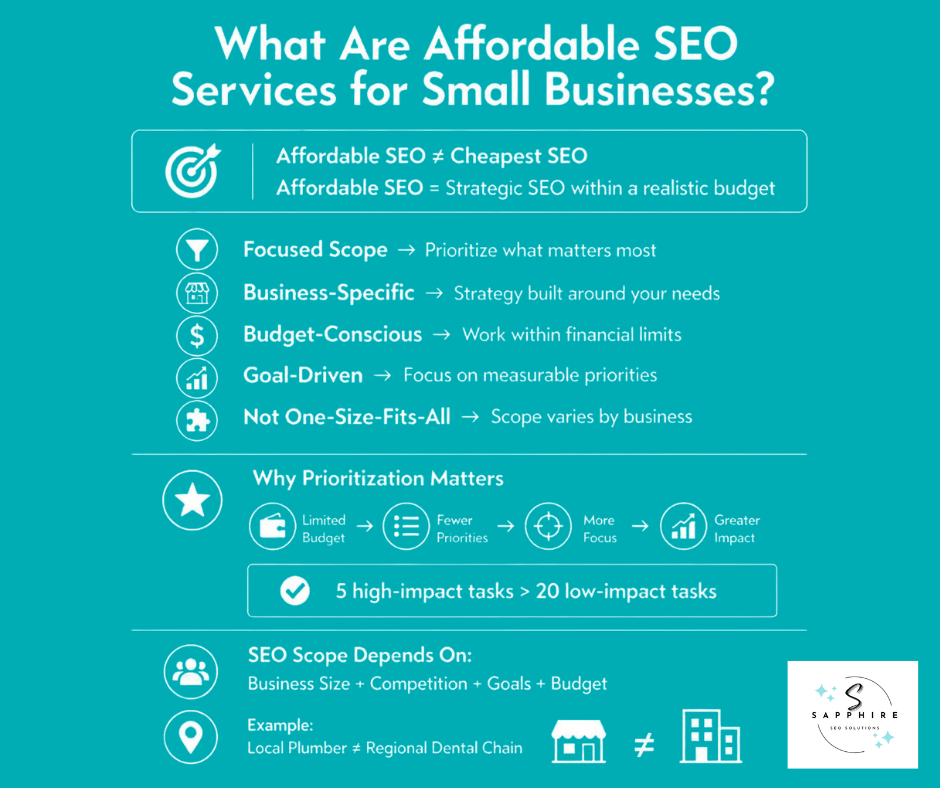
Affordable SEO services for small businesses are SEO work scoped to fit a realistic budget, focused on the tasks that matter most for that specific business. It's not a stripped-down version of "real" SEO. It's a version built with limits in mind from the start.
That's an important distinction, because affordable doesn't mean cheapest. The cheapest option often skips strategy altogether and just checks boxes. Affordable search engine optimization does the opposite. It starts by asking what this particular business needs before building a plan around that, rather than selling every business the same package regardless of size or goals.
Scope varies a lot from one business to the next. A small business SEO plan for a single-location plumber looks nothing like one for a regional chain of dental offices because of differences in budgets, competition, and goals.
Limited budgets force prioritization. And that's not necessarily a bad thing. A narrow campaign that fixes the right five problems will usually beat a bloated package that spreads a small budget across twenty low-impact tasks.
Competition plays a role too. A business chasing a term with fifty competitors needs a different strategy than one with almost none.
Budget-friendly services work when the scope matches the business, not the other way around.
What Should an Affordable SEO Package Include?
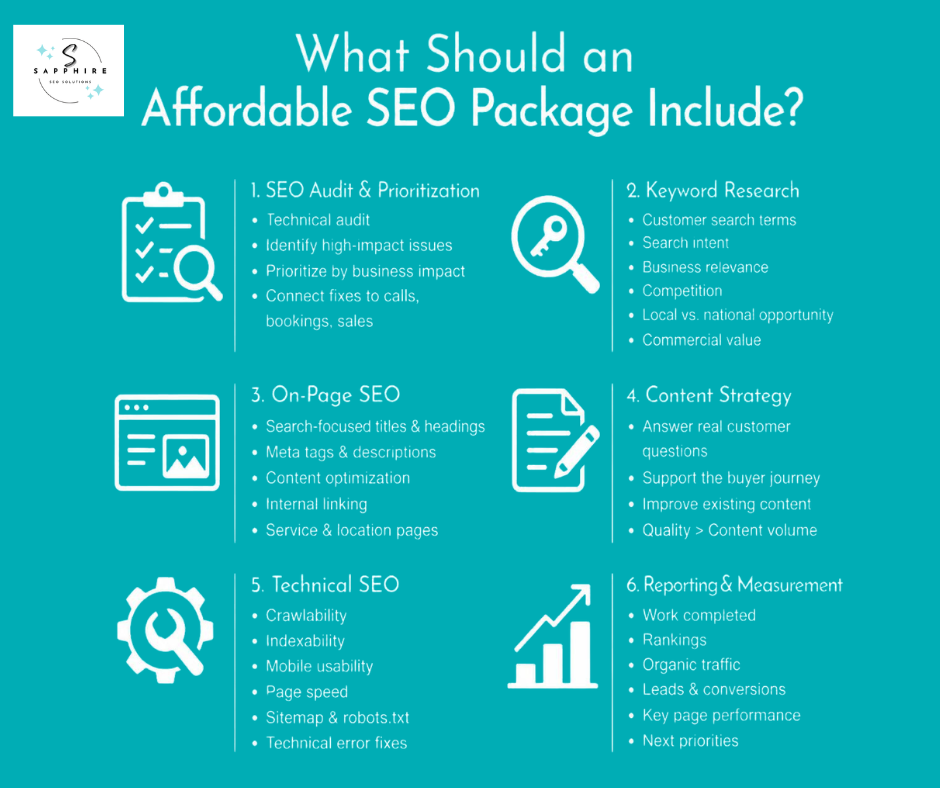
A real SEO package, affordable or not, should always include a few core pieces, including:
SEO Audit and Prioritization
Every campaign should start with a technical SEO website audit. This can help find:
What's broken
What's slowing things down
What's stopping Google from finding certain pages
An audit sets a baseline, so everyone knows where things actually stand before any work begins.
After that, the SEO strategy should rank issues by impact, not by how easy they are to fix. A homepage that's invisible to Google matters more than a typo in a footer link. Good SEO campaigns connect every recommended fix back to what the business actually wants: more calls, more bookings, more foot traffic.
Keyword Research
Keyword research for a small business isn't about chasing the highest search volume. It's about finding terms real customers actually type in, terms that match what the business sells, and terms the business has a real shot at ranking for.
That means:
Weighing search intent (is someone ready to buy, or just browsing?)
How relevant the term is to the business
How much competition already owns that space
Whether it matters locally or nationally
Tools like Google Keyword Planner help surface ideas, but the real work is filtering those ideas down to ones with commercial value for specific, niche audiences. Chasing every trending term based on market trends alone wastes a limited budget fast.
Keyword targeting should focus on low-competition long-tail keywords. That's what many SEO agencies will tell you, but they won't explain why. Targeting low-competition terms means targeting specific people who are ready to convert. They know what they're looking for, but they need a bit of convincing that your service/product is the right one.
On-Page SEO
On-page optimization makes sure a page's content actually matches what someone searching for it wants to find. That starts with titles and headings that reflect real search intent, not just company jargon.
Meta tags and meta descriptions (the text that shows up in Google's search results under a page's title) need to accurately describe the page and give someone a reason to click. Beyond that, content optimization should focus effort on internal linking and on the pages that actually make money: service pages, location pages, and anything close to a sale.
Content Strategy
Good content strategy isn't about hitting a monthly article quota. It's about answering the questions real customers are already asking, and building pages that fit somewhere in their sales journey, whether that's the very first search or the moment right before they call.
Content writing services for small businesses should also include improving pages that already exist and already get some traffic, not just publishing new pages endlessly. One strong page that ranks and converts beats five thin ones that don't.
Technical SEO Basics
Technical SEO covers the fundamentals, including:
Making sure Google can actually crawl and index the site
Fixing major technical errors
Confirming the site works well on mobile
Addressing site speed issues that hurt both rankings and user experience.
Sitemap and robots.txt problems, the files that tell search engines what to crawl and what to skip, also fall under technical SEO. Search Console, Google's free tool for monitoring how a site performs in search engine results, is usually where these issues show up first.
Reporting and Measurement
A good package explains what was done, not just what changed. Reporting should cover completed work, ranking movement, organic traffic trends from Google Analytics, and leads or conversions where they can be tracked. It should call out how important pages are performing and lay out what's next.
Qualified traffic, visitors who actually match what the business sells, matters more here than raw visitor counts.
Check out our guide on "Why Most SEO Reports Are Useless" to learn more about how our SEO reporting is different.
Which SEO Services Should a Small Business Prioritize?
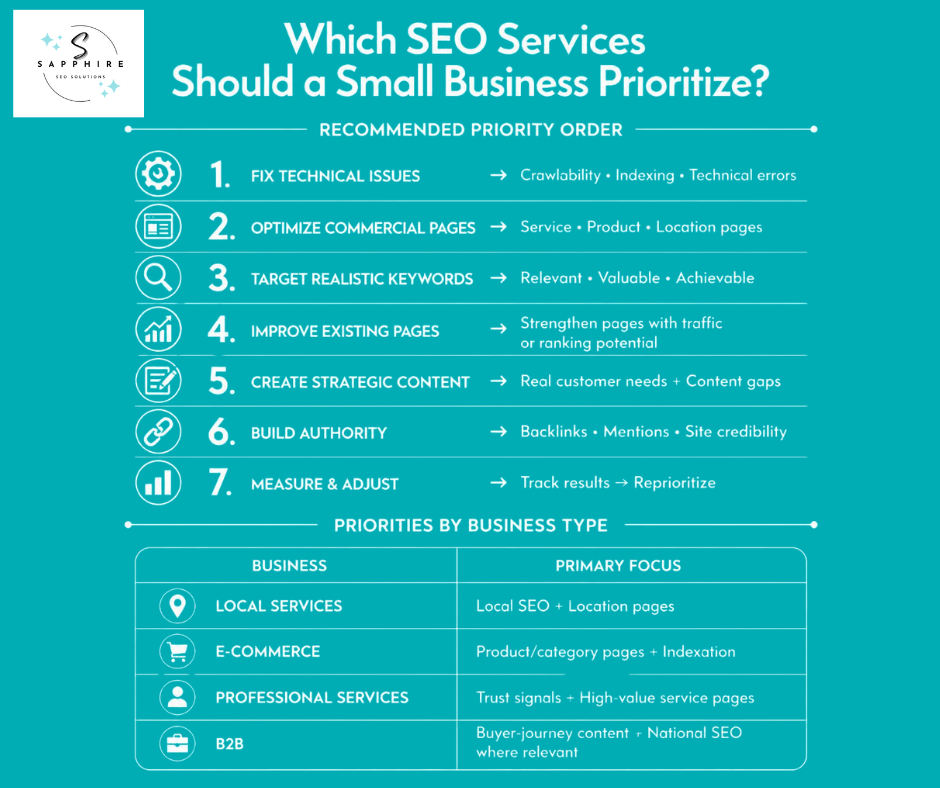
There's no single order that works for every business doing SEO for small businesses. But a few priorities tend to matter most, regardless of industry.
Start with anything stopping Google from properly finding or indexing the site. A technical issue here can undo every other effort, so it usually comes first. From there, the important commercial pages, the ones closest to an actual sale, deserve attention next. After that, focus on search terms that are realistic to rank for and actually worth ranking for, rather than chasing every keyword available.
Existing pages that already show some traffic or ranking potential are often worth improving before creating anything new. Once that groundwork is done, content should be created strategically, aimed at real gaps or opportunities (focus on E-E-A-T), not just for the sake of publishing. In markets with heavy competition, building authority (through things like backlinks, mentions, and overall site credibility) becomes more necessary. And throughout all of it, measuring results and adjusting based on what's actually working matters more than sticking to an original plan out of habit.
That said, how these priorities get weighted changes depending on the type of business.
Local service businesses usually lean hardest on local SEO and location-specific pages since most of their customers are searching nearby. A plumber with multiple locations often needs strong local landing pages for each city or neighborhood they serve more than they need broad national content.
E-commerce businesses tend to prioritize product and category page optimization, along with indexation, since a huge catalog of pages needs to actually get crawled and found.
Professional services, including law firms and accounting firms, usually put more weight on trust signals and high-value service pages, since a single client can be worth far more than a typical retail sale.
B2B and medium-sized businesses often prioritize content that supports a longer buying journey since those customers rarely convert on a first visit. Some of these businesses need national SEO rather than local, depending on who they're trying to reach and where those customers are.
The right sequence depends on the business. The priorities above are a starting point, not a script.
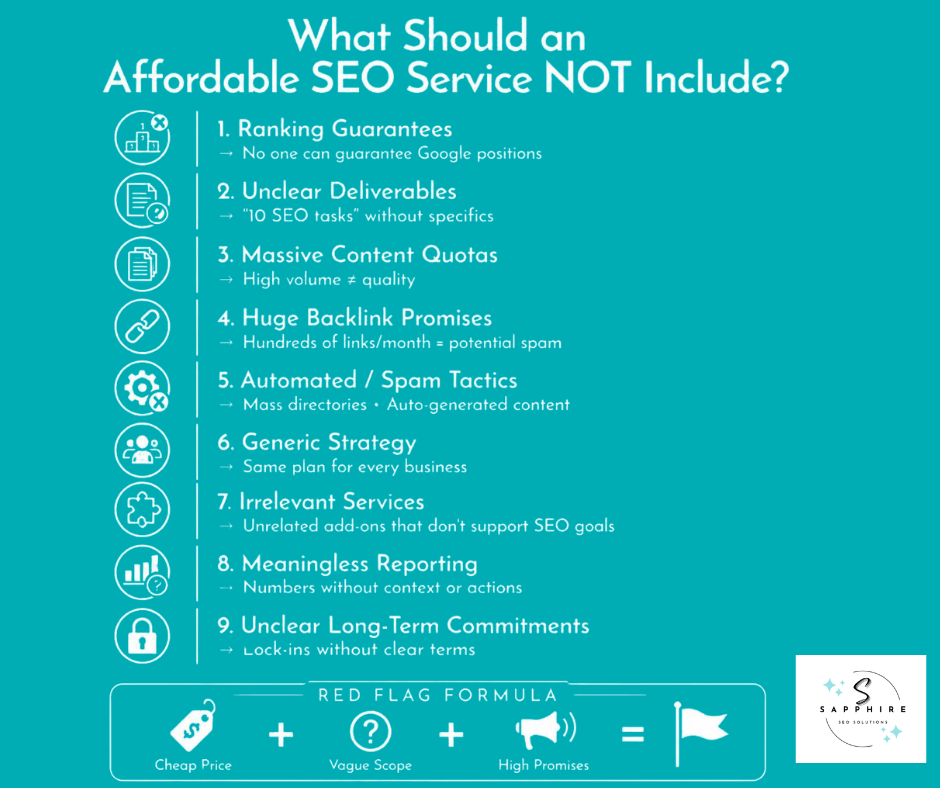
What Should an Affordable SEO Service NOT Include?
Knowing what to avoid matters just as much as knowing what to look for. A lot of cheap SEO offers aren't harmful because they're inexpensive. They're a problem because of what's missing or what's hiding underneath the low price.
Watch out for:
Ranking guarantees: No one can promise a specific position on Google. Anyone who does either doesn't understand search or isn't being straight with you.
Unexplained deliverables: If a package lists "10 SEO tasks" a month without saying what those tasks actually are, that's a red flag, not a bonus.
Massive content quotas: Twenty blog posts a month sounds impressive. It usually means thin, rushed content that does the business no favors.
Huge backlink promises: Some link building is normal and useful. Hundreds of backlinks a month from other websites rarely is, and often signals low-quality, spammy sources.
Automated or spammy tactics: Anything that sounds automated, like mass-submitted directory listings or auto-generated content, tends to do more harm than good.
Generic strategy: If the plan would look identical for a bakery and a law firm, it's not really a strategy.
Services that don't relate to the business: Reputation management, social media posting, or add-ons unrelated to search shouldn't fill space in an SEO package unless they genuinely tie back to the goals.
Reporting that doesn't explain progress: A report full of numbers with no context about what they mean or what the team creates each month isn't reporting. It's noise.
Long commitments with unclear terms: A serious provider can explain what happens if the relationship isn't working out.
None of this means every low-cost tactic is bad by default. It means the details matter more than the price tag ever will.
How Much Should Small Businesses Expect to Pay for SEO?
35% of SEO companies charge $100-$149 per hour, and SEO consulting costs average $100-$150 per hour. But monthly retainers are a common pricing model for SEO services. According to Ahrefs, the most common monthly retainer for SEO services is between $500 and $1,000, while retaining a consultant can be between $2,500 and $5,000 every month.
That said, there's no honest answer to "what does SEO cost" that fits every business. Anyone giving you a flat number without asking a single question about your business is guessing.
Pricing varies because scope varies, and scope depends on a handful of real factors. Competition is one of the biggest. Ranking for "plumber" in a small town takes a lot less work than ranking for "plumber" in a major city with fifty competitors already doing SEO. Geography plays into that too since national campaigns generally require more content and more authority-building than a single-location local business.
The current condition of the website matters as well. A site with major technical problems needs more work upfront than one that's already in decent shape. Content requirements, how many pages the business needs, and how technically complex the site is (a ten-page service business versus an e-commerce site with thousands of products) all shift the scope up or down. Business objectives factor in too. A business that wants to dominate a competitive term nationally needs a different investment than one that just wants to show up for local searches. And the desired pace matters: moving faster generally costs more, since it means more hours of work packed into less time.
Instead of anchoring to an arbitrary number, it helps to think about pricing as a range tied to scope:
Smaller, focused scope: A single location, moderate competition, a handful of important pages needing attention. This is where most affordable seo packages tend to fit.
Mid-range scope: Multiple locations or service areas, more competition, more pages, or businesses aiming for faster results.
Larger scope: National competition, large websites, or aggressive growth goals that require more content, more technical work, and more ongoing management.
AI Overviews and most companies would tell you that technical SEO audits typically cost between $700-$1,000 or that local SEO services often range from $500-$650 per location. They never tell you what it includes.
The right question isn't "what's the average price for SEO?" It's "what scope of work does my business actually need, and what does that cost?" An SEO company or SEO agency should be able to walk through that logic with you, not just hand you a price sheet.
It's also worth remembering that a higher price doesn't automatically mean better SEO. Some digital marketing agencies charge more because they carry higher overhead, not because they deliver more value. The goal is to find an affordable SEO agency whose pricing model matches the scope your business actually needs.
SEO Service Pricing
Here are the average rates for SEO services:
Average SEO Service Rates
Here's What Sapphire SEO Solutions Charges
Our pricing is designed around what your business actually needs, so you don't have to spend your budget on unnecessary SEO work.
Keyword Research
$100 / monthKeyword research costs $100 per month. We brainstorm before conducting extensive keyword research across multiple platforms, including Semrush, Ubersuggest, LowFruits, Answer the Public, and many more. Once we gather a list of keywords, we'll create a comprehensive report that suggests our approach, what we recommend as primary and secondary keywords, and how to approach them.
SEO Content Creation
$30-$60 / 1,000 wordsSEO content creation starts at $30 per 1,000 words (basic SEO content) and goes all the way up to $60 per 1,000 words (AI search-optimized content). Check out our content writing tiers to learn more about what each tier includes and how it could benefit your business. You shouldn't have to pay $160-$220 per 1,000 words. That's highway robbery. And our rates come with SEO-certified in-house writers who have been writing for small businesses since 2007. You're getting professionals with decades of writing experience for much less than what most agencies charge!
Technical SEO
Audits: FreeTechnical SEO audits are free. You shouldn't have to pay to find out issues plaguing your site. We do each audit manually to determine what's wrong and what fixes are needed. Technical SEO starts at $100 per month, depending on the scope of work, and drops by 50% for the subsequent months. Technical SEO should be ongoing work, which is why we do monthly packages instead of a one-time cost. However, our team would be more than happy to provide a one-time cost depending on the complexity and scope of the work needed.
On-Page SEO
$40 / pageOn-page SEO services are $40 per page. This comes with fixing your headers, whether they're H1s, H2s, H3s, or H4s, and making them more SEO-friendly. Our team will conduct the keyword research needed to determine impactful search terms that need to be targeted on that page. We will also craft compelling, SEO-optimized meta titles and meta descriptions for that page. You'll also get image SEO for that page. We'll audit every page that needs work and walk you through everything our team will do to help optimize it.
Local SEO
CustomizedLocal SEO services cost depends on the plan. We can do a complete audit of your website for free and provide a complimentary local SEO plan that's fit for your business. Based on that plan and your requirements, our team will provide a customized quote. If your site needs more content and less technical SEO assistance, we will adjust for that. If your site needs more on-page SEO and content and less off-page SEO, we will cater to that. Our team will craft a plan that maximizes your budget and addresses your goals without the need to spend unnecessarily.
You don't need to spend more just to get effective SEO. Our approach is to identify what your business actually needs, prioritize the highest-impact work, and make your budget go further.
Affordable SEO vs. Premium SEO: What's the Difference?
The difference between affordable and premium SEO services isn't quality. It's scope. A premium package typically covers more ground: more pages, more content, more competitive targeting, more hours of hands-on work each month. That doesn't make it inherently better. It makes it bigger.
Here's how the two generally compare:
Affordable SEO vs. Premium SEO
| Affordable SEO | Premium SEO | |
|---|---|---|
| Scope | Focused on highest-impact opportunities | Broader coverage across the site |
| Resources | Leaner team, fewer hours allocated | Larger team, more hours allocated |
| Content volume | Fewer, strategically chosen pieces | Higher volume of ongoing content |
| Competitive targeting | Realistic, achievable terms | Can pursue more competitive terms |
| Technical depth | Core fixes and high-impact issues | Deeper, more comprehensive technical work |
| Research and analysis | Focused on priority opportunities | More extensive, ongoing research |
| Execution capacity | Limited to what fits the budget | Higher capacity for faster execution |
A business with a smaller footprint, less competition, or a tighter budget often doesn't need everything a premium package includes. Paying for extensive research into keyword opportunities that will never realistically get pursued, or content volume beyond what the business can actually convert, doesn't add value. It just adds cost.
That said, some businesses genuinely need what premium SEO offers. A company competing nationally, or one entering a market where every major competitor already has a large SEO investment behind them, may need that broader scope to keep pace. A seo company working with professional services clients in a crowded, high-value market is a good example of where more resources can matter.
The core thing to understand: premium SEO buys more scope and more resources. It doesn't buy guaranteed results. A well-run, focused campaign from an affordable seo services provider can outperform a larger, unfocused one from an expensive seo agency, especially when the smaller campaign is built around real priorities instead of padded deliverables.
Bigger isn't automatically better. It's just bigger.
Can Affordable SEO Actually Improve Google Rankings and Organic Traffic?
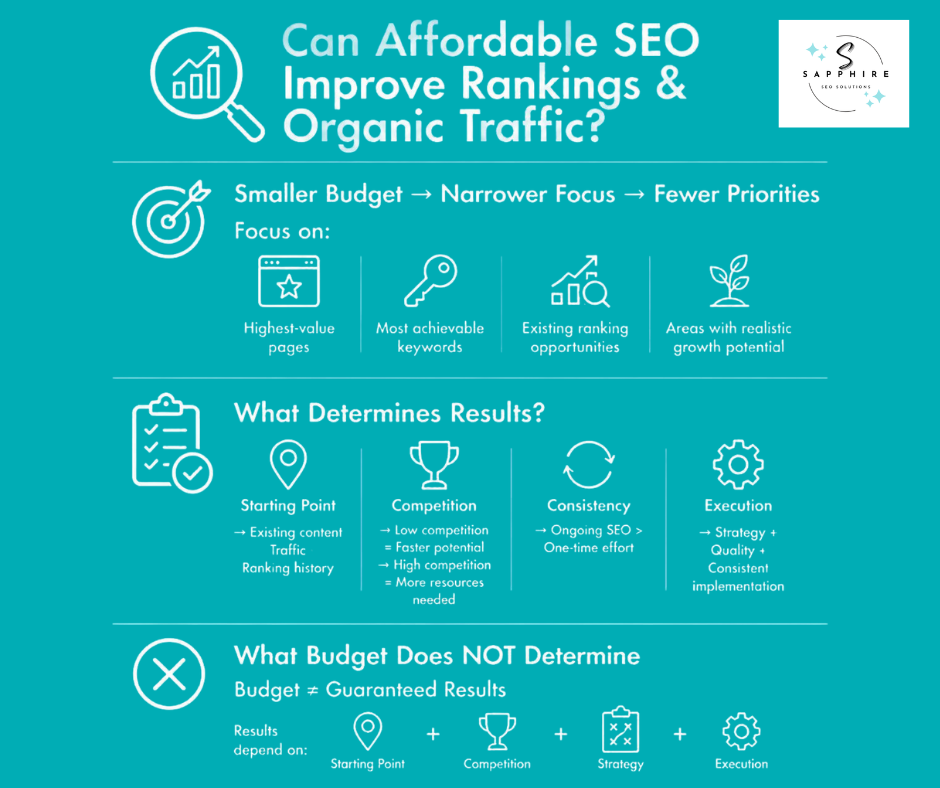
Yes, it can. That's the short answer. The budget doesn't determine whether SEO works. It determines how much ground gets covered and how fast.
A smaller budget just means a narrower focus. Instead of chasing every keyword opportunity across the site, an affordable campaign zeroes in on the handful of pages and terms most likely to actually move a business forward. That kind of focused targeting can make a limited budget go a lot further than spreading it thin across dozens of low-priority tasks.
Existing opportunities on the website matter here too. A site that already has some content, some traffic, or some ranking history usually has room to improve faster than one starting from scratch, since there's already something for Google to build on.
Competition still plays a role, no matter how focused the strategy is. A business chasing a term with almost no competitors will usually see movement faster than one going after a term that fifty other businesses are already fighting for. Consistency matters just as much. SEO isn't something that gets fixed once and forgotten. Steady, ongoing work tends to outperform a single burst of effort followed by nothing.
None of this comes with a guarantee, and any provider claiming otherwise isn't being straight with you. Results depend on the starting point, the competition, and how well the strategy gets executed, not just on how much gets spent.
It's also worth knowing that search engines themselves keep changing. Google's AI Overviews, the AI-generated summaries that now appear above traditional results for a lot of searches, have shifted how some search results get seen and clicked. That's changed the landscape for online visibility overall, and it's part of why ai seo has become something businesses pay more attention to. But it hasn't erased the value of ranking well. Pages that rank tend to have a better shot at being cited or referenced in those AI-generated summaries too.
Highly competitive markets sometimes need more than a smaller budget can realistically cover. In those cases, an honest provider will say so, rather than promising results a limited search engine results strategy can't deliver.
What Results Can You Realistically Expect From Affordable SEO?
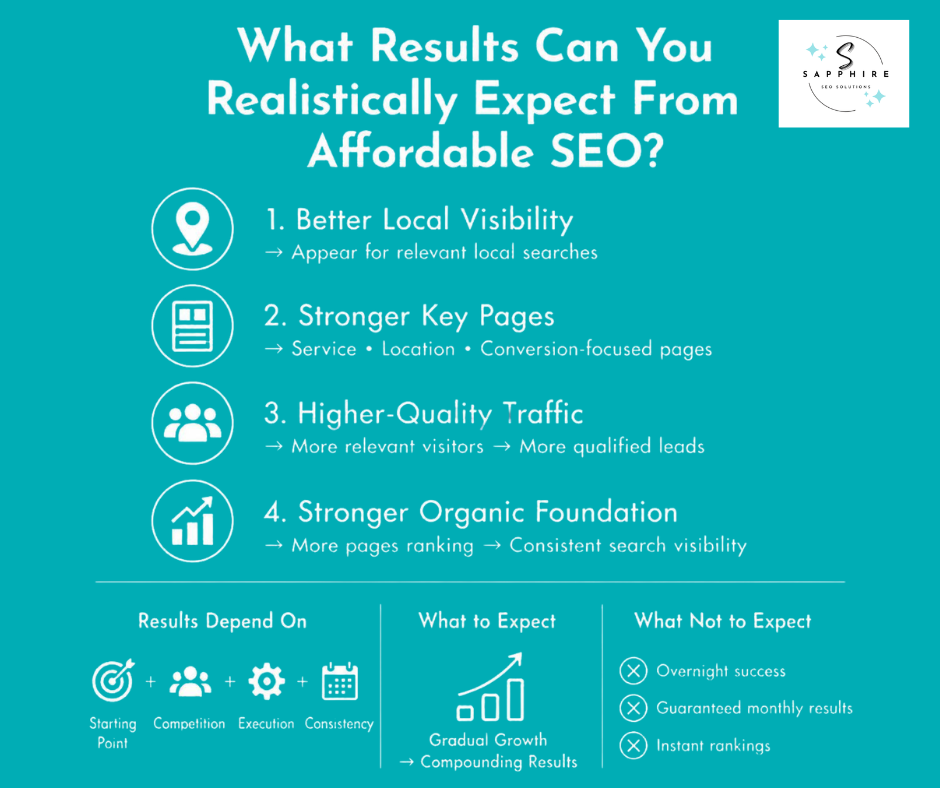
Affordable SEO won't turn a business into an overnight success story. But it can produce real, measurable change over time.
The most common early win is better local visibility. Businesses that weren't showing up for local searches relevant to what they do start appearing where they weren't before. From there, the pages that matter most- service pages, location pages, anything close to a sale- tend to perform better, both in rankings and in how well they convert visitors who land on them.
Traffic quality tends to improve too. It's not just about more visitors. It's about more visitors who actually fit what the business sells, people somewhere further along in their sales journey rather than just browsing. That kind of traffic is more likely to turn into leads, and eventually into sales.
Over time, this builds toward something bigger than any single ranking or keyword: a stronger organic foundation. Pages that used to sit invisible on page five start earning consistent visibility. That foundation doesn't disappear the way paid ad traffic does the moment spending stops.
That said, results depend heavily on where a business starts. A site with major technical problems and zero existing content takes longer to see movement than one that already has some traction. Competition affects the timeline too, and so does how consistently the strategy actually gets executed.
SEO also doesn't work in tidy monthly increments. Results tend to build gradually, then compound, rather than showing up as a guaranteed return every thirty days. A provider with a proven track record should be able to explain that honestly, without promising numbers no one can actually guarantee.
Realistic expectations, paired with focused execution, are usually how small businesses win with SEO. Not shortcuts. Not guarantees. Just steady, well-prioritized work.
How to Choose a Reliable, Affordable SEO Service
Picking the right provider matters more than picking the cheapest one. A few questions can separate a solid, affordable seo agency from one that's cutting corners.
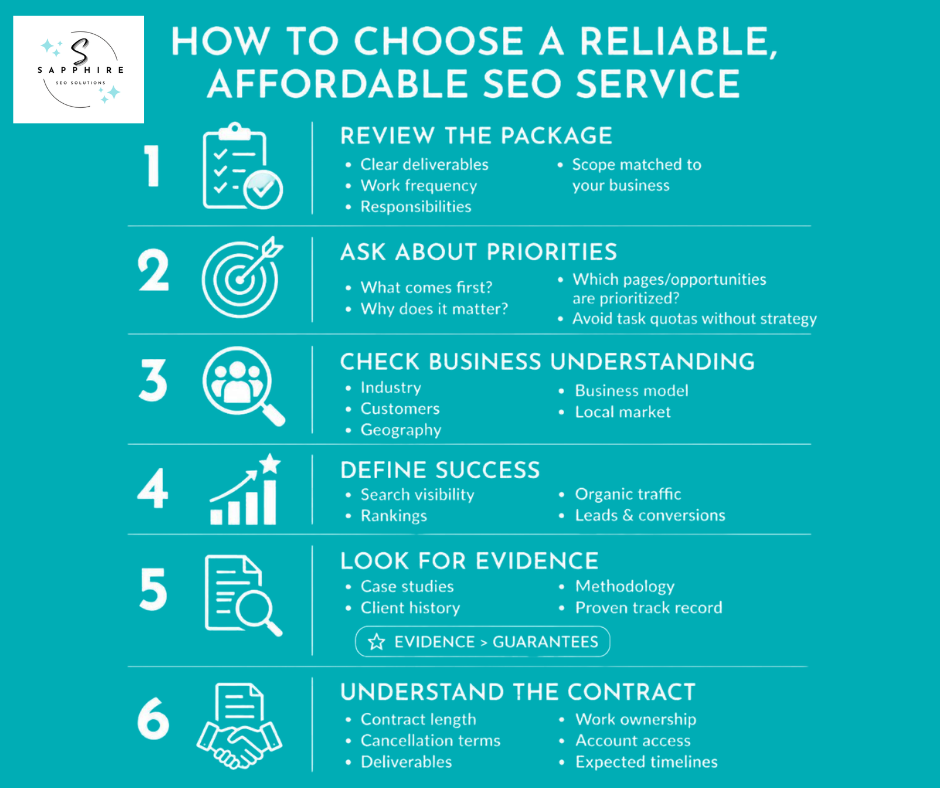
Look at What the Package Actually Includes
Ask exactly what's included, not just the category of work. "SEO services" isn't an answer. Neither is a bullet list of vague tasks with no detail behind them. A solid, affordable SEO agency should be able to explain the actual deliverables, how often work gets done, and who's responsible for what. If SEO services for small businesses are being offered, the scope should match the size of that business, not a copy-paste version of what a much bigger client gets. Good affordable SEO packages spell this out clearly, without you having to ask twice.
Ask How the Strategy Will Be Prioritized
Every business's priorities look different, so the answer to "what are we working on first, and why" should sound specific to your business. A provider should be able to walk through their SEO strategy, explain which pages or opportunities come first, and say why those matter most right now. Watch out for SEO campaigns built around fixed task quotas ("10 links a month," "4 blog posts a month") instead of actual reasoning. Quotas without logic behind them are a warning sign.
Check Whether the Provider Understands Your Business
A provider that understands your customers, your industry, your geography, and your business model will ask questions before making promises. That doesn't mean every provider needs to specialize in your exact industry to do good work. But they should understand who you're trying to reach and where. This matters especially for local SEO services, since things like local citations and Google Business Profile optimization only work well when the provider actually understands the geography and customer base they're targeting. A basic local seo setup should reflect your actual market, not a generic template.
Ask How Success Will Be Measured
Get clear on how progress gets tracked. That should include visibility, organic traffic, and where relevant, leads or other business outcomes, not just a handful of numbers with no context. SEO rankings still matter and shouldn't be dismissed, but they're one piece of the picture, not the whole thing. A provider using Google Analytics or similar tools should be able to show real movement, not just a spreadsheet of jargon.
Look for Evidence, Not Guarantees
Ask for real examples of past work. Case studies, client history, or a clear explanation of methodology all say more than a sales pitch does. A proven track record is a good sign, but testimonials and past results are evidence, not guarantees. Even a provider with a strong history can't promise the same outcome for every business, since every situation is different.
Understand the Contract and Scope
Before signing anything, know the contract term, cancellation terms, what gets delivered and how often, who owns the work once the relationship ends, and whether you'll retain access to your own accounts. A provider that's upfront about all of this, and willing to offer realistic timelines instead of vague promises, is usually one worth trusting.
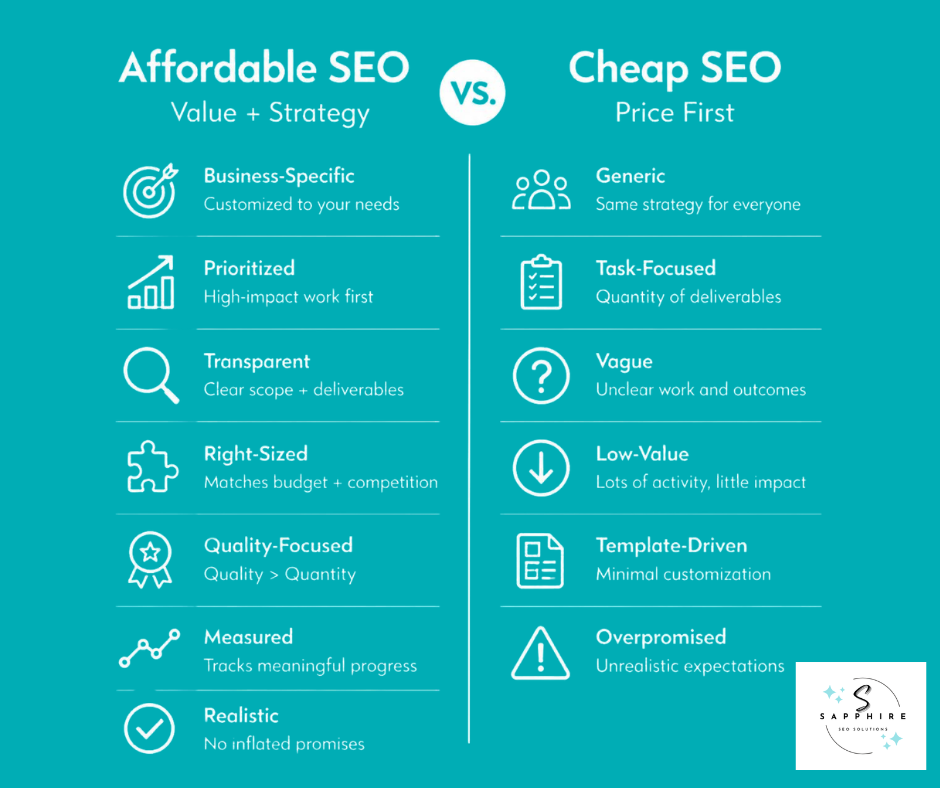
Affordable SEO vs. Cheap SEO: What's the Difference?
These two terms get used a lot interchangeably. They shouldn't be. One is about smart prioritization. The other is usually about price alone.
What Affordable SEO Looks Like
Affordable search engine optimization starts with clear priorities. It's built around the specific business, not a template applied to everyone. The scope is transparent, meaning you know exactly what's being done and why, rather than guessing at what a vague package actually includes.
The strategy fits the business, the budget, and the competition, rather than being oversized or undersized for what's actually needed. Quality takes priority over volume. A handful of well-built pages and a focused campaign will usually outperform a pile of low-effort deliverables. Expectations stay realistic, and progress gets measured in a way that actually means something. Budget-friendly services built this way tend to hold up over time, because they're built on reasoning, not shortcuts.
What Cheap SEO Often Looks Like
Cheap SEO usually starts from the opposite direction: price first, strategy second, or sometimes not at all. The plan looks the same for every client, regardless of industry or goals, because building something custom takes more time than the price allows.
Instead of a few meaningful deliverables, cheap SEO often piles on excessive low-value tasks, work that looks like a lot on paper but doesn't move anything forward. What's actually being done tends to stay vague, and the promises attached to it can sound better than what's realistic. Some cheap SEO leans on diy SEO tools and templates stretched across dozens of clients at once with little real customization behind any of it. That's not automatically harmful. But it often comes without the strategy or oversight that makes SEO actually work.
Warning Signs
A few signals are worth watching for, regardless of price:
Guarantees about rankings or results.
Link building that promises massive quantities of backlinks from other websites in a short period.
Article quotas that seem more about volume than purpose.
No clear explanation of the actual strategy.
Reporting that doesn't explain what happened or why.
No real answer when you ask what work was actually done.
None of this means every low-cost provider is a bad one, or that every cheap tactic causes harm. It means the details, not the price tag, tell you what you're really getting.
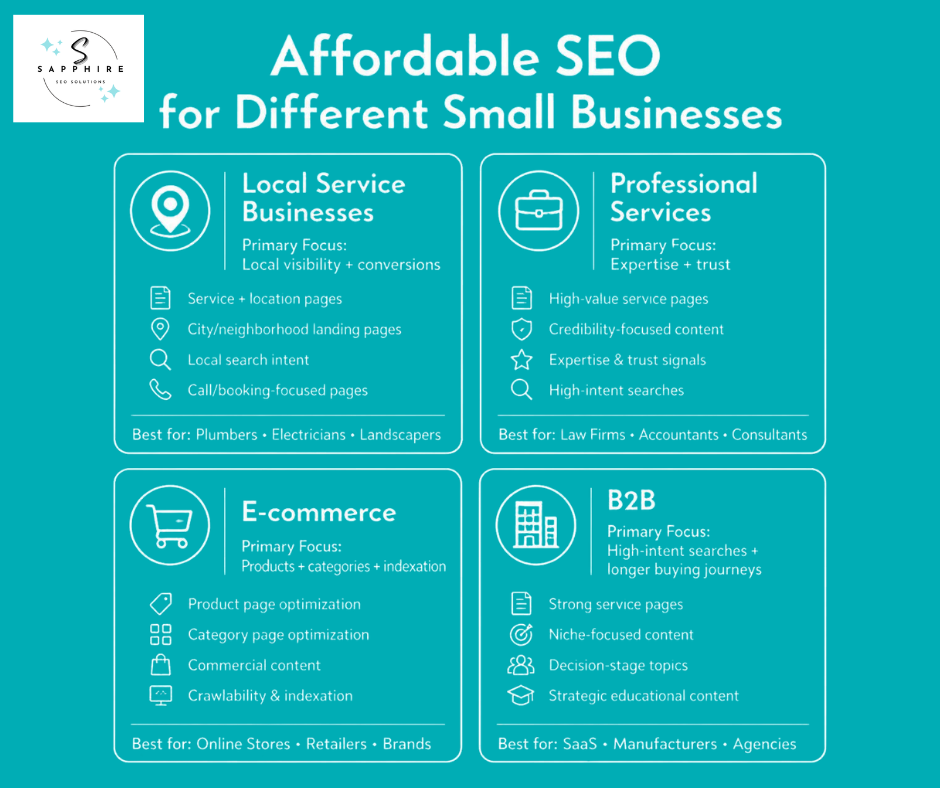
Affordable SEO for Different Types of Small Businesses
What "affordable" actually looks like shifts depending on the type of business behind it. Here is what affordable SEO services look like for different types of small businesses:
Local Service Businesses
For plumbers, electricians, landscapers, and similar businesses, most searches carry clear local intent: someone nearby looking for help right now. Local seo services for these businesses usually center on strong service pages built around specific cities or neighborhoods, since local searches tend to include a location whether it's typed out or not. Local landing pages for each service area, paired with pages built to actually convert a visitor into a call or a booking, tend to matter more here than broad, general content.
Professional Services
Professional services, including accountants, consultants, and law firms, deal with a different kind of search. People searching for these services are often looking for expertise and trust before anything else, since these are decisions that carry more weight and higher stakes than a typical retail purchase. That means content and pages need to reflect real credibility, not just service descriptions. High-value searches in this space tend to be less about volume and more about reaching the right person at the right moment.
E-commerce Businesses
For online stores, affordable SEO usually centers on page optimization across product and category pages, since those are the pages tied directly to commercial queries and actual sales. Content optimization matters here too, but so does indexation, making sure search engines can actually find and crawl every product page in a catalog that might include hundreds or thousands of items.
B2B Businesses
B2B companies and medium-sized businesses often deal with longer buying journeys and more niche audiences, so affordable SEO tends to lean on strong service pages paired with strategic content built for high-intent searches, rather than broad awareness content aimed at a general audience.
When Is Affordable SEO Not the Right Fit?
Affordable SEO works well for a lot of businesses. But it's not the right fit for every situation, and it helps to know the difference before signing up for something that won't match what a business actually needs.
Extremely competitive national markets are one example. A business trying to rank nationally against companies that have spent years and large budgets building authority may need more scope than an affordable package can realistically cover. That's not a flaw in affordable SEO. It's a mismatch between the size of the challenge and the size of the investment.
Unrealistic expectations cause problems too. If a business expects to dominate every search term within a month, no budget, affordable or otherwise, will deliver that. SEO takes time to build, no matter the size of the campaign behind it.
Businesses that need leads immediately are often better served by Google Ads or Meta Ads in the short term, channels built for speed, while SEO builds in the background as a longer-term asset. The same goes for businesses expecting SEO alone to fix a weak offer or a conversion problem on the website itself. SEO can bring the right visitors to the door. It can't fix what happens once they get there.
Major website or platform issues, or a lack of internal capability to actually implement recommended changes, can also slow things down enough that SEO alone won't move fast enough to matter. In those cases, social media marketing or email marketing might serve the business better in the near term, alongside SEO rather than instead of it.
None of this means affordable SEO doesn't work, or that a bigger budget is automatically necessary. The right budget is the one that actually matches the business's goals, competition, and required scope. Nothing more, nothing less.
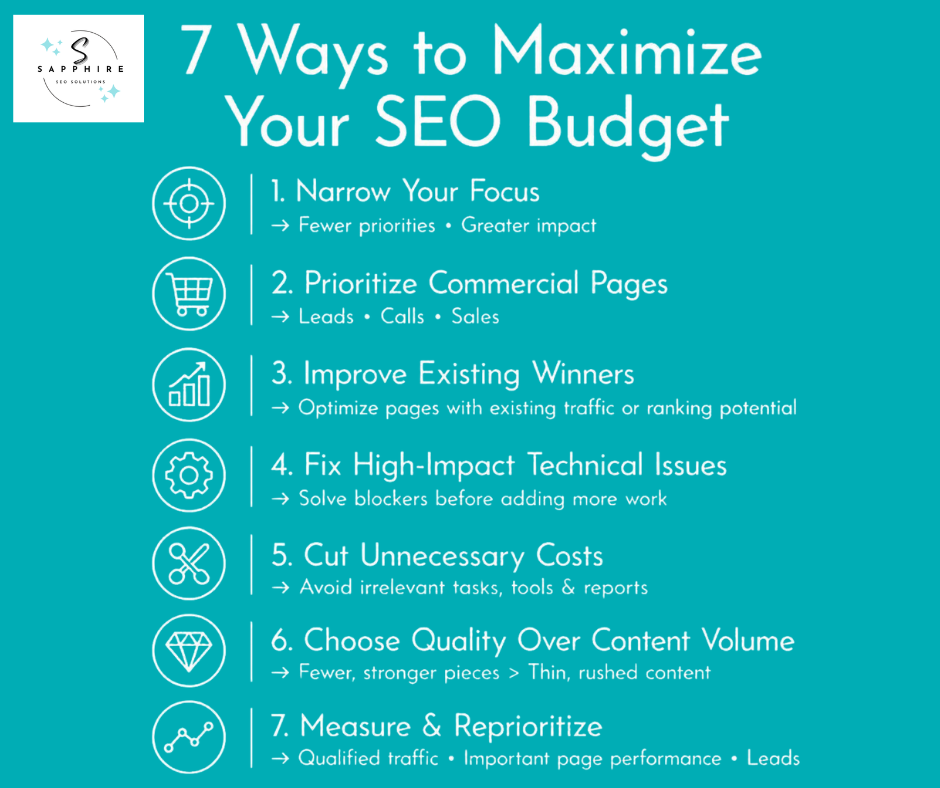
How to Get More SEO Value From a Limited Budget
Getting real value out of a smaller SEO budget isn't about shortcuts. It's about spending every hour on the work that actually matters.
Start by narrowing focus. Chasing every possible opportunity with a limited budget spreads effort too thin to make a real dent anywhere. Fewer, better-chosen priorities almost always beat a long list of half-finished tasks.
Commercial pages deserve attention first, the ones actually tied to leads, calls, or sales. A beautifully optimized blog post means very little if the page where customers actually convert gets ignored. From there, improving pages that already exist and already show some traction is usually a better use of time than starting from scratch. An existing page with decent traffic often needs less work to improve than a brand-new page needs to rank at all.
High-impact problems, the technical issues actually holding a site back, should get fixed before anything else gets layered on top. And it helps to be honest about what's actually necessary. Unnecessary deliverables, extra reports, extra tools, extra tasks that don't tie back to a real goal, eat into a budget that could be doing something more useful.
Content creation works the same way. Publishing fewer, stronger pieces tends to outperform a pile of thin, rushed content writing, especially when the budget can't support both quality and quantity at the same time.
Measurement matters throughout all of this, but it should focus on outcomes that actually mean something: traffic that fits the business, movement on important pages, real leads, not just numbers that look good in a report. Those results should shape what happens next. Priorities should shift based on what's actually working, not stay locked to a plan made months earlier.
Page optimization and on-page optimization done well on the right pages tend to be where small businesses win with a limited budget. And as results build, scaling that investment further usually makes more sense than starting over with something new.
Affordable SEO Services From Sapphire SEO Solutions
Sapphire SEO Solutions provides affordable SEO services for small businesses across all industries, throughout the United States. Our affordable SEO agency's offering is built for business owners who need real search engine optimization work without paying for anything that doesn't apply to their situation.
That idea, not paying for things you don't need, is the core of how Sapphire prioritizes work. Instead of selling a fixed package with the same deliverables for every client, Sapphire customizes each plan around what a specific business actually needs. A local service business with a handful of pages doesn't get billed for the same scope as a business managing a large catalog or competing nationally.
Every campaign starts the same way: a conversation. Sapphire's team discusses goals, needs, and the specifics of the business before running a complete manual audit, done for free, to establish exactly where things stand. That audit becomes a detailed report covering issues found and recommendations to address them. From there, Sapphire builds a personalized SEO services package based on what that report and that business actually require. Once a client approves the plan, the team creates and begins executing the work.
Depending on what a client needs, that work can include technical audits, on-page optimization, content development, and ongoing reporting, among other services tied to small business SEO.
Clients receive monthly reports that break everything down in plain language: where the business stood before the campaign, what work was completed, how that work affected performance, and how the business performed that month. No jargon-heavy spreadsheets left unexplained.
Sapphire's approach to SEO for small businesses centers on this same idea throughout: build the plan around the business, not the other way around.
Business owners who want a clearer picture of where their website currently stands can request a free SEO audit or contact us to schedule a complimentary consultation with one of Sapphire's certified SEO strategists.

FAQs About Affordable SEO
What is the cheapest way to do SEO for a small business?
The cheapest approach usually means fixing high-impact issues first: technical problems, key page optimization, and a handful of realistic keyword opportunities, rather than spreading a small budget across dozens of low-value tasks. DIY work can lower costs further, but it takes real time and some learning curve. For most small businesses, a narrow, focused package from a provider tends to deliver more than a scattered DIY effort.
How much does affordable SEO cost?
There's no single number that applies to every business. Cost depends on competition, geography, the current state of the website, and how many pages and how much content the campaign requires. A focused, single-location campaign typically costs less than one targeting multiple locations or national competition. The right question isn't "what's average." It's "what scope does my business actually need?"
Is affordable SEO worth it?
For most small businesses, yes, as long as the scope matches the goals. A focused campaign built around real priorities can produce meaningful visibility and traffic growth over time. It's not worth it if the budget is so limited that no real strategy can fit inside it, or if the business needs immediate results, SEO simply can't deliver on that timeline.
Can cheap SEO services hurt my website?
Some can, particularly ones that rely on spammy backlinks, automated content, or manipulative tactics that violate Google's guidelines. These practices can lead to penalties that hurt rankings long after the fact. Not all inexpensive SEO carries this risk. The danger comes from the specific tactics used, not the price tag itself.
How long does affordable SEO take to work?
There's no fixed timeline, and any provider promising one isn't being fully honest. Results depend on the starting condition of the site, the level of competition, and how consistently the work gets executed. Many small businesses start seeing early movement within a few months, with results building further from there. SEO tends to compound over time rather than deliver results in tidy monthly chunks.
What is local SEO and why is it important for a small business?
Local SEO focuses on helping a business show up in searches from people nearby, things like "plumber near me" or "best bakery in [city]." It typically includes a well-optimized Google Business Profile, location-specific pages, and local citations (mentions of the business's name, address, and phone number across other websites). For any business that depends on customers in a specific area, local SEO is often the highest-value place to start.
How can I spot a reputable yet inexpensive SEO provider for a startup?
Look for a provider who asks real questions about the business before proposing a plan, explains deliverables clearly instead of using vague package language, and can show past work or case studies rather than relying on guarantees. Transparent reporting and a clear explanation of contract terms matter too. A reputable provider will be upfront about what a limited budget can and can't realistically achieve, rather than overpromising to close the deal.