

AI SEO KPIs to Track: Metrics That Measure Visibility, Authority, and AI Retrieval Success
AI SEO KPIs you need to track are the metrics that measure how often content is retrieved, cited, trusted, and accurately represented by AI-driven search systems, such as Google AI Overviews, ChatGPT, Perplexity, and Gemini. Traditional SEO metrics, such as rankings, clicks, and sessions, no longer reflect visibility in AI-mediated discovery environments. The most important AI SEO KPIs include chunk retrieval frequency, AI visibility, embedding relevance, AI citation count, attribution rate, vector index presence, sentiment, correctness, and zero-click surface presence. Tracking these metrics helps brands understand how AI systems evaluate authority, select sources, and influence user decisions before a click occurs.
Key Takeaways
AI SEO KPIs you need to track are metrics that measure content visibility, retrieval, and authority in AI-driven search environments.
Traditional metrics are fading. Rankings, clicks, and sessions no longer reflect success in AI-mediated discovery.
Focus on machine-validated authority. Track citations, correctness, and consistency to establish trust with AI systems.
Monitor AI visibility and retrieval. Ensure your content is indexed, chunked, and retrievable across major AI platforms.
Optimize for zero-click impact. Improve semantic clarity, structured content, and embedding relevance to appear in AI answers.
Most marketers don't realize it, but search is changing incredibly fast. AI SEO is reshaping how people discover brands, and the old playbook isn't working anymore. How so? The old KPIs built for blue links and browser sessions are becoming relics, as AI-driven systems prioritize different metrics.
Whether it's ChatGPT or any other AI tool, whenever someone asks them for a recommendation, they get it immediately. Even when you search for a question on Google, you get an AI-generated response first. This is known as AI Overviews, and because of this, people are not scrolling down to click on pages.
Right now, your brand either appears in that AI-generated answer or it doesn't exist. This means that the traditional SEO KPIs you used to track are no longer viable.
Today, it's important to track metrics associated with AI-driven search. Because AI summaries have reduced CTR by 34.5% and organic traffic is expected to drop 25% by 2026.
Sapphire SEO Solutions and our team understand that the future of search is GEO, and we have already gained the right certifications to offer affordable AI SEO services. This ensures that our clients have the right strategy to keep delivering results even in the era of AI-generated responses.
In this comprehensive guide, we will cover:
Why are old KPIs fading?
Which old KPIs are fading?
What are the new AI SEO KPIs you should track?
Let's get started!
Why Are Old KPIs Fading?
The search environment, dominated by Google's ten blue links, is disappearing. AI-driven discovery systems are replacing it by answering questions directly. This changes how we measure success completely.
Intent and LLM reasoning have become more important than keyword-matching when it comes to search behavior. When someone asks ChatGPT a question, they're not looking for a list of websites. Instead, they want answers, which makes ranking meaningless for AI-driven searches.
The worst part? AI-mediated search takes up massive real estate in the SERP. Even if you are ranking at the top of the SERPs, Google's AI Overviews completely overshadows your link.
Since fewer people are scrolling down, you're getting fewer clicks, and there's not much you can do about it except change your SEO strategies.
Want to know what's happening behind the scenes? AI systems pull information from vector databases while synthesizing answers from multiple sources instead of crawling and ranking web pages. If AI cannot retrieve your content, you're losing out on traffic. Authority is more than backlinks (off-page SEO). It's machine-evaluated.
The fading traditional SEO metrics can't tell you if your brand appears inside an AI-generated answer. Why? Old-age KPIs only measure clicks, sessions, and impressions.
These don't matter in the AI search era (search and discovery environments), as user attention is captured before anyone clicks. The traditional SEO metrics were built for human interaction with search engine result pages (SERPs), which is no longer the primary way users engage with content in the AI search era.
LLM-led search prioritizes:
Accuracy and factual correctness
Authority backed by data and expert signals
Sentiment and brand perception
Trust and consistency across sources
Semantic relevance to user intent
SEO success has gone beyond appeasing traditional SERPs. It's now determined by AI-driven interfaces like Google AI Overviews, ChatGPT, Perplexity, and Gemini, among others.
These AI-mediated systems, beginning to dominate discovery, don't care about your click-through rates. They care whether your content is retrievable, trustworthy, and useful enough to cite.
This means that if you need to survive in this landscape, you need to track metrics that are relevant. To measure AI in SEO, track core metrics like Organic Traffic, Conversions, Keyword Rankings, and CTR, alongside AI-specific KPIs such as Visibility in AI Snippets and Attribution in AI Outputs.
Which Old KPIs Are Fading?
If you're running the old SEO dashboard, you're still tracking traditional SEO KPIs. While those are still important today, they're losing value as every day passes by.
Since AI answers don't display ranked lists like traditional SERPs, keyword rankings lose their importance. This could explain why your clickthrough rates or organic traffic are on a continuous downward trajectory.
Let's look at this deeper. Bounce rates don't matter. When someone gets an answer from AI Overview, does that count as a bounce or a success? In the digital world where positions have become irrelevant, the average position bounce rate is just noise.
The same is the case with the average session. In most cases, with AI answers, you won't have the need to visit pages. This means that if you have shorter sessions, your content hasn't failed, but you answered the question faster.
Backlinks used to be super important to build authority. Today, machine-validated authority systems matter more. AI doesn't care about citations or how many sites link to yours.
Impressions measure exposure on traditional search engines. They don't tell you if anyone is seeing your brand in AI-generated responses.
Featured snippets? It's the past. Now, they're being replaced by AI snippets and retrieval-based summaries.
With AI-driven answers, visibility happens before people even visit your site. This makes page views or sessions irrelevant. If you're only tracking what happens after the click, you're missing where most discovery now occurs.
Here's just what matters: these metrics aren't useless yet, but they're incomplete. As your bounce rate steadily declines, you need to start tracking AI SEO KPIs.
22 Important AI SEO KPIs You Need to Track
In the generative AI search era, what matters is whether your content gets retrieved, cited, or trusted by AI systems throughout the AI search pipeline. This means that you need to track AI native KPIs, which include the following:
1. Chunk Retrieval Frequency
The number of times your content gets pulled by AI models is commonly referred to as chunk retrieval frequency. Retrieval Augmented Generation (RAG) systems won't cite what they can't retrieve. So, how does this work?
Chunk retrieval frequency is your site's visibility. RAG systems segment content into smaller passages before retrieval. If AI systems aren't getting chunks of your content, it won't appear in the answer. This makes retrieval an important metric to track.
For AI systems to use your content, it needs to be properly formatted and have semantic clarity. To diagnose structural issues before they cost you visibility, we highly recommend chunk retrieval run tests.
High frequency means your content is being consistently pulled for AI answers, while low frequency means that AI systems find your competitors' content better-structured.
2. AI Visibility
How your brand appears in AI-generated results across platforms like ChatGPT is commonly referred to as AI visibility. Instead of rankings where you're tracking positions, you need to use LLM tools to track brand mentions.
Platforms like Ahrefs Brand Radar and Semrush Brand Monitoring can help you see how many times your site appears in AI-generated summaries, explanations, or recommendations across different AI systems.
Consistent AI visibility is a good signal of authority, while lower, inconsistent visibility suggests that AI systems don't understand the topic or your content.
3. Embedding Relevance Score
To measure semantic similarity between your content embeddings and common search terms, you must track the embedding relevance score. This can help determine if your content can be found in vector search.
Since vector databases store content as mathematical representations and not keywords, you're invisible if your embeddings don't match what users are asking about. High relevance means that you're addressing topics that users are actually asking AI platforms.
Why is this metric important? The embedding relevance score is a great way to track if your content is off-topic. This metric looks at semantic alignment between queries and content.
Here, semantic density also plays an important role. Content with more meaning per sentence is likely to score higher.
Another thing to keep in mind is that embedding relevance score has a correlation with chunk retrievability and AI citation likelihood. This makes it a crucial indicator of overall AI performance.
4. AI Citation Count
The number of times your domain gets cited in AI outputs is commonly referred to as the AI citation count. It's similar to backlinks in the traditional SEO world.
So, what does this metric show? In LLM systems, the AI citation count indicates:
Trust
Authority
Factual reliability
Since AI models only cite sources they consider accurate and authoritative, rising citations means that you're building an authoritative footprint in the AI ecosystem. To monitor citation frequency, use tools like Ahrefs, RankPrompt, and Profound AI, among others.
So, what are you looking for? You need to keep an eye out for trends, whether they're growing signals or declining citations. These feed back into future content retrieval.
5. Attribution Rate in AI Outputs
To measure the percentage of AI answers that credit your brand directly, you must track the attribution rate. This includes metrics like linked URLs, quoted statements, or named mentions.
A high AI attribution rate is a good sign of credibility, transparency, and strong brand presence. It's useful for seeing how often you get "credit" inside AI-generated content versus being used without acknowledgment. This is because some AI systems use your content without mentioning you, while others cite you.
6. AI Traffic
When AI assistants mention your site, and people click on it, it is referred to as AI traffic.
Right now, although the volume is much smaller than traditional organic traffic, it has a high conversion rate. This is because users who come to your site through AI platforms have already made their decision based on the AI's recommendation or explanation.
In your analytics, it's important to analyze AI traffic separately. To isolate AI referrals from traditional search traffic, you need GA4 segmentation and custom dimensions.
7. Vector Index Presence Rate
The number of times your content is successfully indexed in the model's vector index or retrievable corpus is referred to as the vector index presence rate. Simply put, it is an index coverage for the AI world.
So, what's the logic behind tracking this? Well, if content is missing from the index, it cannot be retrieved. And AI platforms do not cite or reference content that cannot be retrieved.
Since this metric is influenced by crawlability, technical SEO, and structured formatting, you need to make sure that your content is clean and formatted the right way to ensure chunking and embedding.
Start by checking whether AI bots like GPT Bot can access your site. If they cannot or if they're facing errors, it can adversely impact your vector index presence rate.
8. Sentiment
What AI models think about your brand is referred to as sentiment. This includes:
Perceived tone
Reputation
Strengths
Weaknesses
Objections
Risks
Analyzing sentiments involves examining all of the tone classifications, whether they are positive, neutral, or negative, across different queries and contexts.
To test sentiment, give an AI platform a prompt like: "What do you know about [brand]?" When you get the response, analyze it and evaluate how AI systems characterize you. Pay attention to patterns, not just individual answers.
Brand Skeptic by ChatGPT and manual LLM analysis can help audit sentiments regularly and capture negative perceptions before they spread.
9. Retrieval Confidence Score
The likelihood that an AI selects your content over others when answering a query is commonly referred to as the retrieval confidence score.
Higher confidence is good, as it signals more reliable, factual, well-structured content, while lower confidence shows that the model is uncertain about your content's accuracy or relevance.
Tracking this metric helps you know which content is trusted by LLM systems and which needs improvement.
10. Correctness
AI hallucinations can damage your reputation or misrepresent your products. AI tools can confidently state incorrect information regarding your business, and readers will believe it. Why does this happen? Because of poor online clarity or a lack of authoritative signals.
To monitor AI hallucinations, you must track correctness, which measures whether AI describes your brand, services, and claims accurately in AI-generated responses. If an AI platform is citing a URL that doesn't exist, you should create content or ensure the right redirect.
11. RRF Rank Contribution
Reciprocal Rank Fusion (RRF) determines how multiple retrieval sources blend results. Reciprocal rank fusion models combine signals from embeddings, keywords, metadata, and other factors.
What does this metric do? RRF helps measure how your content ranks across diverse retrieval components. It shows consistency across multi-stage retrieval, revealing whether you're strong in just one signal or multiple.
RRF rank contribution explains how a chunk influences the final ranking in RRF-based rerankers. If you score high on embeddings but low on metadata, your overall contribution suffers.
High contribution means your content consistently ranks across many signals. This is helpful for understanding multi-signal visibility inside AI systems and identifying weak spots in your optimization strategy.
12. Brand Authority Score/Perceived Authority
Brand authority score evaluates whether AI perceives your brand as an expert in its niche. Unlike traditional domain authority, this isn't a formal search engine signal based on links. It's about how AI models assess your expertise.
AI prioritizes authoritative, data-backed content when generating answers. Influenced by original research, data, certifications, expert quotes, and structured claims, this metric reflects whether AI sees you as credible.
Key signals include:
Statistics
Quotes from experts
Case studies
Original research
Verifiable data
Content that cites sources and presents factual claims performs better than opinion-based or vague content.
A strong correlation exists with AI citations and answer inclusion. Brands with high perceived authority get cited more often and appear in more answers. Entity Authority tracks a site's depth and recognized expertise on a subject, which is crucial for AI prioritization of authoritative sources. This is critical for industries where expertise is required, like YMYL, B2B, and healthcare.
13. Content Consistency Score
Content consistency score ensures AI presents consistent facts about your brand across platforms. It measures how often AI responses vary between ChatGPT, Google, Perplexity, and other systems.
Inconsistency indicates unclear content signals or conflicting data online. If one AI says you offer a service and another says you don't, users lose trust, and AI systems lose confidence.
This is a key KPI for reducing hallucinations and improving correctness. Consistent information across your website, social profiles, and third-party mentions helps AI models converge on accurate representations.
Audit your brand information regularly across platforms. Fix contradictions, update outdated claims, and ensure your core facts are uniform everywhere AI might encounter them.
14. LLM Answer Coverage
LLM answer coverage measures how many queries or topics your brand appears in within large language models' responses. It's equivalent to keyword coverage, but intent-based and AI-native.
This metric measures how broadly useful your content is to LLMs. Narrow coverage means you appear for a few specific questions. Broad coverage means you're relevant across many question types and user intents.
LLM answer coverage tracks the breadth of brand visibility across question types. Broad coverage equals more entry points into AI responses and more opportunities to capture user attention.
This helps identify topics where you could or should appear but currently don't. If competitors show up for adjacent topics and you don't, that's a gap worth addressing.
15. Snippet Retrieval Frequency
Snippet retrieval frequency measures how often specific snippets or fact blocks from your site appear in AI answer composition. This is different from chunk retrieval.
Chunk retrieval is about access. Snippet retrieval is about content selection inside the answer itself. Your content might get retrieved but not quoted, or it might get quoted frequently because it's perfectly formatted.
This metric is useful for evaluating structured statements, definitions, stats, and FAQs. Well-formatted facts are more likely to be pulled verbatim into AI answers.
If certain snippets appear often, double down on that format. If they don't appear despite high retrieval, the formatting or clarity needs work.
16. AI Model Crawl Success Rate
AI model crawl success measures whether AI model crawlers can successfully access, parse, and index your content, and how much of your site AI bots can access. If site AI bots can't crawl you, nothing else matters.
This includes bot accessibility for OpenAI, Anthropic, Google-Ext, and others. It also covers sitemaps, robots.txt configuration, and technical hygiene that enables crawling.
Crawl failures prevent your content from entering the LLM ecosystem entirely. Check Google Search Console and server logs to confirm AI bots aren't being blocked or encountering errors.
Many sites accidentally block AI crawlers via robots.txt or poorly configured firewalls. Fix these issues first before worrying about optimization. No crawl means no index, no retrieval, and no visibility.
17. Semantic Density Score
Semantic density score measures the "conceptual richness" of your content inside an embedding. It's about how much meaning your content carries per token or content block.
High semantic density means content that carries more meaning per token gets retrieved more often. Dense, well-structured content is reused more often by AI systems because it efficiently delivers information.
This metric encourages tight, information-rich writing versus fluff. Long-winded explanations with low information density score poorly. Clear, fact-packed content scores high and performs better in retrieval systems.
18. Zero-Click Surface Presence
Zero-click surface presence measures whether your brand appears in AI answers even when it generates no clicks. This is visibility in AI surfaces where no click occurs, like voice assistants, AI summaries, and chatbot responses.
It includes citations, brand mentions, recommendations, and entity recognition. Even if users never visit your site, they're being exposed to your brand and associating you with specific topics.
This is the new impressions metric. Traditional impressions measured how often your link appeared in search results. Zero-click surface presence measures how often your brand appears in answers, whether clickable or not.
This is critical for measuring brand impact in an AI-first world with declining clicks. Brand awareness and authority can grow even when traffic doesn't. Presence matters as much as visits now.
19. Machine-Validated Authority
Machine-validated authority is authority determined by AI models, not backlinks. It's authority as judged by modern AI systems based on algorithmic verification, not popularity contests.
This replaces Domain Authority with algorithmically verified authority. It's derived from multiple signals:
Citations in AI outputs
Correctness scores across models
Consistency of information
Structured claims and data
Factual accuracy verification
Appearance in high-confidence answers
Traditional domain authority signals relied on link graphs. Machine-validated authority relies on whether AI systems trust your content enough to use it. The shift is from who links to you to whether AI believes you.
20. AI Overviews Visibility
AI Overviews visibility measures how often your content appears inside Google's AI Overviews, specifically. This feature is fast becoming one of the most important discovery surfaces in search.
It includes content selection, sources listed, and category-based visibility. Google AI Overviews synthesize answers and cite sources, and appearing there drives significant brand exposure even without clicks.
Track this separately from general AI visibility because Google's reach is massive. Optimizing for AI Overviews means optimizing for the largest AI-driven discovery surface available today.
21. AI Model Misconceptions/Hallucination Tracking
This KPI tracks repeating inaccuracies AI generates about your brand. It can include outdated info, incorrect services, invented quotes, or fake URLs that never existed.
Hallucination tracking provides insight into where your content ecosystem is unclear or weak. If multiple AI models make the same mistake, something in your online presence is confusing or contradictory.
This helps prioritize content updates and fact-clarification efforts. Focus on fixing the most frequent or damaging misconceptions first, then work through less critical ones.
Regular monitoring prevents small inaccuracies from becoming "accepted facts" across AI platforms. Correct errors early before they spread.
22. AI Traffic Conversion Rate/Quality Metrics
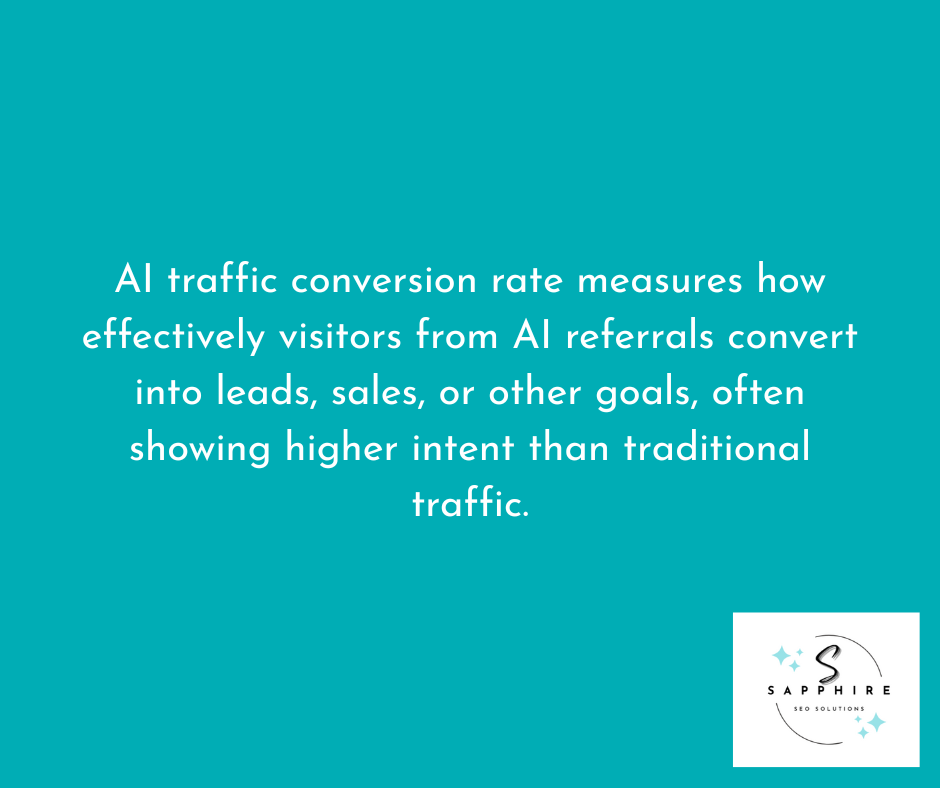
AI traffic conversion rate measures how well AI-referred traffic converts into leads, sales, signups, and other goals. Track this in Google Analytics with proper segmentation.
AI-driven traffic is often smaller but higher intent. Users who click through from an AI answer have been pre-qualified by the AI's recommendation, making them more likely to convert.
Include engagement metrics like time on page, scroll depth, and conversion actions. These reveal whether AI is sending the right audience, not just any audience.
This is critical for proving the ROI of AI SEO efforts. If AI traffic converts at 3x the rate of traditional organic, despite lower volume, that justifies investment in AI optimization.
AI SEO Best Practices to Get Featured by AI
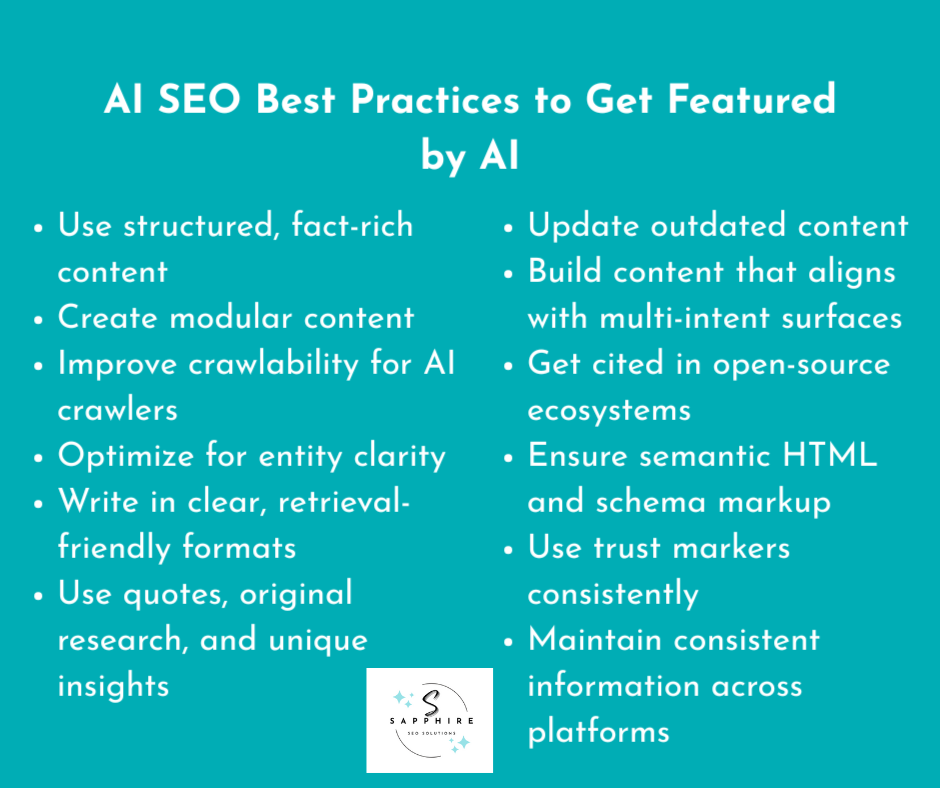
Here are some of the best practices to follow if you want your business to get cited by AI:
Use structured, fact-rich content so that AI can easily pull information.
Create modular content, as it performs well since AI pulls information in chunks.
Check robots.txt, server logs, and firewall settings to ensure AI bots aren't blocked to improve crawlability.
Use consistent naming, structured data, and clear definitions to optimize for entity clarity.
FAQ sections, bullet points, and short paragraphs work best, so write in clear, retrieval-friendly formats.
AI models prioritize authoritative sources, which is why you should strengthen brand authority with expert quotes, original research, and unique data.
Always use original research, proprietary data, and unique insights over generic content to increase your chances of getting a mention.
Since inconsistencies can reduce AI confidence, make sure to maintain consistent information across all platforms.
Regularly audit your content to reduce hallucinations and keep AI responses accurate.
Create how-tos, comparisons, definitions, and overviews to cover multiple intents and increase your answer coverage.
Try to get some citations from sources like Wikipedia, GitHub, ResearchGate, and Wikidata to boost authority.
Use Semantic HTML to help AI systems understand your content structure and schema markup to provide explicit signals about entities, relationships, and content types.
Use author info, citations, and timestamps to help AI systems assess whether your content is authoritative and current.
The goal isn't to trick AI systems. It's to make your content as clear, structured, and trustworthy as possible so AI can confidently retrieve and cite it. When it comes to AI chat interfaces, it's all about ensuring clarity and demonstrating authority.
Work with Sapphire SEO Solutions to Dominate AI Search Results Today!
AI search is rewriting the rules, and most businesses are still playing by the old playbook. While your competitors chase keyword rankings, we're getting our clients featured in ChatGPT answers, Google AI Overviews, and Perplexity results.
Sapphire SEO Solutions specializes in AI SEO strategies that actually work. We don't just optimize for search engines. We optimize for retrieval, citations, and trust across every major AI platform where your customers are finding answers.
According to Search Engine Land, by 2026, organic traffic could drop 25% as AI answers replace traditional clicks. Waiting means losing visibility to competitors who are already optimizing for AI-driven discovery.
Ready to show up where your audience is actually searching? Contact us to schedule a free consultation with an expert today!

Frequently Asked Questions - AI SEO KPIs
How do you track AI citations across ChatGPT or Perplexity?
Use tools like Ahrefs AI Citations, LLM Refs, Waikay, and AIRank to monitor when your domain appears as a source in AI outputs. You can also manually test by querying ChatGPT, Perplexity, Claude, and Gemini with relevant questions in your niche, then tracking whether your brand or website gets cited in the responses. Set up regular monitoring schedules (weekly or monthly) and document patterns to identify which content gets cited most often and which topics need improvement.
What causes AI to ignore or misrepresent your brand?
AI ignores brands when content isn't crawlable, lacks semantic structure, or doesn't align with user intent in vector space. Misrepresentation happens when your online information is inconsistent across platforms, outdated, or contradictory, causing AI models to hallucinate or blend conflicting signals. Poor entity clarity (inconsistent brand names, vague descriptions) and lack of authoritative markers (no author info, no citations, no structured data) also reduce AI confidence in your content. Fix these issues by maintaining consistent information everywhere, using clear semantic HTML, adding schema markup, and regularly updating your content.
How often should you measure AI visibility KPIs?
Monthly tracking is ideal for most businesses, with weekly checks for high-priority campaigns or during major content launches. AI models update frequently, and visibility can shift as new content enters the ecosystem or competitors optimize their presence. Track sentiment and correctness quarterly unless you're in a reputation-sensitive industry, where weekly monitoring makes more sense. High-traffic sites or brands in competitive niches should monitor AI citations and visibility weekly, while smaller businesses can get by with monthly reviews and quarterly deep audits.
Can AI SEO be influenced the same way as traditional SEO?
Not exactly. AI SEO focuses on retrieval and trust rather than ranking and links. You can't manipulate AI citations the way you might build backlinks, and keyword stuffing won't help with embedding relevance. Instead, AI SEO responds to clarity (structured content, semantic HTML), authority (original data, expert quotes, citations), consistency (uniform information across platforms), and technical accessibility (crawler access, proper formatting). The principles are similar (create valuable, authoritative content), but the tactics are different (optimize for chunking, embeddings, and retrieval confidence rather than keyword density and link velocity).
Do backlinks still matter for AI-driven search?
Backlinks matter less but aren't irrelevant. AI models care more about machine-validated authority (citations, correctness, consistency) than link popularity, but backlinks from authoritative sources still signal credibility and can influence how AI perceives your domain. High-quality backlinks from Wikipedia, research institutions, industry authorities, and reputable news sources help establish trust signals that AI models recognize. Focus on earning citations in open-source ecosystems and authoritative publications rather than chasing volume, because quality and context matter more in AI-driven search than sheer link count.
Do keywords still matter for AI-driven search?
Yes, but differently. AI search relies on semantic understanding and intent rather than exact keyword matching, so focus shifts to topic coverage and conceptual alignment. Keywords help AI understand what your content is about, but embedding relevance and semantic density matter more than keyword density. Use natural language that matches how people ask questions to AI, cover topics comprehensively rather than targeting specific phrases, and structure content around entities and concepts rather than keyword variations. Think "semantic intent" instead of "keyword targeting," and write for clarity and information richness rather than keyword placement.
What tools do I need to monitor AI SEO KPIs effectively?
Start with LLM Refs or Ahrefs Brand Radar for visibility tracking, Waikay for retrieval diagnostics and correctness monitoring, and GA4 with custom segmentation for AI traffic analysis. Use Brand Skeptic GPT or manual prompting for sentiment analysis, check server logs (via tools like Logflare or directly) for AI bot crawl success, and monitor Google Search Console for AI Overviews visibility. For embedding and semantic analysis, tools like OpenAI's embedding API or Pinecone can help advanced users, but most businesses can start with the first three tools and manual testing across ChatGPT, Perplexity, Claude, and Gemini to understand their AI presence.
How does AI determine authority or trustworthiness?
AI evaluates authority through multiple signals: citation frequency (how often you're referenced), correctness scores (factual accuracy across models), consistency (uniform information across platforms), structured claims (data, stats, research), and appearance in high-confidence answers. AI models also weigh sources differently based on where else your content appears (Wikipedia citations carry more weight), whether you use trust markers (author credentials, publication dates, citations to reputable sources), and how well your content aligns with established knowledge. Original research, unique first-party data, expert quotes, and clear sourcing all boost perceived authority, while contradictions, outdated info, and vague claims reduce it.
Which KPIs matter most for businesses with low traffic?
Focus on AI visibility, sentiment, and correctness first since these measure brand presence regardless of traffic volume. Track chunk retrieval frequency and embedding relevance to understand whether your content is even retrievable, then monitor AI citation count to see if you're building authority. Low-traffic businesses should prioritize zero-click surface presence over traffic metrics because brand awareness in AI answers can build authority before traffic grows. Content consistency score also matters since you need an accurate representation, even if a few people visit your site. Once these fundamentals are solid, add vector index presence rate and AI model crawl success rate to ensure technical accessibility.
How do I improve my content's retrieval success?
Structure content in modular, stand-alone chunks with clear headings, use semantic HTML and schema markup, and write in retrieval-friendly formats like FAQs, definitions, and lists. Increase semantic density by packing more meaning into fewer words, ensure AI crawlers can access your site (check robots.txt and server logs), and maintain consistent entity naming throughout your content. Add trust markers (author credentials, publication dates, citations), use original data and research to differentiate from competitors, and align content with how people ask questions to AI systems. Update outdated content regularly, fix contradictions across your site, and get cited in authoritative open-source ecosystems like Wikipedia and ResearchGate to boost retrieval confidence.