

How to Improve Page Ranking for a Medical Practice
Medical practices improve page ranking by optimizing Google Business Profiles, building E-E-A-T signals through physician credentials, targeting local and intent-based keywords, fixing technical SEO issues, and generating consistent patient reviews. Google classifies healthcare content as YMYL, requiring higher accuracy and trust standards. A structured 90-day SEO plan, starting with technical fixes, then content optimization, then authority building, produces sustainable ranking improvements and measurable patient acquisition growth.
Key Takeaways
77% of patients use online search to book appointments; page-one rankings are non-negotiable.
Optimizing your Google Business Profile and local citations puts you in front of nearby, ready-to-book patients.
E-E-A-T signals like physician bios, credentials, and cited sources are ranking requirements, not optional extras.
Fix crawl errors, Core Web Vitals, and mobile usability before investing in content or backlinks.
84% of patients check reviews before choosing a provider; a consistent review generation process is essential.
When a patient needs a new doctor, their first move is rarely a phone call to a friend. It's a Google search. For a medical practice, that search is where patient acquisition either begins or gets handed to a competitor.
According to a recently reported survey, over 77% of patients use online searches to book appointments. That number alone explains why search visibility has become one of the most important assets a healthcare provider can build.
The competition in local medical search is growing. More practices are investing in digital marketing, more urgent care clinics are opening in established neighborhoods, and Google's search results are getting more crowded with every passing year. A practice that isn't actively working to improve page ranking is losing ground by default.
That's where medical SEO comes in. Search engine optimization gives healthcare providers a way to get in front of the right patients at the right moment before those patients ever visit a competitor's website or walk through a competitor's door.
At Sapphire SEO Solutions, we offer medical SEO services to medical practices, helping them show up where and when they need to in the online world. From content marketing to digital marketing, we handle everything under a single roof.
This guide covers everything a medical practice needs to know to improve search rankings, attract more patients, and increase appointment bookings. Let's get started!
Why Search Rankings Matter for Medical Practices
Patients today find doctors online. They type a symptom, a specialty, or a location into Google, and they choose from what appears on that first page. The practices that show up are the ones that get the call. The ones that don't are simply invisible.
According to Ahrefs, 96.6% of users click on the first page of Google search results. In other words, if a potential patient searches for a cardiologist, a pediatrician, or an urgent care clinic in your area and your practice is sitting on page two, you may as well not exist to them.
Online visibility doesn't stop at organic results either. Google's local pack is its own competitive arena. 44% of local searchers, according to SOCi, click on local pack results. For a medical practice, appearing in that three-pack is often the difference between a full appointment schedule and an empty waiting room.
There's also the matter of patient trust. Ranking on page one carries a credibility signal that paid advertising simply cannot replicate. When a practice appears at the top of organic search engine rankings, patients interpret that as an endorsement. That perception directly influences whether they click, call, and ultimately book.
The relationship between visibility and appointment volume follows naturally from there. More visibility means more clicks. More clicks mean more calls and form submissions. More inquiries mean more booked appointments. The pipeline is straightforward once the rankings are in place.
The Cost of Poor Visibility
Poor online visibility doesn't just mean fewer new patients. It means those patients are going somewhere else.
Every day, a practice ranks on page two or lower, and competitors on page one are capturing that local traffic. Those are real appointment opportunities.
Practices with poor search engine rankings often compensate with paid advertising. This is an expensive substitute. Pay-per-click campaigns generate traffic only as long as the budget keeps running. The moment spending stops, the visibility disappears. Organic rankings, by contrast, compound over time. The investment builds an asset rather than renting attention.
There is also a longer-term cost to consider. A practice that consistently fails to appear in local search gradually cedes authority in its market. Potential patients begin to associate visibility with credibility, and a competitor who ranks well month after month starts to look like the obvious choice. Visibility shapes perception, and perception shapes patient decisions.

Understand How Patients Search for Healthcare Services
Before a medical practice can rank for the right terms, it needs to understand why patients search in the first place. That reason is called the user's search intent, and it is the foundation on which every effective SEO strategy is built.
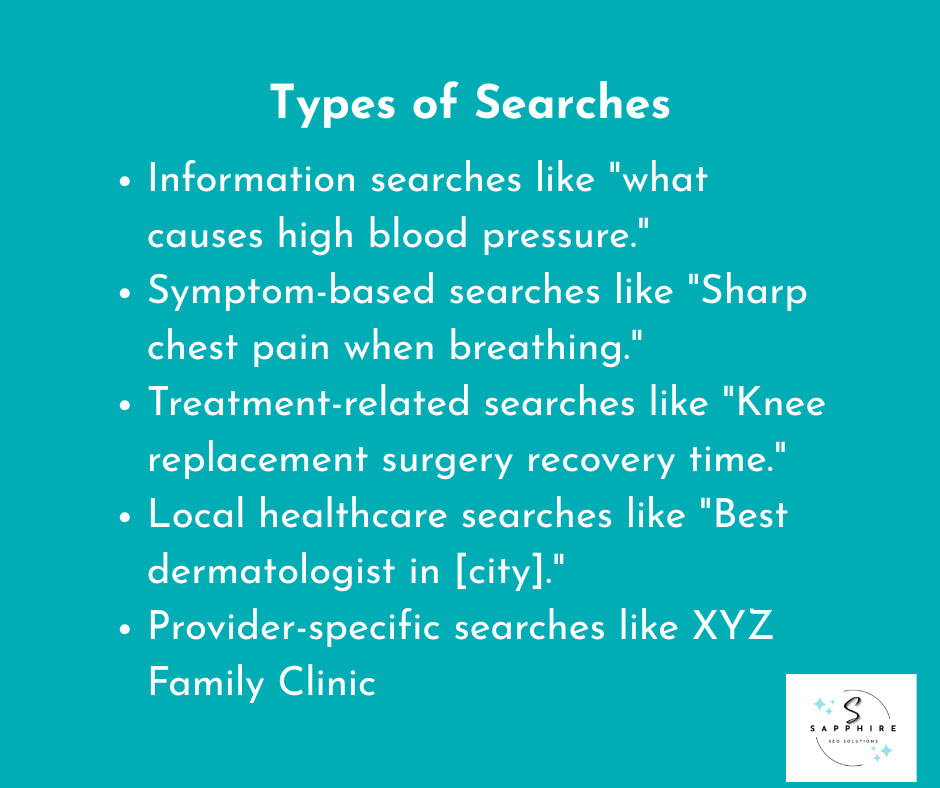
There are five primary intent categories that drive patient inquiries in healthcare:
Information searches like "what causes high blood pressure."
Symptom-based searches like "Sharp chest pain when breathing."
Treatment-related searches like "Knee replacement surgery recovery time."
Local healthcare searches like "Best dermatologist in [city]."
Provider-specific searches like XYZ Family Clinic
Each intent type requires different content. Matching the right page to the right intent is how a practice earns rankings that actually convert.
Identify the Patient Journey
New patients rarely go from a Google search to a booked appointment in a single step. They move through a journey that looks like this:
Awareness stage: The patient recognizes a symptom or health concern but hasn't yet connected it to a provider. Content that answers broad health questions performs here.
Research stage: The patient begins exploring conditions, treatments, and specialists. Detailed service pages, condition guides, and educational blog content serve this stage.
Decision stage: The patient is comparing providers. This is where physician bios, patient reviews, credentials, and location pages become critical. Trust signals matter most here.
Appointment booking stage: The patient is ready to act. A frictionless booking experience, clear contact information, and visible calls to action determine whether that intent converts into a scheduled visit.
A well-structured SEO strategy places the right content in front of the patient at each stage, guiding them naturally from initial awareness to a confirmed appointment.
Analyze Search Results Before Creating Content
Before writing a single word of content for a targeted keyword, it's worth studying what Google is already surfacing in the search results. The search engine results page tells you exactly what Google believes users want to find, and that intelligence should shape every content decision a practice makes.
There are five elements worth analyzing:
Local Pack results (local search results in Map Pack)
Featured snippets
People Also Ask boxes
AI Overviews
Competitor rankings
Skipping this analysis and going straight to content creation is a common mistake. The search results page is a roadmap. Reading it carefully before building content is what separates strategies that gain traction from those that don't.
Perform Keyword Research for Your Medical Practice
Keyword research is where medical SEO becomes concrete. It's the process of identifying exactly what potential patients are typing into Google, how often they're searching for it, and how much competition exists for each term. Without it, content and optimization efforts are essentially guesswork.
Find High-Intent Medical Keywords
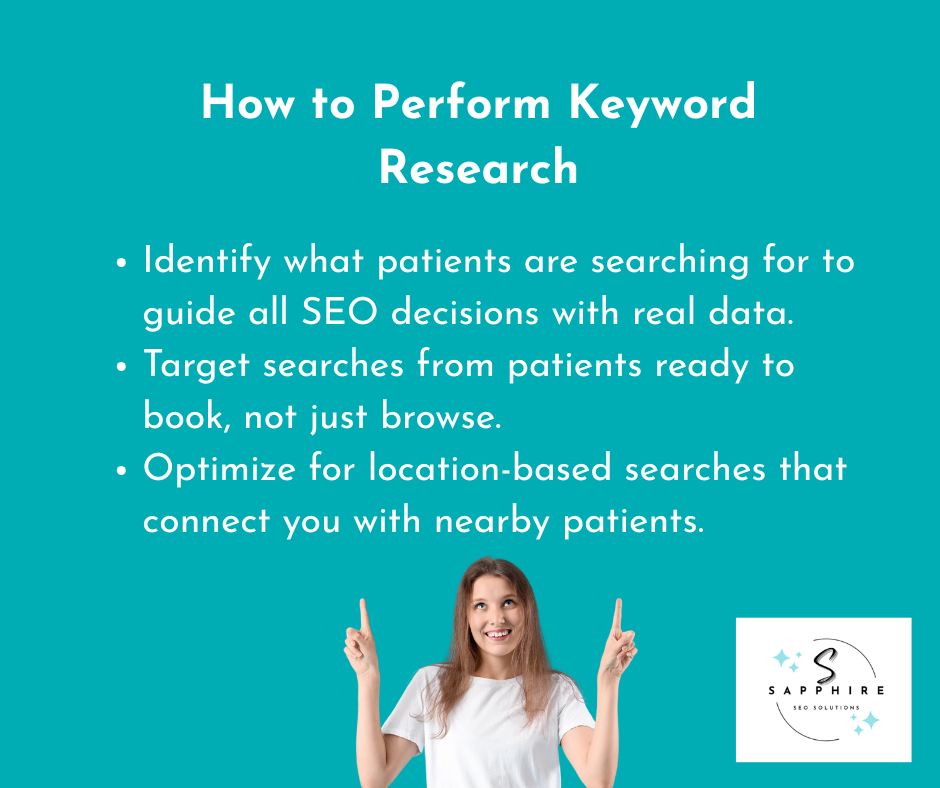
The goal of keyword research for a medical practice is to rank for the most relevant ones. High-intent relevant medical keywords are the searches that come from patients who are ready to act.
There are five categories worth targeting:
Service-based keywords like "Annual physical exam."
Condition-based keywords like "Treatment for plantar fasciitis.
Treatment-related keywords like "Cortisone injection for shoulder pain."
Location-specific keywords like "Family doctor in [city]."
Question-based keywords like "How long does strep throat last without treatment?"
Focus on Local Search Opportunities
For most practices, local search is where the most valuable keyword research happens. A patient searching for a specialist three states away isn't a lead. A patient searching in the same ZIP code is.
Location-based keywords come in several forms, and each one deserves attention:
City modifiers: Adding the city name to a service or specialty term is the most direct form of local targeting. "Orthopedic surgeon Houston" or "OBGYN clinic Chicago" are examples. These terms are competitive but carry high intent.
Neighborhood modifiers: In larger metro areas, patients often search at the neighborhood level. "Primary care doctor in Midtown" or "walk-in clinic Bucktown" can be less competitive and highly targeted.
"Near me" searches: Google handles "near me" queries based on the searcher's location, not the keyword itself. In other words, ranking for these terms comes from optimizing a Google Business Profile and building local signals — not from stuffing "near me" into page copy.
Specialty-specific local keywords: Combining a niche specialty with a local modifier produces some of the most conversion-ready terms in medical SEO. "Pediatric allergist [city]" or "concierge medicine practice [neighborhood]" target a specific patient at a specific moment of intent.
Build Keyword Clusters
Targeting individual relevant keywords in isolation is an outdated approach. Modern medical SEO is built around keyword clusters. This structure signals depth of expertise to Google and makes internal linking far more effective.
A well-built cluster has four components:
Primary keywords: The main term a page is optimized for. This is typically the highest-volume, most competitive keyword in the cluster. For example, "back pain specialist [city]."
Secondary keywords: Closely related terms that support the primary keyword and can be naturally worked into the same page. "Spine doctor [city]," "lower back pain treatment," and "herniated disc specialist" might all support the same page.
Supporting topics: Blog posts, condition guides, and FAQ content that address related questions and link back to the primary service page. These pages build topical authority around the core topic.
Internal linking opportunities: The connections between supporting content and primary pages are what make a cluster work. Each supporting piece should link to the primary page, and the primary page should link to relevant supporting content. Because of this, keyword clusters and internal linking strategy should be planned together, not separately.
Targeted keywords organized into clusters build the kind of topical authority that makes an entire section of a practice's website more competitive over time. To learn more about keywords and how many to use in your content, make sure to read our guide on "How Many Keywords Per Blog Post?"
Strengthen On-Page SEO Across Your Website
On-page SEO is the practice of optimizing the individual elements of a webpage so that search engines can understand what it's about and rank it accordingly.
LLMRefs reveals that nearly 100% of page-one results include their target keyword in the title or H1, making on-page SEO optimization one of the most direct levers a practice has for improving rankings.
Optimize Title Tags and Meta Descriptions
The title tag is the headline that appears in search results. The meta description is the short summary beneath it. Together, they determine whether a potential patient clicks on a result or keeps scrolling.
A strong title tag includes the primary keyword naturally. "Knee Pain Treatment in Austin | Orthopedic Specialists" is more effective than a string of keywords with no readable flow. The title should also signal relevance to the searcher immediately.
Meta descriptions don't directly influence rankings, but they do influence click-through rate. A well-written meta description tells the patient what they'll find on the page and gives them a reason to visit. Phrases like "Learn about your treatment options" or "Book an appointment today" function as soft calls to action that increase clicks from the search results page. Because of this, every service page and location page on a practice's website deserves a unique, purposefully written meta description.
Improve Content Structure
How a page is organized matters as much as what it says. A clear content structure makes pages easier for both patients and search engines to navigate.
A proper heading hierarchy signals the organization of content to Google and makes pages significantly easier to scan. Most patients don't read web pages word for word. They scan for the answer they need, and a well-structured page lets them find it quickly.
Short paragraphs support this. Three to four sentences per paragraph is a reliable ceiling. Beyond that, blocks of text become visually dense, and patients disengage. Strategic keyword placement follows naturally from writing clearly. Relevant keywords appear in headings, in the opening paragraph, and throughout the body where they fit naturally.
Optimize URLs and Internal Links
Clean URL structures are a small but meaningful on-page SEO signal. A URL like /services/knee-pain-treatment is more effective than /page?id=4829. It's readable, it includes relevant terms, and it communicates page content at a glance.
Internal links are the connections between pages within the same website. They serve two purposes:
They help search engines discover and understand the relationship between pages
They guide patients toward the next logical step in their journey
A few internal linking best practices worth following:
Link service pages to related blog content and condition guides
Link supporting content back to the primary service page it supports
Use descriptive anchor text that reflects the destination page's topic
Connect location pages to the relevant service pages they cover
Location page optimization deserves particular attention. Each location a practice operates from should have its own dedicated page with unique content.
Create Patient-Focused Content
Patient-focused content (SEO content writing) is content written for the person searching. The distinction matters more in healthcare than in almost any other industry, because patients are making real decisions about their health based on what they read.
Writing in clear language means avoiding clinical jargon where it isn't necessary, and defining it when it is. A patient reading about their treatment options shouldn't need a medical dictionary to follow along.
Addressing common concerns means anticipating what a patient is worried about before they ask. Pain levels, recovery timelines, insurance coverage, and what to expect during a first appointment are questions patients have, whether or not they type them directly into a search bar. Pages that answer these questions proactively build trust before a patient ever picks up the phone.
Answering frequently asked questions on service pages also creates opportunities to rank in People Also Ask boxes and featured snippets, which extends visibility beyond standard organic rankings.
Demonstrating expertise throughout the content, through accurate medical information, clear explanations of procedures, and visible provider credentials, is what separates patient-focused content that converts from content that merely fills a page.
Build Trust with E-E-A-T and Medical Authority Signals
No industry is held to a higher standard in search than healthcare. For healthcare providers looking to improve rankings, understanding E-E-A-T is foundational.
E-E-A-T stands for Experience, Expertise, Authoritativeness, and Trustworthiness. It's the framework Google uses to assess whether a page's content is credible enough to surface to users, and in healthcare, that assessment is stricter than in almost any other category.
Why E-E-A-T Matters More in Healthcare
Google classifies medical content under a category called YMYL, "Your Money or Your Life." Healthcare websites fall under Google's highest-risk content category, which requires the most accurate and trustworthy information according to Google's own Search Quality Rater Guidelines.
In other words, a poorly sourced recipe blog and a page recommending treatments for a serious condition are not evaluated the same way. The stakes for medical content are treated as higher, and Google's quality standards reflect that.
Trust functions as a ranking factor in this context. A medical practice whose website lacks author credentials, cites no sources, and hasn't been updated in years sends a very different signal than one that features verified physician bios, links to peer-reviewed research, and publishes content reviewed by licensed professionals.
Medical accuracy requirements follow naturally from this. Content that contradicts established clinical guidance, presents outdated treatment information, or omits important safety considerations is unlikely to rank well under Google's current framework, regardless of how well it's optimized for keywords.
Showcase Medical Expertise
The most direct way for medical providers to establish authority is to make the people behind the practice visible on the website.
Physician bios are one of the strongest E-E-A-T signals a healthcare website can display. A bio that lists a provider's medical school, residency, board certifications, and years of experience gives both patients and Google's quality raters something concrete to evaluate. It answers the question: who is saying this, and why should I trust them?
Beyond individual bios, there are several other signals worth displaying:
Credentials and certifications: Board certifications, specialty training, and state licensure are all worth listing explicitly on provider pages
Professional memberships: Affiliations with recognized medical associations add legitimacy and demonstrate engagement with the broader healthcare industry
Awards and recognitions: Designations like "Top Doctor" listings, hospital affiliations, and peer-nominated awards signal standing within the professional community
These elements don't just support rankings. They also build the kind of patient trust that converts a website visitor into a booked appointment.
Support Claims with Reliable Sources
Content that makes clinical claims without backing them up is a liability in medical SEO. Healthcare providers who cite credible, recognized sources signal to Google that their content meets the accuracy standards YMYL content demands.
The most credible source categories for medical content include:
Government health organizations: The CDC, NIH, FDA, and similar bodies produce authoritative, regularly updated health guidance that Google's systems recognize as reliable
Medical journals: Peer-reviewed publications like JAMA, The New England Journal of Medicine, and The Lancet carry significant authority
Research studies: Linking to published clinical research supports specific treatment claims and demonstrates that content is grounded in evidence
Industry publications: Recognized healthcare industry associations and specialty society guidelines are appropriate supporting sources for procedure and condition-specific content
Citing sources doesn't mean turning every blog post into an academic paper. It means grounding clinical claims in something verifiable, and making that sourcing visible to both readers and search engines.
Keep Content Accurate and Updated
Publishing strong content and leaving it untouched is not a sustainable strategy in the healthcare industry. Medical guidance changes. Treatment protocols evolve. Compliance requirements shift. Content that was accurate two years ago may no longer reflect current standards, and Google pays attention.
Regular content reviews ensure that what a practice publishes remains aligned with current medical consensus. Treatment updates should be reflected promptly, particularly for pages that describe procedures, medications, or clinical recommendations.
Compliance considerations add another layer. Healthcare providers operating under HIPAA and other regulatory frameworks need to ensure that content doesn't inadvertently create legal exposure. Patient privacy, testimonials, and any content that could be interpreted as personalized medical advice all warrant careful review as part of an ongoing content maintenance process.
Though keeping content current requires ongoing effort, it is one of the most effective ways to maintain and strengthen rankings over time because freshness, accuracy, and trustworthiness compound in Google's assessment of a medical website's overall quality.
Improve Technical SEO for Better Rankings
A medical practice website can have excellent content, strong credentials, and well-researched keywords and still underperform in search if the technical foundation is broken. Technical SEO is the work done beneath the surface of a website to ensure search engines can find, crawl, and understand every page. It's not the most visible part of an SEO strategy, but it's the part everything else depends on.
Conduct a Comprehensive Technical SEO Audit
Before making improvements, it's worth understanding exactly what's wrong. A technical SEO audit is a systematic review of a website's infrastructure, identifying the issues that are quietly holding rankings back.
There are four problem categories that consistently surface in audits of medical practice websites:
Crawl errors: These occur when search engine bots attempt to visit a page and fail. A page that can't be crawled can't be indexed, and a page that isn't indexed can't rank. Crawl errors are often caused by misconfigured robots.txt files, server errors, or pages that have been accidentally blocked from search engines.
Broken links: Internal or external links that lead to pages that no longer exist create a poor experience for both patients and search engines. They signal neglect and waste the crawl budget Google allocates to a site.
Redirect issues: Redirect chains (where one redirect leads to another, then another) and redirect loops slow down page loading and dilute link authority. Each redirect should resolve cleanly and directly to its destination.
Indexation problems: Not every page on a website should be indexed, but every page that should be indexed needs to be confirmed as such. Duplicate content, thin pages, and misconfigured canonical tags are common causes of indexation issues that prevent important pages from appearing in search results.
Running a full audit at least once per year keeps these issues from quietly compounding.
Ensure Proper Site Architecture
Site architecture refers to how the pages of a website are organized and connected. For a medical practice website, good architecture means a patient or a search engine can find any page in a small number of clicks from the homepage.
Logical navigation is the starting point. The main navigation menu should reflect the most important areas of the site: services, providers, locations, and contact. Pages that are buried four or five levels deep are difficult to crawl and rarely rank well.
Service page hierarchy matters for both usability and SEO. A well-structured practice website typically organizes service pages from broad to specific, which in turn link to individual condition or treatment pages. This hierarchy signals topical depth to Google and makes internal linking more effective.
Location page structure follows a similar logic. Each location a practice operates from deserves its own dedicated page, connected to the relevant service pages it supports. Location pages should never be identical copies of one another.
XML sitemap optimization ties this together. A sitemap is a file that tells search engines which pages exist on a site and how they relate to one another. It should include all indexable pages, exclude redirects and duplicate content, and be submitted directly through Google Search Console.
Secure and Accessible Website Setup
HTTPS implementation means the website uses an SSL certificate to encrypt the connection between the server and the visitor's browser. Google has treated HTTPS as a ranking signal since 2014, and any medical website still running on HTTP is signaling to both patients and search engines that it hasn't been properly maintained.
Beyond rankings, HTTPS helps protect patient data. This is a critical concern for any healthcare provider handling contact forms, appointment requests, or any personally identifiable information.
Mobile usability is equally non-negotiable. Google uses mobile-first indexing, meaning it evaluates the mobile version of a website when determining rankings, even for desktop searches. A medical practice website that displays poorly on a smartphone is being penalized in search, regardless of how well it performs on a desktop browser.
Accessibility considerations extend a website's usability to patients with visual, auditory, or motor impairments. Proper alt text on images, sufficient color contrast, and keyboard-navigable menus are all part of an accessible website. In other words, accessibility improvements and SEO improvements frequently overlap.
Core Web Vitals are Google's standardized measurements of page experience. They cover three areas:
How fast the main content loads (Largest Contentful Paint)
How quickly the page responds to interaction (Interaction to Next Paint)
How stable the layout is as it loads (Cumulative Layout Shift)
Poor scores on any of these metrics can suppress rankings even when other technical elements are in good shape. For a medical practice website, Core Web Vitals performance is worth monitoring continuously.
Optimize Website Speed and Mobile Experience
Site speed is not a background technical detail. It's a direct factor in whether a potential patient stays on a medical practice website long enough to book an appointment or leaves before the page even finishes loading.
Hostinger reveals that as page load time increases from one second to five seconds, the probability of a visitor bouncing rises by 90%. For a practice investing in SEO to drive traffic, a slow website undoes much of that work at the moment it matters most.
Website optimization for speed and mobile usability isn't a one-time fix either. It requires ongoing attention as content grows, third-party tools are added, and patient behavior on mobile devices continues to evolve.
Improve Core Web Vitals
Core Web Vitals are Google's standardized measurements of real-world page experience. They assess three distinct dimensions of how a page performs for the person loading it, and Google uses them as ranking signals.
Largest Contentful Paint (LCP): LCP measures how long it takes for the largest visible element on a page to load. This is typically a hero image, a headline block, or a large section of text. Google's threshold for a good LCP score is 2.5 seconds or under. Pages that exceed this feel slow to users before they've read a single word.
Interaction to Next Paint (INP): INP replaced First Input Delay in 2024 and measures how quickly a page responds after a user interacts with it. A poor INP score means the page feels unresponsive, which erodes patient trust and increases the likelihood of abandonment.
Cumulative Layout Shift (CLS): CLS measures visual stability. A high CLS score means elements on the page are shifting around as it loads. For a medical practice website with appointment booking forms and click-to-call buttons, unexpected layout shifts create friction exactly where conversion needs to happen smoothly.
All three metrics are measurable through Google Search Console and PageSpeed Insights, giving practices a clear, ongoing view of where performance stands.
Speed Optimization Best Practices
Improving site speed doesn't require rebuilding a website from scratch. In most cases, the biggest performance gains come from a handful of targeted optimizations:
Compress images
Use modern image formats like WebP
Support browser caching
Opt for lazy loading
Deliver an Excellent Mobile Experience
More patients are searching for healthcare providers on mobile devices than on desktops. A medical practice website that isn't fully optimized for mobile is actively losing patients to competitors whose sites work better on a phone.
Here's what you need to know:
Responsive design is the foundation.
Make your site more mobile-friendly by improving navigation.
Add a click-to-call functionality.
Short, easy-to-complete booking forms work best.
Use Structured Data to Help Search Engines Understand Your Practice
A well-optimized medical practice website communicates clearly to patients through its content. Structured data does the same thing for search engines. In other words, it's a standardized language that helps search engines understand exactly what a page is about, who it belongs to, and what information it contains.
Implement Medical Schema Markup
Schema markup is the specific type of structured data used to communicate with search engines. It's added to a website's code using vocabulary from Schema.org. There are four schema types that matter most for healthcare providers:
MedicalOrganization schema
Physician schema
MedicalClinic schema
FAQ schema
Enhance Search Visibility
Structured data doesn't directly improve rankings in the traditional sense. What it does is create eligibility for enhanced search features. For a medical practice, these enhancements can meaningfully increase click-through rates even without a change in ranking position.
Here are a few things you should work on to enhance visibility:
Rich results
Knowledge panels
Review snippets
Local search enhancements
Improve Local SEO to Attract More Patients
For most medical practices, the patients who matter most are the ones searching within a few miles. Local SEO is the discipline of making a practice visible to those patients in the map results, in the local pack, and across the directories and platforms where patients look before they book.
According to Google, fully completed profiles get more clicks than incomplete ones and 70% more in-store visits.
Optimize Your Google Business Profile
A Google Business Profile is the single most important asset in a medical practice's local search strategy. It's what populates the local pack, feeds information into Google Maps, and often serves as the first thing a patient sees before ever visiting a website. Optimizing your Google Business profile fully — not partially — is where local SEO begins.
Here's how you can optimize your GBP:
Keep every field complete, accurate, and consistently updated to protect trust and SEO performance.
Add clear service listings so Google can accurately match your practice with relevant patient searches.
Use high-quality photos to build trust and stand out, especially since most profiles have very few images, according to BirdEye.
Post regular updates to signal activity, improve relevance, and keep your profile fresh in local search.
For detailed instructions and best practices, make sure to read our comprehensive guide on"Attract More Visitors to Google Business Profile."
Build Consistent Local Citations
A local citation is any online mention of a practice's name, address, and phone number. Citations appear across online directories, review platforms, healthcare-specific listing sites, and general business directories. They function as trust signals for both search engines and patients.
Here's what's important:
Maintain exact NAP consistency across all platforms to avoid confusion and protect local search rankings.
Ensure complete, accurate listings on healthcare directories like Healthgrades, Zocdoc, Vitals, and WebMD to boost visibility and credibility.
Claim and regularly audit local listings such as Yelp, Bing Places, and Apple Maps to correct inaccuracies before they impact SEO.
Create Location-Specific Landing Pages
For practices operating in more than one location, location-specific landing pages are one of the most effective local SEO tools available. Each page targets a distinct geographic area with content written specifically for that location.
Here's what you need to know:
Create unique, locally specific content for each location page instead of reusing generic templates across cities.
Tailor each page to the most relevant services for that specific patient base and location.
Use local keywords naturally in headings, body content, and metadata to connect pages with nearby patient searches.
Embed Google Maps on location pages to improve user experience and strengthen local search relevance.
Earn Authority with Backlinks and Off-Page SEO
Off-page SEO is the work done outside a practice's own website to build that credibility, and backlinks are the primary currency it operates in.
Build High-Quality Healthcare Backlinks
For healthcare providers, the highest-value backlinks come from sources that are already recognized as credible within the industry, including:
Medical associations
Healthcare publications
Hospital partnerships
Educational institutions
Strengthen Community Authority
Community-based link building strengthens both search visibility and the practice's standing within the local market.
Here's how you can build authority:
Local sponsorships build community backlinks that strengthen geographic relevance and signal active local involvement.
Community events and outreach generate mentions across local platforms, reinforcing the practice’s presence and visibility.
Local news coverage delivers high-value backlinks and increases patient awareness through trusted regional media exposure.
Healthcare events create additional citation and backlink opportunities through participation, speaking, and collaboration with local organizations.
Avoid Risky Link-Building Tactics
Building authority through backlinks requires patience. Because of this, some practices are tempted by shortcuts — and those shortcuts carry real consequences. Google's guidelines on link building are clear, and violations can result in significant ranking penalties that take months to recover from.
There are four tactics worth avoiding entirely:
Spam links
Purchased backlinks
Low-quality directories
Link schemas
Though building a strong backlink profile takes time, it is one of the most durable off-page SEO investments a medical practice can make.
Create Content That Patients and Search Engines Value
Content marketing is where a medical practice's SEO strategy becomes visible to the patients it's trying to reach. Every service page, blog post, and condition guide is an opportunity to answer a question, build trust, and earn a ranking. Done well, creating content accomplishes all three simultaneously.
Patients expect clear, accurate information. Search engines expect depth, structure, and demonstrated expertise. The practices that rank higher are the ones whose content genuinely serves both audiences at once.
Develop Comprehensive Service Pages
A service page is the most conversion-critical content a medical practice publishes. It's where a patient who has already decided they need care makes the judgment about whether this practice is the right choice. A thin, vague service page loses that patient to a competitor whose page answers the questions they actually came with.
Comprehensive service pages are built around four elements:
Treatment explanations
Benefits and outcomes
Patients FAQs
Calls to action
Publish Educational Healthcare Content
Healthcare services pages capture patients who already know what they need. Educational content reaches the patients who are still figuring it out — and building a relationship with them before they're ready to book is one of the most effective long-term patient acquisition strategies available.
There are four content formats that consistently perform well for medical practices:
Blog articles
Condition guides
Preventive care/health tips
Seasonal health topics
Optimize for AI Search and Featured Snippets
The way patients interact with search results is changing. AI Overviews appear at the top of a growing share of Google searches, and featured snippets pull direct answers above organic rankings. Practices that structure their content to compete for these positions gain visibility that standard rankings alone cannot provide.
Here are the best practices to follow if you want your clinic to appear in AI search:
Provide direct, concise answers near the question so users and search engines can quickly resolve intent.
Use structured content with clear headings, short paragraphs, and lists to improve readability and crawlability.
Add dedicated FAQ sections to match real patient questions and expand relevance across search queries.
Build semantic depth by covering related topics and questions to establish true topical authority.
Generate More Reviews and Strengthen Online Reputation
Online reviews are a primary factor in how patients choose their providers. 84% of patients, according to Medical Economics, check online reviews before selecting a healthcare provider, with more than half reading at least six reviews before making a decision. That means a practice's online reputation is being evaluated before a patient ever calls, visits the website, or walks through the door.
For healthcare providers, this creates both a responsibility and an opportunity. A steady stream of genuine positive reviews builds trust, improves local search rankings, and converts more potential patients into booked appointments.
Encourage Patient Reviews Consistently
The single biggest challenge most practices face is gathering reviews. Despite the heavy influence reviews carry on patient decisions, 57% of patients admit they rarely or never leave feedback for their providers. In other words, satisfied patients exist in every practice, but you need to ask them to leave a review, and here's how you encourage patients to do that:
Post-appointment requests
Email follow-ups
SMS reminders
Ethical review generation
Manage Reviews Professionally
Generating patient reviews is only half of the equation. How a practice responds to those reviews shapes its online reputation just as much as the reviews themselves.
Here are the best practices to follow:
Respond quickly and genuinely to reviews to show patients the practice is attentive and engaged.
Handle negative reviews professionally by acknowledging concerns, staying calm, and moving the conversation offline.
Protect patient privacy by following HIPAA guidelines and avoiding any reference to specific care details in public responses.
Monitor Your Online Reputation
Online reputation management for a medical practice extends well beyond Google. Patients leave and read reviews across multiple platforms, and each one contributes to the overall picture a practice presents online.
The platforms worth monitoring consistently include:
Google reviews
Healthgrades
RateMDs
Yelp and local platforms
Managing online reviews across all of these platforms doesn't require a different strategy for each one. It requires monitoring regularly, responding promptly, and using patient feedback as a genuine source of insight into the practice experience.
Measure SEO Performance and Ranking Improvements
Investing in SEO without measuring results is like running a practice without tracking patient outcomes. The data exists, it's accessible, and ignoring it makes improvement impossible. For a medical practice, measuring SEO performance means understanding not just where the website ranks, but how those rankings translate into real patient inquiries and booked appointments.
Google Analytics, Google Search Console, and a handful of supporting tools give practices everything they need to track this. The challenge is knowing which metrics actually matter and what to do with them.
Track the Metrics That Matter
Not every number in an analytics dashboard deserves equal attention. These four are the ones that reflect genuine SEO progress:
Keyword rankings
Organic traffic growth
Local Pack visibility
Click-through rates
Measure Patient Acquisition
Search rankings and organic traffic are leading indicators. Patient acquisition metrics are the numbers that connect SEO performance to actual practice growth. There are four conversion points worth tracking for every medical practice:
Phone calls
Form submissions (via Google Analytics)
Appointment requests
Revenue attribution
Build an Ongoing SEO Reporting Process
SEO is an ongoing process. Rankings shift, competitors adapt, algorithm updates occur, and patient search behavior evolves. A reporting process that captures performance data consistently is what separates practices that sustain growth from those that see brief improvements followed by stagnation.
Run monthly reports tracking rankings, traffic, local performance, and conversions to measure progress consistently.
Set and review performance benchmarks to give SEO data meaningful context over time.
Include competitor analysis in every report to identify shifts, threats, and new opportunities.
Use reporting insights to drive continuous optimization and improve SEO performance month after month.
90-Day Medical SEO Action Plan
A solid SEO strategy doesn't happen all at once. For healthcare providers starting or resetting their organic search efforts, a structured 90-day plan removes the guesswork and creates measurable momentum from day one.
An effective healthcare SEO strategy follows this sequence deliberately. Skipping ahead to content creation before technical issues are resolved wastes effort. Building backlinks before service pages are optimized produces diminishing returns. The order matters.
| Phase | Focus Area | Key Actions |
|---|---|---|
|
Phase 1
Days 1–30
Start Here
|
Fix Technical Issues |
|
| Phase 2 Days 31–60 | Content & On-Page Optimization |
|
| Phase 3 Days 61–90 | Authority & Growth |
|
How Sapphire SEO Solutions Helps Medical Practices Improve Search Rankings
Improving search rankings for a medical practice requires more than general SEO knowledge. It requires an understanding of how patients search, how Google evaluates healthcare content, and how local competition shapes visibility in each specific market.
Sapphire SEO Solutions works exclusively with the kind of focused, strategic approach that medical practice growth demands. Here's what that looks like in practice.
Our Medical SEO Services
Every engagement is built around the core pillars that drive sustainable ranking improvements for healthcare providers:
Technical SEO
Local SEO
Content marketing
Authority building
What Makes Our Approach Different
Medical SEO services are not a commodity. The strategies that produce results for a healthcare provider differ meaningfully from those applied to an e-commerce store or a software company. Sapphire's approach reflects that distinction in four ways:
Industry expertise ensures SEO strategies follow YMYL, E-E-A-T, HIPAA, and real patient search behavior standards from the start.
Data-driven decisions use real search data, competition, and performance metrics instead of assumptions.
Transparent reporting provides clear monthly insights into rankings, traffic, visibility, and patient acquisition results.
Long-term focus prioritizes sustainable SEO growth that compounds over time rather than short-lived ranking spikes.
Claim Your Free Medical SEO Audit
The most direct way to understand where a practice stands in search and what it would take to improve is a thorough audit of the website and its competitive landscape. Sapphire SEO Solutions offers a free medical SEO audit that covers:
Website analysis
Ranking opportunities
Competitive insights
Customized recommendations
Start Improving Your Medical Practice's Rankings Today
Sapphire SEO Solutions offers a free medical SEO audit for practices ready to understand exactly where they stand and what it would take to rank higher, attract more patients, and grow with confidence. The audit covers technical health, ranking opportunities, competitive insights, and a customized action plan at no cost and no obligation.
Contact us today and take the first step toward a stronger search presence for your practice!

Frequently Asked Questions
How can I boost local SEO for a medical practice website?
To boost local SEO for a medical practice, start by fully completing and optimizing your Google Business Profile. Build consistent NAP citations across healthcare directories like Healthgrades and Zocdoc. Create location-specific landing pages for each area you serve, and generate a steady stream of patient reviews on Google. These steps directly influence how prominently your medical practice appears in local map results.
What are the best tools to track page ranking improvements for healthcare sites?
The most reliable tools for tracking search engine optimization performance on a medical website are Google Search Console (free, direct from Google), Semrush or Ahrefs for keyword ranking tracking and competitor analysis, BrightLocal for local pack and citation monitoring, and Google Analytics for organic traffic and conversion measurement. Together, they cover rankings, visibility, and patient acquisition in one reporting stack.
How can I optimize Google My Business listing for a medical office?
To optimize a Google Business Profile for a medical office, complete every available field — name, address, phone, hours, and services. Upload quality photos of the facility and team. Select the most accurate primary and secondary categories for your specialty. Publish regular updates and respond to all patient reviews. Consistent activity and completeness are the two factors that most directly improve local search visibility for healthcare SEO.
What content strategies increase page ranking for medical websites?
The content strategies that most reliably improve rankings for medical websites are building comprehensive service pages that address patient questions, publishing condition guides and educational blog content to capture informational searches, targeting local keywords across location-specific landing pages, and structuring all content with clear headings and FAQ sections to compete for featured snippets. For healthcare SEO, depth and accuracy outperform volume every time.
What is the most important ranking factor for medical practices?
There is no single ranking factor, but for medical practices, E-E-A-T — Google's framework for assessing Experience, Expertise, Authoritativeness, and Trustworthiness — carries more weight than in most other industries. Google classifies medical content as YMYL, meaning it applies stricter quality standards. A technically sound website, credentialed provider pages, accurate content, and a strong local presence together form the foundation that SEO for doctors is built on.
How much does medical SEO cost?
Healthcare SEO services typically range from $1,000 to $5,000 per month for most medical practices, depending on market competitiveness, the number of locations, and the scope of work required. Larger health systems or practices in highly competitive markets may invest more. Unlike paid advertising, SEO builds a compounding asset — the rankings and authority earned over time continue delivering local patients without ongoing per-click costs.
What are the biggest SEO mistakes healthcare websites make?
The most common medical website SEO mistakes are neglecting technical issues like slow page speed and crawl errors, publishing thin service pages that don't address patient questions in depth, ignoring Google Business Profile optimization, failing to build consistent local citations, and not actively generating patient reviews. For healthcare SEO, the combination of weak E-E-A-T signals and poor local optimization accounts for most underperformance in search rankings.