

Service Area Pages for Landscaping Companies (Expert Guide)
Most landscaping companies don't just work in one town. They cover a whole cluster of cities, maybe a dozen zip codes, sometimes more. But their website usually acts like they only serve one place: home base.
That's where service area pages come in. A service area page gives one specific location its own space on your site, built around the homeowners who actually live there. Not a copy-paste job with the city name swapped out. A real page, with real details about that town and the work you've done in it.
Sapphire SEO Solutions has been working with landscaping businesses since 2007. We know what works, what doesn’t, and how to adjust strategies based on the business’s needs and goals. Our experts can help create the right service area pages for your business.
In this guide, we'll walk through what makes a strong service area page for landscaping companies, what to include, and where most landscaping businesses go wrong.
Key Takeaways
Service area pages help homeowners in each city find and trust your landscaping business, not just search engines.
One page per city, built around real local details, beats dozens of generic, copy-pasted pages.
Never build pages for cities you don't actually serve, even if it seems harmless.
Sapphire SEO Solutions helps landscaping companies build service area pages that genuinely convert local homeowners.
Start with cities you serve today, add real photos and testimonials, and update pages every few months.
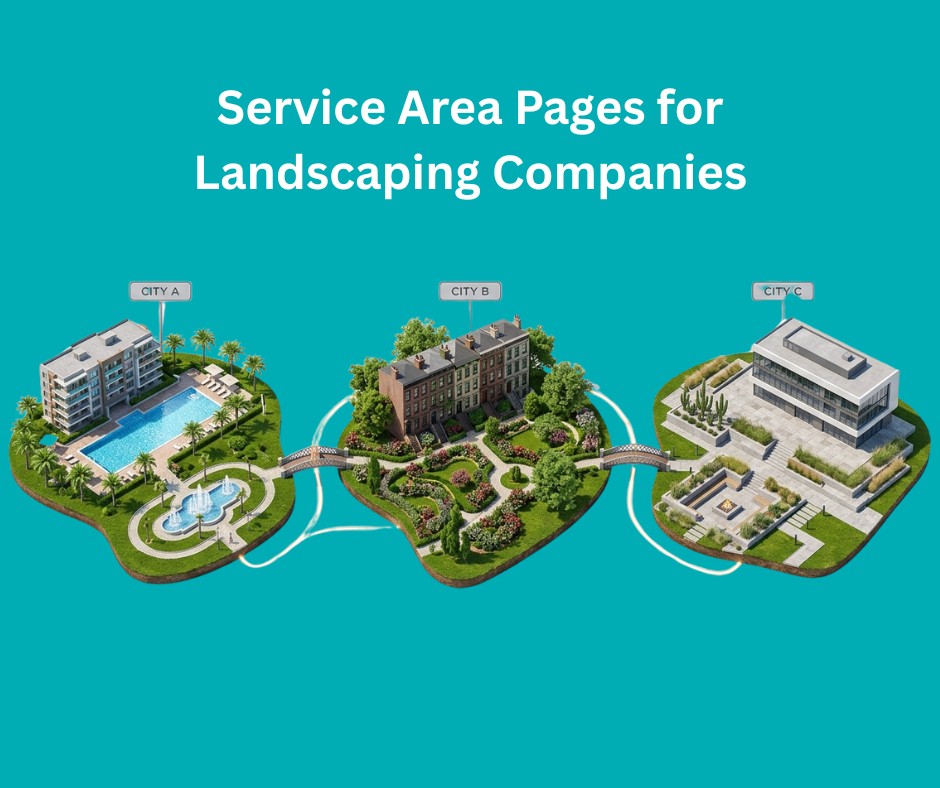
What Is a Service Area Page?
A service area page is a dedicated page built around one specific town, city, or neighborhood you work in. It acts as a location page, just written for one specific audience instead of everyone at once.
Your homepage has to speak to your whole defined service area. It's general on purpose, covering everything you do and everywhere you go. A city page works differently. It zooms in. If you serve Westerville, Dublin, and Powell, each of those towns gets its own page, written for the homeowners who actually live there.
That's the part people miss. One location per page. Not a single page listing ten cities, and not a homepage pretending to cover them all. Separate pages, each one focused.
Say your company offers lawn care, landscape design, and mulching. The services don't change from page to page. What changes is who you're talking to and what matters to them. A homeowner in Dublin might care about HOA rules. Someone in Powell might be dealing with heavier clay soil. Same local service, different context.
For service-based businesses working across several towns, that distinction is what makes a page actually useful instead of just another page on the site.
Plan Your Service Area Pages Before You Start Writing
Most landscaping businesses don't need fifty pages. They need the right dozen.
Before you write a single word, sit down and make a real list. Every city, every town, every zip code you actually send crews to. Not the places you'd like to work someday. The places you already do.
Most landscaping companies get this backwards. They start writing pages for wherever sounds good, then realize half those towns aren't even in their defined service area. Here’s what you should focus on:
Start with the list first, listing all important cities, towns, and neighborhoods you serve.
Once you've got the list down, prioritize. Bigger markets with more homeowners should usually come first, since those pages tend to do more work for you. Smaller towns can follow once the bigger ones are solid.
Travel distance matters too. If a town is barely inside your service radius, and you'd be lucky to make it out there twice a season, it probably doesn't deserve its own page yet. Think about where your company is headed as well. If you're planning to expand into a new county next year, it's worth mapping that out now, even if the page itself waits.
This is also where local keywords and a solid local seo strategy start to matter, though figuring out exactly which terms to target is its own process.
What Every Landscaping Service Area Page Should Include
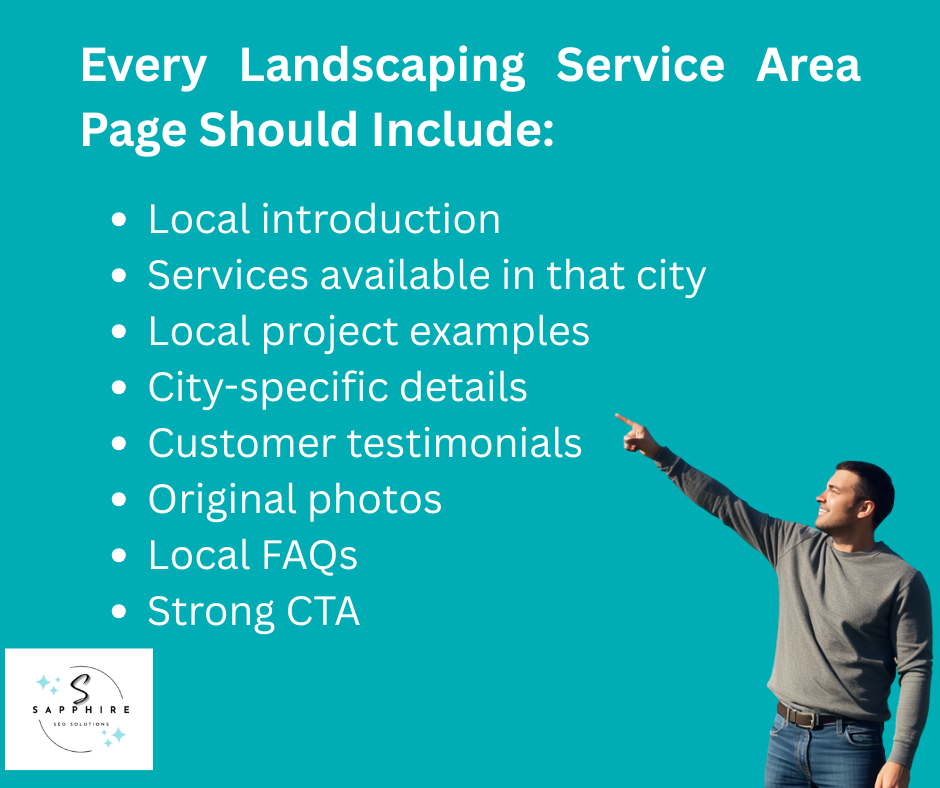
A service area page only works if it actually feels like it was written for that city. Here's what needs to be on it:
Local Introduction
Open by naming the city, but don't force it in awkwardly. Something like "If you're a homeowner in Dublin dealing with clay soil and shrinking lawn space, you already know the struggle" works a lot better than "Welcome to our Dublin landscaping services page."
Speak directly to homeowners in that location, like you already know what their yards look like. Generic openings are the fastest way to make a page feel copy-pasted, and homeowners notice.
Services Available in That City
List out the specific services you offer there, with real service descriptions, not just a bullet with three words.
If you do lawn care, landscape design, and commercial landscaping, explain what each one actually looks like for that town. Maybe lawn maintenance is in high demand in one neighborhood because of bigger yards, while a landscape designer gets called more often in another because of smaller, more decorative lots. Point that out if it's true.
Local Project Examples
Nothing builds trust faster than proof you've actually worked there. Include:
A handful of completed projects from that specific city
Before-and-after photos showing real transformations
Short case studies explaining what the homeowner needed and how it got solved
This is where potential customers stop reading generic marketing copy and start picturing their own yard.
City-Specific Details
This is the section most companies skip, and it's the one that matters most.
Mention actual neighborhoods you've worked in. Talk about property styles common to that area, whether it's older homes with mature trees or newer developments with smaller lots.
Soil conditions matter too. Clay-heavy soil needs different treatment than sandy soil, and homeowners searching for help already know their yard has problems, even if they don't know why.
If the city has HOA requirements that affect landscaping choices, bring that up. It shows you actually understand what homeowners are dealing with.
Customer Testimonials
Reviews carry more weight when they come from someone in the same city. A satisfied customer in that exact neighborhood tells a reader, "this company already knows my area," which a generic five-star review never quite manages.
Positive reviews tied to a specific location do double duty: they build trust, and they answer the unspoken question every homeowner has, which is "have you actually worked near me?" Read our detailed guide on “The Role of Online Reviews in Local SEO Ranking” to learn more about the importance of reviews for your landscaping business.
Original Photos
Use real photos from real projects completed in that city. Stock photos are easy to spot, and they undo a lot of the trust you just built. Add descriptive captions too, mentioning the neighborhood or the type of project, since that reinforces the local connection.
Local FAQs
Answer the questions homeowners in that specific city actually ask. Not generic landscaping FAQs. Real ones, tied to that location.
Strong CTA
End with a clear way to take action. A contact form, a phone number, and a free estimate offer, all easy to find, especially for mobile users who might be searching on their phone standing in their own backyard.
How to Make Every Service Area Page Unique
Here's the mistake that sinks most service area pages: taking one page, swapping the city name, and calling it done. Google sees straight through that, and so does anyone comparing your Westerville page to your Dublin page in two browser tabs.
Never just swap city names. If two pages are identical except for one word, they're really just one page pretending to be two. That's the fastest way to end up with a generic page that doesn't help anyone, homeowner or search engine.
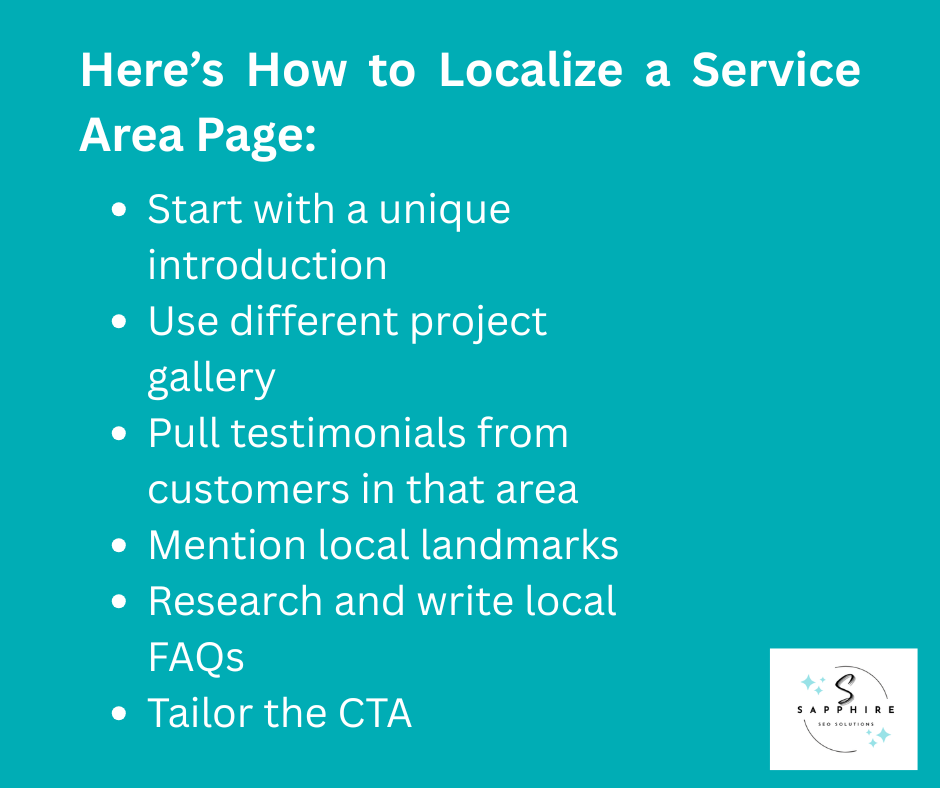
Here’s what you should do to ensure that your service area page is unique:
Start with the introduction. Write a new one for every city, grounded in something true about that specific place. Then keep the differences going.
Use a different project gallery for each page, pulled from work actually completed there.
Pull testimonials from clients in that exact city, not a general pool of reviews.
Mention local landmarks where it fits naturally, a park, a well-known street, a neighborhood everyone in town would recognize.
Highlight the specific neighborhoods you've served.
Write different FAQs for each page too, based on what homeowners in that town actually ask, and bring up landscaping challenges specific to that area, whether it's drainage issues after heavy rain or soil that fights back against anything you plant.
Tailor the CTA if it makes sense, especially if you're running a seasonal promotion in one city but not another.
None of this is about trying to stuff keywords into every paragraph. Keyword stuffing doesn't build local authority; it just makes pages harder to read. Real differentiation is what builds local visibility and helps a page earn better local rankings over time.
A page that actually reflects one city, in detail, tends to hold up a lot better in search engine results than ten pages built from the same template. That's the difference between search visibility that lasts and a bunch of thin pages that quietly disappear.
Structuring Your Service Area Pages for Long-Term Growth
Writing the pages is only half the job. How they fit together on your landscaping website matters just as much, especially once you've got more than a handful of them.
Here’s how to achieve long-term growth with service area pages:
Keep your URL structure consistent. Something like yoursite.com/landscaping-dublin-oh, repeated the same way for every city, is a lot easier for homeowners and search engines to make sense of than a different format for every page.
Organize the pages logically, too, grouped together instead of scattered randomly across the site.
Link your service pages to your location pages, and the other way around. If someone's reading about lawn care on a core service page, they should be able to click straight through to the city page for wherever they live. It works the other way too. Someone on a city page should be able to find your core service pages just as easily.
It's also worth linking nearby service area pages together where it makes sense. If you serve Dublin and Powell, and they're a few miles apart, connecting those pages helps homeowners and search engines alike.
Keep navigation consistent across the whole site. And build with room to grow. Solid internal links and a clear structure now make it a lot easier to add new cities later without redoing everything, which keeps the whole landscaping website feeling like it's kept up, not abandoned halfway through.
Common Service Area Page Mistakes
Even companies that understand the value of service area pages manage to undercut themselves with a few avoidable mistakes. Here are some of the most common mistakes landscapers make when creating service area pages:
Copy-and-paste pages top the list. Building one template and swapping the city name might save time upfront, but it produces generic content that neither homeowners nor search engines find convincing.
Along the same lines, pages with no local proof, no real projects, no local testimonials don't give anyone a reason to trust that you actually work in that city.
Stock photography only makes it worse. A page full of photos anyone could find online tells a reader nothing about your actual work.
Creating pages for cities you don't serve is another common trap. It might seem harmless, but it wastes effort and can confuse anyone who lands on the page expecting service in an area you don't actually cover.
Forgetting to update pages is easy to overlook too. A page with outdated projects or last year's promotion sitting on it quietly stops helping you the longer it's left alone.
Weak calls-to-action round out the list. A page can do everything else right and still fail to turn a visitor into more leads if the CTA is buried or unclear.
Fixing these issues tends to matter more for organic traffic than chasing every trend in search engine optimization.

Keep Your Service Area Pages Updated
A service area page isn't something you write once and forget about. It needs upkeep, the same way your actual work in that city keeps going. Here’s how you can update your service area pages:
Add new completed projects as you finish them. A page still showing the same three jobs from two years ago doesn't reflect what your crew's actually capable of today.
Refresh the photos while you're at it, and swap in newer testimonials from recent clients in that city, since fresh reviews carry more weight than ones sitting there for years.
Add new FAQs as homeowners ask new questions, and update your service offerings if anything's changed, whether you've added a new service or scaled one back.
If your work shifts with the seasons, keep that information current too. Nobody wants to read about spring cleanup in October.
Just as important, remove anything outdated. Old promotions, discontinued services, projects that no longer represent your work.
Pages that stay current tend to hold up better in local search results over time. It's one of the simpler habits in seo for landscaping, but it's also one of the easiest to let slide, which makes it one of the more overlooked parts of landscaping seo.
How Service Pages and Service Area Pages Work Together
It's easy to mix these two up, but they're doing different jobs.
A service page targets what you do. Think lawn care service, landscape design, or mulching, each with its own page explaining the service in detail. A service area page targets where you do it. Same company, same crew, but built around one specific city instead of one specific service.
Here's a simple way to picture it. Say a homeowner in Powell is searching for landscape design.
Your service pages for "Landscape Design" cover the service itself, what's included, how it works, and what it costs to think about.
Your Powell service area page covers the location, with local project examples and testimonials from clients in that town.
Someone researching either one should be able to find the other easily, because most homeowners want to know both: what you offer, and whether you actually work near them.
Used together, these pages make it a lot easier for local business directories, business listings, and even a mention from the local chamber to point homeowners somewhere useful once they land on your site. They also help any local business build real customer relationships, since visitors get exactly the information they came looking for instead of digging through a generic homepage.
Let Sapphire SEO Solutions Create Unique, Impactful Service Area Pages for Your Landscaping Business!
A strong service area page isn't about how many you can publish. It's about whether each one actually helps a homeowner in that city decide to call you. Real local details, real photos, real proof beat a stack of thin, copy-pasted pages every time.
Build fewer pages, but build them right, and they'll do more for your local seo and your landscaping leads than dozens of generic ones ever could.
Sapphire SEO Solutions has spent years helping local service landscaping companies build pages like this, along with the link-building work that supports them. If you'd rather have an expert handle it, our landscaping seo services are a good place to start. Contact us to book a free consultation with one of our certified SEO experts today.

Frequently Asked Questions
What is a landscaping service area page?
It's a page built around one specific city or town you work in, showing homeowners there the services you offer and proof you've worked nearby.
How long should a service area page be?
Somewhere around 750 to 1,250 words tends to work well. Enough room to cover services, local details, and proof, without turning into filler.
Should every page have different photos?
Yes. Reused photos across multiple cities make pages feel interchangeable, which defeats the purpose.
Can I create a page before working in that city?
No. Only build pages for places you actually serve. A page for a city you've never touched won't hold up once someone reaches out.
How often should service area pages be updated?
Every few months is a reasonable rhythm, especially after finishing new projects or collecting new reviews.
How do I create effective service area pages for a landscaping business?
Keep each one specific to that city, and make sure your business name, address, and phone stay consistent with your Google Business Profile.
What are the best practices for SEO on landscaping service area pages?
Keep an optimized Google Business Profile, stay consistent across Google Maps listings, and never duplicate content between pages. To help you with Google Business Profile Optimization, check out our guide on "Google Business Profile Optimization for Landscapers."