

Does AI Content Hurt SEO? - Insights From a Digital Marketing Expert
Does AI Content Hurt SEO? The short answer is that it depends, because search engines do not penalize AI writing, but they do punish low-quality, unhelpful pages. What matters is delivering helpful, original, accurate information that demonstrates real expertise and meets search intent. AI can support your workflow, but rankings come from adding human insight, unique perspectives, and editorial quality control. This article explains how AI content affects SEO performance, why misused AI leads to poor rankings, and how to use AI effectively so your content remains competitive in both traditional and AI-driven search results.
Key Takeaways
AI content does not hurt SEO when quality standards are met. What matters is helpful, original, search-intent-aligned content.
Google does not penalize AI. It only demotes low-quality, thin, unhelpful, or duplicate content.
Human expertise remains the ranking advantage. Depth, originality, and real experience outperform pure AI output in top search positions.
Use AI as an assistant, not a writer. Fact-check, personalize, and add unique insights before publishing.
Quality beats quantity every time. Strengthen editorial control to avoid shallow, generic, or inaccurate AI-generated pages.
AI content can make or break your site, depending on how you use it. While search engines don't penalize content that's generated by AI tools, they do hold certain standards that you must meet if you wish to rank.
So, what's the truth? AI content doesn't hurt SEO. Bad content does! And Google has been very clear about it. They don't care whether you write the content, use AI to do the writing for you, or hire an overworked leprechaun. What they care about is whether the content is helpful, original, and relevant.
Sapphire SEO Solutions has been working with businesses since 2007, helping them publish SEO-optimized, human-written content that's unique, meets search engines' standards, and engages. Our SEO-certified writers not only produce high-quality content that stands out but also optimize it so that it ranks in traditional and AI search (AI SEO).
In this blog, we will cover what Google actually says about AI content, what the data shows, how AI-generated content may fall short, and how to use it the right way to boost your rankings without getting penalized.
Let's get into it.
Does AI Content Work for SEO?
Yes. AI-generated content can complement your site's SEO. However, it all depends on how you use it.
What Google Officially Says About AI-Generated Content
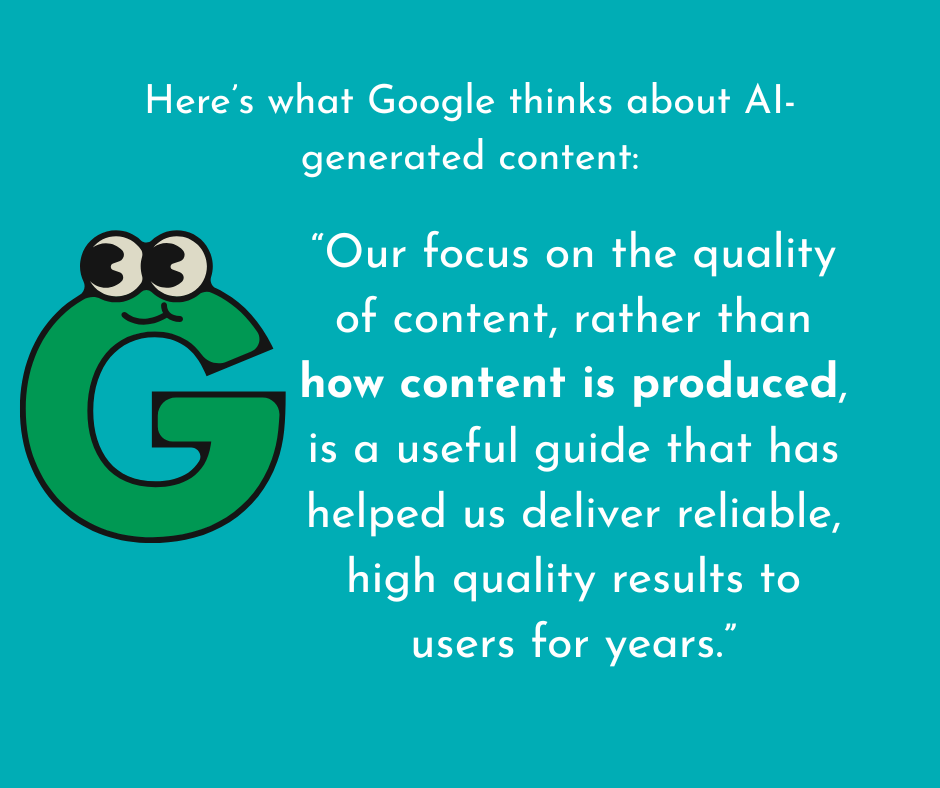
Google published guidelines for search ranking and content creation in 2023, which state that the search engine doesn't penalize content just because it was AI-generated. Google Search features like AI Overviews use AI-generated content, so how could it penalize it?
That said, it mentions that the content should be "helpful." It should solve the searcher's problems.
The Difference Between AI Content and Poor-Quality Content
Low-quality content is bad for SEO, and the majority of the AI-generated content is poor. This is because most business owners use AI tools lazily, requiring them to create an article or service page with a single prompt.
In fact, when the AI tool generates the content, business owners don't even edit it, quickly publishing it as it is.
Content generated by AI that's refined by humans, fact-checked, and demonstrates expertise is a different story.
What Recent Studies Show
According to Ahrefs, 86.5% of the top 20 search results, after analyzing around 600,000 pages, demonstrated some level of AI assistance.
What's even more interesting is that the correlation between AI usage and ranking position was 0.011 (almost zero!). What does this mean?
Google doesn't reward or punish AI content. What matters to the search engine is quality.
In fact, HubSpot's research also supports this finding. The company surveyed marketers and found that 46% of them said that AI tools helped their pages rank higher. Only 36% of the marketers saw no difference, while 10% of them reported a drop.
So, why is it that some people are seeing success while others aren't? Simply put, smart marketers focus on adding human insight and editorial oversight after generating content through AI.
Why AI Content Can Rank (And Why It Sometimes Doesn't)
Google has repeatedly said that content that's helpful, original, and optimized for search intent, regardless of how it's produced, will rank and drive organic traffic.
This is why it's important to focus on E-E-A-T, which is a set of guidelines released by Google that recommends demonstrating Experience, Expertise, Authoritativeness, and Trustworthiness in your content.
However, purely AI-generated content won't help drive website traffic. This is because it lacks depth, a unique perspective, and real-world expertise.
While AI may produce content that may rank somewhere in the search engine results pages (SERP), it won't dominate the first page.
Is AI-Generated Content Bad for SEO?
AI-generated content isn't inherently bad. But it can be if you use it the wrong way. Let's quickly look at whether Google punishes AI content and why it may fail sometimes.

What Google Actually Punishes
Google doesn't penalize AI content. However, it does penalize content that fails to meet its quality standards.
According to the Helpful Content System, Google demotes pages that don't provide value to the searches or demonstrate E-E-A-T. Thin, repetitive, or keyword-stuffed content that doesn't help anyone won't rank.
Google's stance on AI-generated content is that it doesn't care as long as the content is helpful and original.
Why AI Content Fails When Misused
AI content fails when you don't use AI tools properly. Here are a few reasons why your AI content isn't ranking or being indexed by Google:
Vague or generic content due to poor prompt engineering.
Failure to demonstrate E-E-A-T (real-life examples and unique insights) and publishing the AI content as it is.
Publishing at scale with no editorial control can lead to low-quality content (Google has been cracking down on this).
Heard of SEO Heist? This is a real-life example of how a site went viral before crashing due to AI content.
According to Search Engine Land, an SEO professional copied a sitemap of a flourishing website and used an AI tool to produce thousands of pages of similar content. The result? He got instant traction, resulting in millions of monthly visitors.
However, it wasn't long before Google or its algorithms caught on. The website got flagged and witnessed a major drop in organic traffic instantly.
Why? Because it used AI to mass-produce content that wasn't original or helpful.
Remember: duplicate content adds nothing new, and if your content creation process is a single prompt to an AI tool, you're bound to fail.
Use AI tools for assistance. It doesn't make more sense to use these tools to create similar content that's all over the web.
Common Weaknesses of AI-Generated Content
Even when used responsibly, AI-generated content has limitations. They include the following:
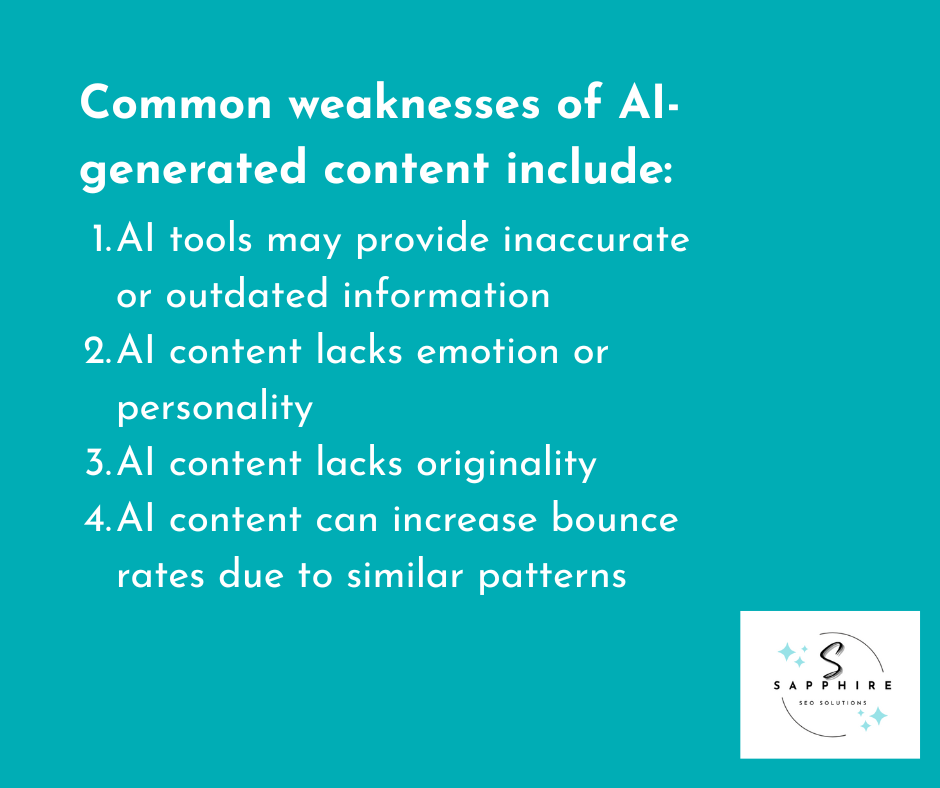
The AI Tool May Provide Inaccurate or Outdated Information
AI models generate text based on patterns in their training data. They don't fact-check. This leads to hallucinations. The AI tool may confidently say something, even if it is incorrect, because it doesn't know it's wrong.
Another problem is outdated information. Most AI tools use old data, often years old, to produce content.
For example, if you ask ChatGPT to write about recent events, it may not provide accurate information, and in many cases, it might fill gaps with false information.
HubSpot did an experiment by asking AI to write about "The Top TikTok Stats of 2024." The tool generated an article using old data. This can affect ranking, as Google prioritizes content with new data.
AI tools are also risky when it comes to producing content in Your Money, Your Life, finance, or health niche. Inaccuracies in such fields can harm others and damage your credibility.
AI Content Often Lacks Emotion, Nuance, and Storytelling
While AI is great for summarizing facts, it lacks emotions. People don't just want information, and if you don't demonstrate human experience, you won't drive engagement or conversions.
Human expertise brings nuances that AI misses. An expert knows what details matter, and they can explain concepts in ways that click with their audience. This is something that AI tools lack.
AI content also lacks a unique voice and storytelling with human emotion. This can affect trust and loyalty among the readers.
AI Content Lacks Originality & Unique Insights
AI tools don't create new ideas. It just mixes old ones because it's trained on what already exists. This means that AI tools will spit out the same information that's already out there, creating an originality problem.
Unique insights are important for content to rank. AI can't do that. In fact, AI can't create helpful content as it hasn't lived all of those years a professional may have to draw experience from.
AI Outputs Can Be Highly Detectable/Duplicate Across the Web
When thousands of marketers ask AI the same question and get similar answers, it leads to a sea of identical content. Google can easily detect it, even if the wording is different. This is because the ideas, structure, and phrasing might be the same.
While Google doesn't punish content that looks like AI-generated responses, it won't rank. Another thing is that AI summaries and AI-generated responses are becoming more common across the web, which makes it difficult to stand out. If you're not adding unique value, your content will blend into the background.
So, what's the solution? Customize your prompts, add original research, inject your perspective, and rewrite sections in your own voice. This will ensure that the content is unique.
Can AI-Generated Content Hurt Search Engine Rankings?
It can hurt search engine rankings if the content fails to meet Google's E-E-A-T standards. Let's discuss this in a bit more detail.
AI Isn't the Problem. It’s the Quality of Content.
According to the study conducted by Ahrefs, there is no correlation between AI usage and ranking. Simply put, pages with high-quality content ranked well, while those with low-quality content didn't.
What stood out in this study was that "pure AI" content barely reached the top spot in the SERPs. The top 20 search results were often dominated by AI-assisted content.
Why? Because top rankings require depth, expertise, and originality that AI alone can't deliver. Human-written content or heavily edited hybrid content tends to outperform purely AI-generated pieces at the highest level.
Another factor that affects ranking is user engagement. If people visit your site and immediately leave due to generic content, Google notices, leading to poor rankings.
When AI Content Does Hurt Rankings
There's nothing wrong if you're using AI to generate articles while polishing them with human touches. However, lazy content can hurt rankings.
Here are a few situations when AI content starts to affect your site's SEO (in a bad way):
Thin or shallow content
Inaccurate information
No difference between your pages and competing pages
Ignoring search intent
Publishing too much content with no pruning
Leveraging AI to pump out content will do your site more harm than good. Focusing and strengthening your writing process is crucial.
If you treat AI as a writer instead of an assistant, you're going to get content that performs poorly in Google's Search Generative Experience and traditional search results. Quality over quantity!
Limitations of AI-Generated Content
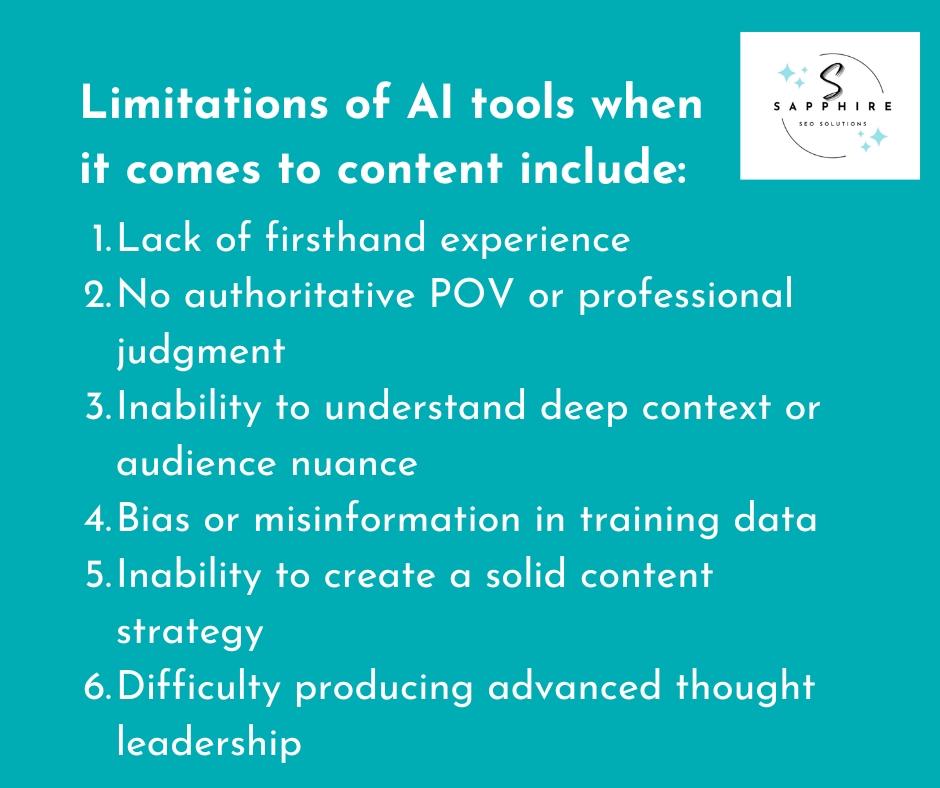
There are several limitations of AI tools when it comes to content generation, and they include the following:
Lack of firsthand experience
No authoritative POV or professional judgment
Inability to understand deep context or audience nuance
Bias or misinformation in training data
Inability to create a solid content strategy
Difficulty producing advanced thought leadership
The abovementioned points aren't something that you can fix with better prompts. These are fundamental limitations of how generative AI tools work. That's why the hybrid model, where AI provides a draft that's used to write articles by humans, works better.
How to Use AI for Content Writing (The Right Way)
If you're looking to create content with AI without sacrificing quality, here are a few ways you can do that:
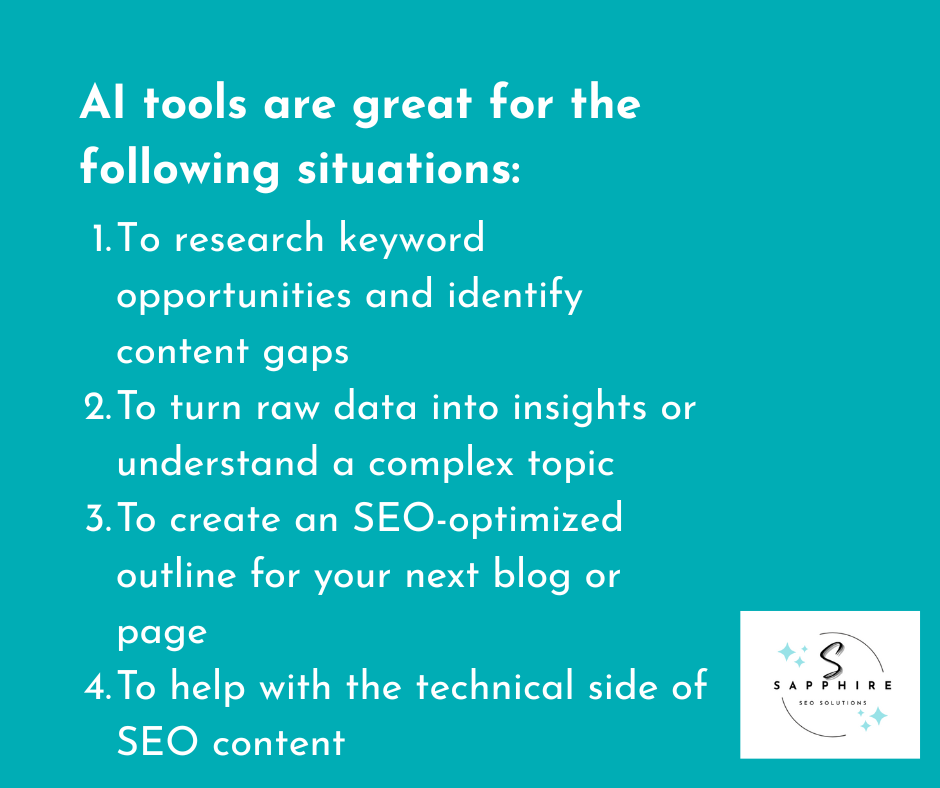
Use AI tools for keyword research opportunities, identify content gaps, and analyze search trends. Remember: data analysis with AI should inform decisions, not make them for you. Check out our page on keyword research to learn more about this topic.
AI is great for synthesizing information quickly. Use it to turn raw data into insights or understand a complex topic fast. AI can even create good content briefs for you, which should be a solid foundation to build on. But always fact-check your information, as you shouldn't assume that the tool pulled data from reliable sources.
As we've mentioned before, use AI tools to create your outline. But focus on prompt engineering by customizing the prompts, providing it with a topic, target keywords, and other details before asking AI to draft the outline. This helps expedite the content creation process.
Since AI-generated text is generic and lacks personality, make sure to edit it properly. Give it your own style, add unique insights, and demonstrate human expertise.
AI is also great for helping with the technical side of SEO content. This includes generating meta descriptions, identifying places to add internal links, and spotting missing sections. Check out our page on technical SEO to learn more about the key technical elements, including schema markups.
With AI tools, you can generate headlines that drive clicks. In fact, HubSpot reveals that AI-generated headlines won 46% of the time, while human headlines won only 24% of the time. Don’t forget to read our page on on-page SEO to learn more about headlines and other key elements.
The most effective approach to creating content using AI includes deciding the target audience, the problem you're solving, and what you offer. Then comes AI. It can help with optimizing the structure of the article and creating a draft.
Don't publish yet. Add human expertise, whether it is real-life examples, case studies, or insights from experience.
Now focus on building authority by adding author bios, links to credentials, and relevant videos. relevant content
How Sapphire SEO Solutions Delivers the Best Human-Written Content That Ranks
Sapphire SEO Solutions believes that 100% human-written content has the ability to dominate the top three search results than AI-generated content.
Here's how we are better than the AI tools many business owners use to churn out articles:
We not only have writers with qualifications across multiple disciplines, but all of our writers are SEO certified. This gives us an advantage when it comes to curating content that ranks.
Since we have many writers who have educational degrees, whether in finance, medicine, legal, or the English language, we have the knowledge to produce high-quality content that aligns with Google's guidelines.
Most of our writers also have professional expertise in their respective fields. This allows us to bring real-world experience to our writing, ensuring every piece we create is unique and not replicable by AI tools.
Many of our SEO-certified writers are also certified in AI search optimization, which means we have the skills, knowledge, and expertise to not only rank in traditional search but also attract AI search engines.
We've been offering content creation services since 2007. That's more than a decade of experience crafting articles, service pages, and other types of content. We add personality, nuances, and human emotions, which AI tools cannot.
Don't just take our word for it. Reach out to us to request some samples of our previous work and see for yourself how our work stands out in a sea of AI-generated garbage.
Work with SEO-Certified Writers to Start Ranking Today!
AI tools can never beat human writers. Even if you use AI and start to edit the work, it can be time-consuming. For business owners, this time can be better utilized elsewhere, whether it's expanding their business or improving operations.
At Sapphire SEO Solutions, we offer affordable SEO content writing services that demonstrate expertise, build trust, establish authority, and help you win in AI-driven search ecosystems.
Contact us to schedule a free consultation and find out how we can help produce content that converts for your business.
Want to place an order today? Check out the different content writing tiers we offer before placing an order online!

Frequently Asked Questions – Does AI Content Hurt SEO?
Can Google detect AI content?
Google can likely detect patterns suggesting AI generation, but it doesn't specifically scan for it. Their focus is on quality, not authorship. Detection doesn't equal penalty; even if they know it's AI-generated, they won't penalize it unless it's unhelpful or violates their spam policies. What matters is meeting their quality standards.
Does Google penalize AI-written content?
No. Google doesn't penalize content based on how it was created. They penalize low-quality content that's generic, inaccurate, or published at scale without editorial oversight. If your AI-assisted content is helpful, original, and demonstrates expertise, it won't be penalized. Search engine algorithms reward quality, not authorship.
Is AI content good for SEO if edited by humans?
Yes. AI content refined by human expertise can rank very well. Add value AI can't provide: real examples, unique insights, and a clear point of view. This hybrid model gives you AI efficiency with the depth and authority of human-created content.
Can AI-generated content rank on Google?
Yes. Ahrefs' study found 86.5% of top-ranking content contains some AI assistance. However, purely AI-generated content rarely reaches #1. Top positions go to content with more human involvement, deeper expertise, and stronger originality. AI gets you in the game; winning requires human input.
Do AI detectors impact SEO?
Not directly. AI detectors don't influence Google rankings. What hurts is being flagged as duplicate content or unoriginal content because it's too similar to other AI-generated articles. The real issue isn't detection. It's differentiation. Blending in means you won't stand out in search results.
Is hybrid human plus AI content better?
Yes. Combining AI tools and human expertise outperforms purely AI content. Leveraging AI for drafting saves time while humans add strategy, originality, and authority. This approach gives you speed without sacrificing substance. That said, purely human-written content that demonstrates E-E-A-T will always perform and also resonate with your target audience.
How much AI content is "safe"?
There's no magic percentage. Ahrefs found 86.5% of top-ranking pages contain AI assistance, with most showing moderate use (11–40% AI-generated). What matters isn't the ratio. It's the quality of the final output. Use AI as long as the result is helpful, original, and demonstrates expertise. That said, we will always recommend purely human-written content if you want to win over your readers and search engines.