

How to Choose the Best Lawyer SEO Company (2026 Guide)
Finding the best lawyer SEO company is critical because 87% of legal consumers start their search on search engines, where specialized expertise in YMYL (Your Money or Your Life) standards and attorney advertising compliance is required to rank. Unlike generalist agencies, a top-tier legal SEO partner focuses on building practice-area authority through high-intent keyword mapping, local Map Pack dominance, and E-E-A-T-driven content that turns organic traffic into signed cases. To choose the right firm, prioritize those that offer transparent reporting, prove their results through legal-specific case studies, and commit to ethical "white-hat" tactics that protect your firm's long-term reputation.
Key Takeaways
High-performing SEO for law firms offer upto 526% three-year ROI, outperforming all other legal marketing channels.
Specialized agencies ensure YMYL compliance and E-E-A-T standards that generalist firms often ignore.
Success requires practice-area authority, local Map Pack dominance, and high-quality legal backlinks.
Evaluate potential partners on signed cases and lead quality rather than vanity traffic metrics.

If you're a lawyer or running a law firm, you should know that, according to Attorney at Work, 87% of people seeking legal advice use a search engine to find the right law firm.
Organic search is now the single biggest client acquisition channel for law firms. Many reliable sources claim that it accounts for 66% of call conversions in the legal industry, and firms that invest in it are seeing a three-year ROI of 526%. No other marketing channel comes close.
Unfortunately, most law firms either aren't investing in search engine optimization at all, or they're paying the wrong agency to do it. And the wrong agency doesn't just waste your money. It can actively hurt your rankings, damage your reputation, and leave you invisible when potential clients are searching for exactly what you offer.
Another thing to note is that not all SEO services are the same. General digital marketing agencies don't understand the legal industry. They don't know how Google evaluates legal services content, they're unfamiliar with attorney advertising rules, and they have no idea how competitive your local market actually is. Getting traffic is one thing. Getting cases is another.
At Sapphire SEO Solutions, we offer affordable SEO services for lawyers to help law firms boost their online presence and get more qualified cases. Our experts know what to do and what to avoid to get your practice ranking ASAP.
In this guide, we will walk you through exactly what separates the best lawyer SEO companies from everyone else, and how to choose the right one for your firm.
Why Hiring the Best Lawyer SEO Company Is Different from Hiring a Regular SEO Agency
Most digital marketing agencies can handle basic SEO. But law firm marketing is a different game entirely.
The legal sector has unique rules, higher stakes, and far more competitive markets than most industries. A generalist marketing agency that works with restaurants, e-commerce stores, and dental clinics is simply not equipped to handle what law firm SEO demands. Here's why:
The Legal Industry Is a YMYL Niche
Google places legal websites in a category called YMYL, which stands for "Your Money or Your Life." Because legal matters can have a significant impact on a person's well-being, finances, or safety, Google applies stricter quality standards when evaluating legal industry websites. That means your site is held to a higher bar than most. An agency that doesn't understand this will produce content that simply doesn't rank.
Google Requires E-E-A-T
On top of YMYL, Google evaluates legal practice websites through a framework called E-E-A-T, which stands for Experience, Expertise, Authoritativeness, and Trustworthiness. State-specific rules can restrict terms like "expert" or "specialist" unless formally certified, and educational content that informs rather than guarantees outcomes is what builds trust with both clients and search engines.
An agency unfamiliar with these standards will produce content that undermines your credibility rather than building it.

Lawyer Advertising Compliance Issues
Attorney marketing is regulated. Legal advertising regulations vary significantly by jurisdiction and practice area, and agencies without legal industry experience may inadvertently create marketing materials that violate bar association rules or state advertising regulations, potentially exposing your firm to disciplinary action. This is a risk no firm should take.
Competitive Local Markets
Metropolitan markets can see 50 or more law firms competing for top rankings in high-value practice areas. Competitive markets like personal injury, criminal defense, and family law require a level of strategy and resources that generic marketing companies simply aren't built for.

Practice-Area-Based SEO Strategy Is Needed
A family law firm in Dallas and a personal injury firm in Miami need completely different strategies. The best legal sector SEO companies build campaigns around your specific practice areas, target geography, and ideal client profile. Cookie-cutter approaches don't work here. Direct competitors are too sophisticated, and the stakes are too high.

What the Best Lawyer SEO Companies Actually Do (That Others Don’t)
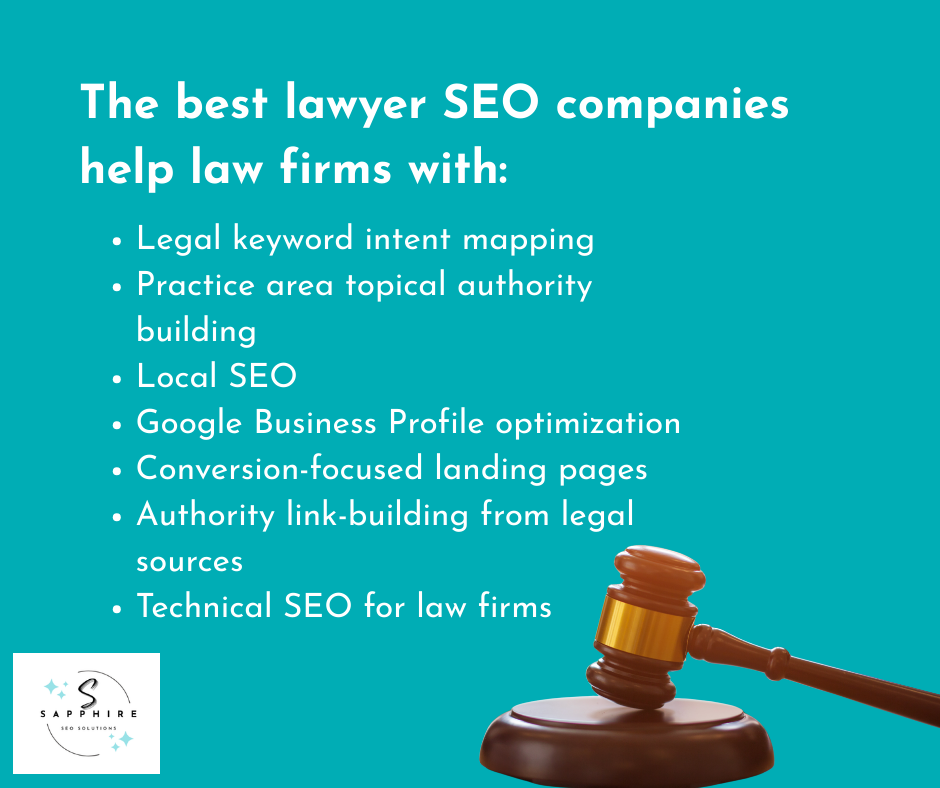
There's a big difference between an agency that talks about SEO strategies and one that actually delivers qualified leads and signed cases. The best law firm SEO companies offer a full set of tailored SEO strategies built specifically around how potential clients search for legal help. Here's what that looks like in practice:
Legal Keyword Intent Mapping
Generic keyword research isn't enough. The best agencies go deeper by mapping keywords to intent. Someone searching "what happens after a DUI arrest" is in research mode. Someone searching for "DUI lawyer in Houston" is ready to hire.
A strong search marketing strategy targets both, but prioritizes the keywords that drive consultations, not just clicks. Factors like keyword difficulty, competition, and search intent all play a major role in determining which keywords will actually move the needle for your firm.
Practice Area Topical Authority Building
Google rewards websites that demonstrate deep expertise in a specific subject area. For legal firms, that means creating comprehensive, well-structured content around each practice area rather than thin pages that barely scratch the surface.
Pages that attempt to cover many topics rarely go into enough depth on any subject, so the best agencies focus on covering one topic well and building authority around it systematically. Firms seeking more cases need to own their practice area online, not just mention it.
Local SEO and Google Business Profile Optimization
Most legal clients are searching locally. Local SEO is what gets your firm into Google's map pack, which sits above the regular search results and captures a massive share of clicks.
According to Search Engine Land, around 75% of users who perform a local search will visit a business within 24 hours, which makes local optimization one of the highest-return activities in legal marketing. Top agencies:
Optimize your Google Business Profile
Build local citations
Manage reviews
Create location-specific content that dominates local search results
Conversion-Focused Landing Pages
Getting traffic to your law firm website means nothing if visitors leave without contacting you. The best law firm SEO agencies treat web design and web development as part of the SEO process, not a separate concern.
Practice area pages should be built to convert, with clear calls to action, trust signals like reviews and case results, and a frictionless path to booking a consultation. A well-designed page turns organic traffic into actual leads.
Authority Link Building from Legal Sources
Link building (off-page SEO) is one of the most important ranking factors in SEO. Backlinko reveals that the number one result in Google search has, on average, 3.8 times more backlinks than pages ranking in positions two through ten.
Top agencies build links from sources that actually matter for law firms: legal directories like Justia, Avvo, and FindLaw, local bar associations, legal publications, and reputable news outlets. Quality matters far more than quantity here.
Technical SEO for Law Firm Websites
Technical SEO is where many agencies fall short. Search engine optimization isn't just about content and links. Your website also needs to be fast, secure, mobile-friendly, and properly structured so Google can crawl and index it correctly.
Technical elements like HTTPS security, Core Web Vitals optimization, and structured data implementation directly improve both rankings and user experience.
With 64.35% of all website traffic coming from mobile devices (Exploding Topics), a site that isn't optimized for mobile is already losing potential clients before they even read a word. The best agencies handle all of this without you needing to ask.
How to Evaluate the Best Lawyer SEO Company (9-Step Framework)
Choosing the right SEO agency is one of the most important business decisions your firm will make. There are hundreds of SEO companies out there, all promising measurable growth and top rankings. Most of them will fall short. This framework cuts through the noise so you can evaluate any SEO firm with confidence before you commit.
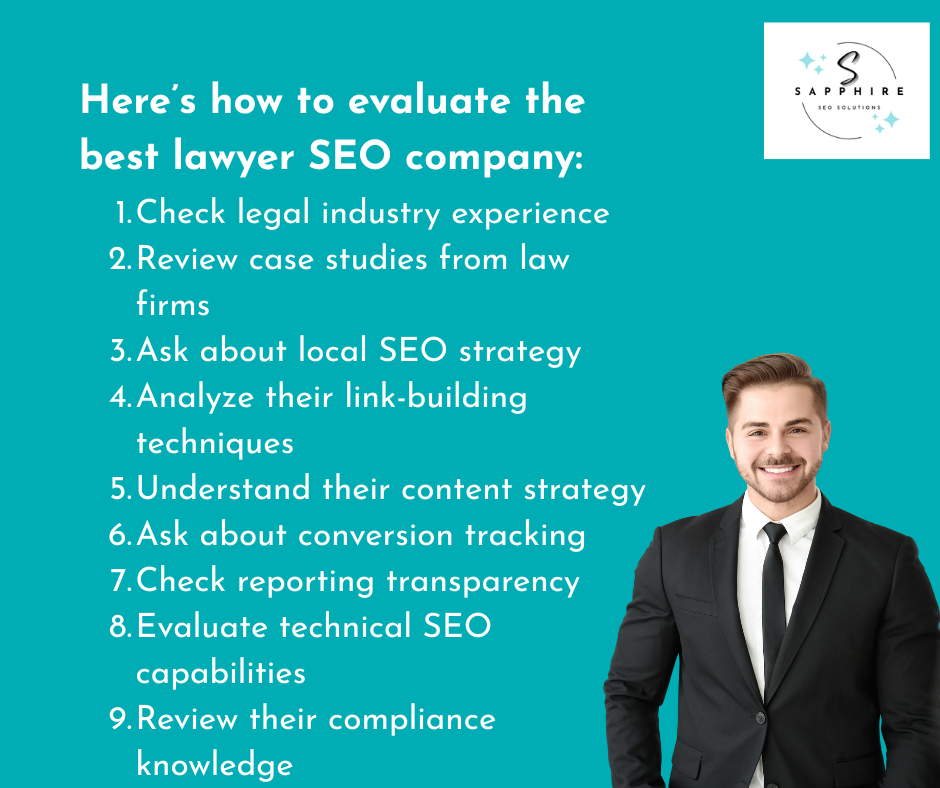
Here are the steps you should follow if you want to work with the right legal SEO company:
Step 1: Check Legal Industry Experience
This is non-negotiable. General SEO agencies don't understand the competitive dynamics, content standards, or compliance requirements of the legal industry marketing. Look for a company that works exclusively or primarily with law firms and can speak fluently about your practice area and market.
Step 2: Review Case Studies from Law Firms
Any agency can claim results. Ask to see the proof. Make sure the firms you're considering can show results that include increased call volume and signed cases. If they can't show those numbers, there's a good chance they're focusing only on vanity metrics that look great on paper but don't translate to growth for your firm. Real law firm clients with real results are what you're looking for.
Step 3: Ask About Local SEO Strategy
If an agency doesn't have a clear, detailed plan for local SEO, walk away. Dominating local search is where most legal cases actually come from. They should be able to speak specifically to Google map pack rankings, citation building, and location-based content strategies for your market.
Step 4: Analyze Their Link Building Methods
Ask where they build links and how. Quality link building from legal directories, bar associations, and reputable publications is what moves the needle. If they're vague about their methods or can't name specific sources, that's a red flag. Black-hat tactics can get your site penalized by Google.
Step 5: Understand Their Content Strategy
Content marketing should be driven by keyword intent and practice area authority, not volume. Ask how they decide what content to create, who writes it, and how they ensure it meets Google's E-E-A-T standards. Generic blog posts written by non-lawyers won't cut it in a YMYL niche.
Step 6: Ask About Conversion Tracking
Rankings and traffic are inputs. Qualified leads and signed cases are outcomes. A serious agency tracks both. They should have a system for monitoring phone calls, form submissions, and consultation bookings, not just website visitors.
Step 7: Check Reporting Transparency
You should never have to wonder what your agency is doing or whether your SEO efforts are working. A reputable agency should be willing and wanting to discuss what they do to support your business. Regular reporting, clear metrics, and open communication are signs of an agency that has nothing to hide.
For more information on our reporting, check out our blog on “Why Most SEO Reports Are Useless.”
Step 8: Evaluate Technical SEO Capabilities
Technical SEO isn't glamorous, but it's foundational. Ask how they handle site speed, mobile optimization, crawlability, and structured data. You don't need to understand every detail, but they should be able to explain their process clearly and show that it's part of their standard workflow, not an afterthought.
Step 9: Review Their Compliance Knowledge
Attorney advertising rules vary by state and bar association. Your SEO company needs to understand this. Content that makes unqualified claims or violates advertising guidelines can expose your firm to disciplinary action. The best agencies treat compliance as a core part of their legal services content strategy, not a box to check.
Top SEO companies tie everything back to data. Rankings go up. Leads increase. Cases get signed. If an agency can't show you a clear line between their work and your firm's growth, keep looking.
Red Flags to Avoid When Choosing a Lawyer SEO Company
Not every agency that claims to specialize in law firm SEO actually does. Some are generalists in disguise. Others use tactics that can get your site penalized or, worse, tank your reputation. Knowing what to watch out for is just as important as knowing what to look for. Here are the red flags that you should keep an eye out:
Guarantees of #1 Rankings
No legitimate agency guarantees rankings. Google's own guidelines warn against this. Anyone promising you the number one spot is either lying or planning to use risky black-hat tactics to get you there temporarily. These tactics might produce short-term gains but lead to penalties later. Avoid them entirely.
No Legal Niche Experience
A generalist agency that works across industries doesn't understand the YMYL standards, E-E-A-T requirements, or bar advertising rules that govern legal content.
Generalist digital marketing firms applying consumer retail tactics to legal services consistently underperform compared to specialized providers who understand jurisdictional variations and practice-specific conversion drivers.
Hiring one of these agencies is one of the most common and costly law firm SEO mistakes you can make.
Focus on Traffic Instead of Leads
Traffic is not the goal. Cases are. If an agency's reporting centers around page views and impressions but can't tell you how many qualified leads or consultations their work generated, that's a problem. Cheap SEO packages that promise big traffic numbers are almost always optimizing for the wrong thing.
Cheap SEO Packages
You cannot dominate a competitive legal market on a $500/month budget. Legal keywords are among the most expensive and competitive in the world.
Agencies offering rock-bottom pricing are either cutting corners, outsourcing to low-quality content farms, or skipping critical work like local SEO and link building entirely. You get what you pay for, and in legal SEO, the cost of a bad agency is far higher than the cost of a good one.
No Local SEO Strategy
If an agency doesn't proactively bring up local SEO, Google Business Profile optimization, and citation building, they don't understand how legal clients actually find lawyers. Most people searching for legal help are searching locally. An agency without a clear local optimization plan is not equipped to compete in your market.
Black-Hat Link Building
Red flags include private blog networks, purchased links, and automated content generation, all of which are prohibited practices that risk severe penalties. Ask explicitly how they build links. If they're vague, evasive, or can't name the types of sources they target, assume the worst.
Generic Blog Content
Content that isn't written with legal expertise, keyword intent, and E-E-A-T in mind won't rank. Some large vendors have been known to reuse boilerplate legal content across multiple client websites or use outsourced writers with no legal expertise. If your blog content could apply to any law firm in any city, it's not doing anything for your online visibility or your rankings.
Questions to Ask Before Hiring the Best SEO Company for Lawyers
Walking into a conversation with a potential SEO company without prepared questions is how firms end up locked into bad contracts. The right agency will welcome tough questions. The wrong one will dodge them. Here are the five most important things to ask before you sign anything:
How Do You Generate Qualified Leads?
Traffic is easy to generate. Qualified leads are not. Ask the agency to walk you through exactly how their work translates into consultation requests and signed cases, not just clicks and impressions. Any agency you consider should clearly explain how its digital marketing efforts lead to more clients, signed cases, and revenue. Anything less isn't worth your time.
What Legal Directories Do You Build Links From?
This question separates agencies that understand legal services from those that don't. The answer should include specific names like Justia, Avvo, FindLaw, Martindale-Hubbell, and relevant local bar association directories. Vague answers about "high-authority sites" are a red flag. Press on their link-building approach and ask why their method works better than other methods.
How Do You Optimize Practice Area Pages?
A strong answer should cover keyword intent, content depth, internal linking, and conversion elements like calls to action and trust signals. If the agency talks only about word count or keyword density, they're behind. Modern search engine marketing is about demonstrating authority and relevance across your entire practice area, not just stuffing keywords onto a page.
What KPIs Do You Track?
The right agency tracks a mix of leading and lagging indicators. Rankings and organic traffic are leading indicators. Phone calls, form submissions, consultations booked, and cases signed are lagging indicators.
Before hiring, define clear goals by asking how they will track website traffic growth, phone calls, contact form submissions, keyword rankings, and return on investment, and clarify reporting frequency and format.
If Google Ads or paid channels are part of the mix, those should be tracked separately so you can see exactly what each channel is contributing.
Do You Track Signed Cases or Just Traffic?
This is the most important question on the list. Not every form fill or phone call represents a viable case. A qualified lead should include prospective clients who have legal issues within your practice area, fall within your geographic service area, and have the means to retain counsel.
Agencies that optimize for vanity metrics will show you impressive dashboards with numbers that don't pay your bills. The best agencies tie their work directly to your bottom line.
Best Lawyer SEO Company vs Freelancer vs In-House Marketing Team
There's more than one way to handle your law firm's marketing. Some firms hire a full-service marketing agency, others bring someone in-house, and some go the freelancer route to keep costs down. Each option has its place, but they are not equal when it comes to competitive legal SEO. Here's how they stack up:
| Factor | SEO Company | Freelancer | In-House Team |
|---|---|---|---|
| Legal SEO expertise | Specialized, team-based | Varies, often narrow | Rarely specialized |
| Full-service capabilities | Yes, all-in-one | No, usually one skill area | Depends on team size |
| Local SEO strategy | Comprehensive | Limited | Limited |
| Content + links + technical | Handled end-to-end | Typically one or two areas | Requires multiple hires |
| Compliance knowledge | Built into process | Unlikely | Unlikely |
| Scalability | High | Low | Medium |
| Cost | Mid to high retainer | Low per project | High (salaries + tools) |
| Accountability for leads | Yes, conversion-focused | Rarely | Internal only |
| Reporting & transparency | Regular, structured | Inconsistent | Internal |
| Best for | Firms serious about growth | One-off tasks | Large enterprise firms |
For most law firms, a specialized law firm marketing agency is the strongest option. Freelancers don't generally take responsibility for conversions and usually complete very specific tasks rather than managing a holistic strategy. They work well for small, isolated jobs but can't build or execute a full campaign on their own.
Building an in-house team requires hiring writers, SEO specialists, developers, and paid media managers, along with paying for tools like Ahrefs and SEMrush, which can add up to $500 or more per month on top of salaries. Unless you're a large firm with the budget to support an entire marketing department, it's difficult to justify.
A specialized full-service marketing agency gives you an entire team of experts for a fraction of what in-house hiring costs. They handle everything from marketing services like content and link building to technical SEO and conversion tracking, and they're accountable for results in a way that freelancers simply aren't. For firms competing in serious markets, that's not a nice-to-have. It's a necessity.
How Long Does It Take the Best Lawyer SEO Company to Deliver Results?
SEO is not paid advertising. There's no switch to flip. Search engine algorithms take time to evaluate your site, build trust, and reward consistent effort with improved search rankings. That said, you can expect a fairly predictable timeline once a well-planned SEO campaign is underway.
Most law firms start seeing initial results within 3 to 6 months, with more significant impact on traffic, rankings, and lead generation coming between 6 and 12 months. The first few months are foundational. Your agency will fix technical issues, optimize your Google Business Profile, build out practice area content, and start establishing local citations. You won't see dramatic movement yet, and that's normal.
By months 4 through 6, content starts getting indexed, local rankings begin to emerge, and long-tail keywords start converting. After 12 months of consistent work, your firm should be competing for the high-value keywords that actually bring in cases. Practice areas like personal injury or criminal defense in major metros can take longer, given how fiercely competitive those markets are.
The long-term ROI is where SEO really separates itself from every other channel. Unlike paid ads, where costs stop the moment you stop spending, SEO builds a sustainable lead flow that compounds over time. Firms that commit to it and stay consistent are the ones that end up owning their market.
If you’re a new law firm, read our comprehensive guide on “How Long Does It Take for Google to Trust a New Site?" On the other hand, if you’ve been practicing law for quite a while, you can check out our detailed guide on “How Long Does SEO Take for Law Firms?“ for more information.

How Much Does the Best Lawyer SEO Company Cost?
Law firm SEO services are not cheap, and they shouldn't be. This is one of the most competitive spaces in digital marketing, and the cost reflects the level of expertise, strategy, and resources required to deliver actual results.
Most law firms spend between $2,500 and $10,000 per month on SEO, with the average investment sitting around $4,889 monthly. Firms in highly competitive markets like personal injury or criminal defense in major metro areas often invest significantly more. Here's a general breakdown of what each pricing tier typically looks like:
Low-end providers ($2,000 to $4,000/month) cover basic on-page optimization, content creation, link building, and reporting, but results can be inconsistent. Mid-level providers ($4,000 to $8,000/month) offer more advanced capabilities with larger teams. High-end providers ($8,000 and above) are top-tier agencies with the resources and expertise to execute sophisticated, competitive campaigns.
When it comes to ROI, the numbers are compelling. Law firms that invest consistently in quality SEO can expect returns of 400% to 800% within 12 months. Compare that to paid advertising like Google Ads, where a single click in a competitive legal market can cost $100 or more, and the economics of SEO become very clear.
The real cost isn't what you spend on good SEO. It's what you lose by skipping it or going cheap. Cheap SEO relies on low-quality content and spammy backlinks, which can actively hurt your rankings, potentially trigger a Google penalty that takes months to recover from. Invest in quality law firm SEO services or don't bother.
Who Should Hire a Lawyer SEO Company?
If your law firm clients come from online searches, you need SEO. It's that simple. Here's a closer look at who benefits most from working with a specialized law firm SEO company:
Solo attorneys often assume SEO is only for big firms with big budgets. That's not true. A solo practitioner in a mid-size market with a focused practice area and a smart local strategy can absolutely compete and win online.
Small firms with two to ten attorneys are often in the sweet spot for SEO investment. They have enough resources to compete but haven't yet hit their ceiling. A dedicated law firm SEO services strategy can fast-track their growth significantly.
Personal injury lawyers operate in one of the most competitive legal firms categories online. High case values make the ROI on SEO exceptional, even with the higher investment required to compete.
Criminal defense attorneys deal with high-priority searches. People searching for a criminal defense lawyer need help now. Showing up at the top of local results at that moment is invaluable.
Immigration law firms serve communities that rely heavily on online search, often in multiple languages. A targeted local SEO strategy can tap into underserved demand that competitors aren't capturing.
Multi-location firms have the most to gain and the most to lose from poor SEO. Each location needs its own optimized pages, citations, and local presence. The right agency manages all of it as a cohesive strategy rather than treating each office as a separate project.
Final Checklist to Find the Best Lawyer SEO Company
Before you hire anyone, run through this checklist. The best agencies will check every box. If a company you're evaluating can't confidently address each of these points, that's your answer. Use this as your shortlist filter for measurable growth, genuine legal industry insight, and long-term online visibility.
Checklist to Find the Best Lawyer SEO Company
- ✔ Legal niche experience – Have they worked exclusively or primarily with law firms?
- ✔ Proven results – Can they show real case studies with leads and signed cases from law firm clients?
- ✔ Ethical SEO practices – Do they use white-hat tactics that comply with Google's guidelines?
- ✔ Conversion tracking – Do they track calls, form submissions, and consultations, not just traffic?
- ✔ Local SEO expertise – Do they have a clear plan for map pack rankings and location-based content?
- ✔ Transparent reporting – Do they provide regular, clear reports tied to your business goals?
Work with a Reputable Lawyer SEO Firm for the Best Results!
Finding the best lawyer SEO company comes down to one thing: finding an agency that understands the legal industry well enough to turn search visibility into signed cases. Not just traffic. Not just rankings. Actual clients.
The right agency will bring proven SEO strategies to the table, whether that's technical SEO, local optimization, content authority building, or conversion-focused landing pages. They'll also understand that video marketing and social media marketing can support and amplify your SEO efforts, but shouldn't replace them.
A true premier SEO agency knows how every channel fits together and builds a strategy around your firm's specific goals, market, and practice areas. Social media services can build brand awareness, but organic search is still where legal clients convert.
If you're serious about growing your firm online and want to work with an agency that knows how legal search intent actually works, you're in the right place. Contact us to schedule a free consultation with a law firm SEO expert today!

Frequently Asked Questions - Law Firm SEO Company
How do I know if an SEO company truly specializes in legal SEO?
A legal SEO specialist works specifically with law firms and understands attorney advertising rules, competitive legal keywords, and compliance requirements. They provide case studies and verifiable client references and offer transparent reporting. They have a clear strategy for your specific practice area and avoid promises of instant rankings. Agencies that cannot demonstrate law firm experience or compliance knowledge should be avoided.
How long does it take to see results from lawyer SEO?
Most law firms see measurable SEO improvements within three to six months, while meaningful lead generation typically takes six to twelve months. Highly competitive practice areas, such as personal injury in major cities, may take longer. Results depend on website technical health, domain authority, local competition, content quality and frequency, and link-building effectiveness. Short-term ranking guarantees are a red flag.
What should I look for in a lawyer SEO company’s track record?
A reputable legal SEO company provides documented proof of results, including practice-area-specific case studies, traffic growth, and measurable lead generation. You should be able to contact client references directly. The agency should offer transparent reporting and demonstrate long-term experience in legal SEO. Strong agencies tie their work to real business outcomes rather than just rankings.
How much does lawyer SEO cost, and is it worth it?
Lawyer SEO typically costs between $1,500 and $10,000 or more per month, depending on market competitiveness and the scope of services. SEO is worth the investment because organic traffic compounds over time, the cost per lead decreases as rankings improve, and you avoid paying per click like with PPC campaigns. Long-term ROI can exceed 400% when campaigns are executed correctly, and results should be measured by signed cases rather than traffic alone.
Can an SEO company get my law firm’s website penalized by Google?
Yes, a website can be penalized if an SEO agency uses black-hat tactics such as buying backlinks, keyword stuffing, cloaking, or duplicate content. Penalties can be algorithmic or manual, causing significant drops in visibility. To protect your firm, confirm that the agency follows Google’s guidelines, provides access to analytics and Search Console, avoids ranking guarantees, and maintains transparency in their strategies. Ethical, white-hat SEO safeguards rankings and long-term visibility.