

How to Improve Local SEO for Chiropractic Clinics
Improving local SEO for chiropractic clinics requires optimizing your Google Business Profile with accurate NAP information and your primary category set to "Chiropractor," as this is the number one ranking factor for local pack visibility. Focus on building consistent citations across healthcare directories like Healthgrades, Vitals, and WebMD while maintaining identical business information everywhere online. Create dedicated service pages for treatments like back pain relief, sports injuries, and prenatal care, each targeting specific local keywords. Implement a systematic review collection process to generate fresh patient testimonials within 48 hours of appointments, as reviews are the second most important local ranking factor. Publish regular blog content addressing patient problems in your area, build local backlinks through partnerships with gyms and healthcare providers, and ensure your website loads quickly on mobile devices. Technical elements like schema markup, HTTPS security, and proper header tags help search engines understand your content, while weekly Google Business Profile posts keep your listing active and engaging for potential patients searching for chiropractic care nearby.
Key Takeaways
Google Business Profile optimization with the correct primary category is the single most important factor for appearing in local search results.
Consistent NAP information across all online directories and citations directly impacts your local pack rankings and patient trust.
Fresh patient reviews posted within three months significantly boost conversion rates and serve as the second most critical local ranking factor.
Dedicated service pages for each treatment type create more ranking opportunities and can increase conversions by up to 500%.
Local SEO results typically appear within 3 to 6 months, with meaningful traffic and appointments developing over 6 to 12 months of consistent effort.

According to a 2021 research paper, 7% of Google searches every day are related to healthcare. When someone types "chiropractor near me," they're ready to schedule an appointment or seek treatment. The top three search results, according to Backlinko, get more than half of the clicks. If your chiropractic practice is not in those spots, you're invisible.
Local SEO for chiropractors puts you in front of potential patients searching in your area. It increases your Google ranking visibility, drives quality website traffic, and generates more phone calls. Local SEO has a greater conversion rate than traditional marketing strategies, and this is where we come in.
At Sapphire SEO Solutions, we have been helping local businesses stand out in the crowded digital space since 2007. Our affordable chiropractor SEO services can help your practice/clinic appear in front of potential patients, increasing traffic to your site and door.
In this guide, we will go over how to improve local SEO for chiropractic clinics. You'll learn how to dominate local search results and attract patients who need your care right now.
The Local SEO Landscape for Chiropractic Clinics
A 2022 research paper revealed that around 72% of internet users seek health-related information online. This means that most patients search online before they book appointments. And 72% of consumers, according to HubSpot, visited a medical facility within five miles. Your local search results determine whether those people call you or your competitor down the street.
Understanding Patient Search Behavior
People search with clear intent. When someone types "best chiropractor near me," they want relief from pain today. Your online presence needs to work 24/7, as Medical Economics says that 42% of healthcare appointments are booked outside standard business hours.
Another thing to keep in mind is that voice search is growing, too. People ask their phones, "Where's the closest chiropractor?"
Search patterns change seasonally. January brings New Year wellness goals. September sees back-to-school injuries. Understanding when patients search online helps you time your content and offers.

The Chiropractic Competitive Environment
The chiropractic industry is crowded. According to the American Chiropractic Association, there are over 70,000 chiropractors currently employed in the US. The industry is fragmented, which means your real competition is local businesses in your immediate area.
Your offline reputation doesn't automatically translate online. A clinic with 20 years of experience can get buried by a newer practice that invests in search engines. Benchmark your performance against competitors by tracking where they rank for your target keywords and how many reviews they have.
Local Keyword Research — The Foundation
Local keywords determine whether your practice appears when people search for chiropractic care. Without the right relevant keywords, you're invisible to your target audience. This makes keyword research super important for your clinic.
Defining Your Target Keywords
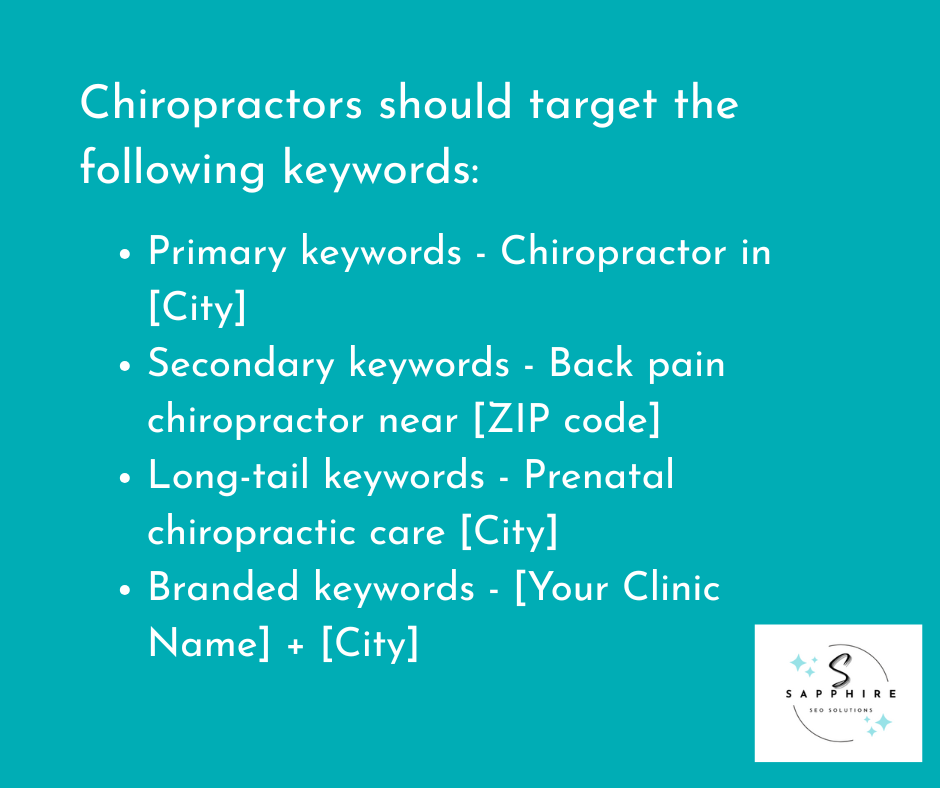
Start with the following keyword tiers:
Primary keywords put your location first. "Chiropractor in [City]" or "Chiropractic clinic [Neighborhood]" are foundation terms. These location-specific keywords tell search engines exactly where you operate.
Secondary keywords add specificity. "Back pain chiropractor near [ZIP code]" or "Sports injury treatment [City]" target people with clear problems. They search with the intent to book.
Long-tail keywords drive conversions. "Prenatal chiropractic care [City]" or "Auto accident chiropractor open Saturday [Neighborhood]" are highly specific. Long-tail keywords have a much higher conversion rate than other search terms, often attracting patients ready to take action.
Branded keywords matter too. "[Your Clinic Name] + [City]" helps people who've heard about you find you online.
Use keywords naturally throughout your content. Forced placement looks spammy and damages rankings.
Keyword Tools and Methods for Chiropractors
Google searches reveal what people actually type. Start typing "chiropractor" in Google and watch autocomplete suggestions appear. Those are real search queries.
For chiropractor SEO, use these keyword research tools:
Google Keyword Planner shows search volume and competition. It's free with a Google Ads account.
Ahrefs provides keyword difficulty scores and competitor analysis. You'll see which terms competitors rank for.
Ubersuggest offers basic keyword data without expensive subscriptions.
Prioritize keywords based on three factors. Local intent comes first. A phrase like "chiropractor near me" has perfect local intent. Search volume matters, but conversion potential matters more. A keyword with 100 monthly searches that brings 30 patients beats a keyword with 1,000 searches that brings five.
Semantic and Related Terms
Search engines care about context. They look for related terms that prove your content is comprehensive.
Pain management terms include sciatica, herniated disc, neck stiffness, lower back pain, and muscle spasms. Chiropractic care encompasses adjustments, spinal manipulation, soft tissue therapy, and rehabilitative exercises. Chiropractic services cover specific treatments like cryotherapy, massage therapy, and corrective exercises.
When you write about back pain treatment, naturally mention related symptoms and solutions. This semantic relevance signals to Google that your content thoroughly addresses the topic.
Google Business Profile (GBP) — The #1 Local Ranking Factor
Your Google Business Profile is the most powerful local SEO asset you control. It's one of the most important local pack ranking factors. When someone searches for a chiropractor, your GBP determines whether you appear in the local pack (the map with three businesses at the top of search results).
GBP Setup Best Practices
Choose your primary category carefully. "Primary GBP category" is the number one ranking factor for the local pack. Select "Chiropractor" as your main category. This single choice has more ranking impact than almost any other factor.
Your NAP (Name, Address, Phone) must be identical everywhere online. Use your local phone number, not a call tracking number, for maximum trust. If you have more than one location, create separate profiles for each. Never list multiple locations under one profile.
Add your appointment URL directly to your profile. Make booking as frictionless as possible.
Optimization Strategies
Your GBP business description needs both local and service keywords. Write naturally about your chiropractic services while mentioning your city and neighborhoods. "We provide sports injury treatment, prenatal chiropractic care, and back pain relief to patients in [City] and [Neighborhood]."
List every service you offer. Each service strengthens your local visibility. Select attributes that matter. "Online appointments available" and "Wheelchair accessible" help patients make decisions.
Read our comprehensive guide on "Attract More Visitors to Google Business Profile in 2025" to learn more about how you can optimize your GBP.
Visual Content
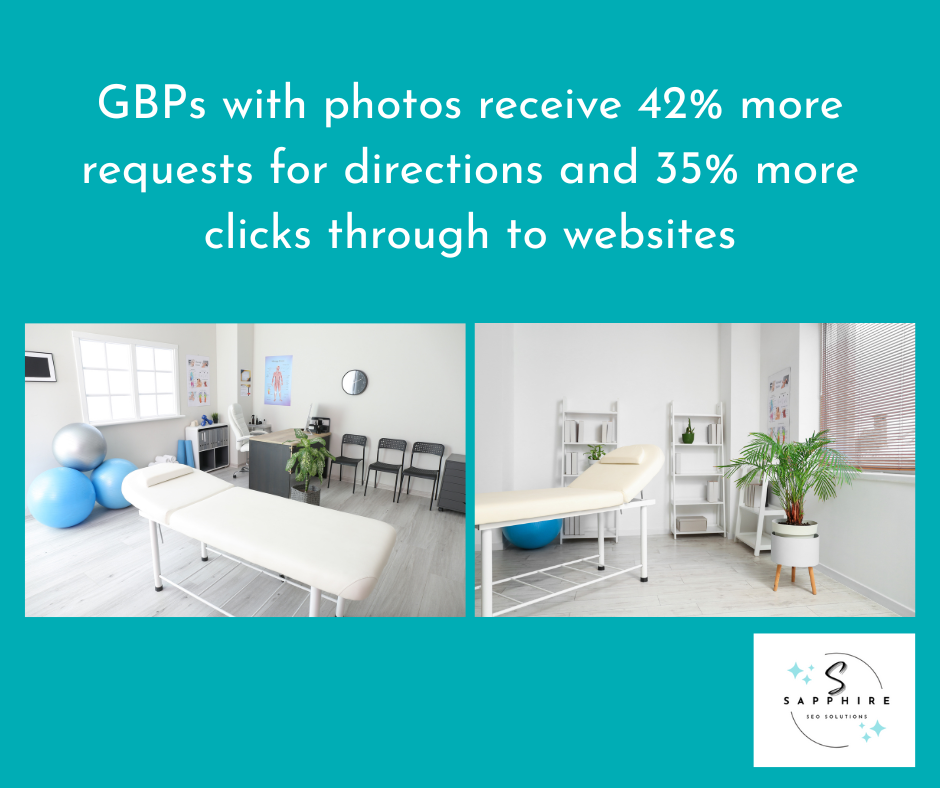
Photos drive engagement. According to BrightLocal, GBPs with photos receive 42% more requests for directions and 35% more clicks through to websites. Verified Google Business Profiles with 15+ photos per location saw stronger engagement across all customer actions.
Here are a few best practices for optimizing images for your GBP:
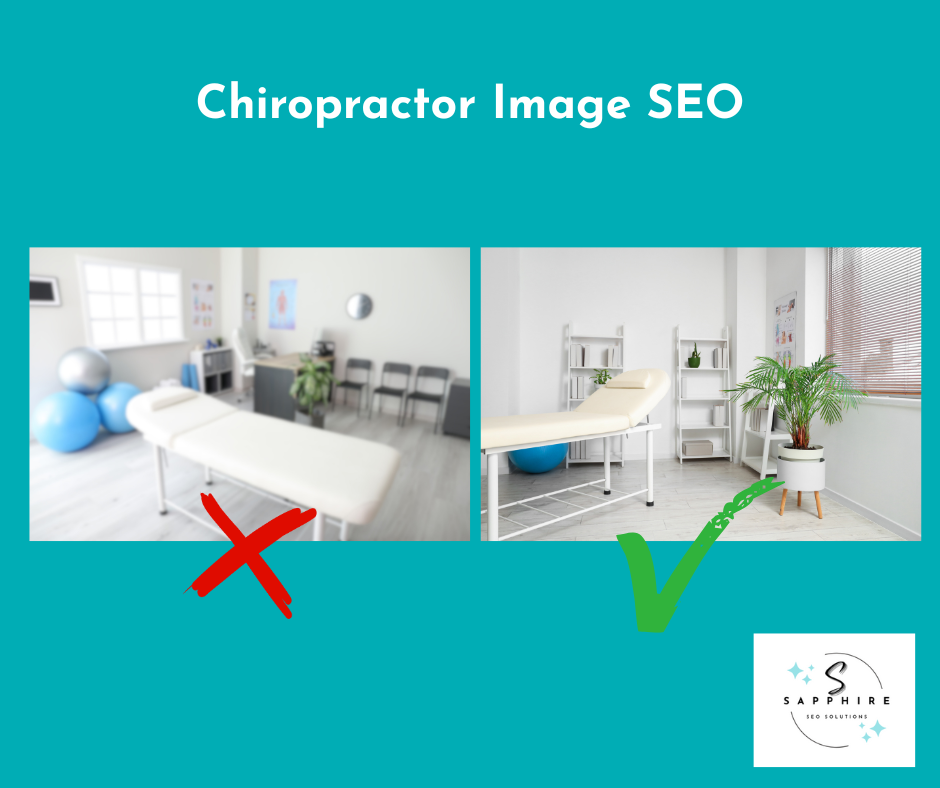
Upload high-quality images of your clinic exterior, treatment rooms, waiting area, and equipment.
Add team photos with doctor profiles. Patient success stories build trust, but get written consent first.
A short clinic tour video shows what to expect on the first visit.
Use real photos, not stock images. Google tracks engagement, and authentic visuals perform better.
GBP Engagement
Post weekly to keep your profile active. Consumers consider businesses that post regularly to their Google Business Profile more than companies that don't. Share offers ("New patient special: $50 off first adjustment"), tips ("5 stretches to prevent lower back pain"), and patient success stories.
Here's how you boost engagement on your GBP:
Event posts promote seminars, workshops, or health fairs. They stay visible until the event passes.
Answer questions in the Q&A section before patients discover them unanswered. Common questions include "Do you accept insurance?" and "Do you treat sports injuries?"
Respond to every review. It signals to local customers that you care about their experience.
Website On-Page SEO — Speak Google's Language
Your chiropractic clinic's website needs to communicate clearly with search engines. On-page SEO translates your website content into signals Google understands and rewards.
Title Tags & Meta Descriptions
Title tags appear as the clickable headline in search results. Shorter title tags have a higher CTR than longer ones. Keep them under 60 characters so they display fully.
Write titles with your primary keyword first. Here's an example: "Chiropractor in [City] | Back Pain Relief" beats "[Your Clinic Name] | Chiropractor."
Meta descriptions don't directly impact rankings, but they determine click-through rates. Well-crafted meta descriptions can improve CTR, which Google considers when ranking pages. Keep descriptions under 160 characters. Include your target keyword naturally and add a clear value proposition.
Here is a meta description example for service pages: "Get relief from [condition] with expert chiropractic care in [City]. Same-day appointments available. Call [phone number]."
Header Tags (H1, H2, H3)
Headers organize content for humans and search engines. Your H1 tag should contain your primary keyword and match user intent. Each page gets one H1.
Use H2s for main sections and H3s for subsections. This structure helps Google understand your content hierarchy and improves your SEO strategy. Don't stuff keywords into every header. Natural language wins.
Structured Data / Schema Markup
Schema markup tells search engines exactly what your content means. Schema markup is a critical component of Local SEO that directly aids search engines in parsing and interpreting website content.
Implement the following three schema types on your chiropractic website:
LocalBusiness schema provides your name, address, phone number, hours, and coordinates. Very few sites have structured data, which means using it gives you a competitive advantage.
Service schema describes your specific treatments, like back pain therapy, sports injury care, or prenatal chiropractic.
Review schema displays star ratings in search results. Rich results with review stars grab attention and encourage more clicks.
Use JSON-LD format and test your markup with Google's Rich Results Test. This is an on-page SEO work and not off-page SEO work that pays dividends.
URL Structure
Clean URLs rank better. Use "yourwebsite.com/chiropractor-city-name" instead of "yourwebsite.com/page?id=123."
Include location keywords in URLs for local pages. Keep URLs short, readable, and descriptive. This clarity signals SEO success to both users and search engines.
Image Optimization
Large images slow down your site. Compress every photo before uploading. Fast sites rank higher and keep visitors engaged, especially on mobile devices.
Add descriptive alt tags to every image. "Chiropractor performing spinal adjustment on patient in [City] clinic" is better than "IMG_1234.jpg." Alt tags with local terms strengthen mobile optimization and accessibility.
Use WebP format for smaller file sizes without quality loss. Learn more about image SEO by reading through our comprehensive guide on "Can Adding More Pictures Increase SEO?"
Local Landing Pages and Service Pages
Keywords Everywhere states that businesses that create well-optimized long landing pages can experience up to a 220% boost in conversion rates compared to generic short web pages. Your chiropractic clinic needs dedicated pages for services and locations.
Clinic Homepage
Your homepage targets local patients looking for general chiropractic care. Here's what you should do:
Display local proof immediately. Feature reviews from patients in your city. Show your Google rating prominently.
Highlight three to five primary services above the fold. Back pain relief, sports injury treatment, and auto accident care are common winners. Each service should link to its own page.
Click-to-call buttons matter. Crazyegg reveals that Desktops have a conversion rate of 4.03%, while mobile devices lag behind at 2.19%. Make your phone number visible on both.
Add an online booking button for new patients who prefer scheduling outside business hours.

Dedicated Service Pages
Each service deserves its own page. Hostinger says that companies with 40+ landing pages see 500% more conversions than those with five or fewer. More pages mean more opportunities to rank for specific search terms and attract more local patients.
Create separate pages for:
Back pain treatment: Target people searching "chiropractor for back pain [City]" or "herniated disc treatment near me."
Sports injury chiropractic: Attract athletes and active patients searching "sports chiropractor [Neighborhood]" or "running injury treatment."
Pediatric chiropractic: Reach parents searching "pediatric chiropractor [City]" or "chiropractor for kids near me."
Prenatal chiropractic: Target expecting mothers searching "pregnancy chiropractor [City]" or "prenatal back pain relief."
Each page needs unique, E-E-A-T content that addresses patient questions, describes the treatment process, and includes a clear call to action. Don't duplicate content across pages. These local SEO efforts only work when each page offers distinct value.
Location-Specific Pages (For Multi-Location Clinics)
If you operate more than one location, create unique pages for each. Location or city pages may not drive a lot of traffic, but they typically get higher conversion rates because visitors are already qualified and local.
Each location page needs distinct content. Don't just swap city names in a template. Google penalizes thin, duplicate content. Reference local neighborhoods, nearby landmarks, and community connections. "Our [Neighborhood] clinic serves patients from [Adjacent Area 1], [Adjacent Area 2], and [Adjacent Area 3]."
Link each location page to its corresponding GBP. This connection strengthens your successful local seo strategy and helps patients find the right office. Include specific address, phone number, hours, and directions for each location.
Add unique elements like staff bios for that location, parking information, and accessibility details. These specifics improve local rankings and user experience.
Local Content Strategy — Beyond the Basics
Content creation separates practices that dominate search results from those struggling for visibility. Your localized content marketing needs to attract website visitors and convert them into patients.
Blog Content That Ranks and Converts
Blogs can increase organic traffic for healthcare clinics. Providers with patient education content see a greater retention rate than those that don't have such content. The secret is to write content that addresses real patient problems in your area.
Here's what you can publish on your site:
Pain condition guides answer "why does my [body part] hurt?" and "what causes [condition]?" Target local searches like "sciatica treatment [City]" or "whiplash chiropractor [ZIP code]."
Treatment walkthroughs explain what happens during specific procedures. "What to expect during your first chiropractic adjustment" or "How spinal decompression therapy works" builds trust with nervous first-time patients.
Local patient stories (with permission) show real results in your community. These perform well for better local SEO because they naturally include location references.
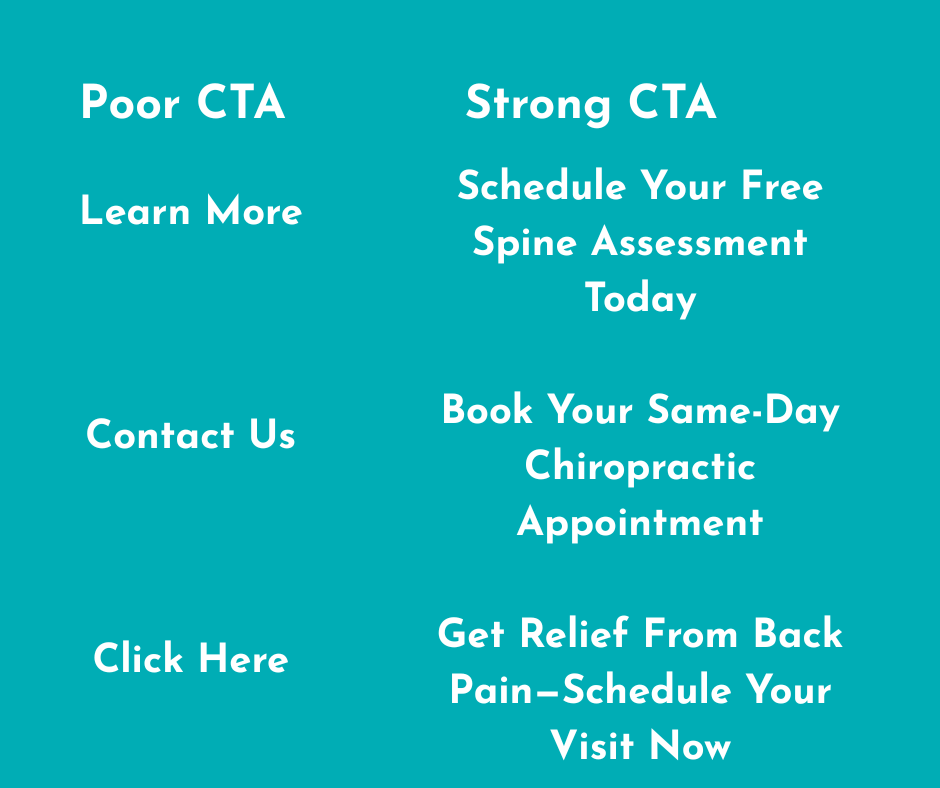
Every blog post follows this framework: identify the problem, explain your solution, and include a clear call to action. Here's an example of a CTA: "Dealing with chronic lower back pain in [City]? Schedule a consultation to discover if chiropractic care is right for you."
DemandSage reveals that businesses that blog consistently see 13x more positive ROI than those that don't. Each local SEO campaign benefits from consistent publishing. Check out our blog writing services to learn more about blogging for your chiropractic practice.
Multimedia Content
HubSpot reveals that 82% of marketing professionals say that video content gives them a positive ROI. 80% of online visitors, especially mobile users, prefer watching a video, while only 20% will thoroughly read written content.
Here's how you should do multimedia content for your site:
Create short videos answering common questions. "What to expect on your first visit" reduces anxiety and increases show rates. 39% of marketers find that videos between 30 and 60 seconds are the most effective (Keywords Everywhere). Keep videos brief and focused.
Before and after patient testimonials build credibility. Viewers are more likely to remember a call to action after watching a video than when reading text. Get written consent before filming any patient content.
Podcasts reach busy people during commutes. Interview other health professionals in your clinic. Discuss common conditions and treatment approaches.
Infographics explaining proper posture or stretching techniques get shared on social media. Visual content spreads faster than text alone.
Localized Content
Mastering local seo requires content that only you can create. Write about topics specific to your community. Here are a few examples:
"Best back health exercises for [City] office workers" targets local searchers with desk jobs.
"How [Local Sports Team] fans can prevent game day injuries" connects with your community.
"Preparing for [Local Event] without hurting your back" ties your expertise to what's happening nearby.
Cover local health events and workshops. Sponsor a 5K. Write about running injury prevention. Attend a health fair. Publish a recap with photos. These local connections strengthen your authority and attract more website visitors searching for community-focused healthcare providers.
Reviews & Reputation — Trust Signals that Drive Local Ranking
Online reviews are the second most important local ranking factor. More importantly, they determine whether people click on your listing and book appointments.
Why Reviews Matter for Local SEO
Reviews impact your local search rankings in multiple ways. Google considers review quantity, velocity (how often you get new reviews), diversity across platforms, average rating, keywords mentioned in reviews, and whether you respond.
Reviews can increase conversion rates. Positive Google reviews correlate with revenue growth. Trust matters more than perfection. You don't need hundreds of reviews. You need consistent, recent positive reviews that tell real stories about satisfied patients getting results.
PowerReviews states that 73% of consumers prefer reading reviews that are less than three months old. Fresh reviews signal active practice. Old reviews suggest you're stagnant or no longer serving patients well. Your local SEO performance depends on maintaining a steady flow of new feedback.
For more information on how reviews impact local SEO, check out our detailed guide on "The Role of Online Reviews in Local SEO Rankings."
Review Acquisition Systems
According to BrightLocal, only 19% of consumers will always leave a review when asked. You need a system that makes asking automatic and easy.
Send automated review requests via SMS or email within 24 to 48 hours after appointments. Consumers read an average of 10 online reviews before feeling able to trust a local business. The sooner you request reviews, the fresher the experience in their mind.
Your message template should be brief and personal: "Hi [Name], we're glad we could help with your back pain. If you have a moment, sharing your experience helps others find the care they need. Here's a direct link to leave a review: [URL]."
Include a direct review link. Don't make patients search for your profile. Every review you generate moves you closer to that threshold.
Ask your best patients first. Target people who never miss appointments, mention positive results, or refer friends. They're most likely to write detailed, helpful reviews. Encourage satisfied patients to share specific details about their treatment and outcomes.
Managing Negative Reviews
KeywordsEverywhere reveals that 53% of consumers expect a response to negative reviews within a week, and 97% read business responses. How you handle criticism matters more than the criticism itself.
Respond professionally to every negative review. Never argue, blame, or make excuses. Acknowledge their experience, apologize for falling short, and offer to resolve the issue offline.
Here's how you should respond to a negative review: "We're sorry your visit didn't meet your expectations. This isn't the experience we aim to provide. Please call our office at [phone number] so we can make this right."
Future patients read your responses more than the complaints. They want to know if you listen and care when things go wrong. A thoughtful reply to a critical review builds trust with people who've never met you.
Monitor online mentions of your practice across Google, Facebook, Yelp, and healthcare-specific review sites. Your competitor could leave a fake review to affect your brand. If you spot fake reviews, report them through the platform's official channels. Don't engage publicly with obvious spam or malicious content.

Local Citations & Directory Strategy
Local citations are mentions of your business name, address, and phone number across the web. Citations rank as a top-five ranking factor for both the local pack and organic search results. They verify your practice exists and operates where you claim.
What Citations Are and Why They Matter
Citations are online listings with consistent NAP data. Every time your practice appears on a directory, review site, or local platform with accurate contact information, you build another trust signal.
To verify its impression of a local business is correct, Google requires a sufficient pool of data. Citations provide that data.
NAP consistency matters more than you think. Even minor inconsistencies can confuse Google enough to drop you from top rankings for two years.
NAP consistency remains one of the top five factors for local pack rankings on Google Maps. Use the exact same format everywhere. "Main Street" in one place and "Main St." in another creates confusion.
Business listings with consistent NAP strengthen your relationship between citation accuracy and ranking. The higher the level of consistency you achieve across your local citation profile, the greater the level of trust search engines and consumers build.

High-Value Chiropractic Directories
Focus on healthcare-specific directories first. These carry more weight than generic business listings for chiropractors. Here are a few platforms you can register with:
Healthgrades is where millions of patients research doctors monthly. Millions of patients use Healthgrades every month to check a doctor's background, education, and patient satisfaction ratings. Claim your free listing.
Vitals offers detailed provider profiles with reviews. The platform emphasizes affordability and quality.
WebMD connects you with patients actively researching health conditions and treatments.
Zocdoc enables online appointment booking. It's a paid directory but converts well.
National Directory of Chiropractic has served the profession for 25 years. The directory lists over 65,000 chiropractors and shows professional credibility. The US Chiropractic Directory focuses exclusively on chiropractors. Since its debut, it has received more than 18.5 million research hits.
The American Chiropractic Association's Find a Doctor tool signals professional membership and high standards.
General directories like Yelp, Facebook, Better Business Bureau, and your local Chamber of Commerce still matter. Build local backlinks from community resources.
Citation Audit and Cleanup
Run a citation audit to find inconsistencies. Search Google for your business name in quotes: "Your Clinic Name." Visit each result and check NAP accuracy.
Use tools like Moz Local, BrightLocal, or Whitespark to scan dozens of directories automatically. They flag duplicates and inconsistencies.
Fix errors systematically. Prioritize high-authority sites first. Google Business Profile, Yelp, Facebook, and industry directories need perfect accuracy.
Delete duplicate listings. Multiple profiles for the same location confuse search engines and split your reviews across different pages.
Update information when you move, change phone numbers, or rebrand. Always update your NAP information promptly when there are changes. Inconsistencies spread through data aggregators like a virus.
Create a master spreadsheet tracking every citation with login credentials, listing URL, and last update date. Review quarterly to maintain accuracy. This systematic approach protects your local links from degradation over time.
Link Building for Local SEO
Links from other websites signal authority to Google. They are part of your off-page SEO efforts. Strong backlink profiles help you appear in impactful searches on search engines. Quality matters far more than quantity. One high-quality link from a medical journal may outweigh dozens from general websites.
Local Partnership Opportunities
Partner with complementary healthcare providers. Physical therapists, massage therapists, sports medicine clinics, and gyms serve similar patients. Cross-promotion benefits both practices.
Reach out to local gyms and fitness centers. Offer to write an article about injury prevention or proper form during exercises. They link to your expertise, and you connect with active people who might need chiropractic care.
Contact sports teams and athletic organizations. Sponsor a youth league or local running club. Backlinks from local business directories, community websites, and local news outlets can generate traffic and warm leads. Team websites typically link to sponsors and healthcare partners.
Physical therapy clinics make natural partners. You treat different but overlapping conditions. A PT might refer patients with alignment issues, while you refer patients needing rehab after adjustments.

Community Involvement
Community engagement builds both links and reputation. Sponsor local health fairs, charity runs, or wellness events. Event websites list sponsors with links back to your site.
Host free workshops at community centers or libraries. "Workplace Ergonomics 101" or "Managing Back Pain Naturally" positions you as an expert. Organizations promoting these events link to your website for registration or more information.
Offer expert quotes to local journalists. HARO (Help A Reporter Out) connects healthcare experts with journalists seeking quotes for articles. When reporters quote you in articles about back pain, posture, or workplace wellness, they include a link to your practice.
Join your local Chamber of Commerce. Members get listed in the directory with a backlink. Chamber involvement opens doors to other business partnerships.
Content-Driven Linkable Assets
Create resources that other websites want to link to. Comprehensive guides about specific conditions make excellent linkable assets. "The Complete Guide to Sciatica Relief" or "Understanding Whiplash After Auto Accidents" attract links from health blogs, forums, and community sites.
Patient education infographics perform well. Visual content explaining proper posture, ergonomic workstation setup, or stretching routines gets shared across social media and linked from wellness blogs.
Publish original research or case studies. Survey your patients about pain levels before and after treatment. Share anonymized success rates for specific conditions. Data-driven content attracts links from healthcare publications and industry websites.
Local health guides specific to your area naturally attract local links. "Best Hiking Trails in [City] for People with Back Pain" or "[City] Office Workers' Guide to Reducing Desk Pain" provide unique value that local websites and blogs want to share.
Technical SEO — The Silent Ranking Booster
Technical SEO determines whether search engines can find, crawl, and rank your content. Your chiropractic clinic's online visibility depends on infrastructure most patients never see. More than 60% of global web traffic, according to Statista, comes from mobile devices, and Google fully transitioned to mobile-first indexing by July 2024. If your site doesn't work on smartphones, you don't exist in search results.
Website Performance
Google judges your site primarily by its mobile version. Your mobile experience determines your desktop rankings, too. Responsive design automatically adjusts to any screen size. Test every page on an actual phone before publishing.
Speed matters more than you think. According to Cloudflare, 47% of customers expect a webpage to load in 2 seconds or less. Website conversion rates continue to drop with every second delay in page loading.
Here's what you should do if you have a slow site:
Compress images before uploading.
Use WebP format instead of JPEG or PNG.
Enable browser caching so returning visitors load pages faster.
Use Google PageSpeed Insights to identify performance bottlenecks. The tool tells you exactly what's slowing your site and how to fix it.
Focus on Core Web Vitals: Largest Contentful Paint (under 2.5 seconds), Interaction to Next Paint (under 200 milliseconds), and Cumulative Layout Shift (under 0.1).

Secure Website (HTTPS)
HTTPS encrypts data between your site and visitors. Google treats it as a ranking signal. Sites optimized for mobile devices tend to rank higher in search results, and security is part of that optimization.
Install an SSL certificate through your hosting provider. Most hosts offer free certificates through Let's Encrypt. The process takes minutes. The green padlock in the address bar builds patient trust and improves rankings.
Crawlability & Sitemap
Search engines need to crawl every important page. After July 5, 2024, websites not accessible with mobile devices are no longer indexable. Make sure Google can find everything.
Here are some best practices to follow:
Create an XML sitemap listing all your pages. Submit it through Google Search Console. The sitemap acts as a roadmap showing search engines which pages matter most.
Check your robots.txt file. Don't accidentally block important pages. Use Google Search Console to test which pages Google can access.
Fix broken links immediately. They frustrate users and waste Google's crawl budget. Run monthly audits to catch 404 errors before they damage rankings.
Tracking and Analytics — Know What's Working
You can't improve what you don't measure. GA4 tracks clicks, video views, and downloads on websites, unveiling visitor interests. Google Analytics shows which marketing efforts bring patients to your practice and which waste your budget.
Tools to Use
Google Analytics 4 is the current standard. GA4 uses machine learning to predict user behavior and give you proactive suggestions. It tracks every interaction as an event, from page views to form submissions to phone calls. GA4 automatically tracks click events, including mailto: and tel: hyperlinks, when someone clicks to get in touch with you.
Set up conversion tracking for appointment bookings, contact form submissions, and phone clicks. Inbound phone calls are more likely to convert than inbound web leads. Don't ignore call tracking.
Google Search Console shows which keywords drive traffic, where you rank, and technical issues blocking your visibility. Check it weekly for new ranking opportunities and problems.
Local rank tracking tools like BrightLocal, Whitespark, or Local Falcon monitor your position in the local pack across different locations. Track rankings for your primary keywords in all neighborhoods you serve.
KPIs That Matter
Track metrics that directly impact revenue. They include the following:
Local rankings and impressions show visibility. You should customize the GA4 Demographics Details report by city so you can see which surrounding neighborhoods bring the most people to your site. Monitor how many people see your GBP and website in local searches.
Phone calls and contact form conversions measure intent. Track which marketing channels generate calls and which convert to scheduled appointments.
GBP engagement metrics include profile views, search queries, direction requests, phone calls, and website clicks. Rising engagement signals a stronger local presence.
Traffic quality matters more than quantity. A practice with 200 highly targeted local visitors beats a practice with 2,000 random visitors.
Bounce rate and time on page reveal content quality. High bounce rates on service pages indicate messaging problems or slow load times.
How to Report and Optimize Monthly
Create a monthly SEO scorecard tracking the same metrics every period. Compare month-over-month changes and identify trends.
Review which keywords improved or declined in rankings. Double down on rising keywords. Investigate drops and adjust content.
Analyze traffic sources. If organic search traffic drops, diagnose the cause. Check for algorithm updates, technical issues, or competitor gains.
Test and refine based on data. If blog posts about specific conditions drive appointments, create more content in that category. If certain service pages convert poorly, rewrite them or improve calls to action.
Schedule quarterly technical audits checking site speed, mobile usability, broken links, and schema implementation. Fix issues immediately.
Local SEO Maintenance Plan — A Repeatable System
Local SEO demands ongoing attention. Search engine algorithms are continuously evolving, requiring businesses to stay updated with the latest trends and best practices. SEO is not a one-time effort; it requires ongoing maintenance to sustain rankings, improve visibility, and adapt to search engine updates. A structured schedule keeps your practice competitive without consuming all your time.
Weekly tasks keep momentum going. Post to your GBP once or twice weekly. Share health tips, patient testimonials (with permission), or special offers. An audit using third-party tools to ensure accuracy and consistency of data is strongly advised at least quarterly, but weekly attention prevents problems from accumulating.
Monitor and respond to new reviews within 48 hours. Check Google Search Console for sudden ranking drops or indexing errors. Scan for broken links on key service pages.
Monthly tasks maintain optimization and identify opportunities. Publish one to two blog posts targeting local keywords. Websites that follow a regular posting schedule, usually several times a week, get significantly more traffic. Consistency beats sporadic effort.
Review Google Analytics to track which content drives appointments. Update older blog posts with fresh information and current statistics. Check competitor rankings to spot gaps in your strategy.
Audit citation consistency across major directories. Run a site speed test and compress any new images that are slowing your pages.
Quarterly tasks address bigger picture issues. Quarterly tasks allow you to step back and look at the bigger picture of your SEO strategy. Conduct a comprehensive technical SEO audit, checking mobile usability, Core Web Vitals, and schema markup implementation.
Review your backlink profile. Identify new link opportunities from local partnerships or content you published. Refresh keyword research to catch seasonal trends or emerging search patterns.
Update service pages with new treatment options or technology. Verify all NAP information across directories remains accurate. Local listings management should be audited quarterly using third-party tools to ensure accuracy and consistency of data.
Analyze which GBP posts generated the most engagement and replicate successful formats. This systematic approach prevents local SEO from becoming overwhelming while maintaining steady progress.
Action Plan — 90-Day Roadmap
Local SEO delivers results, but not overnight. SEO takes at least 6 to 12 months to start seeing results. You might see some initial results within 1 to 6 months, like your website appearing in searches, but meaningful traffic and appointments take longer.
Here's a 90-day roadmap to launch your local SEO strategy.
Week 1-4: Foundation
Claim and optimize your Google Business Profile. Choose the correct primary category. Add complete NAP information, services, attributes, and photos. Google confirms that relevance, distance, and prominence are the key factors for higher rankings in their local pack. Your GBP optimization directly impacts all three.
Run a technical SEO audit. Check mobile responsiveness, site speed, HTTPS security, and crawlability. Fix critical errors immediately.
Conduct comprehensive keyword research. Identify primary, secondary, and long-tail keywords with local intent. Create a spreadsheet tracking target keywords for each service page.
Audit current citations. Search for your business name across directories and note inconsistencies. Create a master NAP format to use everywhere.
Week 5-8: Content and Optimization
Optimize existing service pages with target keywords. Update title tags, meta descriptions, headers, and body content. Add schema markup to key pages.
Create location-specific landing pages if you serve multiple areas. Write unique content for each location with neighborhood references.
Publish two to four blog posts targeting local keywords. Focus on patient problems and treatment solutions.
Fix citation inconsistencies found in your audit. Update or claim listings on high-value directories like Healthgrades, Vitals, and WebMD.
Start collecting reviews systematically. Set up automated review requests sent 24 to 48 hours after appointments.
Week 9-12: Building Authority
Continue publishing one to two blog posts weekly. Consistency matters more than occasional bursts of content.
Build local backlinks. Contact complementary healthcare providers about partnership opportunities. Reach out to local gyms, sports teams, and community organizations.
Upload fresh photos to your GBP weekly. Post updates about services, health tips, or patient success stories.
Monitor analytics. Review which keywords drive traffic, which pages convert visitors to calls, and where improvements are needed.
Set up Google Search Console and Google Analytics 4 if you haven't already. Track local rankings, GBP performance, and website conversions.
Beyond 90 Days
For most businesses, 6 to 12 months is the realistic window to see meaningful SEO results. Your first three months build the foundation. Months four through twelve compound your efforts as Google recognizes your authority and consistency.
Maintain weekly GBP posts, monthly blog content, and quarterly technical audits. Review and respond to every review. Continue building local partnerships and earning backlinks. Update old content with fresh information and current statistics.
Local SEO rewards persistence. Over half of the web pages that rank in the top 10 Google search results are three years old or more. Start now and keep going.
Local SEO 90-Day Launch Checklist
Local SEO delivers results—but not overnight. Expect early visibility in 1–6 months, with meaningful traffic and appointments typically appearing within 6–12 months.
| Phase | Checklist Item | Status |
|---|---|---|
| Week 1–4: Foundation | Claim and fully optimize Google Business Profile (category, NAP, services, attributes, photos) | ⬜ |
| Week 1–4 | Run technical SEO audit (mobile, speed, HTTPS, crawlability) | ⬜ |
| Week 1–4 | Conduct local keyword research and map keywords to service pages | ⬜ |
| Week 1–4 | Audit citations and create a master NAP format | ⬜ |
| Week 5–8: Optimization | Optimize service pages (titles, meta descriptions, headers, content) | ⬜ |
| Week 5–8 | Create location-specific landing pages with unique local content | ⬜ |
| Week 5–8 | Publish 2–4 blog posts targeting local search intent | ⬜ |
| Week 5–8 | Fix citation inconsistencies and claim high-value directories | ⬜ |
| Week 5–8 | Set up automated review requests after appointments | ⬜ |
| Week 9–12: Authority | Publish 1–2 blog posts weekly | ⬜ |
| Week 9–12 | Build local backlinks (providers, gyms, community partners) | ⬜ |
| Week 9–12 | Post weekly updates and photos to Google Business Profile | ⬜ |
| Week 9–12 | Set up and monitor Google Search Console and GA4 | ⬜ |
| Beyond 90 Days | Maintain consistent GBP activity, content, audits, reviews, and backlinks | ⬜ |
Let Experts Handle Your Chiropractic Clinic's Local SEO and Drive Business Success!
Local SEO puts your practice in front of potential patients searching for care right now. Google Business Profile optimization is your foundation. Combined with consistent content, accurate local directories, and strategic reviews, these efforts compound over months.
Chiropractic SEO rewards action over perfection. Start with your GBP. Fix your citations. Publish helpful content. Share patient success stories with permission. Each step builds authority and visibility.
Local SEO can feel overwhelming, which is why it's best to work with experts. At Sapphire SEO Solutions, we are certified SEO professionals who can boost your online presence and take your chiropractic clinic to the next level.
Contact us today to schedule a free consultation with an experienced SEO professional to learn how we can help your practice dominate the local market!

FAQs - Local SEO for Chiropractic Clinics
How long until local SEO results show?
Local SEO results typically begin appearing within 3 to 6 months, though the timeline varies based on your market's competitiveness and your current online presence. You'll often notice early improvements in Google Business Profile visibility and local map pack rankings within the first 8 to 12 weeks as we optimize your listing and build citations. More competitive keywords and organic search rankings generally take 6 to 12 months to show substantial movement since search engines need time to crawl your optimized content, verify your citations, and build trust in your practice's local authority. The good news is that results compound over time, so while initial progress may seem gradual, practices that consistently maintain their local SEO efforts see accelerating improvements in patient inquiries and appointment bookings as their digital footprint strengthens across Google and other platforms.
Do I need citations on every directory?
You don't need to be listed on every directory, but you should focus on the most important ones for local SEO and your chiropractic practice specifically. Priority citations include major platforms like Google Business Profile, Bing Places, Apple Maps, Yelp, Facebook, and healthcare-specific directories such as Healthgrades, WebMD, and Vitals. Beyond these core listings, aim for 30 to 50 quality citations on reputable local directories, industry-specific sites, and local business listings relevant to your area. The key is consistency across these citations because having accurate, matching NAP information (name, address, phone number) signals credibility to search engines and helps improve your local rankings. More citations aren't always better if the directories are low-quality or spammy, so it's better to have fewer high-quality, consistent listings than hundreds of inconsistent or irrelevant ones that could actually harm your local search performance.
Why aren't my GBP views increasing?
Several factors could explain stagnant Google Business Profile views, starting with insufficient optimization of your profile itself, such as incomplete business information, lack of regular posts, missing services or attributes, or outdated photos that fail to engage potential patients. Your profile might not be ranking well in local search results or the map pack due to weak citation consistency, limited reviews, or competitors with stronger local SEO signals in your area. Low engagement metrics like click-through rates and actions taken on your profile also signal to Google that your listing isn't valuable, which can suppress its visibility. Additionally, if you're not actively posting updates, photos, or special offers, Google may deprioritize your profile compared to more active competitors. To boost views, focus on completing every section of your profile, publishing weekly posts about your services or health tips, encouraging patient reviews, adding high-quality photos regularly, and ensuring your practice appears in relevant local searches by strengthening your overall local SEO through citations, on-page optimization, and local content creation.
How many reviews do I need?
While there's no magic number, successful chiropractic practices typically need at least 20 to 50 reviews to establish credibility and compete effectively in local search results, though the exact number depends on what your competitors have in your market. More important than hitting a specific count is maintaining a steady flow of fresh reviews, ideally getting 3 to 5 new reviews per month, since recent reviews signal to both Google and potential patients that your practice is active and trusted. Quality matters as much as quantity, so focus on getting detailed, authentic reviews that mention specific treatments or experiences rather than just star ratings. As you grow, aim to match or exceed the review counts of top-ranking competitors in your area, but remember that review velocity, response rates, and overall star rating also heavily influence your rankings and conversion rates. The ongoing process of requesting reviews from satisfied patients should become part of your practice's routine rather than a one-time effort, as maintaining momentum shows Google your practice consistently delivers value and helps you stand out when potential patients are comparing chiropractors in your area.