

Landscaping SEO vs Google Ads: Which Generates Better Leads?
Every landscaping company runs into the same wall eventually. You've got a marketing budget, and it's not unlimited. So you have to pick where that money goes first: SEO or Google Ads.
Most owners assume one option just beats the other. It doesn't work that way. The right call depends on your goals, your timeline, how much you can spend, what services you offer, and who else is fighting for customers in your area.
This isn't a sales pitch for one channel over the other. We're going to compare SEO and ads, honestly, the way we'd explain it sitting across the table from you, because landscaping SEO vs Google Ads isn't a question with one right answer for every business.
Key Takeaways
SEO builds free, long-term traffic. Organic rankings keep bringing leads without a daily ad budget.
Google Ads delivers fast results. Best for new businesses, emergencies, and short-term promotions, but only if you have the budget.
High-ticket projects favor SEO. Homeowners researching big jobs trust organic listings more than ads.
Most companies use both. Ads cover immediate needs while SEO builds lasting visibility.
Get a free audit from Sapphire SEO Solutions. See exactly where your site stands before choosing a strategy.
SEO vs Google Ads at a Glance
Here's how the two stack up side by side:
Landscaping SEO vs. Paid Advertising Comparison
That table doesn't tell the whole story, though. Every landscaping company has different goals, a different budget, and a different timeline for getting the phone to ring. SEO and Google Ads aren't interchangeable, and neither one fits every business the same way.
The rest of this article breaks down exactly when each option makes sense, so you can figure out which fits where your business stands right now, and how a comprehensive marketing strategy often ends up leaning on both.
When Landscaping SEO Makes More Sense
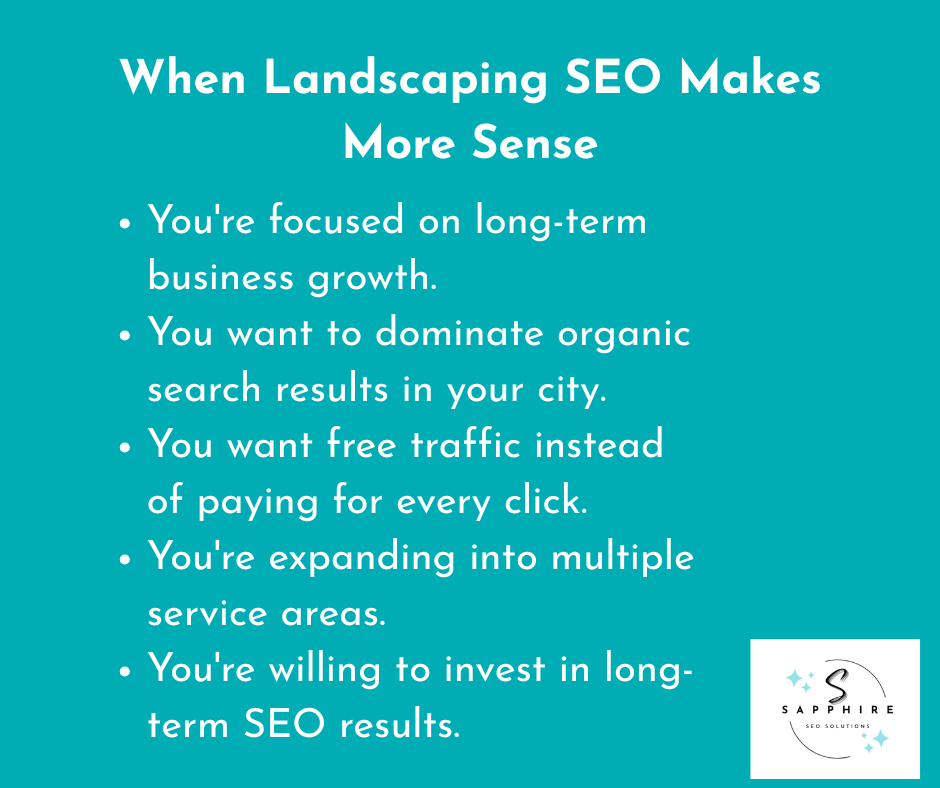
Some landscaping companies are playing the long game. If that's you, SEO usually wins.
Think about a company that wants to own its city. Not just show up once in a while, but actually dominate organic search results for years. That takes patience.
But it also means you're not writing a check to Google every time a homeowner searches for a landscaper near them. Once your organic rankings climb, that traffic is free. You're not paying per click anymore. That's the whole appeal of free traffic: it keeps showing up whether you spend money that week or not.
SEO also makes sense if you're expanding into multiple service areas or if you're chasing high-ticket projects where the sales cycle is longer and trust matters more. Homeowners researching a $40,000 backyard renovation don't usually click the first ad they see. They dig around. Organic traffic tends to convert those buyers better because it feels earned, not bought.
And if you want predictable lead generation instead of a channel that shuts off the second you pause spending, a long-term investment in SEO builds something that sticks around. This is where long-term SEO strategies pay off, not overnight, but over the course of a real seo campaign built for long-term growth.
If you're not sure what that actually involves, our guide, What Is Landscaping SEO?, breaks it down. And if budget is the sticking point, our landscaping SEO pricing guide lays out real numbers.
When Google Ads Makes More Sense
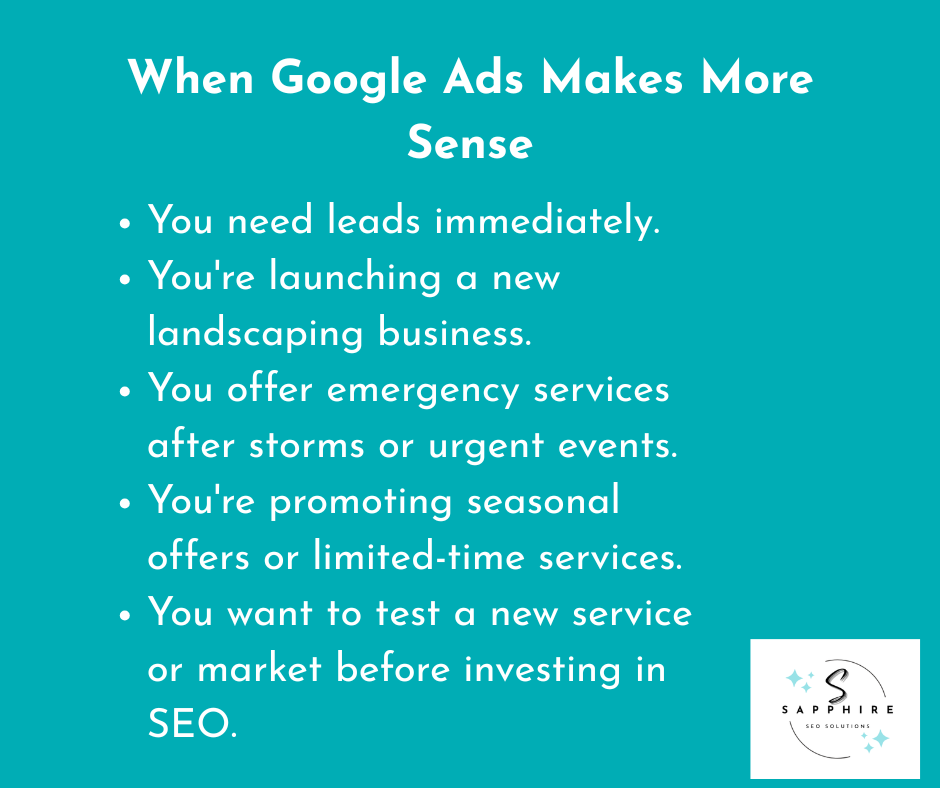
Sometimes you don't have months to wait. That's when ads make more sense.
A brand-new landscaping company doesn't have any organic rankings to lean on yet. So if you need the phone ringing this week, not next spring, paid ads get you in front of homeowners immediately. You pay Google, your ad shows up, and you start pulling in leads. Simple as that.
Immediate results matter in a few other situations too. Say a storm just rolled through and half the neighborhood needs tree removal and cleanup. Nobody's got time to wait on organic traffic to catch up. Running Google Ads campaigns for emergency services puts you in front of people who need help right now, not people who might find you in three months.
Seasonal promotions work the same way. A spring cleanup special or a fall aeration push doesn't need to build authority over time. It needs eyes on it for a few weeks, then it's done. PPC campaigns are built for exactly that kind of short-term push.
Testing new services or a new market is another good use case. Before you invest heavily in content or expand your service pages, search campaigns let you see if the demand is even there. That's how Google Ads work best: fast answers, not long-term commitments.
Neither channel solves every problem. Ads just solve different ones than SEO does.
SEO vs Google Ads for Different Landscaping Services
Not every service gets searched for the same way, and that changes which channel works better.
Lawn care is a good example. Homeowners searching for weekly mowing usually want someone local, available, and trustworthy right now. That's often where a strong Google Business Profile optimization for landscapers and paid ads work together, since search intent here is immediate and practical.
Landscape design and hardscaping are different animals. Someone planning a $30,000 patio isn't searching once and calling the first number they see. They're researching for weeks, comparing portfolios, reading reviews. That kind of buying behavior favors SEO, because by the time they're ready to call, they've usually seen your business more than once in the search volume for those design-related terms.
Tree services split down the middle. Routine trimming behaves like lawn care, mostly local and immediate. But storm damage and emergency removals almost always go straight to ads, since nobody's doing keyword research in the middle of a crisis.
Irrigation, outdoor living, and commercial landscaping all depend on your target audience. A commercial property manager searches differently than a homeowner does, using more specific, particular keywords with lower keyword difficulty but real buying intent behind them.
Finding the right keywords and the relevant keywords your actual customers use matters more than chasing rankings for their own sake.
Which Marketing Channel Brings Better Customers?
"Better" depends on what kind of customer you're actually trying to reach.
Homeowners researching a big project, like a full backyard redesign, tend to trust organic listings more than ads. They'll scroll past the sponsored spot and click into relevant search results further down, because those feel earned rather than paid for. That trust matters for high-ticket jobs, where someone's about to hand you tens of thousands of dollars and wants to feel confident they picked the right company, not just the loudest one.
Ads bring a different kind of customer. Someone who needs a service call this week isn't browsing search engine results for inspiration. They're scanning Google search results, seeing an ad that answers their exact need, and calling. That's a real customer too, just a faster-moving one.
Repeat maintenance customers usually come from potential customers who found you organically first, then stuck around because the relationship built trust over months. Commercial clients often behave more like the high-ticket homeowners: longer sales cycles, more research, more comparison shopping before they commit.
Both channels generate traffic. But the traffic looks different depending on where it comes from. SEO tends to attract people already halfway convinced. Ads attract people who need convincing right now. Neither one is wrong. They're just answering different moments in a customer's search behavior when they turn to search engines for help.
How Your Business Stage Should Influence Your Marketing Strategy
The right marketing strategy isn't fixed. It shifts as your business grows.
Startup: You don't have any online visibility yet, so Ads usually come first. They get leads flowing while you start building your business's online presence from scratch.
Established business: Once you've got steady work and some reviews behind you, shifting budget toward SEO work starts paying off. You're not desperate for leads this week, so you can afford to play the longer game.
Growing into new cities: This is where SEO efforts and ads often run side by side. Ads test the new market fast, while SEO builds a foundation for organic growth in that area over time.
Adding commercial services: Commercial clients research longer and trust organic listings more, so leaning into a stronger SEO strategy tends to fit here.
Building recurring maintenance contracts: SEO tends to attract customers who stick around, which matters more than one-off leads at this stage.
Scaling aggressively: Most fast-growing companies use both, leaning harder on ads in the short term while SEO catches up in the background.
Can You Stop Running Google Ads Once SEO Starts Working?
This comes up a lot. And the honest answer is: it depends.
Sometimes yes. Once SEO results kick in and your rankings hold steady, some landscaping companies scale back continuous ad spend because organic leads are covering enough of the workload.
But often, no. If you're in a competitive city, pulling ads completely can leave a gap that competitors jump straight into. Seasonality matters too. A company that relies on spring cleanup rushes might still need ads during peak weeks, even with strong rankings the rest of the year. Growth goals play a role as well. Expanding into a new area or launching a new service usually means you still need ads to get moving quickly while SEO catches up.
Most companies don't eliminate PPC. They reduce it gradually, watching campaign data the whole way to see what still needs paid support. Using both SEO and Ads together, just in different proportions over time, tends to be the more realistic path.
For more information on PPC and SEO, make sure to read our detailed guide on “SEO vs PPC: Which Is Better for Long-Term Growth?”
Common Mistakes Landscaping Companies Make When Choosing Between SEO and Google Ads
Most of the mistakes we see aren't technical. They're business decisions made without thinking them through.
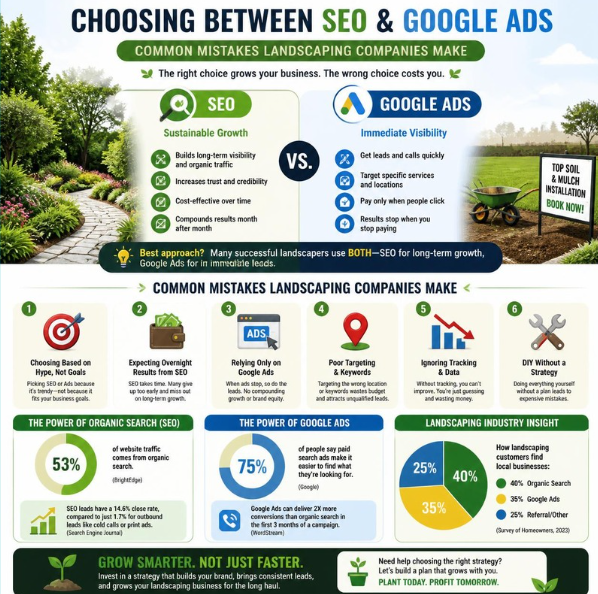
Expecting SEO to work in 30 days: Ranking on the first page takes months, not weeks. Companies that expect quick results often quit right before things start moving.
Stopping Ads too early: Some businesses cut paid search the second cash gets tight, even though that's often when leads matter most.
Choosing solely on price: The cheapest option isn't always the smartest one. A cut-rate pay-per-click setup or a rushed SEO plan usually costs more in wasted spend down the line.
Ignoring long-term growth: Chasing quick wins feels good short-term, but companies that never invest in anything beyond this month's leads tend to stay stuck at the same size.
Investing without tracking leads: Spending money on target keywords or ad campaigns without knowing which ones actually bring in calls is just guessing with a budget.
Thinking one channel replaces the other permanently: SEO doesn't make ads pointless. Ads don't make SEO unnecessary. Businesses that treat it as an either-or often miss opportunities sitting right in front of them, whether that's stronger website content or better landing pages built for constant optimization over time.
If you’re just starting out with SEO for your landscaping business’s site, make sure to go through our comprehensive guide on “Landscaping Website SEO Checklist” so that you’re on the right track.
Why the Best Landscaping Companies Use Both
The two channels don't compete with each other as much as people assume. They cover different gaps.
Ads bring leads in fast. That's their whole job. While SEO is still building momentum in the background, ads keep the phone ringing. They're also useful for testing a new service before committing real time to it. If nobody clicks the ad, that tells you something worth knowing.
SEO plays a longer role. Content creation, link building from reputable websites, and solid on-page optimization all work together to build something that sticks around. Once Google's algorithm starts trusting your site, that visibility doesn't disappear the moment you stop spending. Over time, that tends to lower your cost per customer, since organic leads don't cost anything per click. Small technical pieces matter here too, things like page speed, technical optimization, and clean internal links guiding visitors through your site.
A lot of companies start out leaning almost entirely on ads, simply because they need leads right away and haven't built any organic rankings yet. Over time, as SEO catches up, many shift toward using both strategically instead of relying on one alone. That's not true for every business. Some do fine sticking to a single channel. But for companies planning to stay visible locally for years, pairing this with Google Maps SEO for landscapers tends to round out the picture.
Landscaping SEO vs Google Ads: Which Should You Choose?
There's no universal answer here. But your situation probably points somewhere.
Choose SEO if you're playing the long game, want organic listings that keep working without a daily budget, and can wait a few months for momentum to build.
Choose Google Ads if you need leads now, you're launching something new, or you're testing demand before committing further. Search ads get you visible immediately, even without any history built up yet.
Choose both if you want fast leads today while something more durable grows underneath them. That's often where the Google Ads platform and organic search end up working side by side rather than against each other.
Whatever you decide, base it on where your business actually stands right now, not on what worked for someone else's company down the street.
Claim Your Free SEO Website Audit and Talk to an SEO Expert at Sapphire SEO Solutions Today!
Not sure whether SEO, ads, or both make sense for your landscaping company? That's exactly what we're here to help you figure out.
Sapphire SEO Solutions offers a free website audit, so you can see where your site actually stands right now and what's holding it back from ranking higher.
From there, talk to one of our SEO experts about your goals, timeline, and budget. We'll walk you through what a strategy built specifically around your landscaping business could look like. No pressure attached.
Claim your free SEO website audit today, and let's figure out the right path forward together.
Looking to learn more about landscaping SEO services? Contact us to schedule a free consultation with our SEO specialist today!
Want to order SEO-optimized content for your landscaping business? Check out the different content writing tiers we offer before placing an order online!

Frequently Asked Questions
Which marketing strategy yields better ROI for landscaping businesses: SEO or Google Ads?
It depends on your timeline. SEO usually costs less over time, but Ads bring faster returns when you need leads immediately.
What are the key differences between optimizing for search engines and running paid ads for landscaping?
SEO builds visibility gradually and keeps working without ongoing spend. Ads deliver instant placement, but stop the moment you pause your budget.
What are the top landscaping marketing tools that integrate both SEO and paid advertising platforms?
Google Business Profile, Google Analytics, and Google Ads are common starting points that most landscaping companies already have access to.
What are the best practices for combining SEO and Google Ads to promote a landscaping service?
Use Ads for immediate leads and testing new services, while letting SEO build long-term visibility in the background.
What types of content should a landscaping company create for better organic search rankings?
Service pages, location pages, and project photos showing real work tend to perform best for landscaping companies.
How can a small landscaping business effectively compete with larger companies using paid advertising?
Target specific neighborhoods or services instead of broad terms. Smaller, focused campaigns often outperform big competitors locally.
Is SEO better than Google Ads for landscaping companies?
Neither is universally better. It depends on your goals, budget, and how quickly you need leads.
Should a new landscaping business invest in Google Ads first?
Often, yes. New businesses usually need leads immediately, and Ads deliver that faster than SEO can.
Can landscaping companies use SEO and Google Ads together?
Yes. Many companies run both, adjusting the balance as their rankings and budget change over time.