

What Is Landscaping SEO? (Guide for Landscapers)
Most landscaping business owners have heard the term search engine optimization (SEO). Few actually know what it means. And that's fine. You're in the business of making properties look great, not learning how Google works.
SEO for landscapers isn't some completely separate thing from regular SEO. It's the same idea, just applied to landscaping businesses that serve specific towns, cities, and neighborhoods. The kind of SEO that helps search engines understand what you do, where you do it, and who you do it for.
This guide covers what landscaping SEO actually is, how it works, and what it involves. We'll also touch on how it differs from what national brands do, and how Google and other search engines decide which local businesses are worth showing.
Key Takeaways
Landscaping SEO is traditional SEO applied locally. It helps search engines understand what you do and where.
SEO is not a single task. It covers your website, local listings, content, and online reputation.
Google evaluates four things: relevance, distance, prominence, and authority before showing any landscaping business in results.
Different searches need different pages. One page cannot rank for every service and location you cover.
SEO is not Google Ads, social media, or a one-time website build. It's ongoing work that compounds over time.
What Is Landscaping SEO?
Search Engine Optimization is the process of making your website and online presence easier for search engines to read, understand, and trust. That's it. No magic. No tricks. Just making sure Google knows enough about your business to consider showing it to people who are looking for what you offer.
Landscaping company SEO takes that same process and applies it to the specific needs of landscaping companies. A business that mows lawns, installs patios, or handles drainage in a specific city has very different needs than an online retailer selling nationwide. Landscaping and lawn care businesses serve local areas, work within specific zip codes, and compete against a handful of local competitors rather than the entire internet.
So what does SEO actually tell search engines? Three things, mostly, and they are:
What landscaping services do you offer
Where do you offer them
Whether your business is trustworthy enough to recommend to someone searching right now
The thing most people get wrong is thinking SEO is a single task. It's not. It's a collection of activities, things like your website structure, content, online listings, reviews, and more. Some of those things happen on your website. Some happen off it. But all of them work together.
How Landscaping SEO Is Different from Traditional SEO
A company selling software online doesn't care where its customers live. You do. That's the core difference.
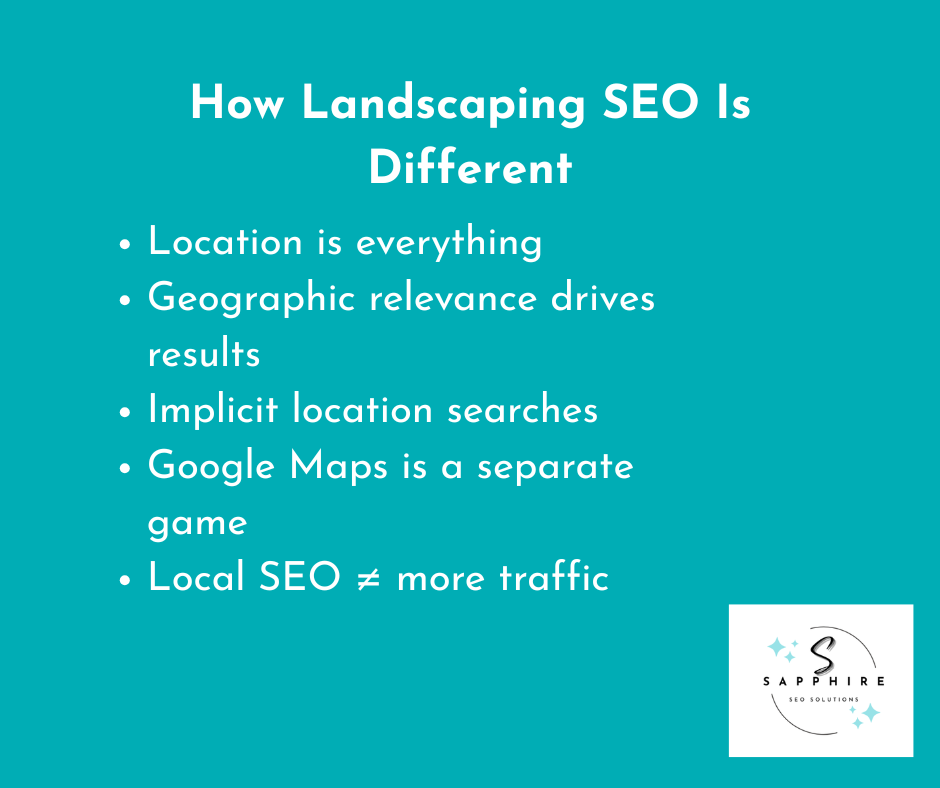
Traditional SEO is built around reaching as many people as possible, regardless of location. Local SEO works differently. Local SEO is built around geographic relevance: who's searching near you, what they're searching for, and whether Google thinks your business is close enough and relevant enough to show them.
For local landscaping companies, location isn't just a detail. It's everything. Someone searching for a landscaper in Phoenix doesn't want results from Denver. Google knows that. So it filters results based on where the searcher is and where the business operates.
That's where local searches come in. Most people looking for landscaping help are searching with location in mind, even if they don't type a city name. Google figures out the location anyway and serves up businesses within a reasonable service area.
This also means Google Maps plays a real role in how local customers find you. The map results that appear at the top of a search page are separate from the regular website results, and getting into them requires a different kind of effort than ranking a webpage.
That's the world local SEO for landscaping companies is designed for.
What Makes Up Landscaping SEO?
Landscaping SEO isn't one thing. It's four things, working together. Here's a high-level look at each:
Website SEO
Your landscaping company's website is the foundation. Before anything else can work, the site itself needs to be in good shape. That means Google can actually crawl it, meaning it can read and index your pages without running into dead ends. It means the structure makes sense, pages load reasonably fast, and the site works on a phone.
Technical SEO and technical optimization aren't glamorous, but a landscaping website that Google can't properly read is a landscaping website that won't show up.
Local SEO
This is where your business shows up on Google Maps and in local search results. Your Google Business Profile listing is a big part of that. It's a separate presence from your website, one that tells Google your business name, location, phone number, hours, and more.
Local citations matter here, too. Those are your business listings across local directory listings and online directories like Yelp, Angi, and others. Consistency across all of them signals to Google that your business is legitimate.

Content
Your landscaping service pages tell Google what you do. Your landscaping city pages tell Google where you do it. Educational SEO content builds trust with both readers and search engines. Each type serves a different purpose, and you need all three.

Authority
Google doesn't just want to know what you do. It wants to know if you're worth recommending. Online reviews are a big part of that signal. So is link building, which means getting other websites and industry sites to link back to yours.
Brand mentions matter too, even ones without a direct link. All of it tells Google that real people know your business and trust it.
For more information on the importance of online reviews for local SEO, don't forget to read our detailed guide on "The Role of Online Reviews in Local SEO Rankings."

How These Pieces Work Together
Each piece of landscaping SEO matters on its own. But none of them work in isolation. Here's what actually happens when someone searches for a landscaper.
A homeowner types "landscaping company near me" into Google. In a fraction of a second, Google runs through a checklist. Is there a business nearby that offers this service? Does that business have a page about it? What do their reviews look like? Is the website trustworthy and functional? Do other sites vouch for them?
Google pulls all of that together and decides which businesses deserve search visibility and which ones don't.
That's why organic search can't be fixed by doing just one thing. A great Google search results ranking doesn't come from reviews alone, or a good website alone, or citations alone. It comes from all of them being solid at the same time.
When a business appears in the top search results, it's usually because everything is working together. That's the ecosystem. And that's what landscaping SEO is actually building.
How Google Decides Which Landscaping Companies to Show
Google isn't just picking businesses at random. It's trying to answer one question: which business is the best answer for this person, right now, in this location?
To figure that out, Google looks at a few things, including:
Relevance: Does your business actually offer what the person searched for? If someone types "patio installation" into Google search, Google looks for businesses whose websites and listings clearly cover that service. Matching relevant keywords to the right pages is part of how that relevance gets established.
Distance: How close is your business to the person searching? For lawn care companies, this matters a lot. Google factors in physical proximity when deciding what to show in local results.
Prominence: How well-known and trusted is your business, both online and off? Reviews, mentions, and links from other sites all feed into this. It's Google's way of asking: Do real people actually know this business?
Topical authority: Google rewards businesses that clearly know their subject. A landscaping website that covers a wide range of relevant topics signals expertise.
Helpful content and E-E-A-T: Google wants to show content written by people with real experience, and that follows E-E-A-T guidelines. That means pages written for humans, not search engines.
Structured data: Schema markup or structured data is a brief technical mention worth knowing about. It's a way of labeling your content so Google can read it more clearly.
All of this shapes your search engine rankings on search engine results pages. And better search rankings mean more valuable traffic from people who are actually ready to hire.
What Types of Searches Does Landscaping SEO Target?
Not every search is the same. Someone typing "landscaping company near me" is ready to hire. Someone typing "best grass for Arizona" is doing research. Google knows the difference, and your SEO strategy has to account for it.
This idea is called search intent. It's the reason behind the search. And it's one of the most important things to understand about how potential customers find lawn care services online.
Here are the main types most landscaping businesses should be targeting.
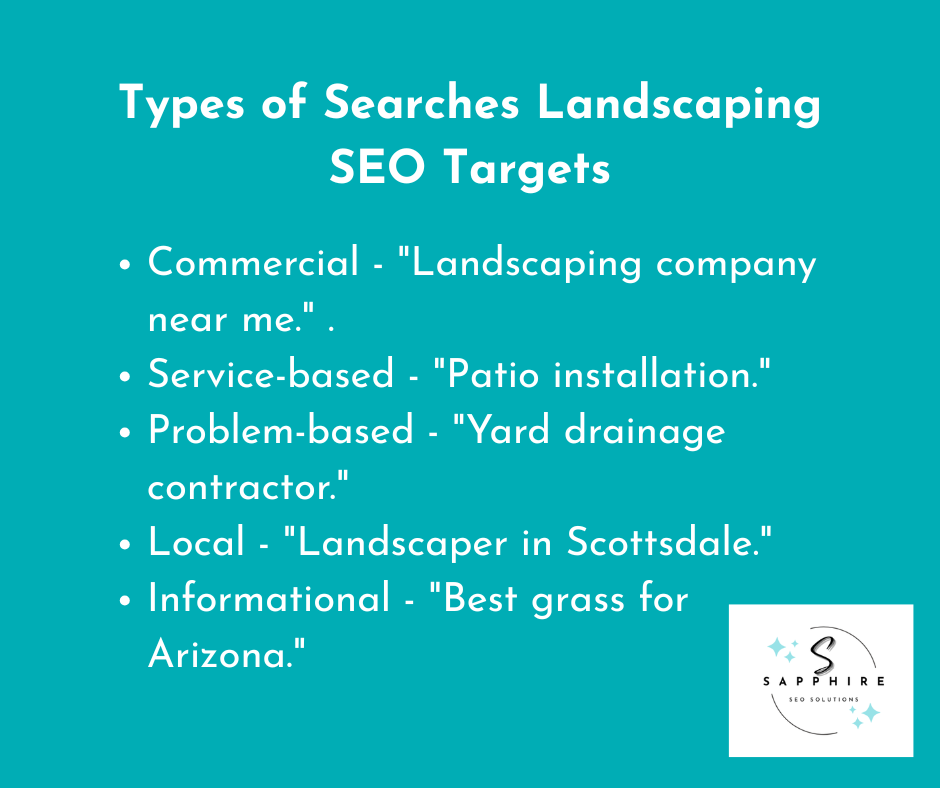
Commercial - "Landscaping company near me." The person wants to hire someone. Soon. These searches are high priority.
Service-based - "Patio installation." They know what they want done but haven't picked a company yet. A dedicated service page is what shows up here.
Problem-based - "Yard drainage contractor." They have a specific issue and need someone to fix it. These are some of the most valuable searches because the potential customers searching them are motivated.
Local - "Landscaper in Scottsdale." Location is built right into the search. These are exactly the kind of local keywords that drive real calls.
Informational - "Best grass for Arizona." They're not ready to hire yet, but they're in the research phase. Educational content captures them early.
Each type of search needs its own page. One page can't do all of this. That's why conducting keyword research with something like Google Keyword Planner or another keyword research tool matters. It tells you what potential customers search for before you build anything.
Common Landscaping SEO Terms Explained
New to this stuff? Here's a quick reference for the terms that come up most often:
Organic traffic - Visitors who find your website through unpaid search results. Organic traffic doesn't cost you anything per click, unlike paid ads.
SERPs - Short for search engine results pages. The page that appears after someone runs a Google search.
Google Business Profile - A free listing that shows your business on Google Maps and in local search results. Separate from your website. Read our detailed guide on "Attract More Visitors to Google Business Profile" to learn how to optimize your Google Business Profile.
Local Pack - The block of three local business listings that appears near the top of Google's search results for location-based searches. High-visibility real estate.
Keywords - The words and phrases potential customers type into search engines. Your content needs to match them.
Search intent - The reason behind a search. What the person actually wants when they type something in.
Backlinks - Links from other websites pointing to yours. Google treats them as votes of confidence.
Citations - Mentions of your business name, address, and phone number across online directories and other sites.
Schema markup - Code added to your website that helps search engines read and categorize your content more clearly.
Title tags and meta description optimization - Text that appears in search results, previewing each page.
Google Analytics and Google Search Console - These are the two main tools used to track how your site performs in search.
What Isn't Landscaping SEO?
A lot of business owners come in with the wrong idea about what SEO actually is. So let's clear a few things up.
SEO is not Google Ads. Unlike paid ads, SEO doesn't cost you money every time someone clicks. The two are both part of search engine marketing, but they work very differently.
SEO is not Facebook marketing. Social media marketing lives on social platforms. SEO lives on search engines. Different channels, different audiences, different results.
SEO is not posting on social media. Sharing photos of your work on Instagram doesn't move your Google rankings. It might help your brand, but it's not SEO.
SEO is not building a website once and walking away. A website that never gets updated, improved, or added to doesn't hold its ground in search. SEO is ongoing.
SEO is not keyword stuffing. Cramming a keyword into every sentence used to work in the early days of Google. It hasn't worked in a long time, and it can actually hurt you now.
SEO is not publishing AI content without quality control. Churning out low-quality pages at scale might look like a content strategy. Google doesn't see it that way.
All of these fall under other digital marketing services or black hat tactics. Some of these have their place in a broader digital marketing strategy. But none of them is SEO.
How Landscaping SEO Has Changed
SEO for landscaping looks different from what it did five years ago. Google has changed a lot, and the old playbook doesn't hold up the way it used to.
For a long time, on-page optimization (on-page SEO) was mostly about keywords. Put the right words in the right places, and you had a shot. That's still part of it, but Google has moved well beyond that.
Helpful content matters more now. Google has gotten better at telling the difference between pages written for real people and pages written just to rank. Experience counts too. Google wants to see that the people behind a website actually know what they're talking about.
Reviews have become a bigger signal. Businesses that actively manage customer reviews tend to perform better than those that don't. Google Business Profile optimization plays into this, too.
Topical authority has replaced the old keyword-first approach for lawn care SEO. And AI search (AI SEO) is starting to change how results get surfaced altogether.
Comprehensive SEO strategies today have to account for all of it.
Need Help with SEO for Landscapers? Reach Out to Us Today!
Now you know what landscaping SEO actually is. It's not Google Ads. It's not social media. It's the work that makes your business show up when someone nearby is searching for exactly what you do. It covers your website, local listings, content, and reputation online. And Google evaluates all of it before deciding who gets seen.
Finding the right seo partner makes a difference. The right landscaping seo company understands local search, knows what Google is looking for, and builds comprehensive seo strategies that bring in more local customers and real local leads over time.
Now that you understand what landscaping SEO is, the next step is learning what results it can realistically produce and how landscaping SEO services can help your business grow. Contact us today to schedule a free consultation with an SEO expert and learn more about how search engine optimization can improve your bottom line!

Frequently Asked Questions
Is landscaping SEO only for companies with a physical storefront, or does it work for service-area businesses too?
It works for both. Landscaping SEO services are built for businesses that drive to customers, not just those with a storefront.
Do I need to do SEO on Google and other search engines separately?
No. What improves your Google presence generally improves your online visibility across other search engines, too.
What's the difference between the regular Google search results and the map results that show up at the top?
Two separate systems. The map results come from your Google Business Profile. The regular results come from your website.
If I already have a website, does that mean I already have SEO?
Not necessarily. A website is just the starting point. SEO is the ongoing work that makes it visible.
Is landscaping SEO a one-time thing or something that needs to be maintained?
It's ongoing. Competitors keep working, Google keeps changing, and your SEO needs to keep up.