

What Is AI SEO? A Complete Guide for Business Owners
Type a question into Google today, and there's a decent chance you won't click a single website to get your answer. Google now generates a summary right at the top of the results page, pulling from several sources at once. That's an AI Overview, and according to Search Engine Journal, it already shows up on roughly half of all Google searches (47%). It's part of a bigger shift in how people find businesses like yours.
More people are also skipping Google altogether. How so?
They're asking ChatGPT for a plumber recommendation.
They're asking Claude to explain a service before they even pick up the phone.
They're asking Perplexity to compare contractors in their area.
AI Overviews is changing digital marketing in a way a lot of business owners haven't caught up to yet.
So, what is AI SEO? At its simplest, it's making sure your business shows up not just in traditional search results, but in the answers AI tools give people. Because those two things aren't the same anymore. A page that ranks well on Google doesn't automatically get mentioned by ChatGPT. And a business that gets cited by an AI assistant doesn't necessarily land on page one either.
That's what this guide covers. We'll walk through why this shift is happening, how search itself has changed, which businesses need to pay attention right now, and what actually makes a website easy for AI tools to find, understand, and recommend.
Key Takeaways
AI SEO gets your business cited inside AI answers, not just ranked in search results.
AI SEO builds on traditional SEO. It doesn't replace technical SEO, content, or authority.
E-E-A-T and original content decide which businesses AI systems trust enough to cite.
Small businesses can compete equally here. AI visibility rewards clarity, not marketing budget.
Start with audience research and site quality, then build topical authority and trust signals.
What Is AI SEO?
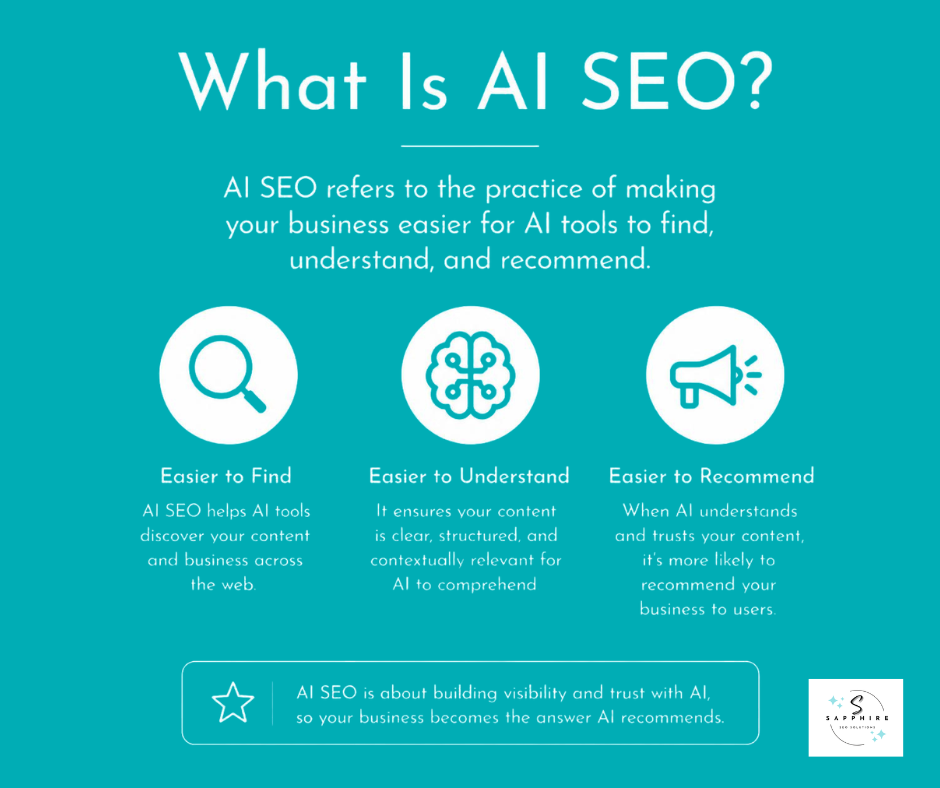
AI SEO refers to the practice of making your business easier for AI tools to find, understand, and recommend. It sits right next to search engine optimization (SEO), which is the work of getting your website to show up in Google's regular results. AI SEO does something similar, but for a different audience. Instead of just ranking for keywords, you're trying to get mentioned by name when someone asks ChatGPT, Gemini, or an AI Overview a question related to your business.
Search engine optimization gets you a spot in the list of blue links. AI SEO gets you mentioned inside the answer itself, sometimes without the person ever seeing a list of links at all.
You'll also hear the term Generative Engine Optimization, or GEO, used almost interchangeably with AI SEO. And for most business owners, treating them as the same thing is fine.
GEO is really just the more technical name for the same goal: getting cited, quoted, or recommended by an AI system instead of just ranked by one. Some marketers draw a fine line between the two. But that distinction matters more to agencies than it does to a landscaping company trying to get found.
That said, AI SEO is not the same as using AI to write your blog posts. Plenty of companies now use ChatGPT to churn out content, and that's a completely separate thing. AI SEO is about structuring and positioning what's already on your site so that AI systems can pull from it accurately. You could write every word of your website by hand and still do AI SEO well. Or you could publish AI-written content all day and never show up in a single AI answer.
Say you run a dental practice in Austin. Someone asks ChatGPT, "What should I look for in a family dentist?" If your website clearly explains your services, your credentials, and what makes your practice different in a language an AI can actually pull from, there's a real chance your practice gets named in that answer. That's the goal. Not just ranking. Getting recommended.
Why Is Everyone Suddenly Talking About AI SEO?
A few years ago, "AI SEO" wasn't a phrase anyone used. Now it's showing up in every marketing newsletter and every agency pitch. So what changed?
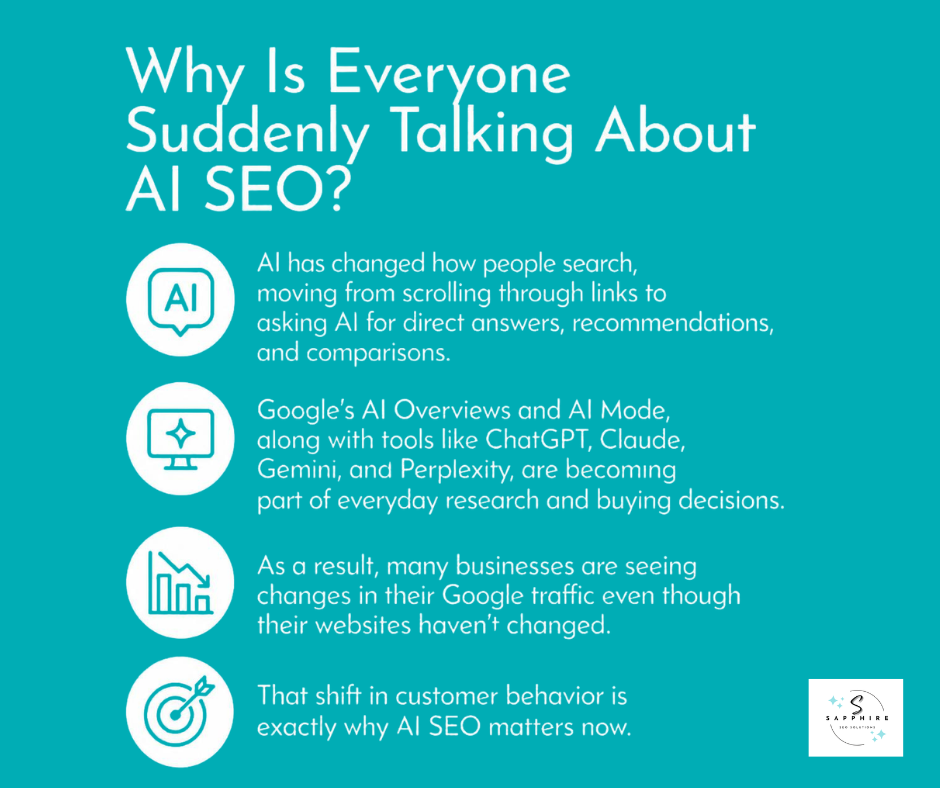
Mostly, it comes down to how fast people started using AI to search. Google's AI Overviews now show up on close to half of all Google searches, summarizing an answer right at the top of the page before a person ever scrolls down to the actual results. Google also rolled out AI Mode, a more conversational way to search that lets people ask follow-up questions the way they would in a chat.
And Google isn't the only place this is happening. AI chatbots have become a genuine research tool, not just a novelty. ChatGPT alone has more than 800 million people using it every week. Claude, Gemini, and Perplexity have their own growing audiences too, and a lot of those people are using them the same way they used to use Google. They're asking for recommendations. They're comparing options. They're researching a purchase before they ever visit a website.
That's generative AI doing what it does best: giving people a direct answer instead of a list of links to click through themselves.
Customer behavior has shifted right along with it. Someone looking for a roofer used to type "roofers near me" into Google and scroll through the results. Now, that same person might just ask ChatGPT which roofer to call, and Google might just answer the question itself without sending them anywhere at all.
Business owners are the ones noticing it first, though. Website traffic that used to come in steadily from Google search has started dipping for a lot of companies, even ones that haven't changed a thing about their website. That's usually the moment someone starts asking what AI SEO even is. Not because they read about it somewhere. Because their numbers told them something changed.
How Search Has Changed: Then vs Now
For most of the last two decades, search worked the same simple way. You typed something into Google, you got a page of blue links, and you clicked on a few of them until you found what you needed. That was traditional search, and it trained an entire generation of business owners to think about visibility in terms of rankings. Show up on page one, get the click, win the customer.
That's not really how it works anymore.
The search landscape has shifted toward something faster and more direct. Instead of scrolling through ten results and picking one, a lot of people now get their answer right there on the results page, generated by AI, with no click required at all. Search behind the scenes has quietly become AI search, even when someone's still typing into the regular Google search bar.
Here’s how search has changed:
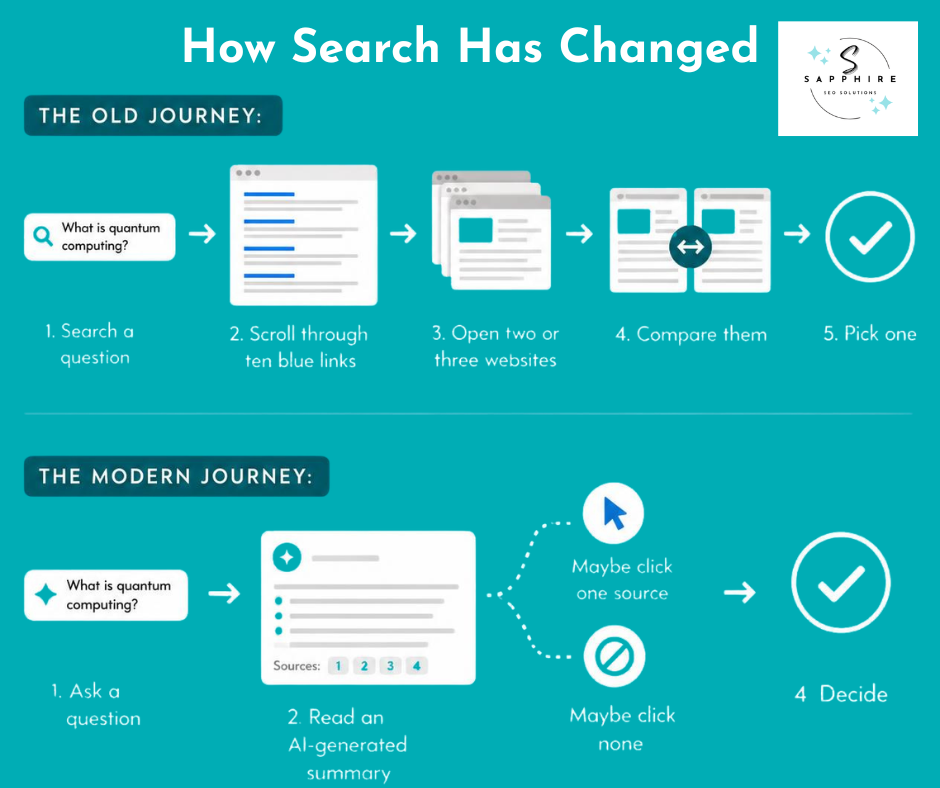
That gap in the middle is what people mean when they talk about zero-click searches. A huge share of searches today, especially when an AI Overview shows up, end without the person visiting a single website. They got their answer and moved on.
So do websites even matter anymore? They do, just differently. AI-generated answers have to come from somewhere. When ChatGPT or an AI Overview names a business, recommends a service, or explains how something works, it's pulling that information from real websites out on the open web. No website, no source material, no mention. The website didn't disappear from the equation. It just moved from being the destination to being the ingredient.
That's the real change in search behaviors worth understanding. Customers used to travel to your website to get their answer. Now, a lot of them get their answer without ever leaving Google or their AI assistant of choice, and your website's job has shifted toward feeding that answer accurately. Whether AI-powered search ends the visit at your homepage or ends it at a one-sentence summary, the businesses that show up in that summary are the ones still winning the customer.
Why AI SEO Matters for Small Businesses
If you run a small business, you already know how much competition is out there. But that competition just got a new venue. It's no longer just about outranking the plumbing company two towns over on Google. Now you're also competing for a mention inside an AI-generated answer, and that's a fight most small businesses haven't even realized they're in yet.
Here's why that matters more than it might seem.
Your website's visibility used to have one measure. Where do you rank on Google? That's it. Now there's a second measure sitting right next to it. Do AI tools know who you are, what you do, and why you're worth recommending? That's AI visibility, and it works differently than a ranking. You can't buy your way into an AI answer the way you can bid on an ad. The AI either has enough clear, trustworthy information about your business to mention you or it doesn't.
That's actually good news for a lot of small businesses, though.
For years, organic visibility on Google favored whoever had the biggest budget and the most backlinks. Bigger companies with bigger marketing teams usually won.
AI search doesn't play by quite the same rules. An AI assistant doesn't care how big your company is. It cares whether your website clearly explains what you do, whether other sources back that up, and whether the information holds together.
A well-run local business with an honest, clear website can get cited right alongside a national chain. That's a real shift in the field, and it won't stay wide open forever.
Here are a few reasons to take AI SEO seriously now:
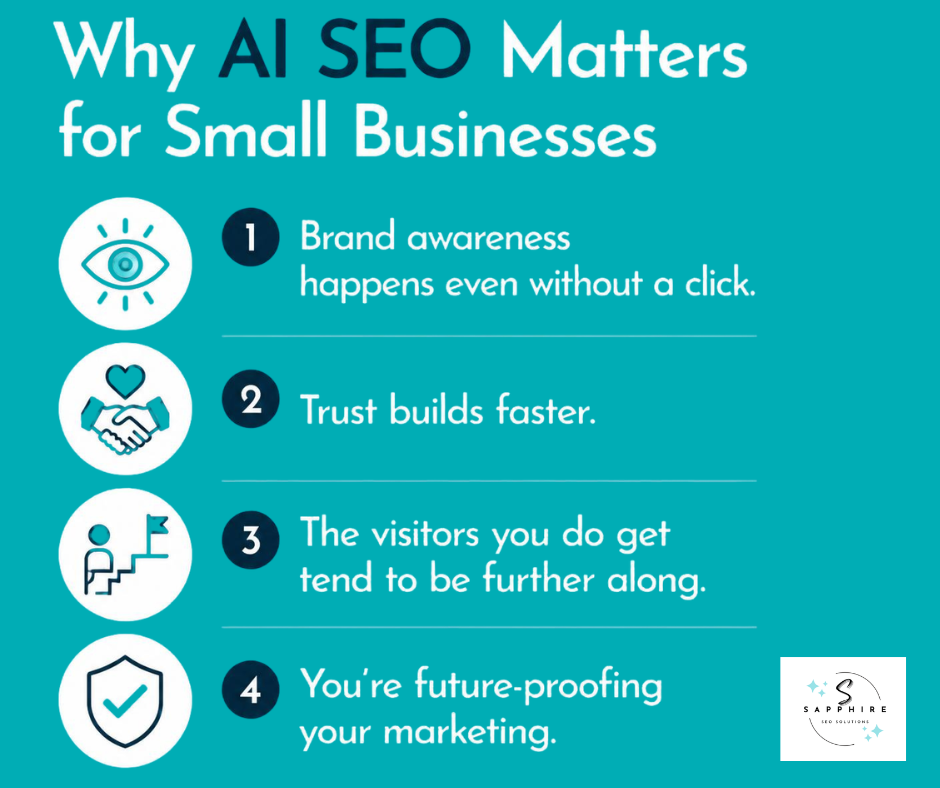
Brand awareness happens even without a click: When an AI assistant mentions your business by name, people remember it, whether they visit your website that day or not.
Trust builds faster: Being named by an AI tool the customer already trusts carries weight. It reads less like an ad and more like a recommendation from a friend.
The visitors you do get tend to be further along: Someone who clicked through from an AI answer already got context on who you are. They're not just browsing. They're closer to picking up the phone.
You're future-proofing your marketing: More people are starting their search with an AI tool every year, not fewer. Businesses that build AI visibility now won't be scrambling to catch up in two years.
None of this means Google traffic stops mattering. It doesn't. But more traffic isn't coming from just one place anymore, and businesses that only chase the old kind of search are going to miss a growing slice of their potential customers entirely.
The businesses that stay ahead here aren't necessarily the biggest ones. They're the ones paying attention early, while a lot of their competitors are still asking what AI SEO even means.
Traditional SEO vs AI SEO: What’s the Difference?
Traditional SEO and AI SEO come from the same family. Both exist to help the right person find your business at the right moment. Both depend on having a clear, trustworthy, well-built website. Neither one works if your business doesn't actually deliver what it promises. So no, this isn't a case of one replacing the other. It's more like a sibling that showed up later and does things a little differently.
Here's where they actually split.
Traditional SEO has always been about earning a spot in the list of search results. You pick your keywords, you build your pages around them, and if you do it well, Google puts you somewhere on page one. The whole game centers on rankings. Position three beats position eight. Page one beats page two. It's measurable, and it's been the standard for twenty years.
AI SEO, on the other hand, isn't chasing a position in a list. It's chasing a mention inside an answer. Instead of ranking, the goal is getting cited. An AI tool pulls together information from a handful of sources and generates a direct response. If your business is one of the sources it pulled from, you show up. If not, you don't, no matter how well you'd have ranked on a traditional results page for that same question.
That difference shows up in a few other places too.
Traditional SEO leans heavily on keywords. You figure out what phrase someone's likely to type, and you build content around that exact phrase. AI systems work more loosely. They think in terms of entities and concepts rather than exact phrasing. So a page can get cited by an AI tool even if it never uses the precise words someone typed into ChatGPT, as long as the AI understands that the page is about the same topic and trusts what it says.
User intent matters in both worlds, but AI systems tend to dig a layer deeper into it. A traditional Google search for "best coffee shop" might return ten shops in the general area based mostly on relevance and location. An AI assistant asked the same question tries to actually reason through what the person probably wants. Are they asking because they want a quiet place to work? A quick espresso on the way to work? Search intent on Google is often inferred from keywords. In an AI answer, it's inferred from the whole context of the question.
Then there's the traffic question, and this is the one that trips up a lot of business owners. Search traffic and AI visibility aren't measured the same way at all. A page can generate steady clicks from Google every month while getting mentioned by AI tools zero times, because nobody bothered building the kind of clear, citable content AI systems pull from. The reverse happens too. A business can get cited constantly in AI answers and see almost no direct clicks from it, because the person got their answer without ever needing to visit the site.
Brand authority still holds everything together, though. Search engines and AI systems both lean on the same basic signal: does this business seem legitimate, consistent, and trustworthy across the internet? That part hasn't changed. It's just being read by two different systems now instead of one.
Here's how the two stack up side by side:
Traditional SEO vs AI SEO
| Comparison | Traditional SEO | AI SEO |
|---|---|---|
| Main goal | Rank in search results | Get cited in AI-generated answers |
| Success looks like | Page one, top position | Being named or quoted directly |
| Core building block | Keywords | Entities and topics |
| How intent is read | Mostly from the search phrase | From the full context of the question |
| Where traffic comes from | Clicks from the results page | Brand mentions, sometimes with no click at all |
| What it depends on | On-page optimization, backlinks | Clarity, trust, and citable information |
| What builds it | Consistency over time | Consistency over time |
The takeaway isn't that one of these matters more than the other. It's that they're solving two different problems, and most businesses today need both handled at once.
Does AI SEO Replace Traditional SEO?
No, it doesn’t. Not even close.
A lot of business owners hear "AI SEO" and assume it means starting over. It doesn't. Every AI system pulling together an answer still has to find your website first, understand what it says, and trust that the information holds up. That's traditional SEO doing exactly what it's always done. AI SEO doesn't skip that step. It sits on top of it.
Think about what actually makes a website easy for anyone, human or AI, to work with.
Fast load times.
Clear navigation.
Pages that load properly on a phone.
That's technical SEO, and none of it stopped mattering just because AI tools entered the picture. If anything, it matters more, because AI systems crawl and read websites the same way search engines always have. A site that's slow or confusing for Google is just as confusing for an AI assistant trying to pull information from it.
Content quality still carries the same weight it always did, too. Vague, thin, copy-and-paste content never ranked well on Google, and it doesn't get cited by AI tools either. Authority works the same way. A business that's built a real, consistent reputation across the web, through reviews, mentions, and genuinely useful content, has always had an edge in search results. That same authority is exactly what AI systems lean on when deciding which source to trust and quote.
User experience closes the loop. A confusing website loses a human visitor fast. It loses an AI system just as fast, since neither one sticks around to work through a broken page.
So here's the honest way to think about it. AI enhances SEO rather than replacing it. It adds a new destination, being cited in an AI-generated answer, on top of a foundation that hasn't actually changed. The businesses seeing real results right now aren't the ones who threw out their old SEO work. They're the ones who kept it solid and let AI SEO build on top of it.
Which Businesses Need AI SEO?
Almost every business type benefits from this, but not for identical reasons. Your target audience determines what AI visibility actually looks like for you, and it's worth seeing yourself in a few of these examples before assuming this doesn't apply to you.
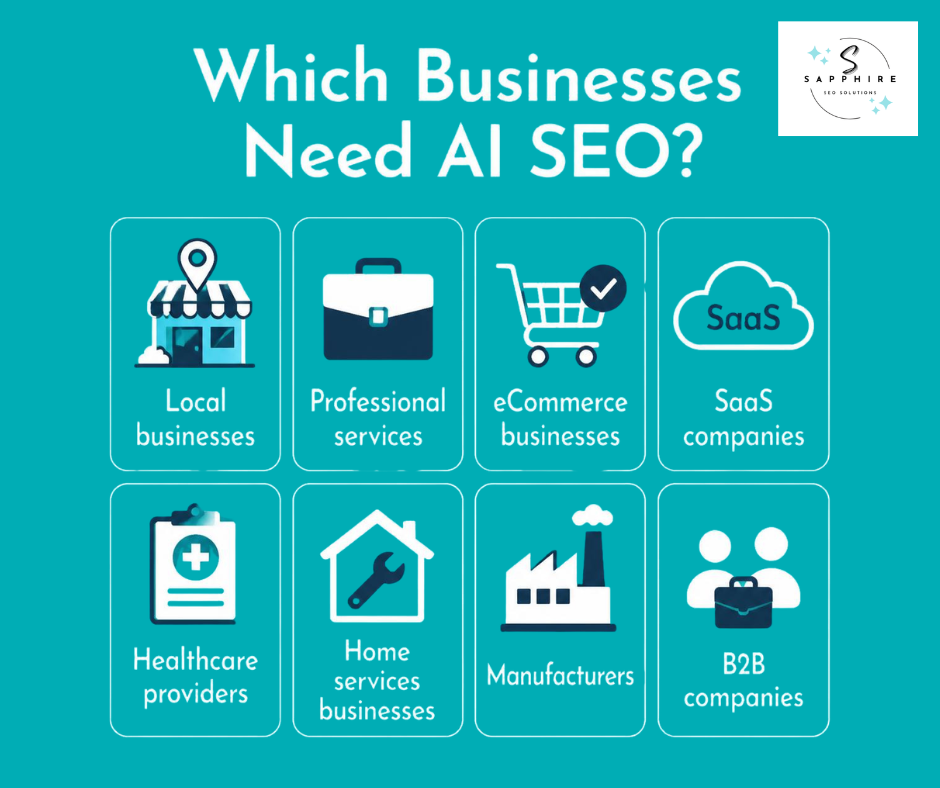
Local businesses: These have the most obvious use case. Someone asks ChatGPT for a good electrician nearby, or asks an AI Overview which bakery in town has the best custom cakes. If your business isn't clearly described online, with real information about what you do and where, an AI assistant has nothing to pull from. A family-owned hardware store that's built a clear, honest web presence has a real shot at getting named here, even against a national chain down the road.
Professional services: These run on trust, and that's exactly what AI systems look for before citing anyone. A financial advisor, an accountant, a law firm. Someone researching "do I need an LLC or an S-corp" is far more likely to get an AI-generated answer now than a list of ten blue links. Firms that explain their expertise clearly are the ones getting pulled into that answer.
eCommerce businesses: Someone might ask an AI assistant to compare two pairs of running shoes before they buy either one. If your product pages don't clearly explain what makes your product different, an AI system has no real reason to mention it over a competitor's.
SaaS companies: Buyers increasingly ask AI tools to compare project management tools or explain the difference between two platforms before ever requesting a demo. Marketing teams at these companies are already adjusting their SEO strategies because a huge share of that research now happens before a human salesperson ever gets involved.
Healthcare providers: People ask AI assistants health questions constantly, from symptoms to treatment options to which specialist to see. A clinic or practice that publishes clear, accurate, well-credentialed information has a real opportunity to be the source an AI system leans on, instead of some anonymous forum post.
Home services businesses: Roofers, HVAC companies, landscapers, and plumbers are seeing some of the fastest shifts in customer behavior. A homeowner with a leaking pipe at 9 PM isn't scrolling through search results. They're asking an AI assistant who to call, right now.
Manufacturers: While most manufacturers might assume none of this applies to them, since they're not selling directly to consumers. But procurement teams and engineers research suppliers with AI tools too, comparing capabilities and specs before ever picking up the phone.
B2B companies: These companies are watching buyer research shift earlier and earlier into AI conversations, often well before a prospect fills out a contact form.
Across every one of these industries, the businesses building real AI SEO strategies right now aren't necessarily the biggest names. They're the ones who took the time to explain, clearly and honestly, exactly what they do and who they do it for.
How AI Search Engines Understand Websites
Old-school search engines worked a lot like a filing system. They matched the words on your page against the words someone typed into the search bar, and whoever had the closest match usually won. This made keyword research really important. On the other hand, AI-powered search engines don't work that way anymore. They read for meaning, not just matching.
Here's the shift in plain terms. AI engines run on large language models, which are systems trained on enormous amounts of text so they can understand how ideas connect to each other, not just how words are spelled or repeated. That training lets them read a page the way a person would. They pick up on what the page is actually about, not just which keywords happen to appear on it.
That's a bigger deal than it sounds like.
Why Keywords Alone Aren't Enough
Say your landscaping website has a page about "lawn care services" but never once uses the phrase "yard maintenance." A keyword-matching system might miss the connection entirely. An AI system won't. It understands that lawn care and yard maintenance are the same idea described two different ways. It's reading topics, not scanning for exact phrases.
This comes down to a few things happening under the hood, and none of it requires you to understand the technical side to grasp why it matters.
Topics and Entities
AI systems try to identify what a page is fundamentally about (the topic) and the specific people, places, businesses, and things it mentions (the entities). A page about "the best plumber in Dallas" isn't just a string of words to an AI system. It recognizes "plumber" as a service, "Dallas" as a location, and starts building a picture of what your business actually does and where.
Context
The same word can mean different things depending on what's around it. "Charge" means something different on a page about credit card fees than it does on a page about electric car batteries. AI systems read the surrounding content to figure out which meaning applies, the same way a person would.
Semantic Search
This is just the practice of searching by meaning instead of exact wording. It's why someone can type "how to get rid of ants in my kitchen" and get results built around pest control, even without the phrase "pest control" appearing anywhere in the query. AI systems apply that same logic when they decide which pages actually answer a question.
Relationships Between Concepts
AI systems also map how ideas connect to each other. They understand that "roof leak," "water damage," and "roof repair" are related concepts that probably belong to the same conversation, even on a page that never uses all three phrases together. That web of connections is part of how these systems decide whether a page fully understands its own subject or just skims the surface of it.
All of this runs on natural language processing, the branch of machine learning that lets a computer actually parse human language instead of just matching text strings. It's the same general technology behind AI systems being able to hold a conversation, answer a follow-up question, or summarize a long article in a sentence.
What does this mean for your website in practical terms? A page that clearly, thoroughly explains a topic, using natural language the way you'd actually talk about it, gives AI systems a lot more to work with than a page stuffed with a single repeated keyword phrase. Artificial intelligence doesn't reward saying the same thing five different ways. It rewards actually explaining the thing well, with enough context that the connections are obvious.
That's the real shift here. Search used to reward matching. Now it rewards understanding.
How AI Search Engines Choose Which Sources to Cite
Not every website that shows up in Google gets pulled into an AI-generated answer. AI systems are pickier than that. They're not just finding relevant pages. They're deciding which handful of sources they trust enough to actually speak on their behalf. So what tips the scales?
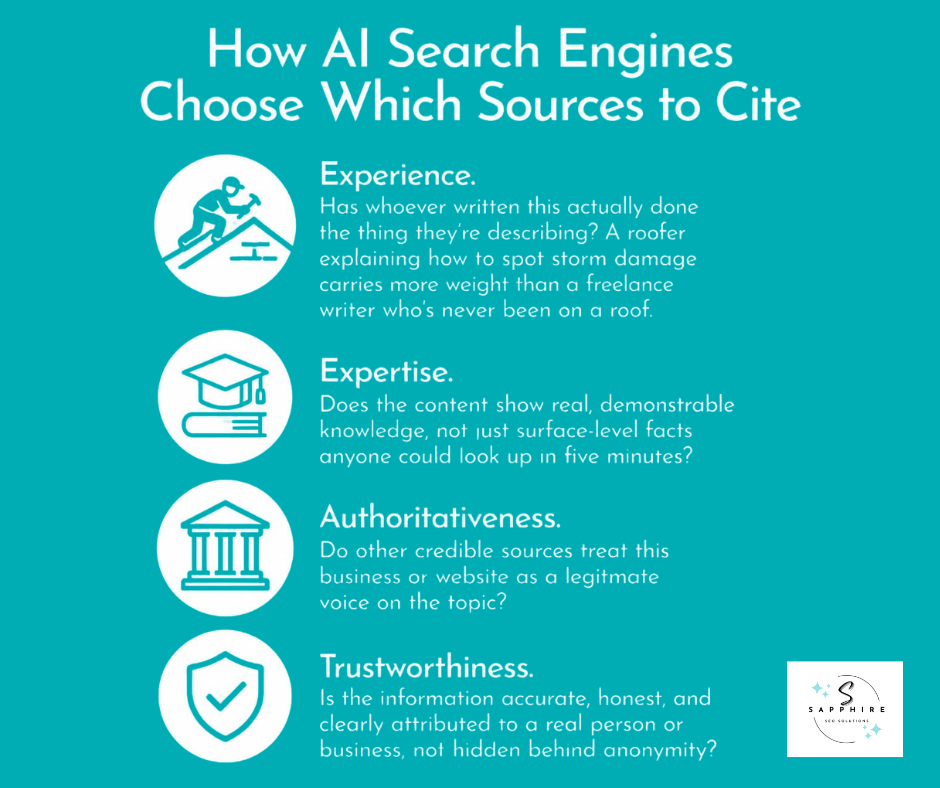
A lot of it comes back to a framework Google's used for years called E-E-A-T. It stands for Experience, Expertise, Authoritativeness, and Trustworthiness, and it was originally built to help Google's human quality reviewers judge whether content deserved to rank. These days, that same framework shapes AI citation decisions too. Here's what each piece actually means in plain terms.
Experience: Has whoever wrote this actually done the thing they're describing? A roofer explaining how to spot storm damage carries more weight than a freelance writer who's never been on a roof.
Expertise: Does the content show real, demonstrable knowledge, not just surface-level facts anyone could look up in five minutes?
Authoritativeness: Do other credible sources treat this business or website as a legitimate voice on the topic?
Trustworthiness: Is the information accurate, honest, and clearly attributed to a real person or business, not hidden behind anonymity?
AI systems lean on these same signals when they're scanning through relevant content to answer someone's question. If a page shows real human expertise behind it, an actual name, real credentials, a clear point of view, it reads as more citable than a page that feels generic or auto-generated.
Original information matters here too, and this might be the single biggest differentiator. AI systems are trained on an ocean of content that mostly repeats itself. A page that adds something new, your own data, your own case study, your own take based on actual work you've done, stands out from the noise. A page that just rephrases what ten other sites already said doesn't give an AI system much reason to cite you over any of those other nine.
Brand authority and reputation work together here. AI systems, like Google before them, pay attention to what the rest of the internet says about a business. Consistent mentions across review sites, industry publications, and other trusted sources build a kind of reputation that's hard to fake and easy to spot. It's part of why backlink profiles, meaning who links to your site and how credible those sites are, still carry weight even in an AI-driven search world. A business that only exists on its own website, with nobody else talking about it, looks a lot less trustworthy than one that shows up consistently across the web.
Freshness plays a role too, more for some topics than others. A page about a fast-moving subject that hasn't been updated in three years is a weaker citation candidate than one that's clearly current. Slower-moving topics don't need constant updates, but stale information on anything time-sensitive tends to get passed over.
Topical authority ties a lot of this together. A website that covers a subject thoroughly, from multiple angles, over time, reads as more credible than a site with a single thin page loosely related to the topic. If your landscaping business has real, useful content about lawn care, irrigation, seasonal maintenance, and plant selection, an AI system gets a much clearer picture of your expertise than if you've got one generic "our services" page.
Supporting evidence matters just as much as the claim itself. A statement backed by data, a specific example, or a cited source reads as more trustworthy than a flat assertion. And consistency- saying the same accurate thing about your business across your website, your social profiles, and other places you're mentioned online- reinforces that trust rather than muddying it.
All of this adds up to something people are starting to call large language model optimization, which is really just a formal name for making sure your content gives AI systems every reason to trust and cite it. It's less a separate discipline and more the natural extension of what's always made content genuinely good.
At the end of the day, AI systems are looking for the same thing a smart, careful person would look for before recommending a business to a friend. Citations across the web, real evidence, and content that's actually helpful, not just present. That's what "helpful content" has always meant. AI search just made it a little harder to fake.
What Makes a Website AI-Friendly?
Some websites are easy for AI systems to work with. Others are a maze, technically live, but confusing enough that neither a person nor an AI assistant can figure out what's actually going on. The difference usually comes down to a handful of practical things, most of which have nothing to do with anything technical.
Clear site architecture is the foundation. Think of your website like a building. If someone walks in and can't find the front desk, they leave. AI systems and web crawlers, the automated programs that scan websites to understand what's on them, work the same way. A site built around clear categories, like "Services," "Locations," and "About," gives a crawler an obvious map to follow. A site with pages scattered randomly, buried three folders deep with no clear connection to anything else, makes that job a lot harder.
Logical navigation follows right along with that. Your menu should tell a visitor, and a crawler, exactly what they'll find and where. If a customer looking for "emergency plumbing" has to hunt through five submenus to find it, that's a problem for your human visitors first, and everything else second.
Readable formatting matters more than people expect. Big blocks of unbroken text are hard for anyone to scan, human or machine. Short paragraphs, clear breaks, and a logical flow from one idea to the next make it far easier for an AI system to pull an accurate summary from your page instead of misreading it or skipping it entirely.
Helpful headings do a lot of quiet work here. A heading like "Our Services" tells a crawler almost nothing. A heading like "24-Hour Emergency Plumbing Repair in Dallas" tells it exactly what that section covers. Good headings act like signposts, both for a person skimming your page and for an AI system trying to figure out what you actually do.
Internal linking, meaning the links between your own pages, helps tie your website together into something that reads as one coherent whole. If your homepage links to your services page, and your services page links to relevant blog posts, that structure signals which pages matter most and how they relate to each other. A website full of orphaned, unlinked pages looks disconnected, and that's harder for anything to make sense of.
Structured information helps too, and this doesn't need to be complicated. Using tables for comparisons, bullet points for genuine lists, and FAQ-style sections for common questions gives AI systems clean, well-organized information to pull from. This overlaps with structured data (schema markup), which is essentially labeling the information on your page so it's easier for search engines and AI systems to identify things like your business hours, your services, or your reviews accurately.
Title tags and meta descriptions, the short bits of text that show up in search results, still matter here too. They're often the first thing a crawler reads before it even gets into your actual content, so a clear, accurate title and description set the tone for everything that follows.
Original insights carry real weight. A page that just repeats general industry information doesn't give an AI system much reason to trust it over a hundred other pages saying the same thing. A page written by someone who actually knows the subject, with real observations from real experience, stands out.
That's where expert authors come in. A page with a named author who has real credentials or hands-on experience in the subject reads as more trustworthy than an anonymous, unattributed page. That's true for a human reader deciding whether to trust your advice, and it's just as true for an AI system deciding whether to cite it.
Mobile usability and fast-loading pages round this out, and neither is optional anymore. Most people searching for a local business are doing it on their phone, and a site that loads slowly or looks broken on mobile loses that visitor before they even read a word. AI systems that crawl and evaluate your site notice the same thing.
Put it all together, and content optimization and optimizing content for AI visibility isn't really a separate project from just building a genuinely good website. It's the same work, done with a little more intention.
The Core Elements of AI SEO
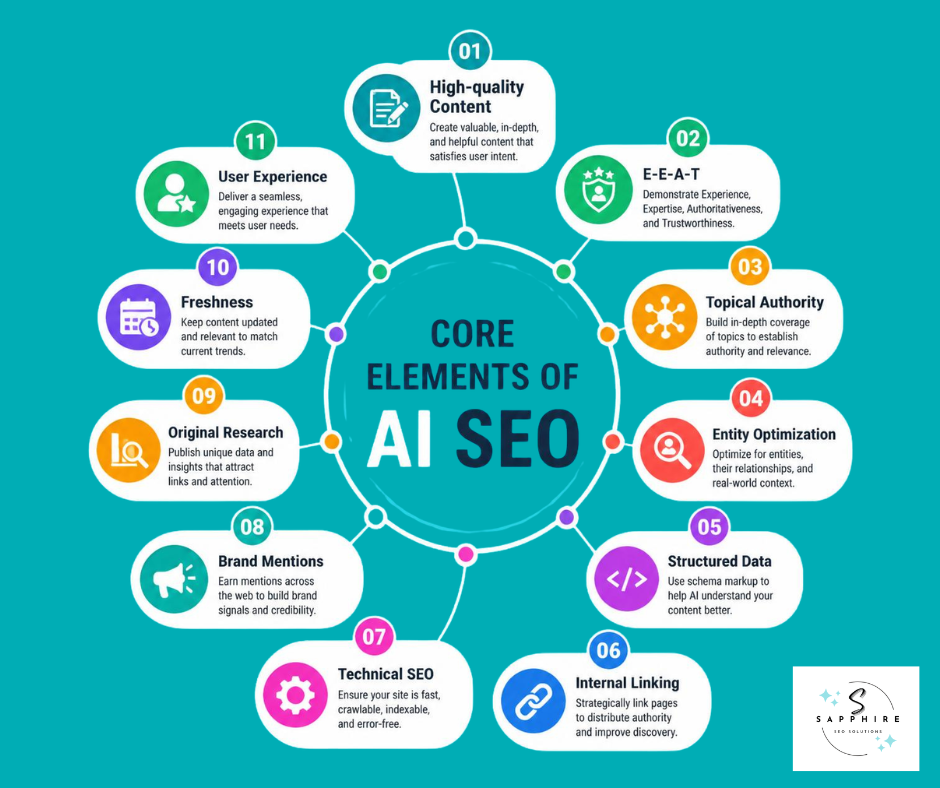
AI SEO isn't one single tactic. It's a collection of pieces working together, and most of them build directly on things good SEO has always cared about. Here's what actually makes up the discipline.
High-Quality Content
This is still the foundation, and it hasn't changed much in spirit. Content that actually answers a question, in enough depth to be useful, beats content that skims the surface just to hit a word count. AI systems are good at spotting the difference between a page written to genuinely help someone and a page written just to exist. Depth, clarity, and honesty still win.
E-E-A-T
Covered in more detail earlier in this guide, but worth repeating here because it touches almost everything else on this list. Experience, Expertise, Authoritativeness, and Trustworthiness shape whether AI systems and search engines trust your content enough to use it. Every other element below either builds E-E-A-T or falls apart without it.
Topical Authority
A single great page rarely builds trust on its own. A cluster of pages, all genuinely useful, all covering different angles of the same subject, does. If you run an HVAC company, one page about air conditioning repair helps. Ten pages covering repair, maintenance, seasonal tune-ups, energy efficiency, and common problems by brand builds something a lot stronger. That depth is what tells an AI system you actually know this industry, not just this one topic.
Entity Optimization
This is the practice of making sure AI systems and search engines clearly understand who you are, what you do, and where you operate, as a distinct, identifiable business rather than a vague collection of pages. Consistent business information across your website, your Google Business Profile, and other places you're listed online all feeds into this. The clearer and more consistent that picture is, the easier it is for an AI system to confidently mention you by name.
Structured Data
Labeling information on your site, like your services, hours, or reviews, in a way that search engines and AI systems can read accurately. It doesn't change what a human visitor sees. It just makes the information underneath easier for a machine to parse correctly instead of guessing.
Internal Linking
The links between your own pages do more work than people give them credit for. They show which pages matter most, and they help both visitors and crawlers understand how your content fits together. A blog post about "signs you need a new roof" that links to your roof replacement service page connects the dots for anyone reading it, human or AI.
Technical SEO
The behind-the-scenes stuff. Fast-loading pages, mobile usability, a site that doesn't throw errors or dead links at visitors. None of this is glamorous, and none of it is optional. A site that's technically broken never gets the chance to prove how good its content is, because nothing ever finishes loading it.
Brand Mentions
Being talked about across the web, in reviews, local news, industry roundups, even social media, builds a kind of reputation that AI systems pick up on. A business that only exists on its own website looks thinner than one that shows up consistently in other places too. You don't need to control every mention. You just need enough of them to paint a consistent, credible picture.
Original Research
This might be the most underused element on this whole list. A page built entirely from information other websites already published gives an AI system no real reason to prefer it over the dozens of similar pages saying the same thing. A page built around your own data, your own survey of customers, or your own real-world findings gives it something nobody else has.
Freshness
Not every page needs constant updates. A page explaining a timeless concept ages fine. But anything tied to pricing, regulations, seasonal information, or fast-moving topics needs regular attention, or it starts working against you instead of for you.
User Experience
Everything above falls apart if visitors, or AI crawlers, hit a confusing, cluttered, hard-to-navigate site. Good user experience is what makes all the other elements actually land.
Where the Work Actually Gets Done
Building all of this out starts with the same basic homework SEO has always required. Keyword research helps you understand what your customers are actually searching for, and figuring out relevant keywords for your specific business is still worth doing well. Long-tail keywords, the longer, more specific phrases like "emergency water heater repair Fort Worth" instead of just "plumber," often reveal exactly what a customer needs at the moment they're searching, and they tend to line up closely with how people phrase questions to AI assistants too.
Content creation and content generation have to follow through on that research with something genuinely useful, not just technically correct. This is where a lot of businesses stumble. It's easy to publish a page that checks every SEO box and still says almost nothing.
None of this has to be done entirely by hand, though. SEO tools, AI tools, and other artificial intelligence tools have gotten genuinely useful for handling the parts of this work that used to eat up entire afternoons. Automating repetitive tasks, like pulling keyword data, tracking rankings, or auditing a site for broken links, frees up time for the parts of the work that actually require a person's judgment. Repetitive tasks and time-consuming tasks that used to take a full day can often get handled in an hour now, which matters a lot for a small business without a dedicated marketing department.
That same technology is useful on the analysis side too. Tools that help identify patterns in customer search behavior, or identify trends across an industry over time, give businesses a much clearer picture of what to focus on next. Data analysis that used to require a specialist can now surface insights a lot faster, though someone still has to interpret what those insights actually mean for the business.
Put together, these elements aren't a checklist to rush through once. They're the ongoing work of building a website that both people and AI systems trust, one piece at a time.
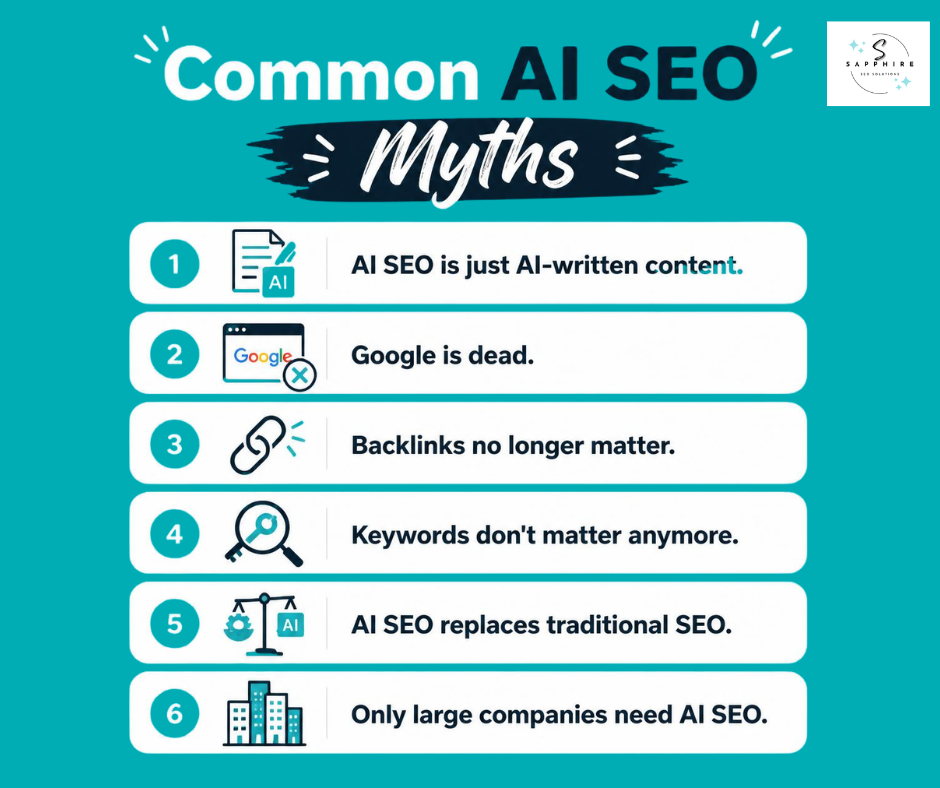
Common AI SEO Myths
There's a lot of noise out there about what AI SEO actually means, and some of it is just wrong. Here are the myths worth clearing up.
Myth: AI SEO Is Just AI-Written Content
This one trips up more business owners than any other. Using ChatGPT to write your blog posts isn't AI SEO. It's just AI-assisted writing, and it can actually work against you if the content ends up generic or inaccurate. AI SEO is about structuring and positioning your website so AI systems can find, understand, and trust what's already there. You could write every word by hand and still do this well. Plenty of businesses publish AI-written content all day and never show up in a single AI answer, because the content itself never earned that trust.
Myth: Google Is Dead
It isn't, not even close. Google still handles trillions of searches a year, and most of those searches still show a traditional results page. What's true is that Google's own results now include more AI-generated summaries than they used to, and a growing share of research is happening on other AI-powered platforms too. That's a real shift in the search experience. It's not the end of Google.
Myth: Backlinks No Longer Matter
Backlinks, other websites linking to yours, still carry real weight. They're one of the clearest signals a business is legitimate and trusted by other people online. AI systems lean on that same signal when deciding which sources to cite. What's changed isn't whether backlinks matter. It's that they're no longer the only thing that matters.
Myth: Keywords Don't Matter Anymore
Keywords still matter, just not in the old "stuff the exact phrase everywhere" sense. AI systems read for meaning and context, not just exact word matches. But understanding what your customers actually search for is still the starting point for building content that answers real questions, whether a human reads it or an AI system generates a response from it.
Myth: AI SEO Replaces Traditional SEO
Covered earlier in this guide, but it's repeated often enough that it belongs here too. AI SEO builds on traditional SEO. It doesn't tear it down and start over. A site with weak technical SEO and thin content won't suddenly succeed at AI SEO just because someone decided to focus on it.
Myth: Only Large Companies Need AI SEO
This might be the most damaging myth of all, because it convinces small businesses to sit this one out. AI systems don't care how big your marketing budget is. They care whether your website clearly, honestly explains what you do. A local business with a clear, well-built site can absolutely earn a spot in AI-generated responses, sometimes ahead of a much bigger competitor who never bothered to make their own website easy to understand.
The truth sits somewhere quieter than any of these myths. AI SEO is neither magic nor a gimmick. It's the same fundamentals, applied to a search landscape that's genuinely changed.
Is AI SEO Worth the Investment?
This is the question most business owners actually care about, once they've made sense of what AI SEO even is. And it's a fair one to ask, because attention and effort are limited, and not every marketing trend deserves either.
Here's the honest answer. AI SEO isn't a quick win. It's a marketing investment in the same sense that traditional SEO always has been. You're not going to build strong AI visibility in a week, and anyone promising otherwise is stretching the truth. But the long-term value here looks a lot like the long-term value of good SEO always has: slow to build, and hard for a competitor to copy once it's in place.
That's actually the point worth sitting with. A paid ad campaign disappears the moment you stop paying for it. A strong reputation built through genuinely useful content, consistent brand mentions, and real expertise doesn't work that way. It compounds. The businesses putting in the work now are building something that gets harder to catch up to with every month that passes.
Competitive advantage matters here too, and it's a narrower window than most people realize. Right now, a lot of businesses still don't understand AI SEO or haven't done anything about it yet. That's an opening. The businesses that show up clearly and consistently in AI-generated answers today are the ones that will still be showing up a year from now, largely because their competitors waited too long to start.
Which brings up the cost of waiting, and it's a real cost even though it doesn't show up on an invoice. Every month a business puts this off is another month a competitor might be building the exact trust signals that get them cited instead. Organic traffic from Google isn't going away, but it's no longer the only channel worth paying attention to, and businesses that only optimize for the old kind of search are going to miss a growing share of the market without ever realizing why.
Business growth tied to AI visibility tends to look different than growth tied to paid ads, too. It's steadier. A business getting mentioned consistently in AI-generated answers is building the kind of trust that shows up in SEO performance across the board, not just in one metric, and not just for one campaign that ends when the budget does.
Sustainable visibility is really what this comes down to. AI SEO isn't about chasing a temporary spike. It's about building a website and a reputation solid enough that both search engines and AI systems keep coming back to it as a trustworthy source, month after month, without you having to constantly re-earn that trust from scratch.
So, is it worth it? For most businesses, yes, but it takes some strategic thinking to do it well. It's not about doing everything at once. It's about starting now, doing it properly, and letting that work build on itself the same way good SEO always has.
Real Examples of AI SEO
Theory only goes so far. Here's what AI SEO actually looks like when it's applied to five different kinds of businesses. These are illustrative examples, not real case studies, but they reflect the kind of shift a lot of businesses are working through right now.
Landscaping Company
Before: A family-owned landscaping business in Ohio had a decent website. Five service pages, a photo gallery, a contact form. Each page was thin, though, just a paragraph or two describing what they offered, written mostly to fill space rather than actually explain anything.
Strategy: The company rebuilt its content around real depth instead of just coverage. Instead of one generic "lawn care" page, they built out separate, genuinely useful pages on seasonal lawn treatment, irrigation system repair, and mulching, each written by someone who actually does the work and explains it the way they'd explain it to a customer standing in their driveway. They also started publishing a regular blog post answering the exact questions customers actually ask, like when to aerate a lawn in their climate or how to spot early signs of grub damage.
Potential outcome: An AI assistant asked "when should I aerate my lawn in Ohio" now has a clear, specific, locally relevant answer to pull from, one written by a business that clearly knows the subject and operates in that exact region. That's the kind of specificity that gets a business mentioned by name instead of skipped over for something more generic.
Law Firm
Before: A personal injury firm had strong local rankings on Google but almost no presence in AI-generated answers. Their website explained their services in vague, brochure-style language: "aggressive representation," "dedicated advocates," phrases that said very little about what actually happens when someone hires them.
Strategy: The firm rewrote its content around the actual questions clients have after an accident. What happens after you're hit by a driver with no insurance? How long does a typical case take? What's the difference between a settlement and a trial? Each attorney also got a real author bio with credentials and case history, instead of a generic "our team" page.
Potential outcome: Someone asking an AI assistant what to do after a car accident is far more likely to get pointed toward content that clearly, specifically answers that question, especially when it's written by an attorney whose expertise is easy to verify. Vague brochure language rarely earns a citation. Specific, credentialed answers to real questions do.
Dentist
Before: A dental practice had a functional but generic website. Standard service list, a few stock photos, nothing that distinguished it from any other dental practice in town.
Strategy: The practice started publishing content around common patient questions, what to expect at a first visit, how to handle dental anxiety, what the difference actually is between a crown and a veneer, all written or reviewed by the dentists themselves and clearly attributed to them by name.
Potential outcome: Health-related questions are exactly the kind of thing people now ask AI assistants directly. A practice with clear, credentialed, genuinely helpful answers to those questions has a real shot at being the source an AI system leans on, rather than an anonymous forum post or a generic health website with no local connection.
SaaS Company
Before: A project management software company had solid product pages but almost nothing comparing itself honestly to competitors. Buyers researching options were finding comparison content written by third parties instead, most of it outdated or incomplete.
Strategy: The company started publishing honest, detailed comparisons of its own, including where competitors were genuinely a better fit. They also studied competitor strategies to understand what gaps existed in the existing comparison content out there, and built pages that filled those gaps with real detail instead of marketing spin.
Potential outcome: Buyers increasingly ask AI tools to compare software options before ever requesting a demo. A company that's published clear, honest, detailed comparisons gives an AI system something solid to reference, and honesty about tradeoffs tends to build more trust than a page that only says good things about itself.
Online Retailer
Before: An online retailer selling outdoor gear had strong product pages but wrote nearly identical descriptions across similar products, with little explanation of what actually made one option different from another.
Strategy: The retailer studied actual user behavior on its site, which products customers compared most often, which questions came up in customer service most frequently, and rebuilt product content around those real patterns. Comparison pages explained genuine differences in materials, durability, and use case instead of repeating generic marketing copy.
Potential outcome: Someone asking an AI assistant to compare two specific products is far more likely to get a useful, specific answer from a retailer that's actually explained the difference, rather than one that copied the manufacturer's description onto every listing.
Across all five examples, the pattern holds. Specificity beats vagueness. Real expertise beats generic marketing language. And businesses that answer the actual questions their customers are asking tend to be the ones that show up when an AI system goes looking for an answer.
How to Get Started with AI SEO
Knowing what AI SEO is and actually doing something about it are two different things. If you're ready to start, here's a practical order to work through it. Not every step needs to happen at once, and none of it needs to happen perfectly on the first try.
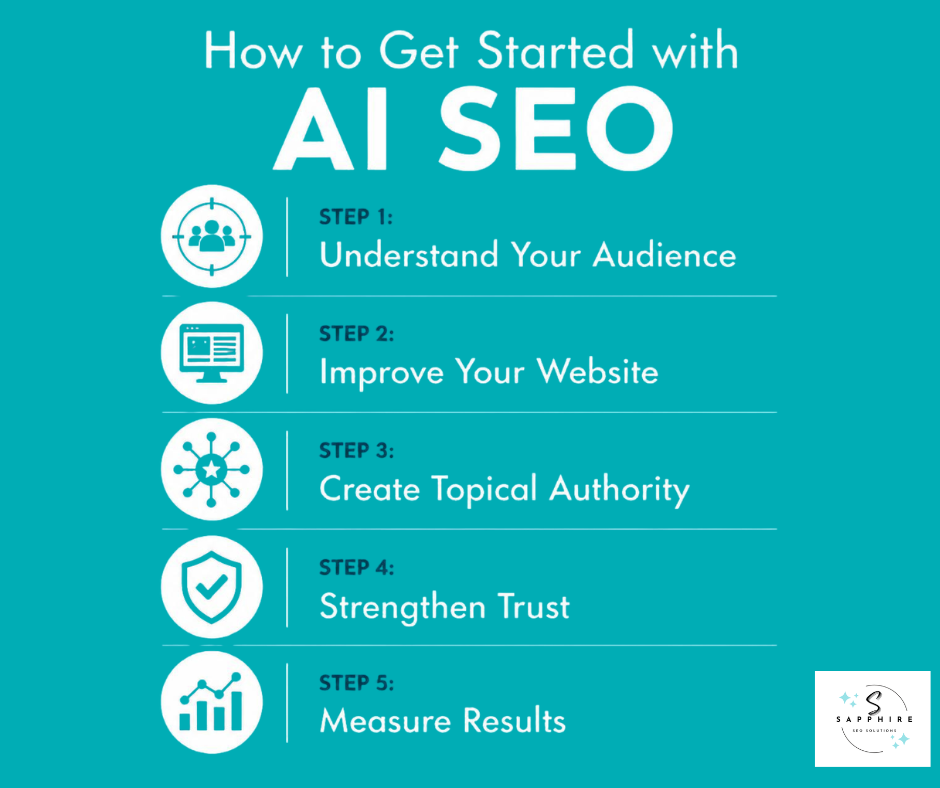
Step 1: Understand Your Audience
Before touching a single page on your website, get clear on who's actually looking for you and what they're asking. This sounds obvious, but most businesses skip it. Sit down and write out the real questions your customers ask before they hire you or buy from you. Not the polished marketing version. The actual words a nervous homeowner types at 11 PM when their water heater fails, or the exact comparison a buyer runs through before choosing between two software options. AI systems answer real questions with specific language, and you can't write content that matches that language if you haven't taken the time to understand it first.
Step 2: Improve Your Website
Once you know who you're talking to, make sure your website can actually hold up its end. This means fixing the basics: pages that load quickly, navigation that makes sense, mobile usability that doesn't frustrate anyone. It also means rewriting thin, vague pages into something genuinely useful. A page that just lists your services in three sentences isn't helping anyone, human or AI. This is also the point where a lot of business owners realize how differently search engines work now compared to a decade ago. Matching a keyword isn't enough anymore. The page has to actually explain the thing.
Step 3: Create Topical Authority
A single strong page rarely moves the needle on its own. Build out a genuine cluster of content around your core services, covering the subject from different angles instead of just touching it once. If you're a roofer, that might mean separate pages and posts on storm damage, material options, maintenance, and warranty questions, not just one page that says "we do roofing." This is where AI search platforms start to see you as someone who actually knows the subject deeply, rather than a business that happens to mention it once.
Step 4: Strengthen Trust
This step is less about your website and more about your reputation across the rest of the internet. Get real, honest reviews. Make sure your business information is consistent everywhere it appears: your website, your Google Business Profile, any directories you're listed in. If you have credentialed staff, put their names and expertise on the content they're responsible for instead of hiding behind an anonymous "team" byline. None of this happens overnight, but it's exactly the kind of signal both search engines and AI systems use to decide whether you're worth citing.
Step 5: Measure Results
Once the work is underway, pay attention to what's actually happening. Traditional metrics like rankings and organic traffic still matter, but they don't tell the whole story anymore. Watch for mentions of your business in AI-generated answers when you search your own industry questions. Notice whether the visitors you do get seem further along in their decision, since that's often a sign someone read a thorough AI-generated answer before ever landing on your site. This is also where a lot of businesses realize their existing marketing setup wasn't built to track this kind of visibility, which is exactly why more SEO teams are adjusting how they report on performance altogether.
A Realistic Note on Pace
None of these five steps happen in a week, and they don't happen in a strict straight line either. You might strengthen trust while you're still improving your website. You might revisit your audience research six months in once you've learned more about what's actually working. That's normal. What matters is starting somewhere instead of waiting for a perfect plan before you begin.
The businesses seeing real traction with this aren't the ones who did everything at once. They're the ones who worked through it steadily, treating it the same way they'd treat any other part of running a business well: one solid decision at a time, built on top of the last one.
AI SEO Checklist - What You Need to Check
Use this as a quick reference once you've worked through the guide. Print it, save it, or just run through it category by category.
AI SEO Checklist
A Quick Way to Use this AI SEO Checklist
Don't try to check every box in one sitting. Pick the category that's weakest right now, usually content quality or technical foundation, and work through that one first. The categories build on each other anyway. A technically solid site with thin content still won't get cited, and great content on a broken site won't get read.
Run through this checklist every few months, not just once. AI search is still moving, and a site that's AI-ready today can fall behind in a year if nobody's paying attention.
Partner with Sapphire SEO Solutions to Create an Impactful AI SEO Strategy for Your Business!
Search changed, and it changed faster than most business owners expected. Google's AI Overviews now answer a huge share of questions before anyone scrolls past the top of the page. ChatGPT, Gemini, Claude, and Perplexity have become genuine research tools for millions of people. And a lot of those searches never end in a click at all. That's the world businesses are marketing in now, whether they've caught up to it or not.
None of that makes traditional SEO obsolete, though. If there's one thing worth remembering from this entire guide, it's that AI SEO builds on the same foundation SEO has always relied on. Clear content. Real expertise. A trustworthy reputation across the web. A technically solid website. AI SEO doesn't throw any of that out. It just adds a new place for that work to pay off, inside the answers AI tools give people every day.
The businesses figuring this out early aren't necessarily the biggest ones. They're the ones paying attention while a lot of their competitors are still asking what AI SEO even means. That gap won't stay open forever. Every month spent waiting is a month a competitor might be earning the trust and visibility that gets them mentioned instead.
If you're not sure where your business stands right now, that's a normal place to be. Most business owners are figuring this out in real time. At Sapphire SEO Solutions, our team includes AI SEO certified experts who spend their time staying ahead of exactly this kind of shift, so you don't have to figure it out alone. Contact us to learn more about our AI SEO services and what we can do for your business!

Frequently Asked Questions
What is AI SEO?
AI SEO is the practice of making your business easy for AI tools like ChatGPT, Gemini, and Google's AI Overviews to find, understand, and recommend. It builds on traditional SEO rather than replacing it.
What is Generative Engine Optimization?
Generative Engine Optimization, or GEO, is essentially another name for the same goal. Some marketers draw a technical line between AI SEO and GEO, but for most business owners, they mean the same thing: earning a mention inside an AI-generated answer.
Is AI SEO different from SEO?
Yes, but not in the way people often assume. Traditional SEO chases a ranking position in a list of search results. AI SEO chases a citation inside an AI-generated answer. They share the same foundation, though. A site with weak SEO fundamentals rarely succeeds at AI SEO either.
Does AI SEO help Google rankings?
Often, yes. A lot of the work that improves AI visibility- clearer content, stronger authority signals, better site structure- also supports traditional rankings. They're not separate projects running in parallel. They overlap more than they diverge.
Can ChatGPT recommend my business?
It can, if your business has clear, trustworthy information available online that ChatGPT can pull from. There's no guarantee, and no way to buy a mention outright. But businesses with well-explained services and a solid reputation across the web have a real shot at it.
Does AI-generated content help SEO?
Not automatically, and sometimes it works against you. Content written entirely by AI, with no real expertise or original insight behind it, tends to blend into the flood of similar content already out there. What actually helps is genuinely useful, accurate content, regardless of whether a person or a tool helped write the first draft.
How long does AI SEO take?
Longer than most people want to hear. This is long-term work, closer to traditional SEO timelines than a quick ad campaign. Meaningful results usually take several months of consistent effort, not days or weeks.
Can small businesses benefit from AI SEO?
Yes, and often more than people expect. AI systems don't weigh marketing budget the way paid advertising does. A small, well-run business with a clear, honest website can get cited right alongside a much bigger competitor.
Do backlinks still matter?
They do. Backlinks remain one of the clearest signals that other people trust and reference your business. AI systems lean on that same signal when deciding which sources to cite, right alongside newer factors like content depth and topical authority.
Is schema required for AI SEO?
It helps, but it's not the whole picture. Structured data makes it easier for search engines and AI systems to read specific details on your site accurately, like your hours or services. It supports the work. It doesn't replace genuinely good, well-organized content.
How do AI search engines find websites?
The same way traditional search engines always have, through crawling. Web crawlers scan your site, and AI systems then interpret what they find based on meaning and context, not just keyword matching.
Is AI SEO only for Google AI Overviews?
No. It covers visibility across ChatGPT, Gemini, Claude, Perplexity, and any other AI tool people use to research businesses, not just what shows up inside Google's own results page.
Can AI SEO improve local SEO?
Yes, and for a lot of small businesses, this is where it matters most. Clear, consistent business information and genuinely useful local content help AI systems confidently recommend a business for searches tied to a specific area.
Should I hire an AI SEO agency?
That depends on your time, your team, and how comfortable you are handling ongoing content and technical work yourself. Some businesses manage this in-house successfully. Others prefer bringing in outside help to move faster and avoid the trial and error of figuring it out alone. Either path can work, as long as the fundamentals actually get done well.