

AI content can rank on Google right alongside anything written by a person. Google has never said content made with AI is banned from the top of search rankings. That's not how it works.
But here's where people get confused. There's a real difference between:
Content that's AI-generated with real thought behind it
Content that's AI-assisted, meaning a person used it as one tool among several
Scaled AI content, pumped out fast and in bulk, mostly to game the system
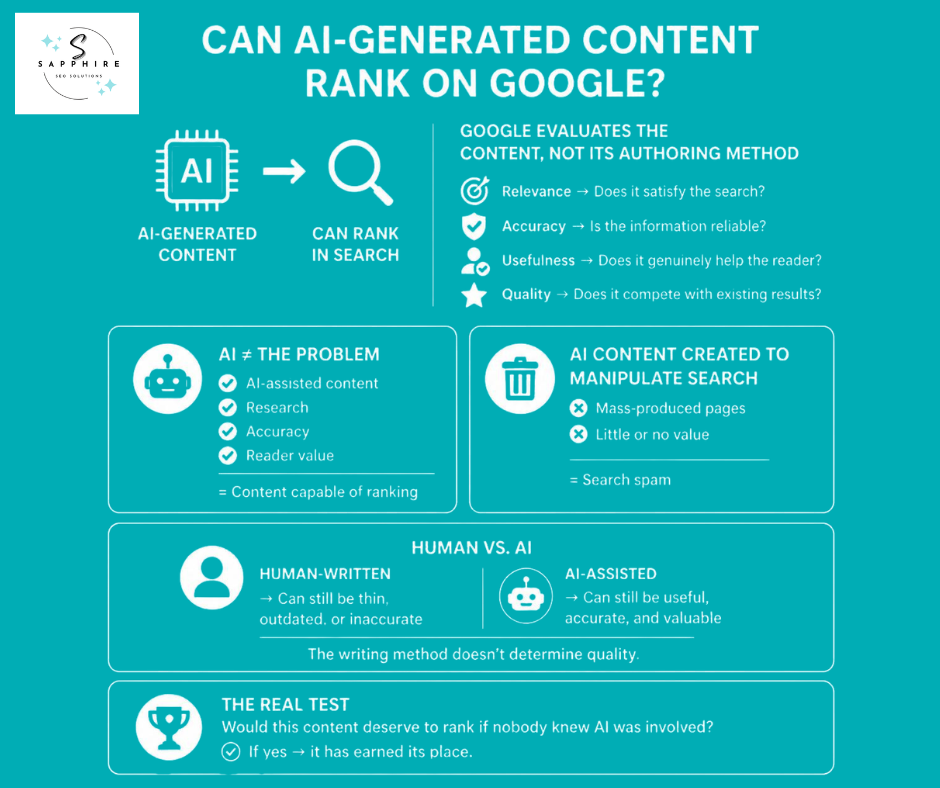
Google doesn't really care which bucket you started in. What Google cares about is what came out the other end. Is it useful? Is it accurate? Does it actually help the person who searched for it? That's the test, not how the words got on the page.
And here's the part a lot of businesses miss: using AI doesn't hurt your chances, but it doesn't help them either. It's not a shortcut to the top.
So does AI-generated content rank on Google? It can. But it doesn't automatically deserve to.
This guide walks through Google's actual position about AI-generated content, why some AI content succeeds while other AI content flops, how to use AI the right way, what all this means for AI search, and why a lot of businesses still need a real content strategy behind the words.
Key Takeaways
AI-generated content can rank on Google. There's no blanket policy against it, and never has been.
Google's scaled content abuse policy targets pages "without adding value," not AI as a method.
The real test: would this page deserve to rank if no one knew AI was involved?
Commodity content (rephrased, generic) fails. Non-commodity content (original, firsthand, specific) succeeds.
AI handles drafting and structure. Humans still supply expertise, fact-checking, and editorial judgment.
AI Overviews and AI Mode run on core Search systems. No special schema or llms.txt needed.
Human-written content isn't automatically better. Authorship alone was never a real quality signal.
A business's real edge comes from what it knows, not from producing more words faster.
Can AI-Generated Content Rank on Google?
Yes. AI-written content shows up in search engines every single day, and plenty of it ranks well. Using AI to write a page isn't a red flag to Google by itself. It never has been.
Here's the thing to understand, though. Search engines don't look at your page and ask, "Did a person or a machine write this?" They look at the page itself.
Does it answer the question?
Is it accurate?
Does it hold up against everything else already ranking for that topic?
That's the evaluation. Google runs every page, no matter how it was made, through the same broader system built to judge quality and usefulness.
So what actually separates a page that ranks from one that doesn't? It comes down to purpose.
There's a real gap between content that happens to be AI-generated and content that's AI-generated specifically to flood search engines with pages that don't help anybody. One is a tool being used well. The other is an attempt to game the system. Google treats those very differently, but not because of the AI part, but because of the manipulation part.
And this cuts both ways. A human-generated content page can be thin, outdated, or just plain wrong. Plenty are.
Meanwhile, an AI-assisted page built around real research and a clear understanding of what the reader needs can be genuinely useful. So authorship alone, human or AI, was never a reliable stand-in for quality. It never told Google much on its own.
Which brings up a better question than "was AI involved?" Ask this instead: if the reader had no idea whether AI touched this page, would it still deserve to rank? Would it still be worth their time? That's the test that actually matters. Not how the written content got made, but whether it earns its spot once it's out there. Content ranks, or it doesn't, and AI has very little to do with deciding which.
Does Google Penalize AI-Generated Content?
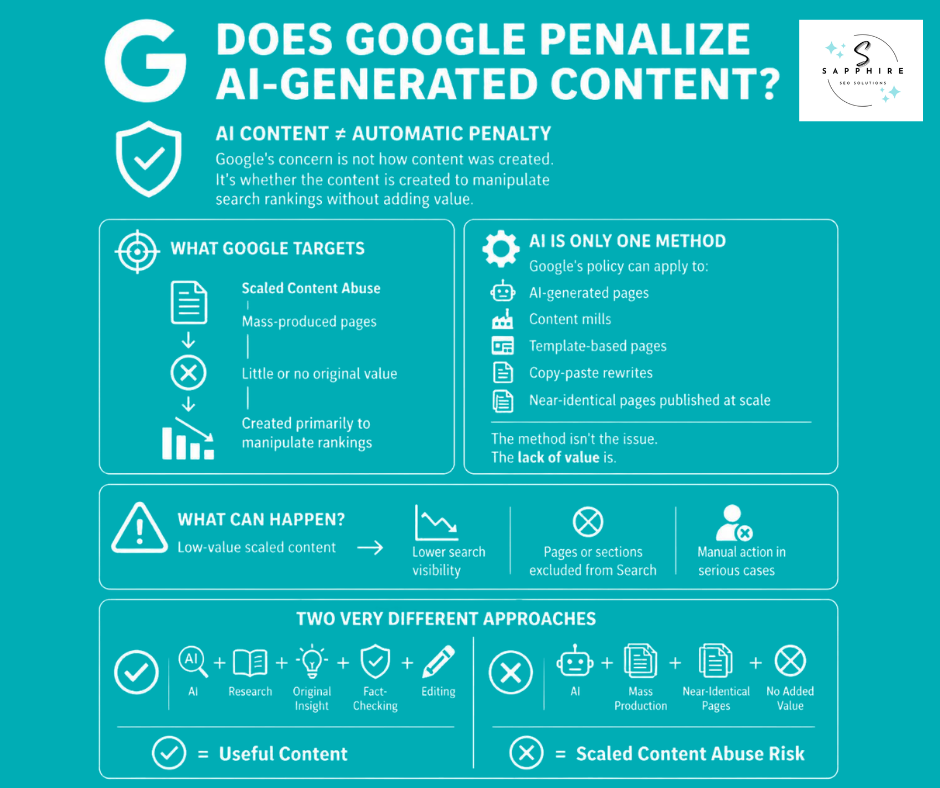
There's no such thing as an "AI content penalty." Google has never rolled out a policy that says AI-written pages get bumped down just for being AI-written. That's not how Google decides to punish AI content, and it's worth clearing that up before anything else.
What Google actually has is a policy called scaled content abuse. It targets pages created mainly to manipulate search rankings rather than to help the people reading them. The policy calls out AI generation by name as one way this happens, but it's not the only way. Templates, outsourced content mills, and copy-paste rewrites can trigger the same problem. The method isn't the issue.
The phrase that matters most here is "without adding value." That's the actual line. A business publishing 400 AI-written city pages that all say roughly the same thing, with the city name swapped out, adds nothing new for the reader. That's the pattern Google is after. It's not about the tool used to produce it. It's about low-quality pages stacked at scale with nothing original inside them.
So what happens if a site crosses that line? A few things, depending on severity:
Lower visibility in search results
Pages or entire sections excluded from Search altogether
A manual action, in more serious or repeated cases
None of that is automatic just because AI touched the page. It's tied to the pattern Google finds, not the fact that a model helped write something.
Here's the distinction worth sitting with. A business that uses AI as part of a real content process, researching the topic, adding original insight, fact-checking claims, editing for the reader, isn't the target of this policy. A business that generates hundreds of thin, near-identical pages and publishes them without much thought is. Same tool. Completely different outcome.
SEO teams report that Google's own guidance backs this up directly: focus on accuracy, quality, and relevance when using generative AI, not on hiding that AI was involved or trying to slip spam content past detection. There's nothing to disclose and nothing to hide. The only real question is whether the page is worth the reader's time. Treat AI as one part of the process, not the whole strategy, and this policy has very little to do with you.
What Does Google Actually Want From Content?
Forget keyword counts and density scores for a minute. While keyword research is important, it’s not what decides whether a page earns its spot. What actually matters comes down to a handful of things, and understanding them explains almost everything else in this article.
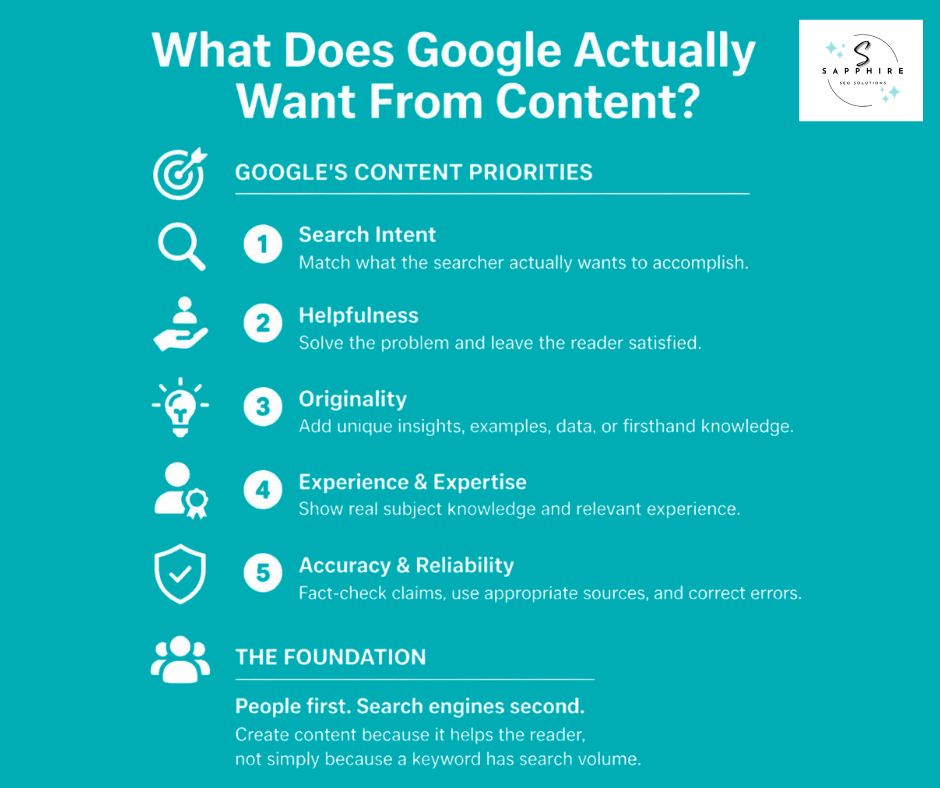
Search intent comes first. Before anything else, a page has to satisfy what the searcher is actually trying to do. That's different from just answering the literal question. Someone searching "how much does a new roof cost" isn't looking for a dictionary definition of roofing. They want a real number, or at least a real range, and enough context to know if they're being ripped off.
Search intent generally falls into three buckets:
Informational (they want to learn something)
Commercial (they're comparing options before buying)
Transactional (they're ready to buy right now)
Matching the format matters too. A commercial-intent search usually expects a comparison or a list of options, not a 2,000-word history lesson.
Helpfulness is the real test.
Does the page solve an actual problem?
Does the reader walk away with enough to move forward?
Does the experience feel worth their time?
Google's own guidance asks something close to this directly: will readers feel they've learned enough to reach their goal, and will they leave satisfied? That's the bar, in plain language.
Originality carries real weight. Original analysis. Original examples. Data nobody else is showing. Firsthand observations. A genuine expert's take on the subject. Information that isn't just a reshuffled version of what's already sitting on page one.
Experience and expertise back it up. Firsthand knowledge where it's relevant. Real subject-matter understanding. Examples pulled from actual work, not invented ones. A review from someone who actually knows the topic, when the stakes call for it.
Accuracy and reliability hold it together. Claims get checked. Sources are appropriate for what's being said. Nothing gets stated with false confidence, and if an AI tool generates a claim that isn't backed up, it gets corrected before it goes anywhere near "publish."
And underneath all of it sits one honest question: would you create this content if search engines didn't exist? Is it built primarily to help the person reading it, or mostly because a keyword happened to have decent search volume? Google is specific about this. It warns against search-engine-first content, and against running automation across dozens of topics just to cover more ground. That's the opposite of content quality, no matter how the words got there.
Put together, these pieces are what create helpful content actually means. Not a checklist to game. A description of what a genuinely useful page looks like, and the foundation every real content strategy should be built on.
Why Some AI-Generated Content Ranks While Other AI Content Doesn't
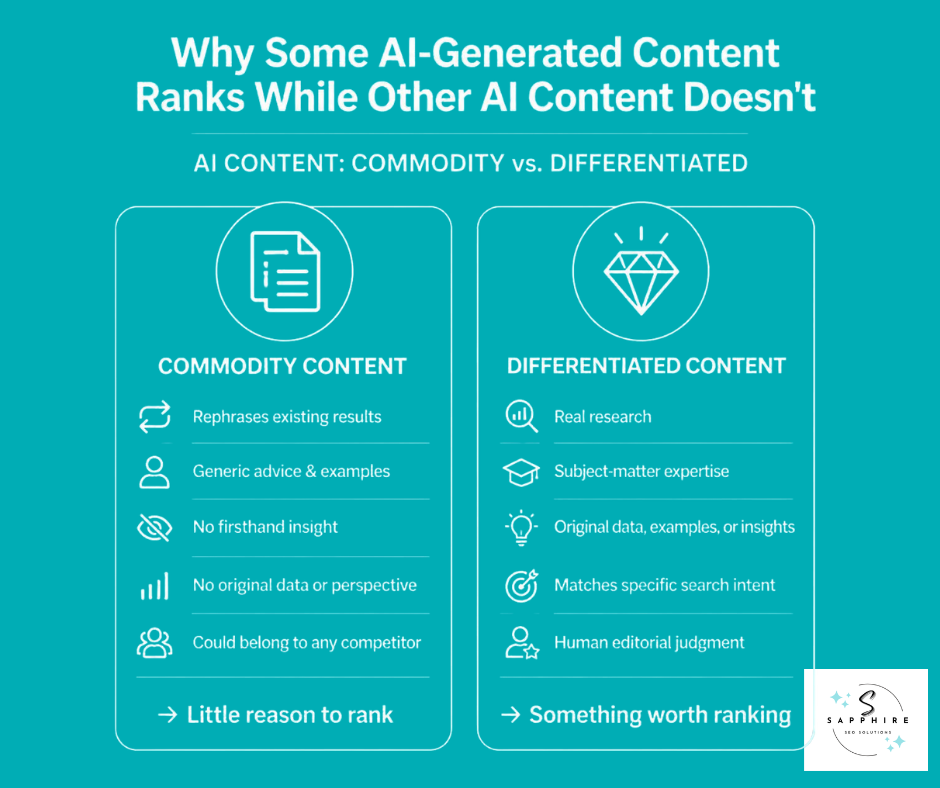
Here's the pattern worth understanding, because it explains almost every question in this article. It's not "AI content vs. human content." It's commodity content vs. differentiated content. And that split decides everything.
Commodity content is the stuff that could have come from anywhere. It rephrases what's already sitting on page one. It gives generic advice, leans on predictable examples, and never touches anything close to firsthand experience.
No original data.
No angle nobody else has.
Swap out the business name at the top, and it could belong to any company in the industry.
This is what poor-quality content usually looks like when it doesn't rank. It's not that it's badly written. It's that it doesn't add anything. Ten competitors could publish the same raw AI output on the same topic, and nobody would notice the difference.
Differentiated content works the opposite way.
It starts with actual research instead of a quick prompt.
It draws on real subject-matter knowledge.
It includes something original, whether that's a data point, an observation, or an example pulled from real work rather than invented for the page.
It answers the specific thing the searcher came looking for, not a loosely related version of it.
Someone made editorial calls along the way, cutting what didn't matter and keeping what did. And by the end, the reader has something they couldn't easily find somewhere else.
That gap is exactly why some AI content performs well in ranking pages and other AI content quietly disappears. Pure AI content, generated fast with no research, no editing, and no specific knowledge behind it, tends to land in the commodity bucket almost by default. But AI-assisted content built around real expertise and original input can absolutely land among top-ranking pages, sitting next to human content without a problem.
Google's own current guidance backs this up directly. It points to non-commodity content, material with a genuine point of view behind it, as one of the biggest factors in whether a page holds up in AI-powered search over time. The tool used to draft a page barely enters into it. What the page actually says, and whether anyone bothered to make it worth reading, is what decides the outcome.
AI-Generated vs. Human-Written vs. AI-Assisted Content
Most businesses picture this as a fight. AI on one side, people on the other, pick a winner. That framing doesn't really hold up. What actually matters is which workflow produces the page a reader will find useful, and each of these three approaches gets there differently.
Here are the differences between the three types of content:
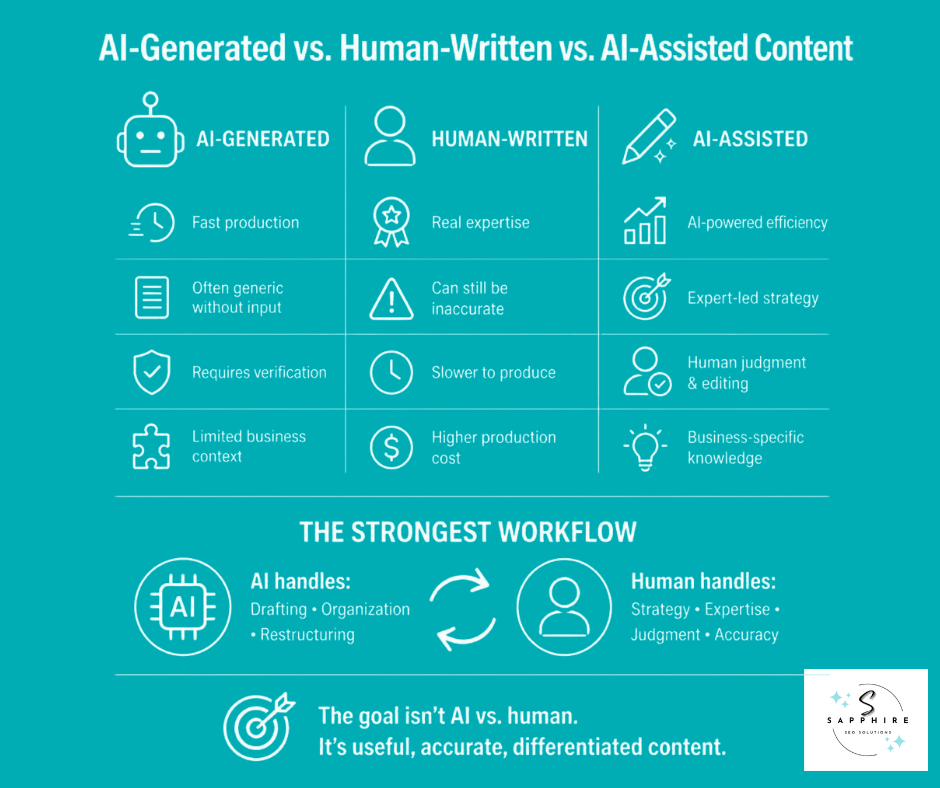
AI-generated, minimal human involvement: This is the fastest route by far. But speed comes with a cost. Without someone shaping it, the output tends toward generic, and it needs real verification before it goes anywhere near "publish." Unless business-specific knowledge gets fed in deliberately, the page won't know anything the AI didn't already know, which usually isn't much.
Human-written content: A person writing from real expertise and experience can bring things AI simply doesn't have on its own. But human-written content isn't automatically good just because a person typed it. It can still be inaccurate, generic, or poorly matched to what people are actually searching for. It also tends to take longer and cost more to produce, which matters when a business needs to cover a lot of ground.
AI-assisted, expert-led: This is where AI handles the parts it's actually good at: drafting, organizing, restructuring, speeding up production. Meanwhile, a person supplies the strategy, the judgment, the specific business knowledge, and the final check for accuracy. Done well, this is where AI-assisted content performs closest to its potential. It's not AI replacing a person. It's human input directing the tool instead of the other way around.
None of this means Google prefers one method over another; it doesn't. So here's the real takeaway. The strongest workflow isn't "AI" or "human" as a category. It's whichever one actually produces something useful, accurate, and different from what's already out there. For most businesses, that means real human involvement somewhere in the process, not necessarily every word of it. A little human touch at the strategy and judgment level tends to matter more than who typed the first draft.
Can ChatGPT Content Rank on Google?
Yes, content created with ChatGPT can rank. But ChatGPT itself isn't the thing doing the ranking. It's just one of many AI tools a business might use somewhere in the process, and Google doesn't treat it any differently than it treats other AI-written content.
Here's where a lot of businesses go wrong, though. Typing a prompt, copying the response, and hitting publish isn't a strategy. It's a shortcut, and it usually shows. That workflow skips almost everything that makes a page worth ranking in the first place.
What ChatGPT is actually good for is the early and middle stages of the content creation process. Brainstorming angles. Building an outline. Organizing research into something usable. Producing a first draft. Restructuring a section that isn't working. Helping tighten up the editing pass. Used this way, it saves real time.
But leveraging AI for those tasks doesn't replace what a business or writer still has to bring to the table. Someone still needs to figure out what the reader is actually searching for and why. Someone needs to add information that isn't already sitting on every competing page:
Real examples
Business-specific knowledge
A perspective that comes from actually doing the work
Someone needs to fact-check what the AI output claims, because it will state things confidently whether they're accurate or not. And somebody needs to make the editorial calls: what stays, what gets cut, what's worth saying at all.
So the honest answer is this. ChatGPT can be part of a page that ranks well. It's rarely the whole reason a page ranks, and it's never a substitute for the judgment a person brings to the finished product.
What Types of AI Content Are Most Likely to Struggle?
Some patterns show up again and again in pages that never gain traction. None of them are automatically penalized on sight, and none of them mean AI shouldn't be used. But they line up closely with what Google's scaled content abuse policy is actually describing, so they're worth knowing before you produce content at any real volume.
The patterns that tend to struggle:
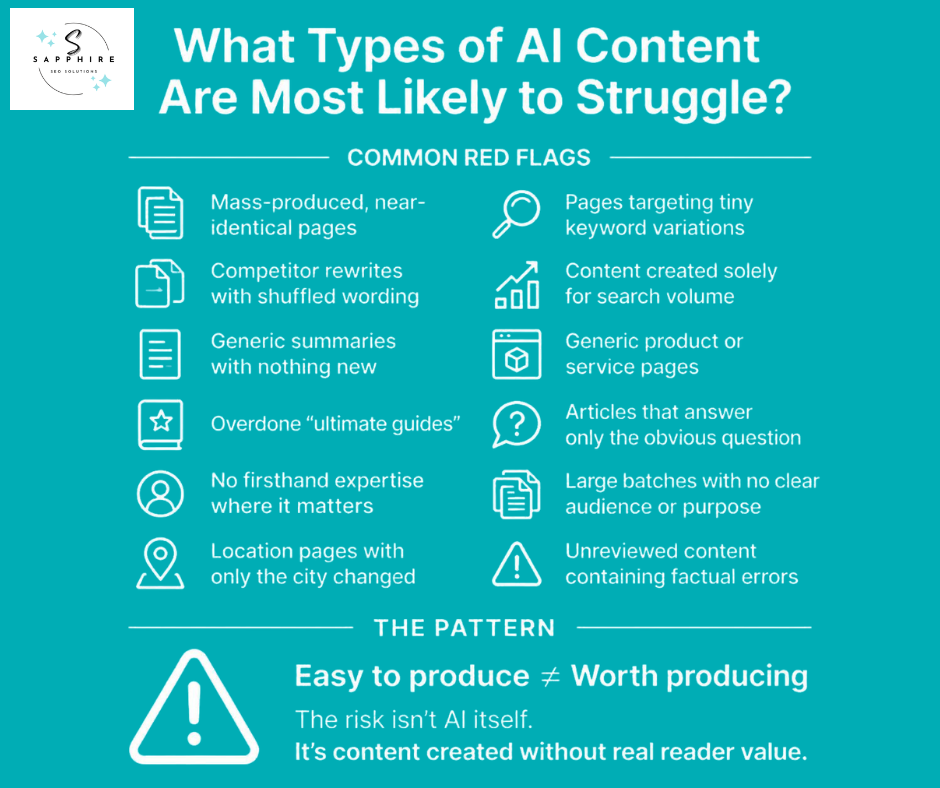
Mass-produced pages that all say basically the same thing with small variations
Rewrites of a competitor's article with the wording shuffled around
Summaries that restate existing information without adding anything new
Generic "ultimate guides" covering ground that's already been covered a hundred times
Articles with no firsthand experience behind them, on topics where experience matters
Local pages where only the city name changes and nothing else reflects that location
Large batches of pages built around tiny keyword variations of the same core topic
Content made because a keyword has search volume, not because anyone needed to say something
Product or service pages with no real business-specific detail in them
Articles that answer the obvious question and stop, leaving the reader with nowhere further to go
Pages published at scale with no clear audience and no real business reason behind them
Content with factual errors nobody caught, because nobody reviewed it before it went live
It's not about AI generation as a method. It's about creating content without anyone actually thinking through whether it helps the person reading it. Every one of these patterns can happen with human writers too. AI just makes it possible to do them faster and at a much bigger scale, which is exactly what Google's scaled content abuse policy is built to catch: pages made mainly to fill out a sitemap rather than to serve a reader.
None of this means local pages are off-limits, or that content production at scale is inherently risky, or that shorter content is doomed. A hundred location pages can work fine if each one reflects something real about that location. The difference is always the same. Was this page built around an actual reader's need, or was it built because it was easy to make another one?
What Makes AI-Assisted Content Good Enough to Rank?
This is the real question underneath everything else in this article. Not "can AI write it," but "what actually has to be true for it to earn a spot." Here's what separates content that competes for the very top of the results from content that sits buried on page four.
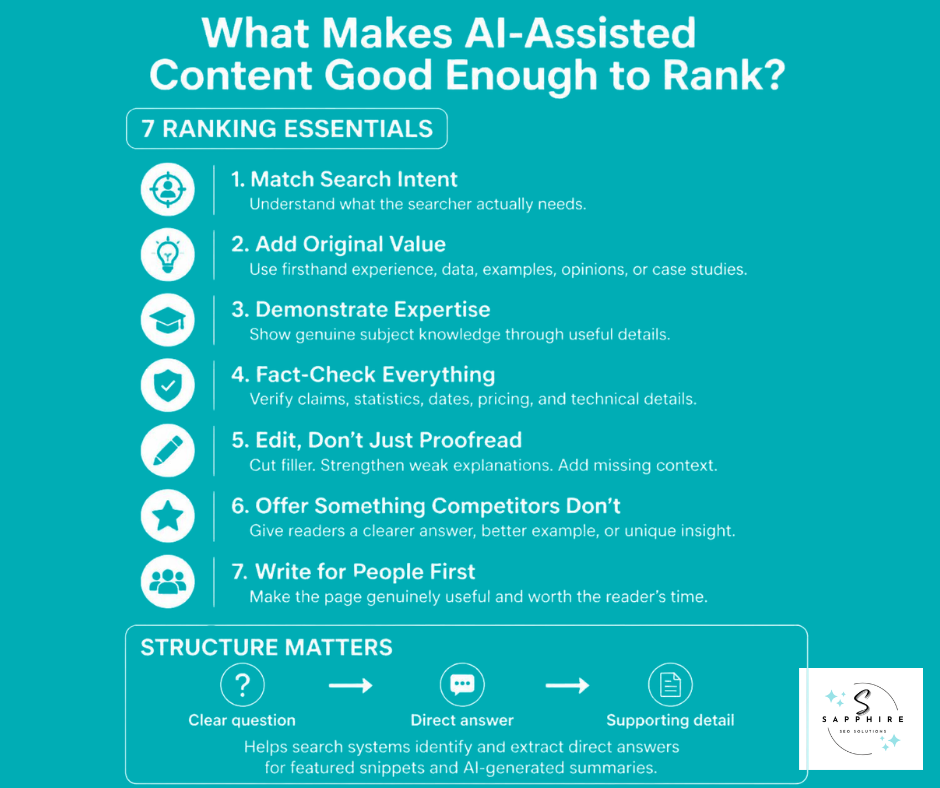
It Begins with Search Intent, Not a Topic
Before a word gets written, the query itself needs to be understood. What are the currently ranking pages actually giving readers? What's the real problem behind the search, underneath the literal words typed into the box? Once that's clear, it's possible to figure out what a genuinely satisfying answer looks like, rather than guessing.
It Adds Something Original
Firsthand experience
Original research
Proprietary data nobody else is publishing
Business-specific examples pulled from real jobs, not invented ones.
An expert's actual opinion.
A case study with real numbers attached.
This is the piece most content marketing skips, and it's usually the piece that matters most.
It Demonstrates Real Expertise
Subject-matter knowledge that shows up in the details, not just the topic sentence.
Genuine experience with the subject.
Input from someone who actually knows it.
Enough context about the author or business to back that up when it's relevant.
It Gets Fact-Checked
Important claims get verified.
Statistics get validated against a real source.
Technical details get double-checked.
Dates, regulations, pricing, and specifications get confirmed rather than assumed, especially anywhere being wrong would actually cost the reader something.
It Gets Edited, Not Just Proofread
This distinction matters more than most people realize. Proofreading catches typos. Editing does something bigger:
Cutting the generic filler sections
Rebuilding explanations that don't quite land
Tightening the logic
Adding context that's missing
Sharpening weak examples
Removing any claim that can't actually be backed up
Most SEO professionals will say this step is where AI drafts either become worth publishing or don't.
It Gives the Reader Something Competitors Don't Have
A clearer explanation.
A better example.
Original data nobody else is showing.
Real experience behind the advice.
Something that actually helps someone decide, not just informs them in the abstract.
Specific business insight instead of generic industry talk.
It’s Built for People First
The question worth asking before publishing anything: would the person reading this feel it was worth their time? Google's own current guidance on this is direct: content that's unique, genuinely useful, and clearly written for a reader is what's likely to hold up in AI-powered search over the long run, not content engineered to game a system.
One more thing worth naming. Well-structured content, meaning a clear question in the heading followed immediately by a direct answer, tends to perform well for a practical reason. It's exactly the shape Google's systems look for when pulling direct answers into featured snippets and AI-generated summaries. That's not a trick. It's just writing clearly enough that a system built to extract answers can actually find one.
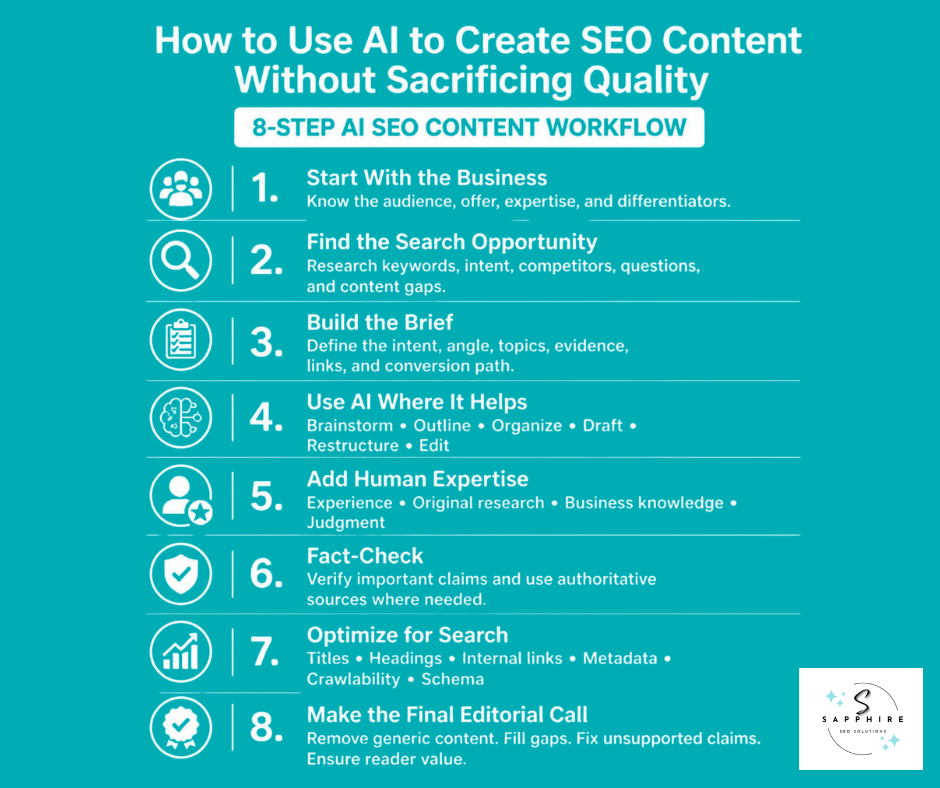
How to Use AI to Create SEO Content Without Sacrificing Quality
This is where the theory turns into an actual process. None of this depends on a specific AI platform or a magic prompt. It's a workflow, and it works whether the tool is ChatGPT, Claude, or whatever comes next year.
Here are the steps that you should follow when using AI to create SEO content:
Step 1: Start with the business, not the keyword. Before any content creation begins, get clear on what's actually being sold, who's buying it, what customers keep asking, what makes this business different from the one down the street, and what real expertise or experience the business can draw on. Skip this step and every following step is guesswork.
Step 2: Find the actual search opportunity. Real keyword research. A clear read on search intent. A look at what's already ranking, what those pages get right, and where they fall short. The related questions people are asking. The gaps competitors have left open.
Step 3: Build a content brief before writing anything. Define the primary intent, the audience, the angle, the topics that need covering, the evidence that'll back it up, where internal links should point, and where there's a natural opening to move the reader toward a service.
Step 4: Bring AI in where it actually helps. Brainstorming angles. Building an outline. Organizing scattered research into something usable. Producing a first draft. Restructuring a section that isn't working. Assisting with the editing pass. This is genuinely useful work, and there's no reason to do it by hand if a tool can speed it up.
Step 5: Add what AI can't generate on its own. Real expertise. Firsthand experience. Original research. Information specific to this business that no AI model has access to. Judgment calls about what actually matters to this audience. This step is usually the difference between a page that ranks and one that doesn't.
Step 6: Fact-check everything that matters. Verify the important claims. Replace anything unsupported with something that's actually backed up. Pull from authoritative sources where the topic calls for it. If the subject touches something sensitive, legal, medical, or financial, get a specialist to look it over before it goes live.
Step 7: Optimize it properly. A clear page title. A logical H1 and H2 structure. Internal links with anchor text that actually describes where they lead. Solid metadata, including meta descriptions that reflect what's really on the page. Confirm the page is crawlable. Add structured data or schema markup where it genuinely applies, not everywhere just because it's available. Bring in useful media if it adds something.
Step 8: Do one final editorial pass before publishing. Ask a few honest questions. Is this genuinely useful, or does it just look finished? Is anything still generic? Is any claim sitting there unsupported? Is something missing that the reader would expect to find? Would the intended audience actually walk away satisfied?
That's the whole process. No prompt template, no fully automated pipeline, no shortcut that skips the judgment part. AI speeds up the mechanical work. The business and the writer are still responsible for making sure what gets published is worth AI answers pulling from it, worth a reader's time, and worth ranking for.
Can AI-Generated Content Appear in Google AI Overviews and AI Mode?
Yes, it can. AI-generated or AI-assisted content can absolutely turn up as a supporting source inside Google AI Overviews and AI Mode, right alongside pages written entirely by hand. There's no separate rulebook here just because the surface has "AI" in the name.
That's because Google has said directly that these features are built on its core Search systems, not something running apart from them. Same index. Same crawl. Same quality signals that decide everything else in search results. Which means the foundational SEO work businesses already need to be doing is exactly what carries over here too. There's no separate discipline to learn from scratch.
The technical bar is simple, and it's the same bar as regular Search. A page has to be indexed and eligible to appear with a snippet. That's it. Google states plainly that there are no additional technical requirements layered on top of that just for AI Overviews or AI Mode.
Which clears up a lot of confusion floating around right now:
No special schema markup exists for AI features. Regular structured data, applied where it actually fits, is all there is.
No llms.txt file or other "AI-readable" text file is needed. Google has said directly that its Search systems ignore these files entirely.
No secret optimization technique unlocks inclusion. If something's being sold as an "AI Overview trick," it isn't describing anything Google has documented.
AI search experiences pull supporting links from relevant pages already sitting in the index, the same pages that could otherwise show up in a regular organic result. So a page already doing well on fundamentals is already in the running.
But here's the part worth being honest about. Meeting these requirements doesn't guarantee anything. A page can be indexed, snippet-eligible, and technically flawless and still never get pulled into an AI Overview or shown among the AI-generated answers. Inclusion isn't a checkbox. The content still has to earn its spot the same way it would anywhere else: by actually being useful enough that a system built to surface generated answers decides it's worth pulling in.
What Makes Content More Valuable to AI Search Systems?
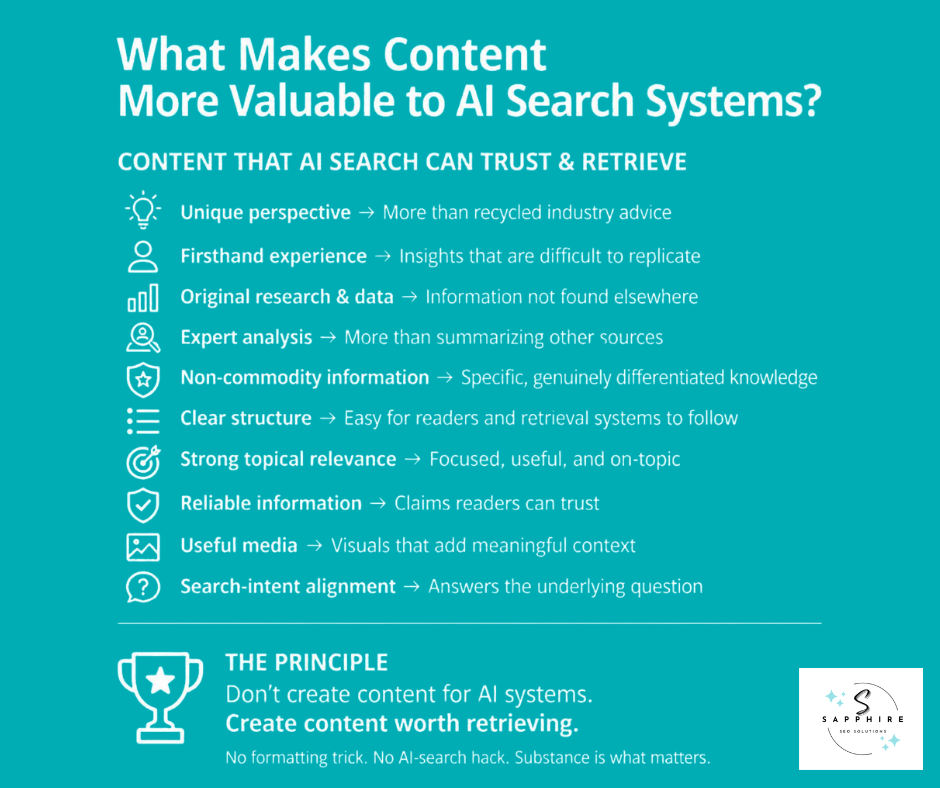
Some businesses hear about generative engine optimization and assume there's a secret set of tricks for getting pulled into an AI answer. There isn't, at least not according to Google. What actually moves the needle looks a lot like the same quality signals that have mattered for years, just applied with a bit more precision.
A few things tend to stand out when content ends up feeding AI search results:
A genuine, unique point of view, not a rehash of the same five arguments every competitor makes
Firsthand experience with the topic, the kind that's hard to fake and even harder to copy
Original research or data that didn't exist anywhere else before this page published it
Real expert analysis, not a summary of what experts elsewhere have already said
Non-commodity information, meaning something specific enough that it couldn't have been generated by any AI model working from common knowledge alone
Clear explanations that don't bury the point three paragraphs deep
Content that's genuinely well-organized, with a logical structure a reader (or a retrieval system) can follow
Strong topical relevance, actually staying on-topic instead of drifting into loosely related filler
Information that's reliable enough to trust without a second source
Supporting media that adds real value, not decoration for its own sake
Content that answers the underlying question a person is actually asking, not just the exact words they typed into the search bar
Google's own current guidance is direct about this: content that's unique, genuinely valuable, and non-commodity is what's likely to shape a website's presence in generative AI search over the long run. Not a file. Not a formatting trick. The substance of the page itself.
Here's the principle worth holding onto through all of this. Don't try to manufacture content specifically for AI systems. Create something that's genuinely worth retrieving, and the rest tends to follow. Google has specifically warned against building out separate pages for every possible variation of a query, mainly to try to manipulate either regular rankings or AI-generated answers. That approach isn't a shortcut. It's the exact pattern Google's spam policies are built to catch.
There's no hack that reliably earns a citation from ChatGPT or gets a page featured in an AI answers box, and anyone promising that outcome is promising something outside of what these systems have actually documented. What does hold up, consistently, is the same thing that's held up all along: content worth a reader's time, written by someone who actually knows the subject.
More Resources on AI SEO to Explore
To learn about AI SEO and how your small business can appear in AI search results, make sure to read our detailed guides on:
What AI Search Optimization Actually Means for a Small Business
All of this raises a fair question. If AI mode and generative search are changing how people find answers, does a landscaping company or a plumbing outfit need a whole new strategy just for AI? No. And that's actually good news.
Google frames this pretty clearly: optimizing for generative AI search is still SEO. Not a separate discipline running alongside it. Not a new set of rules replacing the old ones. Whatever's already working across regular search engines carries over here too, because the same underlying systems power both.
So what does that actually look like for a small business? A few practical things, none of them exotic:
Having the core services explained clearly, in plain language, without making a visitor guess what's actually offered
Creating pages that answer the real questions customers keep asking, not just a services list
Showing real expertise, not just claiming it
Publishing original knowledge that comes from actually doing the work, not recycled industry talk
Making sure the important information on the site is easy to crawl and easy to find
Building internal links that connect related pages in a way that actually makes sense
Keeping business information accurate and current: hours, service areas, pricing ranges, licensing
Building out local, product, or service content where it genuinely serves a real customer need, not just to check a box
Underneath all of it, a website needs to communicate a handful of things clearly: what the company actually does, who it serves, where it operates, why it's qualified to do the work, and what makes it different from the next name on the list. That's not content marketing jargon. That's just a website doing its basic job.
None of this requires dozens of brand-new "AI-specific" pages, and nobody can promise a business will get pulled into an AI answer just because they followed a checklist. What actually helps is business-specific content that reflects a real company doing real work, explained clearly enough that both a person and a system built to retrieve answers can understand it. Digital marketers chasing GEO gimmicks are mostly chasing something that doesn't exist as a separate playbook. The fundamentals were always the point.
If AI Can Write Content, Why Should a Small Business Hire a Content Writer?
Fair question. If ChatGPT can spit out an article in thirty seconds, why would anyone pay a person to write one instead? It's a reasonable thing to wonder, and it deserves a real answer instead of a defensive one.
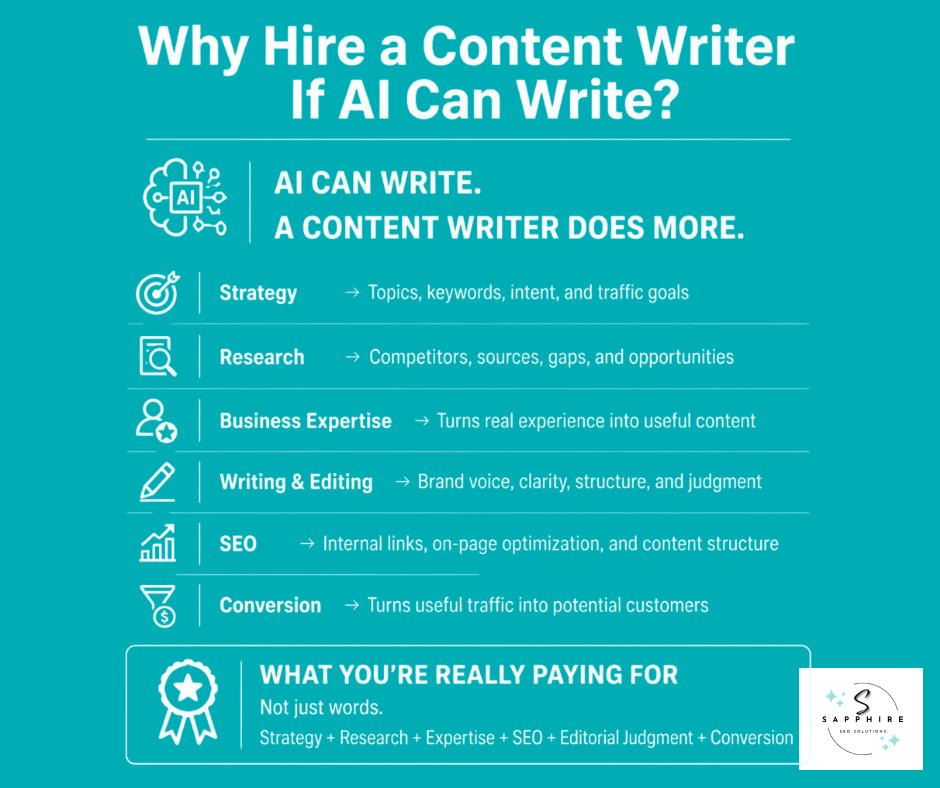
Here's the honest version. AI can write. What it can't do is everything that has to happen before and after the writing.
Strategy comes first, and it's not automatic. Which topics are actually worth creating? Which keywords matter to this specific business, not just any business in the industry? Which topics will actually bring in the right kind of traffic instead of just any traffic? What's the real intent behind each search, and does the content plan account for it? That's judgment, built from experience, not something a prompt produces on its own.
Research takes real digging. Looking at what competitors are doing and where they're falling short. Studying what's already ranking and figuring out why. Going to primary sources instead of secondhand summaries. Spotting the gaps nobody else has filled yet. SEO professionals do this work before a single sentence gets drafted.
Someone has to pull the business's actual knowledge out into the open. A content writer sits down with the owner, or the crew, or whoever actually knows the work, and turns that experience into something usable. Interviewing the people with real expertise. Digging up the specific detail that makes this business different from the next one. Building original examples instead of generic ones.
Writing and editing still need a human hand. Clear communication that actually sounds like this business, not a template. A consistent brand voice. Logical structure that leads somewhere. A real understanding of who's reading this and what they need. And, frankly, stripping out the generic filler that raw AI output tends to produce when nobody's checking it.
SEO ties it all together. Matching search intent properly. On-page details done right. Internal links built with purpose. A content structure that actually connects to the service pages that generate revenue.
And somebody has to think about conversion. Moving a reader who's just gathering information toward an actual next step. Answering the objections they haven't said out loud yet. Supporting the decision they're already halfway through making. Attracting the traffic that's actually worth having, not just traffic in general.
So here's the real takeaway. A business isn't paying a writer for the words themselves. AI can produce words for almost nothing. What a business is actually paying for is the strategy, the research, the human involvement that turns raw business knowledge into something worth publishing, and the editorial judgment that decides what belongs on the page and what doesn't. That's the part digital marketers and content teams get paid for, and it's the part AI still can't do by itself.
How to Evaluate AI-Generated Content Before Publishing
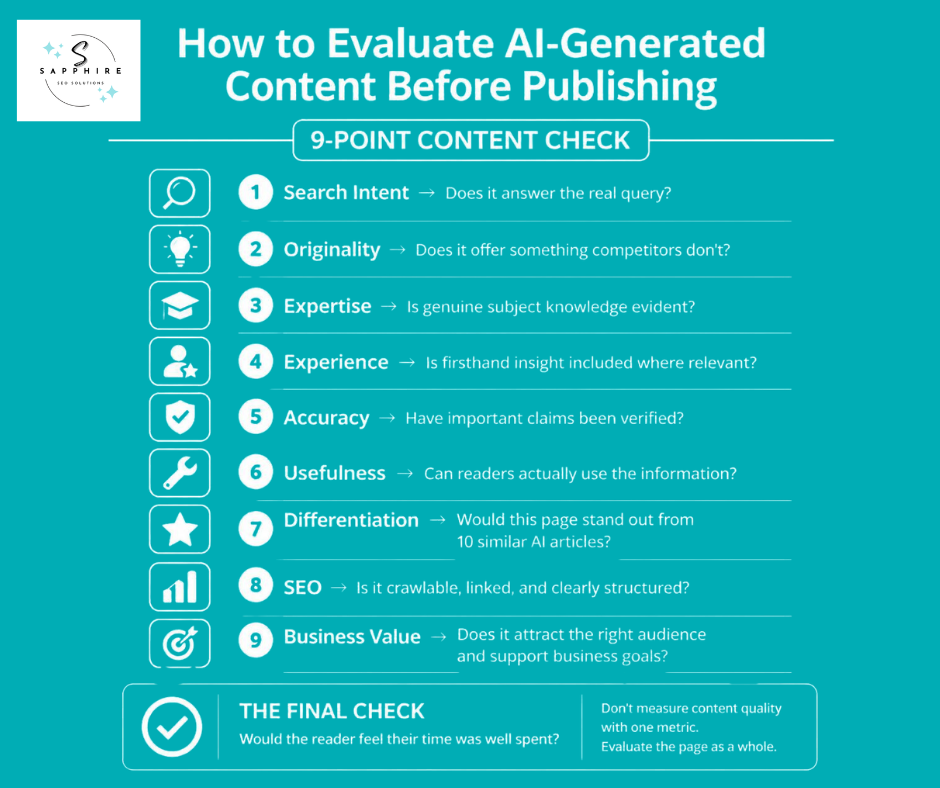
Before anything gets published, it's worth running it through a real check. Not an AI detector score, not a keyword density percentage, nothing that measures the wrong thing well. Just a handful of honest questions that actually predict whether a page is worth putting out into the world.
Search intent: Does this actually answer what the searcher wanted, or does it circle around the topic without landing on the point?
Originality: What does this page give the reader that competitors don't already offer? If the honest answer is "nothing," that's worth fixing before publishing, not after.
Expertise: Is there real subject knowledge sitting underneath this, or does it read like a summary of what everyone else already said?
Experience: Where firsthand knowledge would actually matter, is it there? Or is the whole thing written from a distance?
Accuracy: Have the important claims actually been checked? Not glanced at. Checked.
Usefulness: Can a reader actually do something with this information, or is it interesting in theory and useless in practice?
Differentiation: Here's the sharpest test of all: if ten competitors published an AI-generated article on this exact topic, would this specific page still stand out? If the honest answer is no, it's not ready yet.
SEO: Is the page crawlable? Is it linked to from somewhere relevant on the site? Is it structured clearly enough for both a reader and a search system to follow?
Business value: Is this bringing in the right audience, the kind that actually needs what the business offers? Does it connect back to the services or products that matter?
The people-first test: Would the reader who landed on this page feel satisfied after reading it? Would they feel like their time was well spent?
None of these questions has a pass-fail score attached, and there's no shortcut version of this list. Content quality and helpful content aren't things a single metric can measure. They show up in the honest answers to questions like these, one page at a time.
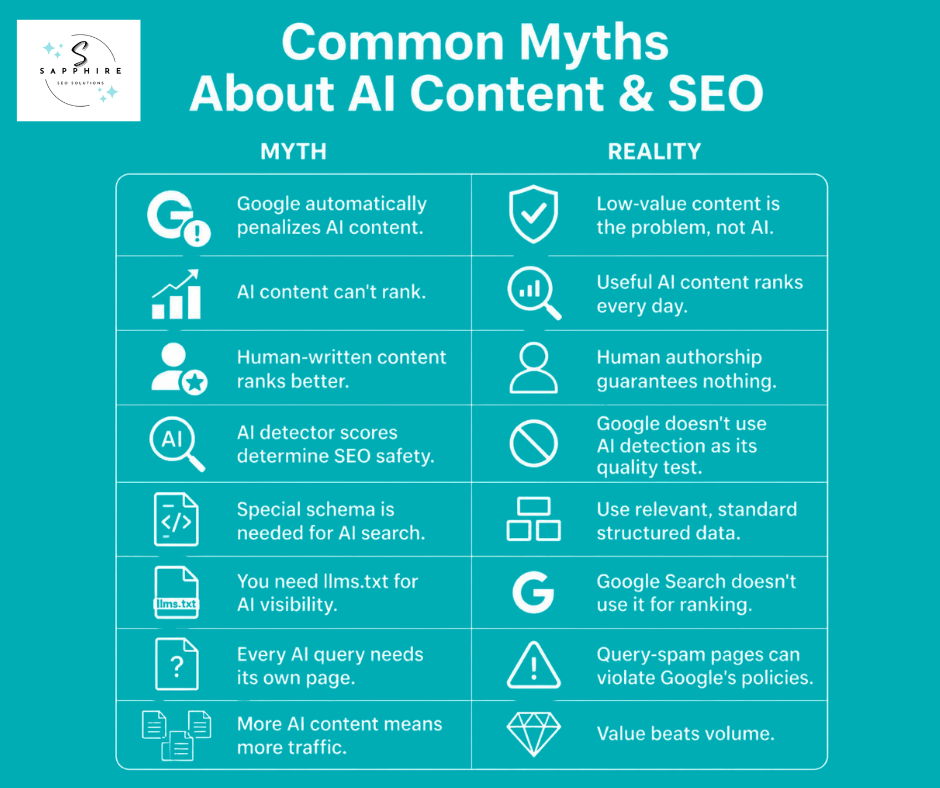
Common Myths About AI Content and SEO
A lot of bad advice circulates around this topic. Here's what's actually true, stripped of the noise.
Myth: Google automatically penalizes AI content.
Reality: It doesn't. The generation method was never the trigger. What gets flagged is low-value content published at scale, whether a person or an AI produced it.
Myth: AI content can't rank.
Reality: It ranks all the time, as long as the resulting page satisfies readers and meets Search's actual requirements. Nothing in Google's policies bars it.
Myth: Human-written content automatically ranks better.
Reality: It doesn't. A person typing every word guarantees nothing about whether that page is actually useful. Authorship was never the quality signal people assumed it was.
Myth: Passing an AI detector means the content is SEO-safe.
Reality: AI detector results have nothing to do with how Google evaluates a page. Detection isn't part of the actual quality test, and it never has been.
Myth: You need special schema markup for AI search.
Reality: There's no dedicated schema markup built specifically for AI Overviews or AI Mode. Regular structured data, applied where it genuinely fits, is all there is.
Myth: You need an llms.txt file to show up in AI search.
Reality: Google has said directly that its Search systems ignore that file entirely. Creating one changes nothing for Google visibility.
Myth: You need a separate page for every possible AI query variation.
Reality: Google specifically warns against this. Building pages just to cover every phrasing of a question, mainly to try to manipulate rankings or AI responses, is the exact pattern its spam policies target.
Myth: More AI content automatically means more traffic.
Reality: Volume without value doesn't hold up. A hundred thin pages don't outperform ten genuinely useful ones, and they usually drag the whole site down instead.
The pattern running through every one of these myths is the same. People keep looking for a shortcut, some hidden mechanism to punish AI content or reward it artificially. There isn't one. Whether content is AI-written or written by hand, the same basic standard applies: is it actually worth the reader's time?
AI Can Generate Words. It Can't Automatically Create Value.
So, back to the original question. Can AI-generated content rank on Google? Yes. That much has been true throughout this whole article. But AI use was never really the deciding factor, and it never will be. Low-value content published at scale can run into real trouble, not because of the tool that made it, but because of what it fails to offer.
Strong content, whatever produced the first draft, still needs the same things it always needed. Relevance to what someone's actually searching for. Real usefulness. Something original. Genuine expertise and experience behind it (EEAT). Claims that hold up. Solid SEO underneath it all. None of that changed with generative AI. If anything, it matters more now, since these same principles are what shape visibility in AI-powered search too.
The smart move is using AI where it genuinely speeds things up, not handing over an entire content strategy to a text generator and hoping for the best. A business's real advantage was never going to come from producing more words faster. It comes from what the business actually knows, and whether that knowledge makes it into the content at all. That's what it takes to generate helpful content worth a reader's time, and worth ranking for.
Work with Sapphire SEO Solutions to Create Helpful Content That Ranks
If generic AI content isn't the answer, what is? For most businesses, it's a real content strategy behind the words, not just the words themselves.
That's what Sapphire SEO Solutions builds. Keyword research that actually reflects what your customers search. Search-intent analysis that shapes each page around a real reason to exist. Content briefs that give every piece direction before a draft ever starts. Human-led writing, supported by AI where it genuinely speeds up the process, never the other way around.
The result is original, business-focused content: pages built around what your company actually knows, tied together with solid on-page SEO and internal linking that connects back to the services driving revenue. All of it is built with both traditional search and AI-powered search in mind, because the fundamentals behind both are the same.
Explore our SEO Content Writing Services to see how it comes together.

FAQs About AI-Generated Content and Google
Does AI-generated content rank on Google?
Yes. AI content can absolutely earn a spot in Google rankings. Google doesn't have a rule against content made with AI. What determines content rank is whether the finished page actually helps the person reading it, not how it got written.
Does Google penalize AI-generated content?
Not for being AI-generated, no. There's no blanket AI penalty. Google's scaled content abuse policy targets pages made mainly to manipulate rankings without adding real value, and that applies whether the pages came from AI, templates, or a person typing every word by hand.
Can ChatGPT content rank on Google?
It can, but ChatGPT isn't what does the ranking. It's a tool that can help with drafting, outlining, and organizing research. What actually earns the ranking is everything added on top: real expertise, fact-checking, original examples, and a page built around what the searcher actually needs.
Is AI-generated content against Google's guidelines?
No, not inherently. Google's guidelines focus on primary purpose. Content created mainly to help a real reader is fine, regardless of what tools were involved. Content created mainly to flood search results without adding anything is the problem, and that's true whether or not AI touched it.
What makes AI-generated content rank well?
The same things that make any content rank well. Real search intent alignment. Original information a competitor doesn't already have. Genuine expertise behind the page. Fact-checked claims. Careful editing rather than a quick proofread. Pages built this way tend to become high-ranking AI content, while pages skipping these steps usually don't.
Can AI-generated content appear in Google AI Overviews?
Yes. A page just needs to be indexed and eligible to show a snippet, the same baseline as regular Search. There's no extra technical requirement layered on for AI Overviews specifically, and no special file or markup unlocks inclusion.
Does Google prefer human-written content?
No. Google's quality systems evaluate helpfulness, accuracy, and usefulness. There are no criteria in Google's guidance asking who or what wrote the page. Human-generated content and AI-assisted content are judged by the same standard.
Can AI-generated content hurt SEO?
It can, but not because of the AI part. Thin, repetitive, unoriginal content published at scale can hurt a site's visibility, and AI just makes it easier to produce that kind of content quickly. The risk comes from the pattern, not the tool.
Should businesses use AI to write website content?
AI can be a genuinely useful part of the process, especially for drafting, outlining, and speeding up research. But blog posts and service pages still need a person adding real expertise, checking every claim, and making the editorial calls that AI can't make on its own.
Should I hire a content writer if AI can write articles?
Usually, yes, especially for anything meant to represent the business and bring in real traffic. A content writer brings strategy, research, and judgment that raw AI output doesn't have. AI can speed up production, but it doesn't replace the thinking behind high-quality content that actually connects to a business's goals.
A quick note on how these AI systems actually work behind the scenes: large language models like the ones powering ChatGPT and Google's AI features are pattern-based, built to generate the most likely next response based on training data. That's exactly why they don't automatically know what makes a specific business different, and why AI-assisted content performs best when a real person supplies that missing piece. Generated content without that human layer tends to read as generic because, in a real sense, it is.