

ChatGPT SEO for Small Businesses (A Guide to Getting Found)
People used to type a question into Google and scroll through ten blue links. Now a lot of them ask ChatGPT instead. Instead of a list of websites, they get one synthesized answer, sometimes with a source or two linked underneath. That's AI search at work.
That shift matters if you own a business. Ask ChatGPT to recommend a plumber or a landscaper, and your business needs to be discoverable enough for the system to find you and understand what you do. You can rank on page one of Google and still be invisible here.
That's where ChatGPT SEO comes in. Here's the misconception to clear up first: this isn't about finding a secret trick to rank #1 in ChatGPT. There's no page one. No blue links to fight over. The goal is making it more likely that ChatGPT can find your business, understand it correctly, and mention, cite, or recommend it when relevant.
ChatGPT SEO sits inside the bigger discipline of AI SEO. In this guide, we'll cover how ChatGPT search works, how it finds information about businesses, what it needs to understand your business, what you can do to improve your website visibility, and how to measure results.
Key Takeaways
ChatGPT SEO improves your website and online presence so ChatGPT can discover, understand, and surface your business.
ChatGPT visibility works differently than a traditional Google ranking. There's no fixed position to climb.
Your business can be mentioned, cited, surfaced as a source, or recommended in an answer.
ChatGPT Search can pull from the web and use relevant sources when answering questions.
Clear information, useful content, real expertise, and technical accessibility all make your business easier to discover.
ChatGPT SEO should complement your traditional SEO efforts, not replace or compete with them.
Focus on being genuinely useful and credible rather than trying to manipulate AI systems.
What Is ChatGPT SEO?
ChatGPT generates 1.4 billion visitors monthly. It has changed how people search. In fact, Microsoft invested $14 billion in OpenAI, ChatGPT's parent company. This makes it important to understand the AI tool, how it works, and what ChatGPT SEO is.
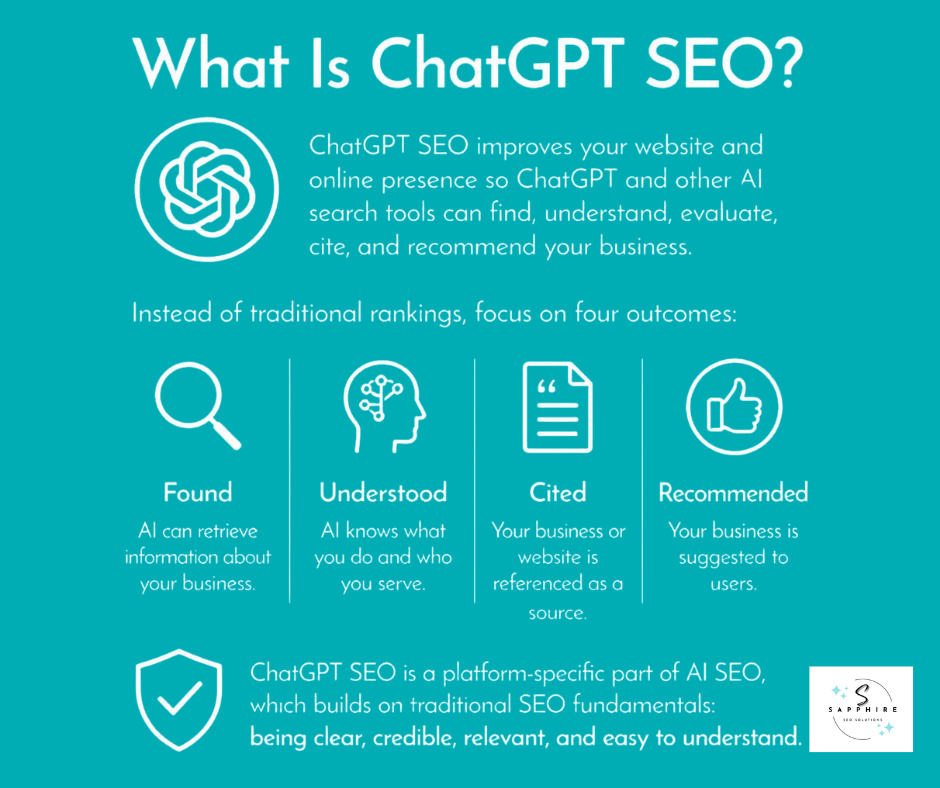
ChatGPT SEO is the process of improving your website and your broader online presence so ChatGPT and other AI-powered search tools can find, understand, evaluate, and surface your business when someone asks a relevant question.
That's really what you're going for. Instead of a ranking, you want to be discovered, understood correctly, considered relevant to the right questions, cited as a source, and recommended by ChatGPT and other AI tools.
"Ranking in ChatGPT" gets thrown around a lot, and it's not quite the right way to think about it. There's no single results page to climb. It helps to break the idea into the following four separate pieces instead:
Found: ChatGPT can actually retrieve information about your business.
Understood: It can figure out what you do and who you serve.
Cited: Your website, or another source that talks about you, gets referenced in an answer.
Recommended: Your business shows up as an option when someone's asking for one.
Some businesses get found but not understood. Some get understood but never cited. They're different outcomes, and they call for different things from you.
This is also a good place to be clear about something. Search engine optimization, whether you call it traditional SEO or the newer generative engine optimization, is really one connected effort. ChatGPT SEO is a platform-specific piece of the bigger discipline, which is often called AI SEO. Artificial intelligence search tools are changing how people find businesses, but the fundamentals underneath (being clear, credible, and easy to understand) haven't changed nearly as much as people assume.
If you want the fuller picture of that discipline, our detailed guide on What Is AI SEO? is a good place to start.
How Does ChatGPT Search Work?
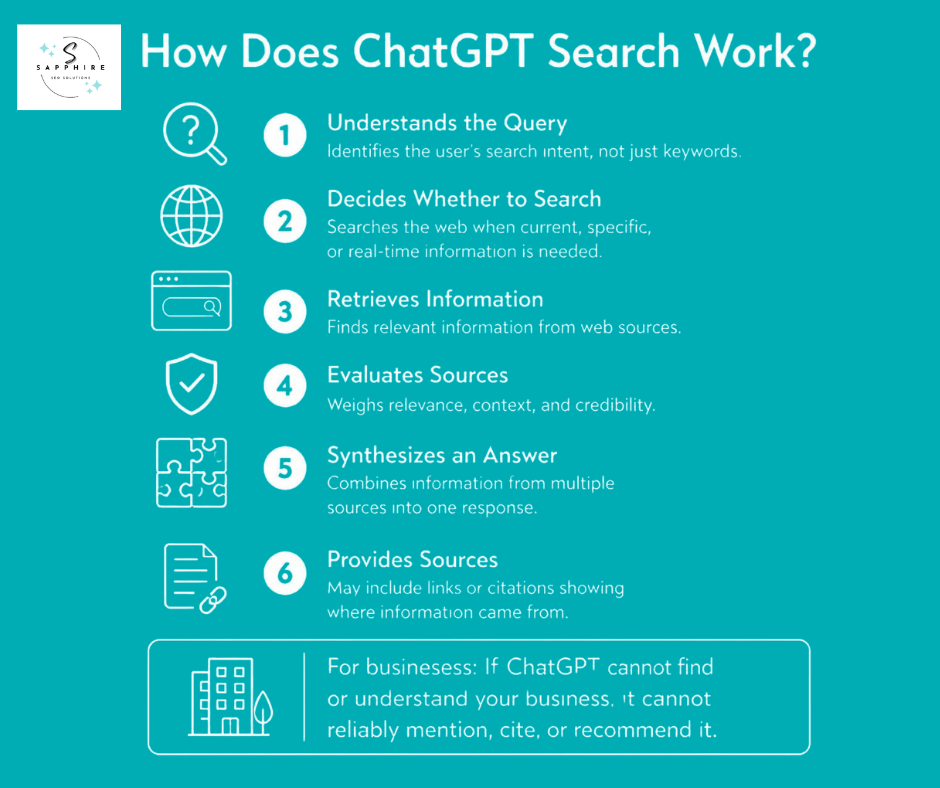
You don't need to understand the plumbing to use ChatGPT SEO well, but a rough mental model helps. Here's what happens between someone typing a question and ChatGPT answering it:
It Understands What You're Actually Asking
This relies on natural language processing, which is a fancy way of saying the system reads past your exact words to your real intent. Someone typing "who is the best roofer near me" isn't asking for a definition of "best." They want providers, location, expertise, and maybe reputation. ChatGPT tries to catch that full search intent, not just match keywords.
It Decides Whether It Needs to Search the Web
ChatGPT doesn't always search the web for information. If someone asks something general or evergreen, AI models can often answer from what they already know. But when a question calls for real-time data, current pricing, or specifics about a business, ChatGPT can run a search and pull in outside information.
It Retrieves Information from the Web
This is where ChatGPT search actually goes and looks. It pulls from web sources through search partners, scanning what's out there for anything that fits the question. For a business, this step is the whole ballgame. If your information can't be found here, none of the later steps matter.
It Evaluates What It Finds
When ChatGPT retrieves information, it weighs relevance, context, and credibility to figure out which relevant information actually answers the question and which is noise.
It Synthesizes an Answer
ChatGPT responses rarely come from a single page. More often, the system pulls pieces from several sources and blends them into one answer. That's why a final response usually isn't a copy of any one webpage. It's a synthesis.
It Generates a Response with Sources Attached
The final ChatGPT responses and AI responses you see are often written as direct answers, sometimes with links underneath pointing to where the information came from. ChatGPT doesn't provide sources for every answer. But when they're there, they give the user, and you, a way to trace where the information came from.
What This Means for Your Business
Here's the principle underneath all of it: ChatGPT cannot mention, cite, or recommend your business if it cannot find or understand information about it. That's really the whole game. Every section after this one comes back to that same idea in some form: discoverability, clarity, relevance, expertise, and having enough supporting information out there for the system to actually work with. For a deeper look at this process in general, go through our comprehensive guide on "How Does AI Search Work?"
Can You Actually Rank in ChatGPT?
People type "how to rank in ChatGPT" into Google the same way they'd type "how to rank higher" for anything else.
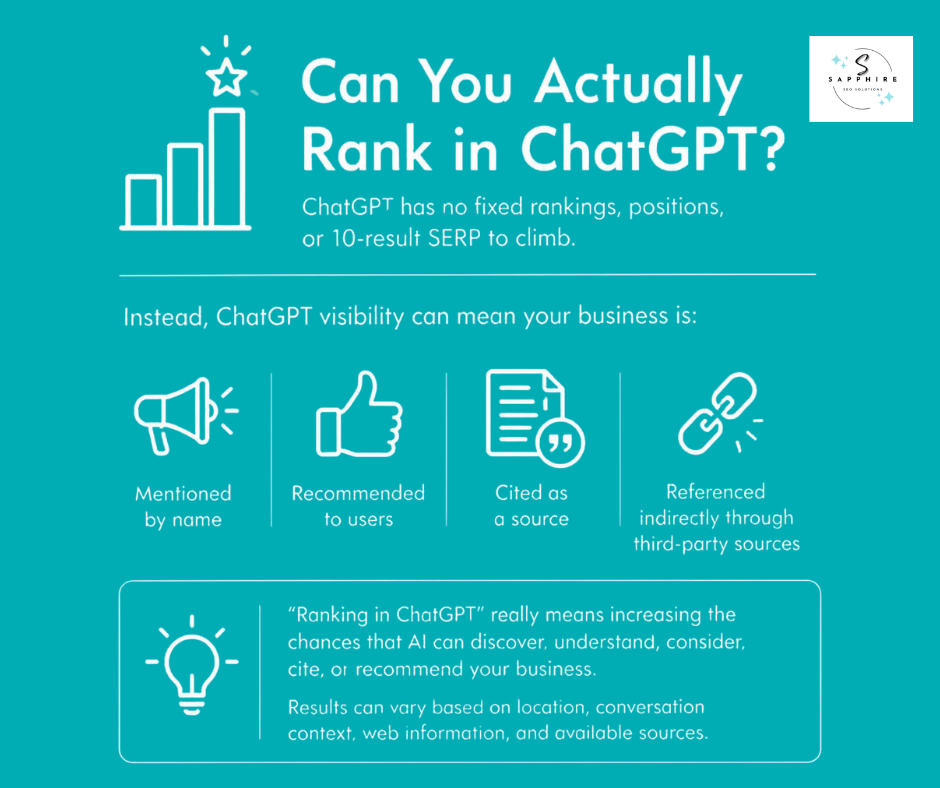
With traditional search engines, a Google search hands you a ranked list. ChatGPT doesn't work that way. There's no ten-result page to climb, no fixed slot with your name on it. Even Google AI Overviews and AI Overviews more broadly have moved away from that model, and ChatGPT never used it to begin with.
What you get instead are different kinds of visibility. Your business might get:
Mentioned by name
Actively recommended
Cited directly
A third-party source that talks about you might get surfaced instead of your own site. Or your business information might simply get folded into the answer without a citation at all. These aren't the same outcome, and none of them work like a ranking position.
What Does "Ranking in ChatGPT" Really Mean?
"Ranking" really means increasing the odds that relevant information about your business is discoverable, understood correctly, considered relevant to the question, surfaced, cited, or used in a recommendation. That's it. There is no single formula that gets you all of this.
And that likelihood shifts constantly. When someone asks the exact same question you may, ChatGPT uses their location, the context of the conversation, what's available on the web that day, and which sources get pulled to answer it. Two nearly identical questions can produce two different results. That's just how it works, and it's worth keeping in mind before chasing traditional SEO habits that don't translate directly here.
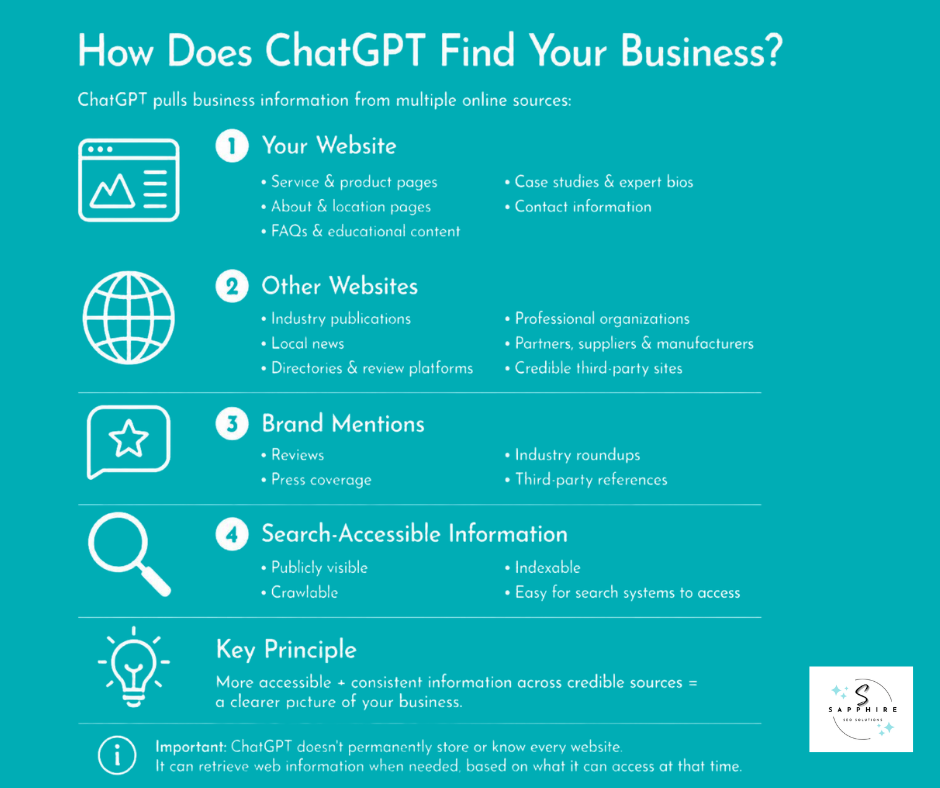
How Does ChatGPT Find Your Business?
There isn't one single place ChatGPT looks. It pulls from a mix of sources, including:
Your Website
Your website is the obvious starting point, and it's usually the most reliable one. Useful information can live in a lot of places on your website, including:
Service pages
Product pages
Your about page
Location or service-area pages
FAQs, educational content, case studies, author or expert bios
Basic contact information
What matters most is clarity. Your site needs to say plainly what your business does and who it's for. Not hinted or buried in long marketing paragraphs. It should be said directly on the pages that matter.
Other Websites
Your own site isn't the only source, though. Information about your business can also live on other websites, such as:
Industry publications
Local news sites
Professional organizations
Relevant directories
Review platforms
Supplier or manufacturer sites
Partner pages
Other credible third parties
If a supplier lists you, or a local paper covers your grand opening, that's information about your business existing somewhere ChatGPT could potentially find it.
Brand Mentions
This matters because your business's presence online doesn't stop at your own domain. Brand mentions on other sites, whether it's a review, a press mention, or a passing reference in an industry roundup, add context. More brand mentions across credible, relevant sources build out a fuller, more consistent picture of your brand's presence, and that consistency helps.
Search-Accessible Information
None of this matters if the information isn't accessible in the first place. Important business details need to be publicly visible and technically easy for search systems to find and read. That mostly comes down to whether your pages can be crawled and indexed properly, which we'll get into more practically later in this guide. For now, just know that if a page is hidden, blocked, or hard to reach, it's a lot less likely that content appears in an answer at all.
A Crucial Distinction
ChatGPT Search retrieving information from the web is not the same thing as ChatGPT knowing everything about every website that exists. It doesn't have a complete, permanent record of your site sitting in memory. It retrieves information when a question calls for it, from what it can access at that moment. The exact mechanics behind what gets retrieved and why aren't fully public, and it's worth being upfront about that rather than pretending the process is more transparent than it actually is.
What Information Does ChatGPT Need to Understand About Your Business?
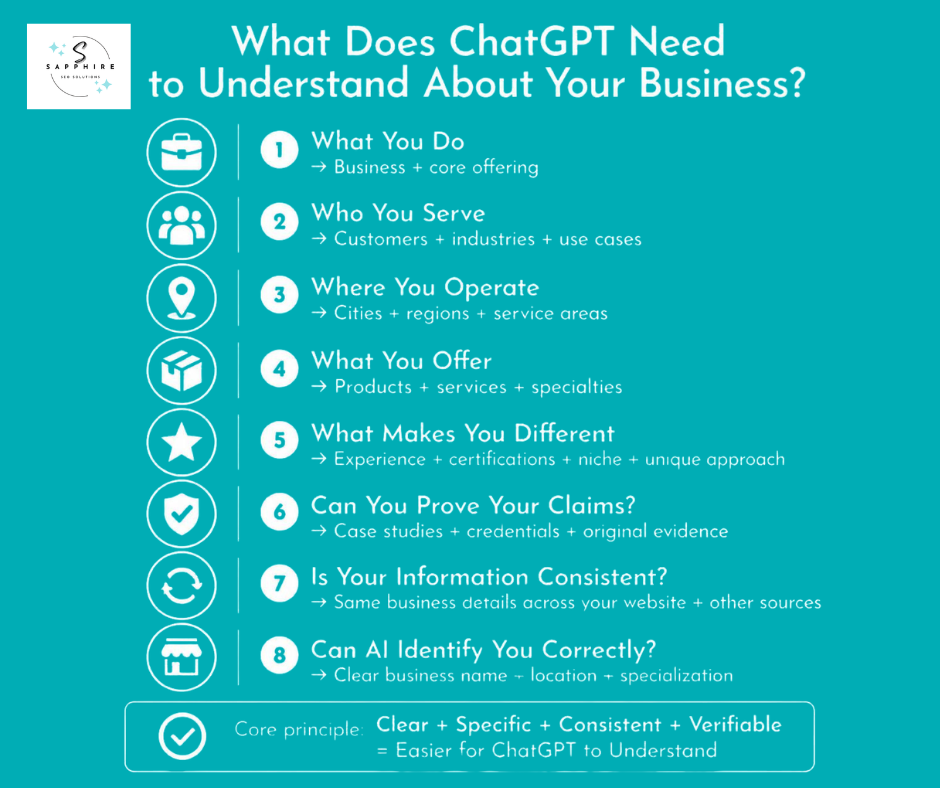
It's all about answering a set of questions clearly enough that anyone, human or machine, would get it right on the first read. Here is some information that ChatGPT needs to understand your business:
What Does Your Business Do?
This one should be obvious within seconds of landing on your site. Not implied. Not wrapped in a tagline that sounds nice but says nothing. If a visitor has to guess, so does ChatGPT.
Who Do You Serve?
Your target audience matters as much as your offering does. Are you working with homeowners or commercial property managers? Small businesses or enterprise clients? Naming the industries, customer types, or use cases you actually serve gives the system real context about who you're for, not just what you do.
Where Do You Operate?
For local and service businesses especially, this is crucial. Say your service areas outright. Don't make anyone infer your coverage from a city name in your footer.
What Products or Services Do You Offer?
Each important offering deserves enough space to stand on its own. A one-line mention buried in a list isn't the same as a page that actually explains what the service involves and who needs it.
What Makes Your Business Different?
Here's what might make your business so it's worth highlighting:
Specialties
Years of experience
Certifications
A particular service model
A niche you've carved out
This is where user intent and your actual differentiation need to line up. If someone's searching for a specific kind of expertise, this is what tells the system you have it.
Can Your Claims Be Supported?
Saying you're experienced is one thing. Backing it up with a case study, a credential, or a concrete example of the work is another. That's the kind of original data that gives your claims weight instead of leaving them as another line of marketing copy.
Is Your Information Consistent?
Your business name, services, and details should read the same way across your site, and anywhere else they appear. Contradictions create doubt, for people and for systems trying to piece together who you are.
Can Your Business Be Distinguished from Others?
This matters more than people think, especially if you share a name with other companies, operate in multiple locations, or work in a crowded market. Being clearly, specifically you, not just "a landscaping company," helps you get identified correctly instead of being confused with someone else.
How to Optimize Your Website for ChatGPT
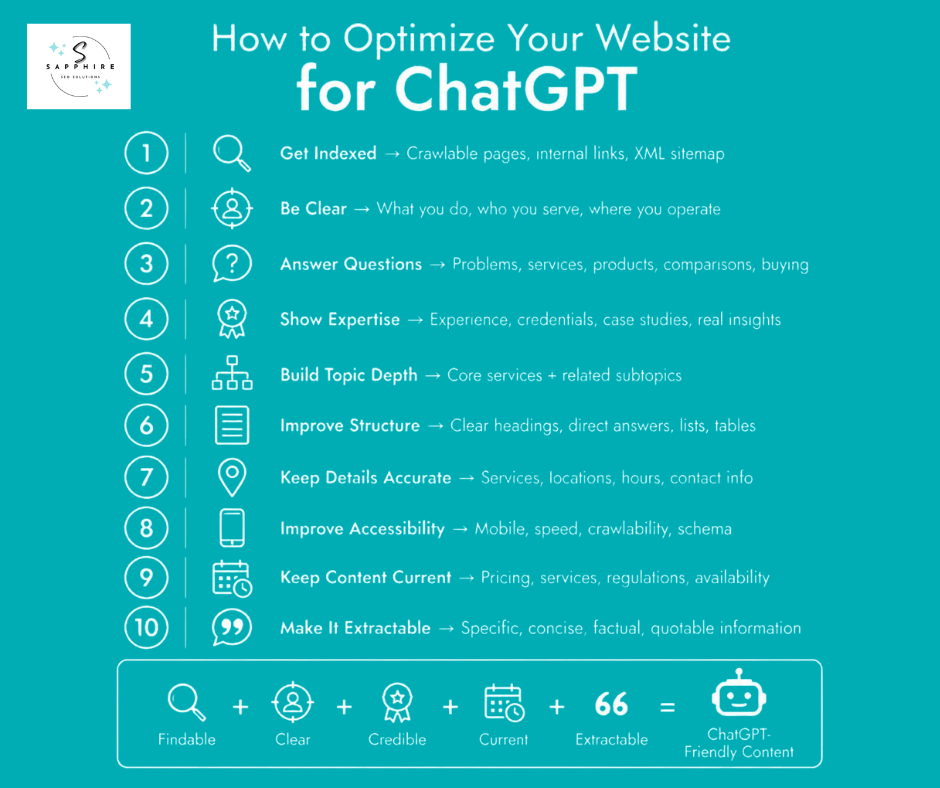
Want to optimize your website for ChatGPT? It's the same fundamentals of solid search engine optimization, applied with ChatGPT visibility in mind. Here's what to do:
1. Make Sure Search Engines Can Find and Index Your Content
ChatGPT Search retrieves information from the web, and it can only retrieve what search engines can actually find. If an important page is blocked, broken, or buried, it becomes a lot harder for it to show up anywhere, including in a ChatGPT answer.
Check the basics. Make sure your important pages can be crawled, aren't accidentally marked noindex, return working URLs instead of errors, and are linked to from somewhere else on your site. Include them in your XML sitemap. Then check whether they're actually indexed. Google Search Console can tell you if Google has indexing problems with your site, and Bing Webmaster Tools does the same for Bing. Important business information shouldn't sit entirely behind JavaScript or interactive elements that make it hard to access, either. This is technical SEO, and on its own it isn't "ChatGPT optimization." But it's the foundation everything else depends on.
2. Make Your Business and Services Clear
Say plainly what you do, who you serve, where you operate, and what you offer. Use specific, descriptive language instead of vague phrases that sound nice but explain nothing. "Family-owned plumbing company serving Austin since 2009" tells you more than "your trusted plumbing partner."
3. Create Pages That Answer Real Customer Questions
Think about what customers actually ask before they call you. For example, think about:
Problem questions
Service questions
Product questions
Comparisons
Buying questions
Answering these clearly gives both your customers and search systems a better sense of what you actually know.
4. Demonstrate First-Hand Expertise
Show your work. Real experience, named authors or experts on your team, relevant credentials, case studies, and first-hand observations all carry more weight than generic claims. If you've solved a specific kind of problem for customers before, say so, with details.
5. Build Depth Around Important Services and Topics
Pick the services that matter most to your business and build real depth around them. For a roofing company, that might look like roofing, then roof repair, then roof leak repair, then emergency roof repair, then roof leak causes, and then roof repair costs. The goal is meaningful coverage of what you're actually good at, not dozens of thin pages published just to hit a number.
6. Make Important Answers Easy to Find
Use clear headings, direct answers near the top of each section, descriptive page titles, and a logical structure. Short sections beat long unbroken blocks of text. Use tables where a comparison genuinely calls for one, and FAQs where they fit naturally. The principle is simple: make important information easy for people and search systems to find and understand.
7. Keep Business Information Accurate
Your business name, services, locations, service areas, contact information, hours, and product details should all be current and correct, everywhere they appear.
8. Improve Technical Accessibility
Keep this one simple. Crawlability, indexability, solid internal linking, mobile accessibility, reasonable page speed, and schema markup where it's genuinely useful all help make your content accessible. This is technical SEO doing its job.
9. Keep Important Content Current
Pricing, service details, locations, regulations, and availability all change. Outdated information doesn't just confuse customers; it can undercut the accuracy of anything a search system pulls from your site.
A note on content creation: using ChatGPT and other AI tools to help draft content can save time, and there's nothing wrong with that. But AI-generated content published without a human touch tends to feel thin, and it shows. Use keyword research to find genuine content ideas, not as an excuse for keyword stuffing. Good structured formatting, real bullet points, real headings, still matters more than volume. These are SEO best practices for a reason. They were true before ChatGPT, and they're still true now.
10. Make Important Information Easy to Understand and Extract
This goes a step further than just being findable. Being easy to find gets someone to the page. Being easy to understand and extract is what makes the information actually usable once they're there, whether "they" is a customer or a system reading the page on their behalf.
Use headings that describe what's actually in the section, not clever ones that require context to make sense. Answer the main question near the top of each section instead of building up to it. Keep each paragraph focused on one idea instead of drifting across three. Use lists when the information genuinely is a list, and tables when a comparison is genuinely easier to read as one. If you use a term a customer might not know, define it right there, in plain language, before moving on.
Vague statements don't hold up well here. Specific facts, real numbers, an actual process you follow, and a genuine observation from doing the work give a reader (or a system summarizing your page) something solid to grab onto. A claim shouldn't require three paragraphs of interpretation before it makes sense. If someone skimmed just the first sentence of a section, would they understand the point? That's a good test.
Here's a concept worth sitting with: make your expertise quotable. Compare these two lines:
"Our team has extensive experience helping businesses improve their online presence."
versus:
"We've helped 37 home-service businesses rebuild their service-page structure around customer search intent."
The second one says something. It's specific, it's checkable, and it's the kind of sentence that actually holds up if it gets pulled into an answer somewhere. The first one could apply to almost any company in any industry. Only use numbers and claims like this if you can actually back them up. Manufacturing a stat to sound more citable does more damage than it's worth.
Question-based headings can work well, but only where they genuinely match how customers ask things. Don't force every section into an FAQ format just because it feels safer, and don't write in a stiff, robotic way because you think it'll get picked up more easily. None of this is a guaranteed ranking trick. It's just good writing, and good writing happens to be easier for everyone, human or otherwise, to understand.
How to Build the Online Authority That ChatGPT Can Discover
Your business's online presence doesn't stop at your own website. It also lives in what other credible sources say about you, and that broader footprint matters for AI visibility too.
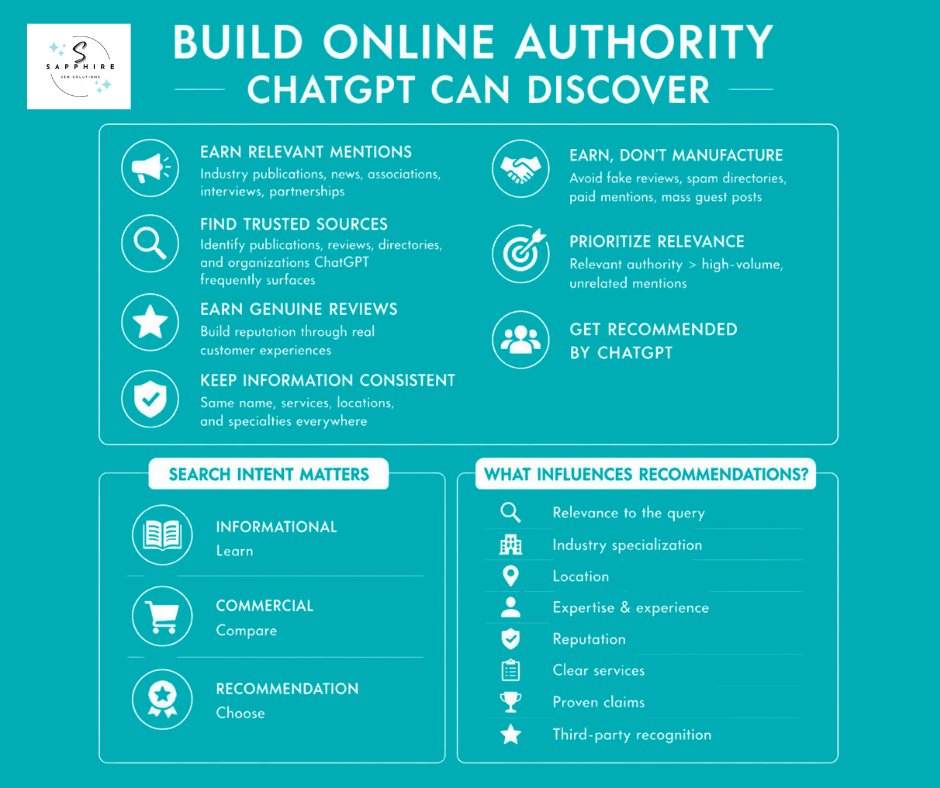
Here are some good practices that you should follow to help build online authority:
Build Relevant Third-Party Mentions
Build credibility by showing up in:
Industry publications
Local news
Professional associations
Supplier or manufacturer sites
Real partnerships
Interviews
Expert contributions
Genuine industry coverage
The goal isn't to rack up mentions wherever you can get them. Relevance and credibility matter far more than volume. A single mention in a respected trade publication does more for you than a dozen mentions on sites nobody in your industry reads.
Identify the Sources ChatGPT Already Trusts in Your Industry
Here's a practical exercise worth trying. Run the kinds of questions your customers might ask through ChatGPT and see which websites keep showing up. Ask a few variations, and patterns start to emerge. For a real map of where credible information in your space already lives, separate what you see into categories, including:
Industry publications
News sites
Review sites
Directories
Comparison sites
Specialist publications
Professional organizations
From there, look for legitimate ways to get included: a guest contribution, an interview, a supplier listing, real participation in that ecosystem. Prioritize relevance over raw domain authority. A mention without a link can still add to your broader presence, and a link from a genuinely relevant publication can help your backlink opportunities and traditional SEO at the same time.
For example, a landscaping company running this exercise might notice landscaping publications, local outlets, home-improvement sites, regional guides, industry organizations, and trusted review sites showing up again and again. That's worth investigating. Why are those sources trusted, and is there a real, earned way in?
Getting backlinks from sites ChatGPT happens to cite won't hand you a ranking. Buying links, mass guest posting, paying for mentions, spammy directories, and manipulating reviews don't build authority. They just create noise, and eventually risk.
Earn Genuine Reviews
Reviews are part of your broader reputation, built from real customer experiences. They're not a shortcut to ChatGPT visibility, and treating them as a guaranteed ranking signal misses the point of having them at all.
Learn more about the importance of reviews on local SEO by reading our guide on"The Role of Online Reviews in Local SEO Rankings."
Keep Brand Information Consistent
Your name, services, locations, specialties, and key facts should match everywhere they appear. Consistency builds trust; contradictions erode it.
Earn Recognition Rather Than Manufacture Mentions
Fake reviews, spammy directories, manufactured mentions, and mass guest-post campaigns tend to backfire. SEO experts and SEO specialists who've watched these tactics play out over the years generally agree that they damage credibility faster than they build it.
Focus on Relevant Authority
A mention from one respected, relevant source in your industry can matter more than a hundred scattered, irrelevant ones. Depth of trust beats breadth of noise.
How to Get Your Business Recommended by ChatGPT
Not every question someone types into ChatGPT wants the same thing back. Understanding the difference matters if you want to show up for the right ones.
Informational Visibility
Someone asking "what is SEO?" isn't looking for a provider yet. They want to understand a concept. If your content answers that kind of question well, you can show up here, but the person reading it isn't ready to hire anyone.
Commercial Investigation
"What SEO services does a small business need?" is a different question. The person is past the definition stage and weighing options. They're evaluating what's actually out there.
Recommendation Queries
Then there's "what are the best SEO companies for a small business?" Now the person is asking ChatGPT to help them choose. This is the highest-value moment, and the one most businesses actually care about.
What Information Helps a Business Be Evaluated?
When ChatGPT is working out who to mention for a recommendation-type question, a handful of things seem to matter, including:
How relevant you are to the actual question
Whether you specialize in the right industry
Your location
Your expertise and experience
Your reputation
How clearly your services are described
Whether your claims have evidence behind them
What third parties say about you
Whether you have differentiators that actually mean something to a customer
Explain Why Recommendations Are Contextual
Here's the thing to understand about all of this: "best" is never absolute. It depends entirely on what the person asked. A commercial roofing company might be the right recommendation for a property manager and completely wrong for a homeowner needing a small repair. Location, budget, specialty, business size, and specific requirements all shift what counts as a good fit. There's no single best business for a category. There's a best fit for a specific question, asked by a specific person, in a specific context.
The Key Principle
This is worth sitting with. The goal isn't to convince ChatGPT your business is the best. There's no pitch to make, no argument to win. The real goal is to make why you're relevant, why you're credible, why you're a good fit easy to understand. If that evidence exists and it's accessible, the recommendation can follow naturally. If you ask ChatGPT and other generative engines a version of your customer's real question, you'll get a sense of where that evidence is already working, and where it isn't. That's a better use of your time than chasing a formula that doesn't exist. Any real SEO strategy built around ChatGPT visibility should start there.
ChatGPT SEO for Local and Service Businesses
If you run a local or service business, recommendation-type questions are probably the ones that matter most to you. "Who's the best plumber near me" is exactly the kind of question this whole guide has been building toward.
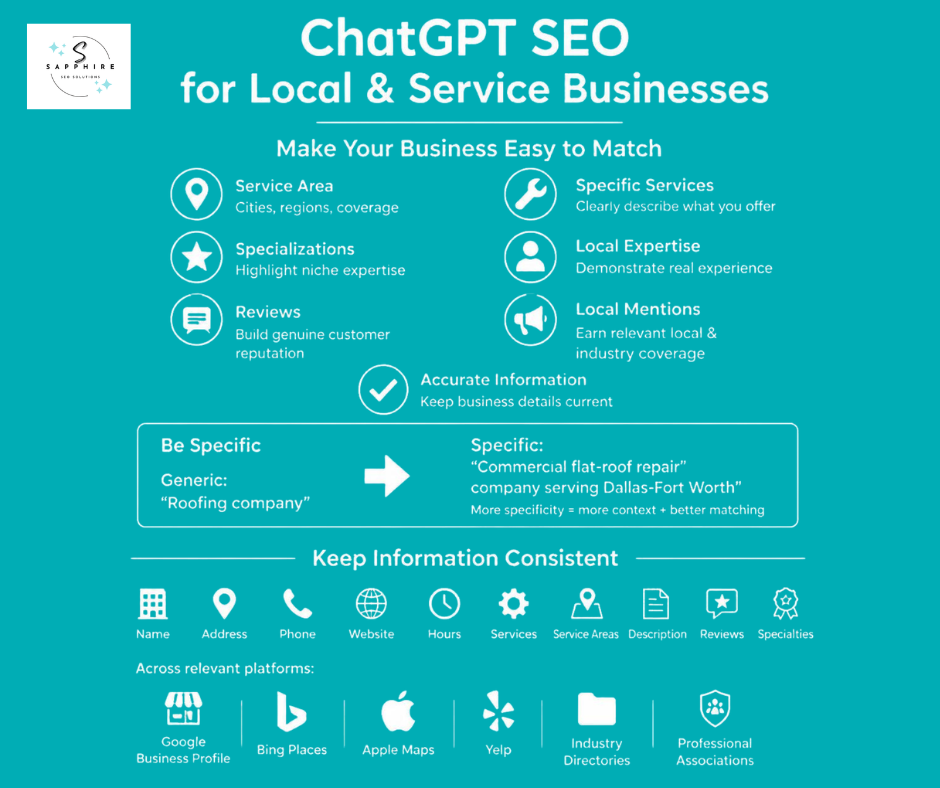
A few things make a real difference here. Make your service area obvious. Describe location-specific services clearly where it's genuinely useful. Show your local expertise instead of just claiming it. Keep your business information accurate. Build real reviews and a real reputation over time. Earn mentions from local and industry sources that actually make sense for your business. And be specific about what you specialize in.
Here's a simple example of what that specificity looks like:
Compare "roofing company" to "commercial flat-roof repair company serving Dallas-Fort Worth." The second one tells you the service, the specialization, who it's for, and where. That's considerably more context for a potential customer and for any search system trying to match you to a relevant question, including Google.
Keep Your Business Information Consistent Across Important Platforms
Your name, address, phone number, website, hours, services, service areas, description, reviews, and specialties should say the same thing everywhere they show up. Depending on your business, that might include:
Your Google Business Profile
Bing Places
Apple Maps
Yelp
Industry-specific directories
Professional associations
Other reputable local listings
None of these platforms are a ChatGPT ranking trick. They're not going to move you up a position that doesn't exist. What they are is additional places where accurate, consistent information about your business can live online, and that consistency is worth maintaining on its own merits.
What About ChatGPT Citations?
When ChatGPT answers a question using information pulled from the web, it sometimes links to where that information came from. That's a citation. In a ChatGPT Search response, it shows up as a source link underneath or alongside the answer, giving the user a way to check where a claim originated.
ChatGPT citations can genuinely help a business. They back up the answer with something concrete instead of leaving it as an unattributed claim. They give the user a direct path to your site if they want to learn more. And every so often, that path turns into an actual visit, or an inquiry.
The sources ChatGPT cites can shift from one query to the next. Ask a similar question two different ways, or ask it again a week later, and you might see different sites cited, even if your business shows up consistently in the answer itself. There's no fixed source list attached to a topic.
That's why citations shouldn't become the whole goal. Chasing a citation on every single answer is chasing something that isn't fully in your control, and it never fully will be. Citation visibility is really an outcome of being useful, relevant, and easy to understand. It's not a separate strategy sitting apart from everything else in this guide.
A business can still benefit from ChatGPT SEO even when a particular answer doesn't cite it directly. Being mentioned, understood correctly, or represented accurately still counts for something, citation or not. The better move is focusing on creating information genuinely worth retrieving and referencing in the first place. The citations tend to follow from that, not the other way around.
How to Measure ChatGPT SEO
There's no single number that tells you how visible your business is in ChatGPT. That's frustrating if you're used to rank trackers, but it doesn't mean you're flying blind. It just means measurement here looks different.
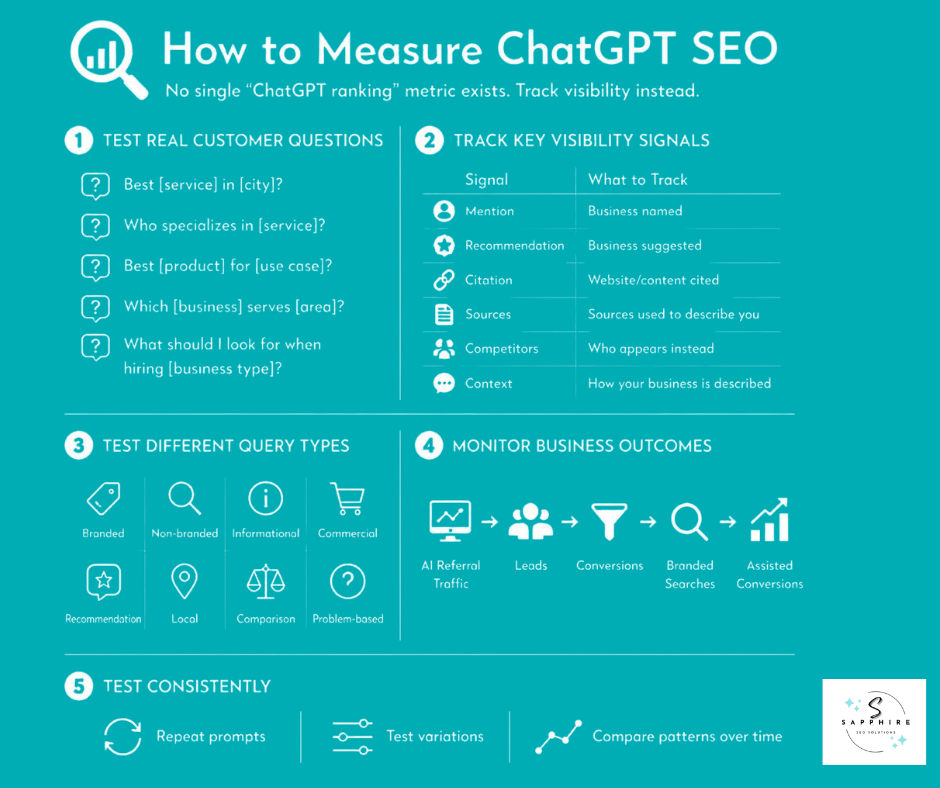
Test Real Customer Questions
Start with prompts based on how customers actually think, not generic keyword phrases. Try things like:
"Who are the best [service] companies in [city]?"
"What companies specialize in [service]?"
"What should I look for when hiring a [business type]?"
"What are the best [product] brands for [use case]?"
"Which [business type] serves [specific area]?"
Record What Happens
For each one, note:
Whether your business gets mentioned
Whether it's actively recommended
Whether your website gets cited
Also pay attention to which competitors show up, which sources get cited, what information about competitors appears that yours doesn't, and what seems to be missing about your own business.
Track Different Types of Visibility Separately
"Visibility" is several different outcomes, and they don't always move together. A business can be mentioned without being recommended, or cited without either. Track the following separately:
Mention: Is the business named in the answer at all?
Recommendation: Is the business actively put forward as a good option, not just referenced in passing?
Citation: Is the business's website or content directly cited as a source?
Source visibility: Which third-party sources is ChatGPT pulling from to describe the business?
Competitive visibility: Which competitors are showing up instead, or alongside?
Sentiment/context: How is the business actually being described? Accurately? Favorably? Is anything outdated or wrong?
A simple tracking sheet covers this well. Just a handful of columns, which could include prompt, date, mentioned, recommended, cited, competitors, sources. Don't complicate things.
It's also worth testing a real spread of query types rather than one flavor of question over and over. Branded and non-branded. Informational, commercial, and recommendation queries. Comparison questions. Local questions. Problem-based questions. Each type can surface different results, and testing only one gives you a narrow, possibly misleading picture.
A few things to keep in mind while you do this. These aren't rankings in the traditional Google sense, so resist the urge to think of them that way. There's no universal position to claim. One prompt, answered one way, doesn't tell you much on its own, and treating every small variation in an answer as meaningful data will just have you chasing noise. And more mentions showing up over time doesn't automatically translate into more leads. It's a signal worth watching, not a guarantee worth banking on.
There are many tools you can use for tracking and performance. We recommend using Semrush's AI Visibility Toolkit to automate performance tracking.
Monitor Broader Business Outcomes
Where you have the data, keep an eye on AI referral traffic, leads, conversions, branded search volume, assisted conversions, and where your referrals are actually coming from. Track your ChatGPT performance by logging query results over time.
Test Consistently
Run the same prompts more than once. Test variations. Consider different locations or customer scenarios if your business spans more than one. Look for patterns across multiple tests, not conclusions from a single response.
One important caveat: AI responses change. Different phrasings can pull different sources. A single prompt, good or bad, doesn't represent your overall visibility, and checking the same prompt daily won't tell you much more than checking it monthly would.
A Simple ChatGPT SEO Strategy for a Small Business
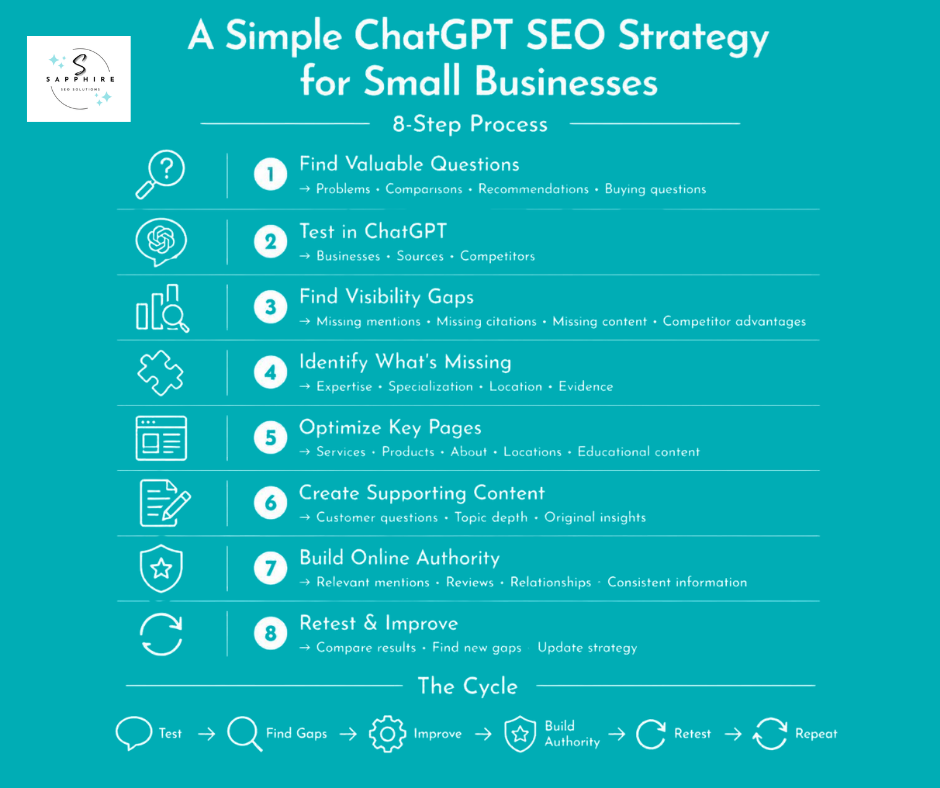
If everything above feels like a lot, here's how to actually put it into practice, step by step:
Step 1: Identify Your Most Valuable Customer Questions
Start with what real customers ask before they contact you. What problems are they trying to solve? What are they comparing? What might they ask if they were looking for a recommendation instead of just information?
Step 2: Test Those Questions in ChatGPT
Run them. See which businesses come up, which sources get used, and how competitors are described in the answers.
Step 3: Look for Visibility and Content Gaps
This is where it gets useful. Look for questions where competitors keep showing up, and you don't. Questions where competitor websites get cited, or where third-party sites get cited instead of anyone's own. Notice information competitors provide that your site simply doesn't cover. Pay attention to recommendation queries, comparison queries, and problem-solving questions relevant to what you do, especially the high-intent ones that tend to sit close to an actual buying decision.
One thing worth being clear about here: the goal isn't to build a page for every single prompt you tried. That's not a strategy; that's busywork. And not every question ChatGPT generates reflects real search demand out there. The goal is spotting genuine, meaningful gaps, not chasing every possible phrasing.
Step 4: Identify the Gaps
Ask yourself directly. Is the business mentioned at all? Is the website actually being used as a source? What do competitors communicate that we don't? Is our specialization clear? Our location? Do we have credible sources backing up our expertise?
Step 5: Improve Your Most Important Pages
Start with what matters most: core service pages, product pages, your about or expertise page, key location pages, and any high-value educational content.
Step 6: Publish Supporting Content
Answer real customer questions. Build genuine depth around your most important services. Show your expertise. Add original examples, not filler.
Step 7: Strengthen Your Broader Online Presence
Earn relevant mentions. Build real relationships in your industry. Encourage genuine reviews. Keep your business information consistent everywhere it appears.
Step 8: Retest and Improve
Go back to your real customer questions. Compare what you find against where you started. Look for new gaps. Keep adjusting based on what you actually learn, not what you assume.
None of this is a guaranteed formula, and it's not a one-time project either. It's a cycle worth revisiting every so often as your business, your competitors, and the answers themselves keep changing.
Common ChatGPT SEO Mistakes
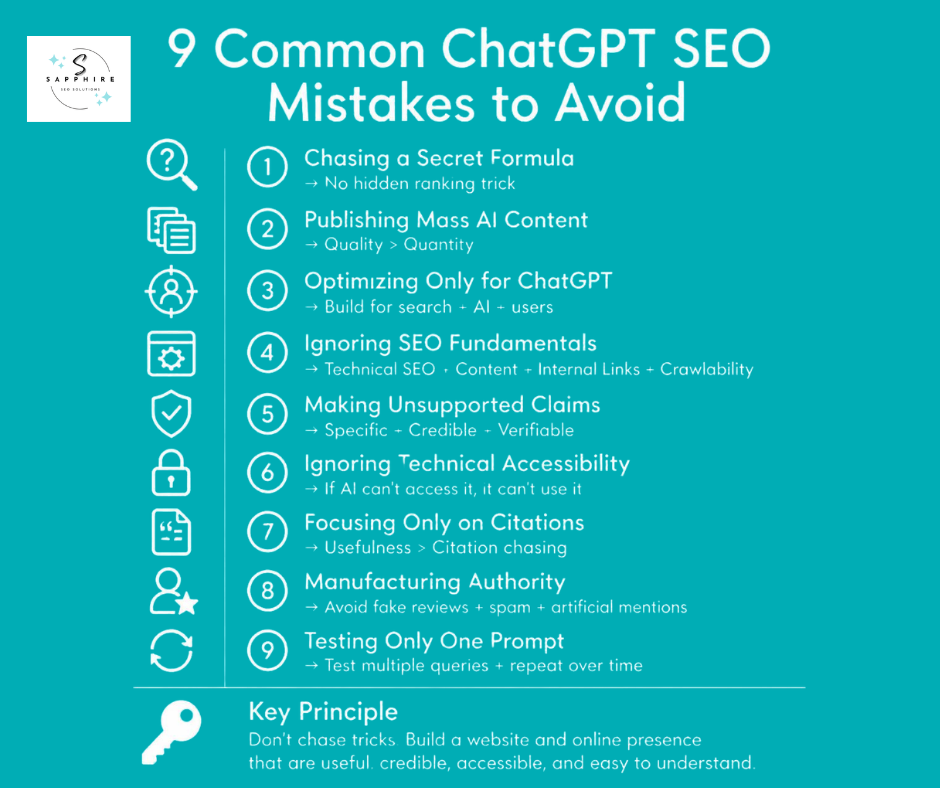
ChatGPT SEO mistakes that tend to waste the most time and effort include:
Mistake 1: Thinking There's a Secret Ranking Trick
There isn't a hidden formula businesses can find and exploit. No publicly documented algorithm to reverse-engineer. If someone's selling you one, be skeptical.
Mistake 2: Creating Huge Amounts of Generic AI Content
Publishing a hundred thin, AI-written pages doesn't create authority. It usually just creates a hundred thin pages. Quantity was never the point. Usefulness was. Check out our detailed guide on E-E-A-T to learn more about helpful content.
Mistake 3: Optimizing Only for ChatGPT
Building a strategy around one platform is risky on its own terms. Traditional search, other AI tools, and direct traffic all still matter, and most of the work that helps here helps everywhere else too.
Mistake 4: Ignoring Google SEO Fundamentals
Technical accessibility, genuinely useful content, solid internal linking, and crawlability haven't stopped mattering just because AI search exists. They're still the foundation everything else sits on.
Mistake 5: Making Unsupported Claims
Vague statements about being "the best" or "highly experienced" don't hold up without evidence behind them. Specific, credible claims carry more weight, and they're more likely to be trusted by anyone reading them, human or otherwise.
Mistake 6: Ignoring Technical Accessibility
If a search system can't discover or access your important pages, none of the content on them matters. This one's easy to overlook because it's invisible until something breaks.
Mistake 7: Focusing Only on Citations
Citations are a nice outcome, but they shouldn't be the main focus. A business chasing citations above everything else usually loses sight of the bigger picture: being genuinely useful and easy to understand.
Mistake 8: Manufacturing Authority
Fake reviews, spammy mentions, and manufactured signals tend to damage trust rather than build it. That's true whether a person or a system is evaluating the business.
Mistake 9: Testing One Prompt and Assuming That's Your Visibility
AI responses vary. One good or bad answer doesn't represent your overall visibility. Broader, repeated testing gives a far more honest picture than a single lucky (or unlucky) result.
Does ChatGPT SEO Replace Traditional SEO?
Traditional search engines still handle the bulk of how people discover businesses online, and that's not changing anytime soon. Technical SEO, content quality, site accessibility, internal linking, and earned authority all still matter exactly as much as they did before ChatGPT entered the picture. In fact, 85% of AI-cited pages also rank for at least one keyword in Google.
What's changed is the number of places worth showing up. ChatGPT SEO doesn't replace anything. It adds another search experience to the list of places businesses need to think about, alongside Google, Bing, and everywhere else people go looking for answers.
Most of the work that improves your visibility in ChatGPT also strengthens your traditional SEO. Clear content, credible information, technical accessibility- none of that is wasted effort split across two different strategies. It's mostly the same foundation, applied a little more broadly.
For a closer look at how the two disciplines actually relate, read our detailed guide on "Traditional SEO vs AI SEO: What's the Difference?"
Is ChatGPT SEO Worth It for a Small Business?
Whether ChatGPT SEO is worth it for small businesses depends on your business.
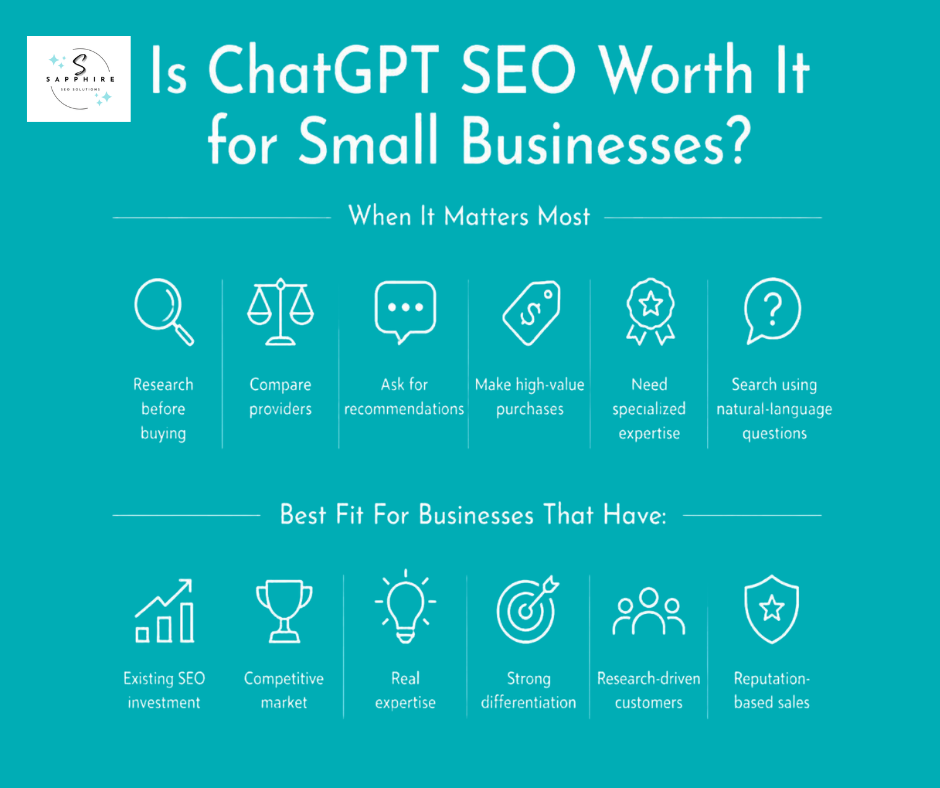
It tends to matter most where customers research before buying, compare providers, ask for recommendations, make higher-value purchases, need specialized expertise, or search the way people talk rather than typing short keywords. If any of that sounds like your customers, this is worth your attention.
It's a particularly good fit if you're already investing in SEO, if you're in a competitive service industry, if you have real expertise or differentiation worth showcasing, if your customers tend to research before ever reaching out, or if your business leans heavily on reputation and recommendations to bring in new work.
Here's the part worth remembering, though. You don't need a separate "ChatGPT SEO campaign" sitting apart from everything else you're doing. Most of the work covered in this guide, such as clear content, credible information, technical accessibility, and a consistent presence across the web, strengthens your traditional SEO, your content, your brand, and your broader visibility in AI search all at the same time. It's less a new project and more an extension of the work that was probably already worth doing.
Not every business needs to treat this as urgent. But for the ones where it fits, it's a reasonable place to put some attention, without expecting overnight results.
More Resources on AI SEO to Explore
Want to learn more about AI SEO? Check out the following guides:
How Sapphire SEO Solutions Can Help With AI Search Visibility
Everything in this guide requires constant work and commitment, and most business owners don't have the time to do it all while also running the business itself. That's where we come in.
At Sapphire SEO Solutions, we help businesses strengthen the same foundations this whole article has walked through. That means improving your AI search visibility while building on the SEO groundwork you likely already have in place. Here's how we do it:
We create useful, expert-led content instead of generic filler, and we build real topical depth around the services that matter most to your business.
We work on your site structure and internal linking, sharpen how clearly your business is understood as an actual entity online, and improve the technical accessibility that lets search systems find and use your information in the first place.
We also help strengthen your broader online authority, and we keep monitoring your visibility over time, because this isn't a one-time fix.
We don't "hack" ChatGPT because there's no hack to find. Our certified AI SEO experts help build a website and an online presence that search engines and AI-powered search systems can genuinely understand, trust, and use when your business happens to be the right answer to a customer's question.
If that's the kind of work you're looking to do, explore our AI SEO services, and we'll talk through what it looks like for your business specifically.
Need to talk to an expert? Contact us to schedule a free consultation with an experienced, certified SEO expert today, and we'll address any concerns you may have.

Frequently Asked Questions About ChatGPT SEO
What is ChatGPT SEO?
ChatGPT SEO is the process of improving your website and online presence so ChatGPT can discover, understand, and surface your business for relevant questions. It's not a ranking system. It's about being findable, accurate, and credible when it matters.
How do I get my business to appear in ChatGPT?
Make sure your site clearly explains what you do and who you serve, use content formats that answer real user queries directly, keep title tags and meta descriptions accurate, and make sure search engines can actually find your pages. ChatGPT can generate title tags and meta descriptions for improved CTR.
Can you rank #1 in ChatGPT?
Not in the traditional sense. ChatGPT doesn't return a ranked list of search results, so there's no position one to claim. The real goal is more visibility: being discoverable, understood, and considered relevant, not landing a specific spot.
Does SEO help you appear in ChatGPT?
Yes, to a meaningful degree. Much of what drives increased visibility on traditional search engines- technical accessibility, clear content, credible authority- also helps ChatGPT and other AI platforms find and understand your business correctly.
How does ChatGPT find information about businesses?
It retrieves information from the web when a question calls for it, pulling from your website and other accessible sources to answer user queries. If your information isn't publicly accessible, ChatGPT generally can't use it, no matter how good it is.
Does ChatGPT use Google search?
It's not fully settled publicly. ChatGPT Search has primarily relied on Bing, though some testing suggests parts of the system may also draw on Google's index. OpenAI hasn't confirmed the full picture, so treat this as evolving rather than settled.
Do backlinks help with ChatGPT SEO?
Relevant backlinks from credible, related sources can strengthen your broader online presence, which helps indirectly. There's no confirmed evidence they act as a specific, isolated ranking factor for ChatGPT for SEO purposes on their own.
Do reviews help with ChatGPT SEO?
Reviews contribute to your overall reputation and how your business gets described online. They're one piece of a bigger picture, not a specific lever known to move ChatGPT visibility up or down on its own.
How long does ChatGPT SEO take?
There's no guaranteed timeline. It depends on where your website and online presence already stand, how competitive your industry is, and how consistently you keep creating content, earning mentions, and refining what's already published.
Is ChatGPT SEO different from AI SEO?
Yes, in scope. AI SEO is the broader discipline covering visibility across AI-powered search generally. ChatGPT SEO is a narrower, platform-specific application of those same principles, focused specifically on how ChatGPT finds and surfaces businesses.
Should I use ChatGPT to help write content for my site?
It can help you draft faster and get keyword suggestions or an outline started. But content written entirely by AI, with no review, tends to sound generic. If you write content with ChatGPT's help, edit it until it sounds like you.