

How AI Search Chooses Businesses (Comprehensive Guide)
Someone types a question into ChatGPT or asks Google's AI mode something like "what's the best landscaping company near me?" They don't get a list of every landscaper in town. They get a handful of names.
And if your business isn't one of them, that's worth paying attention to.
This is happening more and more. Google search used to be the primary way customers found local businesses. Now they're asking AI tools similar questions and getting a direct answer instead of a page of links. That's a real shift, and it's one most businesses haven't caught up with yet.
So how does AI search choose which businesses to recommend? Why does one landscaping company get mentioned in AI recommendations while another, with a perfectly good website, gets left out?
There's no secret formula. No single trick guarantees a business appears in an AI recommendation. But there is a pattern. AI systems need to understand what a business does, then figure out whether it fits what the customer is asking for. They pull from whatever evidence is available: reviews, location details, third-party mentions, and how clearly a business describes itself.
This guide walks through how AI search chooses businesses, what information it uses, which signals can influence AI visibility, and what a business can do to become easier to find and recommend.
Key Takeaways
AI recommendations are contextual, not ranked. The same business can appear for one query and vanish for another.
There's no published AI ranking formula. Anyone claiming otherwise is guessing or selling something.
Ranking #1 on Google doesn't guarantee an AI recommendation. They're related outcomes, not the same one.
Vague service pages lose to specific ones. "Full-service landscaping" loses to "outdoor kitchen design and build."
What a business says about itself is half the evidence. Independent sources provide the other half.
No paid service guarantees an organic AI recommendation. Be skeptical of anyone promising guaranteed citations.
AI visibility isn't permanent. It shifts as reviews, competitors, and business information keep changing.
How Does AI Search Choose Which Businesses to Recommend?
Strip away the complexity, and the process is fairly simple to describe.
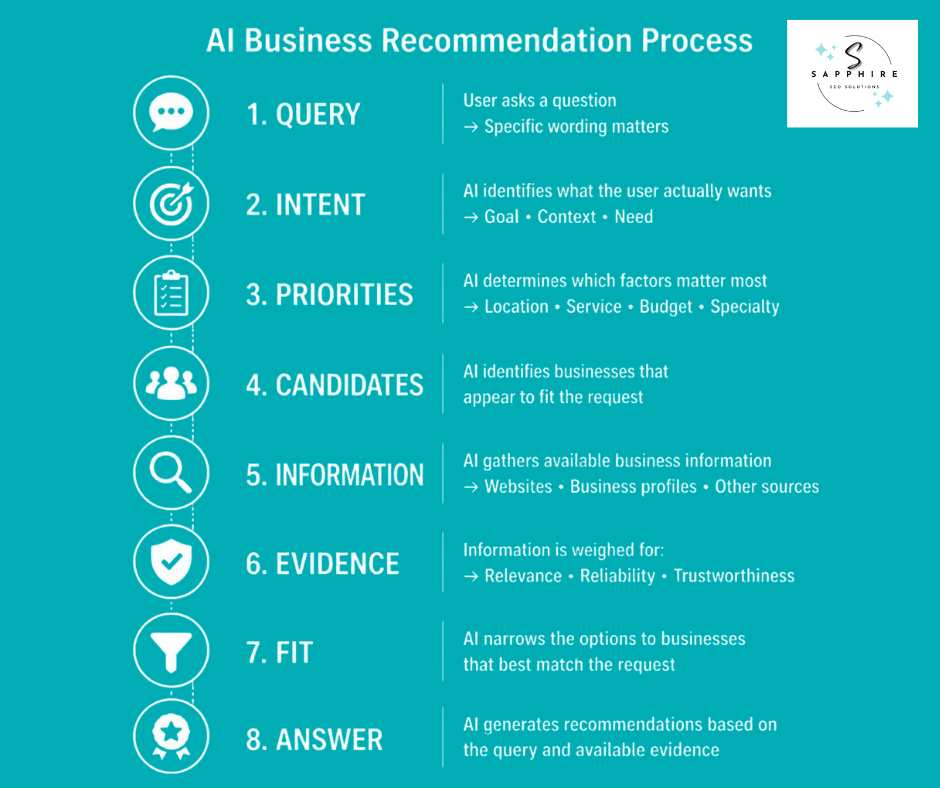
AI assistants decide who to recommend by working through a few basic questions, one after another.
What does this person actually want?
What matters most for this specific request?
Which businesses appear to fit?
And once it has a short list, which of those businesses can it back up with real information?
Here's roughly what that looks like in practice:
A user asks a question. The AI tool interprets the intent behind it, not just the words. "Best landscaper near me" and "landscaper for a small backyard renovation on a budget" aren't the same request, even though they're both about landscaping. From there, AI search engines choose which characteristics actually matter for that particular question, including:
Location
Service type
Budget
Specialty
Whatever the query implies
Once it knows what it's looking for, it identifies businesses that seem to fit, then gathers whatever information it can find about them. That's where the evaluation happens. Some of that information is more reliable than others, so the tool weighs relevance and trustworthiness before it settles on which businesses genuinely fit the request. Only then does it generate an answer.
Search tools built this way, whether it's ChatGPT, Perplexity, or Google's AI experiences, aren't running a static leaderboard. They're not producing the same ten results for every query the way a traditional search engine might. Every one of these AI tools works through the request fresh, which means the recommendation can shift depending on exactly what's being asked.
Query. Intent. Candidates. Information. Evidence. Fit. Answer.
That's the shape of it. What changes from platform to platform, and from query to query, is how each step gets filled in.
Read our guide on “How Does AI Search Work” for further information on how AI tools work.
There Is No Universal AI Ranking Formula for Businesses
No AI platform has published an official formula for how it chooses which businesses to recommend. Nobody outside these companies knows the exact systems behind them, and that includes most people who claim they do.
That's different from traditional search engines, which have spent two decades publishing guidelines, algorithm updates, and public documentation. Artificial intelligence tools haven't done the same, at least not yet.
What we do know comes from observation, not documentation. The same business can show up for one query and disappear for a similar one asked a slightly different way. A recommendation can change based on the user's location, wording, or stated preferences. Information available about a business today might be outdated or replaced by tomorrow, and a competitor's standing can shift just as easily.
So there are no secret factors to chase and no single lever with the greatest impact on whether AI tools rank businesses in a recommendation. The more useful approach is building strong, consistent evidence about what a business actually does, evidence that holds up consistently across sources, rather than hunting for a shortcut. That's likely to matter just as much in the future as it does now.
What Makes a Business Relevant to an AI Search?
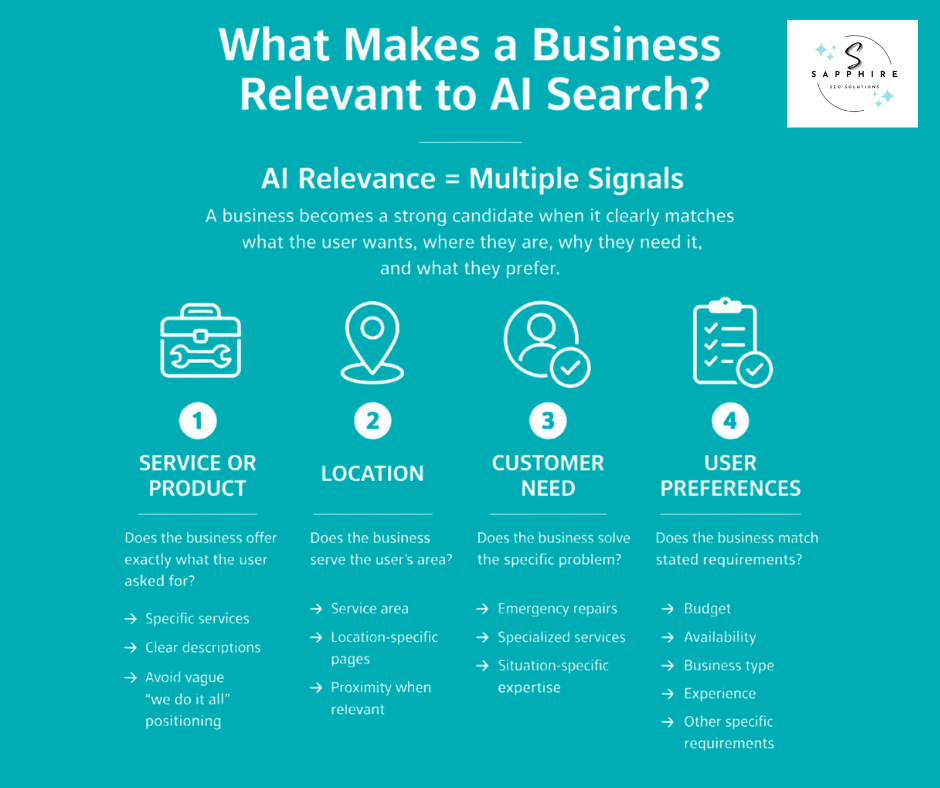
Relevance isn't one thing. It's a handful of questions an AI tool works through at once, and a business needs to answer most of them well to become a real candidate.
The Service or Product the User Wants
This one's obvious, but it's still where most businesses lose the match. Does the business actually offer what the user asked for? Not something close. Not a broader category it technically falls under. The specific thing. A business with clear, specific service descriptions has a much easier time showing up as relevant than one with a vague "we do it all" page.
The User's Location
Location matters, but not in the same way for every query. Sometimes proximity is the whole point. Sometimes a customer just needs a business that serves their area, even if it's not the closest one. Either way, a business needs location-specific pages that make it obvious where it operates and who it can actually reach.
The Customer's Specific Need
Beyond the service itself, does the business fit the situation behind it? A plumber who handles emergency repairs and a plumber who specializes in slow leak diagnostics are technically the same trade, but they solve different problems for different customers.
The User's Preferences
Users bring their own requirements into a query, and AI tools account for them. Budget. Availability. Business type. Experience level. Whatever else gets stated.
Price range
Scheduling or availability
Type of business (residential vs. commercial, for example)
Specific requirements mentioned in the request
Compare "find me a landscaper near me" with "find me a landscaper near me that specializes in large backyard outdoor kitchens." The second version is far more personal, and it changes what counts as a good answer entirely. A business built around general landscaping might be perfect for the first search and invisible for the second, simply because it never made that specialization clear.
What Information Does AI Search Need to Understand About a Business?
Before an AI tool can recommend a business, it needs to actually understand it. That sounds obvious, but a surprising number of businesses make this harder than it should be.
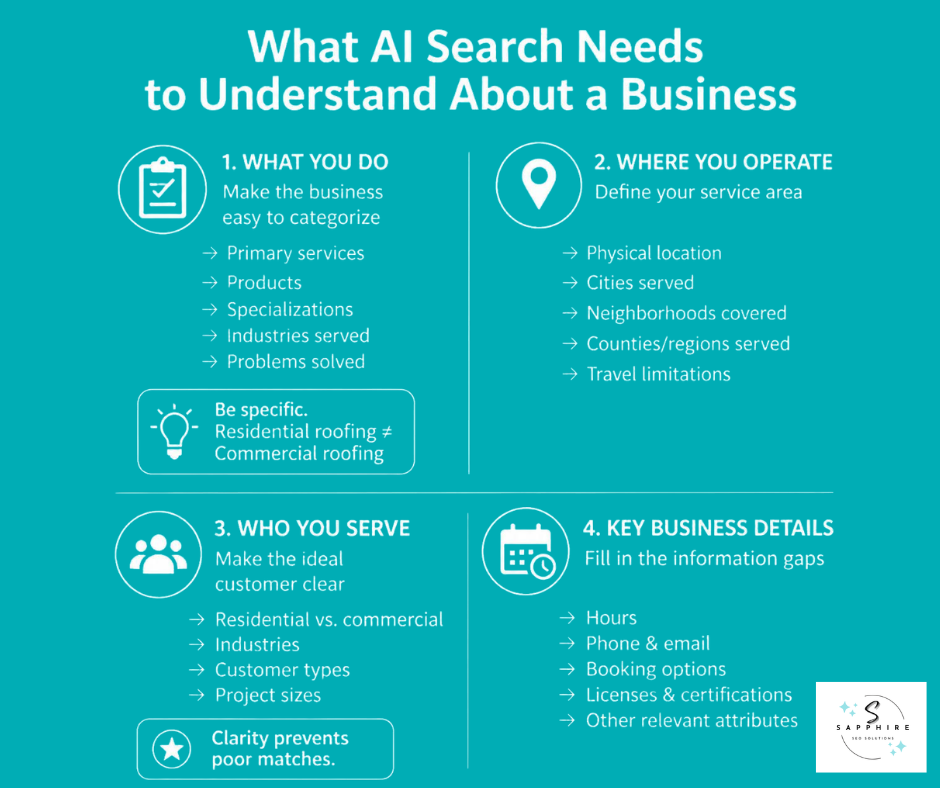
What the Business Does
This is the foundation. What the business does should be clear: primary services, products, specializations, the industries it serves, the problems it solves. A roofer who only does residential repairs and a roofer who handles large commercial installations are different businesses, even if they share a trade. If that distinction isn't spelled out somewhere, AI tools have no way to know it.
Where the Business Operates
Where the business operates matters just as much. Physical location, service areas, the specific cities and neighborhoods it actually covers, and any real limitations on how far it travels. A business that quietly serves three counties but never says so is harder to match to a customer in the second or third county over.
Who the Business Serves
Who the business serves rounds out the picture. Residential or commercial. Specific industries. Certain customer types or project sizes. A landscaper who only takes on large commercial contracts isn't a fit for a homeowner's backyard job, and being clear about that actually helps; it keeps a business from getting matched to the wrong request.
Important Business Details
Then there's everything else that fills in the gaps: hours, contact details, how someone books an appointment, credentials, and any other attributes worth knowing.
Hours of operation
Phone number, email, or contact form
Booking or scheduling options
Licenses, certifications, or credentials
None of this needs to be exhaustive. What matters is data quality. Information that's accurate, specific, and says the same thing everywhere it appears, on the website, in directory listings, wherever a business shows up online. A business's digital footprint is really just this: the sum of what's said about it, and whether all of it agrees. The clearer and more consistent that picture is today, the easier it is for AI systems to understand the business and match it to the right customer.
What Evidence Can AI Search Use When Evaluating a Business?
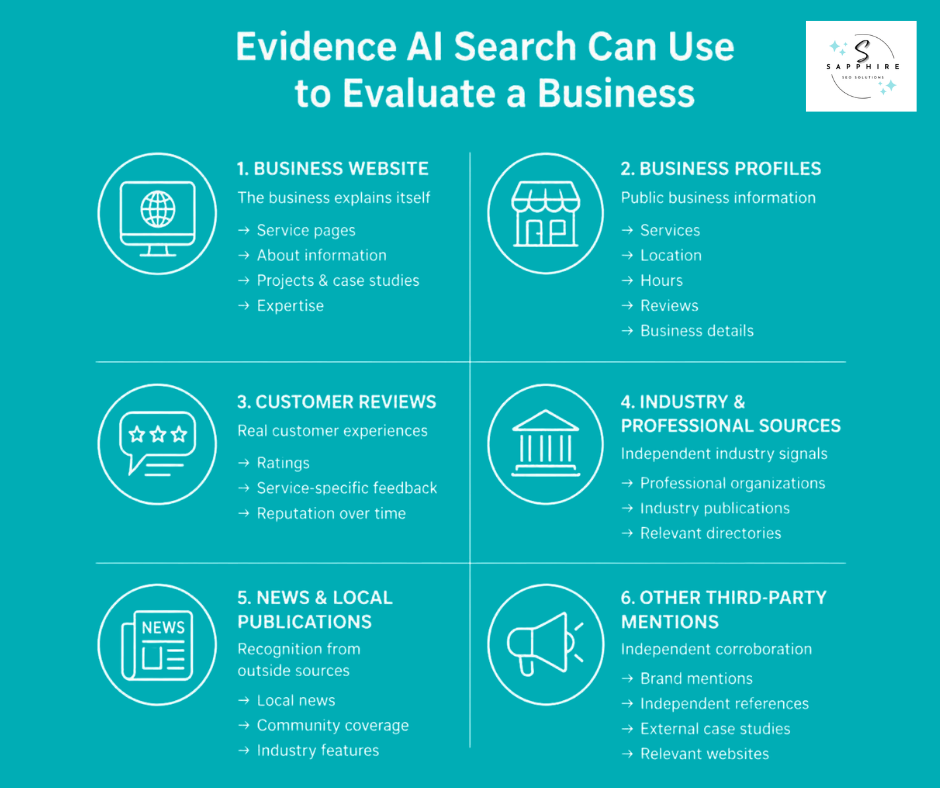
Once an AI tool has a shortlist of candidates, it needs proof. Not just a claim that a business is good at what it does, but actual evidence pulled from across the web. When evaluating a business, AI tools use the following sources:
The Business Website
The website is usually the starting point. Service pages, about information, project details, anything that shows real expertise. This is where a business gets to explain itself, in its own words, on its own terms.
Business Profiles and Local Platforms
Beyond the website, there's everything listed on trusted platforms: business profiles, service details, location, hours, reviews, and whatever else shows up publicly. These sources round out the picture the website started.
Customer Reviews
Reviews add something a website can't: actual customer experiences. Ratings, service-specific feedback, the kind of reputation that only builds up over time, one job at a time.
Industry and Professional Sources
Some evidence comes from further outside the business itself. Industry organizations, professional publications, relevant directories. These are trusted sources precisely because they're not run by the business being evaluated.
News and Local Publications
Local coverage counts too. A feature in a local paper, a mention in industry publications, or community articles- that kind of recognition. It's a signal that other people, not just the business, think it's worth talking about.
Other Relevant Third-Party Mentions
Then there's everything else: independent references, brand mentions, case studies written by someone other than the business, any relevant website that corroborates what the business claims about itself.
Here's the distinction worth holding onto. What a business says about itself is one kind of evidence. What everyone else says about it is another. Neither one is automatically trustworthy on its own, but together they build a fuller, more credible picture.
No single company relies on the exact same mix of sources, and there's no evidence that one type outweighs another in some fixed way. What matters is that the authority signals add up: a website that backs its claims, profiles that stay accurate, reviews that reflect real work, and outside sources that confirm what the business says about itself.
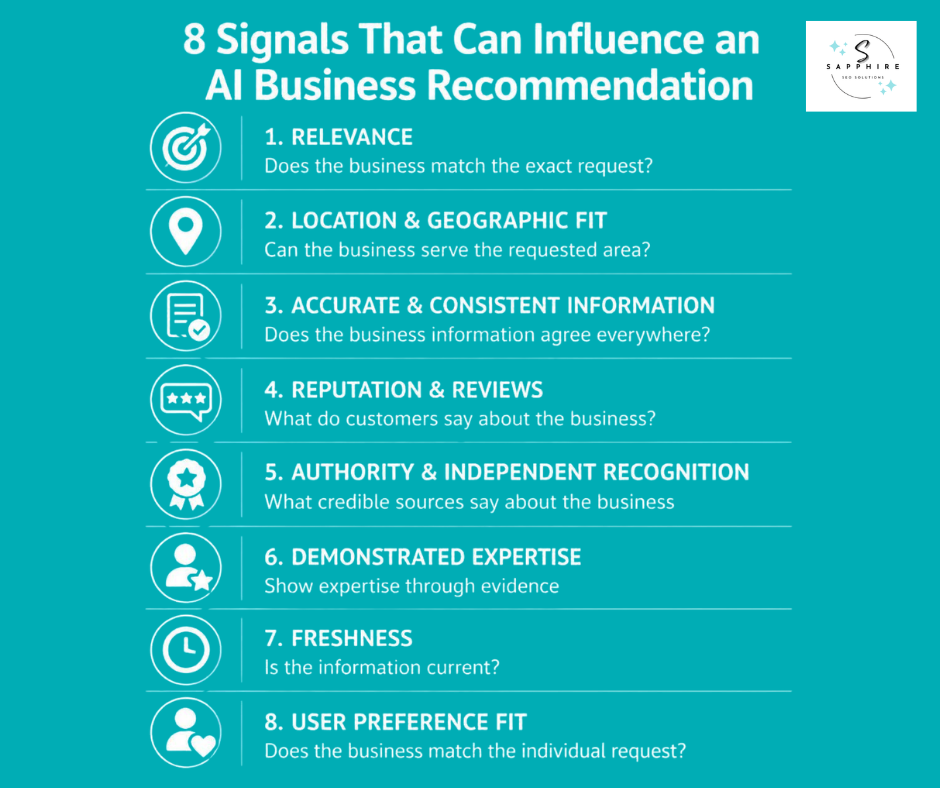
8 Signals That Can Influence an AI Business Recommendation
Pull everything covered so far into one place and a pattern starts to emerge. It's not a formula, but it is a set of criteria that AI tools seem to weigh, in one form or another, when they evaluate which businesses to recommend.
1. Relevance to the Search
This is the starting point. Does the business actually match what's being asked for? Not the general category, the specific service, the specific need, the specific version of the request. Relevance also accounts for specialization. A general contractor and a kitchen remodeling specialist might both technically qualify for "contractor near me," but only one of them is the obvious answer to "who does high-end kitchen remodels."
2. Location and Geographic Fit
Location shows up in almost every local query, whether it's stated outright or just implied. Where is the business based? What area does it actually serve? Sometimes proximity is the deciding factor. Other times, a business two towns over is still a perfectly good fit, as long as it's clear that it serves that area at all.
3. Accurate and Consistent Business Information
A business needs to be described the same way everywhere it shows up. Its name, its services, its locations, how to contact it. When that information conflicts from one source to another, it creates doubt. And doubt is exactly what keeps a business off a shortlist, even when it would otherwise be a strong fit.
4. Reputation and Customer Reviews
Reputation carries real weight here, but not just as a star rating. Volume matters. Recency matters. What the reviews actually say matters, especially when they mention the specific service someone's asking about. A four-star business with recent, detailed reviews about exactly the right kind of work can be a stronger answer than a five-star business with three reviews from four years ago.
5. Authority and Independent Recognition
Everything a business says about itself is only half the picture. The other half comes from outside sources, including:
Industry mentions
Local press coverage
Recognition from other credible sources that have nothing to gain by mentioning the business
That kind of independent confirmation adds a layer of trust that self-description alone can't provide.
6. Demonstrated Expertise
Expertise needs to be shown, not just claimed. Detailed service pages. Real project examples. Case studies that walk through actual work. Credentials, where they're relevant. "We're experts in X" is a sentence. A page full of finished projects, explained clearly, is evidence.
7. Freshness and Current Information
Outdated information causes real problems. Services that have changed, wrong hours, a location that's since closed, reviews that stopped coming in two years ago. Current information tells an AI tool that a business is actually active and actually operating the way it says it is, right now, not just at some point in the past.
8. Fit for the User's Preferences
Finally, there's the individual asking the question. Budget, availability, business type, and whatever specific requirements they bring to the query. Two customers searching for the same general service can have completely different preferences, and the businesses that fit each of them can look nothing alike. This is part of why a recommendation can shift so much from one query to the next, even when the underlying service is identical.
Why Customer Reviews Can Matter to AI Business Recommendations
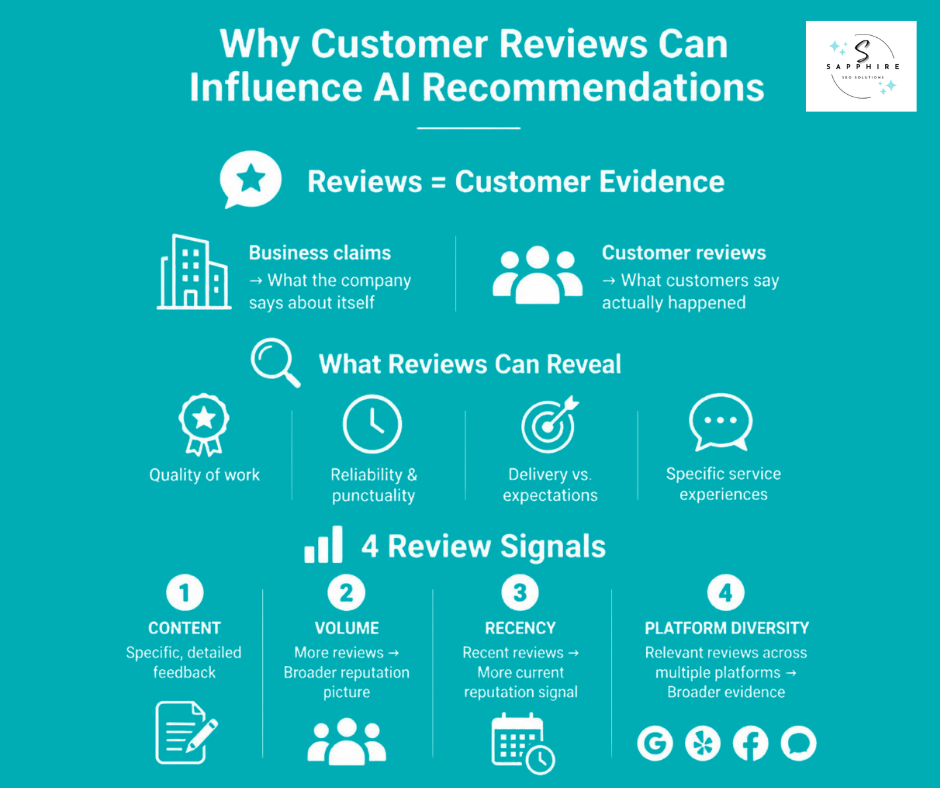
Of everything an AI tool can pull from, reviews might be the most direct. A review isn't a business describing itself. It's a customer describing what actually happened.
That's what makes them useful as evidence. The content of a review can reveal things a service page never will:
Whether a job was done well
Whether someone showed up on time
Whether the work matched what was promised
Ratings offer a broad snapshot of reputation, but the feedback underneath them is where the real detail lives, especially when it mentions the specific service someone's searching for.
Volume adds context too. A handful of reviews tells a much thinner story than a steady stream of them over time. And recency matters just as much as volume. A business with glowing reviews from three years ago and nothing since raises a different question than one with recent, detailed feedback rolling in every month. Recent reviews suggest the reputation reflects how a business operates today, not just how it used to.
Reviews spread across more than one relevant platform can round out that picture further, since no single source tells the whole story on its own.
None of this means a high rating guarantees a recommendation. It doesn't. And manufacturing reviews, or stuffing them with keywords, does more harm than good. It undermines the very thing that makes reviews valuable in the first place: that they're honest.
Why AI May Recommend One Business Instead of Another
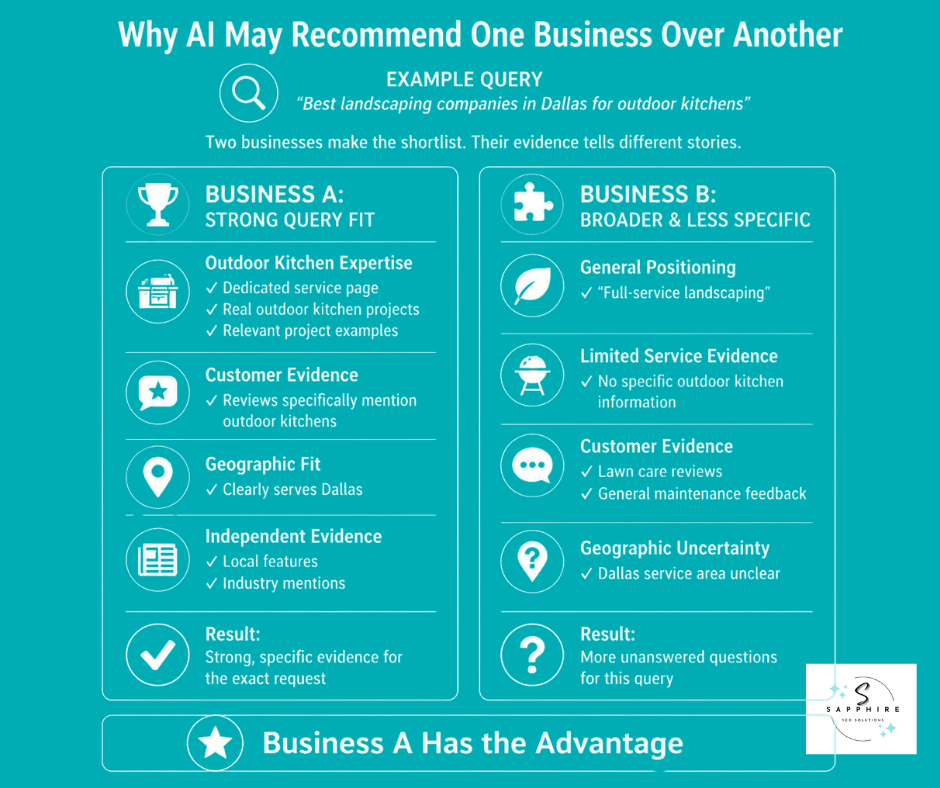
Say someone asks an AI tool, "Who are the best landscaping companies in Dallas for outdoor kitchens?" Two businesses end up on the short list. Here's how that comparison might play out.
Business A Has Stronger Evidence for the Specific Query
Business A has a dedicated page for outdoor kitchen design and build work. It shows real projects. Its reviews mention outdoor kitchens by name, not just "great landscaping." It clearly serves Dallas, and there's outside information, maybe a local feature or an industry mention, that backs up what the business says about itself.
Business B Leaves Important Questions Unanswered
Business B calls itself "full-service landscaping." Nothing on the site mentions outdoor kitchens specifically. The service descriptions are broad enough to cover almost anything. Its reviews talk about lawn care and general upkeep, not the kind of specialized build work the query was actually about. Its service area isn't clearly stated either, so it's not even obvious Business B reaches Dallas at all.
Business A Better Matches the User's Requirements
Put the two side by side, and it's not close. Business A gives a clear, specific fit for this particular request. Business B might be a perfectly good landscaping company, but for this exact query, it leaves too much unanswered.
The Recommendation Can Change With the Query
Here's the part worth remembering: none of this makes Business A the objectively better business. Ask a different question, "who's a reliable landscaper for regular lawn maintenance in Dallas," and Business B might be the stronger answer. A competitor isn't beaten because it's worse. It's beaten because, for this specific request, it offered less evidence that it was the right fit.
That's the real takeaway. The goal isn't to outrank every competitor on every possible search. It's to make sure that for the searches that actually matter to your business, the evidence clearly shows you're a strong recommendation.
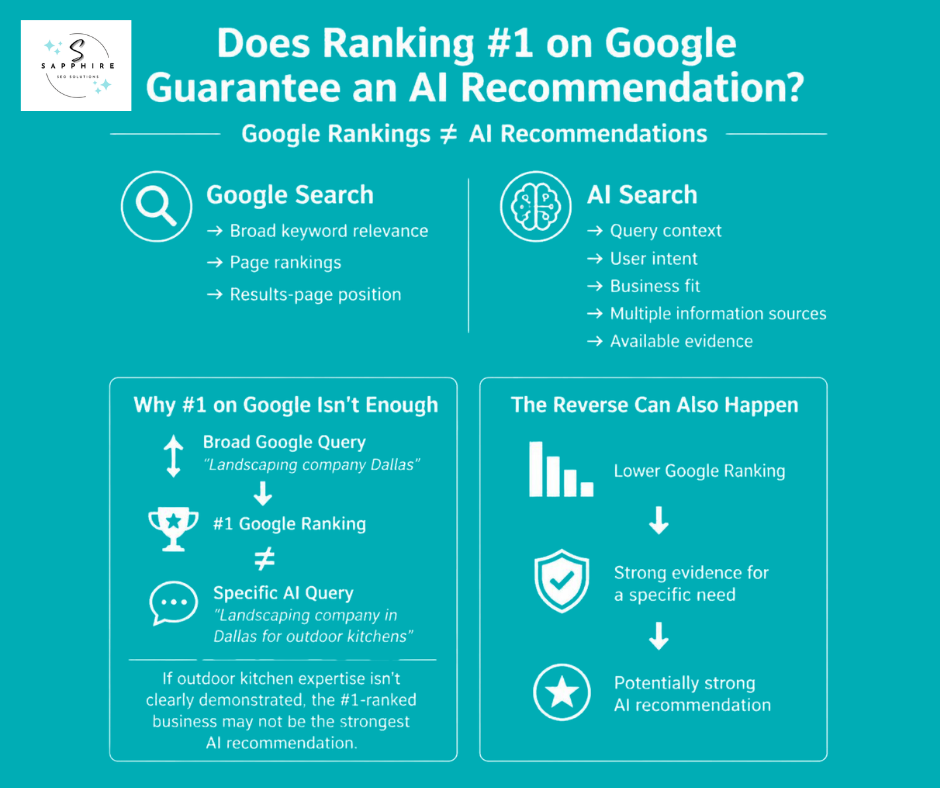
Does Ranking #1 on Google Guarantee an AI Recommendation?
No, it doesn't. Ranking first on Google and getting recommended by an AI tool are related, but they're not the same thing.
Traditional search engines rank pages against a broad keyword, and that ranking mostly stays put until something changes. AI recommendations don't work that way. They're contextual. The same business can be a great fit for one question and a poor fit for the next, even if both questions sound similar on the surface.
Part of the reason is that AI tools pull from more than one source when they put a recommendation together, not just how a page happens to rank businesses on a results page. A business can sit at the top of Google for "landscaping company Dallas" and still lack the specific detail an AI tool needs to recommend it for "landscaping company in Dallas for outdoor kitchens." The reverse is just as true. A business that's nowhere near #1 for a broad search engine query can still be exactly right for a narrow, specific one.
None of this means traditional SEO stops mattering. It just means ranking well on Google and getting recommended by AI are two different outcomes, related, but not interchangeable.
Read our detailed guide on “Traditional SEO vs AI SEO” to learn more about the differences and similarities between the two.
Why AI Business Recommendations Can Change
Getting recommended once doesn't mean it sticks. This is happening constantly, and it's worth understanding why.
Queries change; even small wording shifts can point to a different business. User preferences change too. Beyond that, the underlying evidence keeps moving. New reviews come in. A competitor's reputation shifts, up or down. New third-party mentions appear somewhere online. A business adds a service, drops another, or updates its hours and locations.
None of this happens on a fixed schedule. It's just what business today looks like: information changes, reputations evolve, and AI platforms themselves keep adjusting how they work.
That's why staying current matters more than chasing a one-time fix. A business that keeps its information accurate and consistently up to date gives itself the best shot at staying relevant, not just for this month's queries, but for whatever comes next.
How AI Search Personalizes Business Recommendations
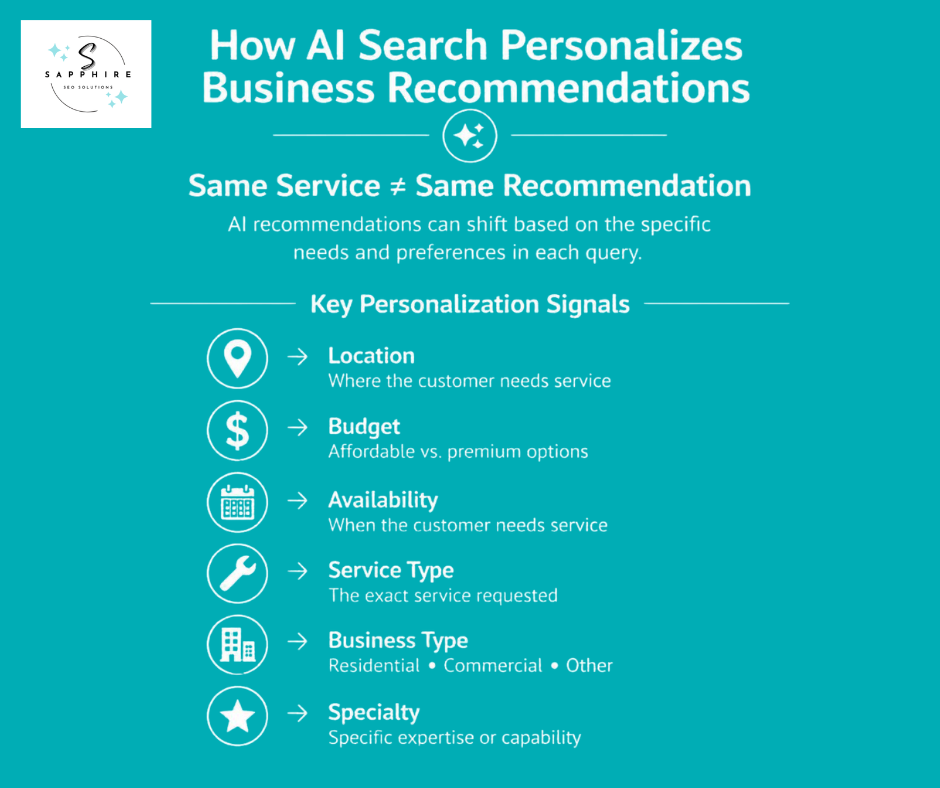
Two people can ask about the same service and end up with completely different recommendations. That's not inconsistency. It's usually just the questions being different.
Think about location, budget, availability, the specific service someone needs, business type, and whatever preferences show up in the wording. Each of those can shift what counts as the best answer.
Compare "find me a highly rated electrician near me" with "find me an affordable electrician near me who specializes in EV charger installation." Both are electrician searches. But the second one narrows things down by price and specialty, which means the businesses that qualify as a strong fit aren't necessarily the same ones.
This is why there's no fixed "best business" for a given service. What counts as personal to one query, like budget or a specific specialty, can be irrelevant to the next. A search strategy built around ranking for one broad term misses this entirely. What actually matters is being a clear, specific answer across the range of ways real customers ask.
Can You Pay to Get Your Business Recommended by AI?
Not directly, no. There's no paid service that guarantees an organic AI recommendation, and it's worth being skeptical of anyone who says otherwise.
Advertising and organic AI visibility aren't the same thing. Some platforms are exploring ad products of their own, but that's a separate lane from earning an actual recommendation inside a conversational answer. If a provider promises guaranteed ChatGPT citations or a guaranteed spot in AI results, that's a claim worth questioning closely. Nobody outside these platforms controls that outcome, and no one can honestly promise it.
What actually works is less flashy but more reliable: strengthening the real, underlying digital presence that AI systems can find and evaluate on their own. Clear service information, credible reviews, consistent details, real expertise- that's the groundwork. Legitimate solutions in this space focus on building that foundation, not on shortcuts. Any provider that skips straight to guarantees is skipping the part that actually matters.
How Can a Business Become Easier for AI Search to Understand and Recommend?
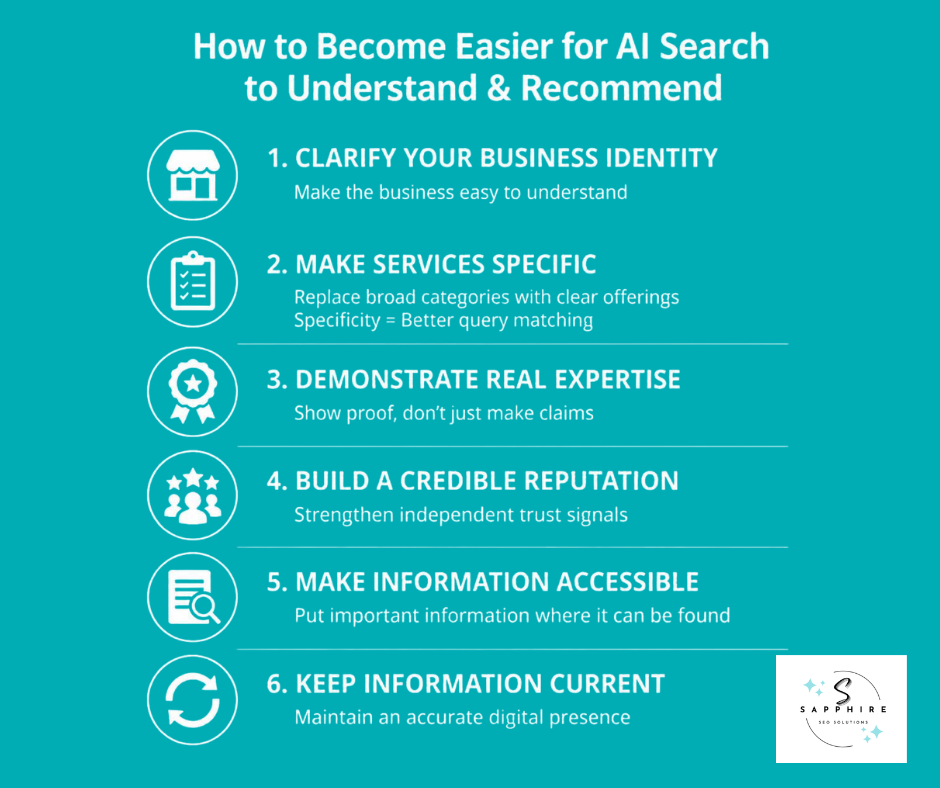
Everything covered so far points toward one idea: AI tools recommend businesses they can understand and trust. So the real question isn't how to game a system. It's how to make a business genuinely easier to understand. Here's where to focus.
Make Your Business Identity Clear
Start with the basics. Who is this business, and what does it actually do? That sounds simple, but a lot of businesses blur it with vague taglines, generic descriptions, and information that doesn't quite match from one page to the next. Say clearly who you are and what you do, and keep that story consistent everywhere it appears.
Make Your Services Specific
Vague service pages are one of the biggest gaps. Instead of "we do landscaping," explain the individual services: design, installation, maintenance, whatever applies. Call out specialized offerings by name. Explain the types of customers and projects the business actually takes on, because that specificity is exactly what lets a business match the right query instead of getting lost in a broad category.
Demonstrate Real Expertise
Claims are cheap. Evidence isn't. Show real projects. Share case studies that walk through actual work. List credentials where they're relevant. If there's useful, original knowledge worth sharing, expert content that reflects real experience, that counts too. The goal is proof, not just a claim of being the best.
Build a Credible Reputation
Genuine customer reviews matter more than any shortcut. So does recognition from outside sources, industry mentions, local coverage, anything independent that backs up what the business says about itself. Keep that information consistent across every site and platform it appears on.
Make Important Information Accessible
None of this helps if it's hard to find. A site with a clear structure, content that's easy to read, and pages that get straight to the point make it far easier for both people and AI tools to understand what a business offers. If important information is buried, hidden behind unnecessary barriers, or scattered across confusing pages, it's not doing its job.
Keep Business Information Current
Finally, keep it updated. Services, locations, hours, contact details, whether the business is even still operating the way it says it is. Outdated information creates the exact kind of doubt that keeps a business off a shortlist.
None of this is a trick. It's not a visibility strategy built on shortcuts. It's the same fundamentals that make a business easier for anyone, human or AI, to understand and trust.
How to Measure Your Business's Visibility in AI Search
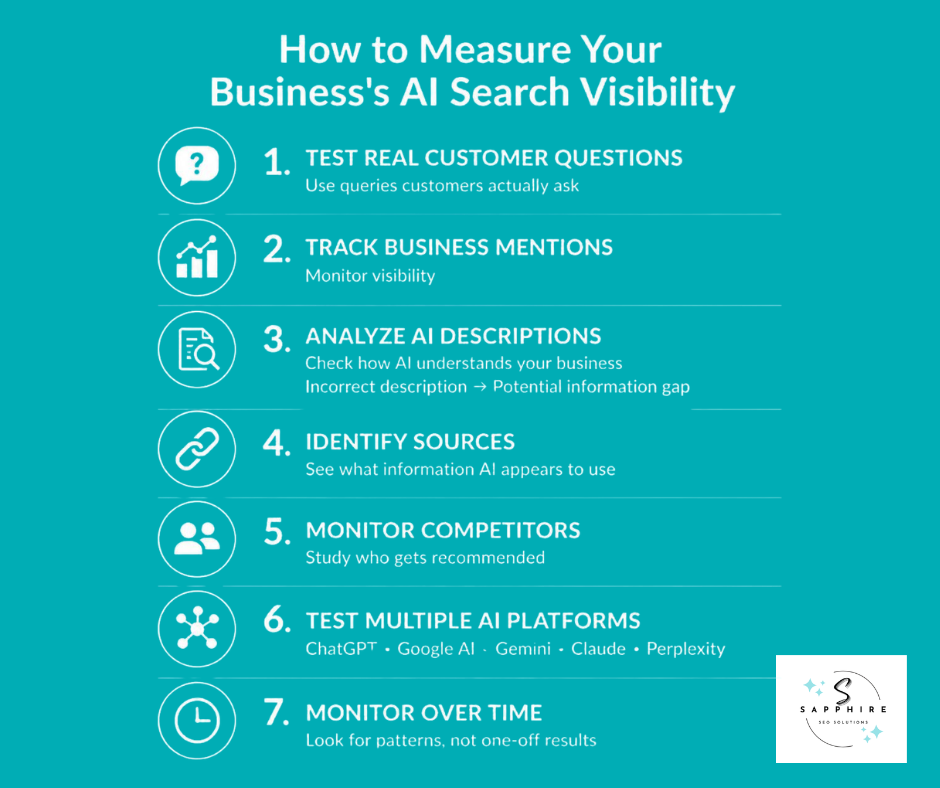
There's no single dashboard for this, but there is a practical way to measure where a business actually stands. Here's where to focus.
Test Real Customer Questions
Start with the kinds of questions real customers actually ask. "Best landscaper in Dallas." "Top-rated electrician near me." "Affordable roofer for a small repair." "Best plumber for tankless water heaters." Use the real service and city, not a placeholder.
Track Whether Your Business Is Mentioned
Notice whether the business shows up at all, how often, and where it lands in the list when position is even part of the answer.
Track How AI Describes Your Business
Pay attention to how the business gets described. Are the services accurate? Is the location right? Does it mention the right specialization, or does it sound generic? Small errors here point to gaps worth fixing.
Track Which Sources AI Uses
When possible, notice what the answer seems to draw from: the website, a business profile, reviews, a third-party mention. That's a clue about what's actually carrying weight.
Track Which Competitors Are Recommended
Just as important: who else shows up. What do those businesses have, in their information or reputation, that might explain why they made the list?
Test Across Multiple Platforms
Run the same questions across more than one of the major platforms: ChatGPT, Google's AI experiences, Gemini, Claude, Perplexity. Results can differ from one to the next, and that variation is itself useful information.
Monitor Over Time
One test proves very little. Repeat the same queries periodically, note what changes, and look for a pattern rather than drawing conclusions from a single check.
What an AI Recommendation Does Not Mean
A few quick clarifications, since it's easy to draw the wrong conclusion from any of this.
Being Recommended Doesn't Mean You Rank #1 on Google
These are related outcomes, not the same one. A recommendation doesn't confirm a top ranking, and a top ranking doesn't guarantee a recommendation.
Being Cited Doesn't Mean You're Automatically the Best Business
A mention in one AI-generated answer reflects fit for that specific query, not a permanent verdict on which business is objectively best.
More Reviews Don't Guarantee Recommendations
Volume helps build a picture, but a pile of reviews doesn't override poor relevance or missing information elsewhere.
Schema Doesn't Guarantee AI Visibility
Schema can help systems parse a page, but it's not a shortcut to visibility on its own.
AI-Generated Content Doesn't Automatically Improve Recommendations
Publishing more content, including AI-written content, doesn't inherently strengthen a business's case. Accuracy and specificity matter more than volume.
One AI Platform's Recommendation Doesn't Guarantee Another's
Showing up in one tool doesn't mean showing up in all of them. Each platform evaluates authority and evidence on its own terms.
AI Search Recommendations Are Built on Evidence
Pull back far enough, and everything in this guide comes down to six ideas. Relevance: does the business actually fit the request? Clarity: can a system understand what it does? Evidence: is there real information behind its claims? Reputation: what do customers and outside sources say? Authority: is it recognized beyond its own website? And fit: does it match what this particular customer actually needs?
None of these guarantee anything on their own. Together, though, they shape whether a business becomes a credible answer to a real question.
The goal was never to convince an AI that a business is "the best." It's to build a digital presence that gives AI systems accurate, relevant, and trustworthy evidence that the business is a good answer for the right customer, and that's a far more achievable goal than chasing a formula that doesn't exist.
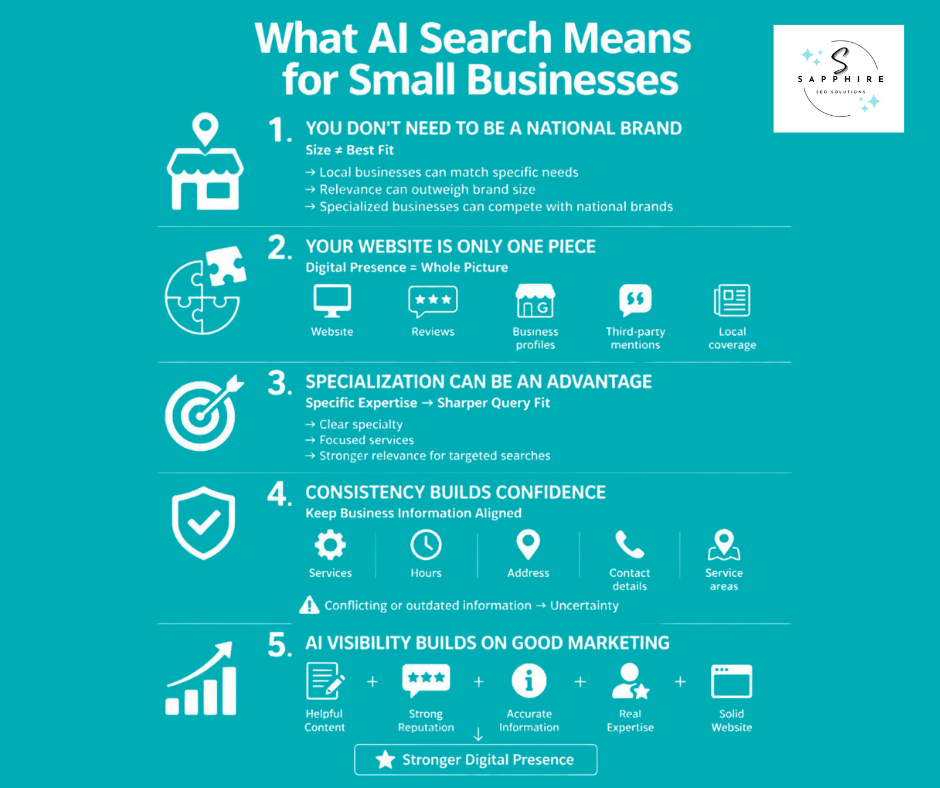
What This Means for Small Businesses
Here's what all of this means for small businesses:
You Don't Need to Be a National Brand
A small landscaping company or a local electrician can be exactly the right answer for a specific customer, even sitting next to a national brand with far more resources. Being the biggest name in the industry isn't the same as being the best fit for a particular request. Relevance is specific. Size isn't.
Your Website Is Only Part of Your Digital Presence
A website tells AI what a business says about itself. That's only half the picture. Everything else on the internet- reviews, third-party mentions, local coverage- fills in the rest. A business's digital footprint is the whole picture, not just the homepage.
Clear Specialization Can Work in Your Favor
Being known for one thing, and being clear about it, can matter more than trying to look like a full-service operation. Specific expertise gives a business a sharper edge for the exact queries it's actually well suited to answer.
Consistency Matters
Business details shouldn't contradict each other across the web. Outdated hours, an old address, a service that's no longer offered- small inconsistencies like these create doubt, and doubt is exactly what keeps a business off a shortlist.
AI Visibility Is an Extension of Good Digital Marketing
None of this requires a reinvented strategy. Helpful content, a strong reputation, accurate information, real expertise, solid website fundamentals- that's the same groundwork that's always mattered. AI search just adds another reason to get it right.
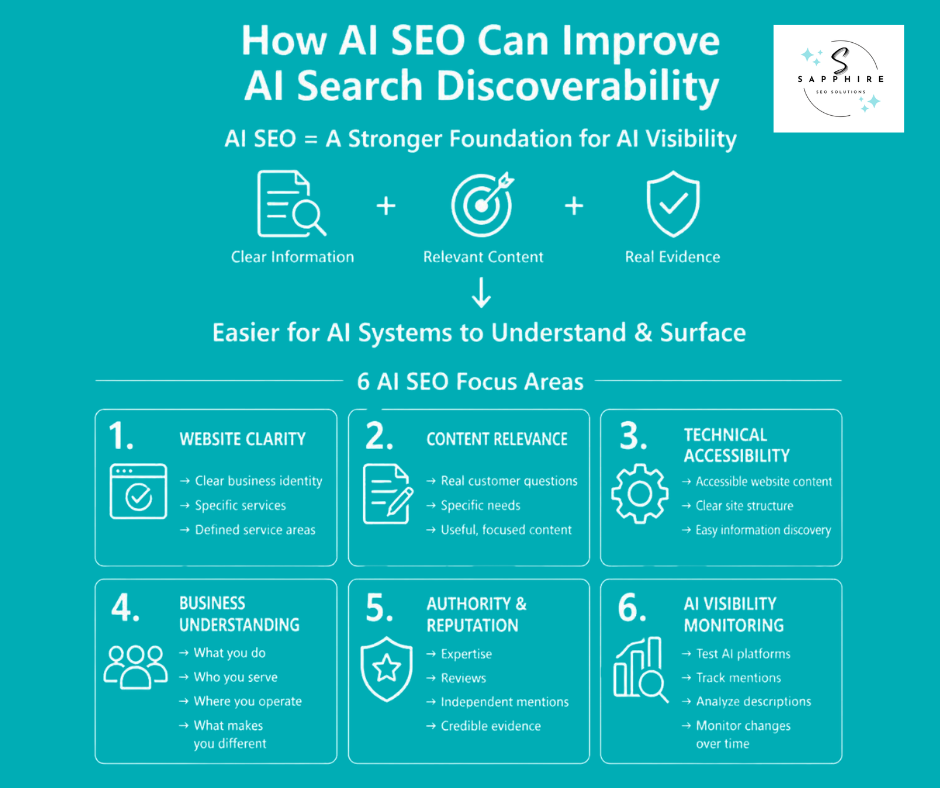
How AI SEO Can Improve a Business's AI Search Discoverability
Everything covered in this guide points toward one conclusion: businesses that are clear, well-documented, and backed by real evidence have a stronger foundation for AI recommendations. AI SEO is the practice of building that foundation deliberately.
It doesn't replace traditional SEO. It builds on it, extending the same fundamentals toward how businesses get understood and surfaced across newer search experiences, not just Google's results page. That can mean sharpening website clarity, making content more directly relevant to real customer questions, improving technical accessibility, helping systems understand exactly what a business does, strengthening brand authority, building a more credible reputation, and tracking how a business actually shows up across AI platforms over time.
None of this is about manipulating a recommendation. There's no lever for that. It's about strengthening the underlying signals and evidence that AI systems already look for, the same ones covered throughout this guide.
A solid search strategy today accounts for both. Learn more about what AI SEO is and how platform-specific approaches like ChatGPT SEO and Claude SEO fit into the broader picture.
More Resources on AI SEO to Explore
To learn more about AI SEO and how to implement it for your small business, make sure to read the following guides:
Want Your Business to Get Found in AI Search?
There's no single trick behind an AI recommendation. It comes from a strong digital presence built over time, clear information, real evidence, and a credible reputation.
That's the work Sapphire SEO Solutions does with clients every day: strengthening the fundamentals that help AI systems understand and trust a business. If you're ready to build that foundation, explore our AI SEO services to see how we can help.

Frequently Asked Questions About How AI Search Chooses Businesses
How do AI-powered search engines rank local businesses?
They don't rank local businesses the way traditional search engines rank pages. Instead, AI tools interpret what a customer is asking for, then identify businesses that appear to fit, and evaluate the evidence available about each one before generating a recommendation.
What factors influence AI search results for business listings?
Several things can play a role: how well a business matches the specific request, its location, how consistent its information is across the web, its reputation, outside recognition, and how current everything looks. No single one of these guarantees a result on its own.
What factors influence AI search engines when recommending businesses?
Much the same: relevance to the query, location fit, accurate business details, reputation, third-party authority, demonstrated expertise, and how well a business matches the customer's specific requirements. These factors work together rather than in isolation.
What criteria do AI algorithms use to recommend businesses?
There's no published, universal set of criteria shared across platforms. What tends to hold up, based on how these systems behave, is that businesses with clear, specific, well-supported information are easier to evaluate and recommend than businesses with vague or inconsistent details.
What data points do AI search algorithms prioritize when evaluating businesses?
Service and location details, business identity information, customer reviews, and independent sources like local coverage or industry mentions all appear to feed into the evaluation. How these get weighed likely varies by platform and by query.
How do customer reviews affect AI business recommendations?
Reviews offer evidence of real customer experiences. Ratings, volume, recency, and the actual content of the feedback can all matter, especially when reviews mention the specific service someone's searching for. A strong rating alone doesn't guarantee a recommendation.
Does ranking #1 on Google guarantee an AI recommendation?
No. The two are related but different outcomes. A business can rank highly on Google for a broad term and still lack the specific evidence an AI tool needs for a narrower request, and the reverse is just as possible.
How does AI search personalize business recommendations?
Two people asking about the same service can get different answers because their questions carry different requirements, budgets, locations, specific needs, and preferences. The wording of a query shapes what counts as the best fit for that particular person.
How does AI search verify whether a business is legitimate?
There's no single verification step. AI tools appear to cross-reference information across multiple sources, a business's own website, business profiles, reviews, and independent mentions, looking for consistency. Conflicting or outdated information can raise doubt about legitimacy.
Can I hire an SEO professional to improve my AI search visibility?
Yes. A professional can help strengthen the underlying evidence AI systems evaluate: website clarity, consistent business information, credible reviews, and outside recognition. No ethical provider can guarantee a specific recommendation, but strengthening these fundamentals genuinely helps companies become easier to discover.