

Traditional SEO vs AI SEO: What's the Difference?
Search isn't just about ranking pages anymore. Traditional search engines still send people to a results page full of links. But now, a growing share of searches end with an AI-generated answer instead. According to Semrush, nearly 9 in 10 queries trigger AI Overviews. That shift is what's behind the traditional SEO vs AI SEO conversation, and it's not going away.
Traditional SEO is still about earning visibility in classic search results. AI SEO takes that same goal and applies it to a different environment: AI-generated answers, chat-based tools, and conversational search. You don't have to pick one.
This guide will break down how the two differ, what they share, whether traditional SEO still matters, and how AI search's growth should shape where you focus first.
Key Takeaways
AI SEO doesn't replace traditional SEO. It extends the same foundation into AI-generated answers and conversational search.
Most businesses need both. Traditional rankings still drive traffic, while AI visibility opens a newer discovery channel.
Entity understanding and topical depth now matter as much as keywords. AI systems need context, not just exact-match phrases.
Start with your technical SEO foundation, then expand. Fix what's broken before chasing AI visibility signals.
Measurement is evolving, not settled. Track rankings and traffic alongside mentions, citations, and AI referral traffic.
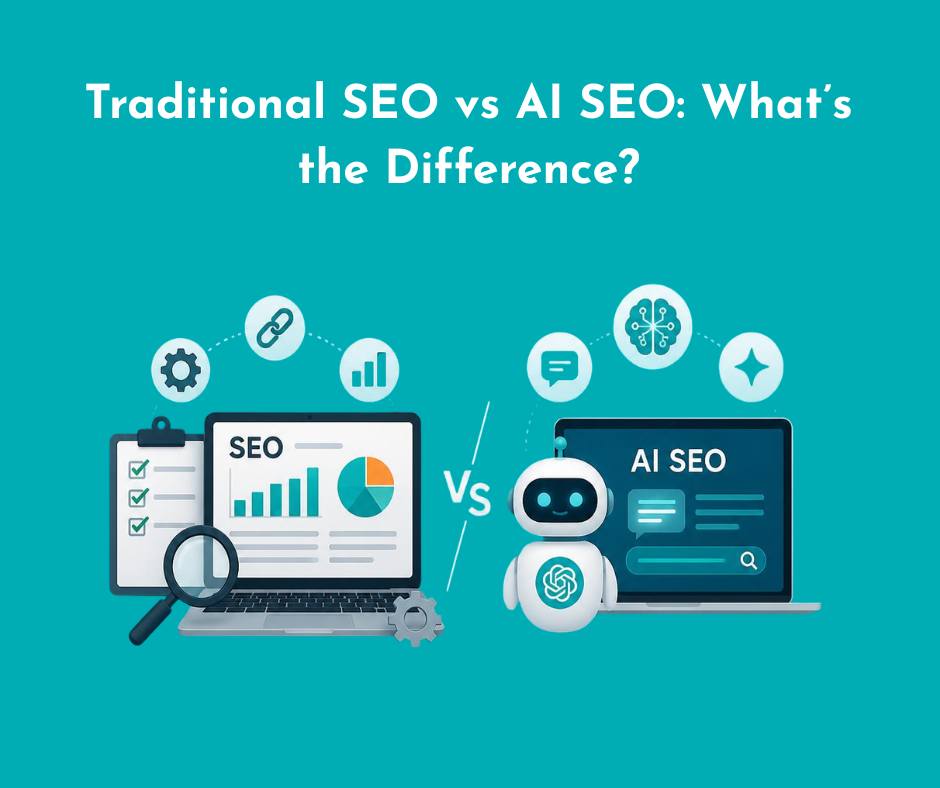
Traditional SEO vs AI SEO at a Glance
Want the short version before we get into details? Here's how traditional SEO and ai seo compare, side by side:
Traditional SEO vs AI SEO
| Factor | Traditional SEO | AI SEO |
|---|---|---|
| Primary goal | Visibility in search results on conventional search engines | Visibility in AI-powered search experiences |
| Search behavior | Keyword and query-based searches | Conversational questions and multi-step research |
| Content focus | Relevance, intent and rankings | Relevance, context, authority and answerability |
| Optimization | Pages and websites | Pages, entities, topics and broader digital presence |
| Visibility | Rankings, impressions and clicks | Mentions, citations, inclusion and referrals |
| Content structure | Search-friendly and user-friendly | Search-friendly, user-friendly and easy to interpret |
| Measurement | Rankings, traffic and conversions | AI visibility, citations, traffic and conversions |
| Relationship | Foundation | Extension of SEO |
Look at that last row for a second. It's the one that matters most.
AI SEO isn't a replacement for traditional SEO. It builds on a lot of the same principles, then adapts them for a different kind of search experience. Traditional SEO already accounts for relevance, authority, and user experience. AI search engines rely on those same signals. They just add more to the mix, like how well your content answers a real question and how clearly it explains who you are.
So this isn't two competing disciplines fighting for your budget. It's one goal, which is online visibility playing out across more places than it used to. The key differences are really about where and how that visibility shows up.
What Is Traditional SEO?
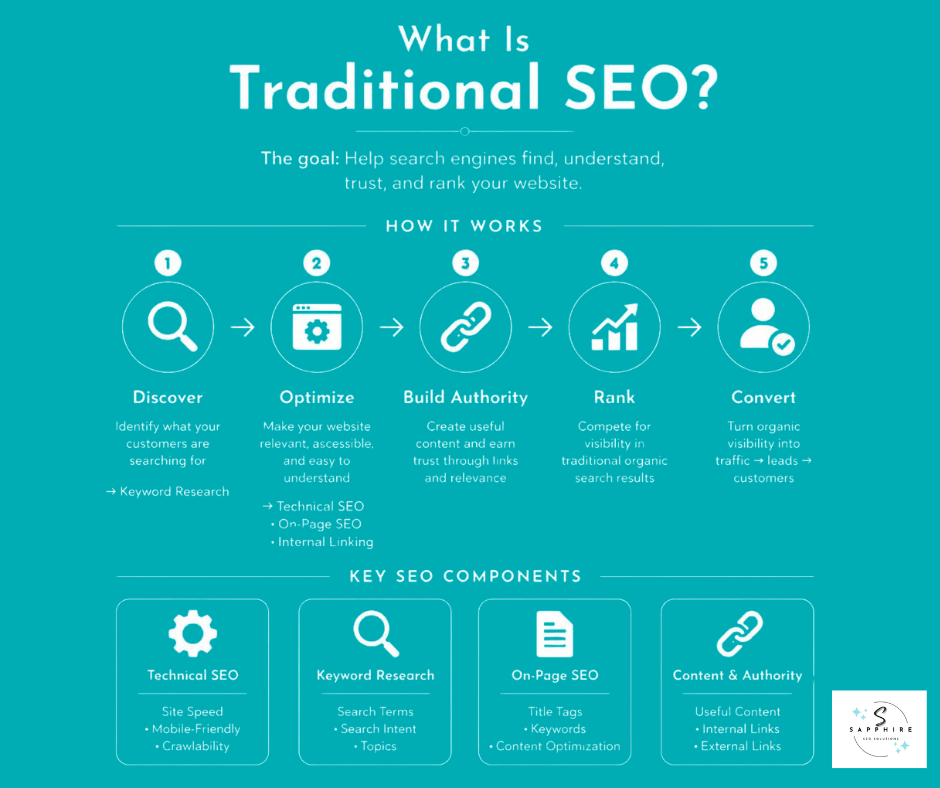
Traditional search engine optimization (SEO) is the practice of helping search engines understand your website, so they know when to show it to someone searching for what you offer. It helps Google find your site, understand it, and trust it enough to rank it.
Here's roughly how it works:
Search engines send out crawlers that scan websites and add their pages to an index, kind of like a massive library card catalog.
When someone runs a search, search engine algorithms sort through that index and decide which pages deserve a spot on the search engine results pages.
Rank high enough, and you show up in the blue links people actually click.
Traditional SEO focuses on a handful of connected pieces. There's technical SEO, things like site speed, mobile-friendliness, and making sure your site is easy to crawl. There's manual keyword research, where you figure out what your customers are actually typing into Google. There's on-page optimization (on-page SEO), including title tags, keyword placement, and using relevant keywords in a way that reads naturally. And there's internal linking, content quality, and building authority over time.
But here's the thing: Google rankings were never really the goal. The real goal is organic traffic that turns into leads and, eventually, sales. A page ranked at the top of Google that nobody clicks, or that doesn't convert, isn't doing its job.
How Traditional SEO Works
The process usually looks like this:
Figure out what potential customers are searching for.
Build pages that genuinely answer those searches.
Make sure search engines can access and understand those pages (this is where Google Search Console comes in handy for tracking how it's going).
Show relevance and authority through content and links.
Earn a spot in traditional organic search results.
Convert that visibility into calls, quotes, and customers.
That full sequence, start to finish, is what traditional SEO work actually looks like. And tracking traditional SEO metrics like rankings, traffic, and conversions tells you whether it's working.
What Is AI SEO?
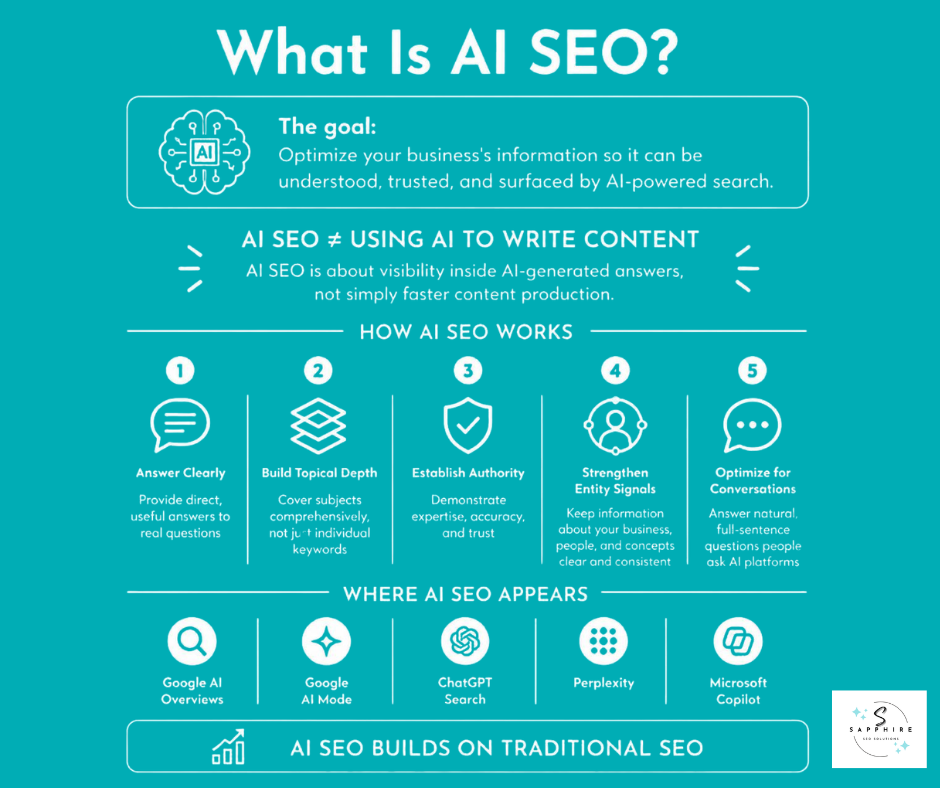
Let's clear something up first. AI SEO doesn't mean using AI tools to crank out blog posts faster. It means optimizing your business's information and content so it shows up inside AI-powered search experiences. Two very different things.
AI systems don't just list links anymore. They read through multiple sources, then generate a direct response to what someone asked. Whether that's Google's AI Overviews sitting above the regular results, ChatGPT search, Perplexity, Microsoft Copilot, or Google's AI Mode, the pattern is the same: an AI engine pulls together information and hands the user an answer instead of a list of pages to click through.
Because of that, AI SEO focuses on a slightly different set of priorities than traditional SEO alone. Clear, direct answers matter more. So does topical context, meaning your content needs to cover a subject fully, not just hit a keyword.
AI models also seem to weigh entities (the specific people, businesses, and concepts involved), demonstrable expertise, and whether your information stays factually consistent across the web. And since people often ask AI platforms questions in full sentences, writing that answers real conversational questions tends to perform better than writing built around short keyword phrases.
None of this happens in isolation from traditional SEO, though. A lot of what makes content useful to AI crawlers and shows up well in AI-generated answers is the same stuff that's made content useful to search engines for years: clarity, accuracy, and real authority. Some people call this Generative Engine Optimization or Answer Engine Optimization. Different name, same general idea.
One thing worth being straight about: nobody outside these companies knows the exact mechanics behind how AI responses get generated or which sources get pulled in. Anyone claiming they've cracked the formula for guaranteed inclusion in AI-generated responses is guessing.
To learn more about AI SEO, make sure to read our comprehensive guide on "What Is AI SEO?"
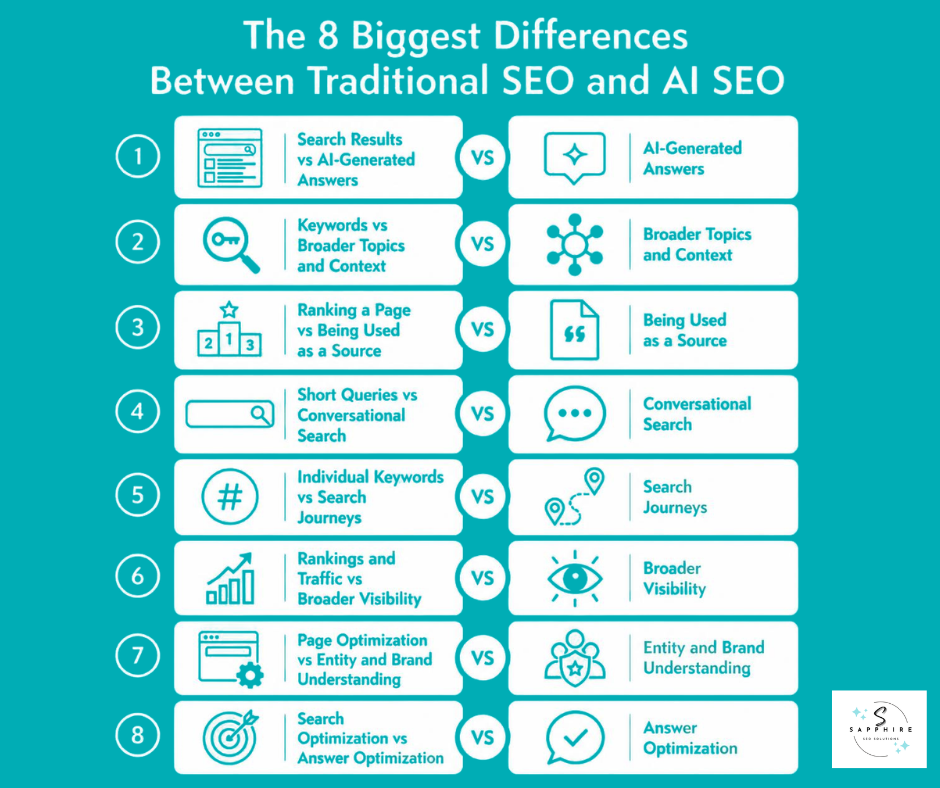
The 8 Biggest Differences Between Traditional SEO and AI SEO
Here's where the two approaches actually pull apart:
1. Search Results vs AI-Generated Answers
Traditional SEO wants one thing above all: a spot on the results page. Click, visit, convert. That's the model.
AI search works differently. Instead of handing someone a list of links, it can pull information together and generate a direct answer right there on the page. Someone can get what they need without clicking through to a single website. That doesn't mean Google is going away, and it doesn't mean every AI answer skips citations or that websites suddenly stop getting traffic. Plenty of AI answers link back to sources, and plenty of searches still land on a traditional results page. But it does mean AI visibility signals, being the source an AI system pulls from, matter in a way they simply didn't five years ago.
2. Keywords vs Broader Topics and Context
For years, SEO ran heavily on keywords. Find the phrase people search, work it into your page, watch your rankings climb.
That's already changed some, even within traditional SEO. Search engines got better at understanding intent, not just matching words. AI search leans into that even further. Because these systems are trying to understand a topic well enough to explain it, context carries real weight, arguably more than any single phrase does. That doesn't mean keywords stopped mattering or that AI systems ignore them entirely. It means the winning move isn't repeating "roof replacement cost" fifteen times. It's covering the topic completely, including the related questions and concepts someone would actually want answered.
3. Ranking a Page vs Being Used as a Source
Traditional SEO asks a pretty simple question: can this page earn a position in the results? AI search asks something slightly different: can this information be pulled into an answer?
That's a real distinction. A business can show up as a cited source, generate brand mentions, or get referenced in an AI mentions context, all separate from where its pages happen to rank. Worth being careful here, though. Ranking first doesn't guarantee a citation. No specific schema markup guarantees one either. Nobody outside these AI companies has confirmed one fixed formula for how sources get selected. What tends to help is the same thing that's always helped: genuine content quality, clear organization, and topics grouped in a way that shows real depth (keyword clustering plays a role here too, organizing related terms so your content covers a subject fully instead of piecemeal).
4. Short Queries vs Conversational Search
Old habit-typing three or four words into Google and scanning the results-that's still common. But AI search makes it a lot more natural to just ask the full question, then follow up with another one.
That shift matters for how you think about search intent. It's not that Google searches were never conversational. Some always have been. It's that AI interfaces make longer, more specific questions the default, and businesses need to understand the actual questions their customers ask, not just the shorthand version. That doesn't mean turning every page into a Q&A format or bolting on an FAQ section just to catch AI traffic. It means writing content that answers the real question directly, with enough surrounding context to actually be useful, which happens to serve user intent either way.
5. Individual Keywords vs Search Journeys
A customer almost never has just one question.
Someone dealing with a damaged roof might ask, "Do I need a new roof?" Then, "How much does a roof replacement cost?" Then, "Which roofing material is best?" Followed by, "How long does installation take?" And eventually, "Which roofing company should I hire?" That's not one search. That's a whole research process, and AI search is well suited to supporting exactly that kind of back-and-forth.
For a business, this opens up a real opportunity. Building content around that entire journey, not just the final "hire a roofer" keyword, creates more chances to show up both in traditional rankings and in AI-generated answers. This is part of what's driving AI search's growth in the first place. It's not about replacing SEO. It's about search stretching to cover more of the decision.
6. Rankings and Traffic vs Broader Visibility
Traditional SEO has well-established ways to measure success that are clean, familiar, and easy to report on. They include:
Rankings
Impressions
Clicks
Organic traffic
Conversions
AI SEO adds new layers on top of that. They include:
Mentions across AI platforms
Citations
Brand visibility
Referral traffic coming from AI tools
Worth saying plainly: measurement here is still evolving. There's no single, universally agreed-upon traditional SEO metrics equivalent for AI visibility yet, and a mention in an AI answer doesn't automatically translate into revenue. But tracking things like branded search volume over time can at least hint at whether AI exposure is building awareness.
7. Page Optimization vs Entity and Brand Understanding
Traditional SEO tends to zero in on individual pages. Optimize this page for this keyword, earn this page a ranking.
AI systems need something broader. They need to:
Understand what your business actually is
What your business does
How your business relates to other entities, people, and concepts in your industry
Keeping your business information consistent across your website, directories, and profiles helps build that picture. So does clear author information and evidence backing up what you claim. This is where E-E-A-T (experience, expertise, authoritativeness, and trustworthiness) becomes especially relevant, along with basics like structured data and local SEO signals that help establish who and where you are. None of that means a business can somehow "train" Google's AI, and entity optimization isn't some separate magic technique. It's an extension of building a credible, well-documented presence.
8. Search Optimization vs Answer Optimization
Traditional SEO asks: how do I make this page competitive for this search? AI-oriented optimization asks something in addition to that: can this information be understood clearly enough to get incorporated into an answer accurately?
In practice, that means structure matters more than ever. Here's what that translates to:
Clear headings
Direct answers stated plainly with supporting explanation right after
Factual accuracy
Logical organization that a reader or a system can follow without getting lost.
There's no secret "AI-readable format" that guarantees results, and stuffing a page with bullet points and FAQs purely to please a machine tends to backfire; it reads robotic, and readers notice. The honest version of this idea is simpler: AI SEO builds on writing that's genuinely well organized, which was always good practice for AI visibility and for human readers alike.
What Traditional SEO and AI SEO Have in Common
With all those differences laid out, it's worth stepping back. Traditional SEO and AI search overlap a lot more than they diverge.
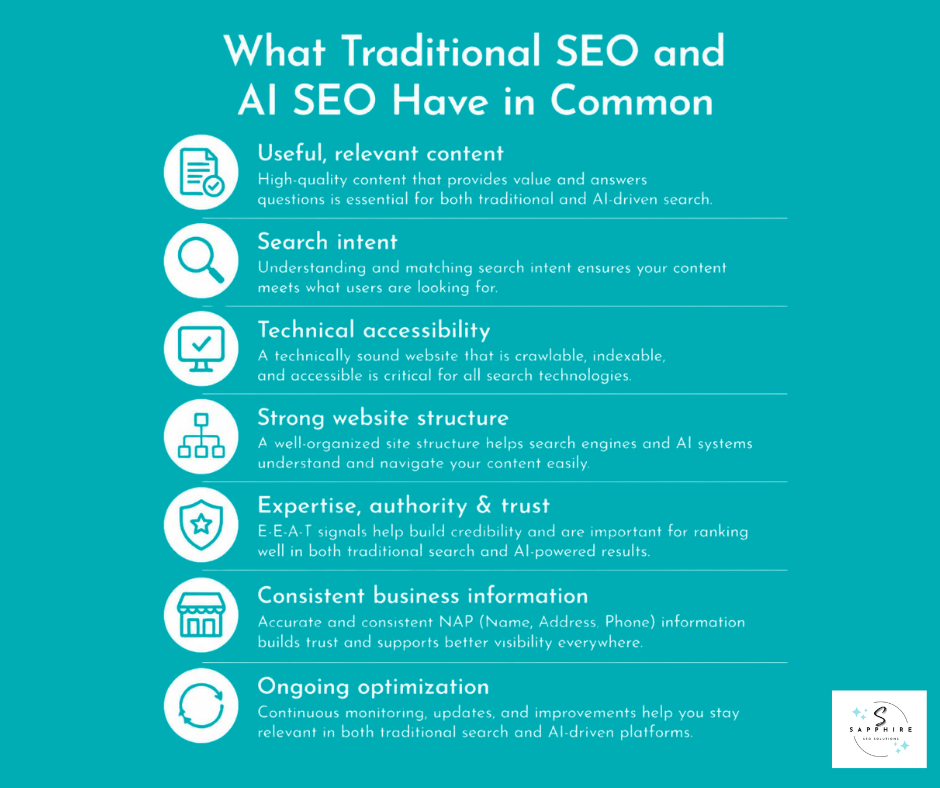
Both depend on useful information.
Both care about search intent, meaning content that actually matches what someone's trying to accomplish, not just what they typed.
Both need technical accessibility, a website that's fast, functional, and easy for search systems to read.
Both rely on strong website architecture and clear, well-organized information.
Expertise, authority, and trust matter to both. So does genuine user experience, consistent business information across the web, real content quality, and ongoing optimization instead of a one-time fix.
In other words, this isn't two separate philosophies competing for attention. It's mostly the same foundation, just extended.
AI SEO Builds on Traditional SEO
Traditional SEO lays the foundation: technical accessibility, relevant content, search intent, authority, strong website structure, and a genuinely helpful user experience. Without that groundwork, nothing built on top of it holds up.
AI search adds a layer on top of that foundation, not a replacement for it. That layer includes:
Writing that handles conversational questions
Deeper topical context instead of narrow keyword targeting
Clearer entity understanding (who you are, what you do, how you relate to your industry)
Content built to actually answer a question well
A broader way of measuring visibility that goes beyond rankings alone
That's really the whole idea. AI SEO isn't traditional SEO with a few AI tools bolted on, and it isn't some separate discipline built from scratch. It's what happens when a solid SEO strategy gets extended to cover how people search today, including inside AI platforms.
For a business, that's good news. It means SEO success built the right way, with real content marketing, technical accessibility, and genuine authority, isn't wasted the moment search habits shift. AI SEO builds directly on that work. It doesn't ask you to throw it out and start over.
Does AI SEO Replace Traditional SEO?
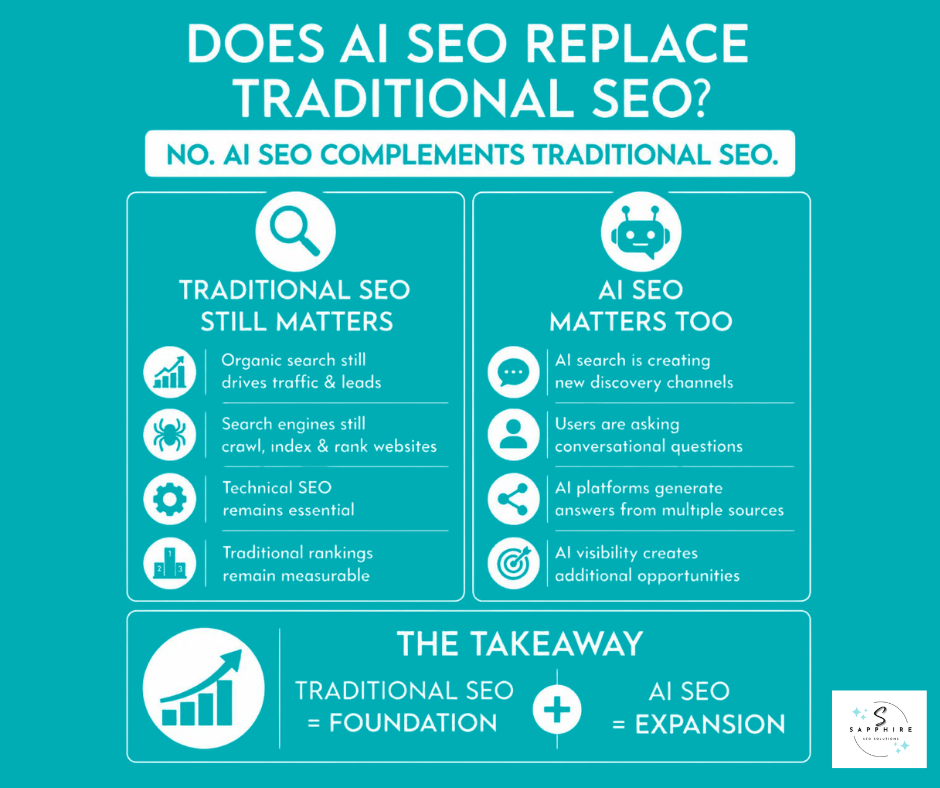
For most businesses, AI SEO should complement traditional SEO, not replace it.
That question comes up a lot, usually from someone who's read one too many alarmist headlines like “Is traditional SEO dead?” It's understandable. But it doesn't hold up once you look at how people actually search.
Why Traditional SEO Still Matters
Organic search hasn't gone anywhere. Millions of people still type a query into Google every day and click through the results, same as always. Search engines still need to crawl your website, understand it, and index it before any of the rest of this matters, AI search included. A technically sound site is the entry ticket.
And traditional rankings still generate real, measurable traffic and leads. A business ranking well for the searches that matter to it is going to keep getting customers from that ranking. Plenty of people haven't changed their search habits at all, and plenty more move back and forth between a regular Google search and an AI tool depending on what they need that day.
Why AI SEO Matters
At the same time, search behavior is genuinely expanding, not shifting from one thing to another. AI-powered search experiences are becoming another way people find businesses, sitting alongside traditional search rather than instead of it. More people are asking full, conversational questions and getting answers pulled together from multiple sources instead of a plain list of links.
That creates a real opportunity. A business that shows up inside those AI-generated answers gets a form of visibility it wouldn't have gotten otherwise, on top of whatever it's already earning through traditional rankings.
Nobody serious about the SEO industry is arguing that traditional SEO is finished, and nobody credible is promising that AI SEO is about to make it obsolete either. What's actually happening is more straightforward: the places people search have multiplied, so the places a business needs to show up have multiplied too.
That's not a case for replacing SEO with something newer and shinier. It's a case for building on what already works while paying attention to where search is headed next.
Which Is Better: Traditional SEO or AI SEO?
Neither one is universally better. It comes down to where your business actually stands right now. Here's how to figure out where your priority should be.
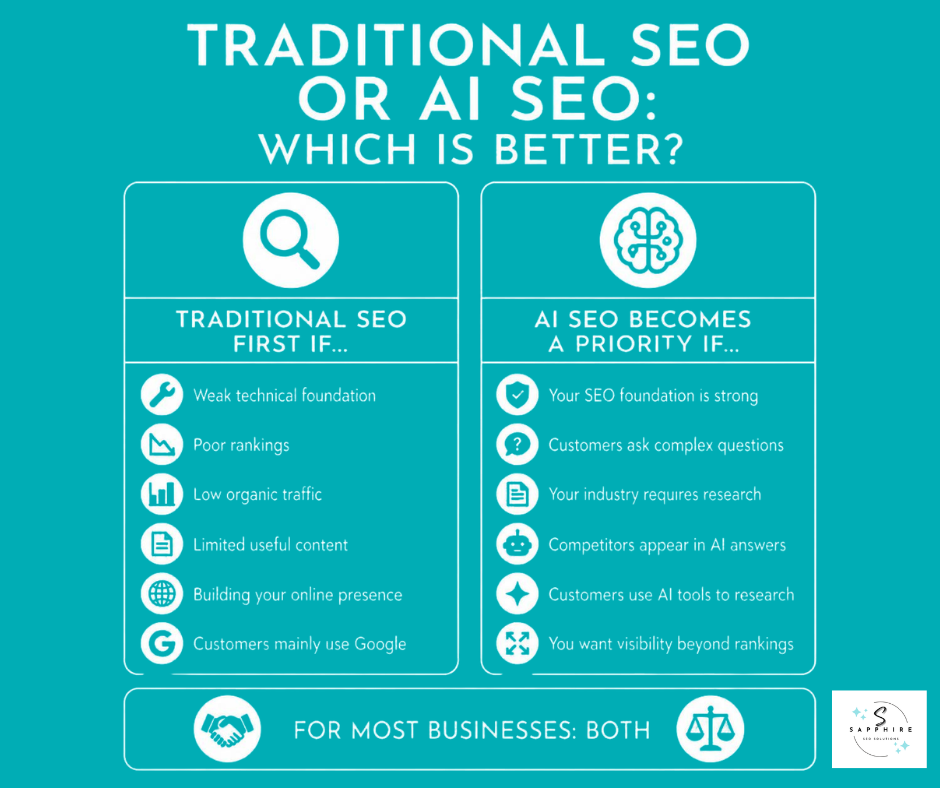
Traditional SEO May Be the Priority If...
Your website has weak technical foundations
Your pages aren't ranking for the searches that matter most
You're not generating enough organic traffic
Your website has little useful content to work with
Your business is still establishing its online presence
Customers primarily find you through a traditional search engine
If most of that sounds familiar, start there. Building on a shaky foundation just means everything on top of it wobbles too.
AI SEO Becomes More Important If...
Your SEO foundation is already solid
Your customers ask complex questions before they buy
Your industry involves a lot of research before a decision gets made
Competitors are already showing up in AI-generated answers
Customers increasingly turn to AI tools while researching products or services
You're after broader visibility, beyond just rankings
Notice the first item on that list. AI SEO tends to matter more once the traditional groundwork is already in place, not instead of it.
For Most Businesses, the Answer Is Both
Realistically, this isn't an either-or decision for most companies. It's a question of where to put your attention first, and that depends on a handful of things specific to your business:
How mature your SEO already is
How your customers actually search
What your industry looks like
What your competitors are doing
How visible you already are
What you're trying to accomplish
How much time or budget you actually have to work with
There's no magic split here, no "spend 70% here and 30% there" formula that applies across the board. A landscaping company just getting its website in order needs a different starting point than an established HVAC company competing in a market where competitors are already showing up in AI answers.
The question you should be asking is: which one solves your biggest gap right now?
How Traditional SEO and AI SEO Work Together
Here's how traditional SEO and AI SEO work together in real life:
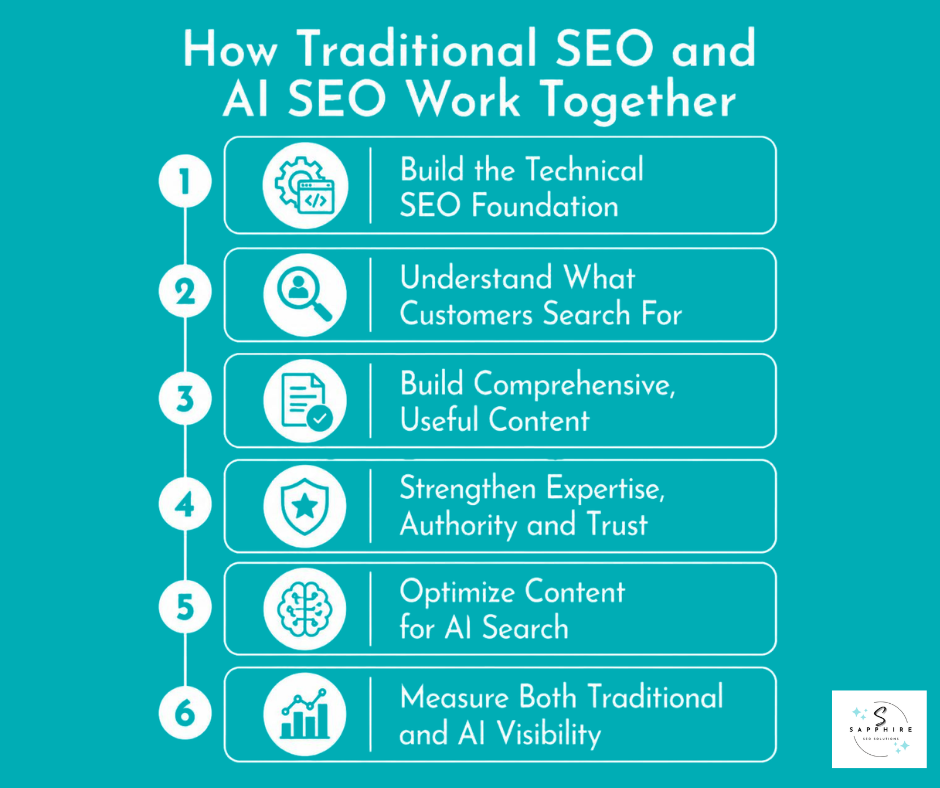
1. Build the Technical SEO Foundation
Nothing else on this list matters if search engines can't crawl and index your site properly. That means checking crawlability, making sure your important pages are indexable, keeping your site structure logical, and paying attention to page speed and mobile usability. Solid internal linking ties it all together, helping both search engines and visitors find their way around. This isn't the place to get fancy. Just get the basics right.
2. Understand What Customers Search For
Keyword research still matters here, but it's about more than a list of relevant keywords. Look at search intent, meaning whether someone's browsing or ready to buy. Pay attention to the actual questions customers ask, not just the short phrases they type.
Mix commercial searches with informational ones, and don't ignore long-tail, conversational queries just because the search volume looks small. Volume alone isn't the whole story. A low-volume question asked by someone ready to hire you is worth more than a high-volume one from someone who's just browsing.
3. Build Comprehensive, Useful Content
Answer the main question fast. Don't bury it under three paragraphs of preamble. Then give the reader enough context to actually feel satisfied, not just technically answered.
Cover related questions naturally as they come up, back things up with first-hand expertise where you have it, and use real examples instead of vague generalities. Keep the facts consistent across your site.
What you don't want is AI-generated filler, keyword stuffing, or five paragraphs that all say the same thing in slightly different words. Write for the person reading it, not for a crawler.
4. Strengthen Expertise, Authority and Trust
Show who actually created the content. Explain their relevant experience.
Keep your business information (name, address, phone number, services) accurate and consistent everywhere it appears online. Back up important claims with real evidence instead of just asserting them.
None of this is a checklist you complete once and forget. It's an ongoing effort to build a reputation that holds up, and no, reviews or backlinks alone don't guarantee anything on their own.
5. Optimize Content for AI Search
Once that foundation is solid, start answering the real conversational questions your customers ask. Deepen your topical coverage instead of narrowing it. Make sure entities and relationships (who you are, what you offer, how it connects to what people are searching) come through clearly.
Structure content logically, with important information easy to find and pull out. Strengthen your supporting pages and how they link together. Skip anything marketed as an "AI hack." There's no trick that guarantees inclusion in an AI answer, and content written specifically to game a system usually reads exactly like that.
6. Measure Both Traditional and AI Visibility
Keep tracking what you always have: rankings, impressions, clicks, organic traffic, leads, and revenue. Then start layering in the newer indicators too: brand mentions, citations, inclusion in AI-generated answers, referral traffic from AI platforms, and branded search growth.
AI visibility signals are still an evolving area of measurement, and a mention in an AI answer isn't the same thing as a lead. But watching both sets of numbers together gives you a much fuller picture of where your content quality and technical seo work are actually paying off.
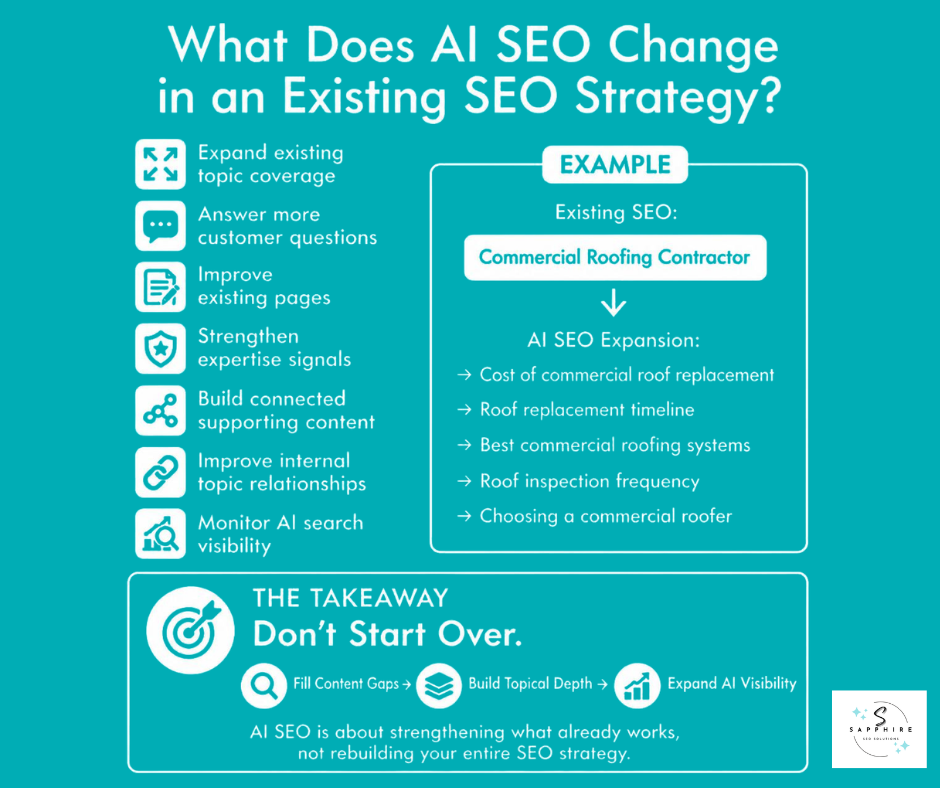
What Does AI SEO Actually Change in an Existing SEO Strategy?
If you already have an SEO strategy running, here's the question that actually matters: does any of this mean starting over? No. AI SEO doesn't mean rebuilding your website or throwing out a campaign that's already working.
What it usually means is expanding, not replacing. That might look like:
Widening your content around topics you already rank for
Finding the customer questions you haven't answered yet
Improving pages you already have instead of creating a pile of new ones.
It also means strengthening expertise signals where they're thin, clarifying information that's currently vague, and building supporting content that connects to your main pages instead of sitting off on its own. Improving how your topics relate to each other internally helps too. And it's worth thinking about visibility across AI search experiences specifically, then adding some form of AI-search monitoring to whatever reporting you're already doing.
Say your existing SEO targets "commercial roofing contractor." That's still a solid page to have. An AI-search expansion doesn't replace it. It builds around it, answering the questions a business owner would actually ask next:
How much does commercial roof replacement cost?
How long does commercial roof replacement take?
Which commercial roofing system is best?
How often should a commercial roof be inspected?
What should a business look for in a commercial roofer?
None of those exact questions guarantee AI visibility. That's not the point. The point is that covering a topic this thoroughly reflects how people actually research a decision that's expensive and complicated, which happens to be exactly the kind of decision AI search tools get used for.
So no, this isn't a rebrand. It's not a signal to rewrite every page you've got. It's closer to filling in the gaps your current strategy left open, using AI tools where they genuinely help with research and monitoring, while keeping the foundation you've already built intact.
How a Small Business Can Start With AI SEO
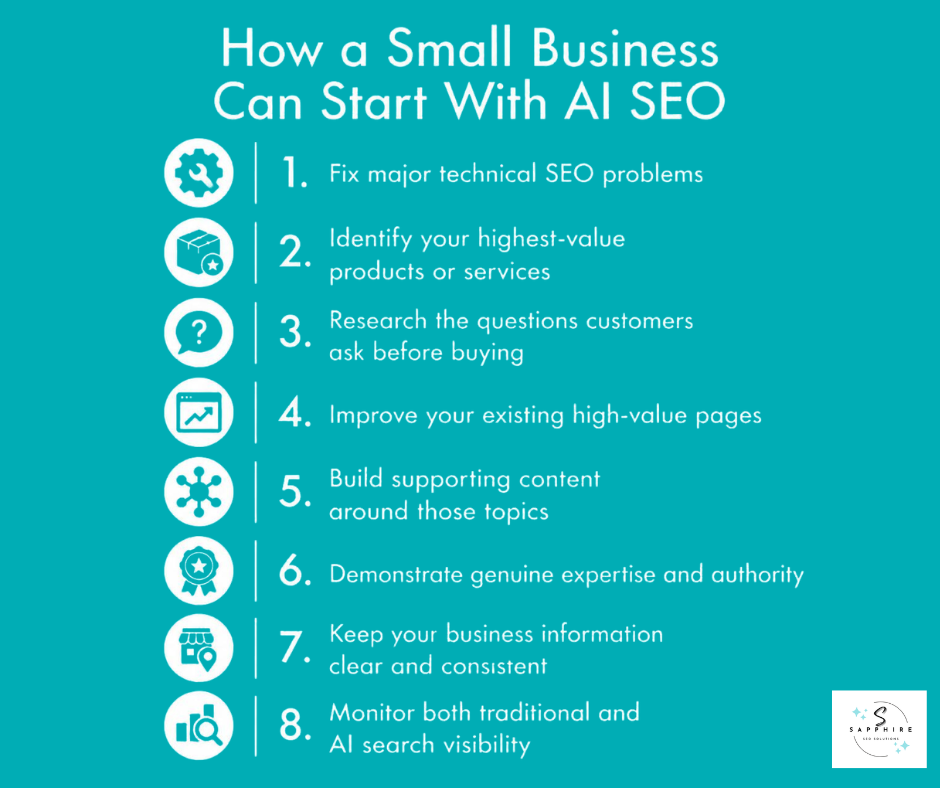
Here's a straightforward sequence to work through:
Fix major technical SEO problems: Broken pages, slow load times, mobile issues, anything getting in the way of search engines reading your site properly. Handle that first.
Identify your highest-value products or services: Not everything you offer deserves equal attention. Start with what actually drives revenue.
Research the questions customers ask before buying: Talk to your sales team, look at what customers actually say on calls or in emails, and pay attention to real language, not just guessed keywords.
Improve your existing high-value pages: Before creating anything new, make sure the pages tied to your best services are as clear and complete as they can be.
Build supporting content around those topics: Answer the follow-up questions your main pages don't fully cover.
Demonstrate genuine expertise and authority: Show who's behind the business, what experience backs it up, and why customers should trust what you're saying.
Keep your business information clear and consistent: Same name, address, phone number, and service details everywhere they appear online.
Monitor both traditional and AI search visibility: Keep an eye on rankings and traffic like always, and start paying attention to whether you're showing up across AI search engines and AI platforms too.
You don't need to tackle all of this at once, and you definitely don't need to optimize every page on your site before you see anything change. Start with the handful of pages and topics closest to actual revenue. That's where search visibility improvements pay off fastest, and it's a far more realistic starting point than trying to overhaul your entire online visibility strategy in one go.
Traditional SEO vs AI SEO: A Practical Example
All of this makes more sense with a real-world picture. So let's build one.
Say you run a landscaping company in Atlanta. Under a traditional SEO approach, your main target is a phrase like "landscaping company in Atlanta." The strategy behind that involves several familiar pieces of traditional SEO tactics:
Optimizing your core service pages
Making sure your location relevance is clear
Matching content to search intent
Handling the technical SEO basics
Building supporting content
Linking your pages together internally
Earning authority over time.
Plus, since this is a service business tied to a specific area, local SEO work (your Google Business Profile, local citations, location-specific pages) carries extra weight here.
That's a solid foundation. But it only covers one moment in a much longer decision.
An AI-search-oriented expansion builds around that same foundation, filling in the questions a homeowner actually asks along the way. Things like:
How much does landscaping cost?
What landscaping services does a homeowner actually need?
How often should a lawn be professionally maintained?
What plants work best in Georgia's climate?
How much does a patio installation cost?
Answering those well means the business shows up not just for "landscaping company in Atlanta," but throughout the research someone does before they ever type that phrase. That matters more now that so much of that research happens through AI search tools instead of a plain list of results.
It's important to note that the goal isn't writing a separate page for every question a homeowner could theoretically ask. Nobody has the time for that, and it wouldn't guarantee an AI citation anyway. The real goal is building genuine topical coverage around what the business actually knows and what its customers actually go through, from "do I need this service" all the way to "who do I hire." Get that right, and both traditional rankings and AI visibility tend to follow.
Partner with Sapphire SEO Solutions and Succeed in the Era of AI-Powered Searches!
Traditional SEO still matters. That hasn't changed, and nothing in this guide suggests otherwise. What's changed is that AI search has opened up new ways for people to discover a business, and new ways for that business to be seen.
AI SEO builds on the same fundamentals traditional SEO has always relied on: useful content, real authority, technical accessibility, a genuinely good user experience. It just extends that focus further, toward conversational questions, deeper topical context, clearer entity understanding, answerability, and brand visibility that shows up in more places than a results page.
None of that is a reason to abandon what already works. The strongest approach, for nearly every business, combines traditional SEO with AI-search optimization rather than treating them as separate paths.
So here's the real question worth asking. Where's your biggest gap right now: your traditional foundation or your AI visibility signals? That's usually where to start.
If your business already has solid SEO success under its belt but wants to become more visible across AI-powered search, our AI SEO services can help pinpoint that gap and build a strategy around it. Contact us to schedule a free consultation with a certified AI SEO expert today and learn what your business needs to succeed online!

Frequently Asked Questions About Traditional SEO vs AI SEO
What is the difference between traditional SEO and AI SEO?
Traditional SEO optimizes for visibility in conventional search results, the familiar list of links on a results page. AI SEO optimizes for visibility inside AI-generated answers and conversational search tools. One's about earning a ranking. The other's about getting included in the response itself.
Is AI SEO replacing traditional SEO?
No. It generally complements established SEO practices rather than replacing them. Traditional search still drives real traffic, and search engines still need the same technical foundation to crawl and understand your site regardless of what else you're doing.
Is AI SEO better than traditional SEO?
Neither is universally better. Which one deserves more attention depends on your business, your customers, how strong your existing SEO foundation already is, and how your audience actually searches. A company still fixing technical issues has a different priority than one whose competitors are already showing up in AI answers.
Does traditional SEO help with AI search?
Yes, quite a bit. Strong technical foundations, genuinely useful content, real authority, and clear, consistent information all support visibility across multiple search experiences, not just conventional ones. Good SEO work isn't wasted on AI search. It's usually the starting point for it.
Do I need AI SEO if my website already ranks on Google?
Strong Google rankings are still valuable, and they're not something to walk away from. But ranking well in conventional search doesn't automatically mean you're visible inside AI-generated answers. Those are related but separate things, so it's worth understanding where you stand in both.
Does AI SEO affect Google rankings?
Some overlap exists, since a lot of what strengthens AI visibility (clear content, real authority, solid technical accessibility) also supports conventional rankings. That said, there's no simple rule that says optimizing for AI search will automatically boost your Google rankings. They're connected, not identical.
How does AI SEO work?
In short, it involves optimizing your content and business information so AI systems can understand it, trust it, and pull from it when generating answers. That means clear writing, strong topical coverage, consistent business details, and real demonstrable expertise.
How can a small business start with AI SEO?
Start by fixing any major technical issues, then focus on the products or services closest to your revenue before expanding outward. We walked through the full sequence earlier in this article, but the short version is: build the foundation first, then expand.