

What Is Entity SEO? A Complete Guide for Small Businesses
Most people searching for a roofing company don't type the exact words on your website. They type "who fixes storm damage roofs near me" or ask a voice assistant a full question. Search engines noticed this shift years ago. So they stopped just matching words on a page to words in a query.
Now they try to understand what a business actually is. Not just what it says, but who it serves, what it offers, and how it connects to everything else in its industry. A landscaping company isn't just a page full of keywords anymore. It's a business, with a location, a set of services, and a reputation that either holds together or doesn't.
That last part matters more than most business owners realize. A site can rank for the right terms and still send a confusing signal about who's actually behind it. Help search engines understand that, and AI-powered tools that summarize and answer questions directly, and you've got a real advantage in today's search results.
That's what entity SEO is about. This guide walks through what entity SEO means, how it works, how it connects to AI search, and what small businesses can actually do about it.
Key Takeaways
Entities are real things (businesses, people, places), not keyword strings search engines are matching.
Relationships between entities matter more than repeating your business name across a site.
A business can rank for keywords and still have a weak, unclear digital identity.
Consistency across your website, directories, and profiles reduces ambiguity for search engines.
Real expertise, shown through specifics and evidence, beats vague claims every time.
External corroboration, genuine reviews and mentions, confirms what your website already says about you.
Entity SEO doesn't guarantee AI citations. It makes your business easier to understand and reference.
Entity SEO adds context and clarity. It never replaces keyword research or traditional SEO fundamentals.
What Is Entity SEO?
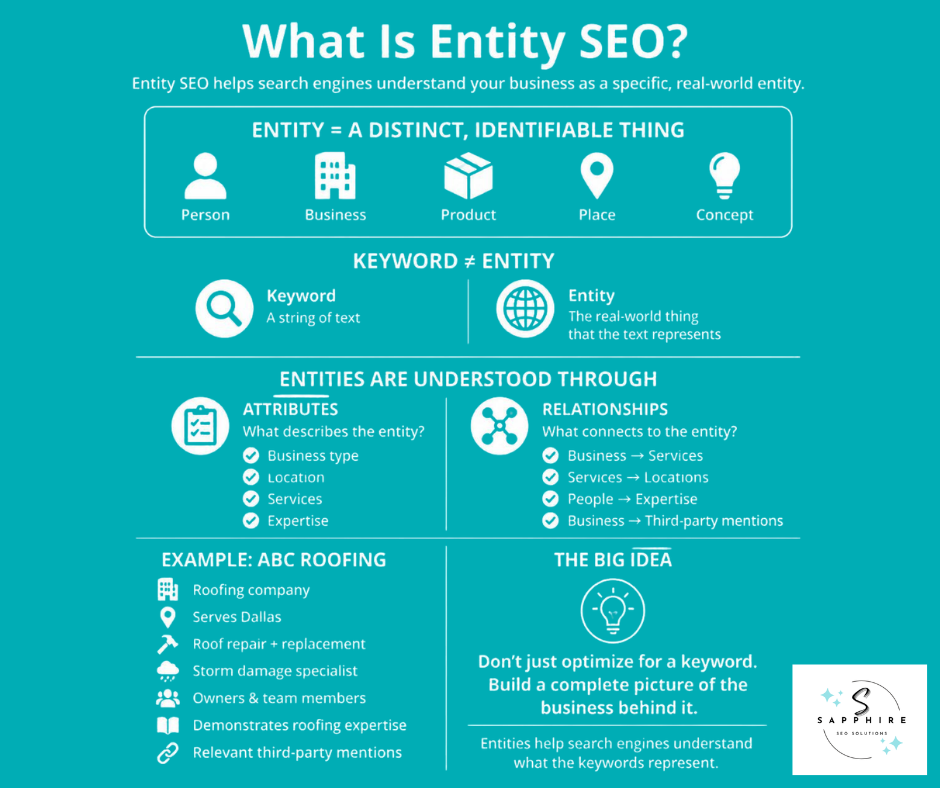
An entity is just a thing that can be identified as its own, distinct thing, for example:
A person
A business
A product
A place
A concept
Your business is an entity. So is your city. So is the service you offer.
What is entity SEO, then? It's the practice of making sure search engines (and increasingly, AI tools) can clearly identify your business as a specific entity, understand what it does, and connect it to everything related to it. Not just match the words on your homepage to the words someone typed into a search bar.
Here's the part that trips people up. Entities represent concepts, not keywords. A keyword is a string of text. An entity is a real thing that string of text might be pointing to. That distinction matters because entities come with attributes and relationships attached to them, and those are what actually build understanding.
Attributes are the facts that describe an entity. For example:
What kind of business it is
Where it's located
What it offers
Relationships are how one entity connects to others. A business relates to its services. Its services relate to the locations it serves. The people who run it relate to the expertise the business claims to have.
Put that together, and you get something far more useful than a keyword ever could. Take a roofing company in Dallas, ABC Roofing, for example:
Is a roofing company
Serves Dallas
Offers roof replacement and roof repair
Specializes in storm damage
Has specific owners and team members
Publishes roofing expertise
Gets mentioned by relevant third parties
That's a business search engines can actually place, and it's a lot more than "roofing company Dallas" would ever tell them. That phrase alone doesn't say whether ABC Roofing is legitimate, established, or even still in business. The fuller picture does.
This is why identifiable entities matter so much for entity-based seo. A business that's clearly defined, with clear attributes and clear relationships, gives search engines something solid to work with. A business that's just a pile of keyword-optimized pages doesn't. Both might rank for a while. Only one builds something that lasts.
What Is an Entity in SEO? (Examples)
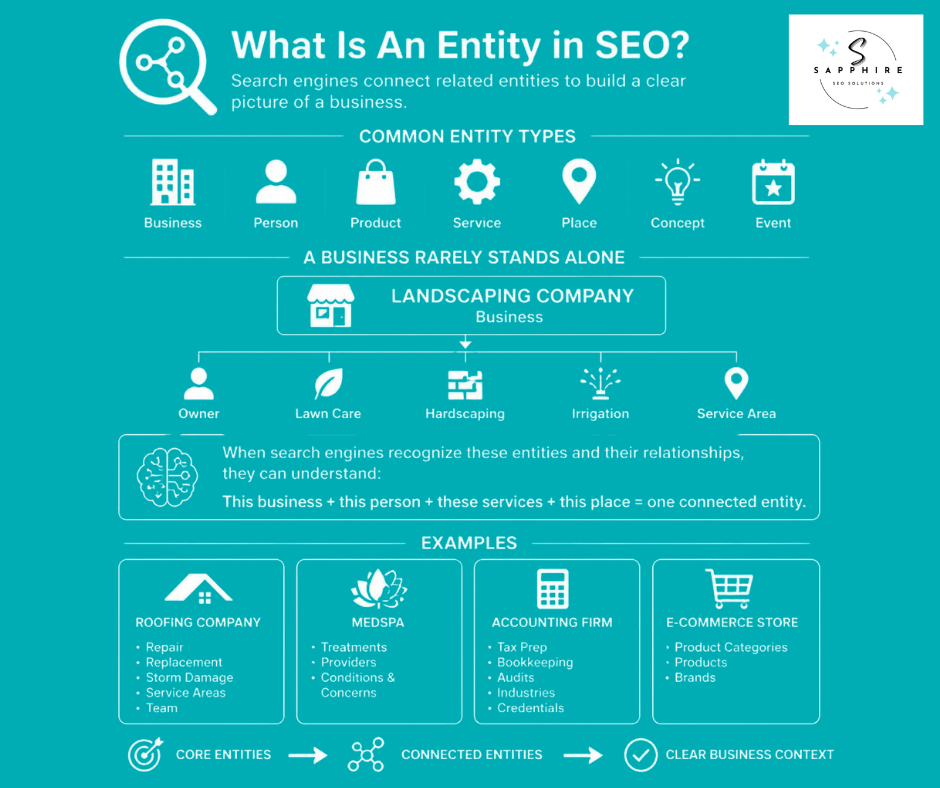
Search engines deal with a handful of entity types that show up again and again. They include:
Organizations and businesses
People
Products
Services
Places
Concepts
Sometimes events, if you run a seasonal promotion or host something in your community
That's really it. You don't need a huge taxonomy to understand the idea.
What matters more is how these different entities connect to each other. A single business rarely stands alone. It's usually the center of a small web of other entities, all pointing back to it and giving it context.
Take a landscaping company. The business itself is one entity. Its owner is another. Its services (lawn care, hardscaping, irrigation) are each their own entity. So is the city it serves. Entity recognition happens when a search engine can look at all of that and confidently say: this business, this person, these services, this place, they all belong together.
The same pattern shows up everywhere, just with different pieces:
A roofing company connects to its services (repair, replacement, storm damage), the cities it covers, and the team members who run it.
A medspa connects to its treatments, its licensed providers, and the conditions or concerns those treatments address.
A professional services firm, like an accounting practice, connects to its specific services (tax prep, bookkeeping, audits), the industries it works with, and the credentials of the people on staff.
An ecommerce store connects to its product categories, individual products, and the brands it carries or manufactures.
Every one of these businesses has core entities at its center (the business itself, its offerings, the people behind it) and a set of distinct entities radiating out from there. None of this requires treating every noun on a page as some kind of entity. That's not how it works, and trying to force it just makes content read strange.
The goal is simpler than that. A business, and the page entities connected to it, should add up to a clear, coherent picture. Not a scattered list of unrelated topics loosely stitched together with a logo.
Entity SEO vs. Keyword SEO - What's the Difference?
Traditional SEO starts with one question: what phrases do people type when they're looking for something? That's keyword matching, and it's been the foundation of search for a long time now. You research how users search, find the relevant keywords, and build content around them. It works because it tells you exactly what people want, in their own words.
Entity SEO asks a different question. Not "what are people searching for," but "what is this business actually about, and how does it connect to everything around it?" A landscaping company isn't just a match for the phrase "landscaper near me." It's a real business, with real services, in a real place, connected to real people.
Unlike keywords, which are strings of text, entities are things. That's the core difference. But here's what a lot of guides get wrong: this isn't a competition between the two approaches.
Keywords still do something entities can't. They reveal demand. They tell you what people are actually typing into Google, in what volume, and with what intent behind it. Someone searching "roof repair cost" wants different information than someone searching "emergency roof leak." Keyword research is still how you find that out.
Entities do something different. They provide context. They help search engines understand what your business is, not just what phrases happen to appear on your pages. A page can be stuffed with the right keywords and still leave a search engine unsure what business is behind it, what makes it credible, or how it relates to the services it claims to offer.
So both matter. Keyword optimization tells you what to talk about and how people phrase their questions. Entity SEO makes sure that once you're talking about it, the business behind the content is clear, consistent, and connected to the right things. One doesn't replace the other. A strong content strategy needs both working together, not one instead of the other.
Here’s a table that summarizes the difference between entity SEO and keyword SEO:
Entity SEO vs. Keyword SEO: What's the Difference?
| Keyword SEO | Entity SEO |
|---|---|
|
Focuses on: What people search for |
Focuses on: What the business, service, or topic actually is |
|
Core question: “What phrases are people typing into Google?” |
Core question: “What is this business about, and how does it connect to related things?” |
|
Works with: Words and phrases |
Works with: Real-world things, concepts, businesses, people, services, and places |
|
Main purpose: Identify search demand and user intent |
Main purpose: Help search engines understand context, meaning, and relationships |
|
Helps you discover: Search volume, popular phrases, and different ways people search |
Helps search engines understand: What a business is, what it offers, where it operates, and what it is connected to |
|
Example: “landscaper near me” |
Example: A landscaping company → landscaping services → local area → business → customers |
|
Strength: Shows you what people want to find |
Strength: Shows search engines what your business is and how it fits into the topic |
|
Limitation: Keywords alone don't always make the business behind the content clear |
Limitation: Entities don't tell you how much demand a particular search phrase has |
|
Role in SEO: Guides what topics and phrases your content should address |
Role in SEO: Adds context and connects your content and business to relevant entities |
|
Don't choose one Keyword SEO works best as part of a broader strategy. |
Don't choose one Entity SEO works best alongside keyword optimization. |
|
Best approach: Use keyword research to understand demand and intent. |
Best approach: Use entity SEO to establish clear, consistent context around your business and content. |
Keywords tell you what people are searching for. Entities help search engines understand what you're talking about and who you are.
They aren't competing approaches. Keyword SEO and Entity SEO work best together. Keywords reveal demand and intent, while entities provide the context and relationships that help search engines understand your business.
Entity SEO vs. Semantic SEO vs. Topical SEO
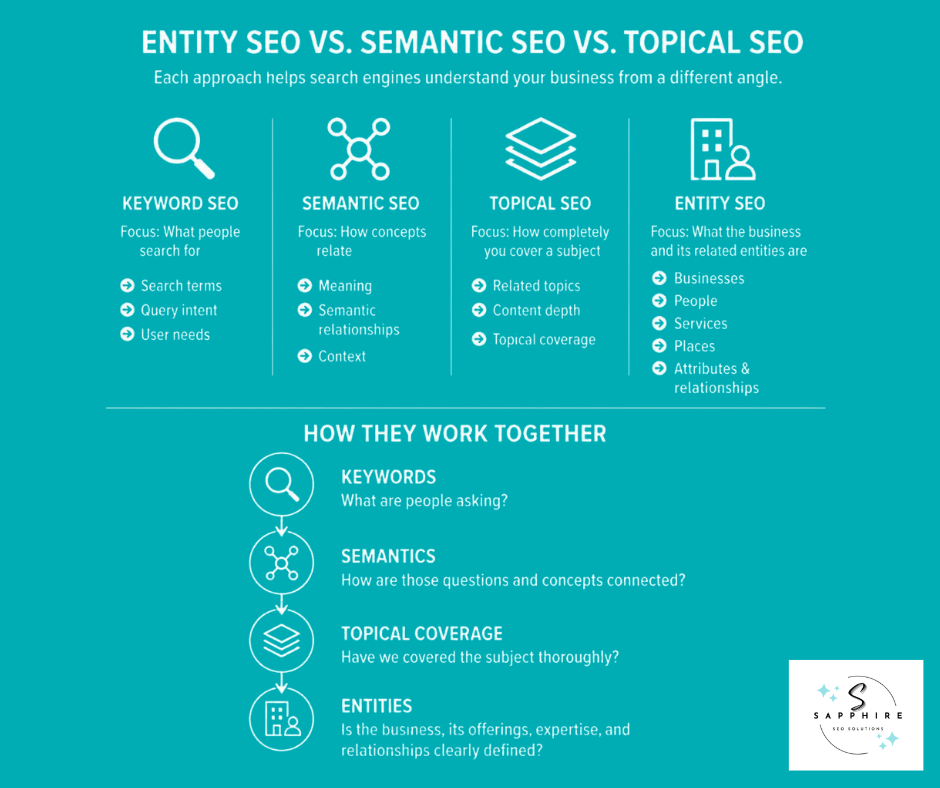
By now you've probably noticed something. A lot of these SEO terms sound like they're describing the same thing from slightly different angles. That's because, in a lot of ways, they are. Worth saying upfront: these terms don't have one fixed, agreed-upon definition across the industry. Different SEOs use them a little differently. But here's a useful way to think about how they relate.
Keyword SEO is the one most business owners already know. It's about search terms and what someone actually wants when they type them in. Query intent, in other words. Someone searching "how much does a new roof cost" wants a price range. Someone searching "roof leak emergency" wants help right now. Different intent, different content.
Semantic SEO zooms out a little. Instead of focusing on individual search terms, it's concerned with meaning and how concepts relate to each other. This is where semantic relationships come in. A page about roof repair naturally relates to pages about roof replacement, storm damage, and insurance claims, because those concepts genuinely connect in the real world. Semantic search is what happens when a search engine uses those relationships to understand a query better than a simple keyword match ever could.
Topical SEO is about depth. It asks whether a website covers a subject completely, or just skims the surface with one or two pages. A roofing site with real content on repair, replacement, storm damage, materials, and maintenance demonstrates topical coverage. A site with a single generic "roofing services" page doesn't.
Then there's entity SEO, which we've already covered. It's about identifiable things (businesses, people, services, places) and the attributes and relationships that define them clearly.
So how do these fit together? Think of them as different lenses pointed at the same underlying goal: helping search engines and readers understand your business well. Keyword SEO tells you what people are asking. Semantic SEO explains how those questions relate to broader meaning and entity context. Topical SEO makes sure you've actually covered the subject in full. Entity SEO makes sure the business behind all of it is clearly defined.
None of these four replace each other. A solid entity-based seo strategy actually depends on the other three doing their job. Keyword research tells you what to write about. Topical coverage makes sure you're not leaving gaps. Semantic relationships and contextual relevance tie it all together in a way that makes sense to both readers and search engines.
They're not competing strategies fighting for the same job. They're four parts of the same, larger picture.
How Search Engines Understand Entities
Let's take a step back and look at how any of this actually happens. Not the exact mechanics inside Google's servers- nobody outside Google knows that with certainty- but a conceptual way of understanding how search engines like Google move from "words on a page" to "understanding what a business actually is."
Think of it less as a single step and more as a series of related tasks working together.
First, there's discovery. A search engine has to find your content before it can understand anything about it. That part hasn't changed much. It crawls the web, finds pages, and adds them to its index.
Once content is discovered, identification kicks in. This is where natural language processing (NLP) and machine learning come into play, helping a system recognize that certain words and phrases on a page refer to real, identifiable things. Not just text, but a business, a person, a service, a place.
Then comes disambiguation, and this is where it gets interesting. Take the word "Apple." On its own, that word could mean a few very different things. Apple Inc., the tech company. An apple, the fruit. Apple Records, the label the Beatles started. A search engine has to figure out which one a piece of content is actually about, and it does that by looking at everything else around the word. A page mentioning "iPhone" and "MacBook" is clearly talking about the company. A page mentioning "orchard" and "harvest" is talking about the fruit.
That's disambiguation in a nutshell, and it's exactly why context matters so much for smaller businesses too. If your landscaping company is just called "Green Thumb," a search engine needs enough surrounding context- your location, your services, your industry- to understand you're a business and not, say, an idiom.
After that comes attribute extraction, where a system pulls out the facts. What does this entity do? Where is it located? What does it offer? Relationship identification follows right behind it, connecting that entity to others. Your business to your services. Your services to your location. Your team to their expertise.
Corroboration is the next piece, and it's an important one. A search engine doesn't just take a business's word for it. It looks for other sources, directories, reviews, and mentions that back up what a business says about itself. This is part of what builds search accuracy over time.
All of this feeds into contextual understanding, and eventually, retrieval. When someone submits user queries, or when a system draws on someone's search history and patterns to predict what they're likely looking for, it pulls from everything it's built up about that entity, not just isolated keywords on a page.
For a small business, this whole process is exactly why entity understanding matters. A roofing company that clearly states who it is, what it does, where it works, and who's behind it gives a search engine far less disambiguation to do, and a much clearer entity to retrieve when someone asks the right question. Worth noting too that not every AI system works through this in exactly the same way. This is a useful mental model, not a universal rulebook.
Here’s how search engines understand entities:
How Search Engines Understand Entities
Search engines move from words on a page to an understanding of the real-world entities behind them.
Crawl pages → Find content → Add to index
NLP + machine learning recognize:
“Apple” could mean:
Combine entities, attributes, relationships, and context.
When a relevant query is made, the search engine can retrieve the entity and its associated information.
The clearer your business identity, services, location, expertise, and relationships are, the less guesswork search engines have to do.
Entity Attributes, Relationships, and Context
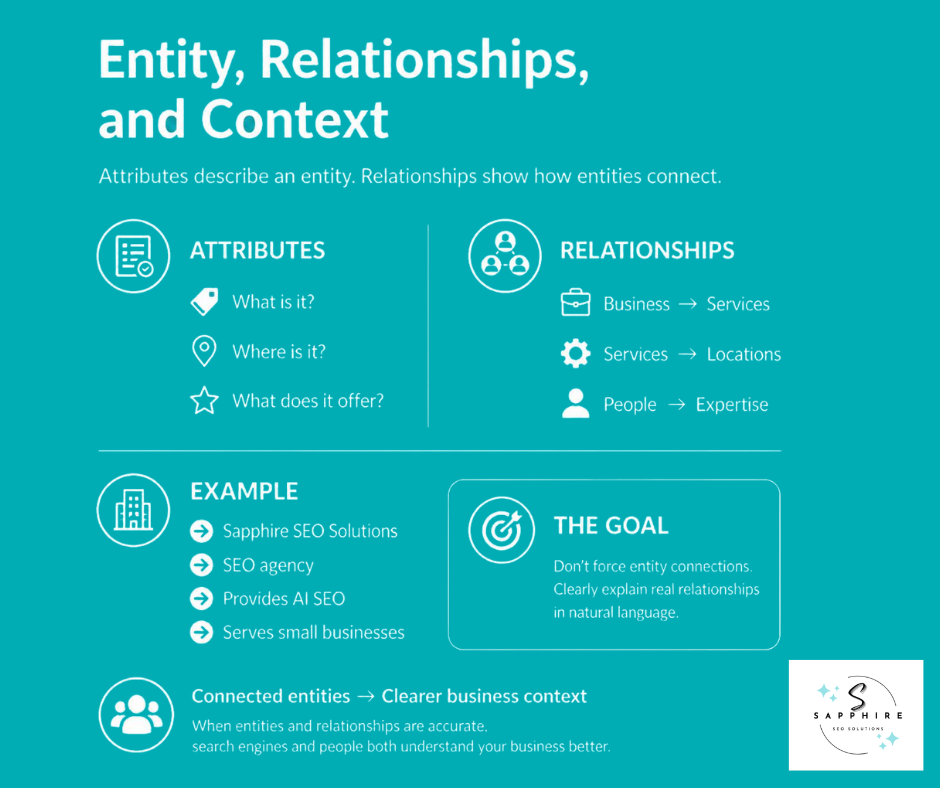
This is really the heart of entity SEO, so it's worth slowing down here. Two ideas do most of the work: attributes and relationships. Once you understand these, the rest of this guide gets a lot easier to apply.
Attributes are simply the facts that describe an entity. Take Sapphire SEO Solutions as an example. Its attributes might include: it's an SEO agency, it serves small businesses, it provides AI SEO, and it provides content strategy. Nothing complicated. Just a clear, factual description of what the business is and what it does.
Relationships are different. They describe how one entity connects to another. Sapphire SEO Solutions provides AI SEO. Sapphire SEO Solutions serves small businesses. Sapphire SEO Solutions operates in a relevant market. Each of those is a distinct connection between the business and something else: a service, an audience, an industry.
Here's why that distinction matters so much. A page that just repeats "Sapphire SEO Solutions" over and over, or lists a pile of unconnected facts, doesn't actually explain much. But a page that clearly shows how the business relates to its services, its audience, and its market tells a much fuller story. Entity relationships carry more information than attributes alone ever could, because they show how things fit together in the real world, not just what they happen to be.
This is where linking entities through natural language does more work than most business owners expect. When a service page explains that a landscaping company provides hardscaping in Austin, and that hardscaping includes patio installation and retaining walls, it's not just listing services. It's showing how related entities connect to each other and to the business at the center of it all.
The mistake to avoid here is trying to force this. You don't build entity connections by cramming keyword-shaped phrases into every sentence just to check a box. That reads unnatural fast, and readers notice before search engines ever do. The goal is writing that naturally explains how entities connect, because the underlying facts are true and clearly stated, not because a formula demanded it.
Do this well across a website, and entities and their relationships start forming a coherent picture on their own. The business, its services, its people, its locations, all clearly connected, all clearly explained. That's a much stronger foundation than a page full of standalone facts with nothing tying them together.
Entity SEO and Google's Knowledge Graph
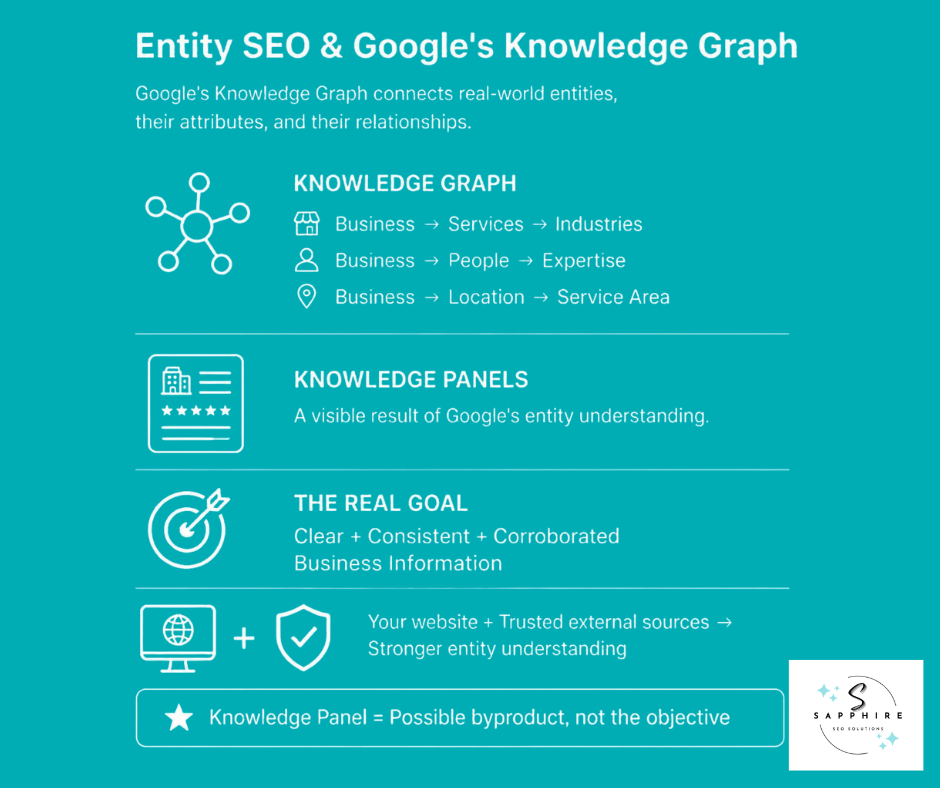
Google has described its Google's Knowledge Graph since 2012 as a system built to understand real-world entities and the relationships between them, rather than just matching strings of text. It's grown a lot since then. It now holds a massive number of facts about a massive number of entities, covering people, places, businesses, and concepts, all connected to each other.
That's really the same idea this whole guide has been building toward, just at Google's scale. Every entity in the graph has attributes attached to it, and relationships connecting it to other entities. A business connects to its services. Its services connect to the industries they serve. None of that is unique to huge, famous brands. The same structure applies to a two-person landscaping company, just with far less data behind it.
You've probably seen one of the more visible results of this: Knowledge Panels. Those boxes that show up on the right side of a search result, or across the top on mobile, with a business name, a short description, hours, and links. They can also help power rich snippets and a handful of other Google services that pull structured facts directly into search results.
Here's where a lot of business owners get the wrong idea, though. A Knowledge Panel isn't a reward for good SEO, and it isn't a goal to chase. Plenty of established, successful small businesses never get one, and that's not a mark against their SEO strategy. Panels tend to show up when Google has gathered enough corroborating information about a business from public, reliable sources, which is a different thing entirely from having good content or ranking well.
So what should a small business actually take from this? Not "how do I get a Knowledge Panel," but "how do I make sure the information about my business is clear, consistent, and backed up wherever it appears." Structured information on your own site, paired with accurate, corroborating mentions elsewhere, contributes to clearer entity understanding, whether or not a panel ever shows up. That's the real goal. The panel, if it comes, is just a byproduct.
Why Entity SEO Matters for Small Businesses
Here's why this actually matters for a small business, not in theory, but in the day-to-day reality of trying to get found online.
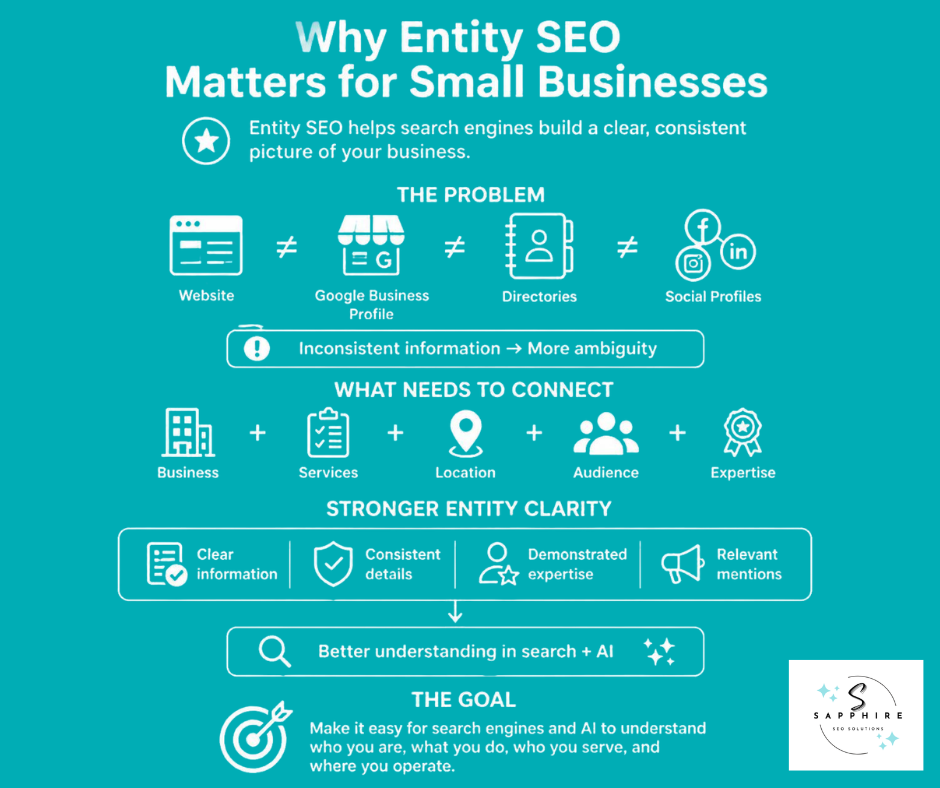
Most small businesses have information scattered all over the place. The website says one thing. The Google Business Profile says something slightly different. A directory listing has an old phone number. Social media bios don't quite match the website copy. None of it is wrong, exactly. It's just inconsistent, and that inconsistency makes it harder for search engines to build a clear, confident picture of who you are.
A lot of websites run into a related problem, too. They explain what a business offers well enough- roofing repair, lawn care, tax prep- but they don't do much to establish real expertise behind it. There's a services page and a contact form, and not much else showing why this business, specifically, knows what it's talking about.
For service businesses, this gets more complicated because there are more pieces that need to connect. The company, the service, the location, the audience. A plumber in Austin who works with homeowners needs all four of those things clearly tied together, not just mentioned somewhere on the site. When that connection is fuzzy, a search engine has to guess. And guessing doesn't produce relevant search results nearly as often as clarity does.
Meanwhile, competitors aren't standing still. Some of them have been building a stronger digital footprint for years: more mentions, more consistent listings, more content that actually demonstrates what they know. That gap is real, and it's one of the main reasons entities matter so much for a business trying to compete in a crowded local market.
Generic websites make this harder to close. A homepage with a paragraph about "quality service" and a bullet list of offerings doesn't give a search engine much to work with. There's no real evidence behind it. Strong content changes that. When a business writes clearly about its services, shares real expertise, and explains how its services relate to the people and places it serves, it builds exactly the kind of contextual evidence a generic site lacks.
Entity clarity works alongside this. The more consistent a business is about its name, its services, its location, and its team across the web, the less ambiguity a search engine has to resolve. Less ambiguity tends to mean a clearer sense of a site's authority on the topics it actually covers.
None of this requires an enterprise-level operation. A small business doesn't need a massive content library or a team of specialists to make progress here. It needs clarity, consistency, and content that actually reflects what the business does and knows. Get that right, and entity seo helps in two directions at once: it supports how a business shows up in traditional search results, and it gives AI-powered tools a clearer, more accurate picture to draw from when someone asks a question the business could actually answer.
How to Optimize Your Website for Entity SEO
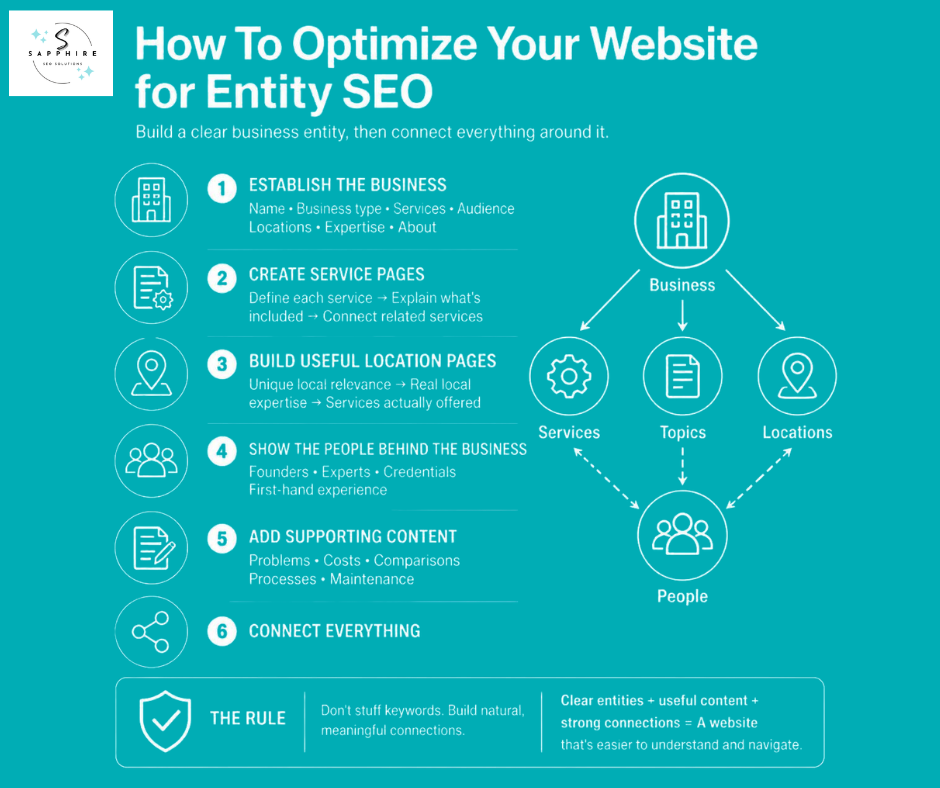
This is the part most business owners actually want: what to do. Everything up to this point has been building toward a practical answer, and it comes down to five things. They are as follows:
Clearly Establish the Business
Before anything else, a search engine needs a clean, unambiguous read on the business itself. That means the primary entity on your site, the business, should be immediately clear from a first visit to any of your web pages. That includes:
Name (used the same way, everywhere)
Business type (what kind of company this actually is)
Services (what it offers)
Audience (who it serves)
Locations (where it operates)
Expertise (what it actually knows how to do)
About information (who's behind it, and why they're credible)
This usually comes together on a homepage and an About page, but it should echo consistently across the rest of the site too. Get this foundation solid, and everything else in entity mapping gets easier, because there's a clear anchor point for every other page to connect back to.
Create Dedicated Service Pages
A single "Services" page listing ten things in a paragraph doesn't give a search engine, or a reader, much to work with. Important services deserve their own dedicated page. Each one should clearly define what the service actually is, what it includes, and who needs it. From there, connect it to related services and any supporting resources that go deeper on specific questions.
A roof repair page, for instance, should explain what counts as repair versus replacement, what the process typically looks like, and link out to a storm damage page or a roof replacement page where it makes sense. That's a real, useful page. A thin paragraph buried in a list isn't.
Build Useful Location Pages
Location pages are where a lot of businesses go wrong, mostly by mass-producing them. A dozen city pages that all say the same three sentences with the city name swapped out don't help anyone, and they're easy for both readers and search engines to spot as filler.
A useful location page has genuine relevance to that specific place. It explains what services are actually available there, reflects real local expertise, and includes something unique: a note about local climate conditions that affect the work, a mention of neighborhoods commonly served, something that couldn't be copy-pasted onto a different city page without editing. If a location doesn't have anything real to say, it probably doesn't need its own page yet.
Establish People and Expertise
Businesses are made of people, and search engines increasingly look for signs of who's actually behind the work. That means giving real visibility to authors, founders, and specialists on staff. Where relevant, show credentials. Where possible, show first-hand experience, actual projects completed, actual problems solved, not just a claim of "years of experience" with nothing behind it.
This doesn't need to be elaborate. A short, specific bio for a founder or lead technician, tied to the services they actually handle, does more than a generic "our team" paragraph ever will.
Build Supporting Topic Content
Once the core business and service pages are solid, supporting content fills in the gaps. This is where you answer the questions people actually have. Common problems. Comparisons between options. Cost breakdowns. What a process looks like from start to finish. Maintenance advice. The kind of decision-making content someone reads before they're ready to call anyone.
This content shouldn't exist in isolation. It should tie back to the services it supports, giving a search engine (and a reader) an easy next step.
Connect Everything
This last piece is what actually makes an entity strategy work as a whole, rather than as a pile of disconnected pages. The connections should run in both directions:
Business → services
Services → topics
Topics → services
Services → locations
People → expertise
A cost-comparison article should link to the service it's about. A service page should link out to the topic content that answers common follow-up questions. A location page should connect to the specific services available there, and to the people who deliver them.
A word of caution as you build all this out. Optimizing entities doesn't mean stuffing your business name or service names into every heading and sentence you write. It doesn't mean using the exact same anchor text every time you link between pages, either. Both of those read as unnatural to a human reader, and they don't help a search engine understand your business any better than natural language does. The same goes for voice search, where questions get asked conversationally, "who does storm damage repair near me," not "roofing company Dallas roofing company." Content written naturally, with real information and real connections, tends to match how people actually ask questions anyway.
When you create content with this structure in mind, business, services, locations, people, and supporting topics are all genuinely connected; you end up with a site that's easy for a search engine to understand, and just as easy for an actual person to navigate.
Entity SEO Through Content: How Content Builds Business Context
It's easy to think of content as a delivery vehicle for keywords. Write about the topic, work in the right phrases, publish it, move on. That thinking made sense for a while. It doesn't hold up as well anymore, and understanding why is a big part of what makes entity SEO different from older approaches.
Content does a lot more than carry keywords. When content writing is done well, it establishes real expertise. It explains services in enough depth that a reader (and a search engine) actually understands what's involved. It addresses genuine customer problems, not generic ones. It demonstrates industry knowledge that a competitor's thin page doesn't bother to include. It builds out locations with real specificity. It walks through processes step by step. And along the way, it naturally builds relationships, associations, and evidence of experience that a bare services page never could.
That's the real value of content in an entity search world. It's not just proving you know the right words. It's proving, through depth and specificity, that you know the subject.
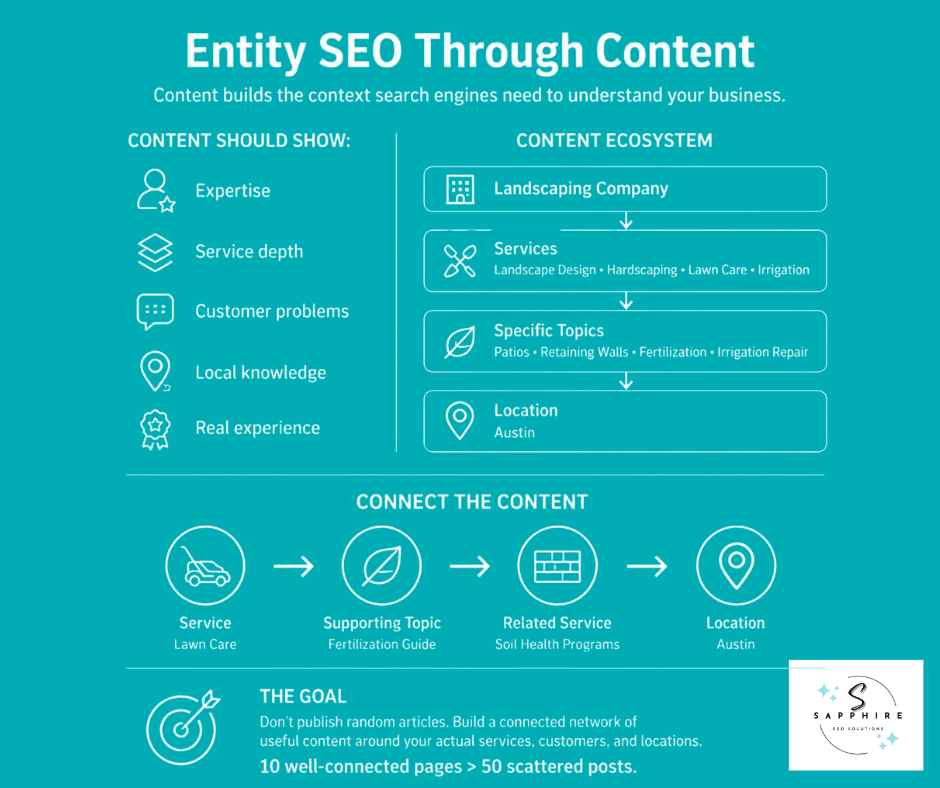
Here's where this gets practical. Picture a landscaping company. At the center is the business itself. Branching out from there are its core service categories: landscape design, hardscaping, lawn care, irrigation. Branching out further are the specific things within each category: patio installation and retaining walls under hardscaping, seasonal maintenance under lawn care. And running through all of it is a location, Austin, that connects back to each service.
Laid out as a content ecosystem, it looks something like this:
Business → Landscaping company
Landscape Design → design consultations, plant selection
Hardscaping → patio installation, retaining walls
Lawn Care → mowing, fertilization, seasonal maintenance
Irrigation → system installation, repair
Austin → local service area tying all of the above together
Each of those branches can become a real, dedicated page. And the value doesn't come from any one page in isolation. It comes from how they connect. A hardscaping page links to a dedicated patio installation page. That page links to a piece answering "how much does a patio cost in Austin," which links back to the hardscaping service and mentions retaining walls as a related option someone might also need. A lawn care page connects to a maintenance guide, which addresses a seasonal problem a homeowner is actually dealing with right now.
That's what entity connections look like in practice. Not a business name repeated across a dozen pages, but a genuine web of relevant entities, services, locations, problems, solutions, all pointing back to each other in ways that actually make sense.
Compare that to random blog publishing, which is still how a lot of small businesses approach content. Someone notices a competitor has a blog, so they start publishing whatever comes to mind. A post about lawn care tips one week. A post about a company anniversary the next. A vaguely related industry news roundup after that. None of it connects to anything else on the site. None of it strengthens a service page or answers a question tied to an actual buying decision. It's activity without direction.
An entity-informed content strategy works differently. Every piece of content has a reason to exist, tied back to a service, a location, or a real customer question, and a clear place it connects to within the site. That doesn't mean publishing constantly. Publishing 100 articles isn't the goal, and treating word count or frequency as the primary measure of progress misses the point entirely. Ten well-connected pages that build entity context around a business's actual services will do more than fifty scattered posts chasing every keyword variation someone found in a research tool.
This also isn't a case for AI-generated filler dressed up as an ecosystem. Content built this way only works because it's genuinely informative, written by people who understand the business and its services well enough to explain them properly. The structure matters, but it doesn't replace substance. It just makes the substance easier for readers and search engines to find and connect.
Internal Linking: Connecting Your Entity Ecosystem
Everything covered so far- the business, the services, the locations, the people, the supporting content- only functions as an ecosystem if the pages are actually connected. That's where internal links come in, and they matter more than most site owners realize.
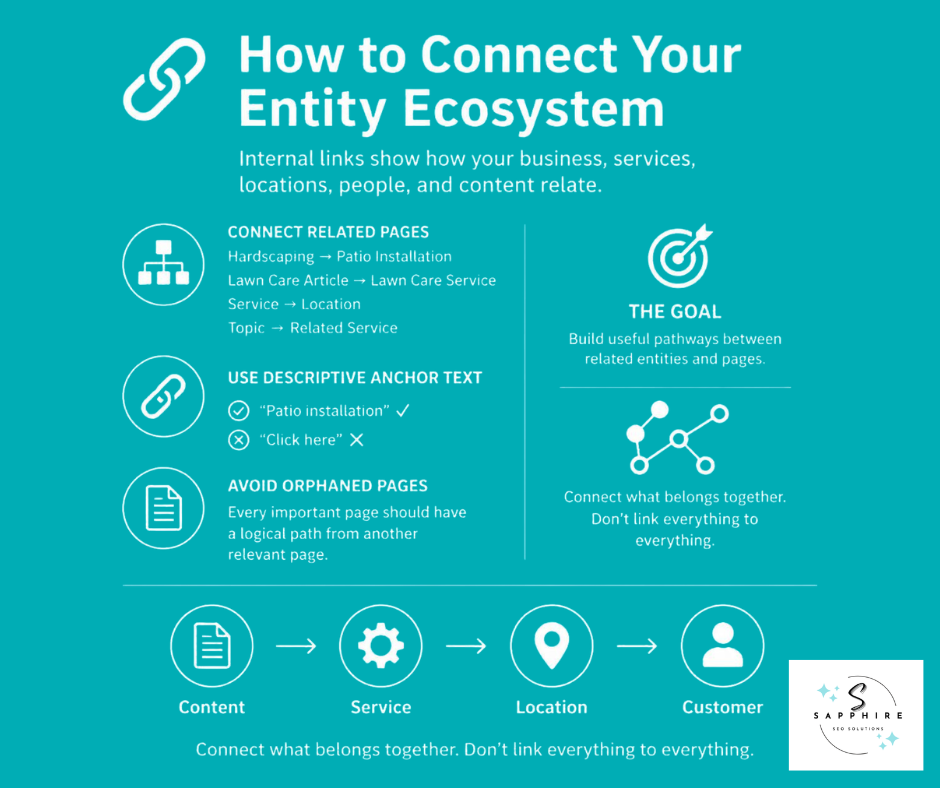
An internal link (on-page SEO) isn't just a navigation shortcut. It's a signal. When a hardscaping service page links to a patio installation page, that link tells both readers and search engines these two things relate to each other. Do this consistently across a site, and you're essentially mapping out how a business's services, locations, and topics fit together, using nothing more than the links already built into the content.
A few things matter for this to actually work. Anchor text should be descriptive. "Learn more about patio installation" tells a reader and a search engine something real. "Click here" doesn't. That said, this isn't a call to use the exact same keyword-stuffed phrase every time you link to a page either. Natural variation reads better and still gets the point across.
Supporting content needs to connect back to commercial pages, not just sit off to the side as a standalone blog post. An article about lawn care costs in Austin should link to the actual lawn care service page, not just mention the service in passing. Services should connect to related topic content the same way. And locations should connect to whatever services are genuinely available there, closing the loop between where a business operates and what it does.
Entity linking also means paying attention to what's not connected. A page with no internal links pointing to it, an orphaned page, is easy for both readers and search engines to miss entirely, no matter how good the content is. Every meaningful page on a site should have a logical path leading to it from somewhere else.
The goal behind all of this is building a logical journey. Someone lands on a blog post about seasonal lawn maintenance, follows a link to the lawn care service page, and from there finds a location page confirming the service is available where they live. That's linking entities through genuine, useful pathways, not a rigid quota of links per page, and definitely not a strategy of linking every page to every other page just to say it's been done. That approach doesn't build clarity. It just creates noise. And it's worth being clear about one more thing: internal links help readers and search engines understand how your pages relate to each other, but they don't directly create entries in Google's Knowledge Graph. The two are related ideas, not the same mechanism.
Structured Data and Entity SEO
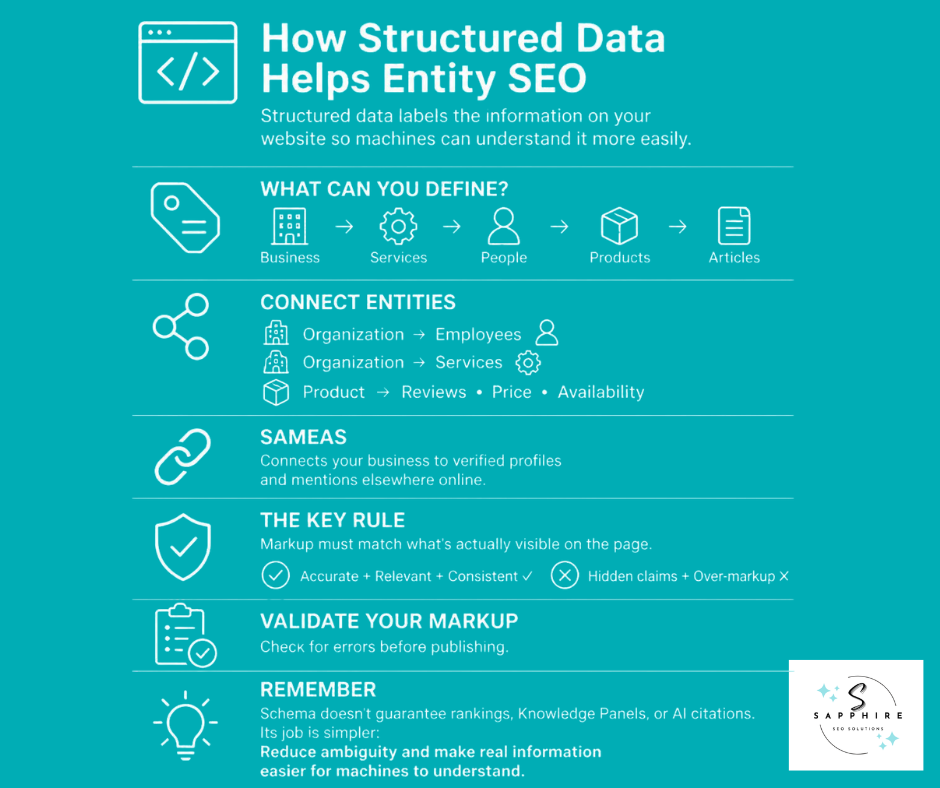
Structured data is a way of labeling the content already on your page so a machine can read it without guessing. Think of it as a translation layer. A human visitor reads "ABC Roofing, serving Dallas since 2010" and understands it instantly. Structured data spells that same information out in a format a search engine can parse directly, no interpretation required.
Most structured data on the web follows a shared vocabulary called Schema.org, a collaborative standard built and maintained by Google, Bing, Yahoo, and Yandex together. It defines a common set of types businesses can use to label their content: Organization, LocalBusiness where a physical location or service area applies, Person, Product, Service, Article, and plenty of others.
Each of these types can also express relationships between entities. An Organization can be marked up with employees who are Person entities. A Service can be connected to the Organization that provides it. A Product can be tied to reviews, pricing, and availability. This is also where sameAs comes in: a property that points to other verified profiles of the same business or person, like a Wikipedia page, a verified social profile, or an industry directory listing. Used where it's genuinely accurate, sameAs helps confirm that different mentions across the web refer to the same entity, not a different business that happens to share a name.
Here's the part that matters most, though: implementing schema markup correctly means matching it to what's actually visible on the page. If your markup states a business offers a service that's nowhere mentioned in the visible content, that's not smart optimization. It's a mismatch a search engine is likely to catch, and it undermines the exact clarity you're trying to build. The same goes for over-marking everything possible just because a schema type technically exists. More markup isn't automatically better. Accurate, relevant markup is what actually helps.
Once markup is in place, it's worth validating it, using a tool like Google's Rich Results Test or the Schema Markup Validator, to confirm it's structured correctly and free of errors. A broken implementation doesn't help anyone, and it's an easy thing to miss without checking.
One thing worth being direct about: schema markup doesn't tell a search engine exactly who you are, and it doesn't guarantee your business gets cited by an AI tool. It's not a ranking cheat code, and it never has been. What it does is remove ambiguity. It confirms, in a format machines read easily, facts that are already true and already visible on your site. That's a meaningful advantage. It's just not a magic switch, and treating it that way sets expectations that structured data was never built to meet.
Building External Corroboration for Your Business Entity
Your website tells search engines who you say you are. That's a start, but it's not the whole picture. What actually strengthens that picture is corroboration: independent sources confirming, in their own words, the same facts your business is telling everyone about itself.
Think about how trust works between people. If someone tells you they're a great electrician, that's one data point. If three of your neighbors independently say the same thing, that carries a lot more weight. Search engines work in a similar way. A business claiming expertise on its own site is useful. That same expertise showing up in relevant industry profiles, reviews, and third-party mentions is a different kind of signal entirely.
A few sources tend to matter most here.
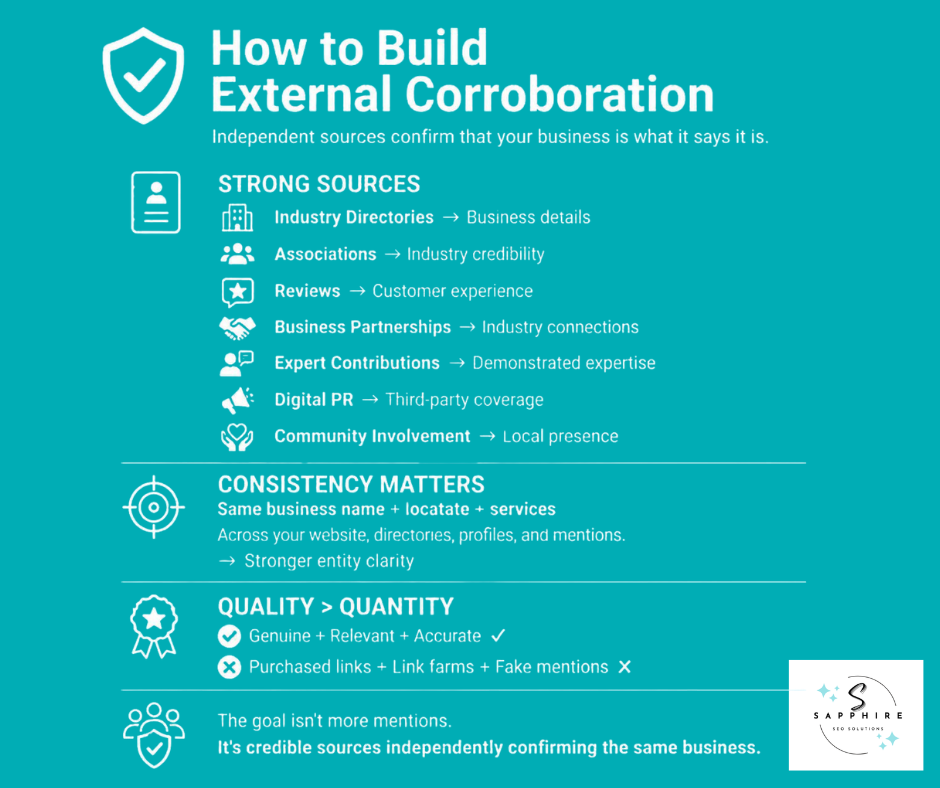
Legitimate directories, industry-specific ones especially, help confirm basic facts: name, location, services, category. Industry associations do something similar, but with added credibility, since membership usually means meeting some baseline standard. Genuine reviews, left by real customers describing real experiences, tell a story no amount of self-description can replicate. Partnerships with other reputable businesses, suppliers, contractors, and complementary service providers add another layer of context about where a business fits in its industry.
Expert contributions matter too. A founder quoted in a trade publication, or writing a guest piece for an industry site, does more to establish real expertise than another page on the company's own website ever could, simply because it comes from somewhere else. The same goes for digital PR and coverage in relevant publications, when it's earned through something genuinely newsworthy, not manufactured for the sake of a mention. Even community involvement, sponsoring a local event, participating in a trade group, plays a role, especially for businesses that depend on local trust.
Running through all of this is one requirement that's easy to overlook: consistency. A business name, address, or service description that varies from one directory site's listing to the next makes it harder for a search engine to confirm these are all pointing to the same place. Consistency is what turns scattered mentions into genuine entity connections, and 그 clarity supports both traditional search and how AI systems describe a business when someone asks about it.
What corroboration is not is a numbers game. Buying backlinks, submitting to link farms, spinning up profiles on every directory that exists whether relevant or not- that's not corroboration. Neither is what some in the industry call entity stacking, artificially manufacturing mentions across low-quality sites just to inflate a count. As Search Engine Land and other credible industry sources have pointed out, this kind of manipulation tends to get flagged rather than rewarded, and it doesn't build the kind of genuine, independent confirmation that actually matters. There's no magic number of mentions that unlocks authority. What matters is whether the sources are real, relevant, and accurate.
Entity SEO, E-E-A-T, and Demonstrating Expertise
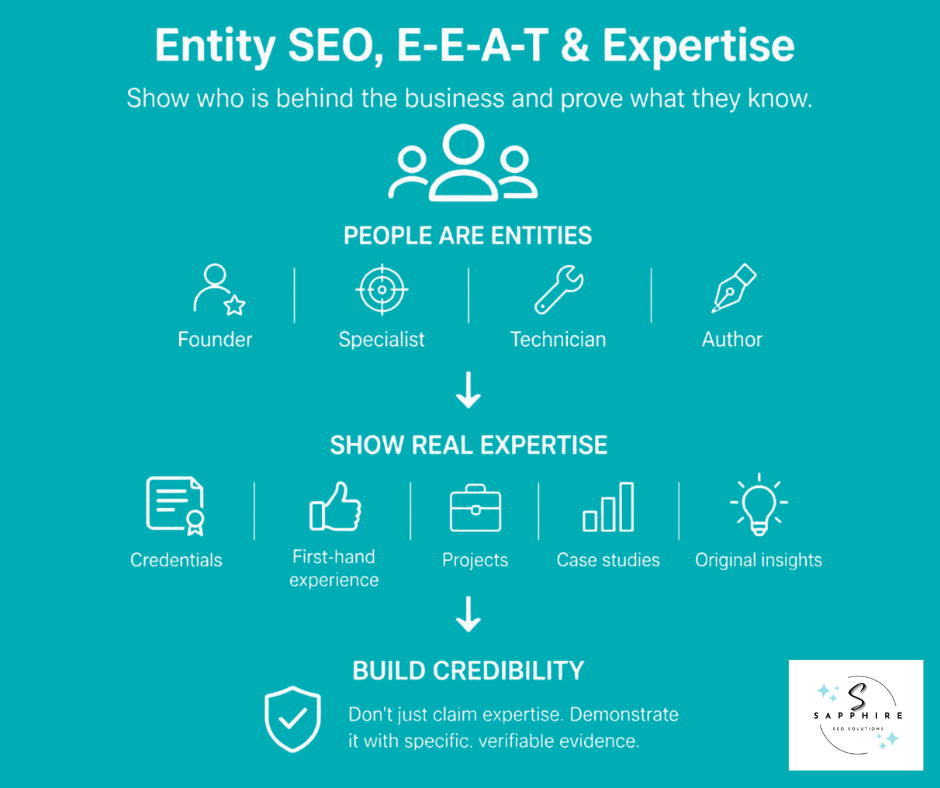
People are entities too, and that's easy to forget when most SEO advice focuses entirely on the business itself. A founder, a lead technician, a specialist on staff- each of these is an identifiable entity in their own right, with their own attributes and their own credibility. When a business connects its content to real people instead of leaving everything anonymous, it adds a layer of context a faceless "our team" page never provides.
This connects directly to E-E-A-T, a framework Google's Search Quality Rater Guidelines use to describe experience, expertise, authoritativeness, and trust. Worth being precise here: E-E-A-T itself isn't a direct ranking factor Google applies to a page. It's a concept used to evaluate quality, and it shows up indirectly through the kinds of signals this whole guide has covered. Clearly, an entity representing a real author, for instance, gives readers and search engines something concrete to evaluate, rather than an unnamed voice making claims from nowhere.
Credentials matter here, but only when they're genuinely relevant. A roofing specialist's manufacturer certifications matter to a homeowner deciding who to hire. A vague list of unrelated awards doesn't add much, no matter how many are listed.
What tends to matter more is experience. Not the word "experienced" sitting in a sentence, but actual evidence of it. A first-hand account of handling a specific type of storm damage repair says more than a claim of "years of experience" ever could. Original examples, real project photos, specific numbers, details only someone who actually did the work would know, demonstrate expertise in a way generic claims can't fake.
Case studies do this particularly well, because they connect expertise directly to real work completed for real clients. That's the underlying principle worth holding onto: expertise should be visible, shown through specifics a reader can actually verify, not just stated and left for people to take on faith. A business doesn't earn credibility by saying it's an expert. It earns credibility by showing exactly why that's true.
Entity SEO and AI Search
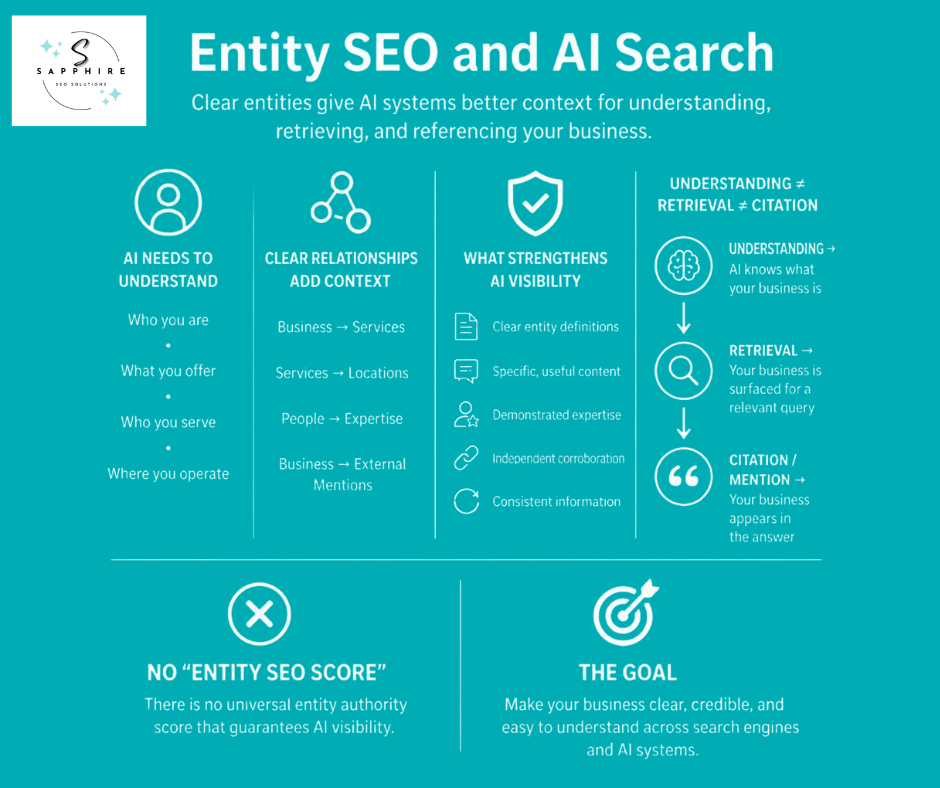
AI search works differently than traditional search results, but it depends on something familiar: interpreting information about businesses and other entities well enough to actually use it. Whether a tool is answering a direct question or summarizing options for someone, it has to figure out what a business is, what it offers, and whether it's a credible answer to whatever the person actually asked.
That's where entity understanding becomes just as relevant to AI search as it is to traditional search results. Clear entity definitions reduce the amount of guessing a system has to do. A business that clearly states who it is, what it does, and who it serves gives an AI tool less ambiguity to untangle before it can even consider using that information. Relationships add another layer of context on top of that. A service connected clearly to a location, and a location connected clearly to a business, helps a system understand not just what something is, but how it fits into a larger picture.
Strong content plays a real role here too. AI systems, broadly speaking, need well-structured, specific, genuinely informative content to draw from. A vague paragraph making general claims gives a system very little to work with. A page that clearly answers a real question, with real specifics, gives it something worth retrieving. External references matter in a similar way. Independent corroboration, reviews, mentions, industry profiles, doesn't just help traditional search engines build confidence in a business. It can factor into how AI tools weigh credibility as well. And consistency across all of it- the same name, the same facts, stated the same way everywhere- makes attribution easier, whether attribution means showing up in a Knowledge Panel or getting mentioned by name in an AI-generated answer.
One thing worth being clear about: there's no single entity-based SEO score that controls whether a business shows up in AI search. No dashboard produces one universal number, and any tool claiming to measure "entity authority" as a precise metric is measuring something it invented, not something these platforms have confirmed exists.
To learn more about AI SEO and AI search, make sure to read our detailed guides on:
Can Entity SEO Help Your Business Appear in AI Search?
Honestly, the fair answer is that it can contribute, but it doesn't guarantee anything. That's not a hedge to avoid a real answer. It's the most accurate way to describe how this actually works.
It also helps to separate three things that sound similar but aren't the same. A business can be understood by an AI system, meaning the system has a clear, accurate sense of who the business is and what it offers. That's a different outcome from being retrieved, which means that understanding actually surfaces when someone submits relevant search queries. And retrieval is different again from being cited or mentioned by name in an actual answer someone sees. A business can be well understood and still not get pulled into every relevant answer. User intent, the specific way a query is phrased, and how a given platform decides what to surface all play a role that's largely outside any one business's control.
It's also worth resisting the urge to treat every AI platform as though it works identically. They don't share the same architecture, the same data sources, or necessarily the same weighting of signals. What Google's Knowledge Graph contains isn't the same thing as what a large language model has learned during training, and treating those as interchangeable oversimplifies both.
What can be said with real confidence is this: entity clarity, genuine expertise, and independent corroboration all make a business easier to understand and more credible to reference, across traditional search and AI tools alike. That's a meaningful foundation. It's just not a guarantee, and any guide claiming otherwise is promising something nobody can actually deliver.
How to Create Content That AI Search Can Understand and Cite
So how does a business actually write content that AI search tools can pull useful information from? Not by writing specifically for one platform or gaming some imagined algorithm, but by writing clearly enough that the value is obvious to a machine and a person at the same time. Most of what works here is just good writing, applied with a bit more intention.
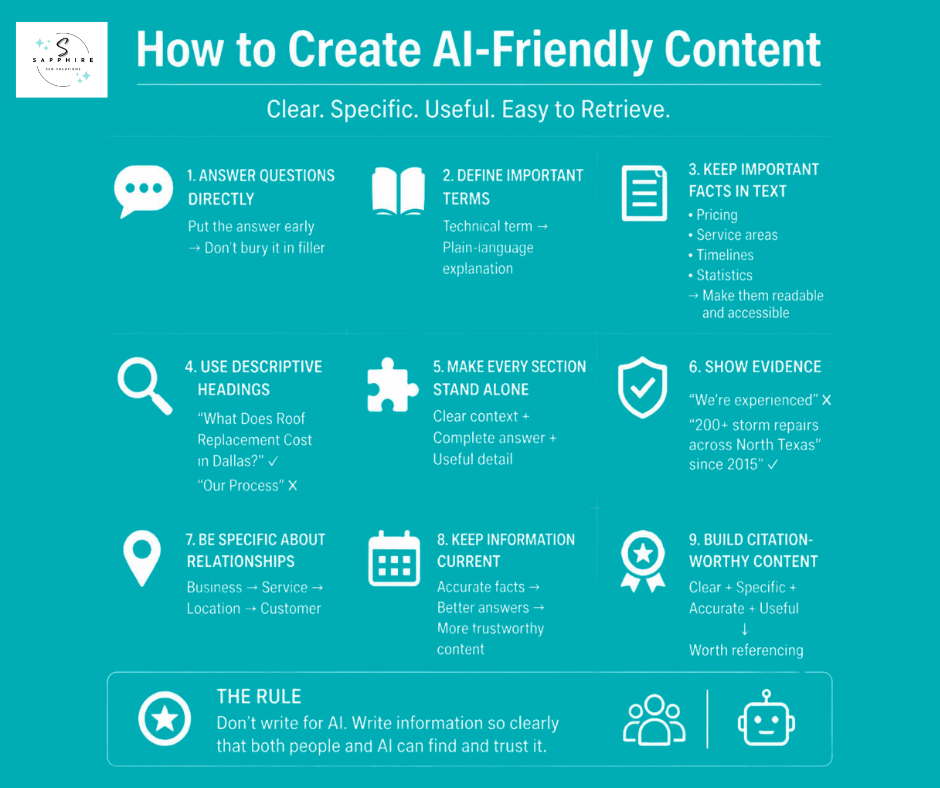
Start by answering questions directly. If a page is about how much a roof replacement costs, the answer should show up in plain language early on, not buried three paragraphs deep behind a story about the company's founding. A system trying to pull a useful answer out of a page has a much easier time when the answer is actually there, stated clearly, instead of implied.
Define important terms as you go. If a page mentions "storm damage assessment," it shouldn't assume the reader already knows what that involves. A quick, plain-language definition, right where the term appears, does double duty. It helps a homeowner who's never dealt with this before, and it gives an AI system a clear anchor for what that phrase actually means in context.
Put the facts that matter in accessible text, not buried in an image, a PDF, or a caption a system can't easily parse. Pricing ranges, service areas, typical timelines, whatever a reader actually needs to know, belongs in real, readable text on the page.
Descriptive headings help more than people expect. A heading like "What Storm Damage Roof Repair Costs in Dallas" tells a reader and a system exactly what's coming next. A vague heading like "Our Process" doesn't. And each section should hold up on its own. Someone (or something) pulling just one section out of a longer page should still be able to understand it without needing the rest of the article for context.
Claims need support. "We're experienced roofers" is a statement. "We've handled over 200 storm damage repairs across North Texas since 2015" is evidence. The second version is the kind of specific, original information that actually distinguishes one business's content from another's, and it's exactly the kind of detail that gives a page a reason to be ranked as web content worth surfacing over a generic competitor.
Avoid vague statements throughout. "We offer a variety of services" says almost nothing. "We offer roof repair, replacement, and storm damage restoration for residential homes in Dallas" says everything a reader or a system actually needs.
Business and service relationships should be explicit, not implied. A page shouldn't just mention "our services" in passing. It should state plainly that this business offers this specific service, in this specific area, for this specific kind of customer. That clarity is what produces genuinely relevant search results, because there's no ambiguity left for a system to resolve on its own.
Keeping information accurate and current matters more than it might seem. Outdated pricing, old service areas, or stale statistics don't just risk misleading a reader. They risk a system citing information that's simply wrong, which helps nobody. And throughout all of this, the goal is making important information easy to retrieve, structured clearly enough that a system scanning the page can find the actual answer without wading through filler to get there.
All of this adds up to something worth naming directly: citation-worthiness. That's not a checklist or a formula. It's simply the quality of being specific, accurate, well-organized, and genuinely useful enough that referencing your content is the right call for whoever, or whatever, is looking for an answer. User queries deserve real answers. Contextual relevance comes from actually providing one.
None of this involves hidden text, buried instructions aimed at AI crawlers, or formatting tricks dressed up as some AI-friendly hack. And no, a bulleted list doesn't guarantee anything gets cited. What earns a citation is the same thing that's always earned attention online: content that's clear, accurate, and genuinely worth referencing.
Our detailed guide on What Is SEO Content? explains more about how to write for humans and search engines, not just forcing in keywords. It perfectly complements this section on writing content that AI search engines can mention.
Entity SEO vs. AI SEO: What's the Difference?
By now, "entity SEO" and "AI SEO" have both come up enough that it's worth drawing a clear line between them. They're related, but they're not the same thing, and mixing them up leads to some confused expectations.
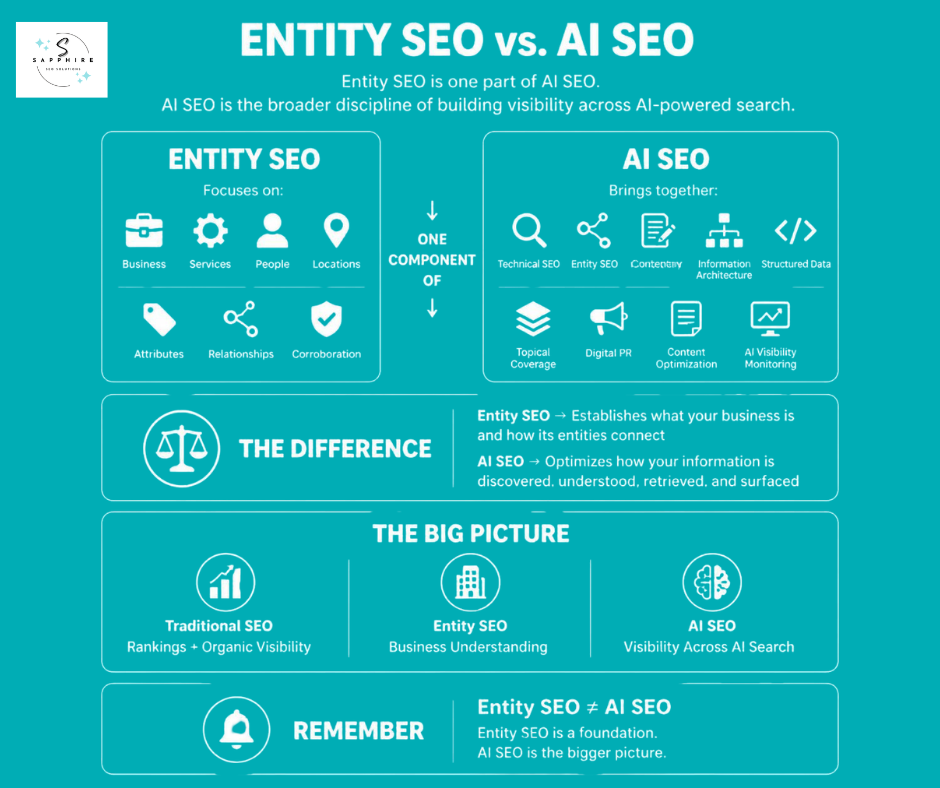
Entity SEO is focused, specifically, on establishing and strengthening identifiable entities and the relationships between them. The business, its services, its people, its locations, all clearly defined, all clearly connected. That's the scope. It's a real and important piece of the puzzle, but it's still just one piece.
AI SEO is bigger. It's a broader discipline concerned with how information gets discovered, interpreted, retrieved, and eventually cited or shown within AI-powered search experiences. That's a wider set of concerns than entity work alone can cover, and it pulls in several other disciplines to actually function.
AI SEO can involve:
Technical SEO, making sure a site is actually crawlable and fast enough to be processed in the first place
Entity SEO, the work this whole guide has been walking through
Content strategy, deciding what to create and why
Information architecture, how a site is organized and connected
Structured data, communicating facts in a machine-readable format
Topical coverage, making sure a subject is addressed in real depth
Digital PR, earning the kind of external mentions that provide corroboration
Content optimization, refining what already exists to be clearer and more useful
AI visibility monitoring, tracking how and where a business actually shows up across AI tools
So entity-based SEO sits inside AI SEO as one important component, not as a stand-in for the whole discipline. Calling AI SEO "SEO for ChatGPT" misses most of what it actually involves, and treating it as identical to entity work undersells everything else that has to come together to make a business genuinely visible.
Traditional search engine optimization hasn't gone anywhere in all this, either. Rankings, organic traffic, and search visibility still matter, and most of the fundamentals still apply. What's changed is the landscape those fundamentals now have to work within, one that includes AI-powered tools alongside traditional results, each with their own way of finding, understanding, and surfacing information. Entity SEO is one part of adapting to that landscape. AI SEO is the fuller picture of what adapting to it actually requires.
How to Measure Entity SEO and AI Search Visibility
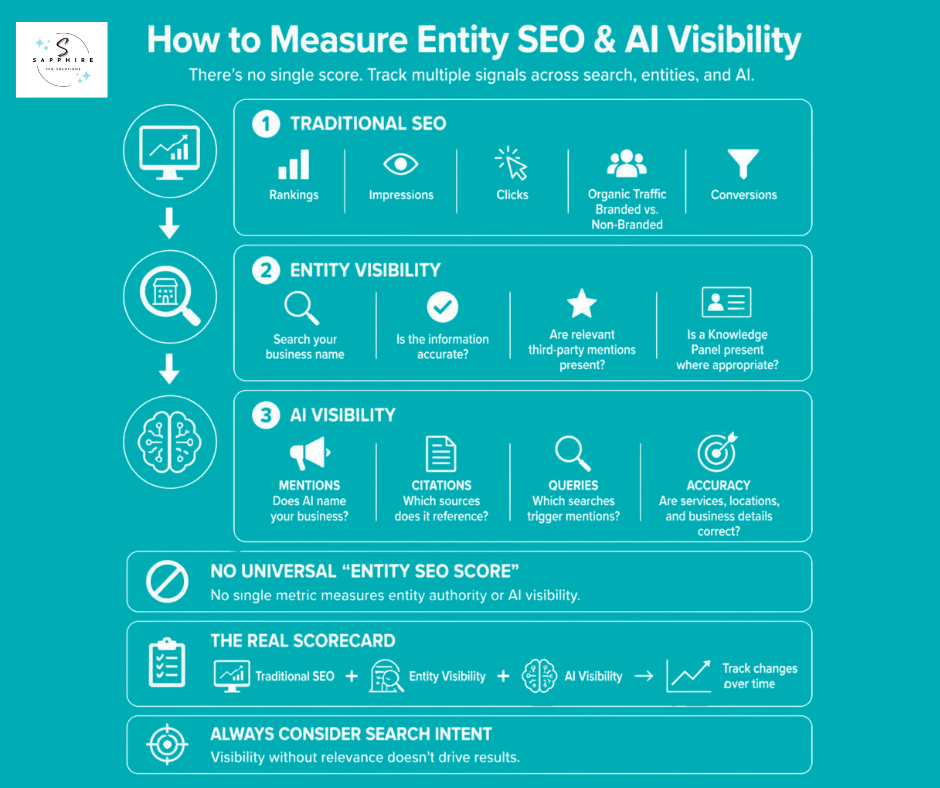
A fair question at this point: how do you actually know any of this is working? There's no single dashboard that answers that, but there are three layers worth tracking, and each one tells you something different.
Traditional SEO metrics are the most familiar starting point, and most business owners already have access to them through Google Search Console and analytics. Rankings for the terms that matter. Impressions and clicks, showing how often a business shows up and how often people actually visit. Organic traffic overall. The split between branded searches (people already looking specifically for your business) and non-branded visibility (people finding you without knowing your name yet). And, of course, conversions, since none of the rest matters much if it doesn't eventually lead somewhere.
Entity visibility is a different layer, closer to what this guide has focused on throughout. This is less about specific keyword rankings and more about how clearly and accurately a business shows up when people search for it directly.
What do search results actually show when someone searches your business name?
Is the information accurate?
Is there a Knowledge Panel, where one would genuinely apply?
Are there relevant mentions and third-party references showing up alongside your own site, or is your business the only source talking about itself?
Watching all of this over time gives a reasonable read on whether entity visibility is improving, even without a single number to summarize it.
AI visibility is the newest layer, and honestly the hardest to measure consistently, since the tools for tracking it are still catching up to the platforms themselves. Even so, there's real signal worth watching. Brand mentions across AI tools, when a business comes up by name in an AI-generated answer. Citations, specifically which sources an AI system pulls from and links to. Which queries tend to generate those mentions in the first place. Whether the service associations and location associations in an AI-generated answer are actually correct, since AI tools can get details wrong just like anyone else. And more generally, the accuracy of how a business gets described when it does come up.
Here's the important caveat running through all three layers: there's no universal entity SEO score, and no single number that captures "AI visibility" the way a keyword ranking captures search position. Any tool or agency claiming to hand you an "entity authority score" is presenting an invented metric as though it's an industry standard, when it isn't. The same goes for treating a Knowledge Panel appearance as proof that a strategy is working. A panel can be one encouraging sign among several. It's not a scorecard, and its absence doesn't mean the underlying work isn't paying off elsewhere.
Realistically, measuring this well means watching a mix of signals over time, not chasing one metric that claims to summarize everything. Search intent still matters in how you interpret all of it too. A business ranking well for informational questions but not converting on commercial ones is a different situation than a business invisible across the board, and the data should be read with that difference in mind, not flattened into a single score that promises more certainty than any of these systems can currently provide.
Common Entity SEO Mistakes
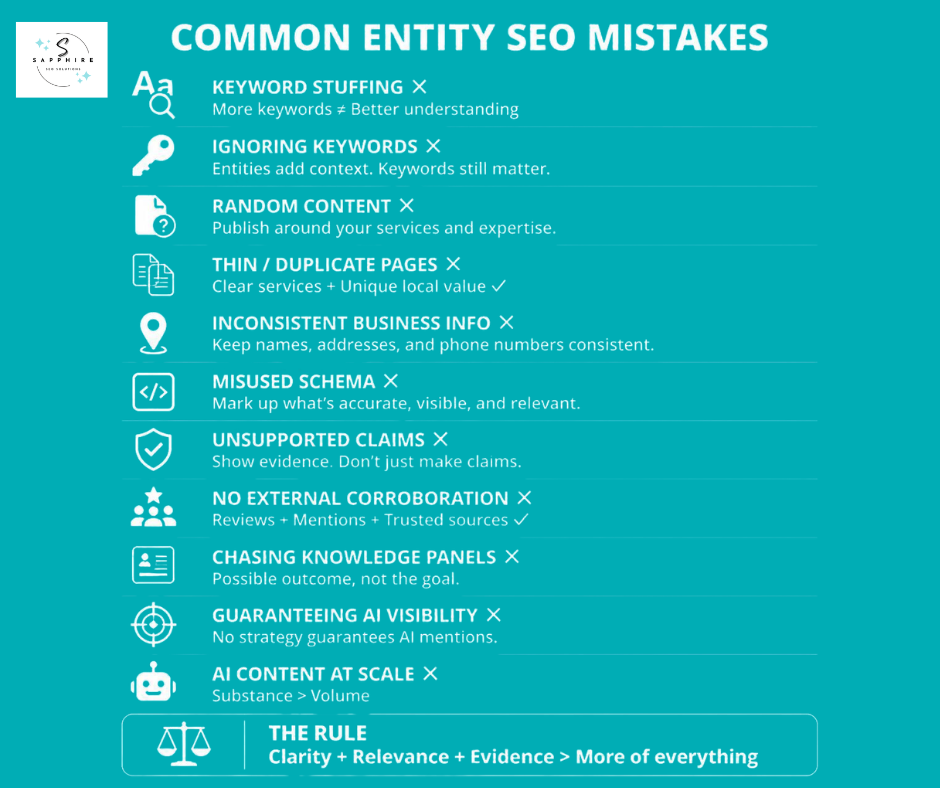
Even with a good understanding of how this works, it's easy to get the execution wrong. A few mistakes show up again and again, and most of them come from taking a good idea and pushing it too far in the wrong direction. Here are some of the most common entity SEO mistakes:
Treating entity SEO as a fancier version of keyword stuffing: Some businesses read about entities and start cramming their name and service terms into every sentence, thinking more mentions equal better understanding. It doesn't. That's just keyword matching with extra steps, and it reads exactly as unnatural as old-school keyword stuffing always did.
Assuming keywords don't matter anymore now that entities are part of the conversation: Keywords still matter. Keyword optimization still tells you what people are actually searching for. Entity work adds context on top of that. It doesn't replace it.
Publishing unrelated blog posts: Content with no connection to the business's actual services or expertise, published because a keyword tool flagged it as having decent search volume. A general industry news roundup or a post with no real tie to what the business does might get a click, but it doesn't build anything.
Thin service pages: A single paragraph describing five different services doesn't give a search engine, or a reader, enough to actually understand any of them. And on the location side, mass-produced pages, a dozen city pages with the same three sentences and a swapped-out name, create the opposite of clarity. They read as filler because they usually are filler.
Inconsistent business information: A different phone number on one directory, a slightly different business name on another, a mismatched address somewhere else. Each one seems small. Together, they make it harder for anything to confidently confirm these are all the same business.
Structured data gets misused: Marking up information that isn't actually visible on the page, or by applying every schema type available whether it's relevant or not, can do harm. Structured data should reflect what's on the page, nothing more.
Making unsupported claims: "Industry-leading" and "best in the region" without anything backing it up doesn't build credibility. It just sounds like every other business making the same claim.
Creating content without real expertise behind it: Content that sounds knowledgeable but was written by someone with no actual connection to the work tends to be vague in ways that are hard to hide.
Focusing only on first-party information: A business that only talks about itself, on its own site, misses the corroboration that comes from third-party mentions, reviews, and relevant external references. Chasing Knowledge Panels falls into a similar trap, treating a byproduct as a goal, and getting frustrated when a panel doesn't appear despite genuinely solid work elsewhere.
Treating AI visibility as something guaranteed is a newer version of an old mistake: No entity strategy, however well executed, promises a business will show up in every relevant AI-generated answer.
Publishing AI-generated content at scale without adding real value: Volume without substance doesn't build entity signals. It just adds more pages that don't say anything new.
Most of these mistakes share a root cause. They chase the appearance of progress, more content, more mentions, more markup, without the underlying clarity and substance that actually make any of it worth something.
Entity SEO Checklist for Small Businesses
With everything this guide has covered, it helps to have a shorter, practical version to actually work from. Here's a condensed checklist covering the essentials, organized by area:
Entity SEO Checklist for Small Businesses
With everything this guide has covered, it helps to have a shorter, practical version to actually work from. Here's a condensed checklist covering the essentials, organized by area.
Business
Before anything else, the fundamentals need to be locked down. This is where entity clarity starts.
Website
This is where the business identity actually gets built out into something a search engine and a reader can navigate.
Structured Data
Markup should support what's already true and visible, nothing more.
External Presence
This is where relevant entities outside the business itself come into play, confirming what the business says about itself.
AI Visibility
The same clarity that helps traditional search also helps AI tools interpret and use a business's information well.
Working through entity mapping using a list like this doesn't require chasing article quotas or hitting a fixed number of backlinks.
Optimizing entities is about entity context built through real clarity, not volume.
A small business that genuinely nails each of these five areas is in a stronger position than one that's simply produced more content or collected more links without any of it connecting to something real.
Working through entity mapping using a list like this doesn't require chasing article quotas or hitting a fixed number of backlinks. Optimizing entities is about entity context built through real clarity, not volume. A small business that genuinely nails each of these five areas is in a stronger position than one that's simply produced more content or collected more links without any of it connecting to something real.
When Should a Small Business Invest in Entity SEO or AI SEO?
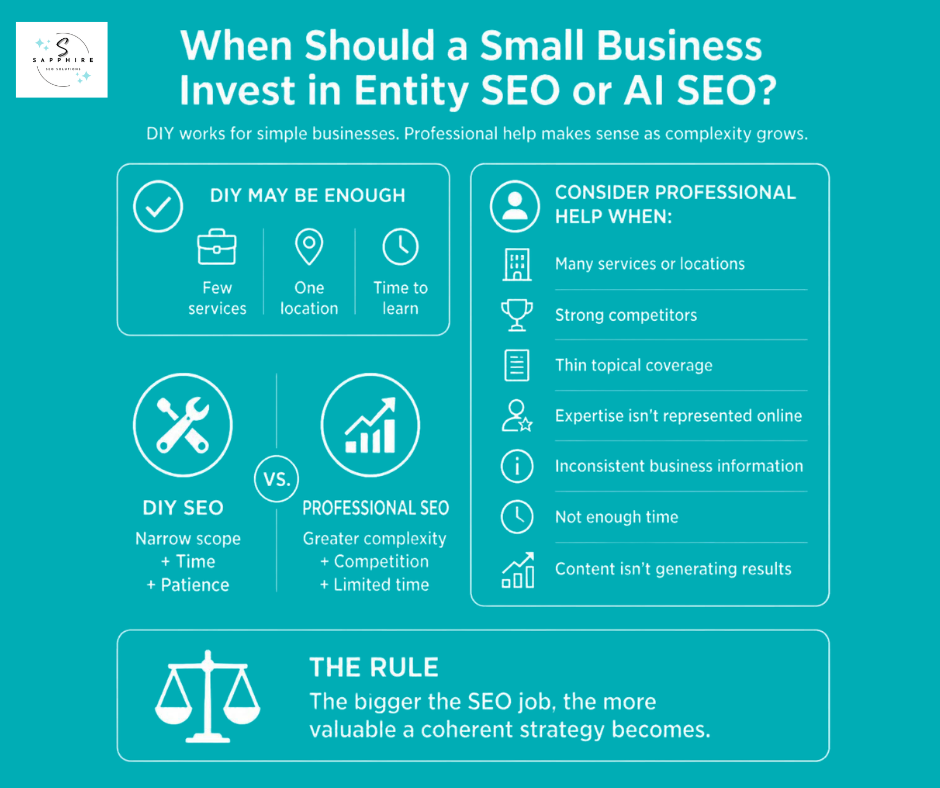
Not every small business needs professional help to put the ideas in this guide into practice. A business with a handful of services in one location can often work through the checklist above on its own, with some time and attention. But there are situations where bringing in outside help genuinely makes sense, not because DIY is doomed to fail, but because the scope of the work outgrows what one person can reasonably manage alongside running an actual business.
A few signs tend to show up together when that point arrives, and they include:
A website with many services: Each service page deserves its own dedicated page, real depth, and clear connections to the rest of the site; it takes considerably more time to build out properly than a business with two or three offerings. Serving multiple markets multiplies that same work again, since each location deserves genuine relevance, not a template with the city name swapped out.
Competition: When competitors already dominate the search results for the terms that matter, closing that gap takes more sustained effort than occasional updates can produce. A related sign is a site with little topical depth, one or two pages per subject where competitors have built out real coverage over years.
Expertise that exists but isn't represented online: A business might have genuine knowledge and experience that simply never made it onto the website in any useful form, which means none of that expertise is currently doing any work for the business's visibility.
Inconsistent information across the web: Different details on different platforms are tedious to track down and fix, and easy to keep putting off without dedicated attention. And for businesses specifically interested in showing up well in AI search, this newer landscape often calls for expertise that's still developing, since best practices here are less established than they are for traditional search engine optimization.
The owner doesn't have the time: Between running the actual business and everything this guide describes, something has to give, and it's usually the SEO work. Related to that, a business that's already invested in content, without much to show for it commercially, often needs a strategic reset more than it needs more of the same.
DIY vs. professional SEO, in short: DIY works well for a business with a narrow, well-defined scope, some time to invest, and patience to learn as it goes. Professional help tends to make more sense once the scope grows past a few services and one location, once competitors have a real head start, or once the business genuinely doesn't have the bandwidth to do this work consistently over time.
None of this means every small business must hire an agency to see results. But when several of these signs show up at once, an entity-based SEO strategy built with professional support usually moves faster and more coherently than trying to figure it all out solo while also running the day-to-day. Entities matter either way. How you get there is the part that depends on your specific situation, and entity SEO helps most when the approach actually matches the size of the job in front of you.
What an AI SEO Agency Should Actually Do for a Small Business
If a business does decide to bring in outside help, it's worth knowing what that help should actually look like. Not every provider calling itself an AI SEO agency approaches this work the same way, and understanding the difference matters before signing anything.
A competent provider starts by actually looking closely before recommending anything. That means reviewing existing entity clarity, how clearly the business, its services, and its locations are currently defined and connected. It means auditing business information for accuracy and consistency across the sites where it already appears. It means understanding search intent behind the terms that matter, not just pulling a list of keywords with decent volume.
From there, real keyword optimization should factor in alongside the entity work, not get abandoned in favor of it. The provider should assess service architecture, whether each offering has a proper dedicated page or whether everything's crammed into one, and evaluate topical coverage to see where real depth is missing. Content quality deserves genuine scrutiny too, not just a count of how many pages exist. Internal linking should be reviewed for whether it actually connects the site logically, and structured data should be checked for accuracy, not just presence.
External corroboration matters as well, examining whether the business has legitimate third-party mentions and reviews backing up what it says about itself. AI visibility should be assessed using whatever reasonable signals are currently available, understanding those tools are still evolving. Competitor positioning helps clarify where the business actually stands, not in the abstract, but against the specific businesses it's competing with for the same customers. And measurement should be built in from the start, not tacked on as an afterthought once work is already underway.
That's a lot to evaluate, which is exactly why it helps to know what to ask before hiring anyone.
Questions to Ask an AI SEO Agency
How do you measure AI visibility, specifically, and what does that reporting actually look like?
How do you decide what content to create, and what's that decision based on?
How do you establish business entities, in practice, not just in theory?
How do you avoid AI-generated filler, given how easy it's become to produce content that says very little?
How do you connect AI SEO with traditional SEO, rather than treating them as separate, competing efforts?
What will you actually change on my website, specifically, in the first few months?
A provider that can answer these clearly, with real specifics rather than vague reassurances, is worth taking seriously. One that leans on buzzwords about cutting-edge technology without answering what they'd actually do is a sign to keep looking. There's more than one legitimate way to approach entity strategy and entity mapping well. What matters isn't finding the one "correct" process. It's finding a provider who can explain their process clearly enough that it actually makes sense, and who demonstrates real entity understanding rather than reciting the same talking points every other agency uses.
How Sapphire SEO Solutions Can Help
Everything in this guide reflects how we actually approach the work at Sapphire SEO Solutions. Not as a checklist we run through once, but as the foundation for how we build out an AI SEO strategy for the small businesses we work with.
Here's the clearest way to put it: we create strategically planned content that helps search engines and AI systems understand your business, your services, your expertise, and your customers. That's a different thing than simply producing content and hoping it performs. It starts with understanding who a business actually is, then building everything else around making that understanding as clear as possible, to a person reading it and to the systems trying to interpret it.
In practice, that means keyword and search-intent research that goes beyond a list of terms with decent volume, actually understanding what someone wants when they search a given phrase. It means service-page content built with real depth, not thin pages that technically exist but don't say much. It means topical content that fills in genuine gaps, connected through internal linking that ties services, locations, and supporting content together in ways that actually make sense.
Content optimization plays a role too, refining what's already there rather than only ever adding more. And a meaningful part of our focus now goes toward AI-search-focused content specifically, built with the same clarity and evidence this guide has walked through, since the same qualities that help a page rank well tend to help it get understood and cited by AI tools too.
None of this works as a one-time project. Structured content architecture, the kind that connects a business, its services, its locations, and its expertise into something coherent, takes ongoing development to build and maintain properly, especially as a business grows or adds new services. And we measure search and AI visibility along the way, using the layered approach this guide already covered, not a single invented score that claims to summarize everything.
We won't tell you we can guarantee rankings, or promise you'll get mentioned in ChatGPT by name, because nobody can honestly make those promises, no matter what their sales page says. What we can do is build entity-based SEO and content strategy work that gives your business a genuinely clearer, more credible presence, both in traditional search engine optimization and in how AI tools understand and reference what you do. That's the work. Entity SEO is a meaningful part of it, and it's one we take seriously, because it's the part that actually holds everything else together.
Sapphire SEO Solutions Can Help Build Clarity That Compounds
Entity SEO was never about walking away from keywords. It's about building on top of them, taking a business that already knows how to show up for the right searches and making sure it's also clear, identifiable, contextualized, connected, and corroborated. Clear about what it is. Identifiable as a real, distinct business. Placed in context alongside its services and location. Connected through content that ties those pieces together. Corroborated by sources beyond its own website. And, in the end, genuinely useful to whoever's trying to find it.
Strong SEO still establishes relevance in search. Entity work adds clarity and relationships on top of that foundation. Real content demonstrates expertise instead of just claiming it. Structured data communicates the facts explicitly, so nothing gets left to guesswork. External references confirm what a business says about itself. Put together, these foundations support visibility across both traditional search and the AI-powered tools that are becoming part of how people find businesses like yours.
That's really the whole idea behind conclusion entity seo work: clarity compounds. If you're ready to see what clarity through AI SEO services look like for your business, Sapphire SEO Solutions is here to help you build it, one clear, connected piece at a time. Entity SEO helps most when it's built with intention, and that's exactly how we approach it. Contact us to schedule a free consultation today!

Frequently Asked Questions About Entity-Based SEO
What is entity SEO?
It's the practice of making sure search engines, and increasingly AI tools, can clearly identify your business as a distinct entity: what it is, what it does, and how it connects to related services, people, and places. It's about building understanding, not just matching keywords.
What is an entity in SEO?
Any identifiable thing or concept. A business, a person, a product, a service, a place. Your company is an entity. So is the city you serve and the person who founded it. Search engines work to identify these things and understand how they relate to one another.
Why are entities important for SEO?
Because search engines have moved well past simple word matching. They're trying to understand real businesses, with real attributes and real relationships. A business that's clearly defined tends to be easier to place, trust, and surface than one that's just a collection of keyword-optimized pages with no real clarity behind them.
How is entity SEO different from keyword SEO?
Keyword SEO asks what phrases people search for. Entity SEO asks what real-world thing a page or business is actually about, and how it relates to everything around it. They're not competing approaches, though. Keywords reveal demand and intent. Entities provide context. A solid strategy needs both.
What is the difference between entity SEO and semantic SEO?
Semantic SEO is broader. It's concerned with meaning and how concepts relate to each other across a site, using those relationships to help search engines understand context. Entity SEO is more specific. It's focused on clearly defining identifiable entities and their direct relationships. Think of semantic SEO as the wider lens, and entity SEO as one important piece within it.
What is the difference between entity SEO and topical SEO?
Topical SEO is about depth of coverage. Does a site actually address a subject thoroughly, or just skim the surface with a page or two? Entity SEO is about clarity of identity. Is the business, and everything connected to it, clearly and accurately defined? A site can have great topical coverage and still lack entity clarity, or the other way around. Strong sites tend to do both well.
What is Google's Knowledge Graph?
A system Google uses to organize information about real-world entities and the relationships between them, rather than just words on a page. It's what powers features like Knowledge Panels and helps Google understand the meaning behind a search, not just the literal words typed into it.
Does schema markup help with entity SEO?
It can, when it's implemented accurately. Schema markup is a way of labeling information already on your page so search engines can read it directly, without guessing. It's a communication aid, though, not a ranking shortcut. It works best when it matches exactly what's visible on the page, nothing more.
How do I optimize my website for entity SEO?
Start by clearly establishing the business itself: name, services, audience, location, and real expertise. From there, build dedicated pages for important services, add genuinely useful location pages where relevant, establish the real people behind the business, and connect everything with clear internal links. The goal is a site where the business, its services, and its content all clearly relate to one another.
Does entity SEO help with AI search?
It can contribute. Clear entity definitions and relationships give AI tools less ambiguity to work through, and strong, specific content gives them more useful information to draw from. That said, entity SEO alone doesn't guarantee visibility in any specific AI tool. It's one meaningful part of a larger picture.
Can entity SEO help my business appear in ChatGPT?
It can help make your business easier to understand and reference accurately, which matters for how any AI system might describe you. But no legitimate strategy can guarantee a mention in ChatGPT or any other AI platform by name. Anyone promising that outcome is promising something outside their actual control.
Does entity SEO replace traditional SEO?
No. Entity SEO works alongside keyword research, technical SEO, content strategy, and everything else that's always mattered for search visibility. It adds clarity and context on top of those fundamentals. It was never meant to replace them.
How long does entity SEO take?
There's no fixed timeline, since it depends heavily on how much needs to be built or corrected, how competitive the market is, and how consistently the work gets done. Clearing up basic inconsistencies can happen relatively quickly. Building out full topical depth, service pages, and external corroboration tends to take months of sustained effort, not a single sprint.
Do small businesses need entity SEO?
Most small businesses benefit from it, especially service businesses competing in crowded local markets. That doesn't mean every business needs a formal, professionally managed strategy right away. A business with a narrow service area and a handful of offerings can often apply the basics on its own. The bigger and more competitive the business gets, the more that clarity tends to matter.