

How to Get Mentioned in Claude Responses with Claude SEO
More people are turning to AI assistants before they ever type a search into Google. Someone needs a landscaper, an accountant, or new software, and instead of scrolling through ten blue links or waiting for the right Google Ads to show up, they just ask AI assistants.
Claude is one of those assistants. Built by Anthropic, it can search the web, pull in current information, and cite where that information came from when it answers a question.
That's where Claude SEO comes in. It's the practice of making it easier for Claude to discover your business, understand what you do, represent it accurately, and cite or recommend it when someone asks something relevant.
It works differently than traditional SEO, though. There's no ten-result results page here, so there's no "position #1" to chase.
Here's the part that matters most, though: you don't need a separate website or a whole new strategy built just for Claude. The same strong site, clear content, and real expertise that support your visibility elsewhere can support it here too.
This guide covers how Claude finds business information, what makes a business easier to understand, how to optimize a website for AI search, how Claude's crawlers affect accessibility, and how to measure whether any of it is working.
Key Takeaways
Claude SEO means being discoverable, understood, accurately represented, cited, or recommended by Claude.
There's no "position #1" in Claude. No ten-result page. No universal ranking spot.
Claude can run a Claude web search, retrieve sources, and cite them when it answers.
You don't need a separate website or strategy. One strong site can serve Claude and Google.
Traditional SEO (content, structure, authority, accessibility) is still the foundation everything else builds on.
Being cited isn't the same as being recommended. Recommendation requires matching a specific need.
Claude's crawlers- ClaudeBot, Claude-SearchBot, and Claude-User- each serve different purposes and matter differently.
Vague, generic content gives Claude little to work with. Specific, evidence-backed content performs better.
One test doesn't prove visibility. Test real questions repeatedly to see real patterns.
Claude SEO is one part of a broader generative engine optimization and AI search readiness strategy, not a standalone fix.
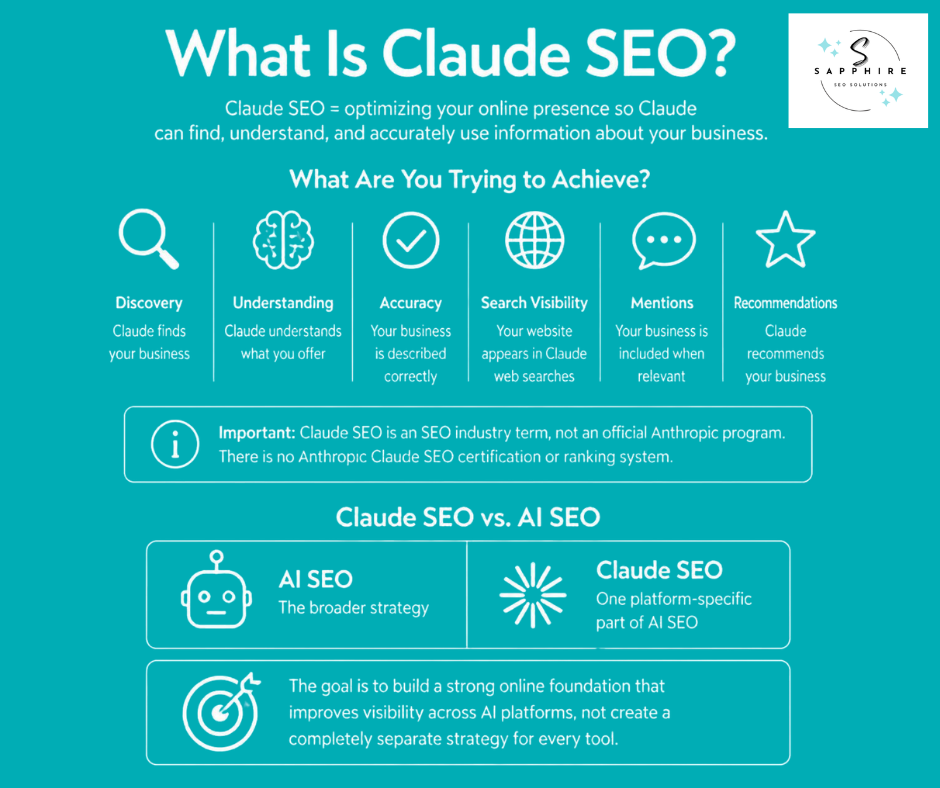
What Is Claude SEO?
Claude SEO means giving your business a better shot at showing up when someone uses Claude to research a problem, a product, or a company like yours. When Claude runs a Claude web search, it pulls information from the open web and pieces together an answer. Claude SEO is about making sure that information, if it involves your business, is accurate, findable, and worth using.
Businesses pursuing this are really after a handful of things. Getting discovered in the first place. Being understood correctly. Getting described accurately. Showing up in web search results when Claude checks the web. Getting mentioned when it's relevant. And, ideally, getting recommended.
One thing worth clearing up. Claude SEO isn't an official Anthropic program. There's no dashboard, no certification, no ranking system Anthropic runs. It's a term the SEO and search engine world uses to describe optimizing for visibility inside Claude, the same way "Google SEO" describes optimizing for Google.
Simply put, you can say that AI SEO is the broader strategy. Claude SEO is one platform-specific piece of it.
Claude SEO Is Part of AI SEO
Claude is one AI environment among several people now use to research things. AI SEO covers visibility across all of them, not just Claude. So the goal isn't building a separate strategy for every AI tool that exists, including Google AI Overviews or AI Mode. It's building one strong foundation that carries across platforms. Our AI SEO Services page covers that broader approach in more depth.
What Does "Being Visible in Claude" Actually Mean?
Visibility in Claude can look like a few different things, and they're not all the same. Sometimes your business just gets mentioned in an answer. Sometimes Claude goes further and recommends it. Sometimes your website shows up as one of the cited sources, with a source URL linked back to your site. Sometimes your content is the material Claude actually pulls from to answer the question. And sometimes it's simpler than any of that: Claude just describes what you do correctly, and your business shows up because it's genuinely relevant to what someone asked.
Each of those forms of visibility offers its own kind of real value, and none of them guarantee the others.
How Does Claude Search Work?
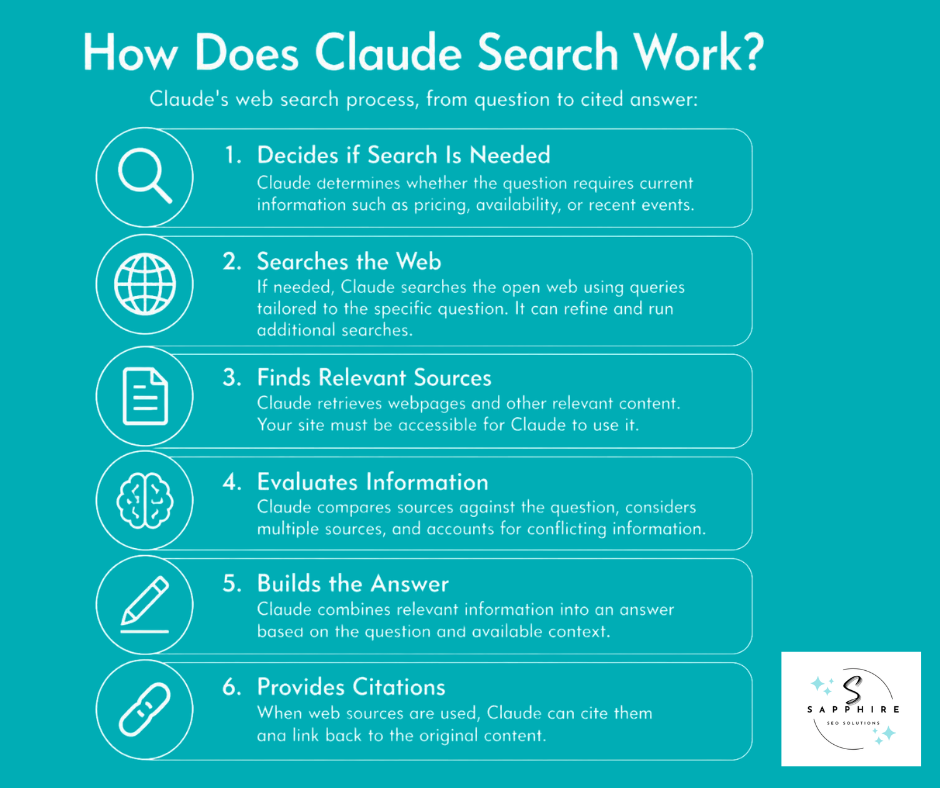
Here's how Claude search works:
1. Claude Determines Whether It Needs Current Information
Not every question needs a fresh answer. Claude can handle plenty of questions using what it already knows. But when a question calls for something current, like pricing, availability, or recent news, Claude decides whether pulling from the web would make the answer better.
2. Claude Searches the Web
When it decides a search would help, Claude runs one, built around the specific question being asked. It's not the same generic query every time. And if one search doesn't turn up enough, Claude can run another, refining as it goes until it has what it needs to answer well.
3. Claude Retrieves Relevant Sources
From there, Claude pulls in webpages and other content from the open web that seem relevant to the question. Relevance matters here, not just existence. This is also where your website's accessibility starts to matter. If Claude can't reach a page, it can't use it, no matter how good the content is.
4. Claude Evaluates the Information
Once Claude has sources in hand, it weighs them against what the person actually asked. Sometimes that means pulling from several sources at once, inside its context window, to build a fuller picture. And when sources disagree with each other, that conflict can shape how confidently Claude represents a business or a claim.
5. Claude Builds an Answer
With the relevant pieces gathered, Claude puts together a response. What that response looks like depends entirely on the question in front of it and the context around it. Two similar-sounding questions can lead to two different answers.
6. Claude Provides Citations
When an answer draws on public web content, Claude can include citations pointing back to where the information came from. Claude can also pull directly from a specific page through web fetch when a URL is given or relevant. That citation is where a business gets the chance to have useful, accurate information referenced. It's not guaranteed. But it's the opening.
For a broader look at how AI tools search and answer questions in general, see our How Does AI Search Work? guide.
How Does Claude Find Information About a Business?
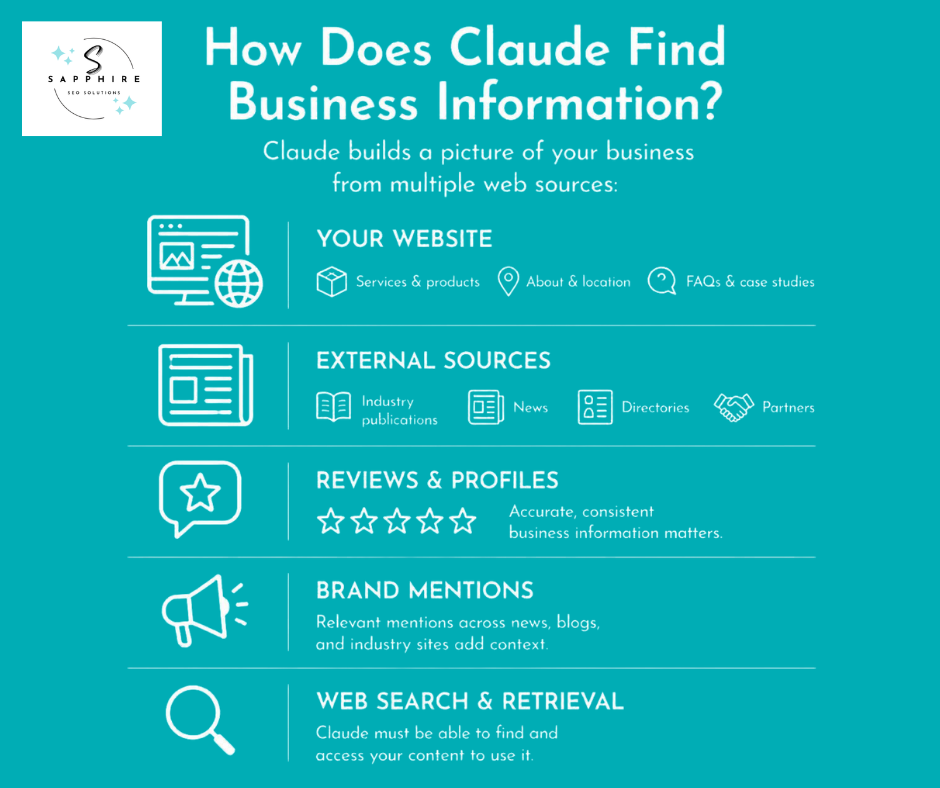
Claude doesn't pull from one single knowledge base. It draws from several different places, and each one plays a different role in how accurately Claude understands a business.
Here's how Claude finds information about a business:
Your Business Website
Your site is usually the most direct source. Claude has firsthand material to work with from the following on your site:
Service and product pages
Your about page
Location details
Staff expertise
Case studies
FAQs
Original research
How well that information comes through depends partly on things like site structure, title tags, and structured data, which we'll get into later.
Other Websites and Publications
Claude also picks up context from outside your own URL. This includes:
Industry publications
Relevant news coverage
Professional organizations
Directories
Partners
Other authoritative sites all add to the picture
None of this means you should chase mentions for the sake of having them. It just means the wider web plays a role, not only what's on your own page.
Reviews and Business Profiles
Reviews and business profiles add to the broader pool of information floating around about a company. A listing like your Google Business Profile, the kind that shows up in the local map pack, feeds into Google's maps intelligence, and keeping NAP consistency (name, address, phone) accurate across those platforms helps Claude form a clearer, more consistent picture too. It can also affect whether that information shows up in rich results elsewhere on the web.
Brand Mentions
Businesses get discussed in plenty of places that aren't their own website. A mention in a local news roundup, a partner's blog, or an industry forum all add context. More mentions don't automatically mean better visibility, though. What matters is whether those references are relevant and accurate, not how many exist.
Claude's Search and Retrieval Systems
None of this matters much if Claude can't actually reach it. Claude relies on its own search and retrieval systems to find and pull in information from site owners across the entire site, not just a handful of pages. Whether those systems can access your content in the first place comes down to some genuinely Claude-specific technical factors, which is exactly what we'll cover next.
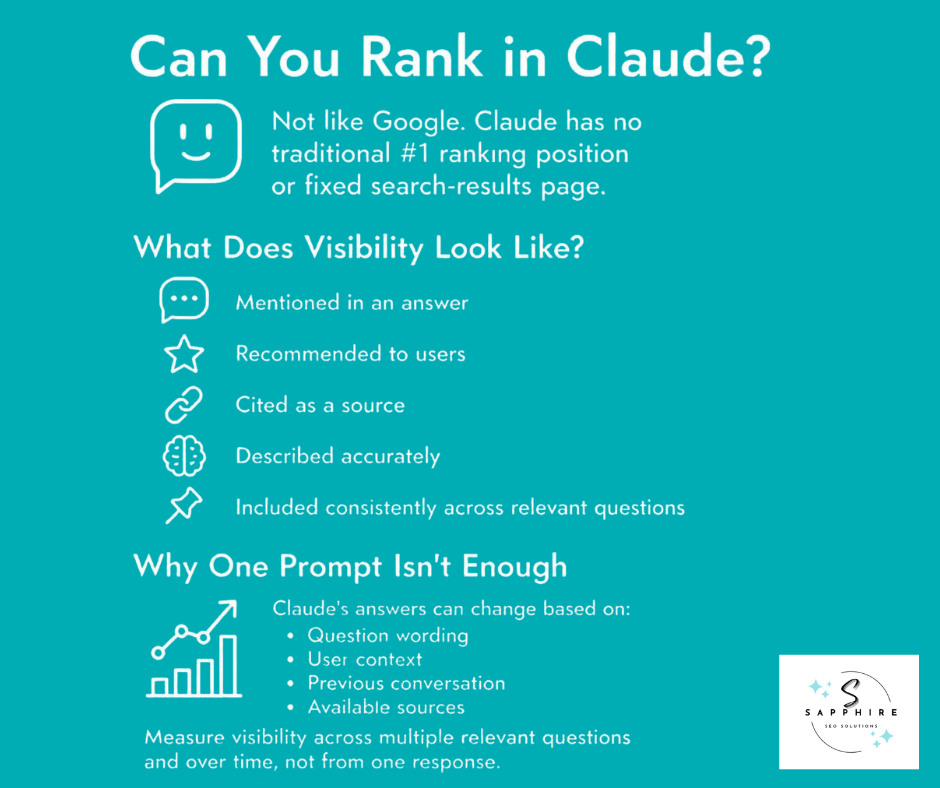
Can You Rank in Claude?
Here's what you need to know about ranking in Claude:
Claude Doesn't Have a Traditional "Position #1"
If you're used to checking SE Ranking or watching where you land in Google search results, Claude works differently. There's no ten-result list to climb. Claude generates a response based on the question in front of it and whatever information it finds relevant, and that response can look completely different from one question to the next. So there's no single, universal ranking position to chase. That doesn't mean visibility is out of your hands, though. It just means influencing it looks different.
What Claude Visibility Actually Looks Like
Visibility can show up in a few different forms, and they're not interchangeable. Sometimes it's a simple mention. Sometimes it's a full recommendation. Sometimes your site gets cited as a source. Sometimes Claude just describes your business accurately when it comes up. And sometimes it's about being included in the answer at all, or showing up consistently across several related questions rather than just one. Each of those matters, but not equally, and none of them can be guaranteed.
Why One Claude Response Doesn't Tell You Much
Ask Claude the same general question two different ways, and you might get two different answers. Context changes things too. Who's asking, what they've asked before, and how the question is worded. A competitor might show up for one version of a question and disappear for another. That's why testing a single prompt once and calling it a result doesn't tell you much. Real visibility only shows up across a range of relevant questions, tested over time.
What Does Claude Need to Know About Your Business?
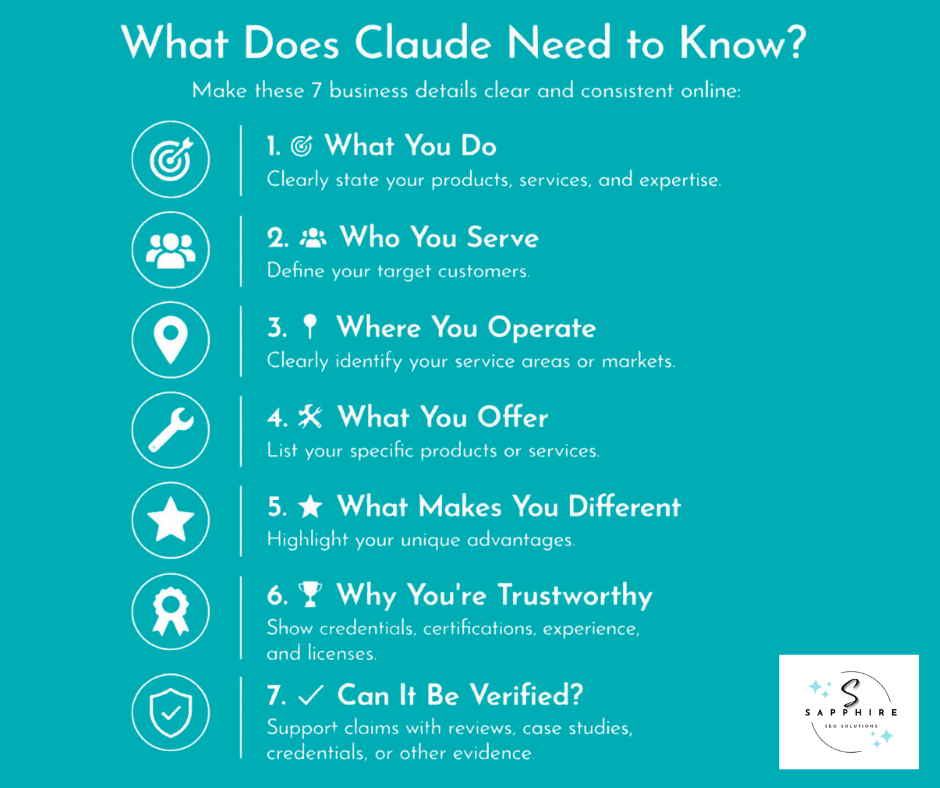
Claude needs to know a couple of things about your business before it can decide whether to mention it. This includes:
What Does Your Business Do?
Claude needs a plain, specific answer here. "We install and repair HVAC systems for homeowners in Phoenix" tells Claude a lot more than "we provide home comfort solutions." Vague descriptions force guesswork, and guesswork makes accurate representation harder.
Who Do You Serve?
A local SEO client base looks different from an international SEO or e-commerce SEO business, and Claude needs to know which one you are. A landscaper serving Austin homeowners and a SaaS company selling to enterprise clients worldwide need to be described very differently.
Where Do You Operate?
Service area matters. A plumber working three zip codes and a consulting firm working across the country need that distinction to come through clearly and consistently, everywhere your business is mentioned online.
What Products or Services Do You Offer?
This one should be specific and complete. Not "we offer solutions," but the actual list: what you sell, what you fix, what you build. If your website and your directory listings disagree, that inconsistency doesn't help Claude get it right.
What Makes You Different?
Every industry has competitors offering something similar. What separates a business from the next one over is worth stating directly instead of leaving Claude to infer it from context clues.
Why Should Someone Trust You?
Credentials, years in business, licenses, certifications. These give Claude something concrete to point to, rather than a vague sense that a business seems credible.
Can Your Claims Be Verified?
A claim backed by something checkable- a review, a case study, a credential- carries more weight than one sitting on its own. Unverifiable claims are harder for Claude to represent with confidence.
How to Optimize Your Website for Claude
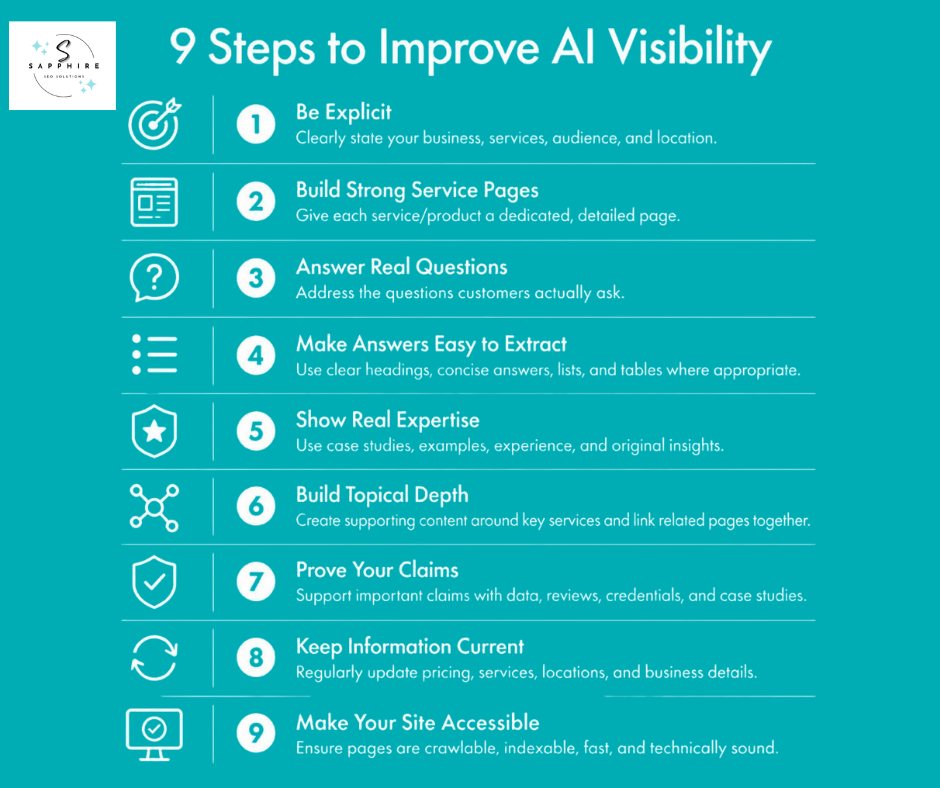
Here are the nine steps to follow to optimize your site for Claude:
1. Make Your Business Information Explicit
Don't make Claude guess. State clearly what your business does, what services or products you offer, who you serve, and where you operate. A landscaping company should say "we design and install backyard landscaping for homeowners in Austin, Texas," not leave that buried in vague brand language. That said, this isn't about stuffing your business name into every sentence or writing copy that only exists to please an algorithm. Say it plainly, once, in the places that matter: your homepage, your about page, your service pages.
2. Create Clear Service and Product Pages
Every service or product deserves its own page with one clear job. Explain what it is, who it's for, and what problem it actually solves. Include real specifics, pricing ranges, timelines, what's included, rather than generic copy that could describe any competitor's page just as easily. And resist the urge to spin up a dozen near-identical pages just to target slightly different keyword variations. One strong page beats five thin ones.
3. Answer Real Customer Questions
Think about what people actually ask before they buy. Some of that is informational. "How much does a kitchen remodel cost in Denver?" Some of it is more about narrowing down a decision. "What's the difference between a general contractor and a design-build firm?" Answer those questions directly, using real keyword research as a starting point, not a script. Skip the questions nobody's actually asking. They won't help a customer, and they won't help Claude either.
4. Make Important Answers Easy to Extract
Use headings that describe what's actually in each section. Answer the question directly before adding context around it. Keep paragraphs tight. Use lists when something is genuinely list-like, and tables when a real comparison is happening, not because formatting feels like it "helps AI." Define any specialized term the first time it shows up. But don't over-format everything into bullet points either. A page that reads like a checklist front to back stops sounding like it was written by a person.
5. Demonstrate First-Hand Experience and Expertise (E-E-A-T)
Case studies, real examples, your actual process, opinions backed by years of doing the work. That's what separates a page with substance from one that could've been written by anyone. "We're industry leaders" tells Claude nothing. A specific example of a project you completed, a problem you solved, or a result you can back up tells Claude a lot. Skip the invented statistics and the AI-written anecdotes dressed up as real experience. That kind of thing tends to fall apart under scrutiny anyway.
6. Build Topical Depth Around Important Services
Your most important services deserve more than a single page. Build out supporting content around the questions, problems, and decisions connected to them, and link those pages together so the relationship is clear. This is really about topical depth: showing that you understand a subject fully, not just that you can define it once. Look for the content gaps where a real customer question goes unanswered on your site. Our What Is AI SEO? guide covers the strategy behind this in more depth.
7. Support Important Claims With Evidence
If you say something matters, back it up. Data, original research, credentials, case studies, reviews, or a mention from a credible third party all do that. "Best in the industry" without anything behind it is just a claim. A stat from a completed project, a client review, or a professional certification is evidence. Claude, like anyone reading your site, has an easier time trusting the second kind.
8. Keep Business Information Accurate and Current
Old pricing, discontinued services, outdated locations- none of that helps. And when your website says one thing while your directory listing says another, that inconsistency makes accurate representation harder across the board. Review your core business details regularly, especially after anything changes.
9. Make Your Website Technically Accessible
None of the above matters if Claude can't actually access your site. That's the foundation of technical SEO: making sure your pages are crawlable, indexable, and genuinely accessible, with clean internal links and structured data where it's actually useful. Core Web Vitals and tools like PageSpeed Insights are worth keeping an eye on too, since a slow, broken site is harder to use no matter who, or what, is reading it. Structured data can help clarify what's on a page. It's not some special code that unlocks Claude visibility on its own, though. It's just one more piece of good content quality and technical hygiene.
Claude Crawlers: Can Claude Access Your Website?
Here are the different elements Claude uses to access your website and how it does it:
ClaudeBot
ClaudeBot is Anthropic's training crawler. It collects public content that may be used to improve Claude's underlying models. Blocking it doesn't stop Claude from mentioning your business in a search-based answer. It only means your content won't be part of future model training. Worth understanding, but not the crawler that determines whether you show up in a live Claude response.
Claude-SearchBot
This is the one tied to search visibility. Claude-SearchBot indexes content specifically to power Claude's web search results. If it's blocked, your site can't be indexed for that purpose, which can affect whether your content shows up when Claude searches the web. Allowing it doesn't guarantee anything, but blocking it removes a real opportunity.
Claude-User
Claude-User fetches a page directly when someone asks Claude a question that requires pulling from a specific site in real time (live web accessibility). If a user asks Claude to check your pricing page and Claude-User can't reach it, that request simply fails. This is a separate agent from Claude Code, which is Anthropic's coding tool and works differently altogether.
Should You Block Claude's Crawlers?
If visibility in Claude matters to a business, blocking Claude-SearchBot or Claude-User works against that goal. That said, this isn't a call to open everything up without thinking it through. Review what each bot actually does, decide what fits your business, and make changes deliberately rather than editing robots.txt on a whim. And keep in mind that allowing crawler access isn't the same as ranking. It's a prerequisite, not a guarantee.
What Makes Content More Useful to Claude?
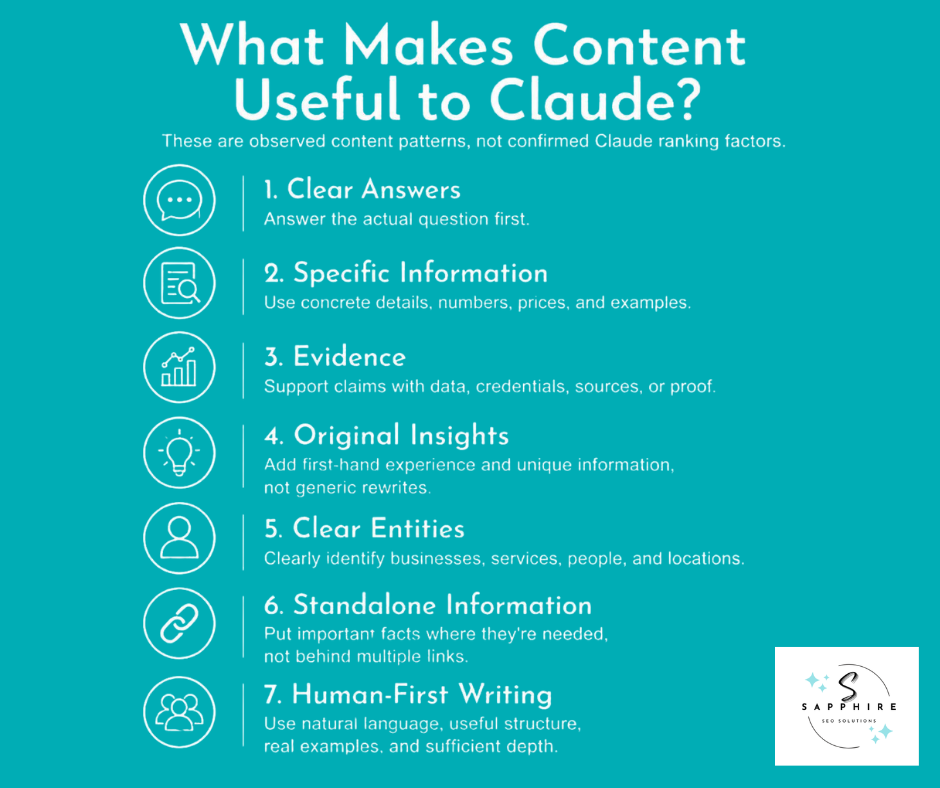
These aren't confirmed ranking factors. Nobody outside Anthropic knows the exact mechanics. But based on how Claude retrieves and uses information, some patterns show up again and again in SEO findings around what actually gets used as a source.
Clear Answers
Pages that answer the actual question tend to get used. If someone's asking what a service costs, bury that answer under three paragraphs of introduction, and it's harder for Claude to find and use. Lead with the answer. Add context after.
Specific Information
"We offer flexible solutions" says nothing. "We install tankless water heaters for $2,800 to $4,500 depending on unit size" says a lot. Concrete details give Claude something real to work with. This makes direct citations more accessible.
Evidence and Supporting Details
A claim sitting on its own is just an assertion. A claim backed by your own credentials, a number, a source, or an example carries more weight and gives Claude more reason to represent it confidently.
Original Insights and Experience
Full content that says something no other page says is worth more than content that repeats what's already out there. If ten sites explain the same concept the same way, there's little reason for any of them to stand out.
Well-Defined Entities
Being clear about who's involved matters. Which business, which service, which location, which person, and how they relate to each other. Ambiguity here just creates room for misrepresentation.
Information That Can Stand on Its Own
Important information shouldn't require digging through three linked pages to piece together. If a fact matters, state it plainly where it's relevant, not buried behind navigation.
Content Written for Humans First
None of this means writing for a machine. Natural language, sensible structure, real examples, and enough depth to actually answer the question- that's what serves a human reader well. It happens to serve Claude well too.
Can Claude Recommend Your Business?
Here's what small businesses need to know about Claude recommending them:
Being Cited Is Not the Same as Being Recommended
Getting cited and getting recommended aren't the same thing. Claude can reference your website as a source, pull a fact from it, or link back to it, without actually recommending your business to the person asking. A recommendation requires something more: Claude has to connect what you offer to the specific thing that person needs. A citation is a data point. A recommendation is a judgment call.
What Information Helps Claude Evaluate a Business?
There's no confirmed formula for this, and reviews alone don't decide it. But in general, the more clearly Claude can understand your services, expertise, location, reputation, reviews, what sets you apart, and how relevant third-party sources describe you, the better positioned it is to judge whether you're a good fit for someone's need. Customer fit matters too. A business that's excellent at one thing but wrong for the question being asked still isn't getting recommended for it.
Recommendations Depend on the Question
Ask Claude for the "best marketing agency," and you'll get a very different answer than asking for the "best affordable marketing agency for a small dental practice in Dallas." The second question hands Claude far more to work with: budget, industry, location. That extra context changes what's actually relevant, and it changes what a good answer looks like. There's no fixed formula behind any single Claude conversation, and no amount of optimization guarantees a recommendation. But being clear about who you serve and where gives Claude a real shot at making that connection.
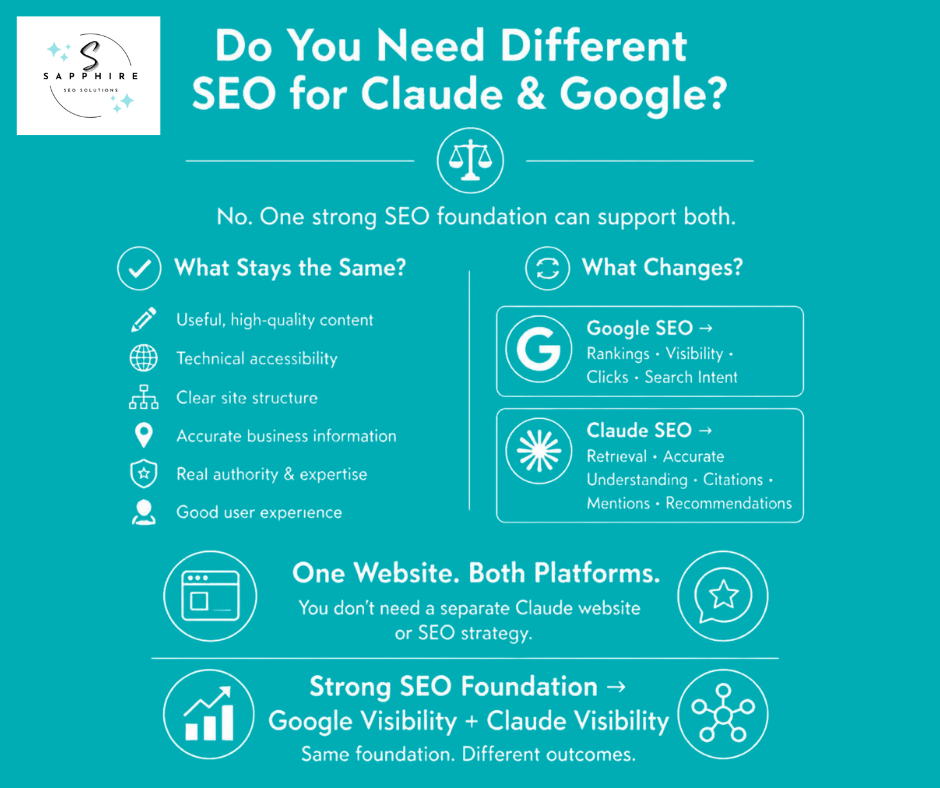
Do You Need Different SEO for Claude and Google?
Whether it's ChatGPT SEO, Google SEO, or Claude SEO, the foundation and concept behind getting mentioned remains the same.
Most of the Foundation Is the Same
Most of what makes a website work for Claude is the same thing that makes it work for Google. Useful content. Technical accessibility. Solid site structure. Real authority. Clear, accurate business information. A good experience for the person actually reading it. None of that changes depending on which search environment finds it.
AI Search Changes What You Optimize For
What shifts is the target. With Google, you're generally thinking about rankings, search visibility, clicks, and matching search intent. With Claude, the goals look a little different: getting retrieved in the first place, being understood correctly, earning citations, showing up in relevant mentions, and getting recommended when it fits the conversation. Same foundation. Different outcome you're aiming for.
One Strong Website Can Serve Both
None of this means building a second, Claude-specific version of your website. That's not necessary, and it's not really how any of this works. One well-built site, with clear information and real substance, can support visibility across both. For a closer look at how the two approaches compare, see our Traditional SEO vs AI SEO guide.
Claude SEO Examples for Small Businesses
Here are some examples of how Claude SEO is for different types of small businesses:
Example 1: Local Service Business
Take a landscaping company in Austin. Someone asks Claude, "Who can help me redesign my backyard in Austin?" To even be considered, Claude needs to understand where the business operates, what services it actually offers, and ideally, some evidence backing that up. Photos or descriptions of real past projects, specific expertise like drainage or native plant design, reviews that reflect actual customer experience, and maybe a mention in a local publication all give Claude more to work with. None of that guarantees a mention. But a business with none of it has little chance of coming up at all.
Example 2: Professional Service Business
Now consider a small accounting firm. Someone asks Claude what type of firm a small business should hire for tax planning. Here, Claude needs to sort out things a generic homepage often leaves vague: what the firm specializes in, what kind of client it typically works with, where it's located, how long it's been operating, and what actually separates it from the accounting firm down the street. A firm that only says "trusted accounting services" gives Claude almost nothing to differentiate it with.
Example 3: B2B/SaaS Company
Or picture a small software company built around AI image generation tools for online retailers. Someone asks what software fits a small company needing that kind of tool. Claude has to piece together the product's actual features, the use case it solves, who it's really built for, some sense of pricing, what it does well, and ideally, information about the product from sources beyond the company's own site. A product page alone rarely covers all of that.
How to Measure Claude SEO
Here's how you can measure your Claude SEO efforts:
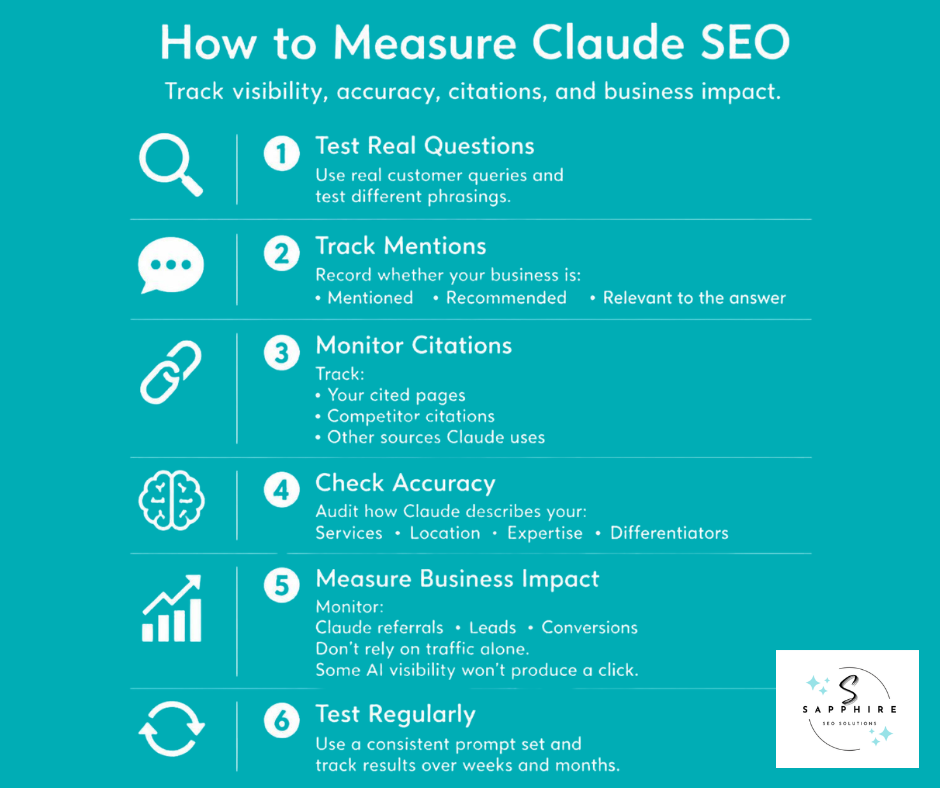
Test Real Customer Questions on Claude Web Search
Start with the questions real customers actually ask, both the informational ones and the ones closer to a buying decision. Ask them a few different ways, too. Small wording changes can lead to different answers.
Track Whether Your Business Appears
For each question, note what actually happened. Did your business get mentioned at all? Was it recommended, or just referenced in passing? And when it did show up, was it actually relevant to what was being asked?
Track Citations and Sources
Pay attention to which of your pages get cited, if any. Look at what other sources show up alongside yours. And notice when a competitor gets cited in a spot where you'd expect to see your own business instead.
Conduct a Full Audit on How Claude Describes Your Business
When Claude does describe your business, check the details. Is the description accurate? Are the services listed correct? Is the location right? Do the things that actually set you apart come through, or does the description sound like it could describe any competitor?
Monitor Referral Traffic and Business Outcomes
Where it's measurable, keep an eye on referral traffic coming from Claude, alongside the broader picture in your SEO analysis and Google Search Console. Leads or conversions that can be traced back are worth tracking too. Just don't lean on traffic alone. Attribution here isn't always clean, and a lot of valuable visibility never shows up as a click.
Test Consistently
Build a repeatable set of prompts and run them on a schedule rather than once. One test tells you almost nothing. A pattern across weeks or months tells you a lot more, and it's the patterns worth paying attention to, not any single result.
Common Claude SEO Mistakes
Here are some of the most common Claude SEO mistakes to avoid:
Mistake 1: Treating Claude Like Google
Chasing a "position #1" that doesn't exist here, or expecting a familiar ranking report to explain what's happening in Claude. It's a different system, and it calls for different expectations.
Mistake 2: Creating Content Only for Claude
Writing copy that only exists to please an AI system tends to read badly and help nobody. Content built for real customers, with real answers, tends to work better anyway.
Mistake 3: Publishing Generic AI-Generated Content
Pages full of vague, interchangeable language don't stand out to Claude any more than they stand out to a person skimming for something useful. A site audit produces clearer answers than guessing here, since it's easy to have generic content and not realize it.
Mistake 4: Making Claims You Can't Support
"Industry-leading" or "#1 in the region" without anything backing it up doesn't help. Unsupported claims are just harder for Claude, or anyone, to trust.
Mistake 5: Ignoring Technical Accessibility
None of the content work matters if Claude's crawlers can't reach your site in the first place. Technical basics come before everything else.
Mistake 6: Focusing Only on Citations
Citations matter, but they're one piece, not the whole goal. A business fixated only on getting cited can lose sight of the bigger picture: being understood and represented accurately.
Mistake 7: Optimizing for Claude While Ignoring Other Search
Claude is one part of a much larger search landscape. Building only for Claude, at the expense of Google or other AI tools, narrows your reach for no good reason.
Mistake 8: Assuming One Prompt Defines Your Visibility
One test, one question, one moment in time. That's not enough to draw conclusions from. Real visibility only shows up across repeated testing.
A Practical Claude SEO Strategy for a Small Business
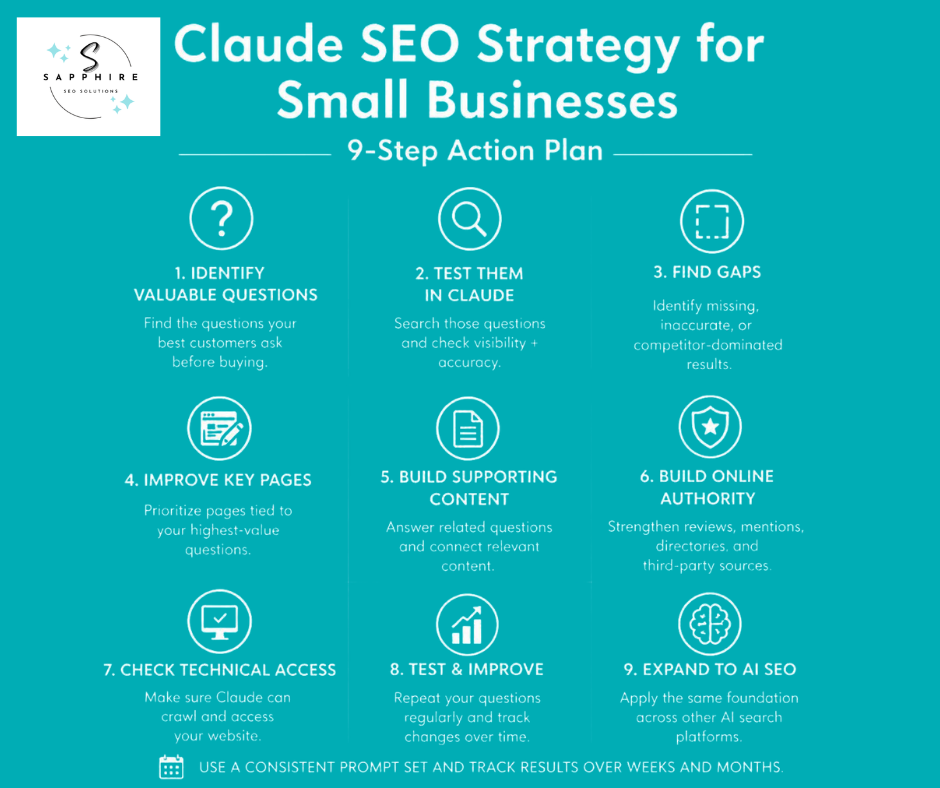
Think of this as a rough executive summary of everything above, turned into something you can actually work through. Here are the nine steps to build and execute a solid Claude SEO strategy:
Step 1: Identify Your Most Valuable Customer Questions
Start with a short list. What do your best customers ask before they buy? Rank them by how much revenue or interest they tend to drive, not by how many questions you can come up with.
Step 2: Test Those Questions in Claude
Run those questions through Claude yourself. See what comes up, whether your business appears, and how accurately it's described when it does.
Step 3: Identify Visibility and Information Gaps
Compare what Claude said to what should be true. Missing entirely? Described inaccurately? Overshadowed by a competitor? That gap is where your work starts.
Step 4: Improve Your Most Important Pages
Fix the pages tied to your highest-value questions first. Everything covered earlier about clarity, specifics, and evidence applies here. Start where it matters most, not everywhere at once.
Step 5: Build Supporting Content (Focus on Content Quality)
Once your core pages are solid, fill in the gaps around them. Answer related questions. Connect the pages together so the full picture is easy to follow. Demonstrate E-E-A-T.
Step 6: Strengthen Your Online Authority
Look beyond your own site. Reviews, third-party mentions, directory listings- anywhere accurate information about your business lives, or should.
Step 7: Check Technical Accessibility
Confirm Claude's crawlers can actually reach your site. This is worth checking early and rechecking periodically, not just once.
Step 8: Test, Measure, and Improve
Go back to your original question set, run it again, and compare results over time. Treat this as an ongoing loop, not a one-time project.
Step 9: Expand Into a Broader AI SEO Strategy
Claude is one piece of a bigger AI search landscape. Once this foundation is solid, the same thinking extends to other platforms. This is usually where a prioritized action plan and some outside expertise start to pay off, since covering every environment well takes more than a single afternoon of testing.
Is Claude SEO Worth It for Small Businesses?
It depends on how your customers actually shop. If the people who buy from you are turning to AI assistants to research options before making a decision, it's worth paying attention to. That's especially true for high-value service businesses, professional services like law or accounting firms, local businesses, companies in competitive industries, and anyone whose customers take a while to decide. If you're already investing in SEO or content, this builds on work you're doing anyway rather than starting from scratch.
That said, Claude SEO shouldn't replace what you're doing for Google. It's not a substitute, and it's not something every small business needs to chase immediately or all at once. The real value here is broader: showing up well across the different places people now go to research a decision, Claude included. For businesses where that research happens early and matters a lot, it's worth the attention. For others, it can wait.
More Resources on AI SEO to Explore
To learn more about AI SEO and how to implement it for your business, make sure to read the following guides:
How Sapphire SEO Solutions Can Help With Claude SEO
At Sapphire SEO Solutions, we don't treat Claude as a separate puzzle to solve on its own. Our work starts with a full site audit and an AI search visibility assessment, looking at how your business currently shows up, or doesn't, across Google and AI-powered platforms alike.
From there, that can mean sharpening how your website and business information are structured, improving content where it's thin, building out topical authority around your core services, cleaning up technical SEO and structured data, and strengthening the brand authority signals that live outside your own site. We also keep an eye on AI visibility over time, since a full audit once a year doesn't tell you much on its own.
Nobody can promise a Claude recommendation. That's not how any of this works. What we can do is build a website and online presence that's positioned to perform well across Google and AI search alike. If that's the kind of foundation you're after, take a look at our AI SEO Services.

Frequently Asked Questions About Claude SEO
What is Claude SEO?
Claude SEO is the practice of making it easier for Claude to discover, understand, accurately represent, cite, or recommend a business. It's not an official Anthropic program, just a term used to describe optimizing for visibility inside Claude specifically.
Can you rank in Claude?
Not in the traditional sense. Claude doesn't have a ten-result SERP or a fixed "position #1." Visibility instead shows up as mentions, citations, or recommendations that vary depending on the question asked. To learn more about the differences between ranking in traditional search and appearing in AI search results, read our guide on "Traditional SEO vs AI SEO: What's the Difference?"
How does Claude find websites?
Claude finds information through its own search and retrieval systems, pulling from business websites, third-party publications, reviews, and other sources across the web, provided those pages are technically accessible to its crawlers.
Does Claude search the web?
Yes. When a question benefits from current information, Claude can run a web search, retrieve relevant sources, and include citations in its answer. Not every question triggers a search, though.
How can I get my business mentioned in Claude?
Make your business information clear and specific, build genuinely useful content around your services, back up claims with evidence, and make sure your site is technically accessible to Claude's crawlers.
Does traditional SEO help with Claude?
Yes. Strong content, technical accessibility, clear site structure, and real authority all support visibility in Claude too. The foundation is largely shared, even though what you're optimizing for differs.
Do backlinks help with Claude SEO?
Relevant mentions and references from authoritative sources can add helpful context around a business. That's different from a traditional link-building campaign built purely to accumulate links.
Does AI-generated content help with Claude SEO?
Generic AI-generated content tends to lack the specifics, evidence, and original insight that make a page genuinely useful as a source. Well-researched, substantive content works better, regardless of how it's produced.
Is Claude SEO different from ChatGPT SEO?
Both fall under the broader umbrella of AI SEO, and the foundational principles overlap. But each platform has its own retrieval systems, crawlers, and behavior, so the specifics aren't identical.
Do I need a separate SEO strategy for Claude?
No. One strong, well-optimized website can support visibility across Google and multiple AI platforms. A separate Claude-only strategy isn't necessary.