

How Does AI Search Work? (A Complete Guide)
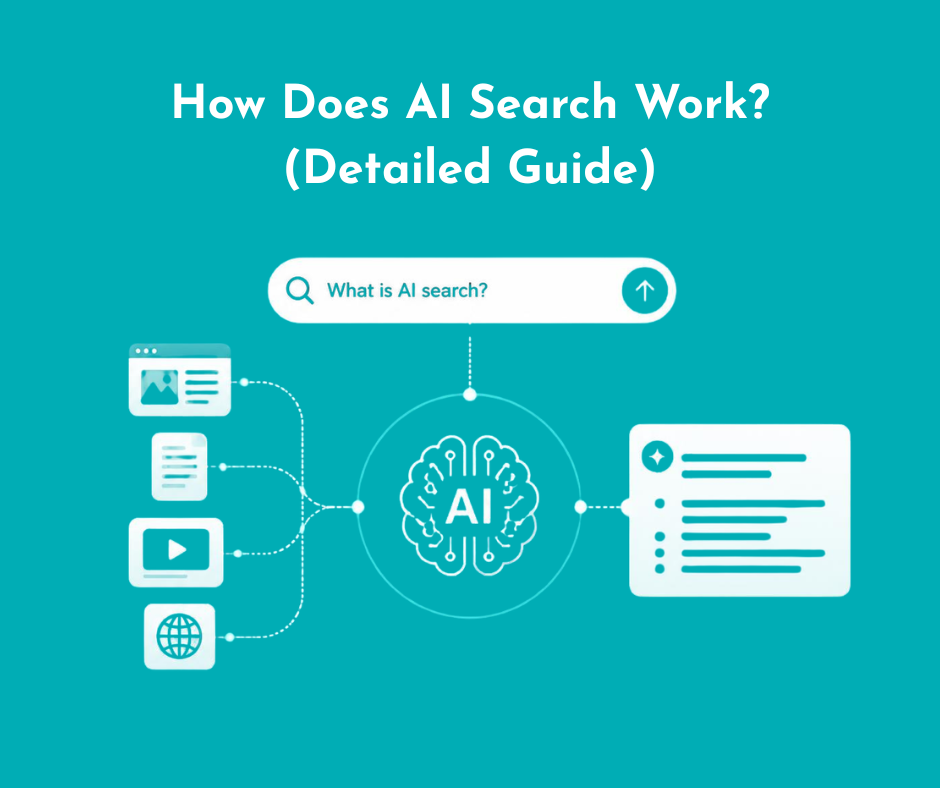
AI search works by using artificial intelligence to understand what someone is asking, gather information from across the web to answer it, and generate a direct response. Instead of typing in a few keywords and scrolling through ten blue links, a person can ask a full question, the way they'd ask a coworker, and get an actual answer back.
How does AI search work, and what's the search process behind it? The system reads the query and works out what it actually means. Then it figures out the intent behind the question, the context around it, and what kind of answer would actually help. From there, it goes and finds relevant information from across the web, weighs which sources are useful and which aren't, and pulls the best pieces together into one response. Often, it links back to the sources it used so the reader can dig deeper if they want to.
That's the fundamental shift. Traditional search hands you options. AI search hands you an answer. And that difference is exactly why search technology like this matters to businesses. Because if AI is doing the answering, businesses need to understand how it decides what to say, and who to mention while saying it.
This guide goes over what AI search is, how AI search works, and how it differs from traditional search.
Key Takeaways
AI search runs on query fan-out. One question becomes several searches behind the scenes before an answer forms.
AI search still depends on traditional SEO. Crawling, indexing, and content quality remain the foundation, not optional extras.
No schema or file guarantees a citation. Google confirms there's no special markup required for AI Overviews or AI Mode.
Rankings and AI-search visibility are different metrics. A top Google ranking doesn't guarantee an AI-generated mention.
Non-commodity content wins in AI search. First-hand experience and original insight outperform generic, recyclable information.
What Is AI Search?
Semrush reveals that by 2027, 90 million US adults will use AI search. And McKinsey & Company states that AI search will process $750 billion in consumer spending by 2028. But what is it?
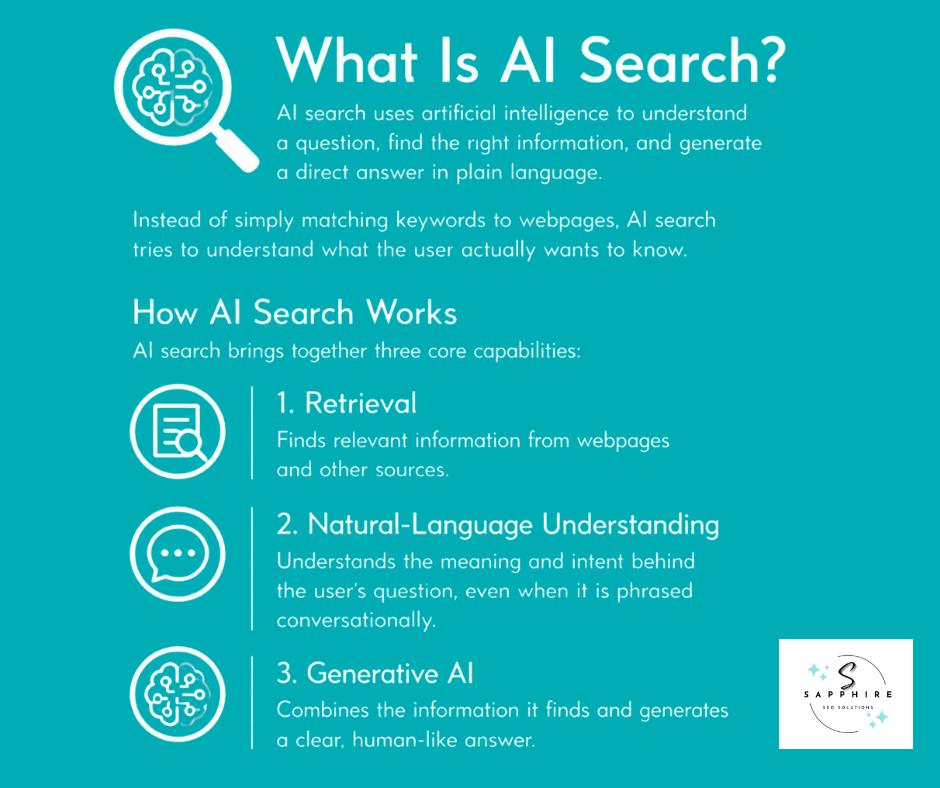
AI search is search that uses artificial intelligence to read a question, go find the information needed to answer it, and write that answer back in plain language. Rather than matching keywords to a webpage and ranking the results, the system tries to understand what's actually being asked and respond as a person would.
Modern AI search engines put three things together to make that happen, including:
First, there's retrieval, the part that goes out and finds information, similar to how a traditional search engine finds webpages.
Second, there's natural-language understanding, which is how the system figures out what a question actually means, even when it's phrased casually.
Third, there's generative AI, which takes what was found and turns it into an actual written answer.
Because of that, the search experience feels different. A person doesn't have to type three keywords and hope for the best. They can ask something long and specific, like they're texting a friend who happens to know everything, and the system will work with it.
Follow-up questions work, too. Instead of a page of links, AI-powered search engines can hand back one synthesized answer, and, where useful, still point to the sources it pulled from, so the reader can check the work themselves.
It's worth being clear about one thing, though. There's no single search platform running the show here. Google's AI Overviews and AI Mode are two well-known examples, and even Google says the two can run on different models and techniques depending on the query.
Other best AI search engines and tools use their own approaches entirely. The search functionality looks similar from the outside. Underneath, it's not one system. It's several, all built a little differently.
How Does AI Search Work? The 6-Step Process
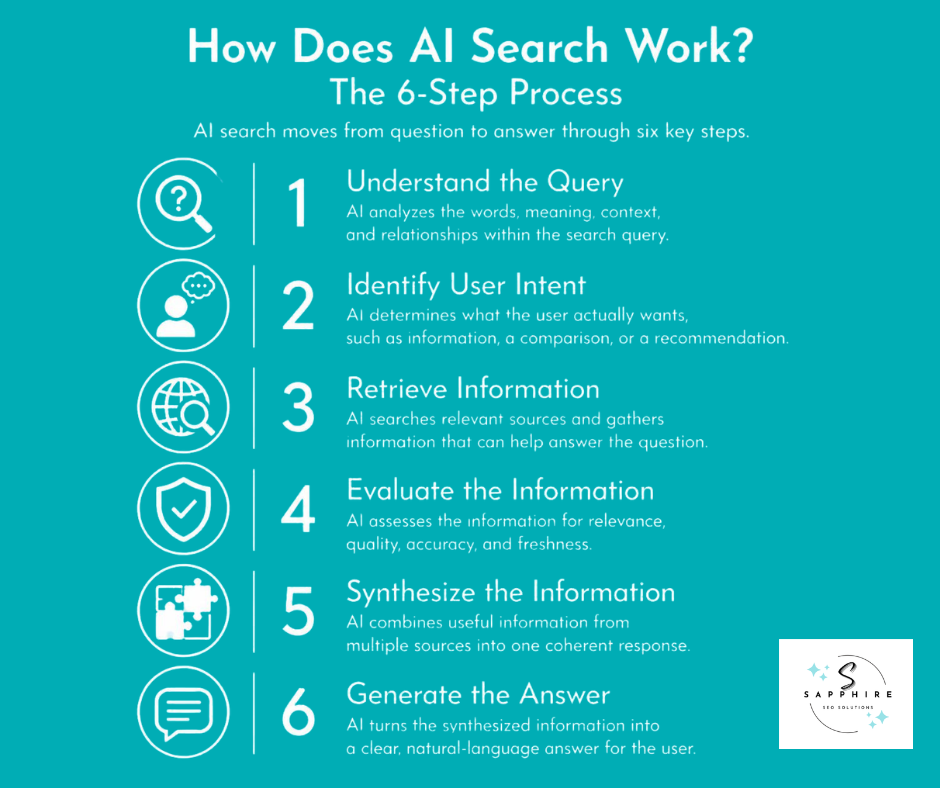
Here's what happens, step by step, from the moment someone types a question to the moment they get an answer:
Step 1: AI Understands the Search Query
Before anything else, the system has to figure out what's actually being asked. This is query understanding, and it's a lot more involved than matching a few keywords. The system looks at the words in the query, sure, but it also looks at:
The meaning behind them
The context around them
How they relate to each other
Take a question like "What's the best roof for a house in a hot climate?" A person asking that isn't just saying the word "roof." They're talking about roofing materials, a residential property, a hot climate, and they want a recommendation based on how different options actually perform in heat. The system has to connect all of that. That's what makes natural language queries so different from old-school keyword searches. Someone can type a full, messy, conversational sentence instead of three keywords crammed together, and the system still has to work out what they mean, including when the wording is vague or could go more than one way.
That's semantic understanding in a nutshell. Meaning first. Keywords second.
Step 2: AI Determines What the User Is Looking For
Understanding the words is only half the job. The system also has to figure out user intent, meaning what the person actually wants out of the search. The same topic can mean completely different things depending on how it's asked.
Here is the same general subject with three different goals:
"What is a metal roof?" is someone learning.
"Metal roof vs. asphalt shingles" is someone comparing options before they decide.
"Roofing companies near me" is someone ready to hire.
AI search tries to sort a question into buckets like these, whether it's informational, a comparison, a purchase decision, or a local search, and then shapes its answer around that. In a conversational back-and-forth, this gets even more layered, because a follow-up question carries context from whatever was asked before it. Someone can ask "What about in a rainy climate?" right after the roofing question, and the system already knows what "what about" is referring to.
Step 3: AI Retrieves Relevant Information
Once the system knows what's being asked and why, it goes looking for relevant information to answer it. This step works a bit like traditional search under the hood. The system pulls from search indexes, which are basically massive libraries of webpages that have already been read and cataloged, and it searches those indexes for relevant documents, current information, and other external data sources that might help.
Here's where it gets more interesting than traditional search, though.
Google has explained that AI Overviews and AI Mode can use something called query fan-out. In plain terms, a complicated question gets broken down into several smaller, related questions behind the scenes. So instead of running one search and calling it done, the system might quietly run five or six related searches covering different angles of the same topic, then gather everything it finds before it even starts putting an answer together.
Let's go back to that roof question again. The system might separately look into roofing materials, heat performance, climate data, and cost, all as their own mini searches, before pulling the pieces into one response. That's how AI search ends up producing a more rounded answer than a single keyword match ever could. It's not one search. It's several, working together, feeding relevant results back to a system that hasn't started writing yet.
Step 4: AI Evaluates and Organizes the Information
Finding information is one thing. Deciding what's actually worth using is another. Once the system has pulled together a set of relevant search results, it has to weigh them. Relevance matters. So does quality, accuracy, and, depending on the topic, how current the information is. The system also looks at how different pieces of information relate to each other, and which sources are strong enough to lean on for support.
Keep in mind that there's no single, publicly documented formula that explains exactly how every AI search platform ranks or chooses what to use. Some agencies will tell you they've cracked the code. They haven't. What's actually out there is general guidance about the kind of content that tends to get used: content that's accurate, well organized, and genuinely useful. Beyond that, nobody outside these companies knows the exact mechanics, and it's worth being skeptical of anyone who claims otherwise.
Step 5: AI Synthesizes the Information
This is where the separate pieces turn into one coherent answer. The system takes what it gathered, often from more than one source, and combines it into something that actually reads like a response to the original question instead of a pile of facts.
Take a question like "Should I repair or replace my commercial roof?" There's no single webpage with a clean, one-size-fits-all answer to that. The real answer depends on the roof's age, how much damage there is, what repairs would cost versus a full replacement, how many years the roof has left in it, and the condition of the building underneath. AI search pulls all of that together, connects the related pieces, and builds a response that actually addresses the different parts of the question instead of just one slice of it. That's the difference between a direct answer and a comprehensive answer. One covers the question. The other covers the whole situation behind it.
Step 6: AI Generates the Answer
Last step. The system turns everything it gathered and organized into a written response, in natural language, the way a person would actually explain it. Depending on the question, that might come out as a direct answer, a short summary, a list, or a side-by-side comparison. Good systems will also anticipate follow-up questions and leave room for the conversation to continue.
One thing worth understanding here: an AI-generated answer usually isn't lifted from a single webpage. It's stitched together from multiple sources, which is part of why AI search can produce comprehensive answers that no single page fully covers on its own. And where it's available, the system will still link back to the pages it pulled from, so the reader isn't just taking the answer's word for it. That's the whole point of generating responses grounded in real sources. Quick and accurate results, with a paper trail behind them.
How AI Search Differs From Traditional Google Search
By now you've got a decent picture of how AI search actually works. So let's put it next to something you already know inside and out, plain old Google search, and look at where they split.
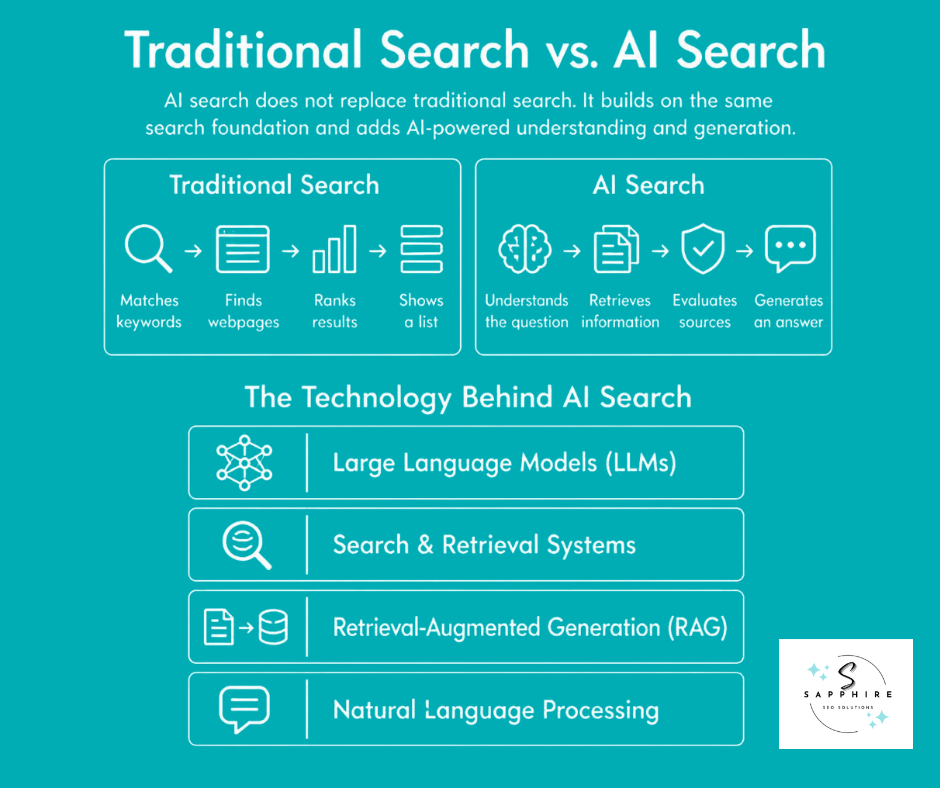
Here are the main differences between AI search and traditional Google search:
How AI Search Differs From Traditional Search
| Traditional Search | AI Search |
|---|---|
| Primarily presents ranked results | Can generate a direct response |
| User often visits multiple pages | AI can synthesize information |
| Queries often produce a SERP | Queries can produce conversational answers |
| Keyword relevance remains important | Meaning and context become especially important |
| Users perform additional searches | AI can handle follow-up questions |
| Results primarily lead users to webpages | Answers can incorporate supporting links |
Look at that middle row for a second. A web search built on traditional keyword searches works off simple keyword matching. Type in "roof repair cost," and the search tool goes hunting for pages containing those words, or close enough to them, then ranks what it finds. AI search doesn't stop at just keywords. It reads the whole question, figures out what's actually being asked, and writes an answer instead of a ranked list.
Here's the part that's easy to get wrong, though. None of this means Google search results have gone away, or that keywords stopped mattering. Unlike traditional search engines, AI search doesn't replace what came before it. It's built on top of it.
Every AI-generated answer still has to come from somewhere, and that somewhere is the same search index Google has been building and refining for decades. Google has said as much directly. Its AI features are rooted in its core Search ranking and quality systems, the very same systems responsible for regular search results. It isn't a separate engine running alongside Google. It's Google, doing something new with the same foundation it's always had.
So when someone runs a search and gets an AI-written answer, that answer didn't appear out of nowhere. A page had to be found, evaluated, and judged worth using first, using much of the same groundwork that's always decided which pages show up in a normal set of search results.
For detailed information on the difference between how AI SEO and traditional SEO are similar and different, make sure to read our comprehensive guide on "Traditional SEO vs AI SEO: What's the Difference?".
What Happens Behind the Scenes? The Technology Behind AI Search
Large language models (LLMs) are the part that handles language. These are AI models trained on huge amounts of text, which is how they learn to understand language, interpret context, and generate a natural-language response instead of a wall of code. Think of an LLM as the part of the system that knows how to talk. It's not the part that knows what's currently true on the internet. That job belongs to something else.
That something else is the search and retrieval system. This is the part that goes out and actually finds relevant information, whether that's webpages, business listings, or other data, and hands it over to the AI system to work with. Without this piece, the language model would just be guessing based on whatever it learned from its training data, which could be outdated or incomplete. With it, the answer is grounded in something real and current.
Put those two pieces together, and you get retrieval-augmented generation, or RAG. It's a simple idea once you strip the jargon away. Here's how RAG works in three simple steps:
First, retrieve. The system looks up relevant, current pages from its search index.
Second, ground. It builds the answer using what it actually found, instead of relying purely on what the model already "knew."
Third, generate. It writes the response. Google's current guidance describes this exact approach, retrieval and grounding, as how it pulls up-to-date pages before generating an AI Overview or AI Mode response.
There's also a layer of natural language processing working throughout all of this, helping the system make sense of entities: businesses, people, products, locations, organizations, concepts, and how they all relate to each other. That's part of what lets a semantic search system understand that "roofing company" and "roofer" mean roughly the same thing, or that a hybrid search setup can blend keyword matching with meaning-based matching to analyze data and represent it semantically instead of just scanning for exact words.
How AI Search Understands Websites and Web Content
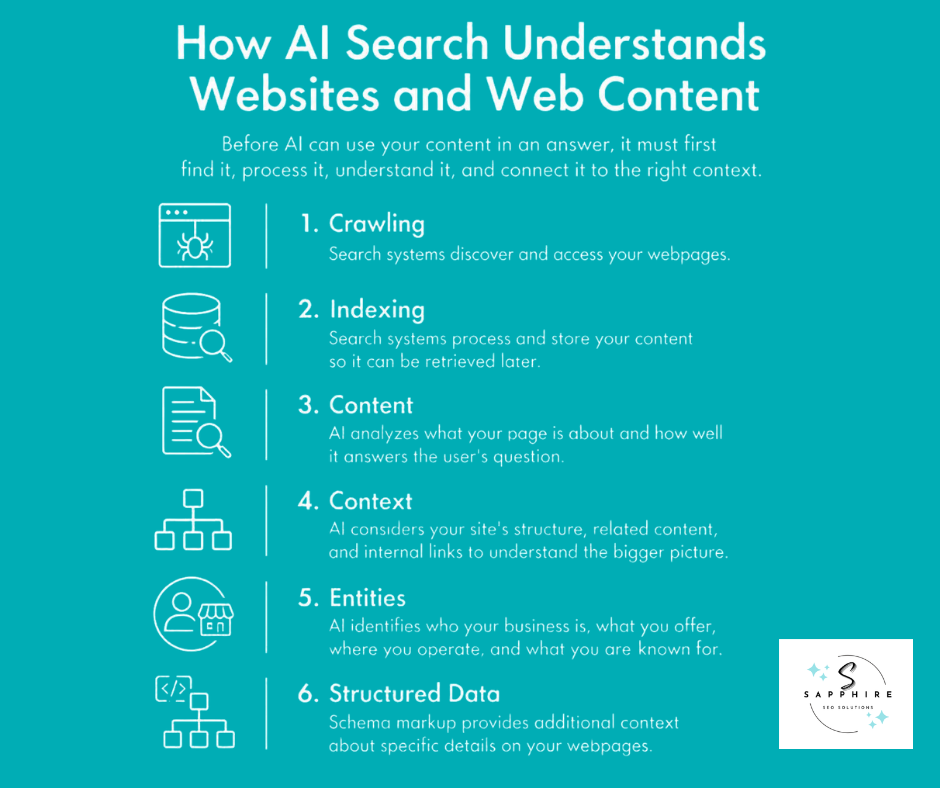
Behind every AI-generated answer, there's still a web page somewhere that had to be found, read, and understood first. Here's what that actually involves:
Crawling: Before a page can show up anywhere, in a normal search result or an AI-generated one, search systems have to find it in the first place. That means the content needs to be accessible. If a page is blocked, buried, or technically hidden from search systems, it doesn't matter how well written it is. Nobody's home to read it. This makes technical SEO super important.
Indexing: Once a page is found, it gets processed and stored so it can be pulled up later. This is what makes a page eligible to appear in search results at all, AI-generated or otherwise. Skip this step, and a page is invisible no matter how good it is.
Content: From there, it comes down to what's actually on the page. What's it about? What questions does it answer? How closely does it match what someone is actually asking? A page that clearly answers a real question has a much better shot at being pulled into an answer than a page that talks around the topic without ever landing on it. E-E-A-T has become more important than ever.
Context: Pages don't exist in a vacuum. Search systems also look at what surrounds a page: related pages on the same site, internal links connecting them, and the overall structure of the website. A single strong page helps. A site where that page connects to other genuinely useful, related content helps more. On-page SEO remains crucial.
Entities: This is where a business needs to be plainspoken about itself. A website should make it obvious who the business is, what it actually offers, where it operates, and which products or services it provides. Not buried in clever copy. Just stated clearly, in more than one place, so there's no ambiguity for a search system trying to piece it together.
Structured data: It's schema markup added to a page that helps search engines understand certain details more precisely, things like business hours, pricing, or reviews. It has a real, limited job. What it isn't is a shortcut to getting cited by AI search. Google has said directly that there's no special schema required for AI Overviews or AI Mode. So don't go relying solely on markup to do work that clear, accessible content should be doing anyway.
AI search isn't a separate universe with its own rules for finding relevant pages. It's still built on the same content accessibility basics that have mattered for years. AI just adds a layer on top that reads, weighs, and writes from what it finds, sometimes even factoring in user behavior patterns to help decide what's actually useful to show. A site that's easy to crawl, easy to understand, and clearly organized isn't just good for classic search capabilities. It's the same foundation AI search needs too.
What Makes Content Useful to AI Search?
Here's the question every business owner eventually gets to: what does AI search actually consider worth using?
There's no shortcut answer, and honestly, anyone selling you one is selling you something. But there's a real pattern in what tends to work, and it's less mysterious than it sounds.
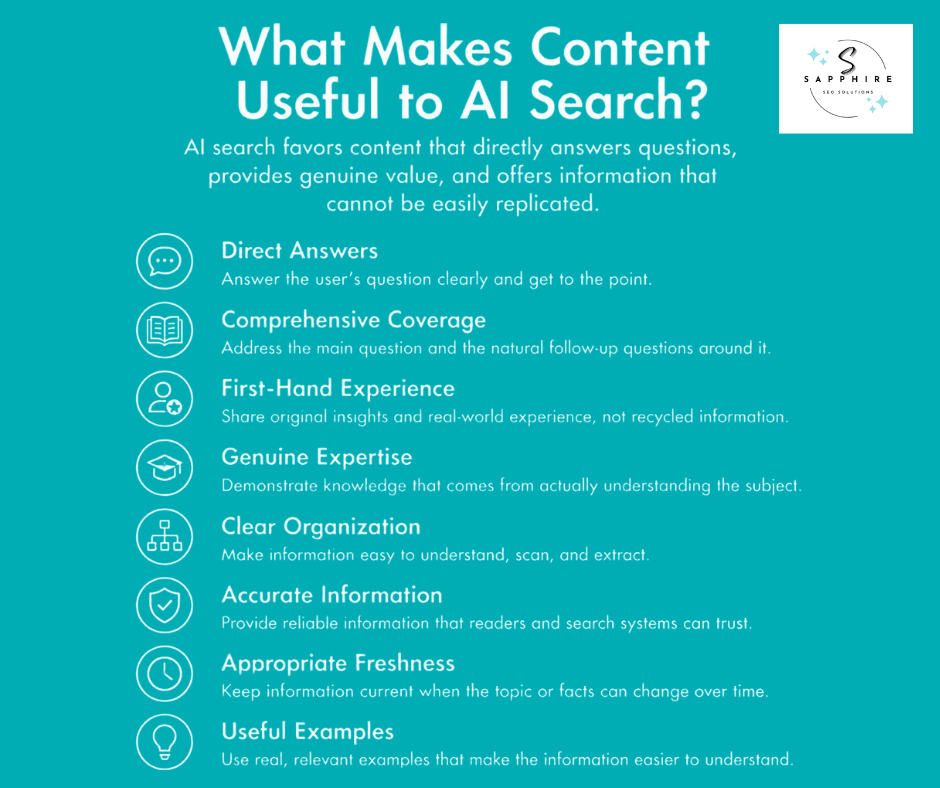
Start with the obvious one. Content that directly answers the question tends to get used more than content that dances around it. If someone asks how much a new roof costs in their area, and your page actually says a number and explains what affects it, that's more useful than three paragraphs about why roofing matters before finally getting to the point.
From there, it's about depth and honesty. A few things tend to separate content that gets used from content that doesn't:
Comprehensive topic coverage: Not just the headline question, but the follow-up questions someone would naturally ask next.
Original insights and first-hand experience: Something written from actual knowledge of the topic, not repackaged from ten other articles saying the same thing.
Real expertise: Content written by someone who genuinely knows the subject, not just someone who researched it for an hour.
Clear organization: Easy to follow, easy to scan, easy to pull a straight answer from.
Accurate, trustworthy information: Answers or content pulled from sources worth trusting in the first place.
Appropriate freshness: Some topics need current information. Others don't change much year to year. Know which one you're writing.
Useful examples: The kind that actually illustrate a point instead of padding out a word count.
Underneath all of that is one theme. Google's own guidance leans hard on this idea of "non-commodity" content, meaning content that couldn't have been written by just anyone, or generated by AI in about ten seconds. A generic list of tips anyone could have written isn't especially useful to a system that's already seen a thousand versions of it. Something built from real experience, a specific answer, an actual opinion backed by knowledge- that's harder to replicate, and it's what tends to genuinely help the reader instead of just filling space.
There's no guaranteed formula for getting cited by AI search. Nobody, including Google, has published a checklist that promises a citation if you follow it closely enough. Anyone claiming they've reverse-engineered the exact formula is guessing, same as everyone else. What actually helps is writing something worth citing in the first place. Not a trick. Just the work.
Learn more about what makes content citation-worthy by reading our comprehensive guide on “What Makes Content Citation-Worthy for AI Search?”
Does Traditional SEO Still Matter for AI Search?
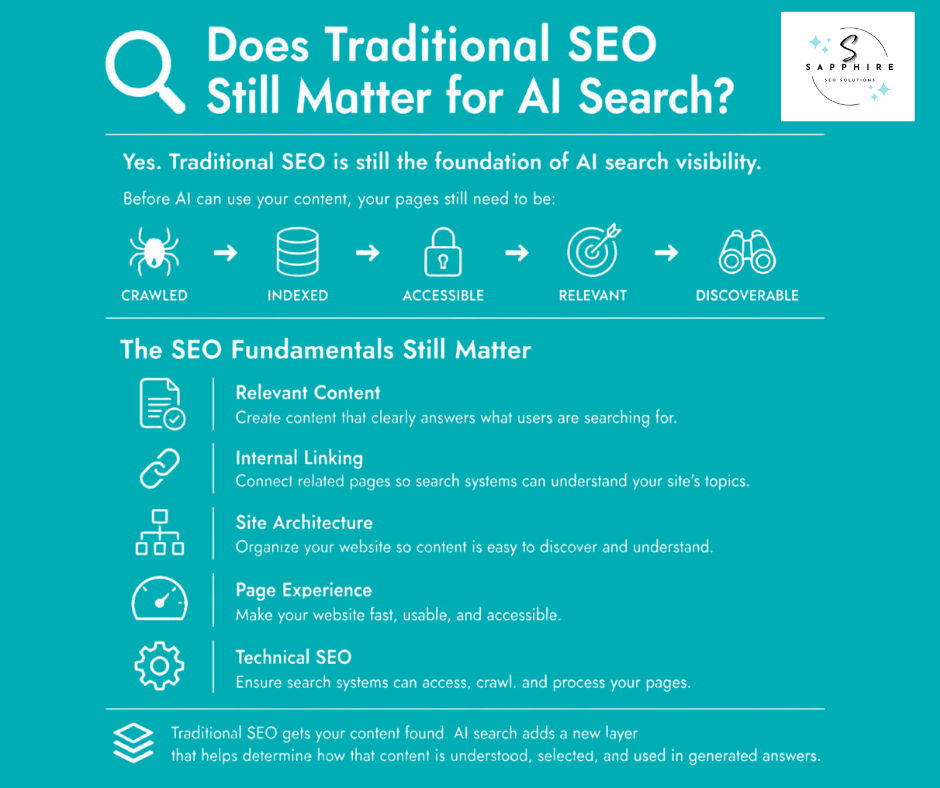
Yes. Traditional SEO still matters for AI search.
Before any large language model can generate an answer, the system retrieves relevant documents to build that answer from. That's what retrieval-augmented generation (RAG) actually means in practice. And those documents have to come from somewhere, which means a page still needs to be crawled, still needs to be indexed, and still needs to meet the same search eligibility requirements it always has. Skip any of that, and it doesn't matter how well written your content is. It was never in the running.
So the fundamentals haven't changed.
Relevant content still matters.
Internal linking still matters, as it helps search systems understand how your pages connect and what your site is actually about.
Site architecture still matters, for the same reason.
Page experience still matters.
Helpful content still matters.
Basic technical accessibility, meaning search systems can actually reach and read your pages in the first place, still matters more than almost anything else on this list.
Google's own documentation is direct about this. Its generative AI features, the ones handling user queries and producing AI-generated summaries, are rooted in the same core search ranking and quality systems that have always powered regular results. There isn't a separate internet running behind the scenes for AI search. It's built on the same traditional search visibility work that's always mattered, with a few extra techniques layered on top.
Traditional SEO gets you found. It's what makes your pages eligible to be pulled into an answer at all. Whatever comes after that- how AI search interprets your content, when it decides to use it, how it handles complex queries or conversational queries built around your topic- that's a separate layer. But it's a layer built on top of the same foundation.
What Does AI Search Mean for Small Businesses?
Somewhere out there, right now, a homeowner is typing "what's the best roofing company near me" into a search bar. Someone else is asking "what should I look for when hiring a landscaper?" A different person wants to know "Which type of HVAC system is best for my home?" Someone dealing with a car accident is asking, "What does a personal injury lawyer do after an accident?" And a small business owner somewhere is asking, "Which accounting firm is best for a small business?"
None of that is hypothetical. People ask questions like these constantly, and more of them are asking AI search instead of scrolling through ten links to find the answer themselves.
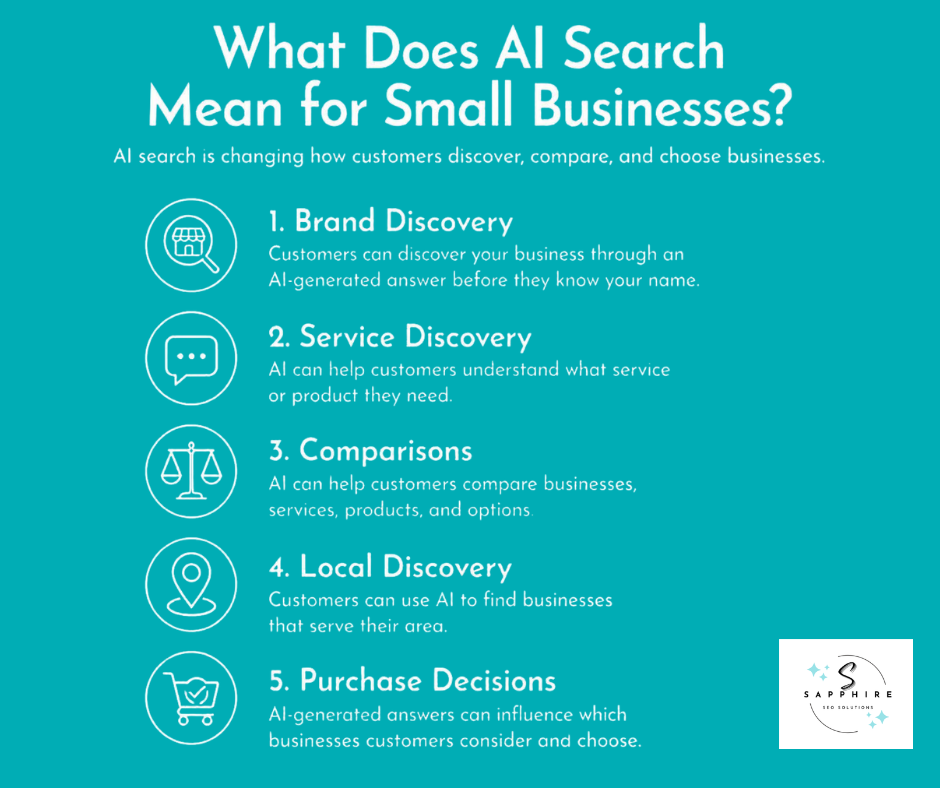
That matters because AI search sits right in the middle of how people find businesses now. It can shape brand discovery; before someone even knows your name, they might learn it from an AI-generated answer. It shapes service discovery and product research, since people are increasingly asking AI to explain what they even need before they go looking for who provides it. It shapes comparisons, local discovery, purchase decisions, website visits, and plain brand awareness. A business doesn't have to be the biggest name in town to show up in that answer. It has to be the clearest one.
That said, this changes what "visibility" actually means, and it's worth being precise about it.
Traditional SEO visibility asks one question: where does my page rank? Simple, familiar, something you can check with a quick search.
AI-search visibility asks something different: does the system find, understand, mention, or link to my business when it's answering a question my customers are actually asking? That's not the same question, and it's not measured the same way. A business can rank well in traditional search and still be invisible to how AI search decides to summarize an answer. The two aren't interchangeable, and treating them like the same metric is going to leave you confused about what's actually working.
Nobody can promise a business it'll get mentioned every time, or that a certain change guarantees a citation. What's true is simpler than that. If AI search is where more of your future customers are starting their search, it's worth understanding how it works, and worth making sure your business is easy for it to find, understand, and mention when the question comes up.
How Can Businesses Prepare for AI Search?
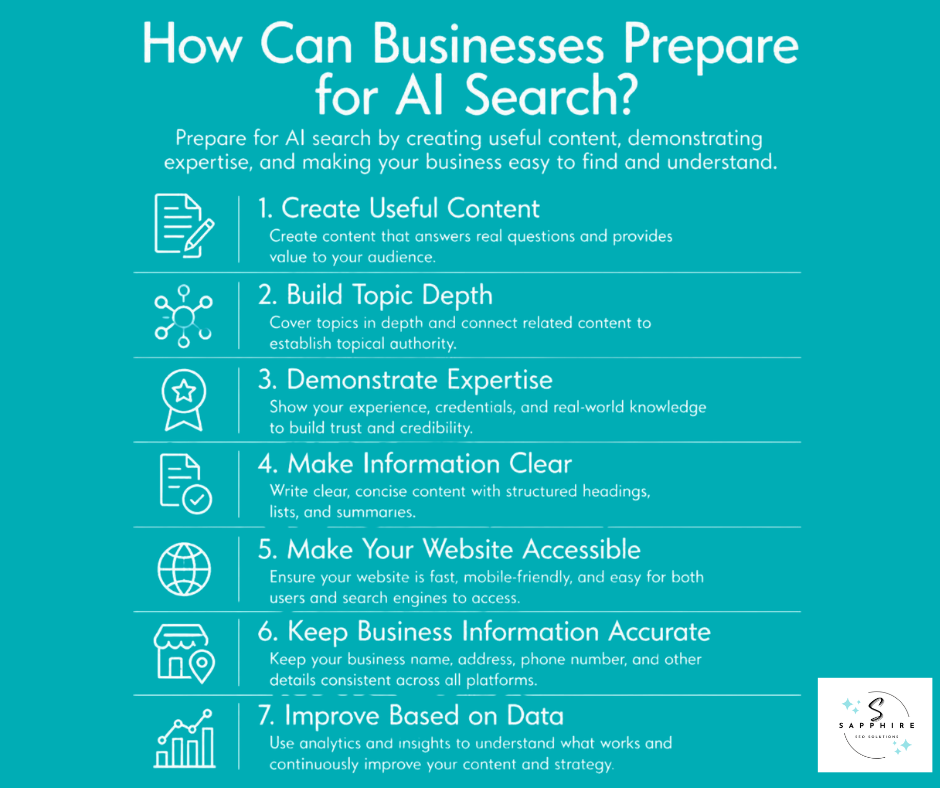
Understanding how AI search works is one thing. Actually preparing for it is another. Here's where to put your energy, without turning this into a full technical checklist:
1. Create Genuinely Useful Content
Start with the obvious move that most businesses still skip. Answer the real questions your customers actually ask, not the questions you wish they asked. Address the actual problems that bring people to you in the first place. If someone's asking why their AC keeps freezing up, write the answer to that, plainly, instead of a vague page about "HVAC services." This is the foundation everything else sits on. Skip it, and nothing downstream matters much.
2. Build Depth Around Important Topics
One page rarely tells the whole story. Cover the related questions someone would naturally ask next. Build supporting content around your main topics instead of one thin page trying to do everything. Then connect those pages to each other with clear internal links, so both readers and search interface systems can see how the pieces relate. Depth beats a single page every time.
3. Demonstrate Real Expertise
This is where a lot of businesses leave value on the table. Write from first-hand experience instead of recycling what's already out there. Use real examples. Share original insights that only come from actually doing the work. Where it fits, credit a qualified author or reviewer who genuinely knows the subject. This is what separates content that gets used from content that gets skipped.
4. Make Important Information Easy to Understand
Clear headings. Short paragraphs. Lists and tables where they actually help. Direct answers instead of long windups before the point. This isn't about dumbing anything down. It's about respecting the reader's time, whether that reader is a person or a system trying to pull a clean answer out of your page.
5. Make the Website Accessible
None of the above matters if the content can't be found. Pages need to be crawlable and indexable. Internal links need to actually connect your site together. And the important stuff needs to exist as real, readable text, not buried inside an image or hidden behind something that won't load properly.
6. Keep Business Information Accurate
Services, locations, contact information, products, the basic facts about your business. Keep them accurate and consistent everywhere they appear. Systems combine traditional methods with newer ones to piece together what a business actually is, and inconsistent information just makes that harder.
7. Keep Improving Based on Actual Performance
Watch what's actually happening. Search Console, organic traffic, conversions, and AI-search visibility where it's measurable. Let real data guide the next move instead of guesswork.
Google's own guidance points in the same direction: apply solid, foundational SEO rather than chasing special AI-only markup or files that don't actually move the needle. There's no shortcut file to add or trick to learn. Just the same fundamentals, done well, consistently.
How Do You Measure AI Search Visibility?
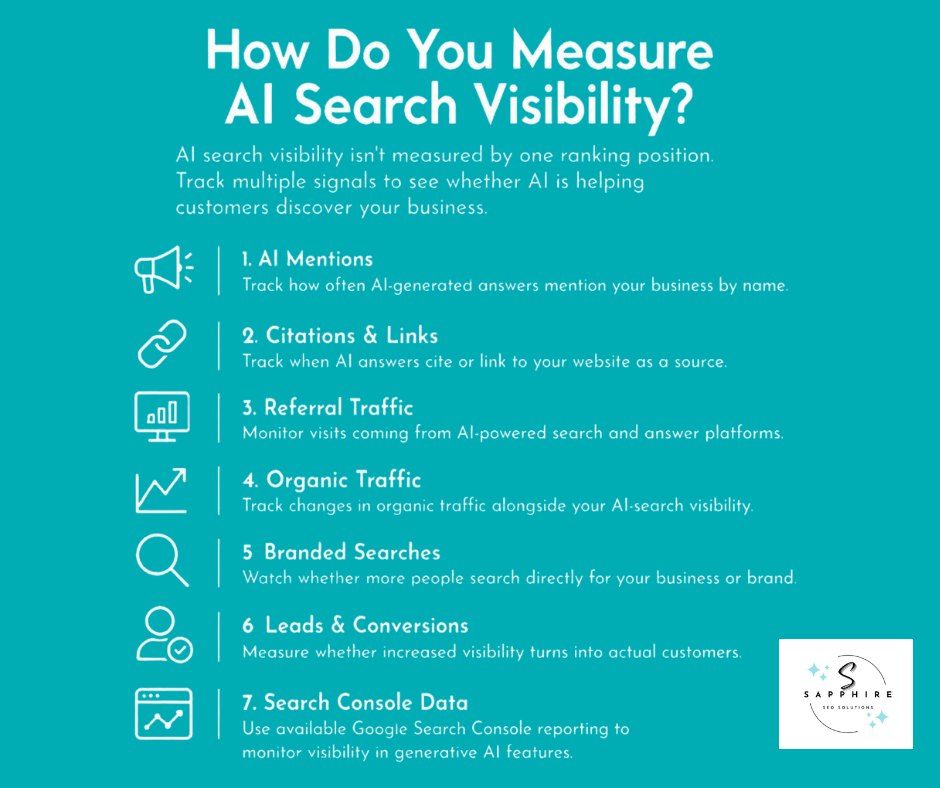
AI search matters to your business, but measuring it isn't as tidy as checking where you rank on a results page. Here's what's actually available to look at.
Start with AI-generated mentions. This is simply whether your business gets referenced by name when AI search answers a relevant question. Related to that are citations and links, meaning whether the AI-generated answer actually links back to your site as a source, giving someone a way to click through and learn more.
From there, look at what you can already track. Referral traffic can show visits coming in from AI-powered platforms, though it doesn't capture everything. Organic traffic and branded searches are worth watching too. If more people start searching your business name directly, that's often a sign they encountered it somewhere first, possibly in an AI-generated answer. And of course, leads and conversions still matter most. Visibility that doesn't turn into an actual customer isn't doing much for you.
None of this replaces traditional rankings. It sits alongside them. A business can still rank well in classic search results while showing up rarely, or not at all, in AI-generated answers. Both are worth tracking. Neither tells the whole story on its own.
Google has also started building out its own measurement tools here. As of June 2026, it began rolling out dedicated Search Console reports showing visibility within generative AI features like AI Overviews and AI Mode, starting with a limited group of sites before expanding further. What that report can show, and who has access to it, is still evolving, so it's worth checking your own Search Console account directly rather than assuming what's available today will look the same in a few months.
There's no single AI search score, and no one metric that captures it all. What's realistic is watching a handful of signals together, and treating AI-search visibility as its own thing worth tracking, not a stand-in for traditional rankings.
Common AI Search Myths Busted
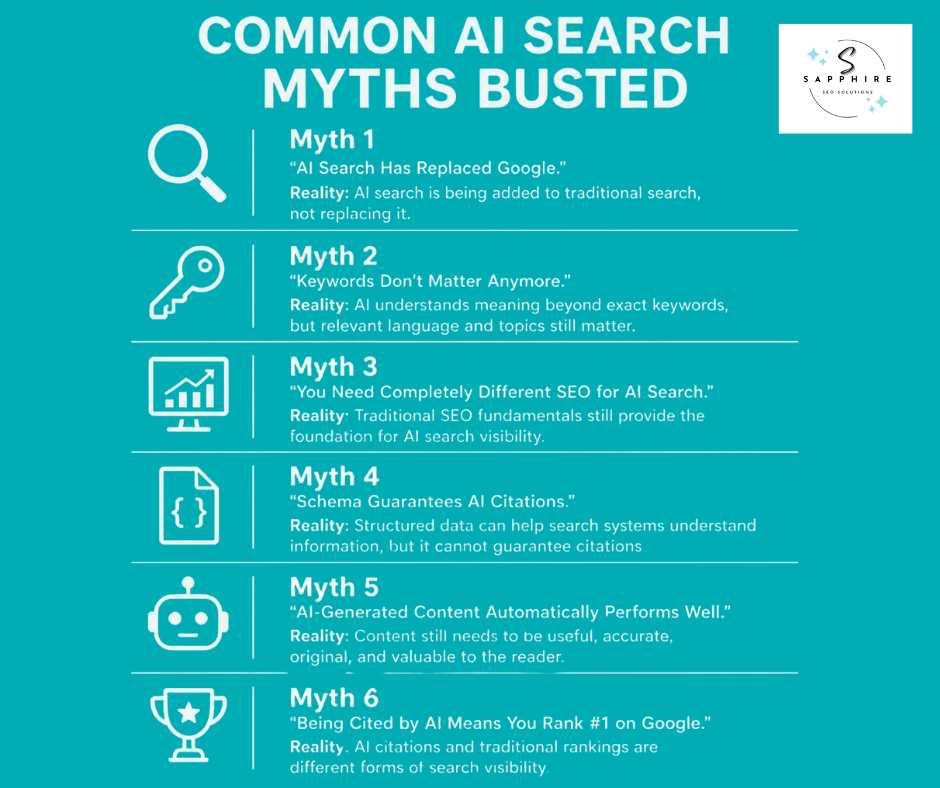
There's a lot of noise out there about AI search, and not all of it holds up. Let's clear out six of the biggest ones, including:
Myth 1: "AI Search Has Replaced Google."
No. AI search is getting woven into the regular search experience, not standing in as a replacement for it. Google still runs classic search results alongside AI Overviews and AI Mode. One didn't push the other out. It's an addition, not a swap.
Myth 2: "Keywords Don't Matter Anymore."
Not true, though the reason is a little more nuanced. Systems today can understand meaning beyond exact-match wording, which means they don't need the precise phrase you typed to figure out what you meant. But understanding user queries effectively still depends on the language and topics real people actually use. Keywords didn't disappear. They just stopped being the whole story.
Myth 3: "You Need Completely Different SEO for AI search."
No. Foundational SEO, the kind built on crawlable pages, clear content, and genuine usefulness, still carries the weight here. AI search builds on that same groundwork instead of replacing it with something entirely new.
Myth 4: "Schema Guarantees AI Citations."
No. Structured data can help systems understand certain details more precisely, but it doesn't guarantee a business gets mentioned or cited. Nothing does.
Myth 5: "AI-Generated Content Automatically Performs Well."
No. Google has been clear that quality and genuine value to the reader matter, regardless of whether a person or a machine learning model wrote the first draft. Thin, generic content doesn't get a pass just because it was produced quickly.
Myth 6: "Being Cited by AI Means You Rank #1 on Google."
No. These are two different forms of visibility, measured in different ways. A business can be mentioned in an AI-generated answer while sitting well outside the top results on a classic search page. They're related, but they're not the same scoreboard.
The common thread through all six of these? AI search runs on up-to-date information, real search patterns, and systems working to represent data semantically so they can actually understand a question, not shortcuts, tricks, or guaranteed formulas. Most of the myths above exist because someone wanted an easy answer. There usually isn't one.
AI Search vs. AI SEO: What's the Difference?
These two terms get mixed up constantly, and it's worth pulling them apart before wrapping up.
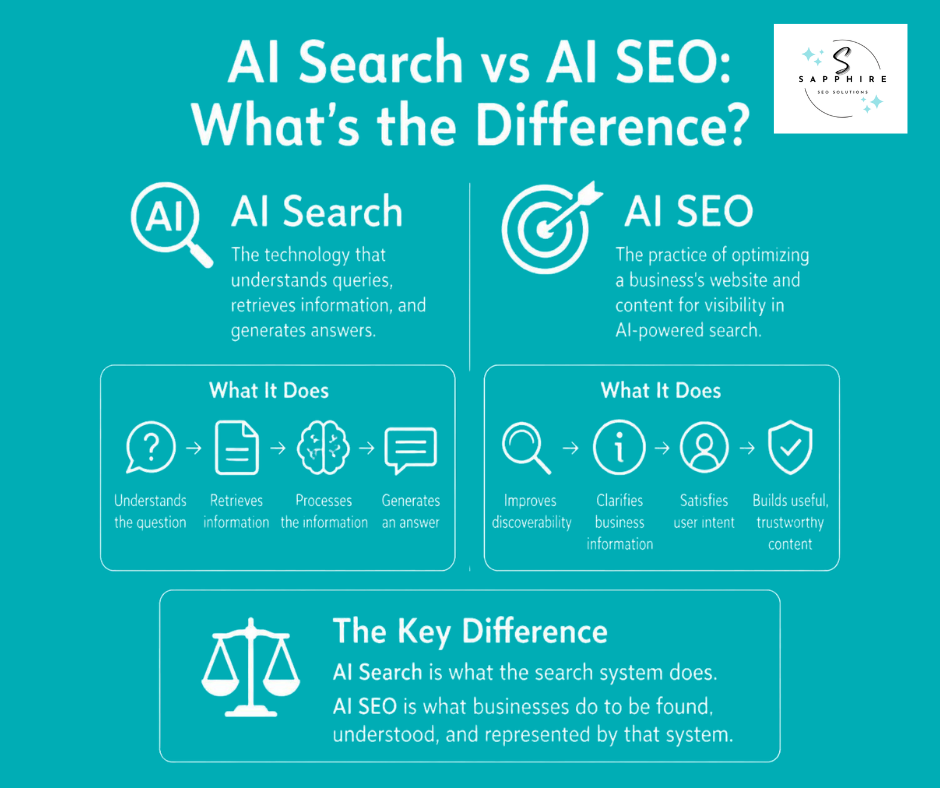
AI search is the technology itself, the search experience doing the actual work. It's what understands a query, goes and retrieves relevant information, processes what it finds, and synthesizes all of that into an answer. Along the way, it might also analyze user behavior and past search patterns to shape what it decides is actually useful. Systems built on large language models (LLMs) are what make this possible, reading language, working out intent, and generating a response instead of a plain list of links. When it's done, it presents that response, often with supporting links back to where the information came from. That's AI search. It's the thing happening on the other end of the question.
AI SEO is something else entirely. It's not the technology. It's the discipline, the work a business does to make sure it shows up well within that technology. That means being discoverable and crawlable in the first place. It means clearly communicating what a business actually does, so there's no ambiguity for a system trying to understand it. It means satisfying what the person asking actually wants to know, and providing information that's genuinely useful and trustworthy enough to be worth using. Done right, it helps a business perform in both traditional search and AI-powered search at the same time, not one or the other.
AI SEO isn't a separate discipline built from scratch. It's an extension of the SEO work that's always mattered, not a replacement for it. Google's own documentation backs this up directly, describing generative AI search optimization as an extension of search optimization, built on the same foundational best practices that have always applied.
To learn more about AI SEO, make sure to read through our detailed guide on "What Is AI SEO?"
More Resources on AI SEO to Explore
To learn more about AI SEO and how to implement it for your small business, make sure to read the following guides:
Partner with Sapphire SEO Solutions and Take the First Step Towards Building Your AI SEO Strategy Today!
So that's the whole process, start to finish. A query comes in. The system works to understand it. It figures out the intent and context behind it. It retrieves relevant information, evaluates what's actually worth using, synthesizes it all together, and generates an answer. Seven steps, one search bar, and a lot happening in between.
What matters for your business is simpler than all of that, though. AI search is changing how people find information, and how they find businesses like yours. Traditional SEO hasn't gone anywhere. It's still the foundation everything else stands on. Content that's useful, accessible, and honest still wins, whether a person is reading it or an AI system is deciding whether to mention it. The businesses that come out ahead here are the ones preparing for both conventional and AI-powered search, not choosing one over the other.
If you're not sure where your business stands right now, that's exactly what we help with. Take a look at our AI SEO services and let's figure out where you're visible, where you're not, and what to do about it. Contact us to schedule a free consultation with a certified AI SEO expert today!

Frequently Asked Questions About AI Search
How does AI search work?
It reads a question, works out what's actually being asked, goes and finds relevant information, weighs what's useful, and writes an answer in plain language. Often, it links back to the sources it pulled from, so the answer isn't a black box.
What is AI search?
Search that uses artificial intelligence to understand a question and generate a direct answer, instead of just handing back a ranked list of links. It combines retrieval, language understanding, and generative AI to do it.
How is AI search different from traditional search?
Traditional search matches keywords and ranks pages. AI search reads meaning and context, then writes a response. One hands you options to sort through. The other hands you an answer, often with links included if you want to dig deeper.
How does AI search find information?
It searches indexed webpages and other sources, sometimes breaking one complicated question into several smaller searches behind the scenes, a technique called query fan-out, before pulling everything together into a response.
How does AI search understand search intent?
It looks past the exact words used and figures out the goal behind them, whether someone's learning, comparing options, or ready to buy. The same topic can carry very different intentions depending on how it's asked.
Does AI search use Google?
Google's own AI features, like AI Overviews and AI Mode, run on the same core Search ranking and quality systems as regular Google search results. Other AI search tools may use entirely different systems and sources.
How does AI search choose sources?
Weighing relevance, quality, accuracy, and how current the information is. There's no single published formula for this, and it can vary by platform, so treat any "guaranteed formula" claim with skepticism.
Does traditional SEO still matter for AI search?
Yes. Pages still need to be crawled, indexed, and genuinely useful to appear anywhere, AI-generated or not. AI search builds on the same foundation traditional SEO has always required.
Can businesses optimize for AI search?
To a degree. Businesses can create clear, accurate, genuinely useful content and keep their site accessible. There's no guaranteed way to be cited, but strong fundamentals meaningfully improve the odds.
How can a website appear in AI search?
By being crawlable, indexed, and worth using as a source, meaning accurate, well-organized, and genuinely helpful. It starts with the same basics that have always mattered for search visibility.
Is AI search replacing Google?
No. AI search is becoming part of the Google search experience, not a replacement for it. Traditional search results are still there, running alongside AI-generated answers.
What does retrieval-augmented generation do?
Retrieval-Augmented Generation (RAG) enhances AI search accuracy.
How does AI search use multimodal search?
Multimodal Search integrates text, image, audio, and video data for enhanced search experiences.
What does machine learning ranking evaluate?
Machine Learning Ranking evaluates signals such as content freshness and user engagement to rank results.
Does AI search have a greater conversion rate than traditional search?
AI search traffic converts at 14.2%, outperforming traditional search. Also, a point worth noting is that search impressions increased by 49% year-over-year due to AI.
Does AI citation come from Reddit?
According to Search Engine Land, 86% of AI citations come from sources brands already control (websites, listings, and reviews/social), not Reddit.