

What Makes Content Citation-Worthy for AI Search?
A search used to mean ten blue links. You typed a question, scanned the list, and clicked whatever looked closest. That's still true a lot of the time. But now the same question might come back as a written answer instead, pulled from several sources and citing a few of them, courtesy of Google AI Overviews, AI Mode, or another AI system. Traditional search hasn't disappeared. It's sharing the page with AI-generated answers, and both still run on search engines built to find and rank information.
That changes what "showing up" means. Ranking still matters. But ranking isn't being retrieved. Being retrieved isn't being mentioned. Being mentioned isn't being cited. And a citation doesn't always turn into a click. A business can win some of these without winning all of them.
Someone can ask an AI system about your service or your industry without ever typing your business name. What comes back might be built from your own website. It might come from somewhere else.
The real question is: what makes a piece of content useful enough, clear enough, and trustworthy enough for an AI system to use as a source? This guide will go over what citation-worthy content means, how AI search finds and uses content, characteristics of citation-worthy content, how you can create citation-worthy content, and more.
Key Takeaways
Five different outcomes exist: ranking, retrieval, mention, citation, and a click. Winning one doesn't guarantee the others.
Citation-worthy doesn't mean guaranteed to be cited. Nothing here promises a citation, no matter how strong the content is.
Good content alone isn't enough. External brand mentions, reviews, and directories provide context a single page can't offer alone.
Indexing comes first. A page must be indexed and eligible for normal Search before AI features even consider it.
No special AI schema or llms.txt is required. Most "AI SEO tactics" are rebranded SEO or unnecessary tricks.
A citation is a signal, not a KPI. Bing confirms citations don't measure rankings, authority, or causation.
Firsthand, local expertise beats generic content. Small businesses often know more specifics than big national publishers do.
Scaling pages for query variations backfires. Google's spam guidance targets mass-produced pages built to manipulate AI responses.
What Does “Citation-Worthy Content” Actually Mean?
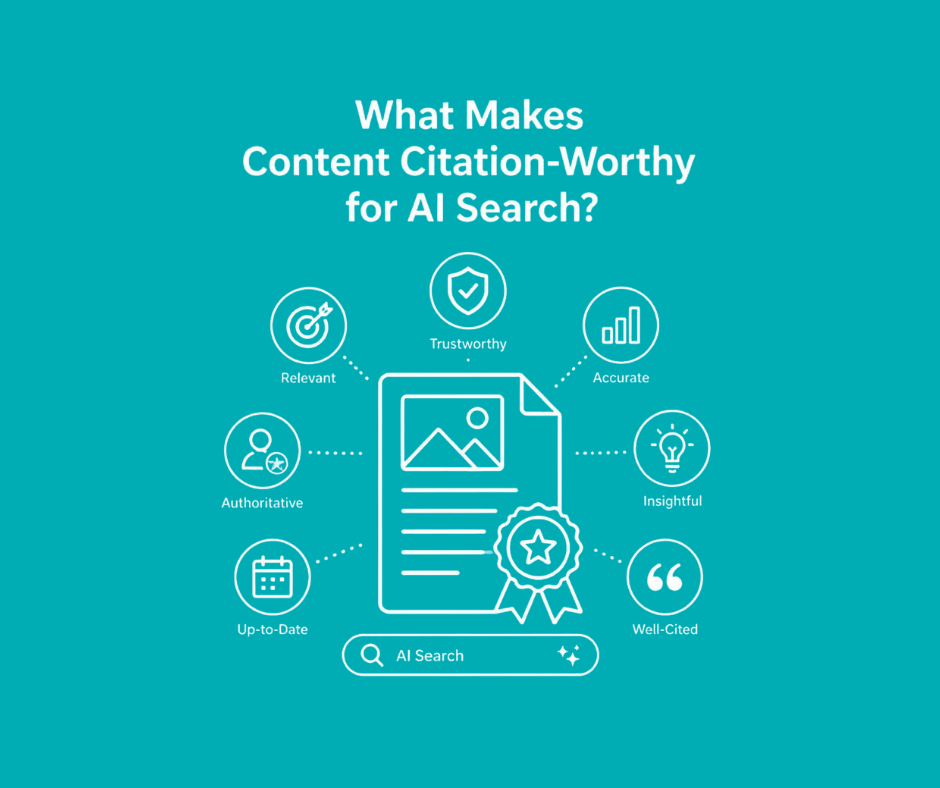
Citation-worthy content is content that gives an AI system something relevant, useful, specific, understandable, and supportable enough to pull into an answer. That's the whole idea. Now here's what each piece actually means.
Relevant: It addresses the question or need someone actually has, not a nearby topic that sort of fits.
Useful: It helps the reader understand something, compare options, decide, or take action. Information that just sits there doesn't count.
Specific: It gives concrete details instead of vague statements that could apply to almost any business in the industry.
Understandable: The subject, the entities involved, and how they relate to each other are all clear. So are the claims being made.
Supportable: The important factual claims can be checked or traced back to something.
Distinctive: It adds something, rather than repeating what a hundred other pages already say.
Current: It stays accurate as the underlying facts change.
Put those together, and you get something closer to a credible source worth citing. Not a perfect page. Not a page that hits some invisible algorithmic threshold. Just a page that gives an AI system a real reason to use it.
One distinction matters here, and it's worth sitting with for a second. Citation-worthy doesn't mean guaranteed to be cited. It means the content has the characteristics that make it a stronger candidate for retrieval, use, and attribution. Those are two different things. A page can check every box above and still not get pulled into a given answer, because AI systems weigh a lot of factors, and no single page is competing in a vacuum.
This also isn't about picking one right content format. A comparison might work best as a table. A process might need numbered steps. An explanation might need actual paragraphs so the reasoning holds together. The format should match the question, not the other way around. What stays constant is the substance underneath it.
How AI Search Finds and Uses Content
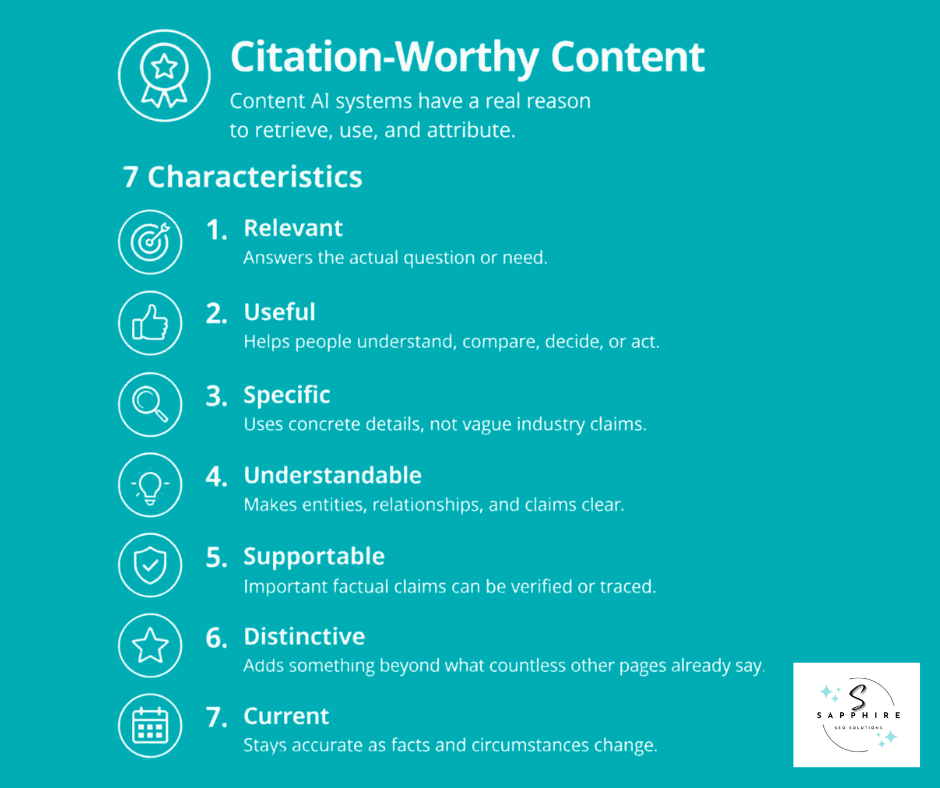
Think of it as a short chain of events. A person asks a question, an AI system interprets what they actually mean, it retrieves information to ground its answer, it selects which sources to lean on, it generates the response, and then it attaches citations or links to what it used. That's the rough path from question to answer.
Here's what's actually documented about that process. Google says AI Overviews and AI Mode may use query fan-out, sending a complex question off to explore several related searches and sources before pulling an answer together. Microsoft describes something similar for Bing and Copilot: grounding queries, the reformulated search phrases a system generates behind the scenes to find and cite content, distinct from whatever the person actually typed. Both are ways of saying the same thing. AI answer engines don't usually treat a question as one search. They tend to break it apart first.
So why does any of this matter to what you publish? A few reasons, and they connect directly back to the characteristics from the last section.
Retrieved information has to be relevant to the question being asked, or it has nothing to contribute to the answer.
Clear content is easier for an AI system to understand, because there's less ambiguity about what the page is actually saying.
Specific claims give a system generating an answer something concrete to work with, rather than a vague statement it can't really use.
Evidence and attribution strengthen confidence in factual claims, which matters more as those claims get repeated inside a generated response.
Current information matters because facts change, and an answer built on stale supporting context is a weaker answer.
One thing worth being straight about. It's tempting to picture an AI system reading every page top to bottom and picking out the single best paragraph. That's not really how it works, and it's not how the companies building these AI models describe it either. What their platform documentation actually says is closer to this: AI search citation systems can retrieve information from different sources and use it when constructing a response, but the exact retrieval, ranking, and citation mechanics vary between systems and aren't fully public. Nobody outside those companies, including us, knows the precise mechanics behind how large language models decide what to pull in. What we do know is which qualities tend to make content more usable once it's found.
The 8 Characteristics of Content Worth Citing
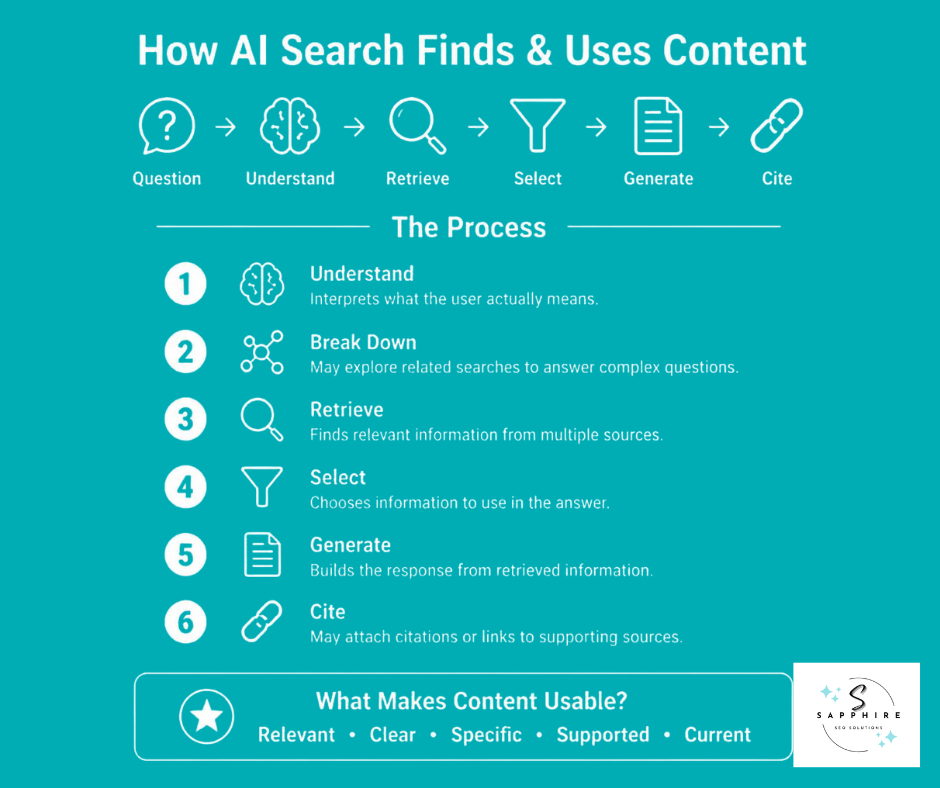
Everything up to this point has been about how AI search works in general. This is where it gets specific. Based on what Google, Bing, and other platforms have actually said about their systems, along with what tends to separate a page that gets used from one that doesn't, eight characteristics show up again and again. None of them is a guarantee on its own. Together, they're the closest thing to a real answer for what makes content worth citing.
1. It Directly Answers the User's Question
Every useful page has one job first: answer the actual question behind it. Figure out what that is, then answer it early. Don't make someone wade through 500 words of setup before they reach the part they came for.
That means writing for user intent, not just the keyword that brought someone in. A search for "water heater leaking" isn't really about water heaters in general. It's about whether this is an emergency and what to do next. Content that directly answers that underlying need works better than content that just mentions the right words.
Related questions are fine to cover too, as long as they genuinely support the main topic. A page about water heater leaks might reasonably answer a couple of natural follow-up questions, like what a repair usually costs or whether a leak means the whole unit needs replacing. Question-based headings help here, when they reflect how people actually ask.
One thing to skip: writing separate pages for every possible variation of a question just to catch more target queries. Google says its systems can understand relevant prompts and match meaning without exact-match phrasing, so that kind of duplication buys little and just spreads one good answer across ten thin ones. Specific answers beat scattered ones.
2. It Provides Something More Valuable Than a Generic Rewrite
There's a real difference between information that exists everywhere and information only this business can actually contribute. Most existing content on a given topic says roughly the same thing in roughly the same order. That's not wrong, exactly. It's just not going to stand out to an AI system weighing several existing pages that all say the same thing.
What stands out is subject matter expertise turned into something specific:
Firsthand experience
Original research
Proprietary data
Case studies
Original examples
A process explained from actual practice instead of a textbook
Google's current generative-AI guidance is direct about this, emphasizing genuinely useful, non-commodity content rather than recycled information already available elsewhere.
A plumber doesn't need another article saying a water heater can leak for several reasons. Everyone already has that article. A stronger source explains which leak locations actually show up most in this plumber's service calls, how they tell a fitting leak from a failing tank, and what a homeowner should check before calling for service. That's practical guidance built from real work, and it's exactly the kind of specific evidence a generic rewrite can't offer.
This doesn't require a formal study. A content team doesn't need a lab. What content marketers need is permission to write down what the business already knows from doing the job, instead of defaulting to whatever already ranks on page one.
3. Important Claims Are Specific, Evidence-Based, and Verifiable
Not every sentence needs a source. But the claims that matter do. A basic explanatory statement doesn't need five citations. A statistic about industry performance absolutely does. The stronger the claim, the stronger the evidence behind it should be.
When you cite something, name it. Point to the actual study, organization, dataset, or expert instead of a vague "studies show." Link to the primary source when you can, and include a date if the timing matters. If a number came from your own research, say briefly how you got it.
Draw a clear line between fact and opinion, too. "Most homeowners wait too long to call" is a judgment. "We see roughly three fitting failures for every tank replacement" is specific evidence, and it should read differently on the page.
Bing's guidance backs this up directly, recommending content that includes examples, data, and cited sources to build trust when it's pulled into AI-generated answers. That combination is a big part of what turns a page into cited content, the kind that shows up in citation data or search citations reporting.
What to avoid is citation dumping: ten sources repeating the same point, or weak sources included just because they agree with you. Neither makes a page a credible source worth citing. It just makes it cluttered.
4. It Demonstrates Firsthand Experience and Appropriate Expertise
Here’s how you demonstrate firsthand experience:
Show what the business has actually done, not what it claims to know in general.
Explain an observation from a real job.
Walk through an actual case.
Describe a process the way someone who's done it a hundred times would, not the way a brochure would.
Google's people-first guidance asks directly whether content demonstrates first-hand expertise, and whether the person writing or reviewing it demonstrably knows the subject. A generic author bio doesn't clear that bar. "Written by our team of experts" tells a reader nothing. Naming the person and what they've actually done tells them something real.
This is a genuine opening for small businesses building a content strategy around AI visibility. A local HVAC company that's run service calls in the same neighborhoods for years often knows more about what actually breaks there than a national publisher ever could. That firsthand knowledge can't be copied, and it does more for brand presence than any generic claim of expertise.
What hurts here is easy to spot:
Invented case studies
Credentials standing in for detail
Expertise claimed but never shown
None of that builds real brand visibility, or gives anyone a reason to track brand mentions back to something genuine.
5. It Makes Entities, Concepts, and Relationships Clear
An AI system needs to know exactly which business, product, service, or person a page is about, and how those pieces relate. Identify who or what the content covers early, then keep using the same name for it. Don't call a service one thing in paragraph one and something slightly different further down.
Define anything unfamiliar the first time it appears. Make relationships explicit instead of implied, like which service treats which problem. Avoid ambiguous pronouns that force a reader, or a system, to guess what "it" refers to three sentences back.
Consistency matters across the whole business too. Name, description, and details on the website should match the business listing, author pages, and other web profiles out there. In AI-driven search, that consistency helps a system trust what it's looking at.
This is less about keyword density and more about clarity of search entities. The real question isn't how many times a word got used. It's whether a system can tell exactly what the content is about and how the pieces connect. Consistency alone won't produce a citation. But confusion about who or what you are will work against you.
6. Its Structure Makes the Important Information Easy to Find
A page's structure should show both a person and a system where an answer begins, what it means, and how it connects to what's around it. That's the real goal of structural optimization, not chasing a formula about ideal paragraph length.
Descriptive headings do a lot of the work here. "What Makes This AC Unit Freeze Up" tells a reader far more than "Common Issues" ever could. Keep a logical order underneath, with H3s that stay on topic under a clear H2, and answer the main question directly instead of burying it three paragraphs down.
Bing's own guidance is specific about this, recommending:
Descriptive headings
Concise sections
Tables
FAQ-style content to make information easier to reference in AI-generated answers
A section that wanders on for a page and a half buries its own point.
Use lists where a list genuinely helps, tables where a real comparison is happening, and prose everywhere else. A short paragraph of two to four sentences often carries an idea more clearly than a bullet trying to do a paragraph's job.
None of this is a trick of content architecture. It's structured content that guides a reader toward the answer, with internal links connecting related pages so people and AI systems alike can follow the topic further.
7. It Contains Concrete, Useful Details
Specificity is what turns a page from something a reader skims into something they can actually use. A number, a measurement, a real comparison, a clear definition, the criteria someone should weigh before deciding. That kind of detail gives a reader something to understand, evaluate, or act on. A vague sentence doesn't.
Here's a distinction worth being clear about. Don't add statistics because "AI likes statistics." That's a common piece of advice in AI-focused SEO circles, and it doesn't hold up. Add a number because it's real, relevant, and properly sourced, and because it makes a claim more useful to the person reading it. An AI system benefits from the same thing a person does: something concrete instead of vague.
This has nothing to do with keyword density. Cramming in a fact every hundred words produces content that reads padded, not informed. So does fake precision, numbers dressed up to look more exact than they are.
Practical guidance built on real detail works across most content formats: a paragraph, a table, a short list. What it produces is specific answers, not filler standing in for substance.
8. It Is Current, Attributable, and Maintained
A page that was accurate two years ago isn't automatically accurate now. Prices change, recommendations change, products get discontinued. Keeping existing content current matters as much as getting it right the first time.
Attribution matters too. A byline where readers would expect one, a publication date, and an updated date when something material actually changes, not a timestamp refreshed for appearances. Where a claim comes from a source, name it.
Bing's guidance is direct about keeping content fresh and accurate, and about keeping text, images, and other media consistent with each other. Google's people-first guidance points in the same direction, encouraging clear authorship and honesty about how content was produced, including AI-generated text, when that context matters to a reader.
This applies whether someone finds a page through traditional search engines or through Google's AI experiences. AI Overviews draw on content indexed the same way regular results are, so a page stale in one place is stale in both, and that shows up in search citations reporting too.
What doesn't help: changing a date without changing anything underneath it, adding a byline purely as an SEO move, or updating a page for the sake of freshness when nothing needed fixing.
What Makes Content Less Likely to Be Useful as an AI Source?
Not everything above is something you add. Some of it is about what to leave out. None of these patterns disqualify a page outright, and it would be too strong a claim to say otherwise about systems nobody outside the companies building them fully understands. But they show up consistently in content that creates visibility gaps, places where a business could be represented and simply isn't.
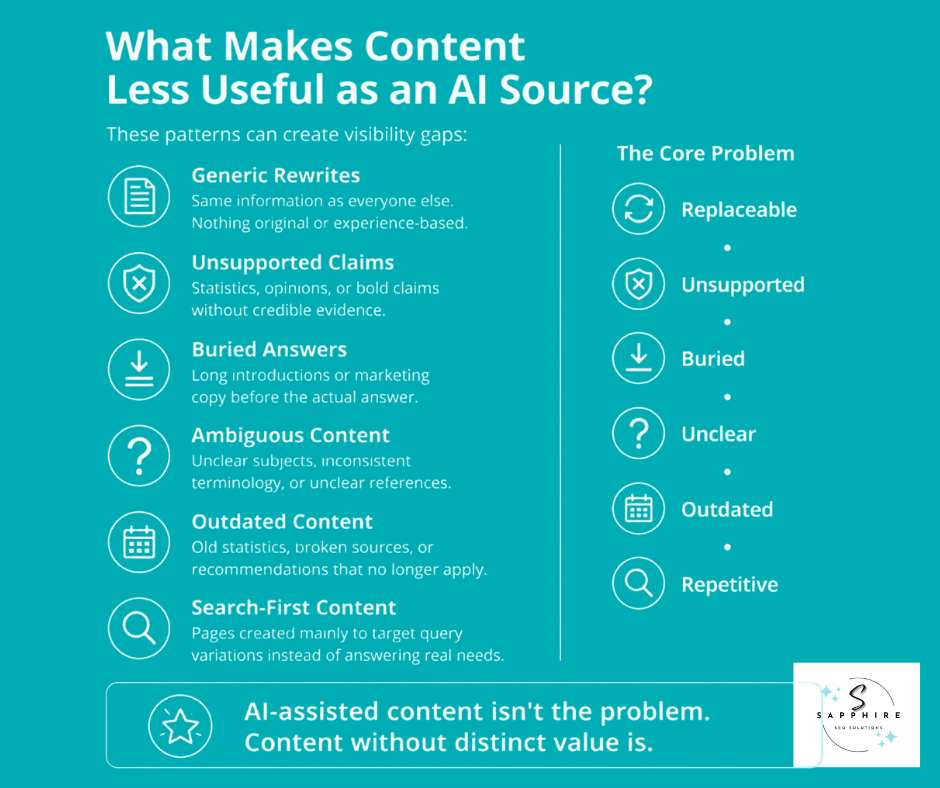
Generic Rewrites
Same information as everyone else, no real experience behind it, no actual analysis. Nothing wrong with the page exactly. It's just replaceable by ten others saying the same thing.
Unsupported Claims
Statistics without a source. Bold claims backed by nothing. A vague "experts agree" standing in for an actual expert. None of it holds up to scrutiny, by a reader or by a system.
Buried Answers
A long introduction before the actual answer shows up. Marketing copy sitting where the information should be. The important part is technically on the page, just three screens down from where anyone would look for it.
Ambiguous Content
Unclear what the page is even about. Terminology that shifts halfway through. References that assume a reader already knows what "it" refers to.
Outdated Content
Statistics from years ago. Broken links to sources that no longer exist. Recommendations that stopped being accurate a while back and nobody noticed.
Search-First or AI-First Content
Pages built mainly to catch query variations rather than answer a real question. Large batches published with barely any difference between them. Google is direct about this one. Its spam policies specifically warn against generating pages at scale primarily to manipulate rankings or AI responses, whether or not AI-generated tools were used to create pages that fast.
None of this means writing quickly, or getting help from AI tools, is the problem. Optimizing content for people first is still the goal, and plenty of fast, AI-assisted writing does that well. What actually undermines answer engine optimization is publishing at scale with nothing distinct page to page, not the tools used to produce it.
Is On-Page Content Enough to Get Cited?
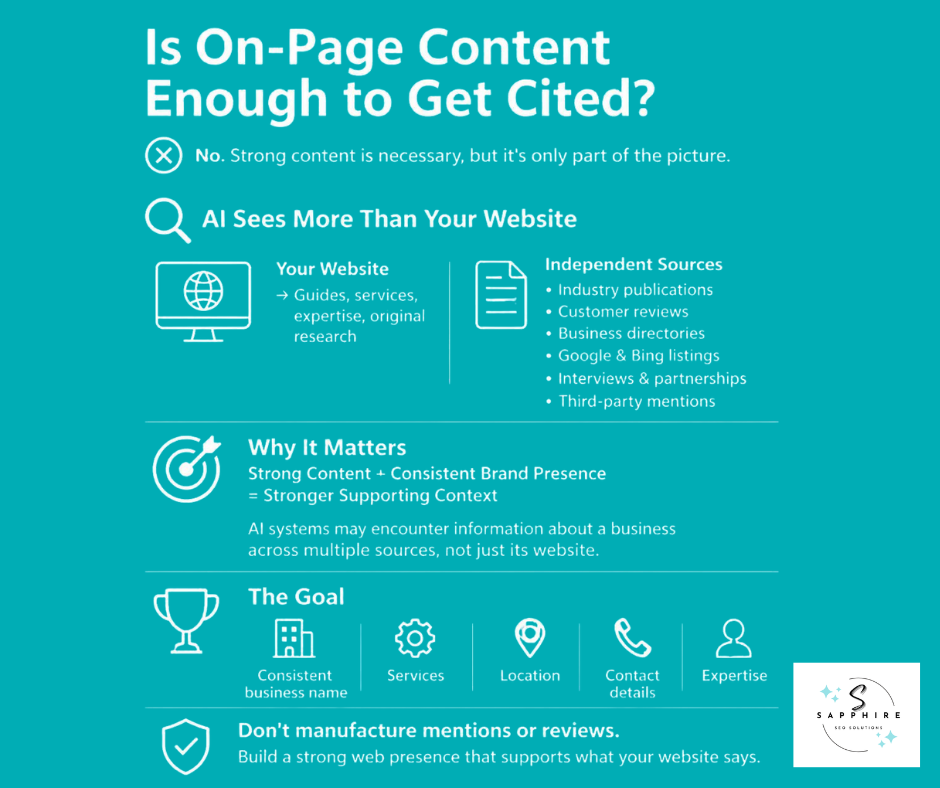
Good content is necessary. It's just not the whole equation. A business can publish something genuinely strong, specific, well-sourced, clearly written, and still not have enough for an AI system to confidently understand and represent it. That gap usually isn't about content quality. It's about everything else the web does or doesn't know about that business.
Your website is the primary source of information about your business. But it's rarely the only source an AI system runs into. Independent brand mentions show up across the web too:
Industry publications covering the business or its work
Customer reviews on Google, Yelp, or industry-specific platforms
Relevant directories and professional organization listings
Local business profiles like Google Business Profile and Bing Places
Earned mentions, interviews, and partnerships
Original research the business published, referenced elsewhere by someone else
None of this means chasing backlinks specifically for AI's sake. Traditional SEO has valued off-site signals for years, and that part hasn't changed. What's worth understanding is that AI systems may also come across information about a business through these independent sources, not just the page you wrote. Real brand presence means the picture of a business stays consistent everywhere it shows up, not just accurate on the one page you control.
Bing's own guidance backs this up in a specific way. Its AI Performance guidance tells local businesses that a maintained Bing Places listing helps details like address, hours, and contact information stay current and eligible for inclusion in AI-generated answers. That's a search platform saying, in plain terms, that outside information feeds what its AI says about a business, not the website alone.
Here's what that looks like for a small business. Say a roofing company publishes a genuinely strong guide on choosing shingles. On its own, that's good content. But the wider web also holds its Google and Bing business listings, an industry association profile, a mention in a local paper, a handful of customer reviews, and coverage of a recent project, all describing the same company, the same services, the same city, in roughly the same terms. That combination creates far more supporting context than the guide could ever provide by itself.
None of this requires buying mentions or manufacturing reviews, and it's not a shortcut around writing something good either. It just means one page, however well-built, isn't automatically cited content. The web around it has to back it up.
Does Traditional SEO Still Matter for AI Search?
Yes. Traditional SEO hasn't been replaced by anything covered in this article. AI search doesn't eliminate SEO. It expands the visibility environment SEO operates in, adding a new way to be found without removing the old one.
Google is direct about this. Its own documentation says a page must be indexed and eligible to appear in classic search with a snippet before it can even be considered as a supporting link in AI Overviews or AI Mode. There are no separate technical requirements for AI features. The same foundation that's always mattered for Google rankings still applies:
Crawlability, so search engines can actually reach the page
Indexability, so it can be included in the index at all
Search relevance and intent, so the page matches what someone's actually asking
Internal links, so related pages connect and reinforce each other
Real textual content, not just images or video standing in for it
A solid page experience, meaning it loads and works the way it should
Structured data, where it genuinely applies
Accurate business information
Content quality, which is really the throughline behind everything else on this list
Here's the distinction worth holding onto. Ranking well isn't the same as getting cited. A page can rank on page one of traditional search engines and never show up in an AI-generated answer, and a page can get cited without holding the top spot. But poor discoverability- a page that's not indexed, not crawlable, or badly targeted- closes off the opportunity before it even starts. You can't get retrieved from a page nobody can find in the first place.
AI search didn't replace the blue links. It sits alongside them, drawing on a lot of the same groundwork underneath.
Do You Need Special AI SEO Tactics to Make Content Citation-Worthy?
A lot of what gets sold under the label generative engine optimization turns out to be a rebrand of things that either don't matter or never needed a special tool. Here's the honest answer on the ones that keep coming up.
Do You Need Special Schema?
No. Google is explicit that no special schema.org markup is required for AI Overviews or AI Mode. Structured data still serves a real purpose. It helps rich results and gives search systems clearer signals about a page. But there's no separate "AI schema" to implement. What matters more is that whatever structured data is there actually matches what's visible on the page. Mismatched markup can cause more harm than no markup at all.
Do You Need llms.txt?
llms.txt is a proposed text file some sites add to give AI systems a quick map of their content. It's not something Google requires, and Google's own guidance says it isn't needed to appear in generative AI search. It's not harmful to have one. It's just not a meaningful lever to pull.
Do You Need to Stuff Questions Into Headings?
No. A heading phrased as a question works when it genuinely reflects how someone would ask it out loud. Forcing every heading into question form because it seems AI-friendly just makes a page harder to read.
Does AI-Generated Content Automatically Hurt Visibility?
No. Using an AI tool to help draft something isn't the problem by itself. Google's guidance focuses on accuracy, quality, relevance, originality, and whether the content actually helps someone, not on which tool wrote the first draft. What does cause problems is large-scale AI-generated content published with no real value behind it, which runs into the same spam concerns covered earlier.
Check out our guide on Does AI-Generated Content Rank on Google? to learn more about AI-generated content and how you can use it for your small business.
Do You Need to Write Separate Pages for Every AI Query?
No. Google specifically warns against creating content for every possible query variation just to try to influence AI responses. One strong page usually does more than ten thin ones built around slightly different phrasing.
How to Create Citation-Worthy Content for a Small Business
None of the eight characteristics above happen by accident. They come from a process, and that process usually starts well before anyone opens a blank document. Here's what it actually looks like for a small business, in nine steps that build on each other rather than nine separate tasks to check off.
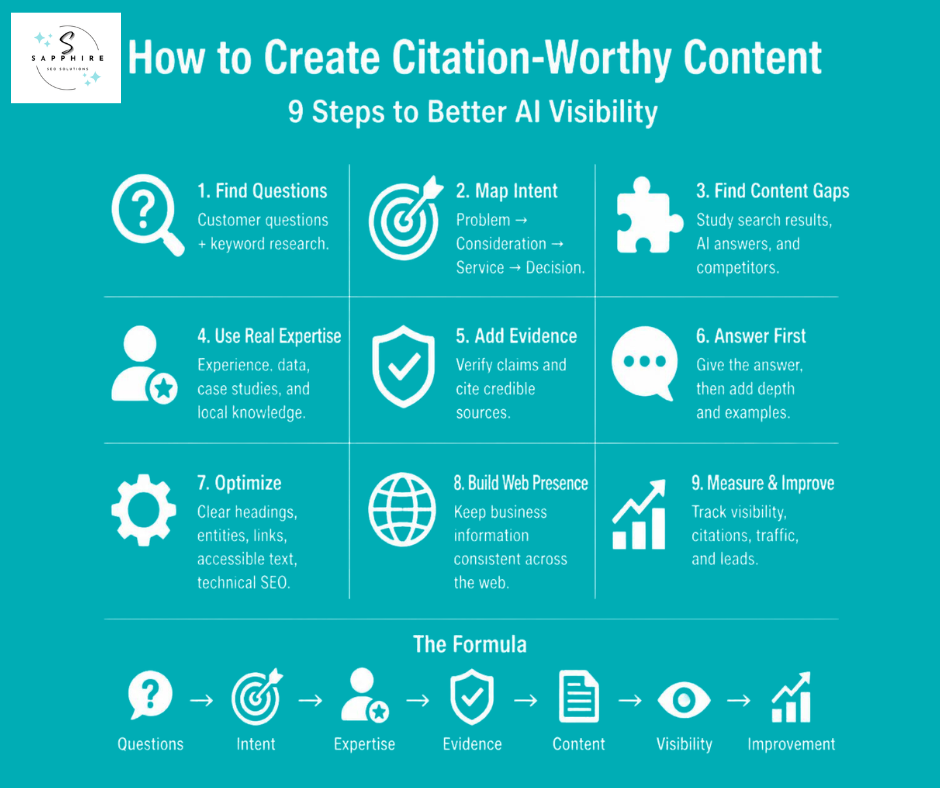
Step 1: Start with Customer Questions
Skip the AI prompt generators for a minute. The best starting point for a content team is what customers already ask: questions from sales calls and service calls, objections that come up before someone books, reviews that mention confusion or hesitation. Pair that with actual keyword research- the search queries people type before they buy- and the result is a list grounded in real, relevant prompts instead of guesses about what an AI might be asked.
Step 2: Map Questions to Business Intent
Every question sits somewhere on a path from confusion to decision. "Why is my AC freezing up?" leads to "Is this something simple?" which leads to "Do I need repair?" which leads to "Who should I call?" Map each question that way- problem, consideration, service, decision- and it becomes clear which informational content actually supports a commercial outcome, and which is just interesting trivia with no path to a customer.
Step 3: Study the Existing Search and AI Landscape
Look at what's already ranking, what AI-generated answers currently say, and what competitors and industry sources cover. The goal isn't copying their structure. It's finding the gap: missing information, weak explanations, outdated numbers, a question nobody's actually answered well. Treat one AI-generated answer as one data point, not the final word on what a good answer looks like.
Step 4: Find the Business's Information Advantage
Ask one question honestly: what can this business explain better because it actually does the work? That might be years of experience, internal data, case studies, local knowledge, a specialization most competitors don't have, or patterns noticed across hundreds of customers. That advantage is what separates a real content strategy from a rewrite of whatever's already on page one.
Step 5: Build Evidence Before Writing
Collect primary sources, internal data, and case-study details before drafting starts. Interview whoever actually does the work if that's not the person writing. Verify any statistic before it goes on the page. This is where generic content writing and real research diverge: research shouldn't begin after the draft is done. It should shape the draft from the start.
Check out our guide on What Is SEO Content Writing? to learn more about content that AI search engines prefer.
Step 6: Write the Answer Clearly, Then Build Depth
A strong structure to lean on: direct answer, explanation, evidence, examples, limitations, practical implications. Not every article needs that exact order. But leading with the answer and building depth afterward, rather than building suspense toward it, respects both a reader's time and how these questions tend to get answered by search systems.
Step 7: Optimize the Page for Search and Understanding
This is where optimizing content actually happens: matching the title and headings to real search intent, linking to related existing pages, keeping entity names consistent, making sure the page is technically sound. Google specifically recommends keeping important information in real text, not locked inside an image, and making sure any structured data matches what's visible. Technical accessibility (technical SEO) matters here too. A page a crawler can't read properly can't be retrieved at all, regardless of how good the writing is.
Step 8: Build the Supporting Web Presence
Keep business information accurate everywhere it appears: directories, review platforms, local listings, industry profiles. Earn mentions where they happen naturally instead of buying them. None of this replaces good content. It surrounds it with the kind of supporting context covered earlier in this article.
Step 9: Measure, Learn, and Improve
Track search performance alongside AI visibility where it's measurable: citation activity, grounding queries where a platform reports them, and the business outcomes that actually matter: leads, calls, conversion quality. This isn't a one-time project for content marketers to finish and move past. It's a loop.
Following nine steps doesn't guarantee a citation, and nobody who tells you otherwise is being straight with you. What it does is put a business in a stronger position than publishing pages aimed at target queries with none of the work behind them.
How to Measure AI Search Visibility and Whether It Matters to the Business
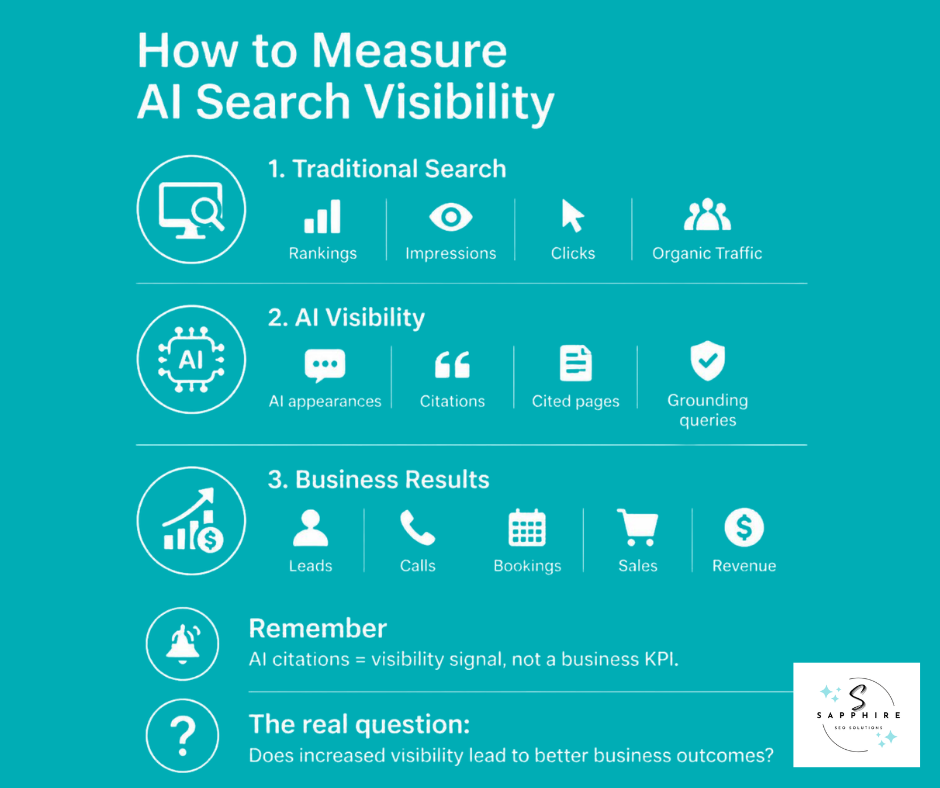
Measuring this well means tracking three different things, not one number that supposedly captures all of it.
Traditional Search Visibility
This part hasn't changed. Impressions, rankings, clicks, organic traffic, and how much of a topic's query coverage a site actually owns. None of that stopped mattering just because AI search showed up. If anything, it's still the baseline everything else gets compared against.
Read our guide on Traditional SEO vs AI SEO to learn the differences between both and how both are important for your small business.
AI Visibility
This part is newer, and it comes with real gaps. Google rolled out dedicated Search Console reporting for Google AI Overviews, AI Mode, and related Discover features, reaching every website worldwide by August 31, 2026. It shows impressions, how often a site's pages appeared inside those AI experiences, broken down by page, country, device, and date. What it doesn't show is which clicks those impressions produced, or which specific queries triggered them.
Bing covers different ground. Its AI Performance report gives citation counts, which pages got cited, grounding-query groupings (the reformulated search phrases tied to what got referenced), and page-level citation activity across its supported AI experiences. Together, these two reports are the closest thing to first-party citation data either platform has offered so far.
Business Outcomes
None of the above means much on its own without connecting it to what the business actually needs: qualified leads, calls, form submissions, bookings, sales opportunities, assisted conversions, and revenue where it's trackable. AI visibility is a leading indicator at best. The business outcome is still the real measure.
One thing worth saying plainly, because it's easy to overstate. Bing itself warns that citation activity doesn't measure rankings, authority, importance, or traffic, and it's explicit that citation changes don't establish causation. A citation is a visibility signal, not a business KPI by itself. Treated that way, it's genuinely useful: a way to track brand mentions across AI systems and build a clearer picture of brand visibility over time. Treated as a stand-in for revenue, it'll mislead more than it helps.
AI search citations will keep evolving as more platforms roll out reporting. What won't change is the need to tie any of it back to something the business can actually count.
Citation-Worthy Content Checklist
Here's a practical citation-worthiness checklist, built from everything covered above. Run a page through it before publishing, or use it to take an honest look at something already live.
CITATION-WORTHY CONTENT CHECKLIST
Relevance
Usefulness
Originality
Evidence
Expertise
Clarity
Structure
Specificity
Freshness
Discoverability
Business Value
None of these questions produce a score, and nothing here adds up to a guarantee. A page can answer yes to all eleven and still not get cited on a given day. What this checklist does is more useful than a scorecard would be. It gives a direct answer to whether a page has the raw materials of citation-worthy content, the kind built to deliver specific answers through structured content that a reader and a system can actually follow.
What This Means for a Small Business Investing in AI SEO
None of this requires a business to reinvent its marketing from scratch. What it requires is doing a few things well instead of chasing every tactic that gets labeled AI-friendly this month.
Here's what doesn't actually help: hundreds of AI-generated posts published for volume, hundreds of FAQ pages built to catch every phrasing of the same question, "AI hacks" promising quick wins, special markup nobody requires, or content written only to please a system instead of a person. None of it holds up, and a chunk of it edges into the exact patterns Google warns against elsewhere in its guidance.
What actually works is closer to what's been covered throughout this article: a focused strategy built around commercially relevant topics, real customer-intent research instead of guesswork, content led by people who actually know the subject, original information backed by evidence, solid technical SEO, internal linking that connects related pages, entity clarity across the site, a supporting web presence beyond the site itself, some way to measure AI visibility over time, and the discipline to keep improving instead of treating any of this as finished.
Here's the position worth holding onto through all of it. Generative engine optimization, or answer engine optimization, whichever label ends up sticking, should make a business's expertise easier to discover, understand, trust, and reference. It shouldn't replace the fundamentals that made the business visible in search in the first place. The AI search era didn't erase those fundamentals. It just added a new set of AI answer engines reading them.
Not every business needs a dedicated strategy for AI-driven search on day one. But every business benefits from doing the underlying work well, because that work is what both people and AI systems are actually looking for.
Here are some more resources to help you learn more about AI SEO and how you implement it for your small business:
Want Content Built for Search and AI Visibility?
Everything in this article points to the same conclusion: getting cited isn't one tactic. It's a full system: research, strategy, content, SEO, authority, AI visibility, measurement, each part supporting the next.
That's the system Sapphire SEO Solutions builds with small businesses. We help identify which search opportunities are actually worth going after, map real customer questions to commercial intent, and develop a content strategy around what a business can uniquely say. From there, we create expert-led content, optimize content that's already live, strengthen internal linking and topical coverage, and shore up the engine optimization fundamentals that still carry the most weight. Alongside that, we work on the newer side of things too: improving content for AI visibility and keeping an eye on how both AI search citations and traditional performance move over time.
Sapphire SEO Solutions offers reliable AI SEO Services that can help give your business a real shot in this AI search-driven era. Contact us to talk to an expert today!

Frequently Asked Questions About Citation-Worthy Content
What makes content citation-worthy for AI search?
Content that's relevant, useful, specific, understandable, and supportable enough that an AI system finds it worth pulling into an answer. Firsthand experience, real evidence, clear structure, and current information all strengthen that case, though nothing guarantees a citation on any given query.
How can I make my content more likely to be cited by AI?
Answer the actual question early, back important claims with real evidence, write from genuine experience rather than a rewrite, keep entities and terminology clear, and keep the information current. None of that is a shortcut. It's the same work that makes content good for people, applied consistently.
Does ranking on Google help with AI citations?
It helps indirectly. A page generally has to be indexed and eligible to appear in traditional search engines before it can be considered a supporting link in Google's AI features. But ranking well and getting cited remain two different outcomes, and a top ranking doesn't guarantee an AI citation.
Does AI-generated content get cited by AI search engines?
It can. AI-generated content isn't automatically excluded from AI answers, and using AI tools to help draft something isn't the issue on its own. What matters more is whether the finished content is accurate, original, and genuinely useful, not which tool typed the first draft.
Does structured data help AI search visibility?
It can support understanding, though it isn't required. Google has said there's no special schema needed for AI Overviews or AI Mode. Structured data still helps with things like rich results and entity clarity, and it should always match what's actually visible on the page.
How important is original research for AI search?
Useful, though not mandatory for every page. Original research, proprietary data, or firsthand observations give a page something a generic rewrite can't offer. Not every article needs a formal study. Most benefit from at least one detail nobody else could have written.
Do small businesses need AI SEO services?
Not universally, no. Some businesses can manage a focused content and SEO strategy on their own. Others benefit from ai seo services simply because the work- research, evidence-gathering, technical SEO, and ongoing measurement- takes real time most owners don't have to spare.
Can an AI SEO service help my business appear in AI-generated answers?
It can help build the underlying conditions that make appearing more likely: stronger content, cleaner technical foundations, a more consistent web presence, and measurement across both traditional search engines and newer AI citation reporting. No service, including this one, can promise a specific placement, since the exact mechanics behind how large language models select sources aren't fully public.