

What Is Search Intent? How to Identify and Match It for SEO
A page can target the exact right keyword and still fail. It shows up on Google. Someone clicks it, and then they leave because the page didn't give them what they actually came for.
That gap between "ranks for the keyword" and "answers the need" is what search intent is about.
Search intent, sometimes called user intent or user search intent, is the underlying goal a person is trying to accomplish when they type something into a search query. It's the reason behind the words being typed in a search engine.
Here's the distinction that matters. There's what someone types into the search bar. There's what they actually want. And there's what kind of result would satisfy them once they get there. Those three things aren't always the same, and mixing them up is where a lot of SEO effort gets wasted.
A few quick examples make this easy to see. Someone searching "what is SEO?" wants to learn something. Someone searching "SEO services for small business" is evaluating whether to hire a company. And someone typing "Sapphire SEO Solutions" already knows where they want to go. Same activity, three completely different goals.
Search engines are built around this idea. Google has said its systems look at things like the meaning behind a query, the relevance and usability of pages, and the expertise behind the content, all to figure out what will actually be useful to the person searching. In other words: relevance and quality, not just keyword matching.
That's why understanding search intent matters so much. It shapes what page you build, what goes on it, and whether chasing that keyword is even worth your time in the first place. It's also increasingly important for how AI-generated answers pull and use content, which we'll get into later.
This guide goes over what search intent is, why it matters, how to read the SERP, spot true intent, and build pages that convert visitors.
Key Takeaways
A page can rank for the right keyword and still fail if it doesn't satisfy what the searcher actually wanted.
The highest-volume keyword isn't automatically the best opportunity. Intent tells you what that demand represents.
Most real searches carry multiple intents at once. Don't force every query into one tidy category.
Studying the actual SERP (page types, formats, what ranking pages cover) beats trusting a keyword tool's intent label.
Intent should decide what page deserves to exist, not just which keywords get stuffed onto one.
Google has no preferred word count. Depth and originality beat length every time.
AI search can fan a single question into several related searches, so content needs real, connected depth.
Always validate intent against the business. A ranking opportunity isn't automatically a business opportunity.
What Is Search Intent and Why It Matters for SEO
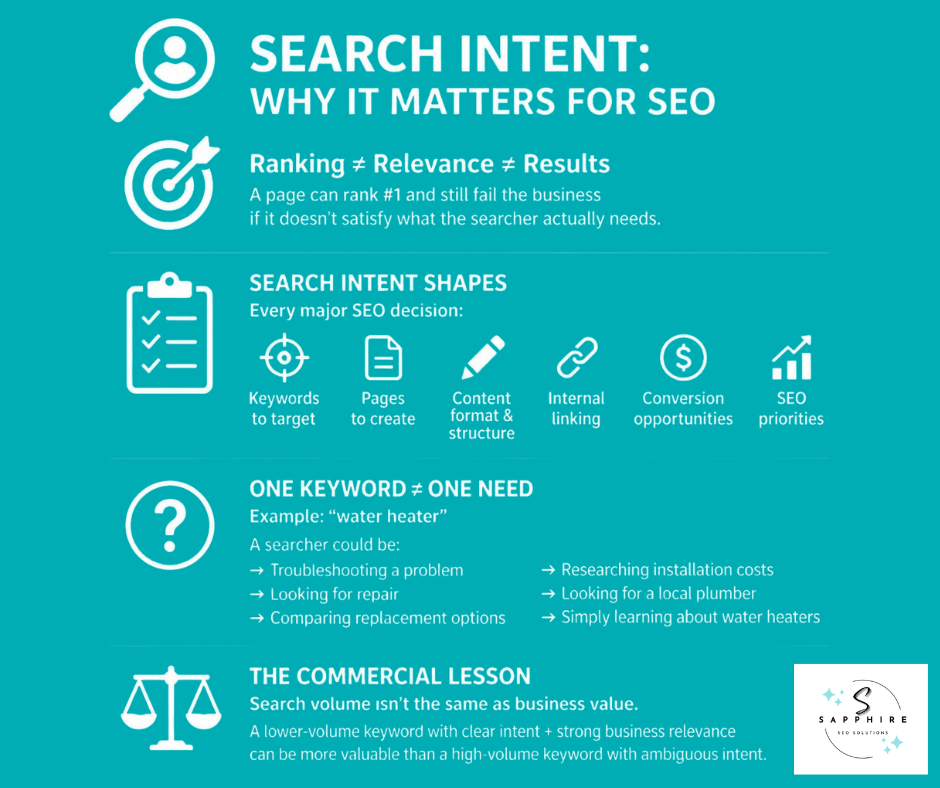
SEO isn't just about getting a page to rank for a phrase. A page can hold the top spot on Google and still do nothing for the business behind it, because ranking and satisfying the person who clicked are two different jobs.
This is why search intent is important. It isn't a nice-to-have concept you bolt on after the keyword research is done. It touches nearly every decision that follows:
Which keywords you actually go after
Which pages you build to target them
What format the content takes
How the page gets structured
Where internal links point
What conversion opportunities make sense on that page
Which projects get prioritized first
There's a real difference between a page being relevant to a keyword and a page being relevant to what the searcher needs. Those sound like the same thing. They're not.
Take a plumber who ranks well for "water heater." Great, that word shows up on the page and Google likes it. But that single phrase doesn't tell the business much.
Is the person troubleshooting a unit that's making noise?
Looking to replace an old one?
Comparing repair costs?
Trying to find installation pricing?
Or just searching for a local plumber who handles water heaters at all?
Six different needs, one keyword. And the page that works for one of those searchers might completely miss the other five.
That's the commercial reality worth sitting with: the highest-volume query isn't automatically the best opportunity. A keyword with less search volume but a much clearer need behind it can be worth more to a business than a big number that could mean six different things.
This is where optimizing for search intent earns its keep. Most businesses don't have unlimited time or budget for SEO. Understanding the audience's search intent is what helps decide where that limited effort actually goes, instead of spreading it across keywords that sound good on a report but don't line up with what the business can deliver.
The Four Common Types of Search Intent
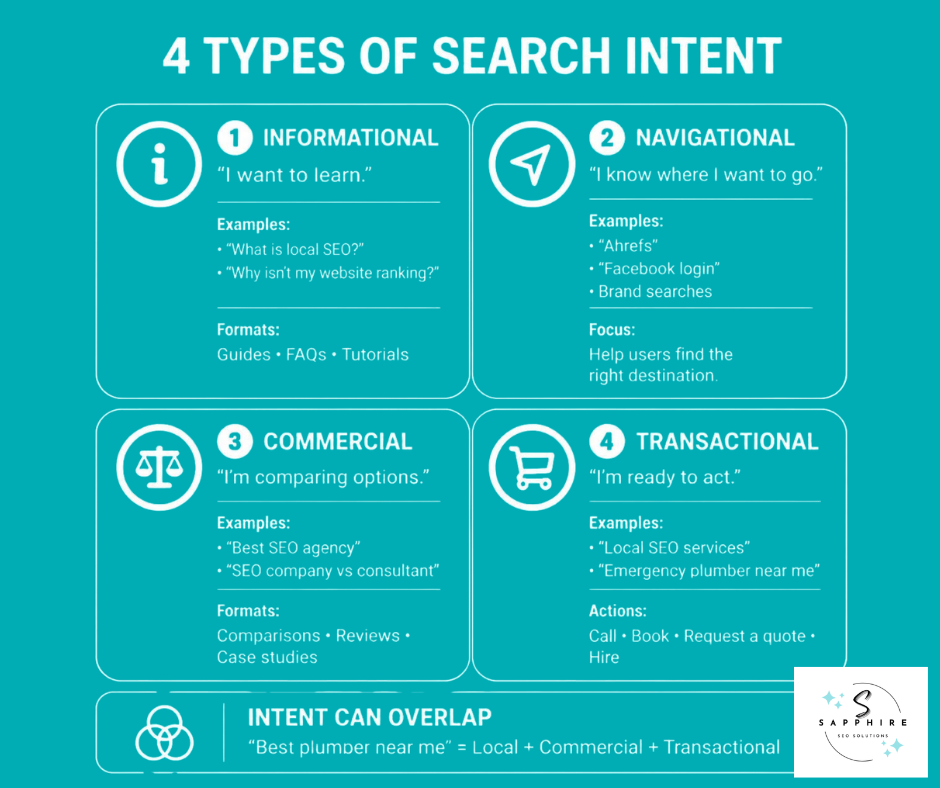
Most SEO conversations eventually land on the same framework: the four types of search intent. It's a useful shorthand, and worth knowing. But it's a starting point, so let's keep this part tight and move on to what actually matters more: figuring out intent for real queries.
Informational Search Intent
Informational intent shows up when someone wants to learn something, understand a concept, or solve a problem they're dealing with right now.
Think "what is local SEO," "how does SEO work," or "why isn't my website ranking." These are informational queries, and they tend to pull in how-to guides, explainers, tutorials, and FAQs.
Here's something worth noting, though: informational searches aren't confined to the top of the funnel. Someone typing "how much does SEO cost?" is technically asking an informational question. But that person could be three weeks away from hiring an agency. The query is informational. The moment might be commercial. Both things can be true at once, and treating every informational keyword as low-value traffic misses that entirely.
Navigational Search Intent
Navigational intent is simple: the searcher already knows where they want to go, and they're using Google as the shortcut to get there.
Someone typing "Google Search Console," "Ahrefs," a company name, or a Facebook login isn't shopping around. They want one specific website, tool, or login screen, not options.
For a business, this mostly comes down to fundamentals. Make sure your brand name and company are easy to find. Keep the pages people are actually looking for accessible. Keep your business information (name, address, category) consistent everywhere it appears, since that consistency is part of what feeds knowledge panels.
Beyond that, there's not much of a content play here. A generic article isn't going to capture a specific website search, and chasing a competitor's brand name with content rarely goes anywhere useful.
Commercial Search Intent
This is where someone is actively comparing their options before they commit to anything.
Queries like "best SEO agency for small business," "SEO company vs SEO consultant," or "SEO services for dentists" fall under commercial search intent. The searcher isn't ready to buy yet. They're gathering the information that will help them decide, which is a meaningfully different job for a page to do.
Commercial keywords tend to pull:
Comparison pages
Service pages
Buying guides
Reviews
Case studies
The common thread is decision support. A good page targeting commercial queries helps someone evaluate their options honestly, weighing tradeoffs, showing real examples, and answering the questions a smart buyer would actually ask. Not every page needs pricing to do this well. But every page should treat the reader like someone still deciding, not someone who's already sold.
Transactional Search Intent
Transactional intent means the searcher is ready to take an action. For a small business, that action rarely means "buy" in the ecommerce sense. It's more likely to be:
Requesting a quote
Calling the office
Booking a slot
Scheduling a service
Hiring someone outright
"Local SEO services," "emergency plumber near me," and "hire an SEO consultant" are all transactional. So is a homeowner searching for someone to fix a leak tonight. None of that involves a shopping cart, and that's exactly the point: transactional doesn't mean ecommerce. It means the person is done researching and ready to move.
One more thing worth flagging before the next section: a lot of real searches don't sit neatly inside just one of these four buckets. "Best plumber near me" carries local search intent, commercial weighing, and transactional urgency all at once. We'll get into that next, because it changes how you should actually think about keyword intent.
Search Intent Isn't Always a Single Category
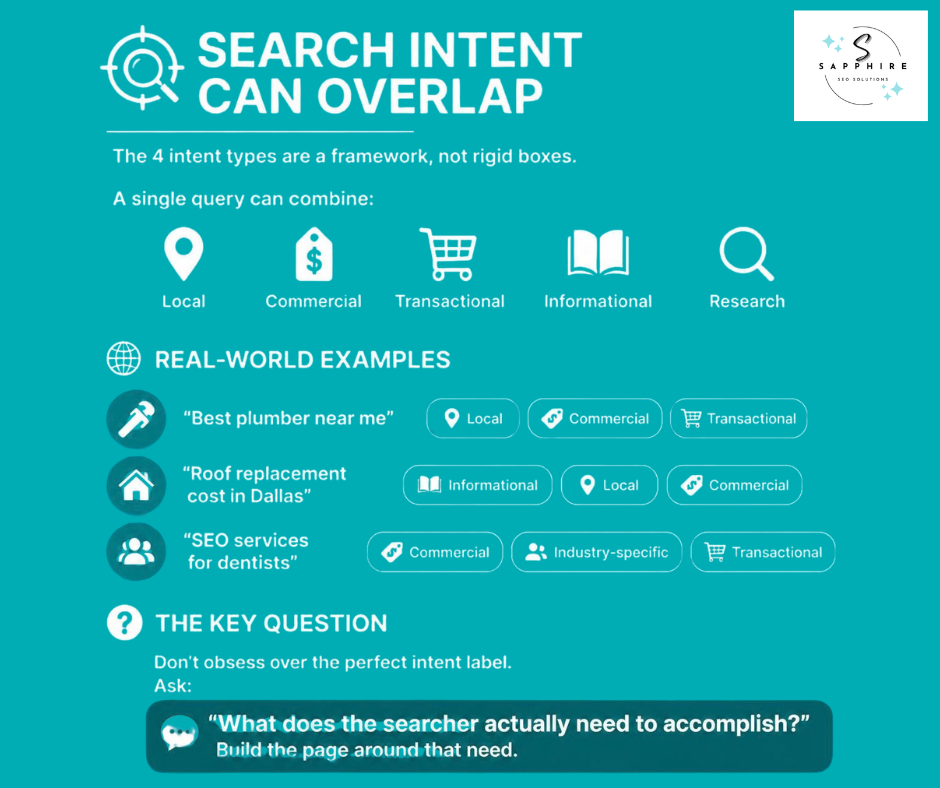
The four categories are a useful mental model. They are not a rulebook, and treating them like one will trip you up the moment you look at a real query.
Most searches carry multiple intents at once. A query can have a primary goal, a secondary one riding along with it, plus local context, commercial context, or research context layered on top. Query intent is rarely as clean as a textbook example.
A few real examples make this obvious:
"best plumber near me" carries commercial intent (comparing options), local intent (a specific area), and likely transactional intent (someone who wants to hire soon).
"how much does a roof replacement cost in Dallas?" is informational on the surface, but it's got clear local search intent and a strong undercurrent of commercial investigation.
"SEO services for dentists" is commercial, industry-specific, and probably transactional depending on where the searcher is in their decision.
Even the tools built to classify this stuff run into the same problem. Bing's AI Performance reporting, which shows publishers how their content gets cited in AI-generated answers, recently expanded beyond the classic four-category model. It now sorts queries into a wider set of labels, including informational, commercial, navigational, research, and local, among others. The point isn't which exact labels Bing uses. It's that even Microsoft's own systems recognize that keyword intent doesn't always fit neatly into one bucket, and that classification gets genuinely harder when a query is ambiguous or doing more than one job at once.
So don't get hung up on finding the "perfect label" for every keyword's search intent. That's a losing game, and it's not really the point anyway. The better question, every time, is this: what does the searcher actually need to accomplish, and what would satisfy that need? Answer that, and the label sorts itself out. This matters just as much when a prompt intent is being interpreted by an AI system as it does for a traditional Google search, which is something we'll come back to later in this article.
How to Identify Search Intent From the SERP
Anyone can memorize four category names. Fewer people know how to determine search intent for a specific keyword in a specific market, and that skill is what makes the rest of this article useful in practice.
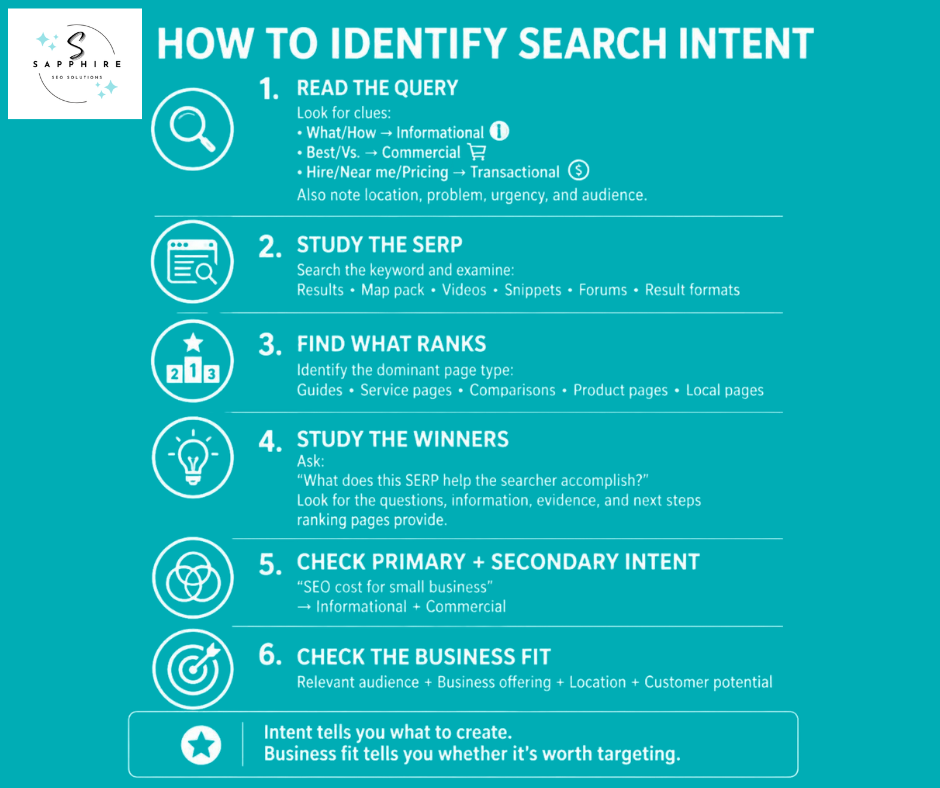
1. Start with the Search Query
Before you touch the SERP, look closely at the words themselves. Wording carries clues.
"What," "why," and "how" often point toward learning.
"Best" and "versus" often point toward comparison.
"Services," "pricing," "near me," "hire," and "buy" often point toward someone ready to act.
Beyond the obvious trigger words, pay attention to what's baked into the phrase itself:
Location (a city or "near me")
The specific product or service named
A problem being described
Any sense of urgency
Who's likely asking (a homeowner, a business owner, a researcher)
Here's the catch, though. These are signals, not verdicts. "How much does SEO cost?" starts with "how," but it's loaded with commercial weight. "Best plumber" starts with "best," but it's really a local, transactional search wearing a comparison word. Treat wording as a first clue, not the final answer, and don't lean entirely on a keyword tool's intent label either. Those labels are a starting guess, built on patterns, not a read of what a real searcher in your market actually wants.
2. Search the Query Yourself
There's no substitute for actually running the search and looking at what comes back. Not skimming it. Studying it.
Check the full mix of what shows up in the search engine results:
Organic results and what they're about
Local results, if any appear
Videos
Shopping results, where relevant
Featured snippets and other SERP features
Forums or discussion threads, if Google is surfacing them
The actual page titles and result formats being shown
Google itself has said that Search features vary depending on the query and the context behind it, which is exactly why one search doesn't tell the whole story. A keyword that pulls in local results and a map pack is telling you something different than one that returns ten blog posts and nothing else. Treat any single result as one data point, not proof.
3. Analyze the Dominant Page Types
Once you've looked at the full SERP, step back and ask what kind of pages are actually winning.
Is it guides?
Service pages?
Product pages?
Category pages?
Comparison content?
Local pages?
Videos?
Forum threads?
Or a genuinely mixed bag with no clear pattern?
The type of page Google is rewarding tells you something real about what it believes will satisfy that search. If nine of the top-ranking pages are service pages and one is a blog post, that's a strong hint about what users expect to land on. That said, this isn't a mandate to copy the format exactly. It's a data point that should inform your decision, not replace your judgment about what's actually right for the business.
4. Study What the Ranking Pages Actually Do
Don't stop at headings. Open the pages that are ranking and actually read them. Look for the questions they're answering, the subtopics they cover, the examples and evidence they use, the decision-making criteria they lay out, any pricing information, local context, product or service detail, and whatever original insight sets them apart. Notice what they offer the reader as a next step, too.
The real question to ask is this: what job is this SERP helping the searcher accomplish? That question is far more useful than counting competitor words. And on that note, word count isn't a shortcut worth chasing. Google has said directly that it has no preferred word count and that writing to hit a specific length isn't a strategy it rewards. The longest result on the page isn't automatically the one satisfying intent best. What matters is whether the content gives someone something genuinely useful that the other results don't.
5. Determine Primary and Secondary Intent
Most real queries carry a primary intent and a secondary one riding underneath it. Take "How much does SEO cost for a small business?" The primary intent is informational; the person wants an answer. But there's a clear secondary layer of commercial investigation underneath it, since anyone asking that question is likely weighing whether to hire someone.
That combination should shape the page directly. Answer the question honestly. Explain what actually drives cost up or down. Walk through common engagement models. Give the reader enough to make a real decision. And offer a next step that fits where they are, without forcing them toward it. You don't need a separate page for every secondary intent that shows up. One well-built page can usually carry the primary need and its secondary layer at the same time.
6. Validate Intent Against the Business
This last step gets skipped more often than it should, and it's the one that keeps SEO grounded in actual business results.
Before committing to a keyword, ask a few honest questions.
Is this audience actually relevant to what the business does?
Does the business genuinely offer what the searcher is looking for?
Is the search geographically relevant to where the business operates?
Can the business answer this better than what's already ranking?
Is the opportunity commercially meaningful, or just a big number on a report?
Does the resulting page fit naturally into the existing site?
And can it plausibly contribute to a real customer journey, from search to inquiry to job?
A keyword can look perfect on paper and still be the wrong one to chase. Determine intent first. Then check it against what the business can actually deliver, because traffic that doesn't connect to the business isn't really an opportunity. It's just a number.
Search Intent and Keyword Research: Look Beyond Search Volume
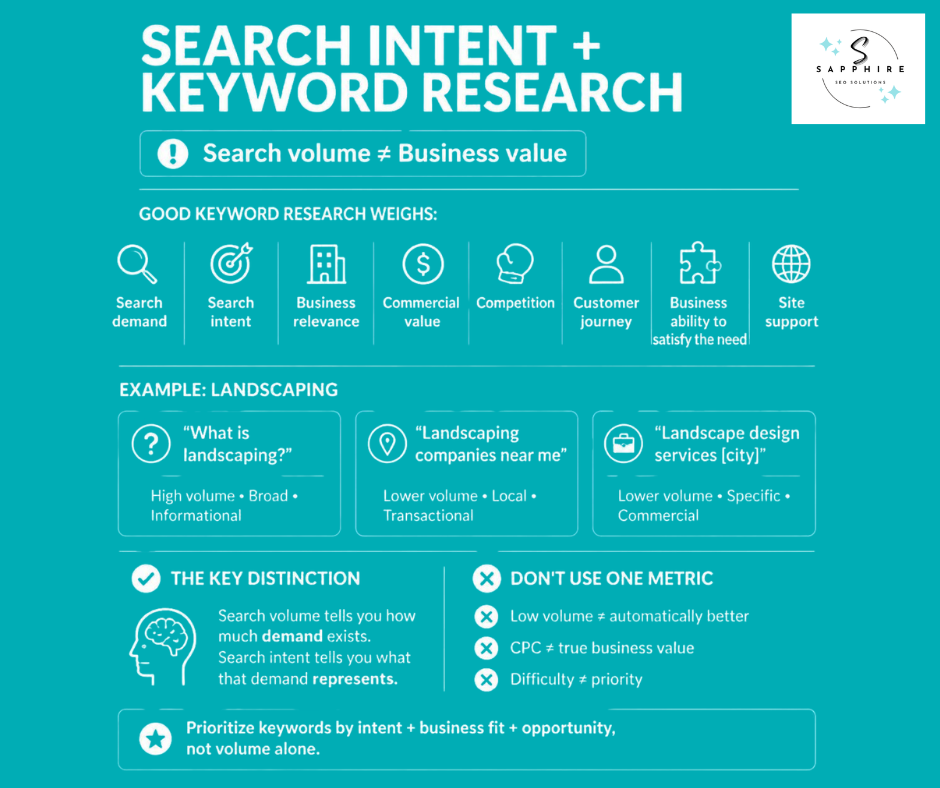
Good keyword research doesn't stop at pulling a list of phrases and sorting them by volume. That's where a lot of SEO plans go wrong, actually, because a big number next to a target keyword doesn't tell you whether that keyword is worth building a page around.
Real prioritization weighs several things at once:
How much search demand actually exists
What the search intent behind it is
Whether it's relevant to the business at all
Whether it carries any commercial relevance
How much competition sits in that space
Whether the business can genuinely satisfy the need
Where it fits in the customer journey
Whether the existing site and pages can support it
Look at a landscaping company weighing three different searches. "What is landscaping?" pulls decent volume, but it's a broad, informational query with a huge, mostly irrelevant audience behind it. "Landscaping companies near me" is smaller but local and clearly transactional. "Landscape design services [city]" is smaller still, but it's specific, local, and squarely aimed at someone ready to talk to a company.
None of these is automatically the "right" one. Each represents a different kind of opportunity, and each calls for a different decision. The first might support a broader content strategy and some long-term visibility. The second and third are much closer to where actual jobs come from. A landscaper with limited time is usually better off starting with the searches closest to real work, then building outward from there.
Search volume tells you how much demand exists. Search intent tells you what that demand actually represents. A keyword with 500 searches a month and clear commercial intent can be worth more to a business than one with 5,000 searches and a vague, mostly informational crowd behind it.
A few things worth being careful about here:
Low search volume doesn't automatically mean better conversion; that's not a rule, just something that happens to be true sometimes.
Cost-per-click numbers from ad tools aren't a reliable stand-in for how commercially valuable a keyword actually is to your specific business.
Keyword difficulty scores are useful context, not the only thing deciding what gets built first.
When you group keywords for planning, intent and business fit should carry as much weight as volume, if not more, especially for a smaller site with limited content marketing resources to spend.
Search Intent Should Help You Choose the Right Page
When a keyword shows up in your research, the reflex is usually the same: write a blog post about it. But that's not actually the right question. The right question is what kind of page deserves to exist for this search at all, and a blog post is only one of several possible answers.
Search intent is what tells you which one fits. Depending on what a searcher needs, the right answer might be:
A service page
A location or service-area page
A product page
A category page
A comparison page
A guide
A tutorial
A case study
A pricing page
A resource page built around FAQs
Ten different keywords can call for ten genuinely different page types, and treating them all the same way is where a lot of content plans go flat.
A few examples make this concrete:
"What is local SEO?" needs an educational guide. The searcher wants to understand something.
"Local SEO services" needs a service page. The searcher wants to know what you offer and how to start.
"Best local SEO companies for dentists" needs commercial or comparison content. The searcher is weighing options.
"Local SEO consultant near me" needs a local, service-oriented page. The searcher is close to reaching out.
Four searches, four different jobs, four different pages. Building one generic article to cover all four would leave most of those searchers without what they actually came for.
Search intent should shape what page deserves to exist, not just which keywords get stuffed onto a page you've already built. That distinction matters more than it sounds like it should.
It also means resisting a few habits that feel productive but rarely are:
One keyword doesn't need one dedicated URL.
A dozen near-identical synonyms don't need a dozen thin variations of the same page.
Building substantially identical city pages, swapping out just the place name each time, tends to create clutter rather than opportunity.
Google's own current guidance actually backs this up directly. It advises against creating content for every possible way someone might phrase a search, including the related queries that show up when AI systems break a question into pieces, warning that this kind of variation-chasing doesn't serve real value and can work against a site rather than for it.
The better move is fewer pages, built with real intention around genuine differences in need. Choose the content format that actually matches what the searcher is trying to do, build it well, and let it earn its place instead of publishing something for every keyword variation your research tool spits out.
How to Create Content That Satisfies Search Intent
Knowing the intent behind a keyword is only half the job. What you actually put on the page is where it either pays off or falls apart. Here's how that plays out for each type of intent, plus a set of standards worth applying no matter what you're writing.
For Informational Intent
Answer the main question early. Don't make someone scroll through three paragraphs of throat-clearing to find out what they came for.
From there, explain the concept underneath the question, not just the definition. Give real examples. Cover the follow-up questions a genuinely curious reader would ask next. Bring in evidence where it strengthens the point, and add something the reader couldn't get from a dozen other blog posts covering the same topic, whether that's original analysis, direct experience, or a perspective built from actually doing the work. The goal is helping the reader accomplish something, not just handing them a vocabulary lesson.
A 300-word introduction before the actual answer shows up, restating that answer three more times through the piece, generic "tips" that could sit on literally any article about any topic, and padding added just to hit a word count nobody asked for.
For Commercial Investigation
Someone comparing options wants help making a decision, not a nudge toward one predetermined answer. Give them what they actually need to evaluate: the real options, honest tradeoffs, relevant use cases, what drives pricing up or down, genuine alternatives, other providers worth knowing about, solid evidence, and case studies that show real outcomes.
What to avoid here matters as much as what to include. Skip the "we're the best" language, since a claim like that means nothing without something behind it. Don't make claims you can't back up. Don't let the comparison quietly turn into a sales pitch. And don't hide the actual comparison behind vague praise; either state the differences clearly or don't bother writing the piece.
For Transactional Intent
Someone with transactional intent is close to acting. Your job is removing friction, not adding pressure. Explain what you actually offer and who it's genuinely built for. Include the service-area details that matter. Answer the objections a real customer would have before they ask. Give them a reason to trust you, whether that's reviews, credentials, or a track record. Then make the next step obvious.
Skip the pile-up of five different calls to action competing for attention on one page. Don't bury basic information a visitor shouldn't have to hunt for. And skip manufactured urgency, the kind of "only 2 spots left!" language that isn't actually true, since readers can usually tell the difference.
For Local Intent
A local page needs to actually be local, not just wear a city name. Establish real relevance to the area. Be specific about what the business actually serves there. Include accurate local information (service area, contact details, anything genuinely tied to that location). Address the needs that are specific to that place when there's a real reason to.
What breaks this fast: swapping a city name into an otherwise identical template across dozens of pages, building thin doorway pages that exist only to rank, faking local experience the business doesn't have, or publishing duplicate city pages that all say the same thing with one word changed.
For Every Intent
Regardless of which category a page falls into, a few questions apply across the board.
Is the page genuinely useful?
Is the information accurate?
Does it show real expertise in the subject?
Does it add something beyond a generic summary anyone could produce?
Is it clear who wrote it or where the information comes from, when that matters?
Is it easy to actually read and follow?
And, honestly, does it leave the visitor satisfied?
This lines up closely with Google's own guidance on people-first content, which asks whether a page offers original information, substantial and complete coverage of the topic, and a genuinely satisfying experience, backed by real expertise rather than a repackaged summary of what's already out there.
What this rules out: writing produced mainly for algorithms instead of people, generic AI summaries with nothing original added, keyword stuffing, and publishing something just because a keyword exists rather than because an actual audience needs it. This is the standard that should sit behind any SEO content writing services worth paying for, and it's the same bar we hold every piece to before it goes live.
Search Intent and AI Search: Why the Concept Still Matters
AI-powered search hasn't made search intent less relevant. If anything, it's made getting it right more important, because the systems generating these answers are working through intent in ways that go well beyond a single keyword.
AI Search Can Break Complex Questions Into Related Searches
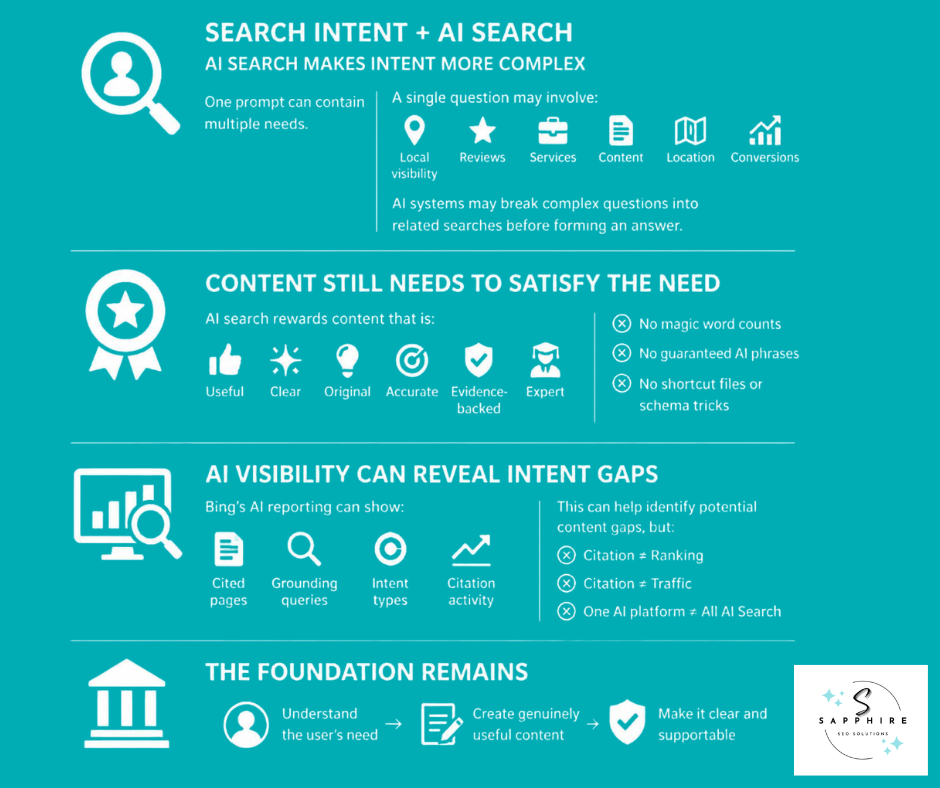
Google has explained that AI Mode and AI Overviews can use something it calls query fan-out, where a single question gets broken into several related searches behind the scenes, pulling from different sources before the system pieces together one answer.
Say a landscaping business owner asks an AI tool, "What's the best way for a small landscaping company to get more leads from Google?" That one question could reasonably touch several connected information needs: local search visibility, service pages, customer reviews, a Google Business Profile, useful content, conversion paths, and geographic targeting.
Worth being clear here: those are illustrative needs a question like that might touch, not a guaranteed list of what any AI system actually generates, and nobody outside Google can say with certainty how a specific query gets decomposed behind the scenes.
What this doesn't mean is publishing a separate page for every possible related search you can imagine. Google has actually warned against that approach directly, saying that creating separate content for every search variation or fan-out possibility, mainly to try to influence AI visibility, isn't an effective strategy.
AI Search Can Combine Multiple User Needs
A prompt typed into an AI tool often carries more than a traditional search query ever did. One message might contain a problem, a goal, a location, some constraints, a preference or two, a comparison, and a follow-up question, all stacked together.
That means content sometimes needs to speak to several connected needs at once without losing focus or turning into a scattered mess trying to cover everything. This isn't a sign that keywords are dead, and it isn't a sign that AI has replaced traditional search. Google has said plainly that its long-standing SEO practices still apply, because its generative AI features are built on top of the same core Search systems that have always powered ranking. The foundation hasn't changed. What's changed is how much a single query can be asking for at once.
What Makes Content Useful for AI Search?
Google's own current guidance is fairly specific here, and it's worth grounding advice in what the company has actually said rather than what's circulating as speculation.
The recurring theme is content that offers real, useful value, not something that could have been written by anyone about anything. That means clear answers, genuinely unique information, evidence behind the claims being made, useful structure, accuracy, appropriate expertise, and clarity about what the content is actually about and how its pieces connect. Google has specifically emphasized what it calls "non-commodity" content, meaning writing shaped by real experience and a specific point of view rather than a generic rundown anyone could produce. Bing's own AI Performance guidance points in a similar direction, recommending clarity, solid structure, real depth, evidence, and content that stays current and lines up with what the searcher actually needs.
What isn't supported by any of this: claims that AI prefers 50-word answers, that short paragraphs are somehow required, that adding a file like llms.txt guarantees citations, that there's a magic phrase that gets a page into ChatGPT, or that schema markup and FAQ blocks are a shortcut to AI visibility. None of that holds up against what these companies have actually published.
Read our detailed guide on What Makes Content Citation-Worthy for AI Search? to learn more about the type of content that gets cited in AI search.
Search Intent Can Help You Understand AI Visibility
Bing's AI Performance reporting, available through Bing Webmaster Tools, now shows publishers which pages are getting cited, the grounding queries tied to those citations, page-level citation activity, topic groupings, intent classifications, and citation share as part of its expanding preview features. The intent labels go beyond the traditional four categories, covering things like commercial, informational, local, comparison, research, and conversational intent, among others.
Here's where this becomes genuinely useful, not just interesting. If a business notices it's being cited mostly around informational questions but wants more visibility for commercial research queries, that gap may reveal something worth investigating, maybe a content type that's missing, maybe a coverage angle that hasn't been built yet. The word there is deliberate: it may reveal a gap. It doesn't prove one, and it definitely doesn't hand over a fix.
Bing has been upfront that this data is observational and sampled, and that it doesn't establish cause and effect or stand in for rankings, authority, traffic, or overall importance. Citations aren't the same thing as traffic. Citation share isn't the same thing as ranking position. And this data reflects Bing's own AI surfaces, not every AI system out there, so it shouldn't be treated as a stand-in for the whole AI search landscape. Understanding search intent still matters here, but the honest read of this kind of reporting is a starting point for investigation, not a verdict, and it's the same discipline that shapes how we approach AI SEO services for the businesses we work with.
Common Search Intent Mistakes
Most search intent problems aren't complicated once you can name them. Run your own content library against this list and see how many apply.
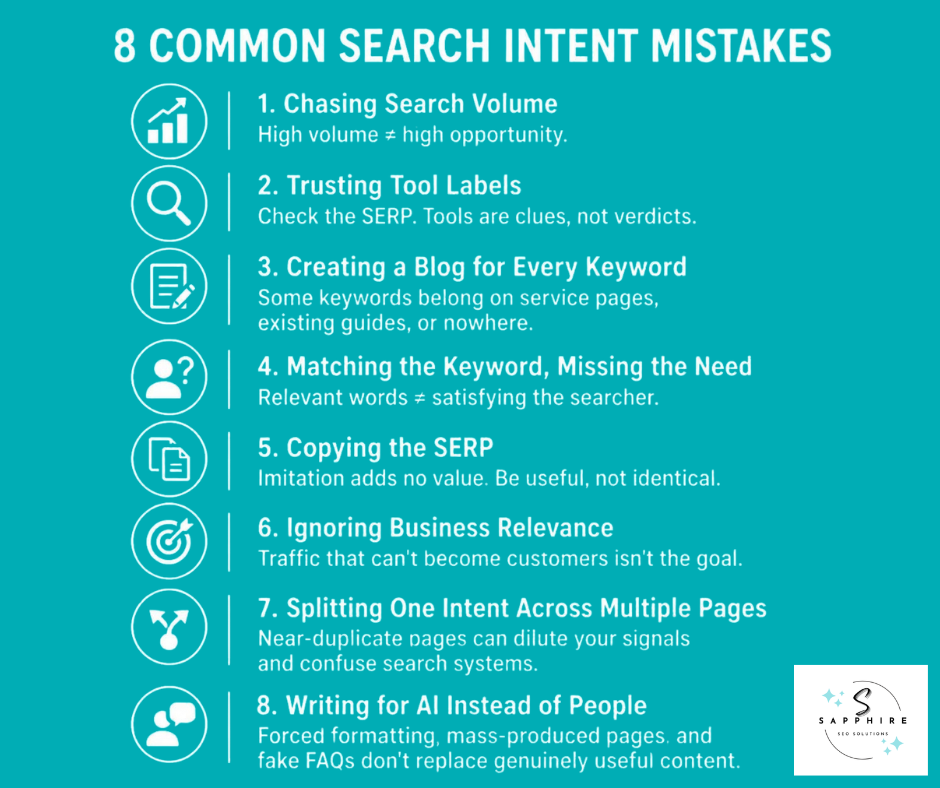
Mistake 1: Choosing Keywords Only by Search Volume
A big number doesn't mean a good opportunity. Demand and opportunity aren't the same thing, and treating them as interchangeable is how a lot of SEO budget ends up chasing traffic that goes nowhere.
Mistake 2: Trusting a Keyword Tool's Intent Label without Checking the SERP
These labels are a starting guess built on patterns, not a read of what's actually happening in your market right now. Treating a third-party website or tool's classification as settled fact skips the one step that actually confirms it.
Mistake 3: Writing a Blog Post for Every Keyword
One keyword doesn't automatically deserve one article. Some keywords belong on a service page, some belong folded into an existing guide, and some don't deserve a dedicated page at all.
Mistake 4: Matching the Topic But Missing the Need
A page can be technically relevant to a keyword and still fail the person who searched it. Ranking for the right words doesn't mean you've actually solved the problem behind them.
Mistake 5: Copying the Current SERP
Reproducing a competitor's headings and structure isn't a strategy; it's imitation, and it rarely adds anything the searcher couldn't already find. Link building and outreach won't rescue a page that offers nothing new.
Mistake 6: Ignoring Commercial Relevance
Traffic that has little connection to what the business actually does isn't a win, no matter how good it looks in a monthly report.
Mistake 7: Creating Separate Pages for Near-Duplicate Intent
Publishing five slightly different URLs to cover what's really one need spreads your signal thin instead of building one page strong enough to actually rank. This has gotten more important with AI search specifically. Bing has said directly that when similar pages repeat the same information, its systems struggle to tell which version best matches the query, which lowers the odds that any of them get selected or summarized in an AI answer at all.
Mistake 8: Creating Content Primarily for AI
This shows up as forced "AI-friendly" formatting, a pile of FAQs that don't reflect real questions, repetitive answer blocks stacked for no reason, mass-produced pages, or content built entirely around a hypothetical AI prompt nobody's actually typing. Google's guidance hasn't budged on this. It's still people-first, and content built primarily to game a system, human or AI, tends to fail both audiences at once.
A Practical Search Intent Framework for Small Businesses
All the theory in this article boils down to a process you can actually run on a Tuesday afternoon. Here's the framework, stripped down to seven questions:
What does my customer actually want to accomplish?
What are they searching to get there?
What does the SERP suggest they want?
Is this audience relevant to my business?
What page would best satisfy that need?
What information does that page need to include?
What business outcome can it realistically support?
Walking through a real example makes this easier to picture. A local landscaping company has a customer who wants to redesign their backyard. That customer searches "landscape design company near me." The SERP that comes back is dominated by local, service-oriented results, mostly business pages, not blog posts, which is a strong signal about what users expect to find. That points toward one clear answer: a landscape design service page.
That page needs real substance to do its job. It should cover:
The services offered
What the process actually looks like from first call to finished yard
The areas the business serves
Real project examples
Some honest pricing considerations
Answers to the questions people usually ask before reaching out
Built well, that page can realistically support a consultation request, a phone call, or a direct inquiry.
Now contrast that with a different search from a different stage: "how much does landscape design cost?" That's a different need entirely, more informational, still commercially relevant, but not ready for a hard service pitch. That search is better served by an educational article that genuinely explains what drives cost up or down, helping the prospective customer understand pricing before they ever pick up the phone.
Both pages matter. Neither one is doing the other's job, and neither should be forced to. Not every page is going to produce a lead directly, and that's fine. Informational content that helps someone understand their options isn't wasted just because nobody filled out a form on it that day. The real customer journey rarely moves in a straight line from keyword to page to sale. It's messier than that, built from a handful of touches that add up, and a solid search intent process should reflect that reality instead of flattening it into a single funnel.
Search Intent Connects SEO, Content, and Business Strategy
Everything in this article connects back to one chain, and it's worth seeing it laid out in full:
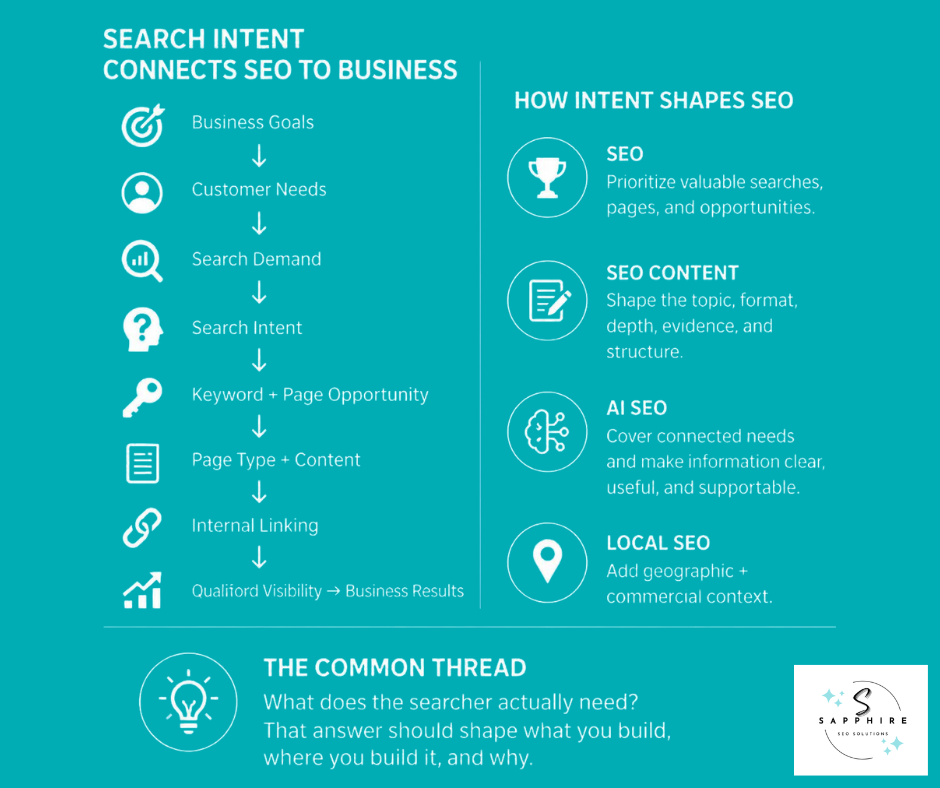
Business goals lead to customer needs. Customer needs shape search demand. Search demand only becomes useful once you understand the search intent behind it. Intent points to the right keyword or page opportunity. That opportunity determines the page type. The page type shapes the content. The content connects through internal linking. All of that adds up to qualified visibility, the kind that actually produces business outcomes instead of just traffic.
Each service we offer touches a different link in that chain.
With SEO services, intent is what determines which searches are actually worth prioritizing, which pages should target them, how those pages fit into the rest of the site, and where limited time and budget should go first. Without that layer, SEO work tends to chase volume instead of value.
With SEO content writing services, intent shapes almost every decision that goes into a piece: what it's actually about, what format it takes, how it's structured, how deep it needs to go, which examples and evidence belong in it, and what journey the reader is on when they land there.
And with AI SEO, intent still does the heavy lifting, just applied to a newer environment. It informs how well a piece covers the layers of a complex question, what related information needs might sit nearby, how clearly a topic is defined, and what kind of supporting detail gives a page a genuine shot at being useful in AI-generated answers.
This same thinking runs through our Local SEO services too, since local intent brings its own layer of geographic and commercial context that shapes the whole chain differently from a national search. Different service, same underlying question: what does the person searching actually need, and how does that shape what gets built?
How Sapphire SEO Solutions Uses Search Intent
Understanding search intent is one of the inputs we use to decide where SEO and content effort should actually go for a given business. It's not the only factor. But it shapes a lot of what happens after it.
Before we prioritize anything, we look at the business's goals, who its real customers are, what it actually offers, how much search demand exists, what intent sits behind that demand, what the SERP looks like for those terms, how much competition is involved, whether geography matters, how the existing site is structured, and where genuine commercial relevance sits underneath all of it.
That thinking runs through each of our three services differently.
Our SEO work uses intent to identify and prioritize the opportunities worth pursuing, decide what pages and landing pages should target them, and build the site around search demand that actually connects to the business.
Our SEO content writing builds content around what the searcher genuinely needs, not around slotting keywords into an article and calling it done.
And our AI SEO work focuses on helping businesses build content that's useful, clearly structured, and backed by real substance, giving it a genuine shot at serving complex searches and showing up across AI-powered search experiences.
We don't promise guaranteed rankings or guaranteed AI citations. Nobody honestly can. What we can offer is a process built around understanding what your customers actually need, and building toward that.
Work with Sapphire SEO Solutions to Turn Keywords into Strategy
A keyword tells you what someone searched. Search intent tells you what they were actually trying to accomplish. That distinction is the whole point of this article, and it's the difference between a keyword list and a real strategy.
The process is straightforward once you've internalized it: query, then SERP, then intent, then the right page, then content built around a real need, then an actual business opportunity. The same thinking carries over into AI search, too, where a single complex question can touch several connected needs at once instead of just one.
If a website is pulling in searches that never turn into real business, more content usually isn't the fix. The better question is whether the site is targeting, and actually satisfying, the right search intent in the first place. That's the work we do through SEO, AI SEO, and SEO content writing, built around what your customers are genuinely searching for.
Contact us to schedule a free consultation with an SEO expert to discuss your goals, and we'll help guide you in the best possible way.

Frequently Asked Questions About Search Intent
What is search intent in SEO?
Search intent is the actual reason behind a user's search query, the goal someone has in mind when they type something into Google. It's different from the words themselves. Understanding the audience intent behind a phrase is what lets you build a page that actually satisfies the person searching, not just one that happens to contain the right words.
What are the four main types of search intent?
Informational, navigational, commercial investigation, and transactional. Informational search intent means someone wants to learn or solve a problem. Navigational search intent means someone's trying to reach a specific website or destination, and navigational queries are usually brand names or specific tool names. Commercial investigation means comparing options. Transactional search intent means someone's ready to act, whether that's calling, booking, or hiring.
Why is search intent important for SEO?
Because ranking for a phrase and satisfying the person who searched it aren't the same thing. Search intent shapes which keywords are worth chasing, what kind of page you build, and how that page gets structured. Get it right, and you tend to see more organic traffic that actually converts, not just bigger numbers on a report. It also shapes broader engagement and marketing strategies, since a business built around real searcher needs makes smarter decisions about where to spend its time.
How do you determine search intent for a keyword?
Start with the wording itself. Keyword modifiers like "how," "best," "near me," or "pricing" are useful clues, though not guarantees. Then actually run the search and study the search results. Look at what's ranking, the title tags and meta descriptions on those pages, and whether local results, videos, or other features show up. Free tools can offer a starting guess about intent, but they're not a substitute for looking at the real SERP yourself.
Can a keyword have more than one search intent?
Often, yes. A lot of real searches carry more than one layer at once, a primary intent plus a secondary one riding along with it. A keyword with high search volume can still be commercially meaningful even if it looks purely informational on the surface. Don't force every phrase into exactly one bucket.
How does search intent affect content writing?
It shapes nearly everything about a piece: format, structure, depth, and what the reader actually needs from the page. An educational guide about a topic reads and functions completely differently than one of your sales pages built to move someone toward a call or inquiry, even if both target related search terms. Matching format to intent is often the difference between a page that ranks and does nothing, and one that actually works.
Does search intent matter for AI search?
Yes, arguably more than before. AI tools often break a single question into several related searches behind the scenes, and a prompt can carry several connected needs at once. Understanding user behavior and what someone's actually trying to accomplish still sits underneath how these systems retrieve and cite content, even though the surface looks different from a traditional results page.
Should every keyword have its own page?
No. Targeting commercial keywords that share the same real intent usually belongs on one strong page, not several thin variations competing with each other. Before building anything new, it's worth checking what's already ranking and, where a site has history, looking at Google Analytics to see how people searching similar terms are actually behaving on existing pages. Sometimes the answer isn't a new page at all. It's strengthening the one you've already got.