

SEO content writing is the process of creating useful, relevant web content around the needs and search behavior of a target audience, while applying search engine optimization principles that help search engines understand and discover it.
That's the plain answer. Now let's unpack what it actually means.
Good SEO content writing pulls three things together:
Writing people actually want to read
An understanding of what they're searching for
Optimization that helps search engines make sense of the page
Miss any one of those three, and the whole thing falls apart. A page stuffed with keywords but light on real information won't hold anyone's attention. A well-written page that ignores how people search might never get found in the first place.
The content itself gets created for people first. Search engines come second. But that doesn't mean structure doesn't matter. Clear headings, logical organization, and language that actually communicates make it easier for both a reader and a search engine to understand what web pages are about.
Keywords play a role here, but they're not the whole story. Search intent (what someone actually wants when they type something into Google) matters just as much. So do relevance, content structure, and whether the page is genuinely useful once someone lands on it.
And this is worth saying directly: SEO content writing is not keyword stuffing. Repeating a phrase over and over doesn't make a page more useful. It makes it harder to read. Search engines have gotten good at spotting the difference, too.
This guide walks through what creating content for SEO actually involves. How keywords and search intent work together. What separates SEO-friendly content from a keyword-stuffed page. How SEO writing compares to regular content writing and to copywriting. What an SEO content writer does, day to day. And how you'd actually know if any of it is working.
What is SEO content writing? Keep reading this comprehensive guide to find out.
Key Takeaways
SEO content writing is good writing informed by search strategy, never a separate, keyword-first category.
A keyword shows what someone searched. Search intent shows why, and intent matters more.
Same topic, different intent, different content. Informational and commercial searches need entirely different pages.
Original value means bringing something competitors don't have, not just writing a longer version.
The goal isn't maximum traffic. It's traffic relevant to what the business actually offers.
Most SEO content mistakes trace back to writing for algorithms instead of the actual reader.
Rankings matter, but they aren't the business objective. Leads and relevant traffic are.
Content isn't finished at publishing. Reviewing performance and updating pages keeps them working.
What Does SEO Content Writing Actually Mean?
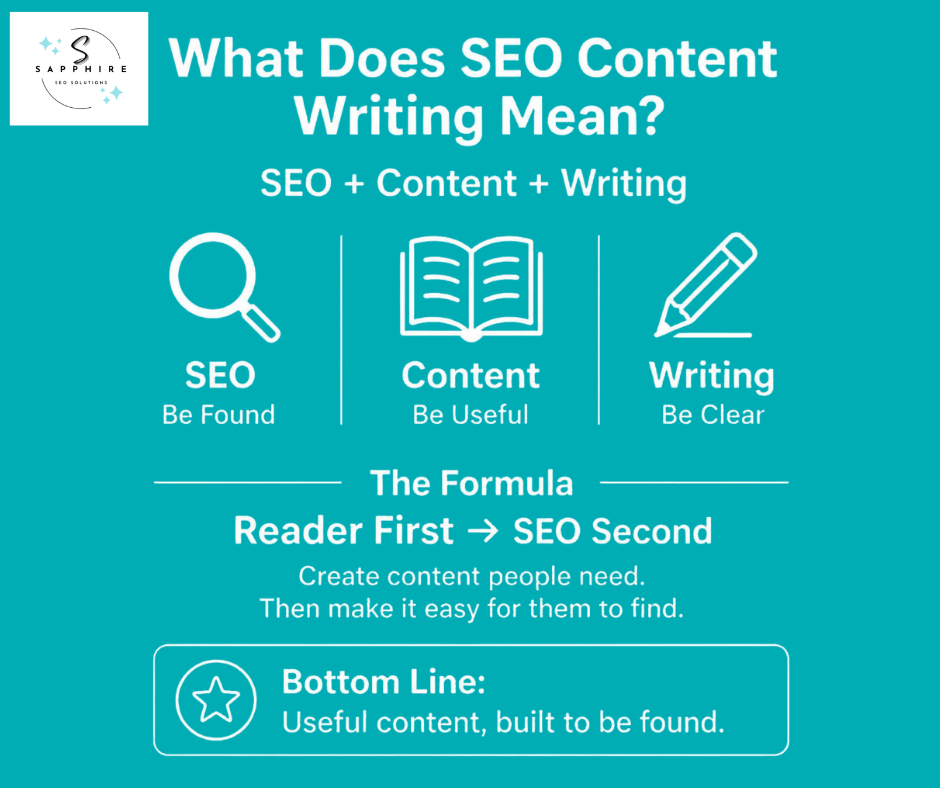
Break the term into its three parts, and it gets a lot less abstract.
SEO is about search visibility. It's whether your content shows up when someone searches for something related to your business, and whether it actually matches what they're searching for. That comes down to relevance, search intent, and discoverability: basically, can people find it, and is it what they were looking for when they did.
Content is the substance. Information, answers, guidance, education. Something a reader can actually use. Without this part, none of the rest matters. A page that ranks but doesn't tell anyone anything isn't doing its job.
Writing is how it all gets delivered. Clarity, organization, readability, the right tone for the audience. A page can have great information and still fail if it's a mess to read.
Put those three together, and you get content creation that's built to be found and built to be useful once someone's there.
Here's the part that trips a lot of people up, though. SEO content writing isn't three separate skills bolted together. It's one process, where search strategy shapes how relevant content gets planned and organized, without taking priority over what the reader actually needs. The target audience comes first. Search behavior just informs how you reach them.
That distinction matters more than it sounds like it should. Plenty of website content gets written backwards, built around a keyword first, with the reader's actual questions treated as an afterthought. That's how you end up with web content that ranks for a moment and then doesn't hold anyone's attention. Real informative content, the kind people bookmark or share or come back to, gets built the other way around: understand the reader, then bring in the search knowledge to make sure they can actually find it.
This is also where SEO content writing overlaps with digital marketing more broadly. It's not a separate island. It's one piece of how a business gets found online, working alongside everything else.
How Do SEO, Keywords, and Search Intent Work Together?
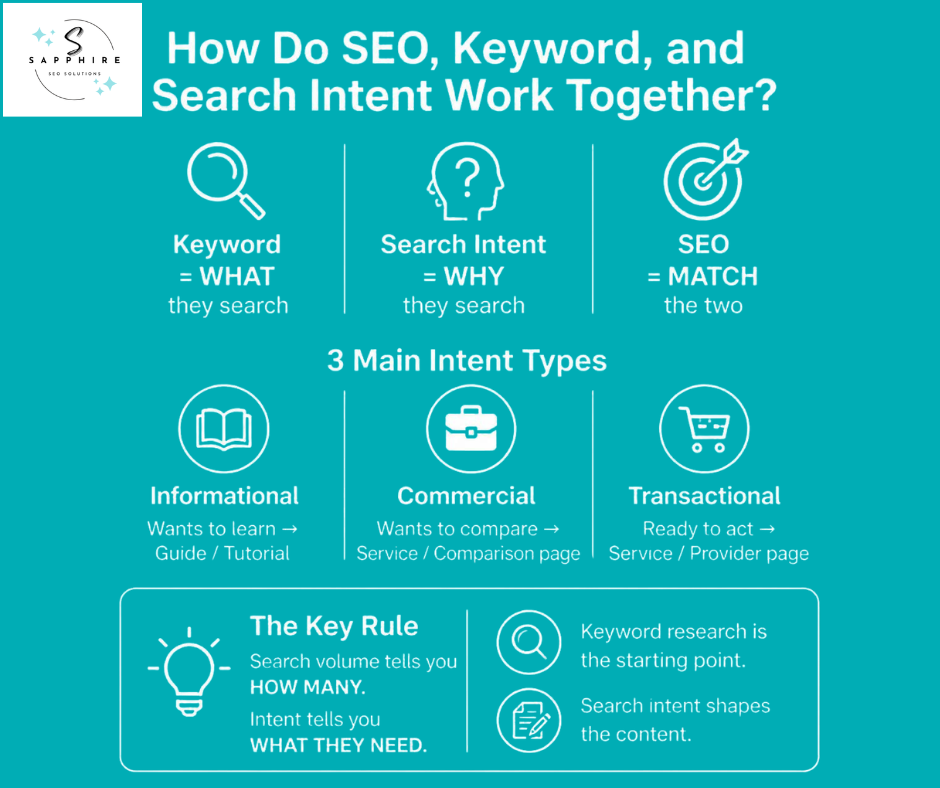
A search query tells you what someone typed into Google. It doesn't tell you why they typed it. That's where understanding search intent comes in, and it's the part a lot of SEO writing skips right past.
Here's the distinction. The keyword is the words themselves. User intent is what the person actually wants to accomplish once they hit search. Someone searching "what is SEO content writing" wants an explanation. Someone searching "SEO content writing services" wants to hire someone. Same general topic, completely different goal, and completely different content needed to satisfy it.
A few examples make this clearer:
| Search | Likely Intent | Appropriate Content |
|---|---|---|
| What is SEO content writing? | Informational | Educational guide |
| How to write SEO content | Informational | Tutorial |
| SEO content writing services | Commercial | Service page |
| Hire SEO content writer | Transactional/commercial | Service or provider page |
Notice the pattern. Informational searches want to learn something. Commercial and transactional searches want to find a business or make a decision. Answer an informational search with a sales pitch, and the reader bounces. Answer a commercial search with a history lesson, and you lose the sale before it starts.
This is why keyword research alone isn't a strategy. Picking a primary keyword or target keyword tells you what topic to cover. It doesn't tell you how to cover it. A good SEO content writer looks past the SEO keywords on the page and asks what the searcher is actually trying to do. That shapes everything, including:
The format
The tone
Whether it's a guide or a service page
Even how long it needs to be
The same logic applies down to long-tail keywords and secondary keywords scattered throughout a piece. Each one carries its own small signal about intent, and relevant keywords get chosen because they match what the reader's after, not just because a tool like Google Keyword Planner shows decent search volume for them. Volume tells you how many people are searching. It doesn't tell you what they need once they find you.
Keyword research matters. But it's the starting point.
How Does SEO Content Writing Work?
There's no single formula that guarantees a page ranks. But there is a professional writing process that experienced SEO content writers tend to follow, even if it looks a little different from one project to the next.
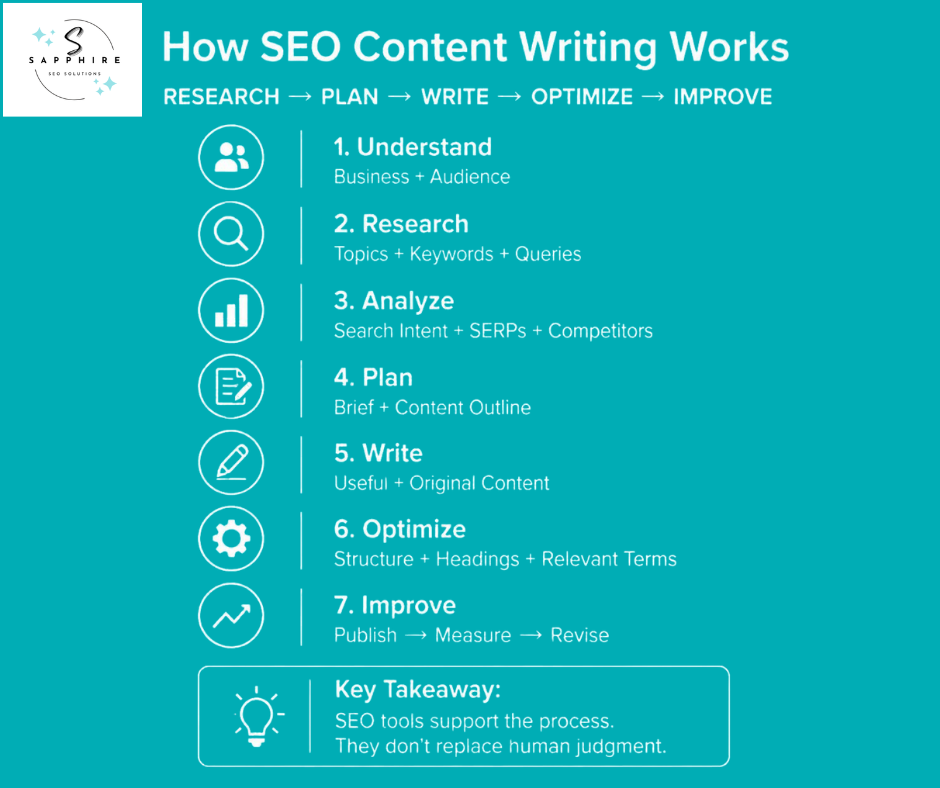
Here’s what the SEO content writing process covers:
Understand the business and audience: Before any writing happens, you need to know who the content is for and what the business actually does. Skip this step, and it’s all guesswork from here onwards.
Identify relevant search topics: What are people in this industry actually searching for? This sets the direction before anyone starts researching individual keywords.
Research keywords and queries: Now the specifics come in. What phrases and questions show up around this topic?
Analyze search intent: As covered earlier, the keyword only tells you so much. This step figures out what the searcher actually wants.
Review the SERP and competing content: The search engine results pages for a given query are full of clues. They show what content type tends to rank (a guide, a list, a product page), what intent Google's already matched to that search, how deep the competing content goes, what questions keep showing up, and what formats readers seem to respond to. Skipping this step means writing blind.
Create the content brief and outline: Everything gathered so far gets organized into a plan before the actual writing starts.
Write useful, original content: This is the part that actually serves the reader. Real information, real examples, something worth reading.
Apply appropriate on-page optimization: Headings, structure, and relevant terms get worked in naturally, in service of the content rather than the other way around.
Publish, measure, and improve: Content isn't finished the day it goes live. What's working gets kept. What isn't gets revised.
That's nine steps, but it's not a rulebook carved in stone. It's a useful content strategy, not a universal Google formula, and not every piece of content needs every step in the same order or depth. A quick blog update might skip half of it. A cornerstone guide might spend real time on each one.
Plenty of SEO tools exist to support pieces of this process, but the process itself is what matters. Tools help writers work faster. They don't replace the judgment involved in following SEO best practices that actually fit the content, not just a checklist.
What Makes Content SEO-Friendly?
This is the question most business owners actually care about, so it's worth answering directly instead of dancing around it.
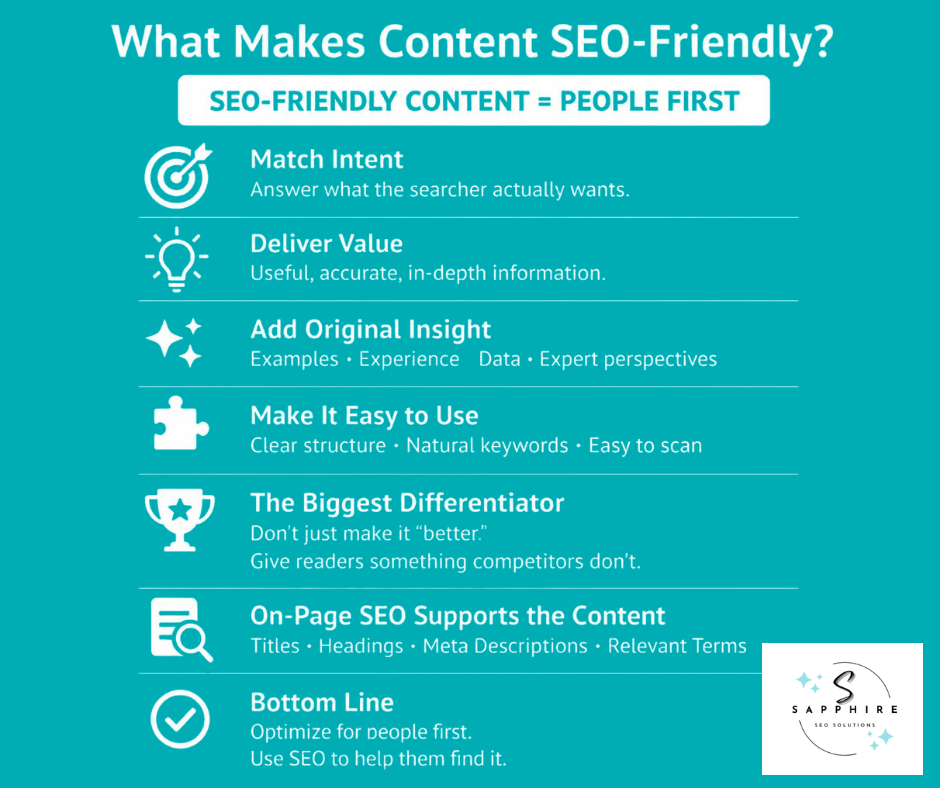
SEO friendly content isn't about hitting a keyword count or checking a list of technical boxes. Google has said plainly, through its helpful content guidance, that it wants content written for people first, not for search engines. So what does that actually look like in practice?
Content that works tends to share a few things in common. It matches what the searcher actually wants, rather than loosely circling the topic. It answers the main question clearly, ideally without making the reader dig for it. It goes deep enough to actually be useful, not just deep enough to look thorough. It works relevant terms in where they fit naturally, instead of forcing them. It's organized in a way that makes sense, easy to scan, easy to follow. And it's accurate, the kind of content that shows the writer (or the business behind it) actually knows the subject.
None of that is a confirmed ranking factor with a checkbox next to it. It's just what high-quality content tends to look like, and it's also what makes for genuinely engaging content, the kind people actually finish reading.
Here's the part that matters most, though, and it's the one a lot of content skips: original value.
"Make it better than competitors" doesn't mean much on its own. What it actually means is bringing something to the page that the other ten results don't have. That could be:
Original examples, not the same three examples every other article uses
First-hand observations from actually working in the space
Useful comparisons that help someone make a decision
Proprietary insights, data, or experience unique to the business
Expert commentary that adds a perspective, not just a summary
Clearer explanations of something competitors gloss over
Better organization that makes the same information easier to use
Information competitors don't cover well, or don't cover at all
That's what separates well-optimized content from a page that just checks the same boxes as everyone else ranking for the same term.
On-page SEO plays a supporting role here, not the starring one. On-page optimization includes things like a clear page title, a well-written title tag, and a meta description that accurately tells someone what they'll find on the page. When you optimize meta descriptions and meta tags, the goal isn't to cram in keywords. It's to give search engines and readers an honest, useful summary of what's actually on the page.
None of this guarantees a ranking. Nothing does. But content built this way tends to hold up, both for readers and for search engines trying to understand it.
SEO Content Writing vs. Regular Content Writing
People sometimes assume there are two totally different kinds of writing: the kind meant for readers, and the kind meant for Google. That's not really accurate.
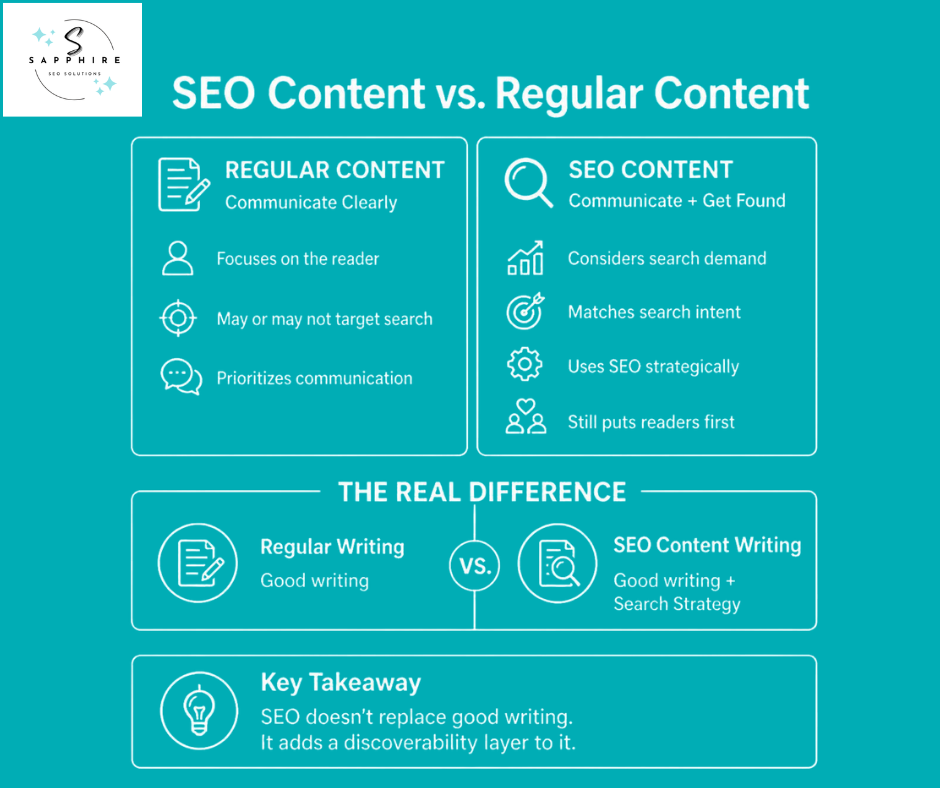
Regular content writing is mainly concerned with communicating well. It might be designed around organic search, or it might not be. Think of an internal newsletter, a brand story, an editorial piece, or an educational resource written for its own sake. The goal is to communicate clearly to whoever's reading it. Search visibility might not even be part of the plan.
SEO content writing does the same core job, communicating clearly, but with a few more layers built in. It considers search demand, meaning what people are actually typing into Google around a given topic. It considers search intent, meaning why they're searching for it. It works in relevant SEO considerations, like structure and terminology, and it's built to be discoverable.
But here's the part that gets missed a lot: it still prioritizes reader usefulness above all of that. The SEO layer supports the content. It doesn't replace it.
So the real distinction isn't "good writing vs. optimized writing." It's this: SEO content writing isn't a different form of writing where SEO takes over and good writing takes a back seat. It's good writing informed by search behavior and SEO strategy. Same writing standards, same care for the reader, just with an added understanding of how people search and what they're looking for when they do.
It's worth being careful about how this gets framed, too. Regular content can absolutely rank well, especially when it's genuinely useful and well written. SEO content isn't automatically better just because it's optimized. And SEO content isn't just keyword-focused writing dressed up with a fancier name. Both are writing. One just carries an added layer of search strategy.
This is a slightly different conversation from SEO copywriting, which serves a more persuasive purpose (more on that in the next section). An SEO copywriter and an SEO content writer often work on related projects, but they're not solving quite the same problem.
SEO Content Writing vs. SEO Copywriting
The two get mixed up a lot, and honestly, they overlap enough that the confusion makes sense. But they're aimed at different jobs.
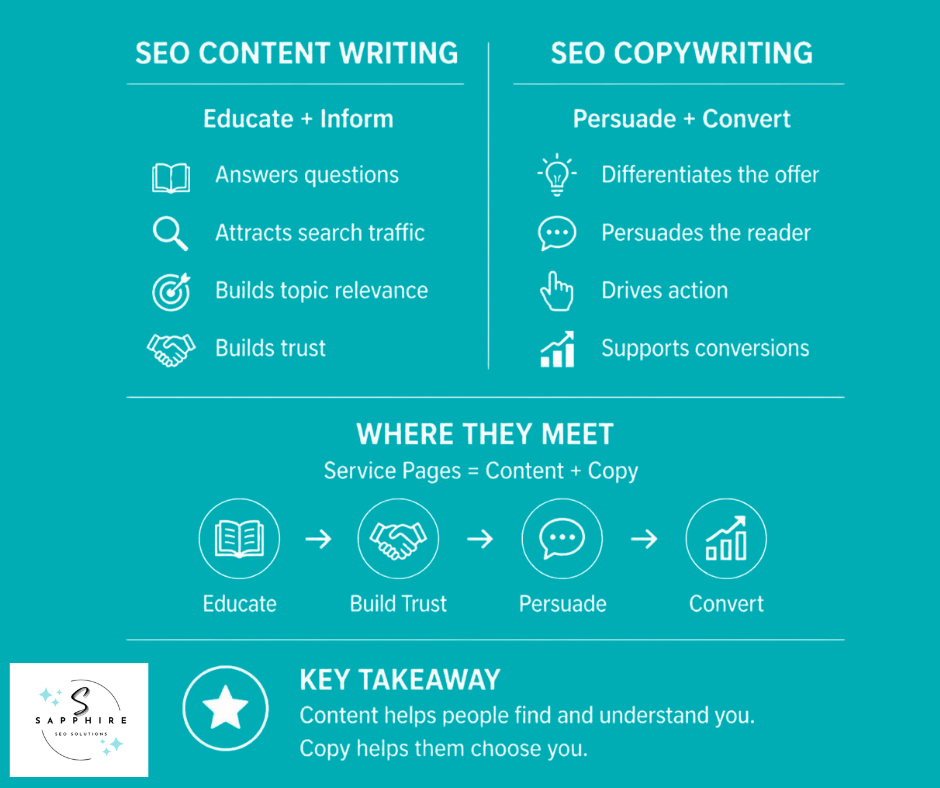
SEO content writing exists to educate, inform, and answer questions. It attracts search traffic by giving people useful information and, in the process, builds relevance around a topic over time. A guide like this one is a good example. The goal is to help, not to close a sale.
SEO copywriting has a different job. It persuades. It differentiates an offer from the ten other businesses offering something similar. It encourages a specific action, and it supports conversions once someone's already interested. A homepage headline or a "why choose us" section leans copywriting.
In practice, these rarely stay in separate lanes. A service page often needs both: enough educational substance to earn trust and rank well, plus persuasive language that actually moves someone toward booking a call or filling out a form. A blog post can do something similar on a smaller scale, informing the reader through most of the piece, then pointing toward a next step near the end without turning into a sales pitch.
So it's less "pick one" and more "know which one you need where." Educational pages lean on content writing. Pages built to convert lean more on copywriting. Most real pages sit somewhere between the two, borrowing from both as needed.
What Does an SEO Content Writer Do?
If you're paying someone to write content for your business, it's worth knowing exactly what that involves. It's usually a lot more than sitting down and typing.
An SEO content writer typically handles:
Understanding the business and its audience before writing a word
Researching topics relevant to that business and its industry
Conducting keyword research to see what people are actually searching for
Analyzing search intent behind those searches
Reviewing the SERPs to see what's already ranking and why
Identifying content gaps competitors haven't filled
Developing an outline before jumping into the draft
Writing the actual content
Incorporating relevant SEO elements throughout
Fact-checking everything before it goes live
Editing for clarity and flow
Improving readability so the content is easy to follow
Adding or recommending internal links to related pages
Updating content over time as things change
That's a long list, and it's worth sitting with for a second. Writing is just one piece of it.
A good SEO writer needs more than the ability to string sentences together. They need research skills to actually understand a topic before writing about it. They need SEO understanding to know how search behavior shapes what gets written and how. They need to understand the audience, not a generic reader, but the specific person a piece of content is meant for. And they need enough subject-matter understanding to write accurately about an industry they may not work in themselves.
That combination is what someone's actually paying for when they hire a writer to write SEO content. Not just words on a page. Research, strategy, and judgment, all bundled into the final piece.

What Types of Content Can Be Written for SEO?
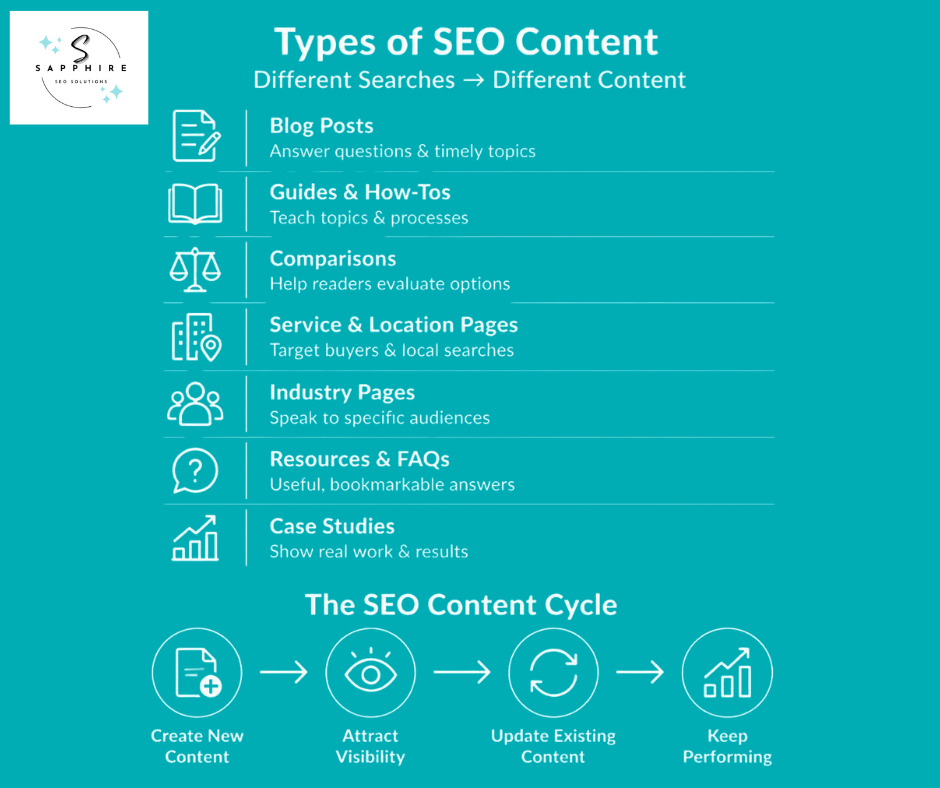
SEO content isn't one format. It covers a range of written website content, each suited to a different kind of search.
Blog posts - Usually the first thing people think of, and a solid way to answer specific questions or cover timely topics. New blog posts are also one of the easiest ways to keep a site active and growing.
Educational guides - Longer, more thorough pieces (like this one) built for people who want a real understanding of a topic, not just a quick answer.
How-to articles - Step-by-step content for people who already know what they want to do and need the specifics on how to do it.
Comparison content - Useful for people weighing options, whether that's two products, two approaches, or two services.
Service pages - Built around what a business actually offers, aimed at people closer to making a decision.
Location pages - Help a business show up for searches tied to a specific city or region it serves.
Industry pages - Speak directly to a particular type of customer or sector, with language and examples relevant to them.
Resource pages - Collect useful information, links, or tools in one place, often becoming a page people bookmark or return to.
Case studies - Show real results and real work, which builds trust in a way general claims can't.
FAQ content - Answers common questions directly, often satisfying quick, specific searches.
Beyond any single piece, all of this fits into a broader content marketing effort. New pages bring in new visibility, while existing content gets reviewed and updated so it keeps performing instead of quietly going stale. Both matter. A site that only ever adds new pages, without maintaining what's already there, tends to lose ground over time.
This list isn't about social posts, email newsletters, or video. It's specifically about the written pages that make up a website and how each one can serve a different kind of search.
Why Is SEO Content Writing Important for Small Businesses?
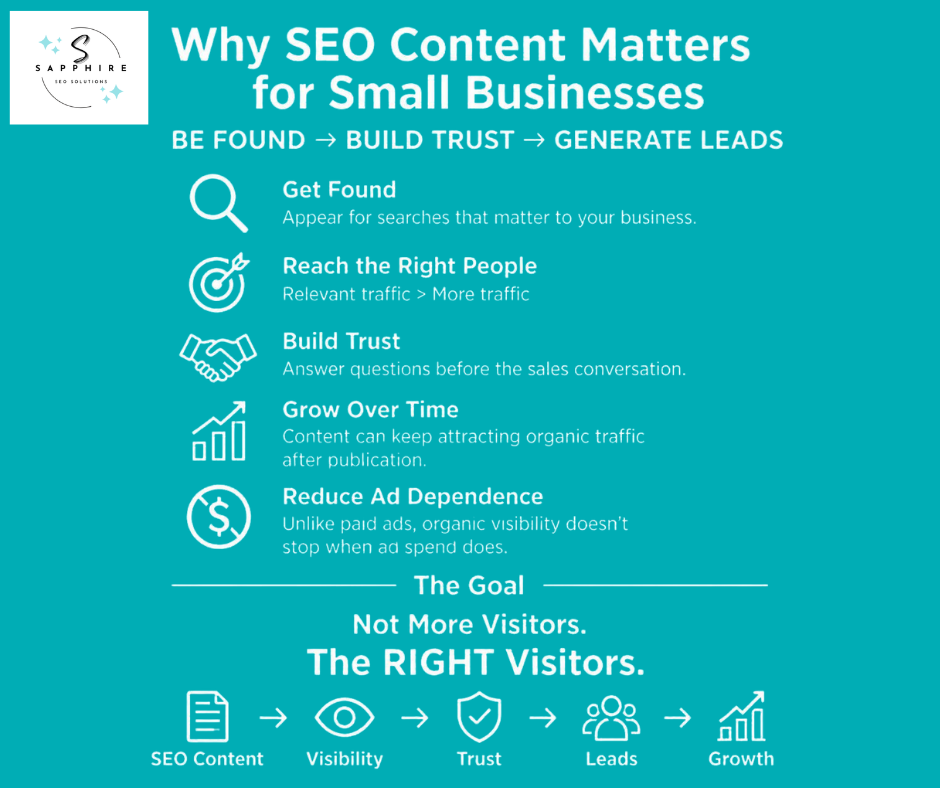
For a small business, showing up in search results isn't just nice to have. It's often how potential customers find out you exist in the first place.
Good SEO content helps a business appear for the searches that actually matter to it. It answers customer questions before a sales conversation even starts, which means by the time someone calls or fills out a form, they already have a sense of what you do and whether it fits their needs. It reaches potential customers earlier in the buying journey too, back when they're still researching, not just when they're ready to buy.
Content also builds search engine visibility around the services a business actually cares about. A well-written page around a specific service, paired with supporting content that goes deeper into related questions, builds topical relevance over time. That relevance supports the service and product pages doing the actual selling. It also demonstrates expertise. A business that clearly knows its subject and shows that through its content earns trust faster than one that doesn't.
Here's the distinction worth sitting with, though. The goal isn't to attract the most organic traffic possible. It's to attract traffic that's relevant to what the business actually offers. A landscaping company doesn't need a million visitors. It needs the right visitors, the ones actually looking for landscaping services in its area. More visitors only helps if they're the right ones.
That's also why SEO content matters alongside paid advertising, not instead of it. Paid ads can bring in traffic quickly, but that traffic disappears the moment the budget stops. Content that continues to improve search engine rankings over time keeps working long after it's published, alongside whatever else a business is doing to bring in direct traffic and new customers.
None of this happens overnight, and none of it comes with a guarantee. But for a small business trying to grow without relying entirely on paid ads, SEO content is one of the more sustainable ways to create real opportunities for leads and conversions.
What Is the Difference Between Good SEO Content and Keyword-Stuffed Content?
This is probably the biggest misconception about SEO writing, and it's worth clearing up directly. A lot of people still picture SEO content as a page crammed with the same phrase over and over, written for a search engine instead of a person. That's keyword stuffing, and it's not what good SEO content looks like.
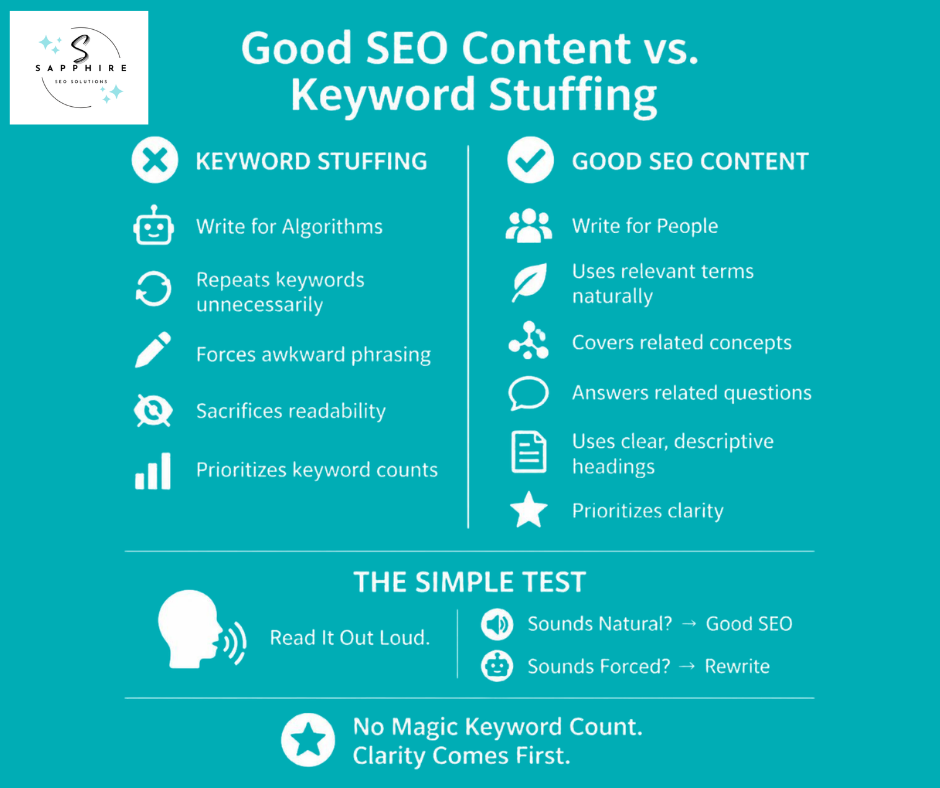
Keyword stuffing usually shows up as unnecessary repetition, the same term appearing again and again well past the point of being useful. It leads to awkward phrasing, sentences that clearly got twisted around just to fit a keyword in. Sometimes it means inserting keywords that aren't even relevant to the surrounding sentence. And underneath all of it is the same mistake: writing for search engine algorithms instead of the person actually reading the page.
Good SEO content takes a completely different approach. It uses relevant terms where they actually fit, not forced into every sentence. It covers related concepts around the main topic, which naturally brings in the language a reader (and a search engine) would expect to see. It answers related questions the reader might have, even ones that go slightly beyond the original search. It uses descriptive headings that actually tell someone what a section covers. And above all, it prioritizes clarity over hitting a specific keyword count.
That last point matters more than it might seem. There's no exact number of times a keyword needs to appear on a page, and chasing one is how content ends up sounding stiff and repetitive in the first place. Repeating a keyword isn't inherently a problem. It becomes one the moment it stops serving the reader and starts serving a checklist instead.
The real test is simple. Read the content out loud. If it sounds like something a person would actually say, it's probably using keywords naturally. If it sounds like it's circling back to the same phrase for no reason, it's worth rewriting.
How Do You Write SEO Content?
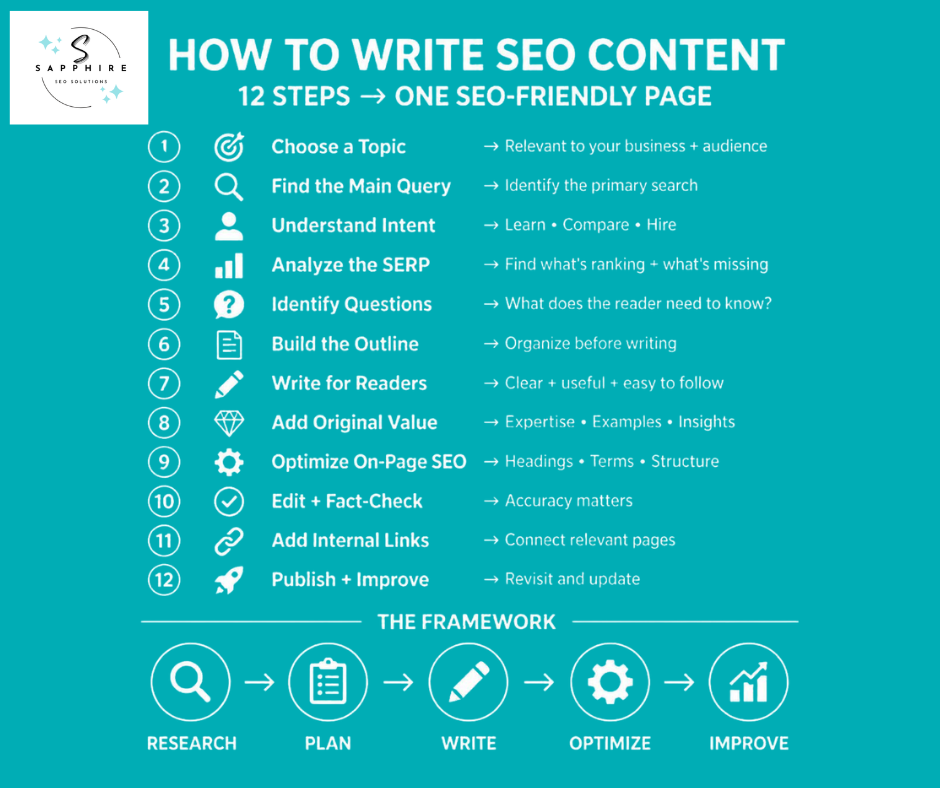
The process covered earlier explains how SEO content writing works in general. Here's what it looks like compressed into a practical framework, if you're wondering how to write SEO content yourself:
Choose a relevant topic. Something that actually matters to your business and your audience.
Identify the primary search query. What's the main thing people would type to find this content?
Understand the search intent. Are they trying to learn something, compare options, or find a business to hire?
Analyze the current SERP. See what's already ranking, and what it's doing well or missing.
Identify the questions the content needs to answer. Look for what a reader would actually want to know.
Build the outline. Organize everything before writing a full draft.
Write for the reader. Clear, useful, and easy to follow, first and foremost.
Add original information, examples, or expertise. This is what separates useful content from a rehash of everyone else's.
Apply relevant on-page SEO. Headings, terminology, and structure that support the topic.
Edit and fact-check. Every claim should hold up.
Add useful internal links. Point readers toward other relevant pages on the site.
Publish and improve. Content isn't finished the day it goes live. Revisit it as needed.
That's twelve steps, but it moves fast in practice once it becomes routine. Each one builds on the last, and skipping straight to writing without the earlier steps is usually where content falls short.
This is meant as a working framework, not a deep dive into any single step. Keyword research, SERP analysis, and internal linking each deserve their own closer look, which is a conversation for another guide.
How Does AI Affect SEO Content Writing?
Search doesn't look the way it used to. More people now run into AI-generated summaries sitting right at the top of search results, answering their question before they even scroll down to a traditional listing.
This doesn't just apply to Google, either. Other search engines have been building similar AI-driven features into how they present answers. The shift is happening across the board, not in one place.
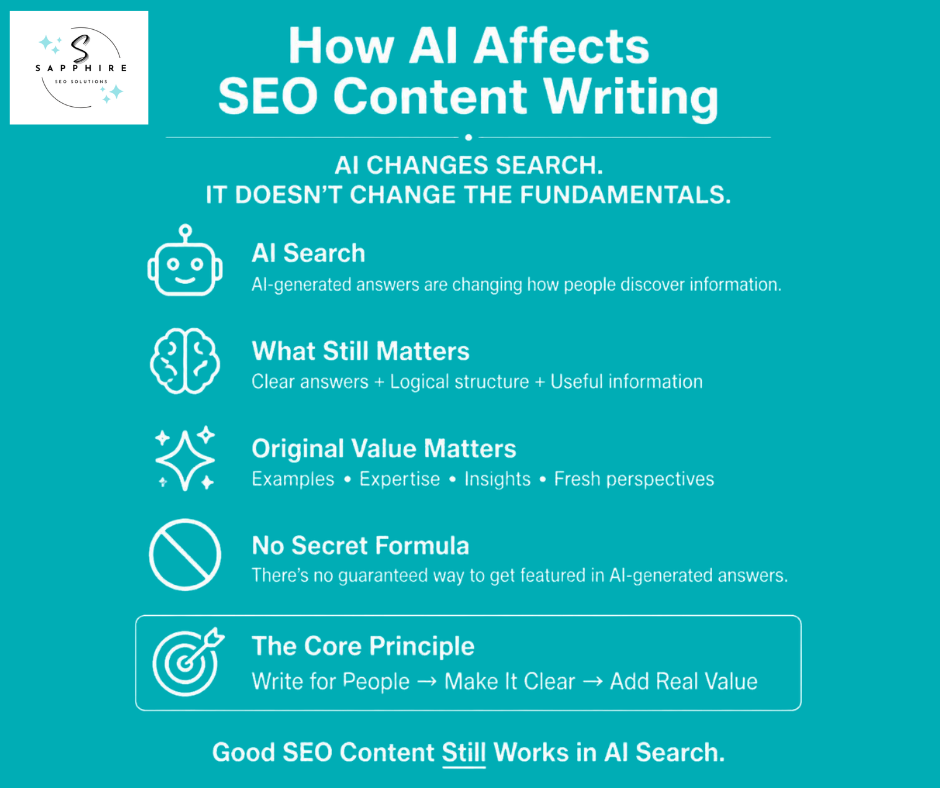
What hasn't changed is what search engines and AI systems both need from a webpage: information they can actually understand. Clear answers matter. So does logical structure, content organized in a way that makes the main point easy to find rather than buried three paragraphs down. That was already true for traditional search engine results. It's just as true now.
Original insight still counts for something too, maybe more than before. When an AI system is pulling together an answer from multiple sources, generic, mass-produced summaries that just repeat what's already out there don't offer much to stand out with. Content that brings something real to the topic- a clear explanation, a useful example, actual expertise- has a better shot at being genuinely useful once someone reads it, regardless of how it gets surfaced.
It's worth being straightforward here: there's no secret formula that guarantees a mention in an AI-generated answer. Anyone promising one is guessing. Google's own guidance has been consistent on this point, stating that the same fundamental SEO practices that support good search visibility also apply to its AI-driven search features. In other words, no separate playbook exists for AI search that overrides everything else covered in this guide.
The practical takeaway is simple. Keep writing content that's clear, well organized, and genuinely useful. That approach was solid advice before AI-generated answers became part of search, and it remains solid advice now that they are.
To learn more about AI SEO, read our guides on What Is AI SEO, How AI Search Chooses Businesses, How to Get Mentioned in Claude Responses with Claude SEO, ChatGPT SEO for Small Businesses, How Does AI Search Work, and Traditional SEO vs AI SEO for more information on these topics.
How Do You Know If SEO Content Is Working?
This is a fair question, and it deserves a real answer instead of a vague one. Knowing whether content is working means looking at a few different layers, not just one number.
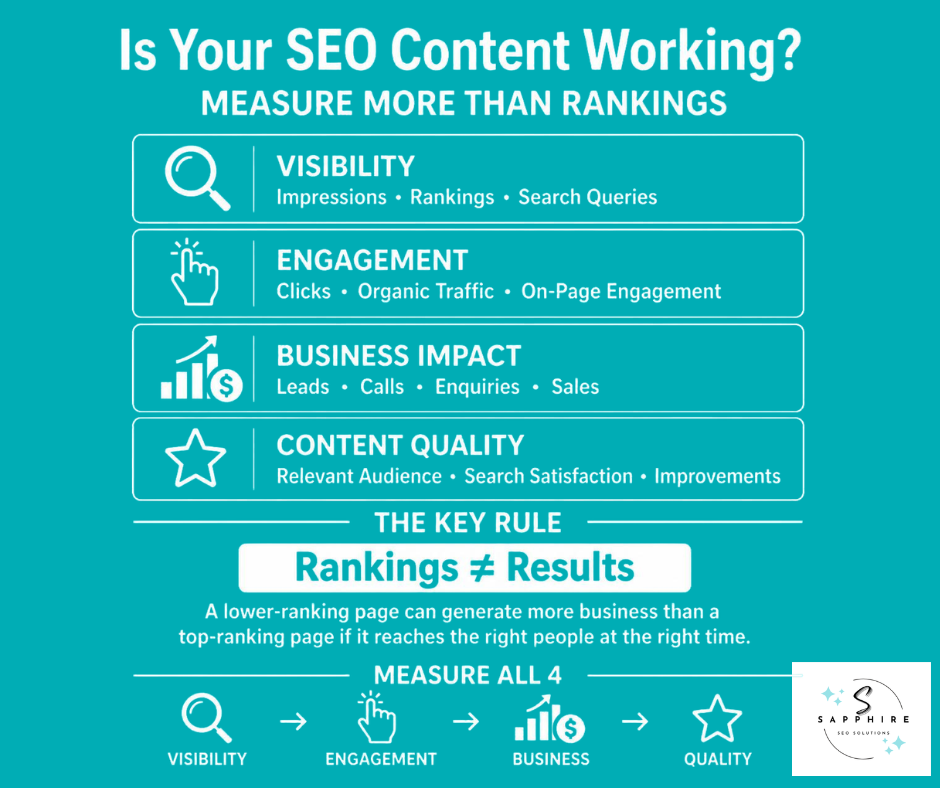
Search visibility comes first. This covers impressions (how often a page shows up in search results), ranking positions for relevant queries, and which specific searches are actually generating that visibility. Tools like Google Search Console make this layer easy to check.
Organic engagement comes next. Visibility doesn't mean much if nobody clicks. This layer looks at actual clicks, how much relevant organic traffic a page is pulling in, and how people engage once they land on it. Do they stay and read, or bounce right back? Google Analytics is usually where this gets tracked.
Then there's business impact, which is really what all of this is building toward. Leads, enquiries, calls, purchases, and assisted conversions (cases where a page played a role in a sale, even if it wasn't the final click) all fall here. This is the layer that connects content back to actual revenue, not just traffic numbers.
Finally, content quality itself is worth checking on its own. Does the page actually satisfy the search it was written for? Is it attracting the audience it was meant to attract? Does it need updating or improving based on how it's performing? This is where reviewing search performance over time matters more than a single snapshot.
Here's the important part, though. Search rankings are a genuinely useful metric, and tracking search engine rankings over time tells you a lot about whether content is gaining traction. But rankings alone aren't the business objective. A page can rank well and still not bring in a single lead if it's not attracting the right audience or not doing enough once someone arrives. And a page can rank a little lower and still drive real business, if it's reaching the right people at the right moment.
Measuring content well means looking at all four layers together, not fixating on just one.
Common SEO Content Writing Mistakes
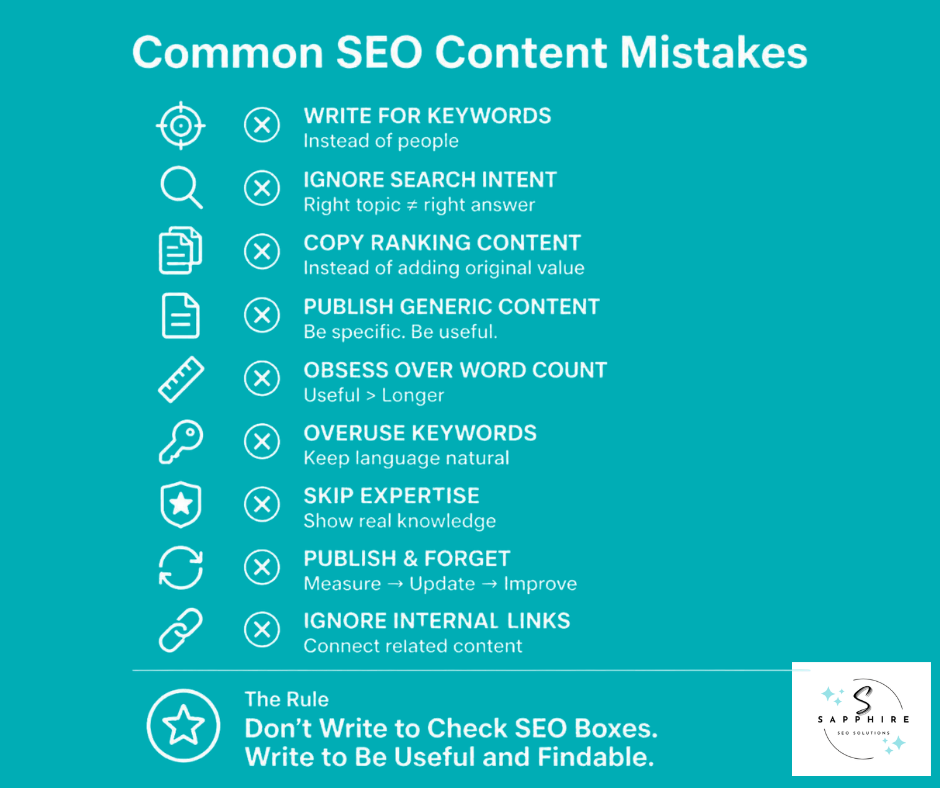
Even with good intentions, SEO content goes wrong in a few predictable ways. Here are the ones worth watching for:
Writing for keywords instead of people: When a keyword drives every decision on the page, the writing usually suffers. The reader should always come first.
Ignoring search intent: A well-written page still misses the mark if it doesn't match what the searcher actually wanted.
Copying ranking pages instead of adding value: Looking at what's already ranking is useful research. Repeating it without adding anything new isn't.
Publishing generic content: Vague, surface-level pages that could apply to any business rarely stand out, and they rarely help the reader much either.
Obsessing over word count: Longer isn't automatically better. Content should be as long as it needs to be to actually cover the topic, no more, no less.
Overusing keywords: Even without full-blown keyword stuffing, repeating a phrase too often makes writing feel stiff and unnatural.
Failing to demonstrate relevant expertise: Content that doesn't show real understanding of the topic is easy to spot, and it doesn't build much trust.
Publishing without reviewing performance or updating when needed: Content isn't a one-and-done task. Pages that get ignored after publishing tend to fall behind.
One more worth mentioning: skipping internal links entirely. A page that never points anywhere else on the site misses a chance to guide readers toward related information, and it leaves search engines with less context about how a site's content fits together. A healthy mix of internal and external links helps both the reader and the page itself.
None of these mistakes come with an automatic penalty attached. But each one chips away at how useful and how findable a page ends up being.
Build Topical Authority with Our SEO Content Writing Services
SEO content writing comes down to a simple idea, even if the process behind it isn't always simple. Write for the person searching, understand why they're searching in the first place, and structure that content so it can actually be found. Keywords, search intent, and optimization all matter, but they support the writing. They don't replace it.
That's easier to explain than it is to do consistently, though, especially alongside running an actual business.
This is where Sapphire SEO Solutions comes in. We've been writing content since 2007, and over that time, we've worked with small businesses across a wide range of industries, from local service providers to specialized trades. Our team includes certified SEO content writers who understand both the writing side and the search side, which is exactly the combination this guide has been talking about.
We're not interested in generic pages that check boxes and disappear into the noise. We build content around what a business actually offers and who it's actually trying to reach, the same approach covered throughout this guide.
If you're ready to see what that looks like for your business, our SEO content writing services are a good place to start. Contact us, and let's talk about what your content could be doing for you.

Frequently Asked Questions About SEO Content Writing
What is SEO content writing?
It's the process of creating useful, relevant content for a website that also helps search engines understand and discover it. The reader comes first. The optimization supports that; it doesn't replace it.
What is the difference between SEO content writing and regular content writing?
Regular content writing is mainly focused on communicating well, with or without search in mind. SEO content writing does the same, but also factors in search demand, search intent, and discoverability, while still keeping the reader as the priority.
What does an SEO content writer do?
More than just writing. Research, keyword research, search intent analysis, outlining, writing, editing, on-page optimization, and ongoing updates all fall under the job.
Does SEO content writing require keywords?
Keywords play a role, since they point to what people are actually searching for. But the goal is using them naturally, where they fit, not building a page around hitting a specific count.
What makes content SEO-friendly?
Content that matches search intent, answers the main question clearly, goes into useful depth, reads well, and offers something genuinely useful the reader can't find just as easily somewhere else.
How is SEO content writing different from copywriting?
SEO content writing informs and educates. SEO copywriting persuades and pushes toward an action. Plenty of pages use a bit of both.
How long should SEO content be?
As long as it needs to be to properly cover the topic. A quick answer might only need a few hundred words. A full guide might need several thousand. There's no fixed number that works for everything.
Can AI write SEO content?
AI can help with parts of the process, but content still needs real expertise, accuracy, and original value behind it. Generic, unreviewed AI output tends to fall flat, both for readers and for search visibility.
Is SEO content writing still important?
Yes. People still search for answers, products, and services constantly, and businesses that show up with useful content still have an advantage over ones that don't.
Does SEO content writing guarantee higher rankings?
No, and it's worth being honest about that. Good SEO content improves the odds of ranking and being useful once found, but nothing guarantees a specific ranking outcome.