

Local SEO for Personal Injury Attorneys: Key Strategies
Local SEO for personal injury attorneys helps law firms rank in Google's local pack, organic search, and AI platforms like ChatGPT and Perplexity. Key strategies include optimizing your Google Business Profile, building location-specific pages, earning local backlinks, and structuring content for AI citation. Firms that execute these fundamentals consistently generate more calls, more leads, and more signed clients.
Key Takeaways
Local SEO puts personal injury firms directly in front of injured clients searching nearby, driving more calls and signed cases.
Ranking in Google’s local pack, organic results, and AI platforms determines which personal injury attorneys get contacted first.
A fully optimized Google Business Profile with reviews, photos, and the correct category significantly improves local visibility and lead generation.
Create dedicated practice area and location pages that answer real accident-related questions in your city to rank and convert better.
Structure content with clear answers, FAQs, and schema markup so Google and AI tools can cite your firm in legal search results.
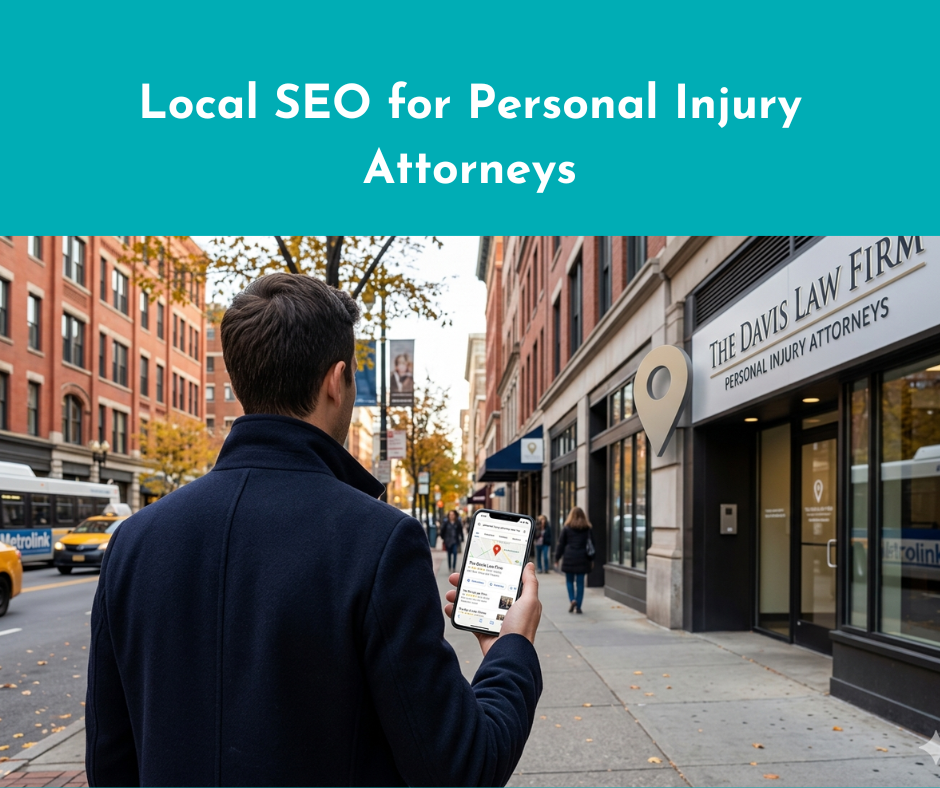
Personal injury is now a $61.7 billion market in the United States, with over 50,000 firms competing nationwide, according to IBISWorld. That's a lot of attorneys chasing the same clients, the same keywords, and the same phone calls.
The reality is that Google Maps listings and local business profiles contribute around 80% of the top search results for personal injury searches. Being higher in these local packs can deliver a massive rise in views and around 113% increase in clicks. And if you're not showing up there, someone else is.
But local search is only part of the picture now. TechCrunch reveals that AI platforms like ChatGPT and Perplexity provided sites with more than 1.13 billion referral visits in June 2025 alone, which is almost 357% year-over-year. That's not a trend worth watching. It's already here. Personal injury attorneys who aren't optimizing for AI search are leaving cases on the table, full stop.
Sapphire SEO Solutions can not only help your law firm rank higher in traditional search but also get mentions from AI platforms for maximum traffic and credibility. Our affordable SEO for lawyers ensures that your practice stays in front of people who are searching for your services.
This guide covers what actually works for personal injury law firms in 2026. We will go over key strategies that you can use to build credibility, boost visibility, and drive qualified traffic.
Importance of Local SEO for Personal Injury Attorneys
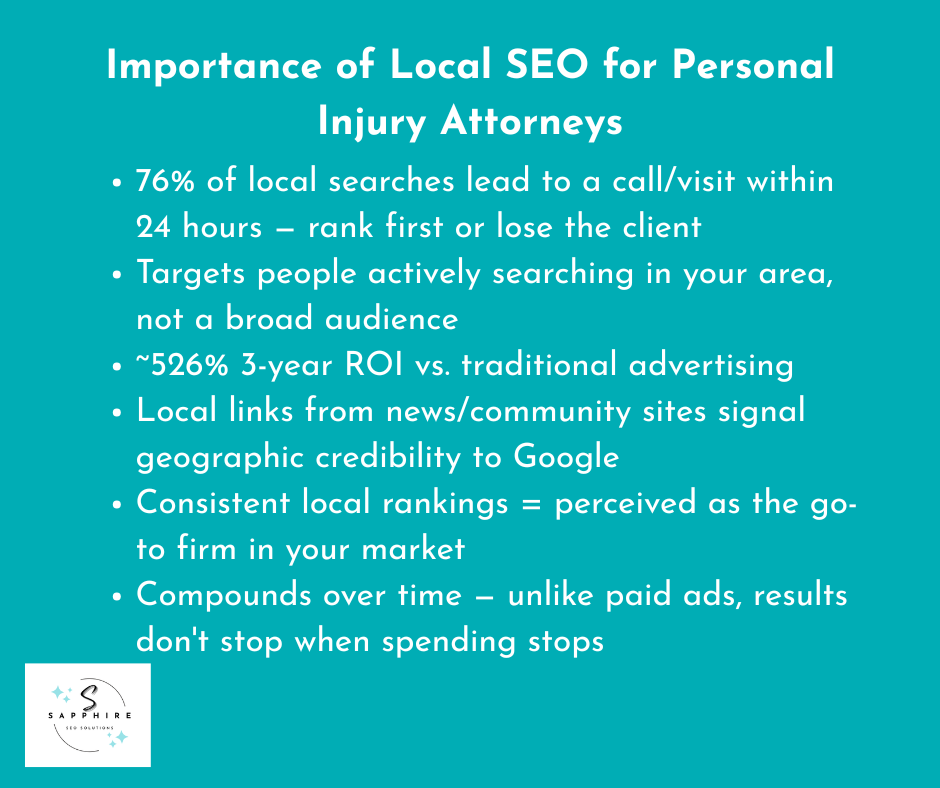
Local SEO for personal injury attorneys is crucial.
When someone gets hurt, they search for help fast. They're not wasting time. They're typing "personal injury attorney near me" into Google and calling whoever shows up first.
According to Search Engine Land, 76% of local searches lead to either a direct call or a website visit within 24 hours. That urgency is exactly why local search visibility is so critical for personal injury law firms.
Local SEO connects you to the people already looking for what you offer, in the city or neighborhood where you practice.
A billboard on a highway reaches everyone. Local search reaches the person who just got into a car accident two miles from your office.
The targeting is incomparably better, and so is the return. Many sources, including LexGrow, state that the three-year ROI for an average law firm investing in SEO sits at around 526%. That’s a lot more than what traditional advertising channels deliver.
Local links are a big part of why. Links from local news outlets, community organizations, and regional directories carry more weight for local rankings than generic national backlinks. Google uses them as proof that your firm is genuinely embedded in a specific geographic area, not just claiming to serve it.
There's also a positioning advantage. Personal injury law firms that show up consistently in local search results are perceived as more relevant and more authoritative than firms that don't. Clients don't just want any personal injury lawyer. They want the one who looks like the go-to firm in their area.
SEO for personal injury is one of the few marketing channels that keeps compounding over time. You build rankings, the rankings bring clients, and those clients bring reviews and referrals that strengthen your rankings further. That cycle doesn't happen with a TV ad or a pay-per-click campaign; you have to keep feeding money into it.
Understanding Your Audience and How They Search Is Crucial for Local SEO
Before you optimize a single page or claim a single directory listing, you need to understand:
Who is searching
Where they're searching
What they're actually typing
Getting this wrong wastes time and budget.
Who Is Actually Searching for a Personal Injury Lawyer?
Potential personal injury clients aren't in a casual browsing mindset. They've just been in an accident, they're dealing with injuries, they're stressed, and they want help fast. That emotional state shapes everything about how they search and what makes them pick up the phone.
Their searches are urgent and specific. Phrases like "best personal injury lawyer near me," "accident attorney in [city]," or "what to do after a car accident" dominate the query landscape. These people are looking for someone they can trust, right now.
That matters for your SEO strategy in a direct way. Prospective clients respond to content that feels reassuring and authoritative, not aggressive or salesy.
Firms that lead with empathy, clear answers, and social proof consistently convert better than firms that lead with "CALL NOW" and a list of settlement amounts.
Understanding user behavior is one of the highest-leverage things you can do to turn search traffic into signed clients.
The Three Search Surfaces You're Now Competing On
Most personal injury clients find attorneys through one of three places, and most firms only show up in one or two of them.
Google's local pack is the map-based "3-pack" that appears at the top of search engine results pages for location-based queries. This is prime real estate. It shows your firm name, rating, phone number, and a map pin before any organic results appear.
Below that are the traditional organic blue links, the standard-ranked web pages. These take longer to build but drive significant traffic for competitive terms and informational searches.
Then there's the third surface, which is newer and growing fast. When AI Overviews appear in search results, according to Ahrefs, top-ranking pages see a 34.5% drop in click-through rates. This means that the AI answer itself is consuming the visibility that would have gone to your website.
ChatGPT, Perplexity, and Google's AI Overviews now directly answer legal questions and recommend firms, often without the user ever visiting a website.
If your firm isn't visible across all three surfaces, you're handing cases to competitors who are.
Local Keyword Research That Actually Reflects Intent
Most keyword strategies for personal injury firms are either too broad or too generic. Keyword research that actually drives calls starts with high-intent keywords tied to specific case types, locations, and urgency.
High-converting geo-specific keywords like "car accident attorney Chicago" or "slip and fall lawyer near me" are the obvious starting point.
But the real opportunity is in long-tail keywords that combine case type, city, and situation. "What to do after a rear-end collision in Houston" or "motorcycle accident attorney downtown Atlanta" are lower competition and often higher intent.
Don't stop at city-level targeting either. Location-based keywords that target specific neighborhoods can outperform broad metro terms in dense markets.
"Car accident attorney near Buckhead" will often face less competition and convert better than "Atlanta personal injury lawyer" because the searcher is signaling exactly where they are.
To find the gaps your competitors haven't filled, keyword research is important. Use Google Search Console to see what queries you're already ranking for but not fully capitalizing on, and use tools like Ahrefs or Semrush to identify relevant keywords your competitors rank for that you don't. Those gaps are where smart firms build content that wins.
Go through our detailed guide on “The Top Keyword Research Tool for SEO” to find out the best tools to help you find hidden keyword opportunities.
Google Business Profile and the Role of Online Reviews on Local SEO
Your Google Business Profile is the single most important piece of local digital real estate you own. Get it right, and it generates calls without you spending a dollar on ads.
What the Data Actually Says About GBP Rankings
A 2025 study by SearchLab Digital analyzed 3,200 personal injury firm profiles across 20 major cities in the United States to find out what actually separates firms at position #1 from those at position #10. The findings are worth paying attention to.
Firms ranked #1 average 40% more reviews than those at position #10 (555 vs. 395). Nearly 100% of firms use keywords in headings, but only 12% include them in title tags. And 76% of firms list 24/7 hours, yet this tactic doesn't improve local search rankings once every competitor does the same.
Most firms are doing the same things and wondering why they're stuck. The differentiators aren't the obvious tactics everyone has already copied. They're the details that most firms overlook.
How to Set Up Your GBP Profile for Maximum Visibility
These local SEO tactics are not complicated. But they do need to be done correctly and completely.
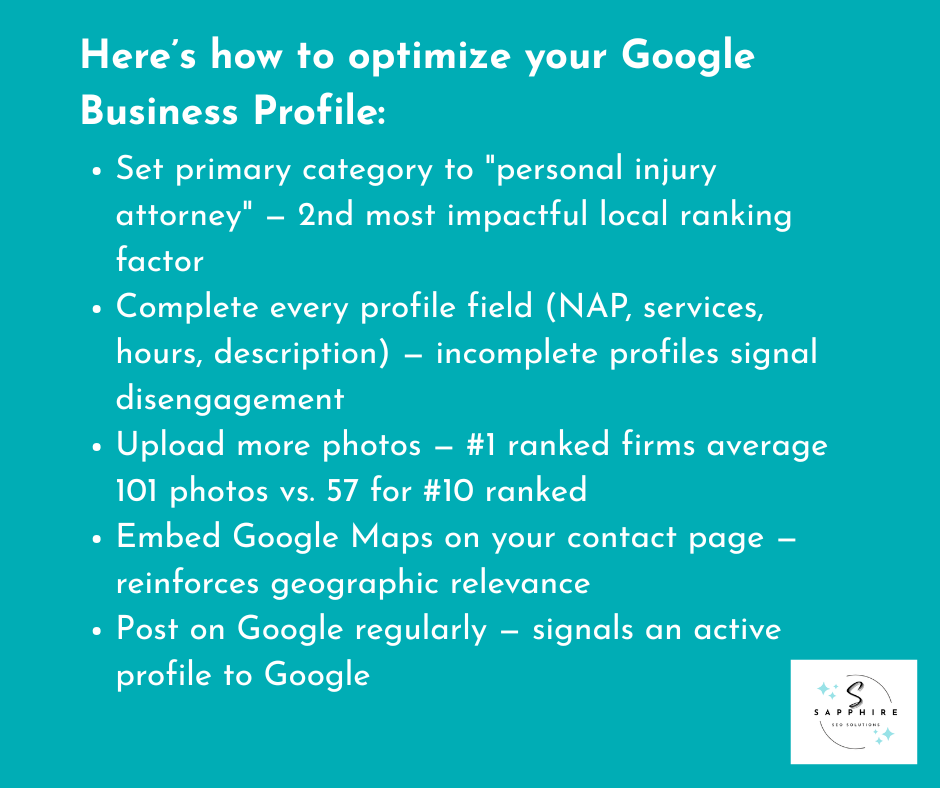
Start with your business category. Setting your primary category to "personal injury attorney" rather than a generic option like "law firm" was found to be the second most impactful ranking factor in local pack studies, because Google wants to match search intent as precisely as possible.
From there, complete every section of your profile: your name, address, phone number (NAP), services, hours, business description, and a booking link if you have one. Incomplete profiles signal a disengaged firm.
Photos matter more than most attorneys realize. Profiles with a larger number of photos tend toward higher positions, and photo quantity appears to have a greater impact than review count or keyword usage alone, likely because it signals an active and engaged firm.
Firms ranked #1 average 101 photos compared to just 57 for those ranked #10. That's a gap you can close quickly.
Add an interactive Google Maps embed to your contact page. It reinforces your geographic relevance and is one of those small signals that add up.
As an essential SEO strategy, also add Google Posts consistently. Each post builds engagement signals that tell Google your profile is active.
Make sure to read through our comprehensive guide on “Attract More Visitors to Google Business Profile” to learn more about the best practices of setting up and optimizing your Google Business Profile.
Building a Review System That Feeds Rankings
Reviews are one of the strongest local search rankings signals for personal injury firms. But their impact goes beyond algorithms. Injury victims want reassurance that others had a positive outcome, felt supported, and trusted your firm.
Reviews are doing double duty: influencing Google and influencing the person deciding whether to call you.
The right approach is a structured, ethics-compliant review request process. That means asking every satisfied client at the right moment, typically after a positive case resolution, with a simple, direct ask and a link that makes it easy.
Don't incentivize reviews. Don't ask in bulk. A steady, consistent flow of new reviews carries more weight than a one-time burst of 30 reviews followed by months of silence. Recency matters to Google's algorithm.
As for responding to reviews, the data suggests it doesn't directly move your local pack position. But it does build trust with prospective clients who read your responses before calling. Do it anyway.
To learn more about why reviews are important for your law firm’s site, make sure to read through our comprehensive guide on “The Role of Online Reviews in Local SEO.”
Google Posts, Q&A, and the Overlooked GBP Features
Two features most firms ignore entirely: Google Posts and the Q&A section.
Google Posts let you share case wins, legal tips, answers to common questions, and firm updates directly on your profile. Posting consistently shows Google your firm is active and relevant, which feeds freshness signals in the local algorithm.
Regular updates, whether legal tips, community involvement, or local news relevant to your practice, keep your profile engaging and current.
The Q&A section is underused and valuable. You don't have to wait for people to ask questions. Seed it yourself with the questions injury victims actually ask, "How long do I have to file a claim?" or "Do I pay anything upfront?" and answer them clearly. This content helps both potential clients and AI systems that surface your profile in search results.
Local SEO Architecture for Law Firm’s Site Is Crucial
Your law firm's website is your most controllable SEO asset. How it's built, organized, and optimized determines whether Google sends traffic your way or your competitor's.
Site Structure That Helps Google (and Clients) Navigate
A logical structure does two things at once: it helps organic traffic find the right page, and it helps Google understand what your site is about.
Think of it as a clear hierarchy: Home > Personal Injury Services > Car Accidents > Uber Accidents. Each level tells Google something more specific about your practice.
Internal linking is equally important. When your practice area pages link to relevant blog posts, and those posts link back to service pages, you're creating a web of context that reinforces topical authority.
Add breadcrumb navigation, and you've also improved the user experience, which reduces bounce rates and sends positive engagement signals back to Google.
Law firm websites with clean, organized site structures index 30% faster in Google's database. That alone is reason enough to get the structure right before anything else.

Practice Area Pages That Actually Rank
A single "personal injury law" page is not enough. It's too broad to rank for specific queries and too generic to convince a potential client you're the right fit for their case type.
Dedicated pages for each case type rank higher and convert better because they match search intent precisely. A page for truck accidents, one for slip and falls, and one for medical malpractice. Each one targets the specific language injury victims actually use when they search.
Go deeper within those pages, too. In the personal injury space, detailing specific scenarios within each case type, such as construction accidents, equipment malfunctions, or hazardous material exposure, immediately signals to a reader that you understand their exact situation.
Include local case examples, jurisdiction-specific statutes, FAQs, and trust signals like verdicts and settlements. Top-performing firms maintain around 1,500 words on landing pages, but depth beats length every time. Useful content that directly answers client questions will always outperform padded content chasing a word count.
Location Pages That Don't Look Like Spam
Building dedicated city and practice-area pages like "Car Accident Lawyer in Dallas" or "Slip and Fall Attorney in Austin" is one of the most effective location-based keyword strategies available to personal injury firms. Relying on a single catch-all service page to rank across multiple cities simply doesn't work anymore.
The difference between a high-quality location page and thin content that Google ignores comes down to genuine local value.
Does the page reference local courts, local statutes, or local accident data? Does it explain what a client in that specific city can expect from the legal process? If you could swap the city name for any other city, and the page would read exactly the same, Google knows it too.
For dense metro areas, neighborhood-level targeting can outperform city-level targeting for a car accident attorney competing in markets like Los Angeles or Chicago. "Car accident attorney near [neighborhood]" often carries less competition and higher conversion intent.
Multi-office firms need to be careful here. Each location page should be genuinely distinct. Duplicate pages with swapped city names are a fast way to cannibalize your own rankings.
Technical SEO Fundamentals for Law Firm Websites
This is where law firm SEO either supports or undermines everything else you build. The good news is that the fundamentals aren't complicated. The bad news is that most firms still get them wrong.
Core Web Vitals are Google's measure of page experience: how fast your page loads, how stable it is visually, and how quickly it responds to interaction. Google says that 53% of mobile users abandon legal websites that take more than 3 seconds to load, and every one-second delay in load time reduces conversions by approximately 7%. Focus on load speed and visual stability first. Those are where most law firm sites lose points.
Mobile-first design is non-negotiable. Over 60% of legal searches happen on mobile, and a personal injury victim searching for help right after an accident is almost certainly on their phone. If your site is hard to navigate on a small screen, you're losing clients before they've read a single word.
Schema markup is the structured data code that tells Google exactly what your pages are about. For personal injury firms, the most important schema types are LegalService, LocalBusiness, Person for attorney profiles, and FAQPage.
Legal websites with structured data see 20-30% improvements in click-through rates compared to those without it. It also feeds directly into AI search visibility, which we'll cover later.
Finally, NAP consistency. Your firm's name, address, and phone number must be identical across every page of your site and every directory listing.
Even small discrepancies, like "St." versus "Street," can dilute your local SEO signals.
Building Local Authority Off Your Website
What happens on your website matters just as much as what happens on it. Digital marketing for personal injury firms is not just about rankings. It's about building the kind of credibility that Google, AI systems, and potential clients all recognize.
The Citations and Directory Strategy That Still Matters
A citation is any mention of your firm's name, address, and phone number on another website. Listings with consistent NAP across directories are less likely to be suppressed or show conflicting information, and even minor discrepancies can undermine your local search rankings. "Suite 100" on your website and "Ste. 100" on Avvo sound trivial. To Google, it's a mismatch.
The essential legal directories every personal injury firm needs to be listed on are Avvo, Justia, FindLaw, and Martindale-Hubbell. These aren't just citation sources. They're high-authority websites in their own right, and a listing on each one doubles as a quality backlink pointing to your firm's website.
To audit what's out there, use tools like BrightLocal or Whitespark. They crawl directories, identify where you're listed, and flag inconsistencies so you can fix them systematically rather than hunting them down manually.
Link Building for Personal Injury Firms: What Actually Works
The most powerful links for local rankings come from locally relevant websites. A link from your local Chamber of Commerce, a neighborhood blog, or a local event you sponsored carries far more weight than a generic link from a national site. That's the fundamental principle driving link-building strategy for personal injury firms.
Legal directories and bar association websites are your foundation. State and local bar associations carry significant authority and are highly trusted by Google in the legal space.
From there, guest posting on legal publications and community news sites builds both links and topical authority, but only when done properly. That means genuine contributions, not thin articles stuffed with keywords.
Collaborating with local businesses for mutual backlinks is an underused tactic. A referral relationship with a local physiotherapy clinic or auto repair shop can translate into a link from a relevant, locally trusted website.
Sponsoring local events, funding a scholarship, or partnering with community organizations are all white-hat link sources that create lasting value. Local link building requires fewer backlinks compared to national SEO campaigns, because geographic relevance matters more than raw domain authority for local search rankings.
Getting Featured in Local Press and Community Coverage
Local media coverage does two things simultaneously: it creates high-quality backlinks and it builds brand authority that no directory listing can replicate.
A quote in a local news story about a road safety issue, a segment on a local TV station discussing injury claims, or even a mention in a community newsletter all contribute to your firm's perceived authority.
The most practical way to get there is to position your attorneys as subject-matter experts on local news outlets. Comment on local accident trends, new traffic laws, or recent court decisions in your jurisdiction. Journalists covering these topics need expert sources, and a personal injury attorney is a natural fit.
Search Engine Land reveals that Digital PR has emerged as the most effective link-building tactic, with 48.6% of SEO professionals rating it highest, which includes HARO (Help a Reporter Out) and direct journalist outreach.
Set up HARO alerts for legal and personal injury topics and respond quickly with concise, expert commentary. One placement in a credible publication can generate more SEO value than dozens of directory listings.
Content That Ranks and Converts in a YMYL Niche
Personal injury clients aren't just looking for information. They're looking for someone they can trust with one of the most stressful situations of their lives. Your content marketing strategy needs to reflect that reality.
Why Personal Injury Content Is Held to a Higher Standard
Legal content falls squarely into what Google calls YMYL, "Your Money or Your Life." Google applies very high page quality standards to YMYL topics because low-quality pages on such topics could negatively impact a person's financial stability, safety, or overall well-being.
For personal injury lawyer SEO, this means the bar for content quality is significantly higher than it is for most other industries.
The framework Google uses to evaluate that quality is E-E-A-T: Experience, Expertise, Authoritativeness, and Trustworthiness.
E-E-A-T for YMYL lawyer content is particularly crucial, as attorneys must provide legally sound information that doesn't put prospective clients or others at risk.
In practice, that means every piece of content on your site should carry an attorney byline with credentials, display a published and updated date, cite credible sources, and reference relevant local or state law where applicable.
The single biggest mistake law firms make with content is publishing generic legal information that could have been written by anyone. "What is negligence?" with no firm-specific context, no local references, and no evidence that a real attorney wrote it isn't content. It's filler.
And Google's algorithm, increasingly refined to detect exactly this kind of thin YMYL content, treats it accordingly.
The Content Types That Drive the Most Local Traffic
The firms generating the most organic traffic aren't just creating blog posts. They're building a content library that covers every stage of the client journey.
Dedicated location and practice area landing pages are the foundation. Each major city or neighborhood you serve needs its own page with genuinely local content, exceeding 500 words and addressing the specific legal context in that area.
From there, the content types that consistently drive traffic and conversions include:
FAQ pages tied to local case types and statutes. These perform well in traditional search and are increasingly cited by AI systems answering legal questions directly.
"What to do after a [accident type] in [city]" guides. These capture searches at peak intent, right when someone has just been in an accident and is looking for immediate guidance.
Case result pages and settlement examples. Real outcomes from real cases build trust and feed E-E-A-T signals. They show Google and prospective clients that your firm has demonstrated verifiable experience.
Video content. Attorney introduction videos, process walkthroughs, and client testimonials significantly increase time on site and build the kind of personal connection that written content alone can't achieve.
Interactive tools like compensation calculators or case eligibility quizzes. These improve engagement, increase time on site, and create a reason for a visitor to keep interacting with your firm before they're ready to call.
Writing for Injured Clients, Not Search Engines
This is where a lot of personal injury lawyer SEO content falls flat. It's written to rank, not to connect.
Injury victims are scared and often in pain. They don't want to wade through legal jargon to figure out if you can help them. They want a clear answer to "do I have a case?" and they want to feel like the firm they're reading about actually understands what they're going through.
Structure your content to build trust before asking for anything. Lead with the answer, provide the context, and let social proof, client testimonials, case stories, and community involvement do the persuasive work.
A prospective client who reads a case story from someone in a similar situation and feels genuinely understood is far more likely to call than one who reads a keyword-optimized page about negligence law.
Write clearly. Use plain language. And remember that the goal of every page on your site is to move a real person one step closer to picking up the phone.
AI Search Is Changing How Users Search
AI search isn't coming. It's already here and already influencing which personal injury firms get called. Understanding how it works is now part of any serious search engine marketing strategy.
How AI Search Works and Why It's Different from Google
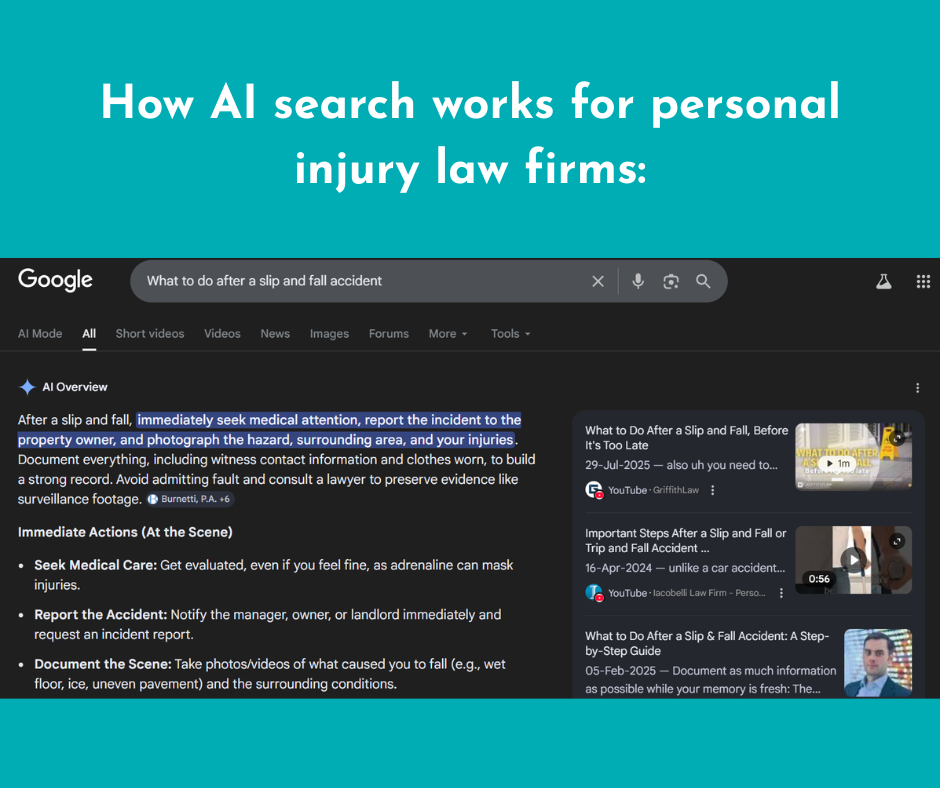
Traditional Google search gives users a list of links and lets them choose. AI search gives them an answer, often with a firm recommendation attached, and many users stop there.
When AI platforms answer legal questions, 60% of users never click through to a website. The firm cited in that answer gets the call before anyone else is considered.
The scale of this shift in the legal space is significant. 27.2% of US searches now end without a click, and this zero-click evolution creates a genuine challenge for law firms dependent on organic search traffic.
For personal injury specifically, the exposure is even higher, with legal queries triggering AI Overviews more than almost any other industry.
There are three distinct channels your dedicated SEO team needs to understand and optimize for:
AIO (AI Overviews) are Google's built-in AI answers that appear above traditional search results. They pull from pages Google already trusts and ranks.
AEO (Answer Engine Optimization) is the practice of structuring your content so it directly answers questions that AI systems are likely to surface, formatting that works across both Google and third-party platforms.
GEO (Generative Engine Optimization) targets platforms like ChatGPT and Perplexity specifically. These generative engines create synthesized answers rather than returning a list of links, and the goal is to be cited, referenced, or pulled into the AI-generated answer itself.
Most firms are optimizing for none of these consistently. Our AI SEO services help law firms maximize visibility and appear in LLM models where it matters the most.
What AI Systems Look for When Choosing Sources to Cite
AI systems don't reward vague authority claims. They reward specificity. A statement like "we have decades of experience handling personal injury cases" signals nothing to an AI model.
A statement like "In 2024, 87% of our personal injury clients received settlements, with the average case resolving in 8.3 months" is specific, verifiable, and exactly what AI systems are trained to cite.
The same principle applies to local laws and jurisdiction-specific content. If someone asks, "How long do I have to file a car accident claim in Florida?", your page needs to answer that in the first sentence, then provide the context.
Instead of a heading like "Understanding Statute of Limitations," use the actual question: "What is the statute of limitations for personal injury in Florida?" and immediately answer it. That's the format AI engines cite consistently.
Attorney-written content with case references, jurisdiction-specific details, and real firm data earns citations. AI-generated content typically doesn't. AI systems consistently favor comparison guides, how-to articles, and clear explanations of legal processes.
The common thread is educational value, content that helps someone understand a topic rather than content persuading them to hire a firm.
There's also the concept of "query fan-out" to understand. When an AI platform answers a complex question, it generates multiple sub-queries behind the scenes to build a complete answer.
One great page covering a broad topic is not enough. You need content that covers the full scope of questions a personal injury victim might ask, so your firm appears across those sub-queries, not just one of them.
How to Structure Your Content for AI Citation
The structural requirements for AI visibility are practical and achievable. The Q&A format is the most effective structure for AI search. Structured content using headings and lists performs strongly for non-question queries, while dense paragraphs perform worst.
Put the key answer in the first paragraph, every time. Don't bury it after two paragraphs of introduction. 44.2% of all AI citations come from the first 30% of a page's text. If your answer isn't near the top, it may not get pulled at all.
Add an FAQ section to every major practice area and location page, with clear question headers written the way clients actually ask them, and direct answers immediately below.
Use FAQPage and LegalService schema markup to make that content machine-readable. FAQ schema markup is non-negotiable for AI visibility. Pages with proper schema show significantly higher click-through rates and rich result eligibility.
Keep information dated and specific. "As of March 2025, Florida requires..." is more likely to earn a citation than "Florida requires..." because AI systems weigh content freshness heavily.
85% of AI Overview citations, according to many different sources, come from content published in the last two years. And that’s not all. Perplexity citations (almost half of all of the citations) used content published in 2025.
Finally, site structure matters here too. If a person can navigate your site easily and find clear answers quickly, AI systems can do the same.
Complicated navigation, buried content, and slow load times are just as damaging to AI visibility as they are to traditional rankings.
Building the Brand Signals AI Systems Use to Recommend Firms
When someone asks ChatGPT, "Who is the best personal injury lawyer in [city]?", the AI doesn't guess. It cross-references available data. That includes your Google Business Profile, legal directory listings on platforms like Super Lawyers, Best Lawyers in America, Avvo, and Martindale-Hubbell, BBB ratings, and mentions across news articles and third-party publications.
Brands in the top mentions, according to Ahrefs, gain over 10 times more AI Overview citations than those in the next quartile. Brand authority signals, including mentions, branded search volume, and branded anchor text, correlate more strongly with AI visibility than traditional backlink metrics.
This means your NAP consistency, your name, address, and phone number across every platform, isn't just a local SEO tactic anymore. It's an entity signal that tells AI systems your firm is a real, established, credible business operating in a specific location.
For personal injury firms, the social proof that AI can actually verify carries the most weight: documented settlements and verdicts, bar certifications, peer ratings, awards from recognized legal publications, and coverage in local and national press.
Measuring What's Actually Working
Running SEO without tracking is the same as running a firm without knowing which cases are profitable. You need to know what's generating qualified leads and what's just generating noise.
The Metrics That Matter (and the Ones That Don't)
The only metrics that actually matter are the ones that turn into revenue. For personal injury firms, that means calls and contact form submissions from organic search and your Google Business Profile. Everything else, impressions, page views, and social shares, is a supporting indicator at best.
Track these specifically:
Calls and form fills from organic and local search. Use call tracking software to separate GBP-driven calls from website calls. This distinction matters because the two channels require different optimization strategies.
Map pack ranking position by keyword and city. Your position in the local 3-pack for terms like "personal injury attorney [city]" directly correlates with call volume. Track this per keyword, not just in aggregate.
Organic traffic, keyword rankings, and conversion rates through Google Analytics and Google Search Console. These tools are free and give you everything you need to monitor whether your content and technical SEO efforts are building momentum.
A key thing to remember is that 48% of personal injury firms misattribute GBP traffic, meaning they can't tell whether a call or visit came from their profile or their website. Fix this by adding UTM parameters to your GBP website link so Google Analytics can correctly categorize that traffic. It's a five-minute fix that gives you much cleaner data.
Tracking AI Search Visibility
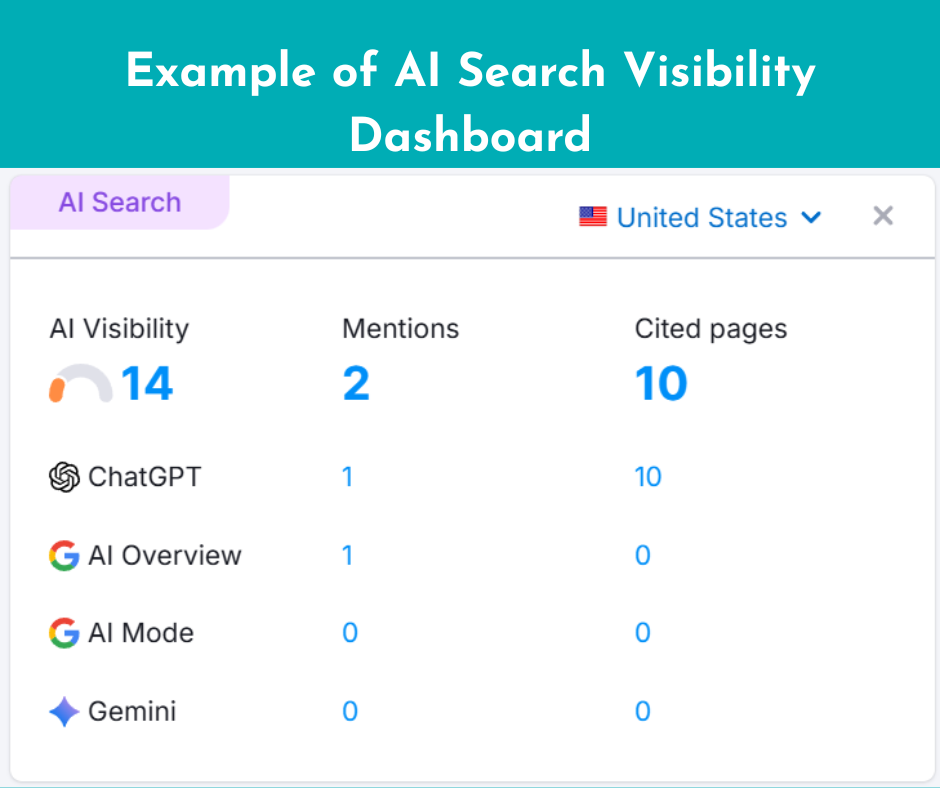
Traditional rank tracking tools don't capture AI visibility. PI lawyer SEO in 2025 requires a separate layer of measurement for how your firm appears in AI-generated answers.
Start with manual testing. Regularly search your target queries in ChatGPT, Perplexity, and Google AI Overviews, and note whether your firm gets cited. It's not scalable long-term, but it gives you an immediate baseline.
For ongoing monitoring, dedicated AI visibility platforms like the Semrush AI Toolkit, Ahrefs Brand Radar, and Profound track how your firm appears across major AI-powered search engines, including ChatGPT, Claude, Perplexity, and Google's AI Overviews, offering insights into citation frequency, source attribution, and competitive positioning within AI-generated responses.
Entity gap analysis takes this a step further. It identifies which competitors are being cited by AI tools for your target queries and what content or authority signals are driving those citations. Where they're appearing, and you're not, is exactly where your next content or PR investment should go.
A Realistic Timeline and What to Expect
SEO is not a fast channel. Any agency or consultant promising first-page results in 30 days is not being straight with you.
A realistic marketing strategy for local SEO looks like this: measurable improvements in search rankings typically begin appearing within 4 to 6 months.
Substantial results, meaning consistent map pack visibility, growing organic traffic, and a meaningful increase in inbound calls, generally emerge over a 9 to 12-month period, and in some cases, even more than 12 months.
Firms typically observe ranking improvements within 90 to 120 days, with compounding growth accelerating after nine months as content volume and authority accumulate.
The three channels compound differently. Map pack rankings tend to move first, especially if your Google Business Profile was previously incomplete or inactive.
Organic rankings take longer because they depend on content depth, backlink authority, and technical SEO, all working together.
AI visibility comes last because it requires that your firm already be recognized as credible across multiple platforms before AI systems will cite you consistently.
The smartest short-term move while organic rankings build is to run Google Local Service Ads (LSAs).
LSAs place your firm at the very top of local search results for verified attorneys, generating calls immediately while your SEO investment matures. The two channels work well together because LSA performance data can also inform your organic keyword priorities.
Who Are The Firms That Will Win in the Next Three Years?
The personal injury firms that dominate local search in 2026 and beyond won't be the ones who found a clever trick or chased the latest algorithm update. They'll be the ones who executed the fundamentals consistently, month after month, while their competitors kept looking for shortcuts.
A firm that builds a well-structured website, earns quality local backlinks, maintains a strong Google Business Profile, and publishes genuinely useful content starts getting cited by Google.
Those citations build authority. That authority earns AI citations. Those AI citations drive calls, which generate reviews, which strengthen local rankings further.
Each layer reinforces the one beneath it. It doesn't happen overnight, but once it starts, it becomes very difficult for a competitor to displace.
For firms starting from scratch, the priority order is straightforward. Claim and fully optimize your Google Business Profile first. Build your website architecture and core practice area pages next. Establish your citations and essential directory listings. Then invest in content and link building as ongoing SEO efforts.
Don't try to do everything at once.
For firms with an existing foundation, the focus shifts to identifying gaps. Where are competitors outranking you? Where are they being cited by AI tools that aren't mentioning your firm? What content is missing from your site that injury victims in your market are actively searching for? Those gaps are your next 12 months of work.
The honest truth about what "actually works" is unglamorous. It's fixing your NAP consistency, writing better location pages, asking satisfied clients for reviews, publishing attorney-written content that answers real questions, and building relationships that earn genuine local links. None of it is exciting. All of it compounds.
Let Sapphire SEO Solutions Grow Your Legal Practice Online Today!
If you want to know exactly where your firm stands and what to prioritize first, we offer a free consultation. Our team will audit your current local search presence, identify the highest-leverage opportunities, and give you a clear roadmap for turning search visibility into signed clients.
Contact us today to get started!
Want to order SEO-optimized content for your law firm? Check out the different content writing tiers we offer before placing an online order.

Frequently Asked Questions - Local SEO for Personal Injury Attorneys
How can my personal injury law firm rank in Google’s Local Pack for “personal injury lawyer near me”?
Claim and fully optimize your Google Business Profile with the correct category, complete NAP, services, hours, photos, and posts. Add local backlinks and maintain location-specific pages to improve local search visibility.
How long does it realistically take for local SEO to generate cases for a personal injury law firm?
Local SEO improvements usually appear within 3–4 months, but consistent results, including more calls and signed cases, typically take 6–12 months. Using effective local seo strategies can help speed up outcomes.
What matters more for local rankings: Google reviews, backlinks, or website content?
For Local Pack rankings, client reviews and strong website content have the biggest impact. Backlinks, citations, and activity on local business listings further boost authority and online visibility.
Do personal injury firms need separate location pages for every city or neighborhood they serve?
Yes. Each city or neighborhood page should have unique, locally relevant content highlighting your legal services and local courts. This helps potential clients search find your firm and signals authority to local clients.
How competitive is local SEO for personal injury lawyers, and how many backlinks or content pages are needed to reach page one?
Personal injury law is highly competitive. Ranking on page one requires multiple practice-area and location pages, backlinks, and a fully optimized Google Profile. Search engine optimization and legal seo are critical, and it’s local seo important to encourage satisfied clients, showing that local seo matters for long-term growth.