

How Do Blogs Help SEO? - 15 Ways Blogs Drive Traffic in 2026
Blogs help SEO by expanding your keyword reach, building topical authority, earning backlinks, and sending strong engagement signals to Google. Each post creates a new indexed page that ranks for multiple search terms, drives compounding organic traffic over time, and positions your business as a trusted expert in your niche.
Key Takeaways
Every blog post is a new indexed page. More posts mean more keywords, more traffic, and a bigger search footprint.
Strategic blogging drives compounding organic traffic. Unlike paid ads, well-optimized posts keep ranking and generating leads for years.
Consistent blogging builds topical authority. Google rewards sites that demonstrate deep, ongoing expertise in a specific niche.
Start with keyword research before writing anything. Content without search intent behind it won't rank, no matter how well it's written.
Blogging supports your entire marketing funnel, from brand awareness at the top to lead conversion at the bottom.
Think of your website as a store. A store with no new inventory gives people no reason to keep coming back, and no reason to show up in the first place. That's exactly what a website without a blog looks like to Google and other search engines.
Unfortunately, most business websites are invisible in search results. They go live, sit there, and wait. But search engines don't reward waiting. They reward activity, relevance, and depth. 96.55% of pages, according to Ahrefs, get zero organic traffic from Google. If you don't have a plan to stand out, you're part of that majority.
That's where strategic blogging comes in, and it should be a part of your SEO strategy. Done right, a blog does two things really well. It drives traffic by consistently putting your website's content in front of people who are actively searching for what you offer. And it builds long-term SEO value that compounds over time, unlike paid ads that stop the moment you stop paying.
Good SEO isn't a one-time fix. It's built through consistent, strategic effort. Blogging is one of the highest-leverage SEO efforts you can make because every post is a new opportunity to rank, earn trust, and shape brand perception as the go-to expert in your space.
Sapphire SEO Solutions makes blogging easy. Our affordable SEO content writing services help business owners keep their site active with relevant content that demonstrates E-E-A-T. This ensures that the business ranks higher in the SERPs and drives traffic to its website.
To learn more about how blogs help SEO, please continue reading this comprehensive guide.
What Is Blogging for SEO?
Blog writing and search engine optimization (SEO) go hand in hand, but only when there's a strategy behind the content. Most people think blogging just means writing about topics in your industry. It doesn't.
There's a big difference between random blogging and SEO-driven blogging, and that difference determines whether your content gets found or gets ignored.
Random blogging looks like this: you write about whatever feels relevant, publish it, and hope for the best. SEO-driven blogging starts before you write a single word. It starts with keyword research.
Keyword research is how you find keywords that your target audience is actually searching for. Not what you think they're searching for. What they're actually typing into Google. It's the process of discovering what your ideal audience types into search engines when they need information, want to solve a problem, or are ready to make a purchase. Without it, you're creating content in the dark.
The next piece is search intent. Every search has a reason behind it. Someone searching "how to fix a leaking pipe" wants a how-to guide, not a product page. If your page doesn't match the reason behind the search, it won't rank well. When creating content, you need to match what you write to what the searcher actually wants to find.
Then comes content optimization. Creating high-quality content means your post covers the topic thoroughly, uses relevant keywords naturally, and is structured in a way that's easy for both readers and search engines to follow.
Put it all together, and you have valuable content that ranks. Skip any one of these steps, and you're just writing without achieving any SEO results.
How Do Blogs Help SEO?
Every post you publish works to expand your visibility, build trust, and bring in traffic that converts. Here's exactly how that happens:
1. More Blog Posts = More Ways for Customers to Find You
Your service pages can only target so many keywords. While your homepage, about page, and contact page are all important, they have a limited search footprint. Blog posts don't.
Every post you publish becomes a new indexed page. A new entry point. A new chance to show up in Google search results. Research shows that the average top-ranking page also ranks in the top 10 for nearly 1,000 other relevant keywords.
That means each post you write doesn't just rank for one term. It can rank for dozens or even hundreds of related searches across search engine results pages. Think of every blog post as a new doorway into your website. The more doors you build, the more people walk through.

2. Targets Long-Tail Keywords in Google Search
Your service pages are built around broad, competitive terms. "Dental services." "Best restaurant." "Fashion designer." These are tough to rank for, especially when you're up against established competitors. Blogs give you a way around that.
Specific phrases like "how to improve local SEO for a small business" or "what is topical authority in SEO" are long-tail keywords. Long-tail keywords are important for SEO because:
They're relatively easy to rank highly for
They can drive high-quality traffic
They have high collective search volumes when grouped together
Long-tail keywords are also the right keywords to go after when you're building authority in a niche. Your service pages won't naturally rank for these specific keywords, but a well-written blog post can. It's a smarter, faster path to ranking, and it brings in visitors who are already looking for exactly what you offer.
3. Answers the Questions Your Customers Are Actually Asking
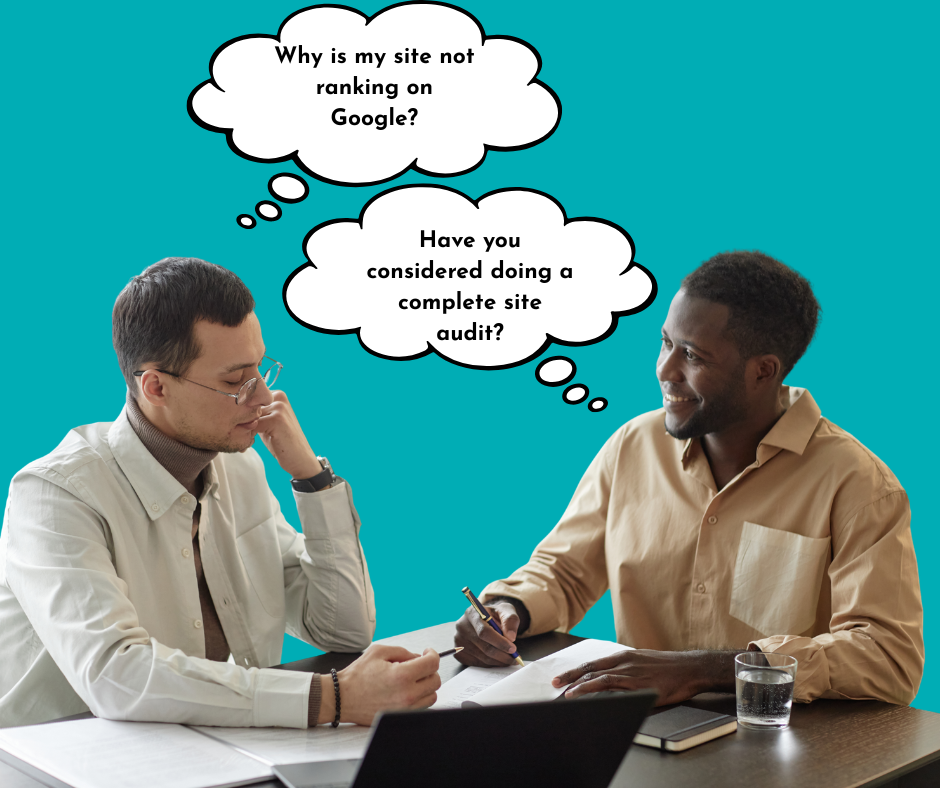
People don't just search for services. They search for answers. "How do I know if my website has an SEO problem?" "Why is my site not ranking on Google?" "What does a backlink do?" These are the searches happening every day, and they're driven by real search intent.
Google search is built to match users with content that directly answers what they're looking for. When your blog targets "what is," "how to," and "why does" questions, you're meeting people early in their journey. Before they've even thought about hiring someone. That's powerful. It builds trust, positions you as an expert, and pre-sells your service before a single conversation takes place. By the time a reader fills out your contact form, they already feel like they know you. That's what relevant content does. It makes users decide faster and with more confidence.
4. Aligns Content Across the Entire Marketing Funnel
Not everyone who visits your site is ready to buy. Some people are just becoming aware of a problem. Others are weighing their options. A smaller group is ready to make a decision right now. Your blog can speak to all of them.
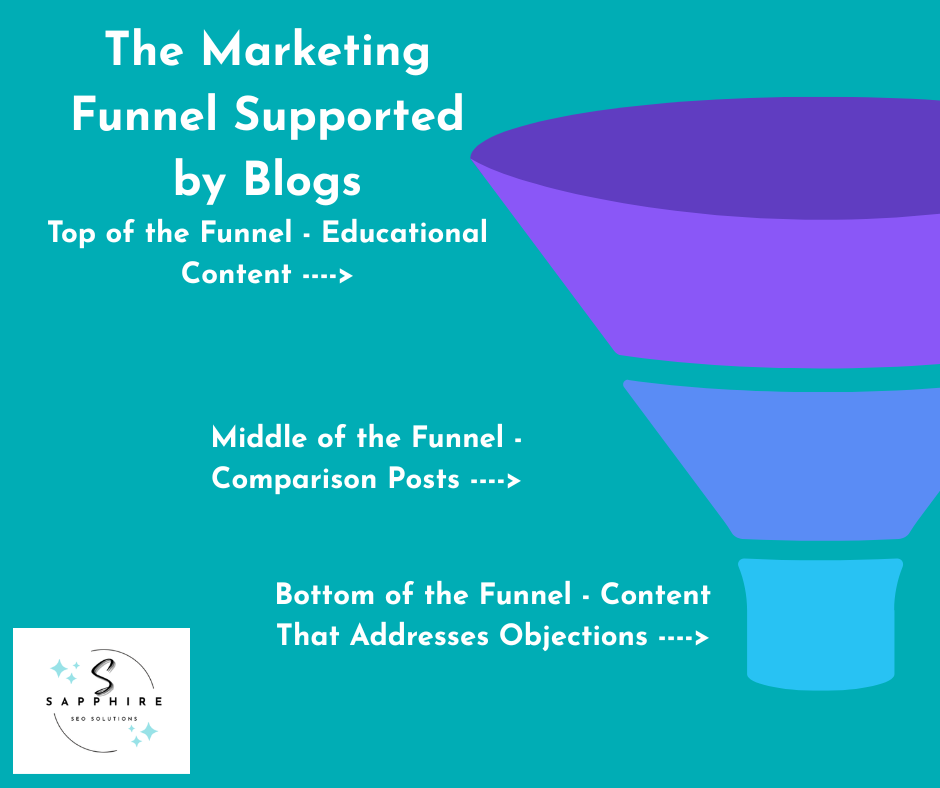
At the top of the funnel, you publish educational content that introduces your target audience to a problem or concept. In the middle, you write comparison posts and case studies that help them evaluate solutions. At the bottom, you produce content that addresses objections and nudges them toward taking action. This is how you encourage users to move through the funnel naturally, without pushing.
Businesses that blog strategically across all three stages tend to build a loyal following because they're genuinely useful at every stage of the journey, not just when someone is ready to spend money.
5. Keeps Your Website Fresh and "Alive" in Google's Eyes
A website that never changes gives Google no reason to keep coming back. Publishing blogs regularly is one of the most effective ways to signal that your site is active, current, and worth indexing.
Frequent publishing ensures your site gets crawled more often. Search engines use more of their resources on sites that update regularly because they need to. More crawling means your new content gets indexed faster and your rankings have more opportunities to improve.
Search engine algorithms are also designed to reward fresh content for certain types of searches, especially anything time-sensitive or competitive. Pages where the majority of content changes not only get crawled more frequently but also rank for more keywords, compared to pages with no content change at all. Keeping your content up to date isn't just good practice. It signals to Google that you're an active business worth showing to searchers.
6. Builds Topical Authority and E-E-A-T
Google doesn't just want to rank good content. It wants to rank content from sources it trusts. That's where topical authority comes in.
Topical authority is built by consistently creating and linking high-quality content relevant to a specific subject or niche. The more informative and in-depth you write about a topic, the more search engines and users see you as a subject matter expert. When you publish authoritative content consistently in one niche, Google stops seeing you as a generalist and starts treating you as a specialist. That distinction matters a lot for rankings.
This ties directly into E-E-A-T, which stands for Experience, Expertise, Authoritativeness, and Trustworthiness. Applying E-E-A-T principles to your website helps improve rankings. If Google views your website as an expert resource on a topic, it's more likely to rank your content higher.
Quality content that demonstrates real expertise is one of the clearest signals you can send. The more your content covers a topic from every angle, the more your rankings across related keywords improve. Competitors with bigger budgets can be outranked.
A newer, highly focused blog can often outrank an older, more established site if it demonstrates clearly superior expertise and coverage. That's the power of letting your content stand on its own merit.

7. Supports Content Clusters and Pillar Pages
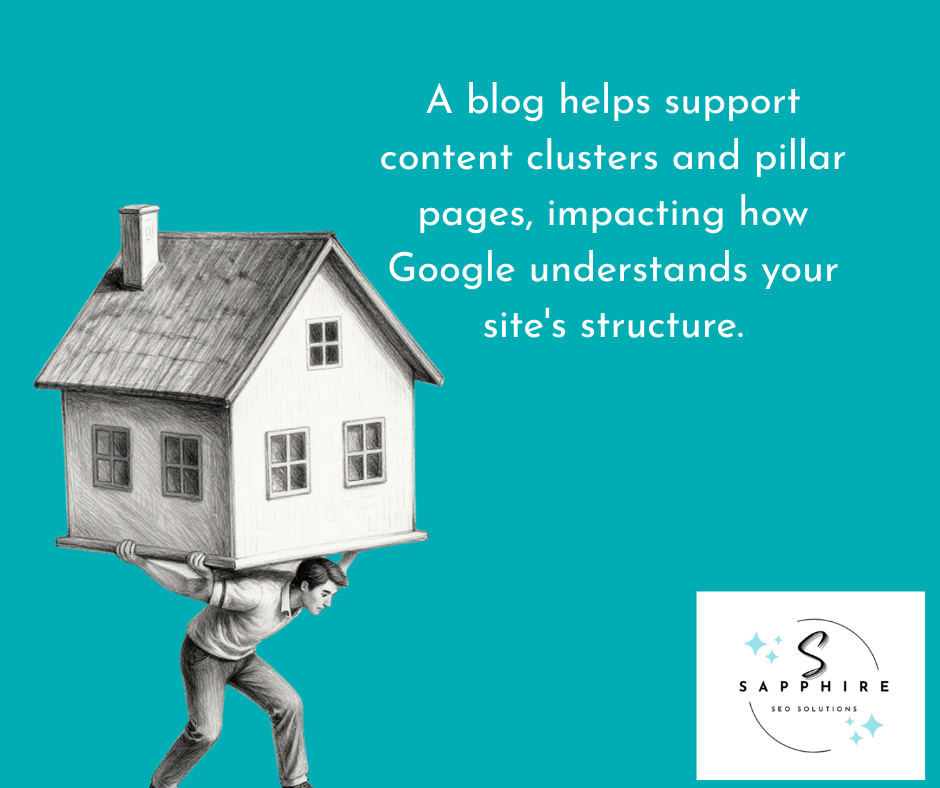
Random blog posts scattered across your site don't build authority. Connected ones do. A well-structured blog supports what's known as a content cluster model, and it has a direct impact on how Google understands your site's structure.
Here's how it works:
You have a pillar page that covers a broad topic in depth.
Your blog posts then act as supporting cluster content, each diving into a specific subtopic and linking back to the pillar.
This creates a tightly connected internal structure that signals topical authority to search engines.
From an SEO perspective, the internal linking helps distribute link equity, improves crawlability, and keeps visitors exploring related content.
The result is that other pages on your site benefit too. When one page in your topic cluster performs well, it also elevates the rankings for other pages in that cluster that link to it. It's a rising tide effect. One well-performing blog post lifts the entire cluster, including the competitive pillar page you actually want to rank.
8. Improves Internal Linking and Boosts Key Pages
Every blog post is an opportunity to direct traffic and authority exactly where you want it. Internal links are one of the most underused tools in SEO, and your blog is the perfect place to use them.
When you publish a blog post, you can naturally link out to your service pages, landing pages, and other relevant content on your site. Those links pass authority from the blog post to the destination page, a concept known as link equity. Over time, your most important pages accumulate more authority and rank higher.
Using internal linking wisely helps readers navigate your blog to find the information they most need. It also helps Google understand your blog's structure and content better, proving that you're an authority in your niche.

9. Earns High-Quality Backlinks Naturally
Getting other websites to link to yours (off-page SEO) is one of the most impactful things you can do for SEO. But chasing backlinks is hard. Creating content that earns them naturally is a much smarter approach, and blogs make that possible.
Reputable websites link to content that gives their audience genuine value. That means in-depth guides, original data, useful insights, and comprehensive resources.
A well-written blog post can become exactly that kind of asset. According to DemandSage, 94% of online content does not get any backlinks, while only 2.2% manages to get external links from multiple websites. That gap exists because most content isn't worth linking to. Strategic, high-value blog content is.
Generating backlinks this way also improves your domain authority over time, which makes it easier for all of your pages to rank. And with link building being one of the most consistently important ranking factors, pages ranking first, according to Backlinko, have 3.8 times more backlinks than pages ranking in positions 2 through 10. The blogs you publish today can earn you links for years.

10. Helps You Capture Featured Snippets and SERP Features
You don't have to rank number one to dominate the search engine results pages. Optimized blog content can land you in featured snippets, "People Also Ask" boxes, and other prominent placements that put your brand front and center.
SERP features are important because they can drive more organic traffic to your site. Since these features take up more space and appear prominently in search results, they're more likely to stand out to users and attract clicks. Securing SERP features can signal to searchers that your content is trustworthy and reliable. When your blog is structured to directly answer questions with clear, concise language, you give Google search exactly what it needs to pull your content into these features. Any business or website that wants to capture top-of-funnel search traffic should optimize for People Also Ask. The best part is that these placements often come from blog posts, not service pages. It's yet another reason why a well-run blog doesn't just help search engines understand your site. It actively puts you above the competition.
11. Drives Consistent, Compounding Organic Traffic
One of the biggest advantages of blogging for SEO is that the results don't stop when you stop publishing. Every post you write keeps working for you in the background, often getting better with time.
Compounding blog posts, according to HubSpot research, represent about one in 10 posts published, but they bring in as much as 38% of total blog traffic. Just one compounding post generates as much traffic as six regular ones. That means the articles you write today can be among your biggest traffic drivers years from now, without any additional effort on your end. While paid ads stop delivering the moment you stop spending, organic rankings can continue bringing visitors for months or even years after initial publication.
The result is a traffic base that grows month over month. As your content library expands, so does your reach. More posts, more keywords, more organic traffic, and a lower cost per visitor over time. That's the kind of return paid ads simply can't replicate.

12. Improves User Engagement Signals
Traffic is only part of the equation. What visitors do once they arrive on your site matters just as much for SEO. And a well-written blog does a lot to keep them engaged.
Good blog content naturally increases time on site, drives more pages per session, and reduces the likelihood of visitors leaving immediately. When people spend real time on your site (reading, watching, clicking), they send a meaningful signal to search engines that you're providing value. Over time, that can give your SEO rankings a real boost, putting you in front of more people who need what you offer.
User engagement also improves when your blog is easy to read across all mobile devices, structured clearly with headers, and enriched with relevant visuals or interactive elements. Session duration is a strong indicator of engagement. If users spend more time on your site, it usually means they're interested in your content, which is a positive signal for search engines. Better engagement signals mean Google is more likely to keep showing your content to people who are searching for what you offer.

13. Builds Brand Awareness and Trust
Every time someone searches for an answer in your industry and finds your blog, that's a brand impression. They may not contact you today, but they'll remember you when they're ready.
Content creation is integral to SEO for brand awareness, not only for generating backlinks and mentions, but for building meaningful relationships with your audience. The goal is to be their go-to resource whenever they need relevant information. That's exactly what a well-run blog does. It puts your name in front of people repeatedly, across dozens of different searches, until your brand becomes familiar. And familiarity builds trust.
Search Engine Land reveals that 59% of American searchers click on results from brands they recognize, and 81% of consumers will only consider purchasing from a brand they trust. Blogging consistently in your niche is one of the most effective ways to build that brand perception over time. It also increases branded searches, where people search for your business by name directly, which is a strong signal to Google that your brand carries real authority. Your blog is working even when no one is contacting you. That's the long game.

14. Supports Link Building, Outreach, and Marketing Channels
A blog post doesn't just live on your website. It feeds your entire marketing operation. That's what makes it one of the most efficient content investments you can make.
Content repurposing allows businesses to maximize their return on investment by leveraging existing content in multiple ways. Rather than creating new content from scratch, repurposing lets you extract additional value from existing assets. A single blog post can become an email newsletter, a series of social media posts, the basis of a guest posting pitch, or outreach material for your link-building campaigns. The most effective distribution channels for B2B marketers include blogs (79%), email newsletters (73%), and email (66%). Your blog sits at the center of all of it.
This creates a full content ecosystem where one piece of content powers multiple channels. Other blogs and publications are also more likely to reference or link back to a well-written, data-backed post. That earns you backlinks without a cold outreach campaign. It's smarter, more sustainable, and builds compounding value over time.
15. Increases Leads and Conversions (Indirectly)
Most people don't buy the first time they visit a website. They research, compare, and think. A blog gives you multiple opportunities to encourage users to stay in your world during that process. It educates them, removes their doubts, and builds the confidence they need to take action. Content marketing costs 62% less than traditional outbound methods, according to Content Marketing Institute, yet can generate up to three times the amount of leads. SEO-driven leads close at a rate of 14.6%, compared to just 1.7% for outbound leads.
By the time users decide to reach out, they've already read your content, understood your expertise, and developed trust in your brand. The blog did the selling before you ever got on a call. That's not a coincidence. That's strategy.

Why Blogging Is a Long-Term Investment
A paid ad delivers results while the budget is running. The moment you stop paying, the traffic stops. A well-written blog post works differently. It gets indexed, starts ranking, earns clicks, and keeps doing all of that for months and years without any additional spend.
This is what's known as the compounding traffic effect. While trending content generates a spike and then fades, evergreen blog content maintains steady traffic month after month and year after year, transforming your content from a one-time marketing expense into a perpetual revenue-generating asset. The numbers back this up. Businesses investing in evergreen content, according to Hostinger, see 13 times more positive ROI compared to those that don't blog consistently.
The economics are hard to argue with. A single blog post might cost a few hundred dollars to produce. When spread across thousands of visitors over three years, the cost per visitor can drop to just a few cents. Compare that to paying $5 to $15 per click in Google Ads for the same keyword, and the difference becomes obvious.
And it scales. With 50 high-performing evergreen articles, you're essentially running 50 continuous lead generation campaigns simultaneously, each working around the clock without additional investment. That's not a cost. That's an asset. One that grows in value the longer you stick with it.

What Are the Hidden Costs of DIY Blogging?
Understanding how blogs help SEO efforts is one thing. Actually executing a strategy that works is another. A lot of businesses try to handle their own blog content and quickly realize it's harder than it looks. Here's where things tend to go wrong:
You Divert Your Focus Away from Running Your Business
Writing a blog post that actually performs takes serious time. The average blog post takes nearly four hours to write, and that's before you factor in keyword research, formatting, optimization, and editing. For a how-to guide or in-depth resource, that number climbs even higher. When you add up the hours spent every month trying to hit the right word count, cutting unnecessary words, structuring the post properly, and making sure it reads well, the time cost becomes significant fast. Time that could be spent running your business.
You Don’t Have the SEO Knowledge to Create the Right Strategy
Writing without a strategy is the most common and most expensive mistake businesses make with their blogs. If you're not doing proper keyword research before you write, you're guessing. And guessing doesn't rank.
Tools like Google Keyword Planner exist for a reason. They show you what people are actually searching for, how competitive those terms are, and which ones are worth targeting. Without them, you have no reliable way to find keywords that will drive real traffic. Content written without search intent in mind might read well, but it won't reach the people looking for what you offer. No strategy, no traffic. It's that simple.
Speaking of tools, don’t forget to go through our comprehensive guide on “The Top Keyword Research Tool for SEO“ to learn more about the best keyword research tools to begin with.
You Don’t Have the Technical SEO Know-How
Technical SEO is where most DIY blogs quietly fail. Good blog content isn't just well-written. It's properly structured. That means using the right header hierarchy from H1 through H3, writing a compelling meta description for every post, making sure your site has a clean XML sitemap that search engines can follow, and taking care of image optimization so your pages load fast. It also means adding descriptive alt text to every image, which helps screen readers and signals relevance to Google. Miss any one of these technical SEO elements, and you're leaving rankings on the table, even if the writing itself is excellent.
You Need to Follow a Blogging Schedule
SEO rewards consistency. One blog post a month won't do much. Neither will a burst of ten posts followed by three months of nothing. Creating content on a regular schedule is what builds momentum, and most businesses underestimate how hard that is to maintain. Marketers who publish more often are far more likely to report strong results, yet keeping content up to date and publishing at a sustainable pace is one of the biggest challenges businesses face. Most quit too early, right before the results start showing.
You Must Maintain E-E-A-T Standards
Google has raised the bar significantly when it comes to content quality. Thin posts, recycled information, and generic advice don't rank anymore. Google sees content quality as critically important and rewards pages that are expert, authoritative, and trustworthy.
High-quality content means genuine depth, original perspective, and real expertise on the topic. Valuable content earns rankings, earns backlinks, and earns trust from readers. Anything less is just noise competing with millions of other posts for attention that it will never get.
To help you create valuable content, make sure to read our comprehensive guide on “Effective Website Content Copywriting“ for the best practices.
When Blogging Works and When It Doesn't
Blogging works when it's strategy-driven. That means every post starts with research, not a random topic idea. You identify relevant keywords, understand what the person searching for that term actually wants, and build content around that. Your main keyword appears naturally throughout the post without forcing it. You avoid keyword stuffing at all costs.
Getting great search rankings starts with smart keyword use. Stuffing your content with too many keywords can get your site penalized and hurt your credibility. When you write for people first and optimize for search engines second, the results follow.
Blogging works when it's consistent. When it matches search intent. When posts are properly optimized, well-structured, and genuinely useful to the reader.
Blogging fails when there's no strategy behind it. Writing about random topics with no keyword research behind them means your content has no clear path to ranking. Starting without proper keyword research can lead to several issues, including targeting terms no one searches for or going after keywords that are far too competitive to realistically rank for.
It fails when the content is thin or generic. Only web pages that satisfy the user's search intent rank well. Content with minimal value to visitors is considered thin content, and Google will not rank it. It also fails when the posting is inconsistent. A few posts followed by months of silence won't build momentum. It just signals to search engines and readers alike that the site isn't active.
The difference between blogging that drives real results and blogging that wastes time and budget comes down to one thing: intention. Post with purpose, or don't post at all. Exploring content from other sites in your niche can also help you understand what's working and where the gaps are that your content can fill.
The easiest way to get started with blogging is to hire an SEO-certified writer. Read our detailed guide on “Hire a Content SEO Writer” to find out how you can hire the right professional for your website content.
Types of Blog Content That Perform Best for SEO
Creating high-quality content starts with choosing the right type for the right topic and the right audience. Here are the formats that consistently deliver the best SEO results:
How-to guides are among the most searched content on the internet.
Listicles work well when the topic lends itself to a clean, scannable format.
Comparison posts target people in the decision-making phase.
Case studies build credibility in a way that no other content format can.
Beginner guides are evergreen workhorses.
Data-driven content earns backlinks naturally.
Industry insights build topical authority.
The best content strategies don't rely on just one of these formats. They mix and match based on what the searcher needs and where they are in the buyer journey.
Want to hire a company for blogging, but aren’t sure how to go about it? Read our detailed guide on “What Makes the Best Blog Writing Services for Small Businesses in 2026?” for more information.
Blogging and SEO: The Compounding Growth Effect
Every blog post you publish sets off a chain reaction. It's not obvious at first. But over time, the pieces connect in a way that makes your entire site stronger.
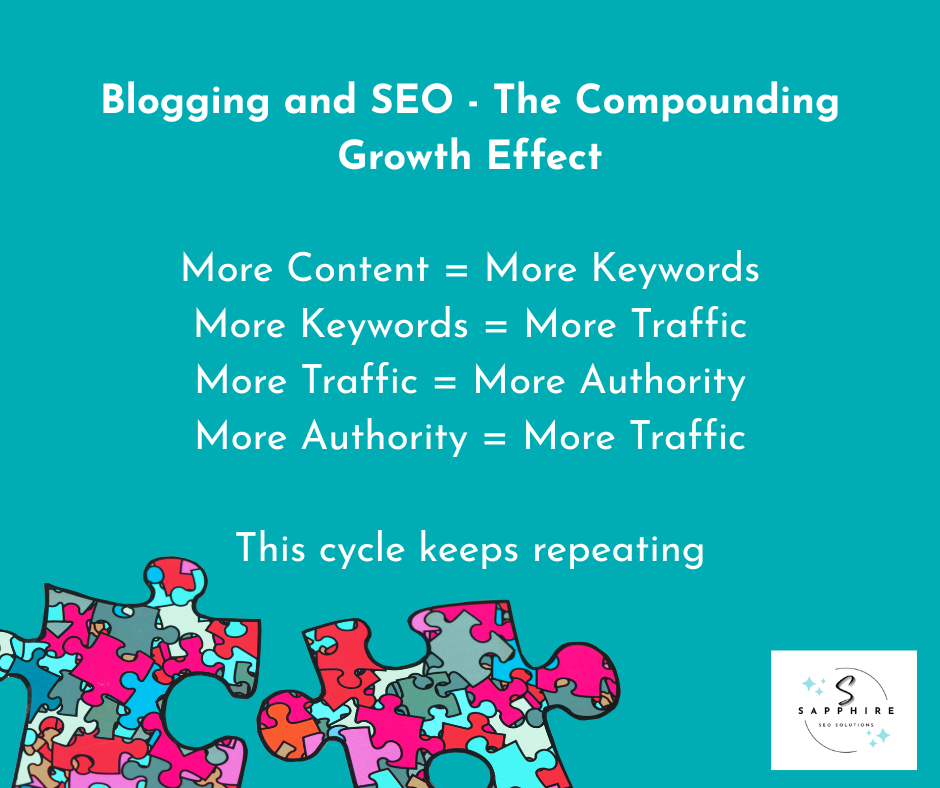
More content means more keywords. Even a single piece of content can rank for hundreds of keyword phrases as it accumulates authority over time. With more keywords getting indexed, every piece of content attracts new searchers, including those using variations of the original search term. That's just one post. Multiply that across an entire content library, and you start to understand the scale of what's possible.
More keywords mean more traffic. More traffic signals to Google that your content is useful and worth showing to more people. Blogging businesses acquire 97% more inbound links than those without blogs, which is a critical factor in building domain authority and improving search engine rankings. More authority pushes your rankings higher. And higher rankings bring in even more traffic, which continues to feed the cycle.
This is why SEO professionals call it the compounding growth effect. Unlike short-term methods such as pay-per-click advertising, blogging for SEO is in it for the long haul, with its benefits growing over time. The more high-quality content you add, the more it boosts your entire site. Think of it like a snowball rolling downhill. The momentum builds slowly, then faster, and then it becomes very difficult for competitors to stop.
The key is helping search engines understand what your site is about at every level. Each blog post you publish helps search engines understand your expertise, your relevance, and your authority in a specific niche. Over time, Google stops evaluating your post by post and starts seeing your site as a whole, trusted resource. That's when rankings across your entire domain start to lift.
When you help search engines connect the dots between your content, your keywords, and your audience, the compounding effect kicks in, and the growth becomes self-sustaining.
Grow Your Business Faster with Sapphire SEO Solutions!
You now know what strategic blogging can do for your business. The question is whether you have the time, tools, and expertise to do it consistently and do it right.
Most businesses don't. And that's not a criticism. Running a business is a full-time job. Adding keyword research, content planning, SEO writing, on-page optimization, and off-page strategy on top of that is a lot to ask of a team that's already stretched thin. When blogging isn't done properly, it doesn't just fail to deliver results. It wastes time and budget that could have gone somewhere more productive.
That's where Sapphire SEO Solutions comes in. Our SEO services are built around one goal: turning your blog into a consistent source of traffic, leads, and revenue. We handle everything from start to finish.
We start with in-depth keyword research to identify exactly what your target audience is searching for. From there, we build a content plan designed around search intent and your business goals. Our SEO writers then create posts that are optimized for both readers and search engines, with proper structure, internal linking, meta descriptions, and everything else that makes content perform. On the on-page side, every post is fully optimized before it goes live. On the off-page side, we work to build the authority your site needs to compete and rank.
Don't let your website stay invisible. Let Sapphire SEO Solutions turn your blog into a traffic and lead-generation engine. Contact us today to get started.
Alternatively, you can order SEO content online. Check out the different content writing tiers before placing an order!

Frequently Asked Questions - Do Blogs Help SEO?
How long does it take for blog posts to rank on Google and bring traffic?
Blog posts typically take 3 to 6 months to start ranking and generating traffic, although low-competition keywords may rank sooner, and highly competitive topics can take 6–12 months or longer. The timeline depends on factors like keyword difficulty, website authority, content quality, and how well the post is optimized for search intent and internal linking.
Is blogging still worth it with AI answers in Google Search results?
Yes, blogging is still worth it because high-quality content is what powers AI-generated answers, featured snippets, and search visibility, even when users don’t click through. Well-optimized blog posts help build authority, increase brand exposure, and drive long-term organic traffic, making them a critical part of modern SEO.
How often should you publish blog posts for SEO results?
Publishing 4 to 8 high-quality blog posts per month is generally recommended for steady SEO growth, but even a few well-optimized posts monthly can deliver results over time. Consistency, relevance, and content depth matter more than volume, and increasing frequency can accelerate traffic and rankings.
Is one blog post per month enough for SEO?
While one blog post per month may be enough to improve SEO if it targets the right keywords, matches search intent, and is properly optimized, the results will grow more slowly compared to a higher publishing frequency. Over time, even a single high-quality post per month can compound into meaningful traffic and rankings.
Can you still compete if your competitors have been blogging for years?
Yes, you can still compete by focusing on long-tail keywords, niche topics, and gaps in your competitors’ content, allowing you to rank faster and build authority over time. A strategic approach that prioritizes depth, relevance, and consistency can outperform older content that is outdated or poorly optimized.
How do you know if your blog is actually helping your SEO?
You can measure whether your blog is helping SEO by tracking increases in organic traffic, keyword rankings, impressions, and engagement using tools like Google Analytics and Google Search Console, which show how users find and interact with your content over time.
How do you know if your blog content is not working?
Your blog content may not be working if it fails to generate traffic, rankings, or engagement after several months, which usually indicates poor keyword targeting, weak alignment with search intent, low content quality, or a lack of proper SEO optimization, such as internal linking and formatting.