

Effective Website Content Copywriting: Tips for Engaging Your Audience
Website content copywriting is a strategic discipline that merges search engine optimization with human psychology to transform casual visitors into paying customers. In today's digital landscape, effective copy must immediately address user intent by aligning messaging with the specific stages of the buyer’s journey—awareness, consideration, and decision. Because approximately 73% of readers skim online content, high-performing website copywriting prioritizes readability through scannable structures and clear value propositions. By integrating established trust signals (E-E-A-T) and personalized calls to action, which have been shown to increase conversions by 202%, businesses can create a digital presence that ranks high in search results while building the long-term authority necessary to sustain growth.
Key Takeaways
High-quality copywriting transforms your website into a powerful sales tool that drives measurable growth.
Strategic copy blends persuasive writing with SEO to answer user questions and encourage specific actions.
Relevant, expert content builds the consumer trust necessary to rank in Google’s top search results.
Short paragraphs and punchy subheadings help capture the attention of the 73% of readers who skim.
High-converting pages eliminate distractions and guide visitors toward a single, benefit-driven call to action.
Your website content copywriting is your most powerful sales tool, but only if it actually connects with your audience. According to 99Firms, readers spend just 37 seconds on an average article, and Wix states that 73% of people admit to skimming rather than reading. That means your website copywriting needs to:
Grab attention immediately
Communicate value clearly
Guide visitors toward action
Effective copywriting isn't just about filling pages with words. It's about understanding what your audience needs, speaking directly to their pain points, and creating content that both search engines and humans love.
Landing pages with clear, concise copy convert better than wordy alternatives, and Sender reveals that personalized calls to action increase conversions by 202%. So, where's the problem?
Well, creating high-quality, conversion-focused content takes expertise, strategy, and time. This is what many small business owners don't have.
That's where we come in. Sapphire SEO Solutions provides affordable website content writing services to small businesses. We specialize in crafting strategic, SEO-optimized copy that drives real results for small businesses. No fluff and no generic content. Instead, we create targeted messaging that speaks to your audience, ranks well in search engines, and turns browsers into buyers.
In this comprehensive guide, we'll cover everything you need to know about effective website content copywriting, including the following:
What is website copywriting?
How to know your audience and build a brand
How to craft compelling website content
Top content writing best practices
Frequently asked questions
Understanding Website Copywriting
While website design is important, content is even more crucial. This is because it drives engagement, builds trust, and turns visitors into customers. The caveat? Your content should be strategic, following a thought-out plan.
What Is Website Copywriting?
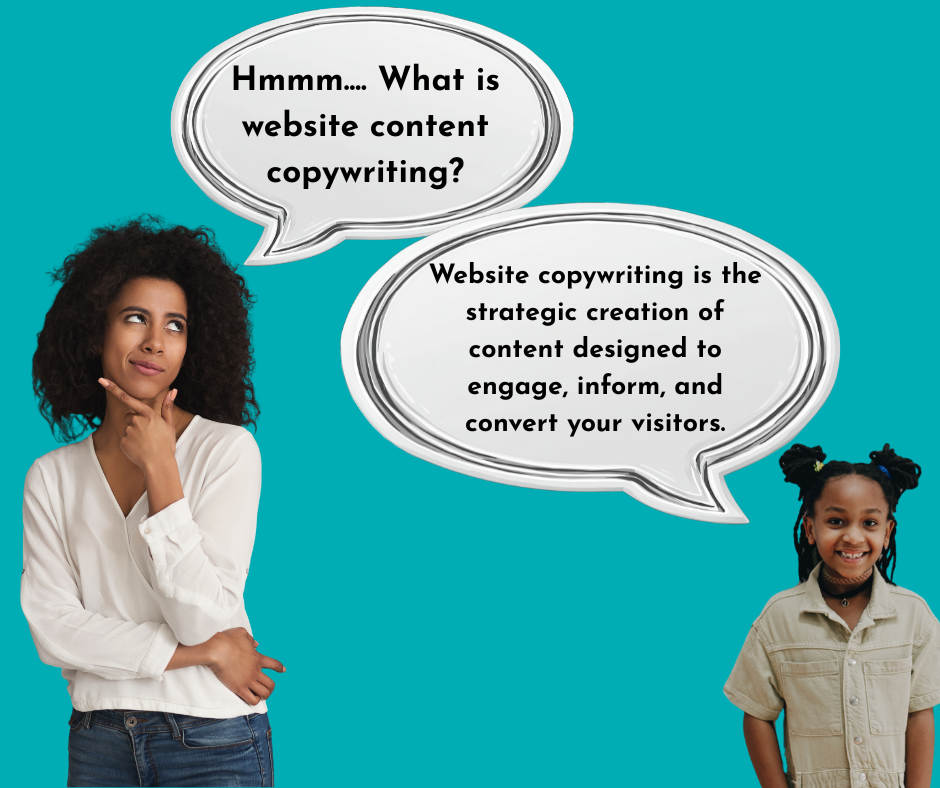
Website copywriting is the strategic creation of content designed to engage, inform, and convert your visitors into paying customers. It's not about filling up a page with words. It's about crafting messaging that speaks directly to your audience's needs while guiding them toward specific actions.
So what makes copywriting different from general content creation?
Website copywriting services blend persuasive writing, SEO optimization, and user experience principles into one cohesive strategy.
You're not just trying to write copy that sounds good. You're creating content that makes people do something, whether it's filling out a contact form, scheduling a call, or making a purchase.
Effective website copy aligns your messaging with your business goals and your audience's search intent. When someone lands on your site looking for a solution, your content should immediately answer their question and show them the next step.
Professional website copywriting services typically include:
Content strategy development
SEO keyword research
Actual writing and editing
Continuous refinement based on performance data
We’ve explained what website content writing is in detail in our comprehensive guide. Make sure to read “What Is Website Copywriting?” for more information on the topic.
Benefits of Good Website Content
Want to know why investing in quality content actually matters for your bottom line?
High-quality content increases engagement by giving visitors exactly what they're searching for, which directly reduces bounce rates. When people find value immediately, they stick around.
But the benefits go far beyond keeping people on your site longer.
Good content builds trust and establishes your brand as an authority in your industry. Research shows that high-quality, E-E-A-T, relevant content is more likely to rank in Google's top ten results, which means more visibility for your business without paying for ads.
Your content doesn't just attract visitors. It drives qualified traffic that's actually interested in what you offer. This translates to higher-quality leads who are further along in their buying journey and more likely to convert.
Quality content also supports your long-term content marketing and sales efforts. Unlike paid advertising that stops working the moment you stop paying, strong content continues attracting and converting visitors months or even years after publication.
Content with 3,000+ words gets 3x more traffic according to Search Atlas, and refreshing old posts can increase traffic by 260.7% (Backlinko). That's compounding success you can build on.
To learn more about content refresh and its benefits, we’ve got just the guide for you: Content Refresh Strategy - How Updating Old Blogs Boosts SEO Fast!
While you can use AI to craft content, it should have a supportive role. You need to edit, refine, and polish the content according to your niche, audience, and brand. To learn more about AI writing tools and whether you should use them, check out our comprehensive guide on "Does AI Content Hurt SEO?"
Understanding Your Audience and Brand
You can't write effective website copy for everyone. The brands that connect deeply with their audience understand exactly who they're talking to. They shape every word around that knowledge.
Your brand voice isn't just about sounding professional. It's about resonating with the right people at the right time.

How to Know Your Audience
Who are your ideal clients? If your answer is "anyone who needs my services," you've already lost half the battle.
Understanding your audience means diving deeper than basic age and location data. You need to explore their psychological characteristics, values, and behavioral patterns. Demographics tell you who your customers are, but psychographics reveal why they buy.
Start by identifying your target demographics, psychographics, and behaviors. What keeps your readers up at night? What objections stop them from buying?
Cross-Border Magazine reveals that over 40% of consumers will unfollow brands whose values don't align with their beliefs. This means that understanding motivations isn't optional anymore.
Map out where your audience is in their buying journey, because someone just discovering their problem needs completely different content than someone ready to make a purchase.
And here's what separates amateur copy from professional work: addressing search intent. Are your readers looking for information, trying to navigate to a specific page, or ready to complete a transaction?
Successful audience segmentation involves quantitative demographic data and qualitative psychographic insights gathered through:
Interviews
Surveys
Analytics
When you write copy that speaks directly to where someone is mentally and emotionally, you create content that feels personal, relevant, and solution-oriented.

Align Copy with the Buyer's Journey
Want to know why your content isn't converting? You're probably asking for the purchase before building the relationship.
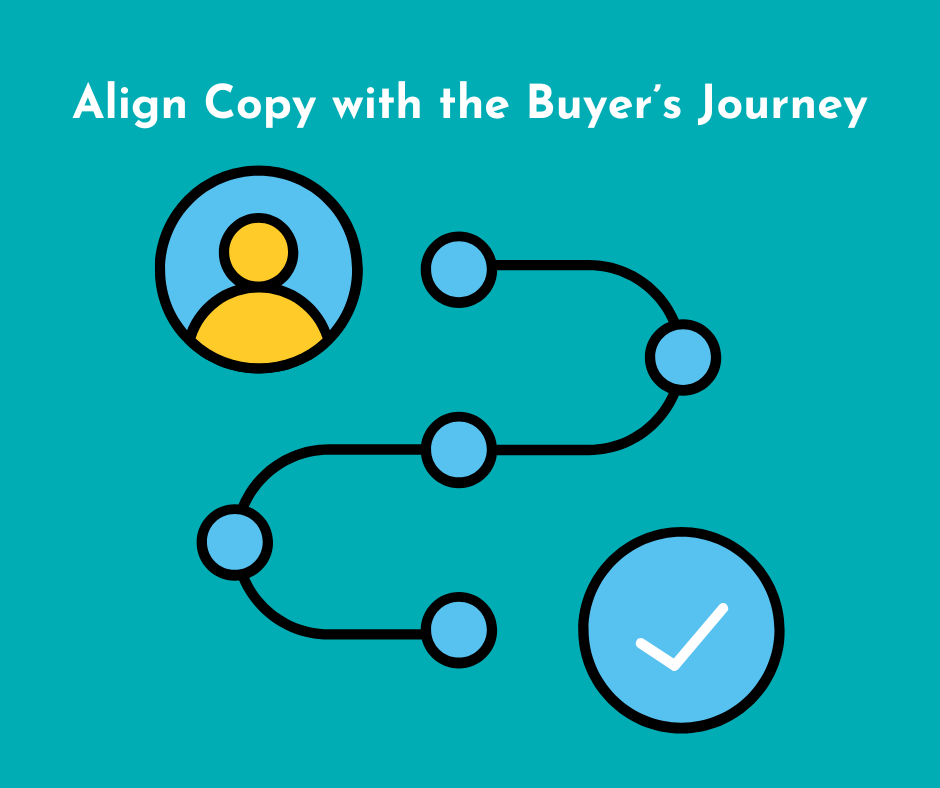
The buyer's journey consists of three critical stages (awareness, consideration, and decision), and each requires distinct content approaches. Trying to push someone to sign your inquiry form when they're still figuring out their problem is like proposing on a first date.
At the awareness stage, your content should educate and help prospects identify their problem. Think blog posts, guides, and informational content that builds trust without any hard sell.
During the consideration stage, shift to solutions, benefits, and differentiation. Show them why your approach works better. Middle-funnel content needs to strike a balance between providing valuable information and subtly promoting your brand. This is where comparisons, case studies, and detailed service explanations shine.
Then comes the decision stage: proof, guarantees, and clear CTAs that encourage action. HubSpot says that businesses that excel at lead nurturing generate 50% more sales-ready leads at 33% lower cost.
But here's the key: ensure each page on your site serves a clear purpose in the funnel. Your homepage shouldn't read like a product page, and your blog posts shouldn't feel like sales pitches. When you align content with the buyer's actual journey, conversions follow naturally.
How to Build and Maintain a Strong Brand Voice
Your brand voice is how people recognize you before they even see your logo. According to Templafy, consistent brand representation can increase revenue by 23-33% and quadruple visibility. Yet most businesses wing it, letting different team members write in completely different styles. That inconsistency confuses your audience and dilutes your story.
Define your tone, voice, and personality guidelines. Then document them. Is your writing style professional and authoritative, or friendly and conversational?
The Consumer Data Platform Institution reveals that 81% of consumers need to trust a brand before buying, and an inconsistent brand voice undermines that trust.
Your voice should reflect your company's values, mission, and positioning while differentiating you from competitors.
When Mailchimp writes with quirky humor, or Patagonia communicates with environmental urgency, you know exactly who's speaking.
Maintain consistency across all website pages and touchpoints. Every email, social post, and landing page should sound like it comes from the same company. This doesn't mean being robotic. Your tone can flex for different situations while your core voice stays constant.
Envive says that 95% of organizations have brand guidelines, but only 25-30% actively use them. Create your style guide, make it accessible, and actually follow it. That consistency reinforces recognition and builds the emotional connection that turns casual visitors into loyal customers.
How to Craft Compelling Website Content
Content creation isn't just writing. It's strategic marketing. Every word you publish should move your business forward, whether that means generating leads, making sales, or establishing authority. The process matters as much as the final product. Create content with intention, not just to fill space.
Here's what's important:
Strategic Website Copywriting
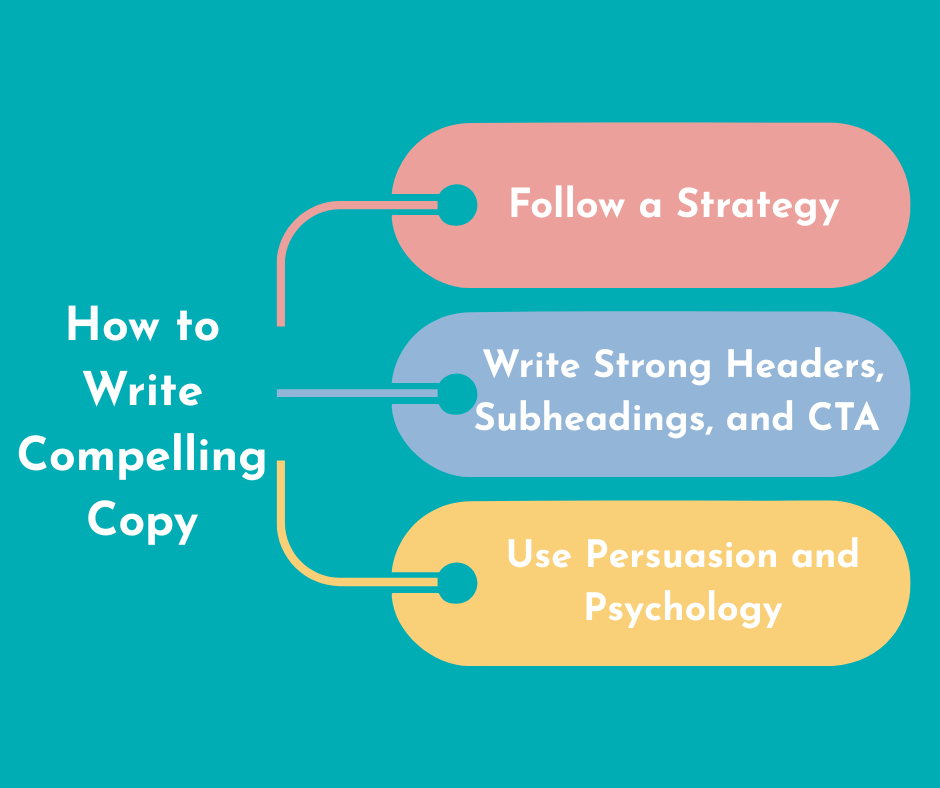
What's the goal of your homepage? What about your service pages? Conversion copywriting focuses on crafting persuasive content that motivates visitors to take specific actions like making purchases, signing up for newsletters, or filling out forms.
Set clear goals for each page, such as lead generation, sales, and education, before you write a single word. When you know where you're taking visitors, you can structure content to guide them logically from awareness to action.
But here's where most businesses stumble: they either optimize for search engines and sound robotic, or they write beautifully, and nobody finds them.
Successful content requires researching target keywords and then seamlessly blending them within persuasive copy that emphasizes solutions to customer pain points. Balance SEO optimized content with natural readability. Your copy needs to rank and resonate.
And stop listing features like they're impressive on their own. Focus on benefits and the actual outcomes your customers care about.
Benefits-focused copy like "We help businesses grow with proven digital strategies" works better than feature-heavy descriptions.
Address objections proactively within your copy, too. If people hesitate because of price, timing, or trust issues, tackle those concerns head-on before they become reasons to bounce. Conversion-focused writing anticipates questions and answers them before they're asked.
Writing Strong Headlines, Subheadings, and CTAs
Your headline has one job: make people read the next sentence. According to Wisernotify, headlines with clear CTAs increased click-through rates by 161% compared to those without CTAs in one marketing study.
Headlines should clearly communicate value and relevance. They shouldn't include clever wordplay that leaves readers guessing. Tell your audience exactly what they'll get and why it matters.
Subheadings aren't decorative. They improve scannability and guide users through your content. Headlines should be punchy and to the point, ideally within 6-12 words for both desktop and mobile responsiveness.
Break up text so readers can find what they need fast. When 73% of people skim rather than read, subheadings become your point navigation system.
Good copy lives or dies on its CTAs. Unbounce simply switched button copy from "Start your free 30-day trial" to "Start my free 30-day trial," increasing click rates by 90%, nearly doubling revenue with one word.
CTAs should be action-oriented, specific, and benefit-driven. "Get Started" is vague; "Get Your Free SEO Audit" tells readers exactly what action to take and what they'll receive.
Use urgency and clarity without being pushy. Phrases like "Offer ends soon" or "While supplies last" trigger FOMO and drive immediate action. The idea is to motivate, not manipulate.
Test CTA placement and wording for performance. AdEspresso mentions that when CTAs looked like buttons instead of plain text, one company saw conversion rates increase by 45%.
Small changes in engaging elements like color, position, or phrasing can dramatically impact results.
Using Persuasion and Psychology in Copy
Want to know what actually drives conversions? It's not just good writing. It's understanding human psychology.
Dr. Robert Cialdini's principles of persuasion include reciprocity, commitment, social proof, authority, liking, scarcity, and unity, all of which influence purchasing decisions. These aren't manipulation tactics. They're recognition of how people naturally make decisions.
Leverage social proof through testimonials, reviews, and client logos. According to Power Reviews, 97% of customers admit that previous customer ratings influence their purchase decisions. When prospects see that others trust you, they're more likely to trust you too.
Real reviews with specific results beat generic praise every time. For example, "This service increased our leads by 150%" carries more weight than "Great service!"
Use emotional triggers, such as fear, desire, and curiosity, strategically to motivate action. When people perceive something is in short supply, they act quickly to get it.
Apply principles like scarcity, authority, and reciprocity throughout your copy. Limited-time offers create urgency. Expert credentials build authority. Free resources establish reciprocity. These aren't tricks. They're honest signals that help people make confident decisions.
Build trust through transparency and clarity. When people are uncertain about what to do, they look to others' behavior for reassurance. Be upfront about pricing, processes, and what customers can expect. The more transparent you are, the more trust you build.
And trust is what turns browsers into buyers. It's always a win-win for you and your customers. They get confidence in their decision, and you get their money because they're happy to pay for solutions they believe will work.
Types of Pages on Your Site and What Approach to Use
Not all pages on your site perform the same function. So why would you write them all the same way?
Each page type needs strategic copy tailored to its specific purpose. A skilled website copywriter understands these nuances and crafts messaging that guides visitors exactly where they need to go.
Homepage Copywriting
Your homepage gets hit with traffic from everywhere, including direct traffic, Google searches, social media, and ads. Homepage copy should be concise, engaging, and persuasive, highlighting your unique value proposition and compelling visitors to explore further. That means you have seconds to answer three critical questions:
Who are you?
Who do you help?
How do you help them?
Clearly communicate who you help and how right at the top. The most effective value propositions directly contrast typical pain points and position their service as the superior solution.
Don't bury your value proposition three scrolls down. Present a strong value proposition above the fold. Your homepage heading should relate back to your readers and the purpose of your website, using your value proposition, asking a relevant question, or using a CTA.
Guide visitors to key actions quickly. The best homepages lead with their strongest, most specific information and include pertinent details rather than generic "Contact Us" buttons.
Whether that's booking a consultation, browsing services, or downloading a guide, make the next step obvious. Reinforce trust and credibility through search engine visibility by including social proof, credentials, or client logos.
Your homepage needs to work hard because it's often the first and sometimes only impression you'll make.
Service and Product Pages
Your product descriptions and service pages need to do more than list what you offer. Effective product pages answer potential customers' biggest objections to make it easier for them to click the buy button.
Focus on outcomes and benefits. What changes for your customers after they work with you or buy from you?
When writing product descriptions, consider the benefits of each feature: How can your product make customers' lives better, easier, or more enjoyable?
Address FAQs and objections directly within your copy. If pricing is a concern, explain your value. If trust is an issue, highlight guarantees or certifications.
Detailed and accurate descriptions demonstrate credibility and encourage customers to add items to their cart. Don't make people hunt for answers. Anticipate their questions and handle them head-on.
Use clear structure and persuasive CTAs throughout. Strategic design details like drop-down menus can provide detailed insights without making the page too text-heavy.
Break up information with bullet points, use descriptive headings, and place CTAs where they make sense naturally. Highlight differentiators and expertise that set your business apart.
What makes your approach unique? Why should someone choose you over the competitor they're probably also considering?
Landing Pages and Conversion Pages
Landing pages have one job: convert traffic into action. Landing pages should eliminate all distractions and give people ONE THING to do. Not 2, not 3, not 10 things to do.
Single goal equals minimal distractions. Backlinko states that the median landing page conversion rate across industries is 6.6%, with persuasive copywriting ranking as the second most important factor for conversion after clear CTAs.
A strong headline, supporting copy, and CTA form your conversion trinity. Your visitors should know within seconds exactly what you're offering and why they need to care. If they don't, they're likely to bounce.
Your headline does the heavy lifting, the body copy removes objections, and your CTA seals the deal. This structure makes the landing page's job a lot easier when everything works together.
Reinforce urgency and value without being pushy. Keywords Everywhere reveals that landing pages with social proof convert 1.1% better than those without, and focusing on a single main CTA boosts conversions.
Use limited-time offers, testimonials, and clear benefit statements that make action feel natural. And here's what's important: align copy tightly with your traffic source.
Matching landing page messaging with ad copy directly affects Quality Score and reduces bounce rates because visitors find exactly what they expect.
If your ad promises a free audit, your landing page better launch with that free audit front and center. Not buried under generic messaging.
Content Writing Best Practices: What You Need to Know
Your writing sets the tone for everything else. Poor quality shows up immediately. Awkward sentences, confusing structure, text that doesn't flow. But excellent content? That's when your ability to connect with readers transforms casual browsers into engaged prospects who actually want to hear what you have to say.
Writing for Readability and UX
Can your readers actually read what you've written? People usually don't actively read text. They passively scan in an F-shaped pattern until something catches their attention.
Use short paragraphs and sentences to make scanning easier. A common practice is using a 16-pixel font size for body text and keeping sentences to 35 words or fewer. Dense blocks of text exhaust people before they even start reading.
Break content into scannable sections with descriptive subheadings. Users won't read web content unless the text is clear, the words and sentences are simple, and the information is easy to understand.
Use bullet points and white space strategically, not excessively, but enough to let your content breathe. Negative space is a kind of breathing room for all objects on the page, helping establish connections between text and non-text elements.
Write in plain, clear language that gets straight to the point. Mobile screens are small and vary in size, so you need legible font sizes, contrast between text and background, and left-aligned text.
Optimize for mobile readers. Effective mobile UX design prioritizes simplicity, clarity, and accessibility to enhance user satisfaction. Exploding Topics reveal that over 60% of web traffic comes from mobile devices. If your content isn't relevant and readable on a phone, you're losing more than half your audience.
Content Creation and Optimization Best Practices
Professional writers understand something amateurs miss: conversational doesn't mean sloppy. Using active voice is clear and to the point, while passive voice makes sentences feel more complicated and harder to understand.
Use a conversational, human tone that sounds like you're actually talking to someone. Short sentences, second-person "you," and simple words create a conversational tone that helps readers feel personally addressed.
Write in active voice whenever possible. "We help small businesses grow" beats "Small businesses are helped by us." Active voice feels natural because it's how we actually speak in everyday conversations.
Avoid jargon unless your audience genuinely uses those terms themselves. Mailchimp's brand voice prioritizes plain English because they understand marketing technology is a minefield of confusing terminology. If you wouldn't say it to a friend, don't write it on your website.
Update content regularly to maintain relevance and freshness. Search is moving to a more conversational format with AI overviews, making natural language increasingly important for SEO. Outdated information damages trust faster than almost anything else.
Ensure accessibility and inclusivity throughout your content. Following Web Content Accessibility Guidelines (WCAG) helps designers create more inclusive and user-friendly experiences. Accessible websites improve user experience for all users, not just people with disabilities, leading to higher engagement and brand loyalty.
Professional writers know that inclusive design isn't optional. It's smart business that expands your reach while demonstrating social responsibility.
For more details on the best practices of search engine optimization, check out our detailed guide on “Best Practices for Search Engine Optimization (2026).”
How to Optimize Website Copy for SEO
SEO isn't optional anymore. It's how customers find you. Your website copy can be beautifully written, but if nobody can search and discover it, you're invisible. Demandsage reveals that SEO drives 1000% more traffic than organic social media. Smart businesses optimize for both humans and search engines simultaneously.
SEO Copywriting Essentials You Need to Know
Start with keyword research based on search intent, not just popular terms.
Keyword research goes beyond finding popular search terms. It's about understanding the intent behind searches, whether informational, navigational, transactional, or commercial.
Tools like SEMrush and Ahrefs reveal what your audience actually types into Google. But here's what matters: focus on keywords that reflect user intent and are relevant to your niche. Long-tail keywords convert better because they're specific. For example, "affordable SEO services for small businesses" beats "SEO" every time.
Strategic keyword placement makes or breaks your SEO optimized content. Use focus keywords in your meta title, meta description, header tags, page copy, and image alt tags.
Place your primary keyword in the H1, sprinkle variations naturally throughout body copy, and integrate related terms in subheadings.
Want to know how many keywords you should use per article? Read our comprehensive guide on “How Many SEO Keywords Should I Use?” for detailed information.
Optimize title tags and meta descriptions. They're your first impression in search results. The title tag is a heavyweight contender in SEO because search engines give it a slight edge by weighing the words used within it more heavily, and it's what users see on search results.
Keep meta descriptions under 160 characters (including spaces), and if the search keyword matches part of the meta description, Google highlights it in the results.
Use internal linking to support topic authority and help search engines understand your site structure. Internal linking helps Google understand how your website is structured and which pages carry the most importance.
Link from high-authority pages to newer content you want to rank. Use keyword-rich anchor text for internal links to optimize pages for target keywords, and link deeper pages to more authoritative pages like the home and category pages.
Structure content for featured snippets by answering questions directly and concisely. Most featured snippets have a length of 40-50 words, and using the inverted pyramid structure (answering the most important part first) helps optimize for position zero.
Use lists, tables, and clear headings that mirror actual search queries. Your blogs and other content should target specific questions people ask Google. SEO-optimized content wins when it provides exactly what searchers need.
How to Measure Success and Improve Website Copy
How do you know if your copy actually works? KPIs in web analytics are specific, pre-defined values that allow you to measure and manage your website or application's performance.
Success isn't about gut feelings. It's about data. Track the right metrics, and you'll spot exactly where your traffic converts and where it drops off. Your expertise grows when you let numbers guide your decisions instead of assumptions.
Tracking Performance and KPIs
Monitor traffic, engagement, and bounce rates to understand how visitors interact with your site. Website pageviews are one of the most important KPIs to track. A drop in pageviews could mean your search engine optimization or traffic campaigns are weakening
If all your pages have a high bounce rate, it typically suggests that your page isn't relevant to searchers. These metrics reveal whether your content delivers what people expect.
Track conversions and goal completions. These are the KPIs that actually affect your bottom line. Conversion rate measures the percentage of people who convert from an advertisement or piece of marketing compared to everyone who saw the materials.
To ultimately determine whether your time and effort invested in attracting leads are paying off, you must break down the conversion rate into the traffic-to-lead ratio and the MQL-to-SQL ratio. Every case study you create, and every example you publish, should connect back to measurable goals.
Analyze keyword rankings and visibility to see if your SEO efforts pay off. Traffic is one of the most crucial KPIs to track in SEO, as it's a measure of how many visitors your website receives.
Use heatmaps and session recordings to understand actual user behavior, not just what you think people do on your site. These insights add context to your KPI data, helping you make more informed decisions.
Tools like Hotjar reveal where users click, scroll, and abandon your pages. Of course, raw data only helps if you know how to interpret it and take action.
Continuous Optimization and A/B Testing
Testing isn't a one-time event. It's an ongoing process. Even incremental improvements to your CTAs will compound into major gains over time.
Test headlines, CTAs, and page layouts systematically. The headline of your landing page is one of the most important components for conversion rate optimization.
At HubSpot, they tested bolding anchor text CTAs, making them larger, and changing the color. After several rounds of iterative tests, they increased leads from the blog by 10%.
Use data to refine messaging and optimize what actually matters. Testing is the only way to find out what resonates for your specific audience, products, and brand. Without careful testing, you're running campaigns on assumptions.
Only test one variable at a time. If you change the copy, color, and placement all at once and see a lift in conversions, you won't know which factor was responsible for the increase.
Iterate content based on user behavior and performance data. GrooveHQ, a helpdesk software company, increased conversions by over 100% by split testing their design and sales copy.
Look for patterns and insights that can inform your future copywriting efforts. Which approaches garnered the most clicks or conversions?
Treat copywriting as an ongoing process of continuous improvement. Set up rolling A/B tests for your main CTAs, running new variations every 2-4 weeks to adapt to changing market conditions and user preferences. The moment you stop testing is the moment your competitors start catching up.
How to Edit and Refine Website Copy
Editing separates amateur content from professional work. Your first draft is never your best draft. Even the strongest writers need to refine, tighten, and polish before hitting publish.
Reading with a close eye after taking time away from your draft helps catch problems your initial review might miss. Quality doesn't happen accidentally.
Content Review and Quality Control
Check for clarity, grammar, and flow as your foundation. Good sentence structure ensures clarity of thoughts and improves coherence, while vocabulary choices should acknowledge your target audience.
The 4Cs of editing require making your content clear, concise, consistent, and creative, eliminating jargon, complex sentences, and unnecessary details that confuse readers. Your ability to self-edit determines whether people actually read what you've written or bounce immediately.
Ensure alignment with your brand voice across every page. When brand voice lacks consistency, you confuse your audience, dilute brand identity, and undermine the trust you're trying to build. Yet 81% of consumers need to trust a brand to consider buying.
Whether writing for social media, website copy, or customer emails, a consistent tone reinforces your brand's identity and makes it easier for audiences to recognize and remember you. Every sentence should sound like it came from the same company.
Remove fluff and unnecessary repetition ruthlessly. Fluff includes any word, phrase, or sentence that doesn't add value, meaning, or information. It includes filler words, weak adverbs and adjectives, jargon, clichés, and repetitions.
Weak verbs and adjectives sap strength from your writing, while words like "really" and "very" usually precede weak adjectives that need replacing. Good copy earns every word.
Optimize for both users and search engines by maintaining natural readability while strategically placing keywords. Manual editing and technical proofreading remain essential. Nothing beats reading content with your own eyes to spot errors and get original ideas for improving readability, variety, and overall flow.
Tools help, but professional judgment separates mediocre content from exceptional work.
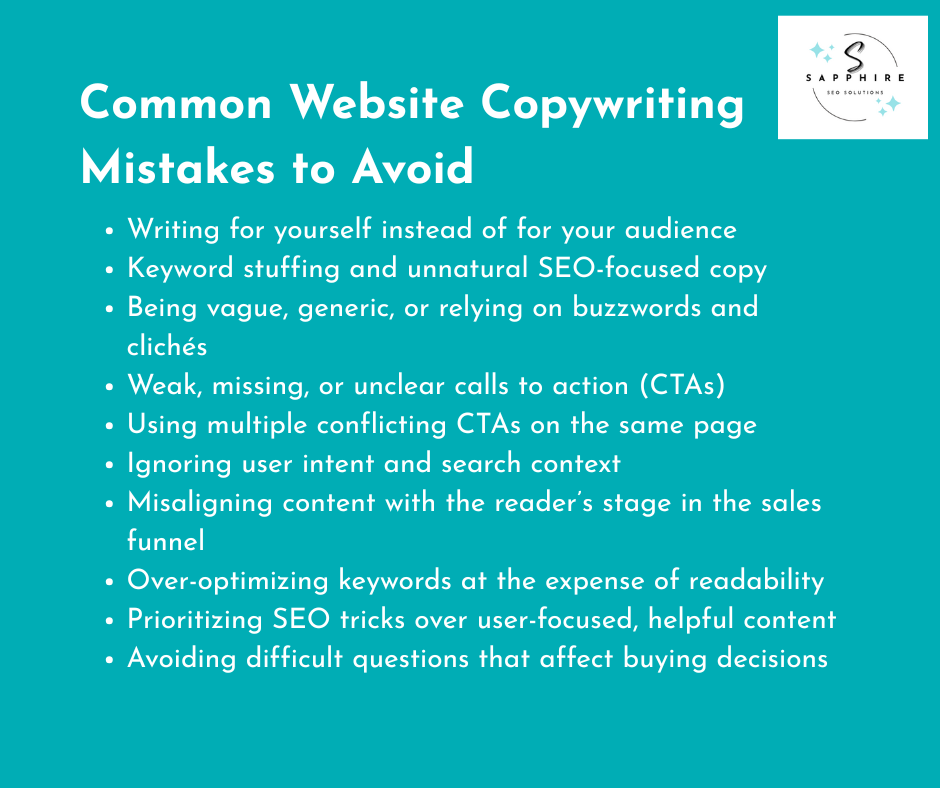
Common Website Copywriting Mistakes to Avoid
Even experienced writers make these mistakes. Your copywriting can follow every best practice and still fail if you commit these fundamental errors. The difference between content that converts and content that bombs often comes down to avoiding a few critical pitfalls.
The most obvious yet often ignored mistake: crafting content that makes sense to you rather than to the audience you need to engage. Writing for search engines instead of humans creates robotic, awkward copy that nobody wants to read.
Keyword stuffing makes text harder to read and significantly detracts from the user experience. This black-hat SEO tactic now leads to penalties from search engines. Sure, you need keywords for SEO, but the moment your copy sounds unnatural, you've crossed the line.
Being vague or overly generic kills engagement fast. Bad copywriting lacks compelling calls to action and often resorts to buzzwords or clichés instead of delivering authentic, meaningful content.
When you write "We provide quality services" or "We're industry leaders," you're saying nothing. Write to a specific target audience, and ONLY write for them to make your copy more persuasive and interesting to the people who matter most. Generic content speaks to everyone, which means it connects with no one.
Ignoring CTAs or user intent leaves money on the table. Including several CTAs on one page that lead to different actions confuses readers. They won't understand what to do.
Give them one clear path forward. And if your content doesn't match what people actually searched for, they'll bounce immediately. You need to understand where readers are in the sales funnel, their awareness level, skepticism, and motivation, to choose the right copywriting technique and proper calls to action.
Overloading pages with keywords is the fastest way to tank your rankings. Google defines keyword stuffing as filling a web page with keywords unnaturally or out of context, often appearing in lists or groups.
Major algorithm updates like Panda have increasingly focused on rewarding high-quality, user-centric content over manipulative SEO tactics. Use keywords strategically, not obsessively.
In March 2024, Google integrated its helpful content system into core ranking systems, making user-focused quality a constant requirement for optimal search performance.
Failing to address objections is like ignoring the elephant in the room. If your copywriting is all about yourself rather than conversing with your audience, you leave a lot of conversions on the table.
Why do people hesitate to buy? Too expensive? Not sure if it works? Worried about implementation? Answer these concerns directly in your copy. When you pretend objections don't exist, prospects assume you're hiding something.
Our “Small Business Content Writing for SEO: Mistakes Small Businesses Make” guide covers all of the common mistakes business owners make and how you can avoid them. Make sure to give it a read for expert insights.
Is Website Content Copywriting DIY or Outsourced?
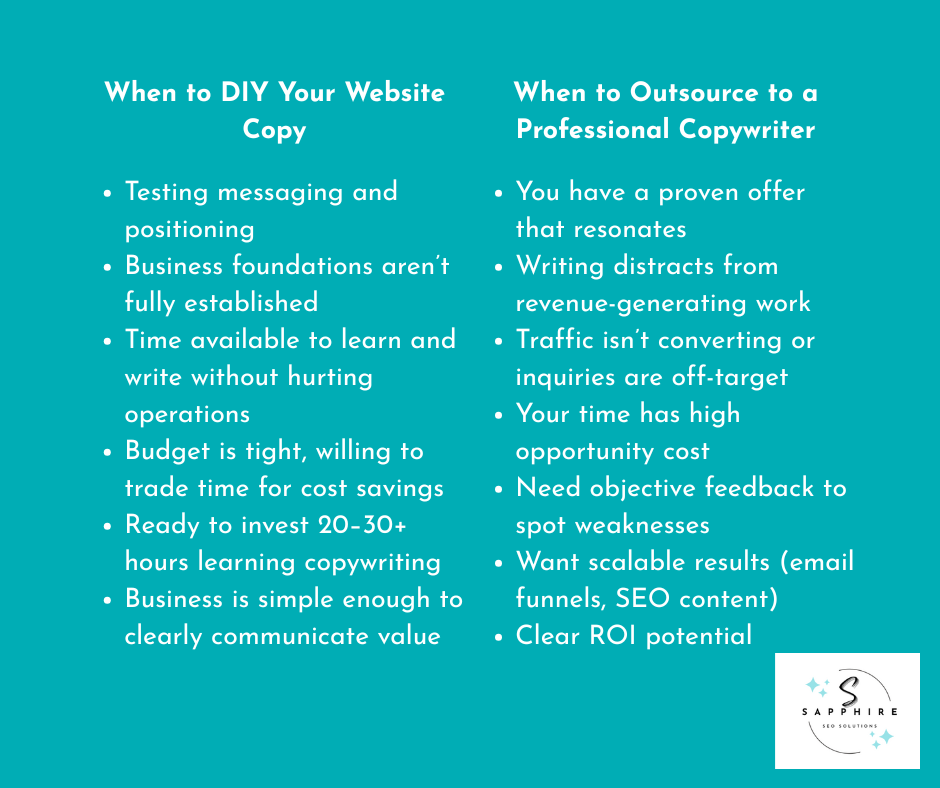
Should you write your own website copy or hire a copywriter? A copywriter can only work effectively when certain foundational aspects of your business are already in place.
Outsourcing too early can put you at financial risk if certain elements aren't yet consistent. The right answer depends on where your business stands today. This isn't a one-size-fits-all decision.
Writing in-house gives you complete control over every word and costs nothing upfront. Many business owners think they can figure out copywriting themselves to save money. You know your business better than anyone, and you understand your goals intimately.
But here's the reality: Writing effective copy is time-intensive and can pull you away from more important business tasks like managing employees or running your business. If you're busy with other responsibilities, outsourcing your copy makes more sense so your time can be better spent elsewhere.
Time, skill, and strategic limitations become obvious fast when you DIY. If you charge $100 an hour for your time and spend 20 hours learning copywriting plus 10 hours writing your first draft, you've already invested $3,000 of opportunity cost.
Many businesses highlight their strengths while overlooking their weaknesses due to a lack of objectivity. This often results in content that fails to achieve its marketing objectives. You might be an expert at your craft, but that doesn't automatically translate to being an expert copywriter. These are different skills.
When does outsourcing make more sense? If writing is eating into the time you could be spending on client work, sales, or respite, then outsourcing makes complete sense.
If you're getting tons of traffic but that traffic just isn't converting, or you're getting loads of inquiries that just aren't aligned, hiring a copywriter becomes essential.
If your business has at least one proven offer that resonates with your audience, it's a strong sign that hiring a copywriter could be beneficial. You've validated your market. Now it's time to scale with professional job-ready copy.
Consider ROI when making this decision. Companies that invest in copywriting see an impressive increase in click-through rates.
A strategic email funnel can make you money on autopilot for years, a stellar website can generate new leads on autopilot for years, and an optimized blog post can build your search authority and drive traffic for years.
When you hire a copywriter, you can see if the money you've made has increased as a result of hiring them, and if it covers the cost of their rate. But if you're just starting out and still figuring out your messaging? DIY makes sense until you have clarity worth investing in.
Make sure to read our comprehensive guide on “SEO Content Writing Agency vs. Freelancers: Which Is Best?” Here, we get into incredible detail about the benefits of working with a freelancer and an SEO agency, and which one you should choose.
What Do Website Content Copywriting Services Include?
Not all copywriting services are created equal. Some agencies hand you generic templates while others build custom strategies from scratch. The most in-demand copywriting services include emails, websites, SEO, direct response advertising, and landing pages. Understanding what's actually included helps you evaluate whether you're getting real value or just paying for words on a page.
Here's what's often included in copywriting services from reputable agencies like Sapphire SEO Solutions:
Developing a Strategy
Content strategy and planning form the foundation of effective services. Customized copywriting services increasingly include conducting keyword research, competitive analysis, audience profiling, and developing diverse marketing content tailored to specific business needs.
Professional agencies start by understanding your business goals, target audience, and competitive landscape before writing a single word. From blogs to emails to social posts to video scripts, comprehensive services deliver all the content needed to truly connect with your ideal customers.
Keyword Research and Optimization
SEO research and optimization should be baked into every piece of content. Blog content services often include end-to-end solutions from competitor research to content creation and link building. This means keyword research based on search intent, strategic placement throughout copy, meta tag optimization, and internal linking strategies. Without SEO integration, your beautifully written copy sits invisible in search results.
Different Types of Content Needs
Page-specific copywriting covers everything from homepages and service pages to landing pages and promotional emails. Services typically include blog posts, website content, e-commerce copy, and SEO content delivered using content credits.
Copywriting also encompasses branding materials like social media posts that help establish your company as a subject matter expert. Each page type requires different messaging strategies. Your homepage isn't your sales page, and your email campaigns need different approaches than your product descriptions.
Editing and Revisions
Editing, revisions, and optimization ensure your copy actually performs. Quality services include two rounds of edits with finished products delivered within specified timeframes. Premium services provide unlimited content requests and limitless revisions with quick turnarounds.
Performance Analysis and Refinement
Performance analysis and refinement complete the package. Top-tier packages include dedicated account managers, content strategy planning, monitoring, and analytics to track how marketing efforts perform.
Real copywriting services treat your content as living assets that need ongoing optimization, not one-and-done projects.
Benefits of Website Content Copywriting Services
The benefits extend far beyond just having someone else write your content. Professional copywriting services transform how your business communicates with clients and customers.
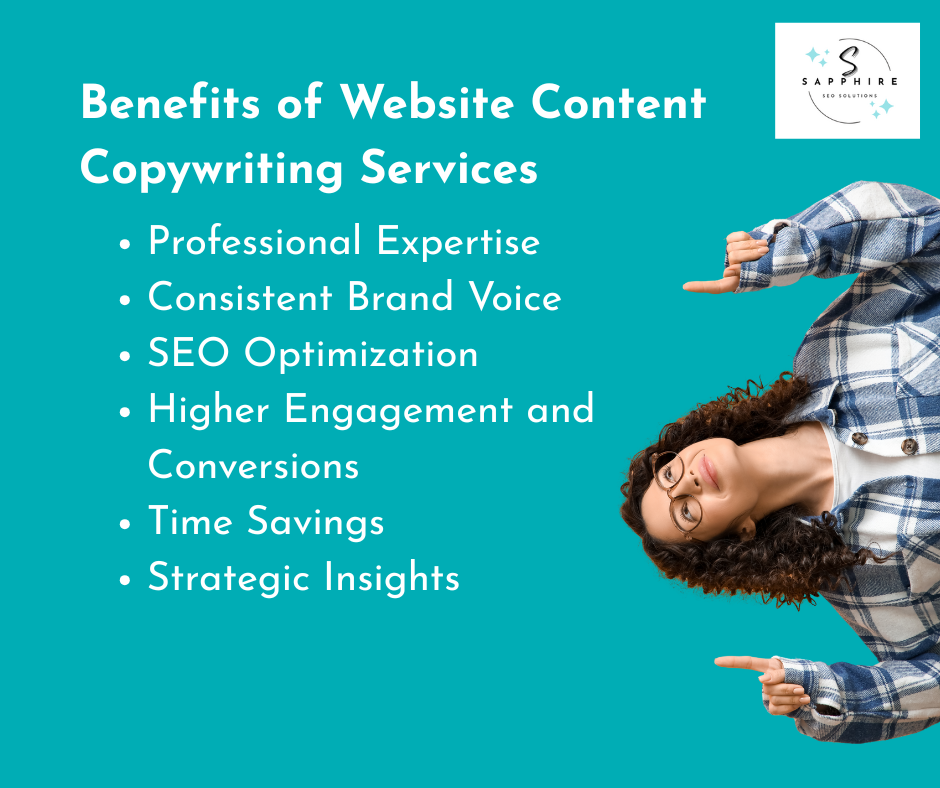
Hiring a copywriter brings professional expertise, time and resource savings, consistent brand voice, SEO optimization, and effective communication to your business. These aren't just nice-to-haves. They're competitive advantages.
Here are some of the benefits of reliable website content copywriting services:
Professional Expertise and Skills
Professional expertise and strategy come standard with quality services. Copywriters are specialists who have strong writing skills cultivated through copywriting courses and years of experience.
A good copywriter knows how to perform research to understand your ideal customer thoroughly. They ask the right questions, identify what resonates with your audience, and craft messaging that actually converts. Professional copywriters understand what your business does, what makes it unique, and how best to explain this in an engaging way that keeps readers interested.
Consistent Messaging
Consistent, conversion-focused messaging across all touchpoints builds trust with your customers. When you hire a copywriter, they'll make sure your brand voice is consistent across all platforms.
With a brand voice guide as their North Star, it'll make the writing process faster, increase your conversion rates, and lower your long-term costs.
Customer-Centric Copy
Copywriters skilled in conversion copy know how to sell without being 'salesy'. They create consumer-centric copy that targets audience needs and ultimately converts. Every page works toward the same goal instead of sending mixed signals.
Search Engine Optimization
Improved SEO and rankings happen when copywriters understand both search engines and human readers. Copywriters act like a compass for your copy, writing the words that rank and convert. Professional copywriters well-versed in SEO optimization can make your content marketing strategy skyrocket by strategically using keywords to boost search rankings.
Good writers have Einstein-level keyword research abilities and on-page SEO expertise that makes any marketer jealous. They know how to satisfy both Google's algorithms and your clients' needs.
Great ROI
Higher engagement and conversion rates deliver measurable ROI. Hiring a copywriter for a $5,000 project who generates $50,000 in more sales represents a 900% return on investment. It's not unheard of for copywriters to bring in hundreds of thousands of dollars for their clients.
Persuasive web copy and ad copywriting can persuade sales prospects to continue through your sales funnel, visit your website, peruse product pages, and make purchases. The numbers speak for themselves.
Time Savings
Time savings for internal teams might be the most immediate benefit you'll notice. Hiring a professional copywriter allows you to delegate the essential yet time-consuming task of content creation, giving you time to focus more on other critical aspects of your business like strategy, operations, and growth.
Professional copywriters work significantly faster than people with less writing experience, crafting great copy in a fraction of the time it would take a business owner or product engineer. Instead of spending hours staring at a blank page, you're running your business while experts handle the words.
Partner with Sapphire SEO Solutions for Results-Driven Website Content Copywriting Services
Your website deserves copy that actually works, not generic templates or keyword-stuffed fluff. At Sapphire SEO Solutions, we create professional content that ranks in search engines and converts visitors into paying customers. Our expertise goes beyond just writing words. We build comprehensive content strategies that align with your business goals and drive measurable results.
Every small business faces unique challenges, and cookie-cutter solutions don't cut it. Our SEO-certified writers take time to understand your industry, competitors, and what makes your ideal customers tick. Then we craft messaging that speaks directly to them while supporting your broader marketing objectives.
Our SEO-driven, conversion-focused copy balances search visibility with persuasive messaging. Through strategic keyword research, competitor analysis, and proven copywriting principles, we create content that attracts qualified traffic and guides visitors toward action. Every page serves a clear purpose in your sales funnel.
Industry expertise and proven results set us apart from agencies that treat all clients the same. We've helped small businesses across various industries increase their organic traffic, improve engagement metrics, and generate more qualified leads. Don't just take our word for it. Check out how our SEO strategist increased a client's organic traffic by 158% in just one month.
Our approach combines technical SEO knowledge with psychological principles that drive conversions because ranking on page one means nothing if visitors don't convert.
Your success matters to us, which is why every client gets a dedicated account manager who understands your business inside and out. No ticket systems or rotating support staff. You work with the same professional who knows your brand voice, goals, and challenges.
Ready to transform your website content into a revenue-generating asset? Contact us to schedule a free consultation with an experienced SEO professional to discuss how Sapphire SEO Solutions can help your small business compete and win online.

Frequently Asked Questions – Website Content Copywriting
How do I balance SEO keywords with natural, engaging copy?
Write your first draft exclusively for the human reader to ensure the narrative flows naturally and maintains an authentic tone. Integrate your primary keyword into the headline and the opening paragraph only after you establish the core message. Use related synonyms throughout your subheadings to provide context for search engines without disrupting the reading experience. This strategy prioritizes search intent and keeps the audience engaged.
What is the difference between features and benefits in copywriting?
Features describe the technical specifications or physical attributes of a product, like its dimensions or processing speed. Benefits explain the specific value or positive change the customer experiences because of those features. Lead with benefits to build an emotional connection with your audience and use features as evidence that proves your claims.
How long should website content be for maximum engagement?
Determine your word count based on the specific intent of the page and the complexity of the topic. Use concise and punchy copy for landing pages to drive immediate action and reduce distractions. Provide deep, comprehensive coverage for educational articles to establish authority and satisfy the user's search query. Focus on delivering maximum value in the fewest words possible to respect the reader's time.
Can I use AI tools like ChatGPT to write my website content?
Use artificial intelligence as a co-pilot to generate outlines, brainstorm headlines, and jumpstart your creative process. Treat AI drafts as raw material that requires significant human editing to inject brand personality and original insights. Verify every fact and refine the tone to ensure your content resonates with your audience and meets high-quality standards.
What is the inverted pyramid style, and why is it used in web copy?
The inverted pyramid places the most critical information at the very top of the page to capture attention immediately. Follow this lead with supporting details and end with general background information for those who want to dive deeper. This structure serves digital readers who scan content quickly by delivering the most important message before they decide to scroll further.
How do I write a call to action that actually converts?
Choose specific, action-oriented verbs that highlight the immediate reward for the user. Replace generic phrases like click here with benefit-driven language such as claim my discount or start my free trial. Design the call to action to stand out visually and tell the reader exactly what result they should expect after they take the next step.
What makes website copywriting effective and engaging?
Effective website copywriting combines deep audience understanding with absolute clarity to move the reader toward a specific action. You must prioritize benefit-driven language that explains exactly how a product or service solves a user's problem. Successful copy also incorporates persuasive elements like emotional triggers to build trust and clear calls to action to guide the journey. By focusing on the user’s needs rather than the company's ego, you create a narrative that holds attention and converts visitors into customers.
How do I write copy that resonates with my audience?
Start by conducting thorough audience research to build detailed buyer personas that reflect your customers’ real-world challenges. Identify their specific pain points and mirror the exact language and tone they use in their daily lives to establish immediate rapport. Focus every sentence on how your offering improves their situation, emphasizing personal benefits over technical features. This tailored approach ensures your message feels like a direct conversation with the reader rather than a generic broadcast.
What are the best practices for SEO-friendly website copywriting?
Balance high-value user information with strategic technical elements to satisfy both human readers and search engine algorithms. Integrate relevant keywords naturally into your headings, subheadings, and meta descriptions without compromising the flow of the prose. Use a clear hierarchy of information and maintain high readability scores to help AI search engines categorize your content. This natural integration demonstrates authority and ensures your page ranks well while remaining genuinely helpful to your visitors.
How can I write compelling headlines and calls-to-action (CTAs)?
Craft headlines that utilize psychological hooks like curiosity, urgency, or a direct promise of value to stop the reader from scrolling. Use active, power-driven verbs in your CTAs to tell the user exactly what they gain by taking the next step. Replace passive phrases with specific outcomes such as "Download Your Growth Plan" or "Join the Community" to create a sense of momentum. Testing different emotional angles helps you identify which specific triggers drive the highest conversion rates for your unique audience.
What format and structure should website copy follow for maximum engagement?
Organize your content into a skimmable layout that accommodates the fast-paced nature of digital reading. Use frequent subheadings, bulleted lists, and short paragraphs to break up large blocks of text and highlight key takeaways. Place the most critical information at the beginning of sections to ensure scanners capture your main message immediately. A clean, well-structured layout keeps visitors on the page longer and significantly improves the overall user experience.
What common mistakes should I avoid in website copywriting?
Avoid using overly complex jargon or academic language that creates a barrier between you and your potential customers. Many writers fail by focusing too much on their own company’s achievements instead of addressing the specific needs and desires of the audience. Steer clear of weak or hidden calls to action and ensure you never sacrifice readability for the sake of keyword density. Correcting these pitfalls prevents user frustration and ensures your copy remains focused on driving measurable business results.