

Many business owners hit the same wall when they start shopping for SEO. Two quotes show up. One is a fraction of the other, and at first glance, they look like they cover the same thing. They usually don’t.
So how do affordable SEO services differ from premium ones? Price is only part of the story. Scope is the work actually included. Quality is how well that work gets done. And value is what you get when you weigh both against what your business needs.
A tightly scoped package, handled by people who know what they’re doing, can hold up just fine. A bigger one can still disappoint. Neither price tag guarantees anything.
That matters for a small business trying to get its business online in front of the right customers. Your digital marketing budget has limits, so the goal is spending it where it counts.
We’ll compare the two side by side, break down what drives SEO pricing, and walk through a simple way to decide what to pay for first.
Key Takeaways
Price, scope, quality, and value are different things. Judge a quote by the work inside it, not the label.
“Affordable” and “premium” are market labels, not official categories, so neither price tag guarantees good or bad work.
Narrowing scope can cut the bill. Cutting corners on the work that remains is the real risk.
Nobody can guarantee rankings, leads, or AI mentions. Google says to walk away from any provider promising first place.
Start with your goal, then fix what’s blocking it. Not every business needs the same service or a big campaign.
Targeted, specific content beats volume. One strong service page may do more than another generic post.
AI search runs on the same basics as Google Search. Google says no special optimizations or files are required.
Get scope, exclusions, and ownership in writing, and keep access to your site and Search Console.
What Is the Difference Between Affordable and Premium SEO Services?
Affordable SEO usually means a focused job at a low cost. Maybe one service page gets rewritten, or a few pages get cleaned up, instead of a full campaign. The scope stays narrow on purpose. Done right, affordable SEO services can be cost-effective because the money goes to the few things that matter most to your business.
Premium SEO services sit at the other end. They cost more, and they often bring more people, more pages, and more back-and-forth with your team. Sometimes a big site needs exactly that. Sometimes it doesn’t.
But neither label is official. No rulebook says what an affordable SEO package has to include, or what expensive SEO has to do. They’re just words agencies use. So affordable SEO can be sharp, focused work, and a pricey package can be padded.
The two tend to differ like this, though every provider is different:
Affordable SEO vs. Premium SEO
| Area |
Affordable
Focused Support |
Premium
Broader Support |
|---|---|---|
| Scope | A few priority tasks | Broader, multi-part work |
| Expertise | Often a small team | Often a larger team |
| Research | Focused on your top goals | Often covers the whole site and market |
| Content | A set number of pages | More pages, more often |
| Implementation | Sometimes you do the work | Often handled for you |
| Reporting | Short, simple updates | Detailed, regular reports |
| Communication | Fewer calls and check-ins | A dedicated contact |
More deliverables don’t automatically mean better work. A bigger package can have weaker writing and sloppier fixes than a small one. Google’s own advice on hiring an SEO says that if a provider guarantees first place in search results, find someone else. That goes for cheap SEO services and pricey ones alike. Price tells you what you’ll pay. Scope tells you what you’re getting.
What Determines the Cost of SEO Services?
Every SEO provider prices differently, so the numbers swing a lot. Ahrefs polled 439 providers worldwide (updated August 15, 2024). The most common monthly retainer, which is a flat fee for ongoing work, was $501 to $1,000, charged by 20.4% of them. In the US and Canada, though, 79.1% charged at least $1,001 a month. Treat these as historical survey figures, not a 2026 price list, since providers reported their own rates.
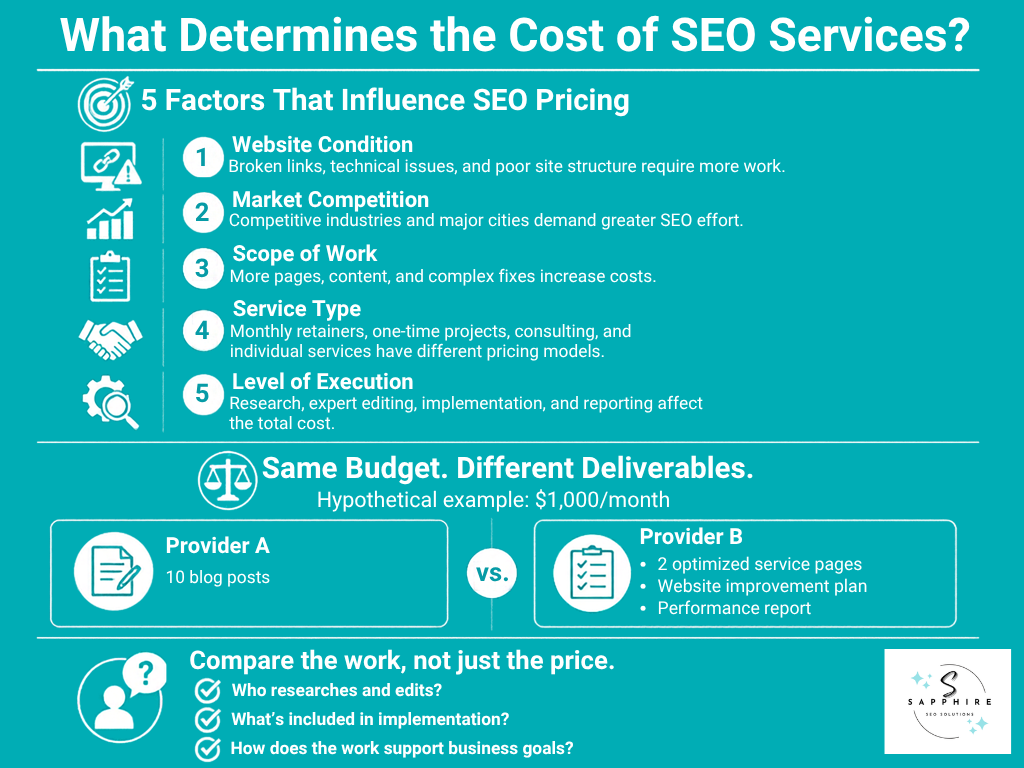
Several things move the price. A slow or broken site needs more repair. A crowded market, like plumbers in a big city, takes more effort than a small town. More pages, more writing, and trickier technical problems all add hours. So does an SEO agency handing over finished work instead of a to-do list.
Fee structure matters too. A one-time project covers a set job. Consulting is advice you carry out yourself. A single service, like rewriting one page, stands alone. Nobody needs a retainer for every problem.
Specialist research, editing, and hands-on work all take skilled time. On a limited budget, you can shrink the scope without cutting corners. Fewer pages, same research, same review.
Picture two quotes at $1,000 a month (a hypothetical):
Provider A: ten blog posts.
Provider B: two rewritten service pages, a fix list for the site, and a short report.
Ask who researches, who edits, and which pieces connect to your business goals. Ask for a sample, too. Ten thin posts may do less than two solid pages.
Without a clear understanding of what’s included, quotes can’t be compared fairly. Compare the work, and you’ll find the right SEO service.
What Should Quality Affordable SEO Services Include?
Successful SEO starts with a conversation. Google’s guidance on hiring an SEO says a good SEO should ask what makes your business unique, who your competitors are, and how your customers find you. If a provider skips those questions, the SEO work that follows is a guess.
From there, search engine optimization (making your site easier for Google to understand and show to the right people) comes down to choosing. A small budget can’t cover everything, so a good provider researches your business and decides what goes first. And that’s focus, not a shortcut. Technical fixes, content, reporting, and hands-on changes belong in the package only when they fit the job. Not every engagement needs a full site audit, a big link push, or a blog post every month.
Trimming scope is fine. Cutting corners on what’s left is not. Leaving ten pages out of the plan is a decision. Rushing the optimization on the pages you kept is the problem. Work that only ticks the right boxes stays at surface level, and poor results can follow. Quick wins are real, but they’re worth more when they build SEO assets, like a service page that keeps bringing in calls.
A good provider also spells out what’s left out and what they need from you, like site access or quick answers to questions. Google reminds site owners that you are responsible for the actions of any companies you hire, so ask for the reasoning behind each change.
A smaller package won’t promise what a larger one might, but it can still deliver results you can track. Use this as a minimum checklist:
Clear scope: Defined deliverables and exclusions
Relevant research: Work informed by your actual business needs
Competent execution: Skilled people and a quality review
Transparency: Clear responsibilities and realistic expectations
Measurement: Signs of progress you can check
Ethical methods: No deceptive guarantees or hidden tricks
Measurement is easy to test. Google suggests asking any provider how they measure success and in what timeframe.
Why Content Quality Matters More Than Content Volume
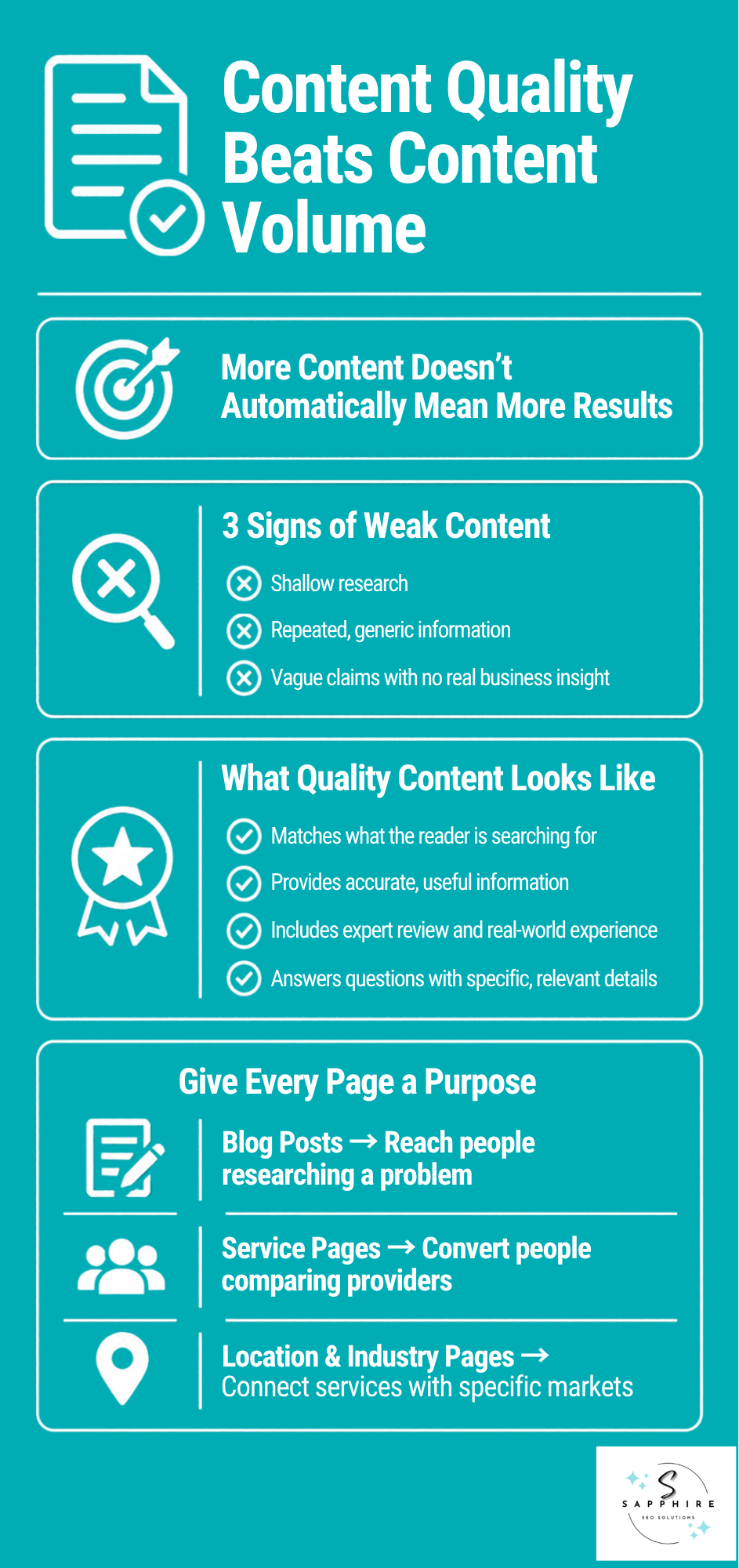
Content creation isn’t a numbers game. Publishing more doesn’t automatically bring more rankings or more calls. Google flags producing lots of content on many topics, hoping some of it performs, as a warning sign. It also says it has no preferred word count, so longer isn’t better by default.
Generic content tends to share the same flaws. The research is shallow. It repeats what’s already out there. The claims are vague, and nothing in it speaks to your business.
Content quality looks different. High-quality content starts with someone checking what the reader wants. The facts are right, and an editor cleans it up.
Google also asks whether an expert or enthusiast who knows the topic wrote or reviewed it. Not every article needs original research, though.
Different pages do different jobs:
An informational article catches someone researching a problem, like a lawn that keeps dying.
A service page catches someone comparing providers, and it’s the service business’s version of product pages.
An industry or town landing page speaks to one type of customer.
Together, they walk a customer from first search to hiring.
Here’s a hypothetical example: A landscaper has twelve blog posts and one thin patio page. The goal is booked patio jobs. A thirteenth post chasing more keywords probably won’t help. Rewriting that page with real project details, honest price factors, and answers to common questions probably will. But if the goal were reaching homeowners still researching, a strong article could win. The goal sets the priority.
Here’s a real case study (client name withheld due to NDA): A US video production company asked us for blog posts to bring in leads, and gave us a topic list. Our SEO manager wanted their budget to go further, so we checked competitors and keyword data before writing anything. We found better topics: ones people search often, with low keyword difficulty (how hard a term is to rank for). They also fit a topic cluster, which is a group of articles that all support one main page. Here, that was the client’s commercial location page. We explained the plan, and the client agreed.
Each article got a Surfer SEO guide, then went live on schedule. After that, we linked the articles to the location page. We also interviewed the client about the challenges at that location and what really happened on a filming day, and used the answers to add real experience to the page. Then we asked Google to index every page and started monitoring.
Within three weeks, the client had 4 leads and closed 1. This is a good number for a video production company. That large video production project easily covered what they spent on content, and they kept our SEO content writing service for the next few months.
We provided this case study to demonstrate that you don’t need to have thousands of dollars or start a massive SEO campaign. Even with a small budget, an experienced SEO agency can guide you on the best possible option to get the most out of your hard-earned money!
How Should a Small Business Prioritize Its SEO Budget?
Many businesses start with the wrong question: which service should we buy? Start with the result you want instead. Maybe that’s more calls for one service in one town. That’s not the same as more traffic. Google’s Search Console guidance says to aim for meaningful impressions, not just more of them. That’s what lead quality is about.
Next, find what’s blocking that result. Maybe the page doesn’t exist, loads slowly, or says nothing a competitor doesn’t. Pick the one or two fixes that matter most. Then look at what potential customers actually search, and which of those searches lead to a job.
For a local business, local SEO works a bit differently. That’s SEO aimed at people searching near you. Google says local results rest mainly on relevance, distance, and prominence (how well known you are), and that there’s no way to request or pay for a better local ranking. So a complete Google Business Profile and real reviews can matter more than a new blog post.
Then weigh each option with five questions:
Commercial relevance: Does this support an important business goal?
Evidence: Is there a demonstrated problem or opportunity?
Feasibility: Can the work be finished with the time and money you have?
Dependencies: Does something else need fixing first?
Measurement: How will you tell it’s working?
Score each option. The ones that pass most questions go first.
One service is often enough. A fast, clear site with thin service pages may only need better content. But a site with broken pages needs repairs first because new pages won’t help. Services should work together only when one depends on the other. And bigger campaigns make sense when the job truly is big, like many locations or a large site.
To measure success, check progress every month or so. Search Console reports impressions, clicks, average position, and click-through rate. None of those is a lead, so count calls and form fills too. Rising organic traffic (visits from unpaid Google results) with no new calls means it’s time to change course. Rankings alone prove nothing. We used this approach with the video production client above: research first, then fund what supports the page that earns leads.
Can Affordable SEO Content Perform Well in Google and AI Search?
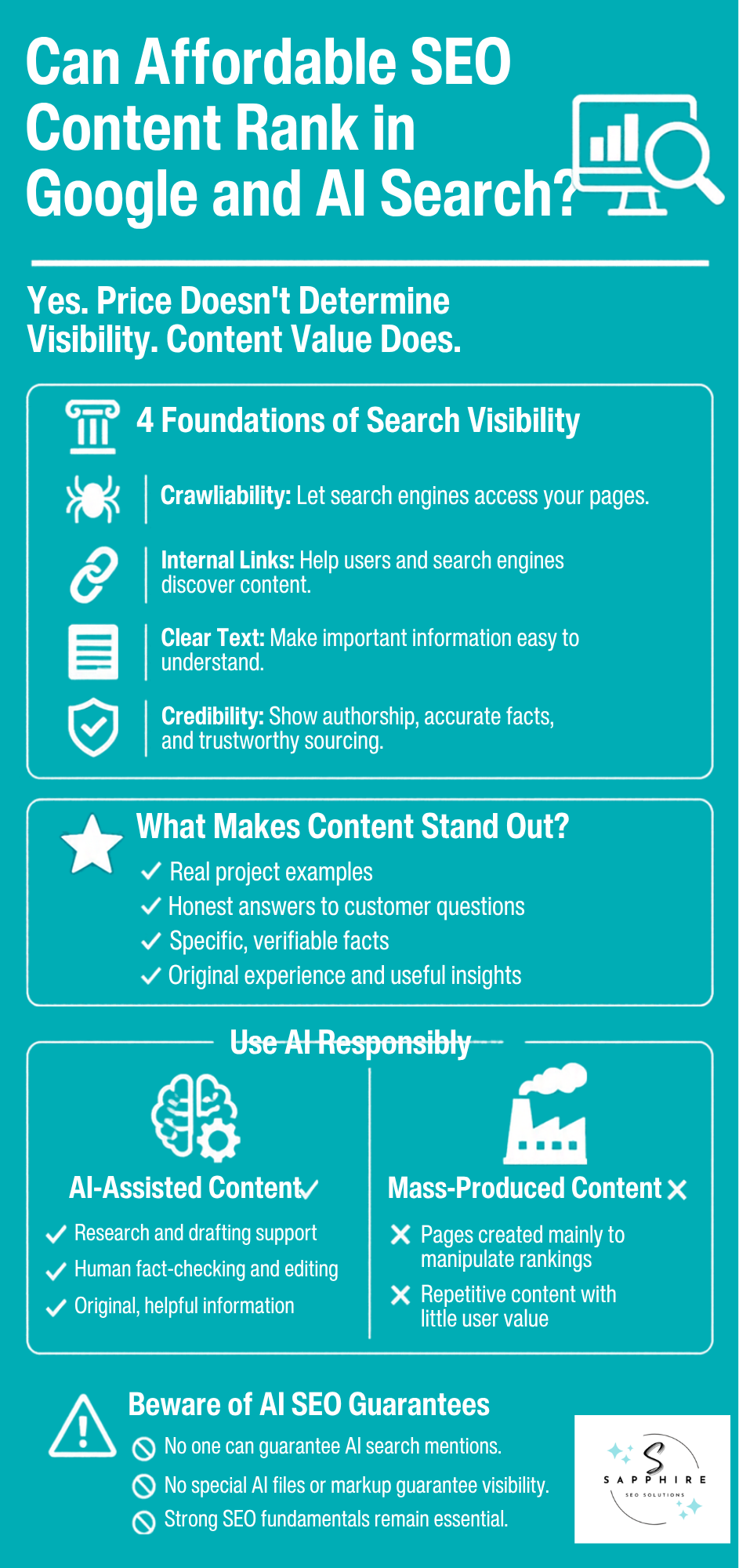
Yes. What a page costs to make doesn’t decide whether Google shows it or an AI answer links to it. What decides it is whether search engines understand the page and whether it actually helps the reader. Google says AI Overviews and AI Mode have no extra requirements and need no special optimizations. Same foundations, then.
To be eligible, a page must be indexed and eligible to be shown in Google Search with a snippet. (Indexed just means Google has stored the page so it can show it.) Beyond that, the usual basics carry over:
Pages Google is allowed to crawl
Internal links that lead people to them
Key information written as plain text
Clear authorship and honest sourcing, which build credibility
Even so, meeting every requirement doesn’t guarantee a page gets crawled, indexed, or shown.
Specific content stands out. A real example from a real job, an honest answer to a customer’s question, and facts that check out give a page something the next one doesn’t.
AI can help with research and drafting. Google says it’s useful for researching a topic and adding structure to original content. But Google also says every AI-generated piece needs a manual fact-check and review before it’s published.
Scale is where trouble starts. Google defines scaled content abuse as generating many pages mainly to manipulate rankings instead of helping users. Affordable content is fine. Affordable content mass-produced to game results isn’t.
No provider can guarantee a mention in ChatGPT, Claude, AI Overviews, or AI Mode. Google says there’s no need for new machine-readable files, AI text files, or special markup, so skip anyone selling those as a shortcut. Any AI SEO services worth hiring start from the basics above.
To check your search visibility, use Search Console. Google added generative AI performance reports there, showing how often your URLs appeared in AI features, and rolled them out to all websites worldwide as of August 31, 2026. AI feature traffic also still counts in your regular Performance report. Impressions aren’t customers, though. Compare them with calls and form fills in a tool like Google Analytics to see whether visibility is turning into business.
How to Evaluate an SEO Provider Without Overpaying
Chasing the lowest quote won’t keep you from overpaying. Finding the right partner for the job you actually have will. Start with proof. Ask for examples of past work, then call the references. Google suggests asking past clients whether the SEO was useful, easy to work with, and produced positive results.
Next, look for a clear explanation of what you’re buying: goals, deliverables, exclusions, and your own part in it. Google says to be careful with a company that’s secretive or won’t explain what it plans to do. Ask how content is researched, edited, and reviewed, and who makes the changes on your site. Automation can be fine. A person should still check the results.
Then settle who owns what. You should retain access to your website, analytics, Search Console, and the content you paid for. Google says a Search Console property needs at least one verified owner, or no one can get in, so make sure that owner is you, and add the provider as a user. If they offer an audit first, Google advises read-only access at that stage.
Here are some warning signs:
Guaranteed rankings
Vague deliverables
Bulk content with no review
Links nobody will explain
A low price alone isn’t a red flag. But the cost of getting this wrong isn’t just money. Google says techniques that break its spam policies can lower your site’s presence in Google or get it removed from the index. That’s how search engine penalties hit your brand reputation.
Save these six questions and ask every provider:
What exactly will be delivered?
Why is each major task necessary?
What is excluded from the quote?
Who performs and reviews the work?
How will progress be measured?
What happens if priorities change?
Then compare on fit and scope, not on who’s cheapest or priciest. A certification doesn’t guarantee results either, so judge the work.
Choose SEO Based on What Your Business Needs
A price is only a number until you know what’s behind it. Scope is the work. Quality is how well it’s done and checked. And what it’s worth is what comes back to your business.
A small, well-scoped job can meet professional standards. A bigger one can still miss. So before you commit to a broad campaign, find the one or two opportunities that matter most to your business, and start there.
That’s how we work at Sapphire SEO Solutions. Our specialists look at your goals and your site first, then recommend only what fits, with a quality check on every piece we hand over.
Need stronger pages? Look at our SEO content writing service.
Curious about AI search? See our AI SEO services. Or tell us what you’re trying to achieve, and we’ll help you work out where to begin. Contact us to schedule a free consultation with an SEO specialist!

Frequently Asked Questions About Affordable and Premium SEO
Are affordable SEO services worth it for small businesses?
They can be, when the work targets one clear goal, like a weak service page. Google says if you run a small local business, you can probably do much of the work yourself, so pay for the parts you can’t do or don’t have time for. Skip anything vague.
Can affordable SEO services deliver high-quality work?
Yes, if the scope is small but the standards aren’t. Look for defined deliverables, research based on your business, a quality review, and honest limits on what’s promised. A short, focused package done carefully beats a long one done carelessly. Ask for a sample before you sign.
Can cheap SEO services harm a website?
Price isn’t the danger. Methods are. Google warns that if an SEO creates deceptive or misleading content on your behalf, your site could be removed entirely from Google’s index. Be wary of paid links, bulk content, and anyone who won’t explain their work.
Does premium SEO produce better results?
Not automatically. A bigger package covers more ground, which helps a large site, but price doesn’t predict outcomes. Google states plainly that no one can guarantee a #1 ranking on Google, at any price. Judge any provider by the work, the evidence, and the fit.
How much should a small business spend on SEO?
There’s no universal number. In Ahrefs’ survey of 439 providers, updated August 15, 2024, the most common monthly retainer was $501 to $1,000, but 79.1% of US and Canada providers charged at least $1,001 a month. Let your goal and scope set the budget, then compare quotes on what’s included.
Can affordable SEO help a business appear in AI search results?
It can help with the basics, but nobody can promise a mention. Google says AI Overviews and AI Mode need no special optimizations; a page must be indexed and eligible to show with a snippet. Good, useful content on a crawlable site gives you a fair shot. Be wary of guarantees.
Should a small business hire an SEO agency or a freelancer?
Either can work. In Ahrefs’ survey, 57.4% of agencies charged $1,001 or more a month, compared with 32.2% of freelancers. A freelancer often suits one focused task. An agency suits work that needs several skills. Ask both the same questions, and check references.