

Local SEO vs National SEO: Key Differences, Costs, and How to Choose
SEO is the work of getting your website to show up when people search on Google. Local SEO focuses on people searching in or near the places you serve. National SEO focuses on people searching anywhere in the country. The difference between local SEO and national SEO comes down to where your customers live and where you can actually serve them.
A landscaper working in one metro area will generally put local SEO first. An online store shipping to all 50 states will generally put national SEO first. Some businesses need both.
From there, your SEO strategy shapes how you appear in search, what your website focuses on, who you compete with, what you pay, and how you track results. We cover each one below. But start with your business goals, because they settle most of the rest.
Key Takeaways
Where your customers live and where you can actually serve them decides local versus national, not company size.
Some businesses need both. Start with the bigger opportunity, then add the other side as resources allow.
Local results rest on relevance, distance, and prominence, and Google says you can’t pay for a better local ranking.
Service-area businesses can hide their address, but fake addresses and unstaffed virtual offices don’t qualify.
Skip near-copy city pages. Google’s spam policies call out city pages that funnel visitors to one page.
No one can guarantee a top ranking, and Google says changes can take hours to several months.
Cost follows scope, competition, and site condition, not the local or national label. Compare proposals by what’s included.
Measure calls, quote requests, jobs, and sales, not ranking position alone, because no single tool shows the full picture.
Local SEO vs National SEO: What's the Difference?
The key differences between local SEO and national SEO start with the searches each one goes after. Local SEO targets searches tied to a place like “roofer in Tampa.” National SEO goes after demand across the whole country.
Local visibility shows up in two spots on the search engine results page:
The local pack and Google Maps, the map listings near the top of results.
Regular website results that are relevant to a location.
National SEO works on service pages, product pages, category pages, and helpful articles. But it can still go after location-specific searches when they make sense for the business.
It’s the same Google either way. The priorities differ.
Google says local results are based mainly on relevance, distance, and prominence. That’s how well you match the search, how far you are from the searcher, and how well known you are. Regular website results depend on a wider mix of SEO factors. And Google says you can’t pay for a better local ranking.
Local SEO vs National SEO at a Glance
Here’s local SEO vs national SEO side by side. Treat it as a map of common patterns, not a set of rules.
Local SEO vs. National SEO
| Factor |
Local SEO
Location-Focused |
National SEO
Countrywide Reach |
|---|---|---|
| Reach | A defined area or specific locations | A countrywide market |
| Common fit | Local services, storefronts, regional providers | Ecommerce, software companies, nationwide providers |
| Search intent | Often needs a provider in a place | Often a product, solution, or topic |
| Where you show up | Local pack, Maps, local website results | National website results and other search features |
| Website focus | Service pages, useful location details | Product or service structure, topic coverage |
| Other factors | Accurate business info, distance, reputation | Technical health, content quality, authority |
| Typical conversions | Calls, bookings, quote requests, store visits | Sales, demos, sign-ups, inquiries |
| What to measure | Qualified local leads by service area | Qualified leads and sales across the market |
Plenty of exceptions exist. Reviews matter for national businesses too, and local sites still need strong content and links. A nationwide plumbing franchise with branches in many cities lives in both columns.
Company size doesn’t decide this. Your business model and where your customers are do. A five-person landscaping crew and a five-person online shop need different plans.
What Is Local SEO, and How Does It Work?
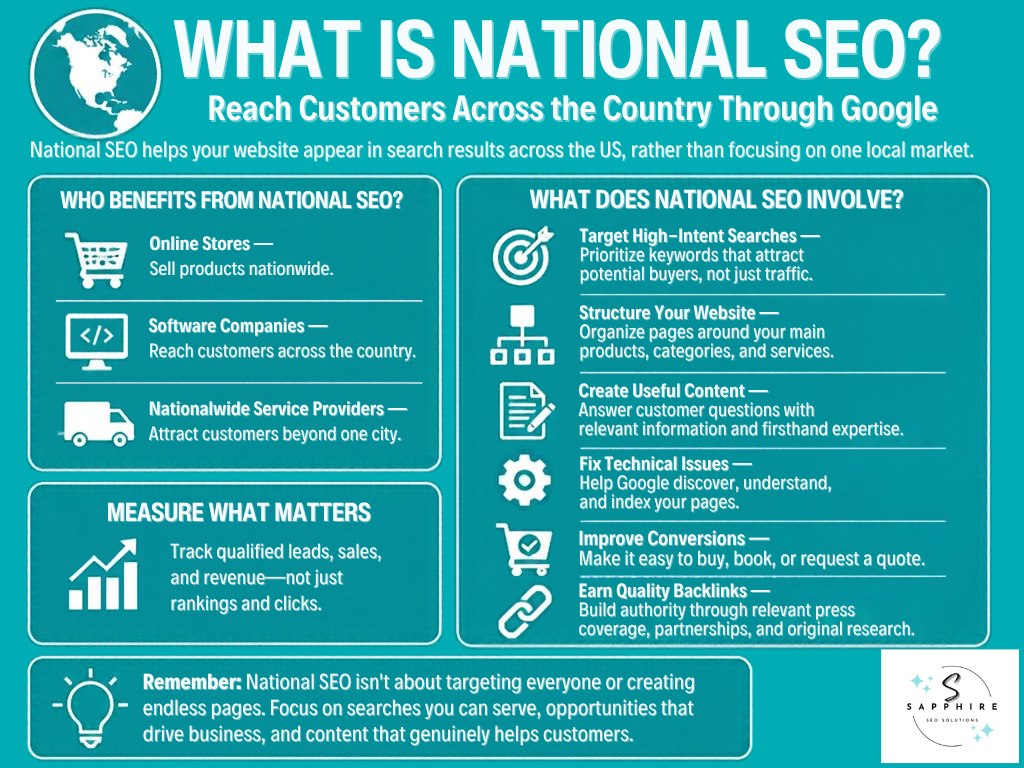
Local SEO, short for local search engine optimization, is the work of getting your business to show up when people search for something you offer in a place you serve. Think plumbers, roofers, dentists, restaurants, landscapers, and any other business with customers in particular places.
Those searches produce two kinds of local search results. One is the map pack, the short list of businesses shown with a map near the top. The other is regular website results. A business can show up in one, both, or neither.
Many local plans include a Google Business Profile, the free listing that shows your business on Google Maps and Search. Not every business qualifies for the same setup, though, and the profile doesn’t replace a good website. Rankings also shift with what someone searches and where they’re standing. And Google doesn’t sell better local rankings.
What Does a Local SEO Strategy Include?
An effective local SEO strategy starts before anyone touches your website. Someone has to work out which services make you the most money, who your best customers are, and where you can truly serve them. A landscaper who won’t drive past the county line shouldn’t chase searches three counties over.
From there, the work usually covers some mix of these:
Finding the searches that bring in real inquiries, not just clicks
Improving your service pages, contact details, mobile layout, and path to a phone call
Linking your own pages to each other so visitors and Google can find them
Managing your Google Business Profile and other business listings
Collecting genuine reviews and earning links from relevant local sites
Tracking calls, quote requests, and bookings, plus how good those leads were
Local citations are mentions of your business name, address, and phone number on other websites, like directories. Think of them as listings in a modern phone book. Accuracy matters more than volume, and no business needs hundreds.
Priorities follow the opportunity. A weak service page deserves attention before a big citation campaign. And skip the page-for-every-city trap, because Google’s spam policies call out pages aimed at specific cities that funnel visitors to one page. Build a separate page only when it helps a customer on its own.
What Is National SEO, and How Does It Work?
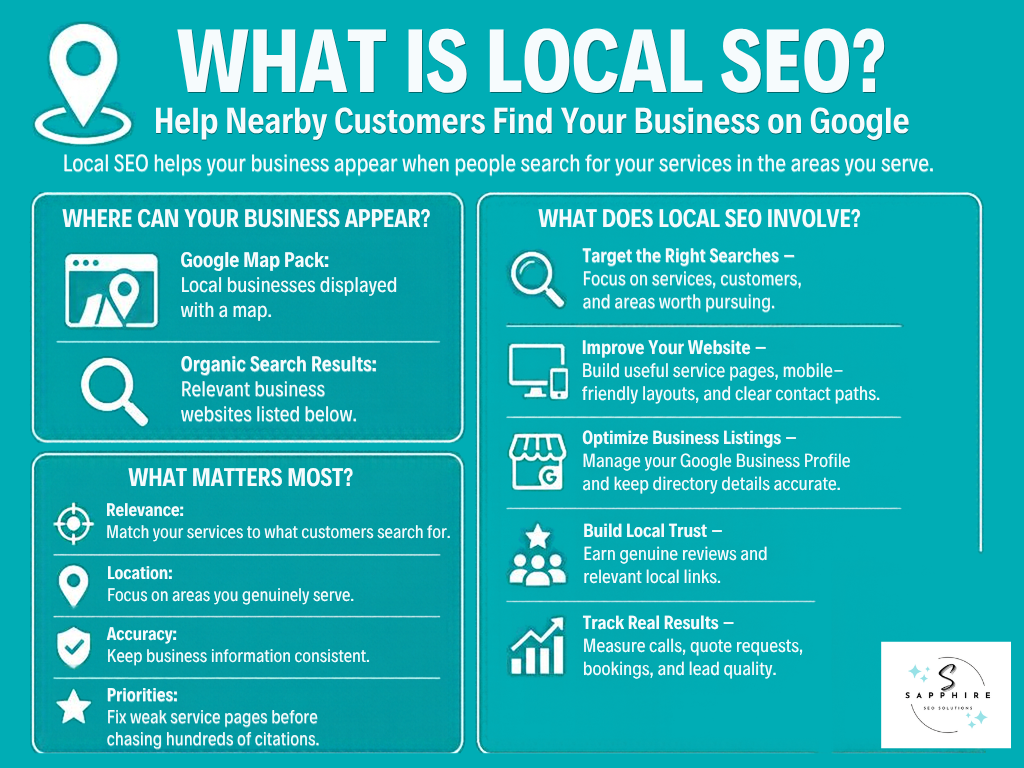
National SEO is the work of getting your website to show up in Google for relevant searches across the whole country, not just one metro area. Think online stores, software companies, nationwide service providers, and other businesses that sell remotely across the US.
Reaching a national audience doesn’t mean chasing only short, broad keywords. Many national SEO targets are specific searches from people ready to buy, like “payroll software for restaurants.” Broad terms can draw plenty of clicks from people who aren’t ready to buy anything.
Whatever you target has to match what searchers want and what you can actually deliver. A company that can’t ship to Alaska shouldn’t chase searches from there. Wanting nationwide reach isn’t reason enough to run a national campaign. And a business with branches in several cities may still need local visibility in each market, so national doesn’t mean ignoring local search.
What Does a National SEO Strategy Include?
National SEO strategies start with research. Which searches do your customers make, which ones signal they’re close to buying, and which bring in the most business? Group them by what the searcher wants, then plan around the ones that matter most.
From there, the work usually includes:
Organizing the site around your main products, categories, and services so people and Google can follow it
Content creation that answers real customer questions and shows firsthand experience
Technical fixes so Google can find, read, and list your pages without duplicates competing
Clear product details and an easy path to buy or book
Tracking landing pages, qualified inquiries, sales, and revenue where the data is reliable
Link building means earning links from other websites to yours. Think of each one as a referral. Aim for high-quality backlinks from reputable sites, the kind a real person would click, through press coverage, partnerships, or original research. Link count alone doesn’t measure authority. And Google’s spam policies treat buying links for ranking purposes as link spam.
Not every national business needs a big blog or hundreds of pages. Pages with nothing new to say don’t help anyone.
How Local SEO and National SEO Differ in Practice
Here are the differences between local SEO and national SEO in practice:
Search Intent and Keyword Targeting
Someone typing “landscaper in Denver” has local search intent. Someone typing “project management software” wants a product, wherever they live. So local keywords pair a service with a place, while national ones name a product or category.
Wording alone doesn’t settle it, though. Not every city search triggers the map listings, and local intent can show up without a city name. In keyword research, run the search yourself. Maps and nearby businesses point to a local plan. Software reviews and comparison pages point to a national one.
Big search volume isn’t the same as business value, either. What your customers search right before they hire matters more.
Website Structure and Content Priorities
Local sites usually lean on service pages: one for each job you do, with what a nearby customer needs, like areas covered and how to reach you. National sites often need more structure, organized around products, categories, services, or topics.
Both need pages with a clear job, links between related pages, and content that matches what searchers want. That’s how organic search, the regular results and not the ads, puts your business online in front of people looking for services online like yours.
Before building a city page, run one test. Would it still help a customer if Google didn’t exist? If not, skip it.
Competition, Authority, and Geographic Constraints
Local businesses mostly compete with providers serving the same area. National businesses may face industry leaders and affiliate sites, the review and comparison sites that earn commissions, across a much wider market. How tough it gets depends on the niche, the search, the place, and who shows up in the results.
Distance adds a limit; local plans feel more than national ones. Google says local results rest on relevance, distance, and prominence, which is how well-known a business is, and reviews feed into it. Scores like domain authority, a Moz metric, aren’t Google’s. Think of overall authority as reputation: how well known and trusted you are. No review, link, or listing guarantees a ranking.
Conversion Goals and Business Outcomes
A roofer wants phone calls and quote requests. A restaurant wants foot traffic. An online store wants purchases, and a software company wants demos and sign-ups. Not every local business measures success by calls, though.
Rankings and visits show progress. They aren’t the goal. Local traffic that never turns into work doesn’t pay anyone’s bills, and a few qualified leads can be worth more than a flood of irrelevant visits.
Check what happens after the form or the call. Was it a real customer in your service area? Did the job get booked? A submission isn’t automatically a good lead, and a call isn’t always a customer.
Which Businesses Should Prioritize Local SEO?
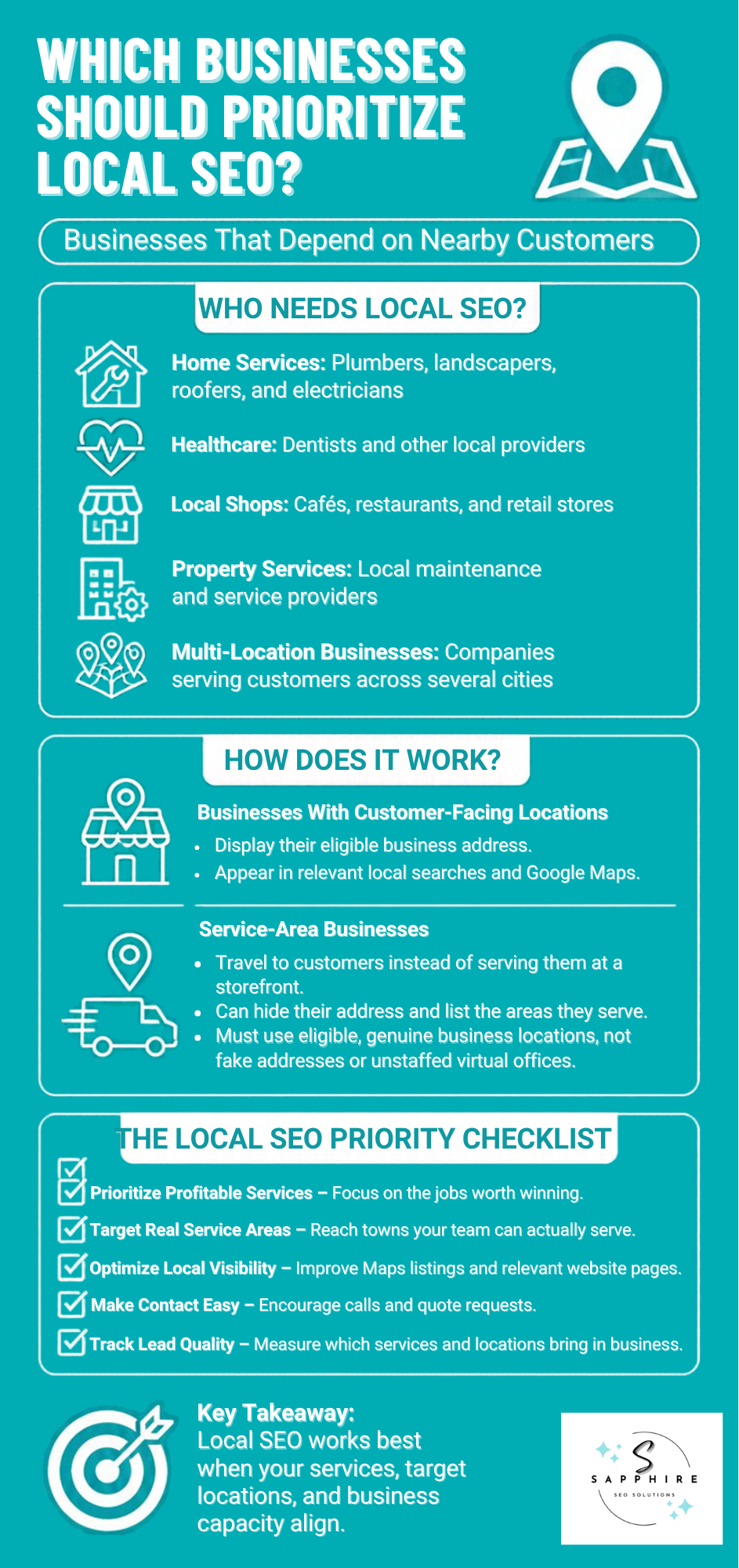
Local SEO usually comes first when customers need a provider in a specific location, or when distance limits how far you can serve. That covers local businesses like landscapers, plumbers, roofers, electricians, dentists, and property service providers. Size doesn’t decide it. A company with several branches can need it as much as a one-truck operation.
Someone with a burst pipe searches for an emergency plumber and picks from the Google Maps results. Someone craving a latte does the same for a coffee shop. That’s local search, and it’s how nearby customers find you.
A business with a physical location customers visit, like that coffee shop, shows its address. A service-area business that travels to customers, like the plumber, can hide its address and list the areas it covers. Fake addresses and unstaffed virtual offices don’t qualify.
With several locations, each real one needs accurate details and a useful page of its own. Google allows a profile per location, and service businesses need separate staff and service areas at each.
Take a landscaping company with one crew:
Focus on the most profitable jobs, like full yard installs
List only the towns the crew can actually reach
Show up for those jobs in Maps and regular results
Make calling or requesting a quote easy, then track what comes in
Aim at the local area and local market where local customers want your work, and your crew can show up. A crew that can’t serve a town shouldn’t chase it.
When Does National SEO Make More Sense?
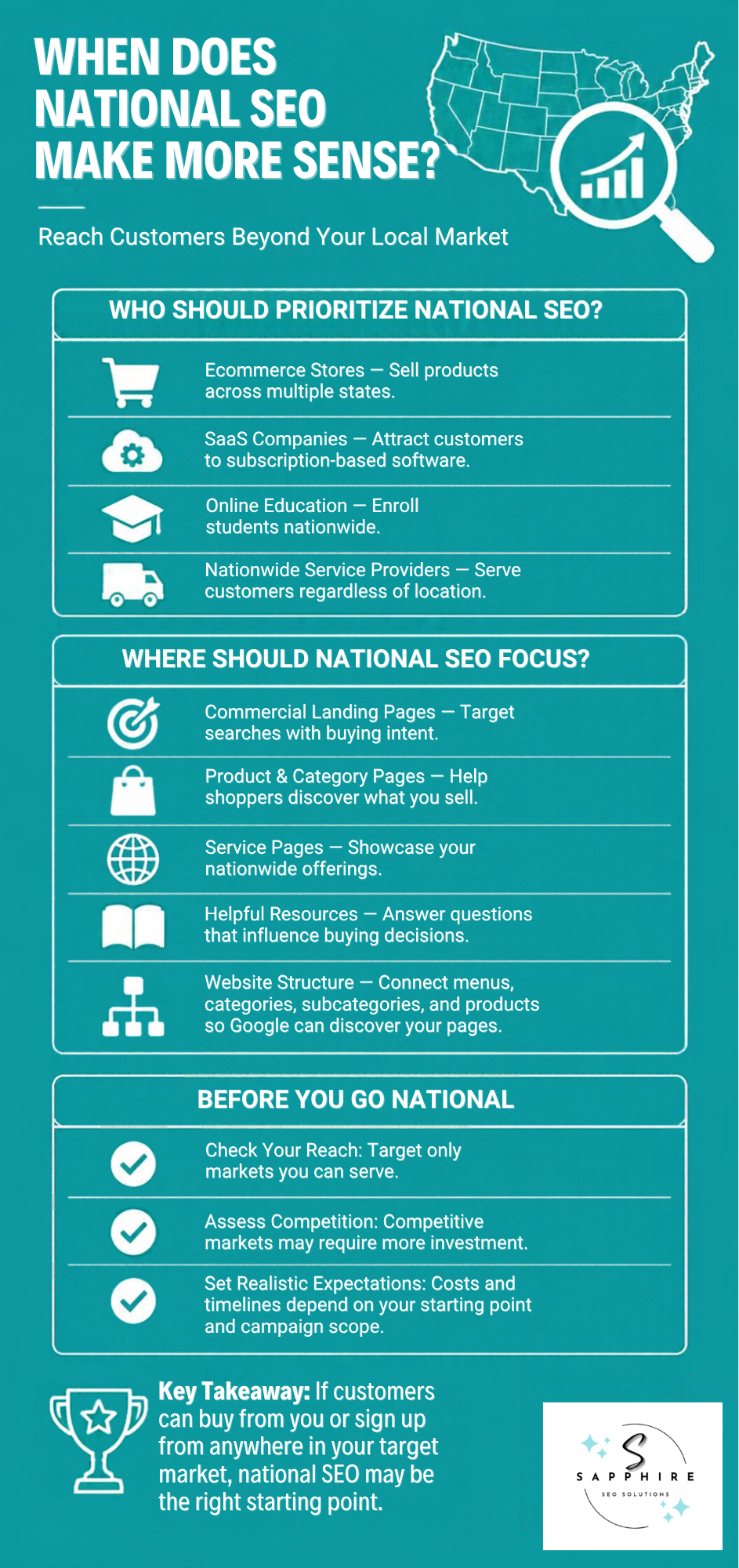
When customers can buy from you or sign up no matter where they live, choose national SEO as the starting point. A national business depends on being found by people searching from anywhere, not on a map listing.
That fits ecommerce stores, SaaS companies (software sold by subscription), online education, nationwide service providers, and other online businesses. Usually the work centers on commercial landing pages, product or category pages, service pages, and helpful resources that answer buyer questions.
Take a retailer that ships coast to coast. Maps visibility matters little to it. Growth comes from shoppers finding its products in search. Google’s ecommerce guidance recommends linking menus to category pages, categories to subcategories, and subcategories to every product, so Google can find them all.
A broad audience can mean more demand, but only the demand you can fill. A company that can’t ship to every state shouldn’t chase national rankings in all of them.
Competitive markets can call for more investment. Still, scope and starting point set the real cost, and national isn’t always pricier or slower.
How to Choose Between Local SEO and National SEO
The right SEO strategy starts with a few honest questions, not a quiz that spits out a score. Work through these in order:
Define customer geography: Can customers buy from anywhere, or must you serve a particular area? That shapes your target market more than anything else.
Identify valuable searches: List the searches tied to your most profitable services, products, or customer problems. Google Search Console, a free Google tool, shows which searches already bring people to your site.
Inspect the search results: Search your top terms and see what Google shows: map listings, local providers, national pages, shopping results, directories, or a mix.
Assess where you stand: Are key pages missing? Is something technical holding you back? Are competitors stronger in content, links, or local reputation? Honest answers identify opportunities fast.
Prioritize by resources: Put limited time and money behind the best opportunity first, not every service and location at once.
Many businesses fit one of these patterns:
Choose the Right SEO Starting Point
| Business Situation | Likely Starting Point |
|---|---|
| Customers must be served in a defined area | Local SEO |
| Customers can purchase from anywhere in the US | National SEO |
| Business serves several genuine local markets | Local SEO with a market-specific plan |
| Business sells nationally and has physical branches | A coordinated local and national strategy |
| Business is unsure which searches drive valuable customers | Research demand, search results, and conversion data first |
Budget matters, but it shouldn’t be the only factor. And no single keyword number settles the question. Choosing one approach first doesn’t rule out the other later.
Revisit the choice when your business model, service footprint, or results change. A custom SEO strategy built around your target audience should shift as you do.
Can a Business Use Local SEO and National SEO Together?
Yes. Local and national SEO can work together when a business has real demand at both levels. Not every business needs both, though.
Picture a roofing brand with branches in several states. Each market needs local leads from people searching for roof repair in their own town. The brand also wants visibility for services across the country like commercial roofing. That calls for a hybrid SEO strategy, and multi-location businesses often land there.
Different pages do different jobs. Core service pages explain what you do. Location pages carry each branch’s real details, like address, team, and local projects. Informational resources answer questions that aren’t tied to one place. Because each page has a clear purpose, they don’t fight over the same search. And a city page that’s a near-copy with only the name swapped doesn’t earn its place.
It runs the other way, too. A national brand may need local attention for its branches, and a local company may sell something that draws buyers nationwide.
Build the hybrid strategy in phases. Start where the most valuable opportunity sits and where your resources allow, then add the other side. A unified strategy keeps the two from tripping over each other.
How Much Do Local SEO and National SEO Cost?
There’s no universal price gap between local SEO and national SEO. Neither one is always cheaper. Fees follow the work, and the work depends on your business model, your market, and where your website starts.
Several things move the price: competition, the condition of your site, the number of locations, how wide an area you cover, technical needs, how much content you need, building authority (earning trust from other websites), and reporting.
Local work often includes local research, service-page improvements, Business Profile management where the business is eligible, location-specific work, reputation support, and building local authority. National work often needs broader keyword and competitor research, content planning, site structure, technical fixes, authority building, and conversion work.
A competitive city or a high-value niche can make local work resource-heavy. Some national campaigns have a tight scope, like a handful of product categories. So the local SEO vs national SEO label doesn’t tell you much about price.
When you compare proposals, look past the label and the monthly number. Check what’s included, what gets done first, how you’ll hear about progress, what reports you’ll get, and how the work ties to your goals. Google says a good SEO should ask what makes your business unique, who your competitors are, and how customers find you. And be wary of anyone who guarantees a top spot in search results. Google says no one can.
Think about what the work could bring in, not price alone.
How Long Does Local SEO Take Compared With National SEO?
No honest provider can give you one fixed timeline. How long it takes depends on where you start, how tough the competition is, how strong your site is, how well known you are locally, how much work the campaign covers, and how well the changes get carried out.
Local SEO isn’t automatically faster than national. A crowded city or a high-value niche can move slower than a focused national category.
Google says changes can take anywhere from a few hours to several months to show up in search engine results, and it suggests waiting a few weeks before judging whether a change helped. It also says no one can guarantee a top ranking.
So watch two kinds of progress. Early signs include pages getting found and listed by Google and appearing for more searches. The payoff is qualified leads and sales. Set milestones for both, then review them over time instead of expecting a ranking by a certain month.
How Should You Measure SEO Performance?
Good measurement connects search visibility to business results: calls, jobs, and sales. A ranking position alone proves nothing.
Local: Business Profile numbers like calls, direction requests, and website clicks, plus qualified calls, quote requests, and bookings by service or location. Together, these show your local SEO performance.
National: groups of related searches, how landing pages do in organic results, and qualified inquiries, transactions, and revenue where the data is reliable.
Each tool sees only part of the picture. Google Search Console, a free Google tool, shows which searches brought people to your site. Analytics tracks what visitors do once they arrive. Call tracking records where calls came from. A CRM, the system where you log customers and jobs, shows which leads turned into paying work. Google itself notes that Business Profile call counts track clicks on the call button, so they can differ from the calls you actually receive.
Record a baseline before major work starts, then review results over months, not days. And remember that customers may convert later, or after seeing you on other channels. So don’t credit SEO with every win or blame it for every miss.
What Does AI Search Mean for Local SEO and National SEO?
AI-powered search, like Google’s AI Overviews and AI Mode, can show links and sources inside its answers. Getting one depends on the search and on what the system picks.
Google says there are no extra technical requirements and no special optimizations needed to appear. A page has to be indexed and eligible to show in regular Google Search, with a snippet. The usual basics still apply: pages people and Google can reach, and content that’s useful and reliable.
For local businesses, accurate details and plain information about the services and locations you offer give customers something solid to work with. For national businesses, clear explanations, original evidence, and real expertise that answers genuine customer questions do the same job.
No tactic guarantees a mention or citation. Be skeptical of anyone who promises one.
More Resources on Local SEO to Explore
For more resources on local SEO, check out the following guides:
Choosing the Right SEO Strategy for Your Business
Businesses serving a defined area will often put local SEO first. Businesses serving customers nationwide may start with national SEO. Some need both.
A sound recommendation looks at where your customers are, which services make you the most money, what people actually search for, who you’re up against, how visible you already are, and what you can realistically put into it.
Sapphire SEO Solutions helps businesses sort through their local search opportunities and decide what to tackle first. For a closer look at that work, see our local SEO services page.
Serve customers in a particular area? Contact us, and we’ll talk through your local search opportunities. We offer free consultations!

Frequently Asked Questions
What Are the Main Differences Between Local SEO and National SEO?
Local SEO targets searches tied to a place, like “plumber in Tampa,” for businesses serving a defined area, and includes the local pack (the map listings at the top), Google Maps, and relevant website results. National SEO targets demand across the country, often for a product or service, and fits ecommerce, software, and nationwide providers. Some businesses need both.
How Do Local SEO Services Compare With National SEO Agencies in Terms of Pricing?
There’s no standard price gap. Fees follow the work: scope, competition, website condition, number of locations, and deliverables. A local plan in a crowded city can take more effort than a focused national one, and the reverse can be true too. An agency’s label doesn’t show how much work is included, so compare proposals by priorities, reporting, communication, and how they tie to your goals. A lower number can mean less work, not a better deal.
Is Local SEO Better Than National SEO for Small Businesses?
Often, yes, when the business serves a limited area. A plumber, dentist, or landscaper often puts local SEO first because customers search for someone nearby. But a small business that sells nationwide, like an online shop, may need national SEO instead. Customer geography and business model decide it, not company size.
Can a Service-Area Business Use Local SEO Without a Storefront?
Yes. Google lets eligible service-area businesses, those that travel to customers, hide their address and list the areas they serve instead. The business still has to follow Google’s Business Profile guidelines: represent itself accurately, list real service areas, and skip fake addresses or unstaffed virtual offices. Google also recommends keeping service areas within about two hours’ drive of your base. You can read the details in Google’s guidelines.
Can a Business Use Local SEO and National SEO at the Same Time?
Yes, when the business has real local and national demand. Picture a multi-location company that wants local leads in each city and also ships products nationwide. That company needs both kinds of visibility. Not every business needs two campaigns, though. Start with the bigger opportunity and add the other side later.
How Do I Know Whether My Business Needs a Local SEO Agency?
Look for warning signs: you’re hard to find in local search, your service pages aren’t pulling in inquiries, leads are poor quality, your business details are wrong across the web, or you can’t tell which calls come from search. Plenty of businesses handle some of this themselves. Review the real problem first, then read any proposal for what it covers.