

What Are Local Citations? How to Build, Fix, and Track Them
So what are local citations? They’re online mentions of a business’s name, address, and phone number. You’ll find them in directories, mapping platforms, industry websites, local publications, and plenty of other corners of the web.
For local businesses, citations are one way customers find you. When someone runs a local search for a plumber or landscaper, accurate listings give them more places to spot and reach you. Google also pulls business details from many sources, so consistent information supports your local SEO. Citations don’t guarantee a spot in local search results, though.
This guide covers the types of citations, where to build them, how to fix errors, and how to track results. The goal is stronger local search visibility without wasting time on listings that don’t matter.
Key Takeaways
A citation is any online mention of your name, address, and phone number. A link isn’t required.
Citations play a supporting role. Google publishes no ideal citation count and no separate weight for quantity.
Start with the big platforms: Google Business Profile, Bing, Apple Business, and Yelp. Then add industry and local directories.
Audit existing listings before submitting anything new. Duplicates and old details are easier to fix before you add more.
An outdated phone number is a real problem. “St.” versus “Street” usually isn’t. Fix the first kind fast.
Don’t delete duplicate listings on sight. Check platform rules first because merging and removing affect reviews and content differently.
Measure calls, inquiries, and qualified leads, not citation count. Fixing 20 listings is activity, not a result.
Keep access to your own profiles. Ask any provider what happens to your listings if you stop paying.
What Are Local Citations in SEO?
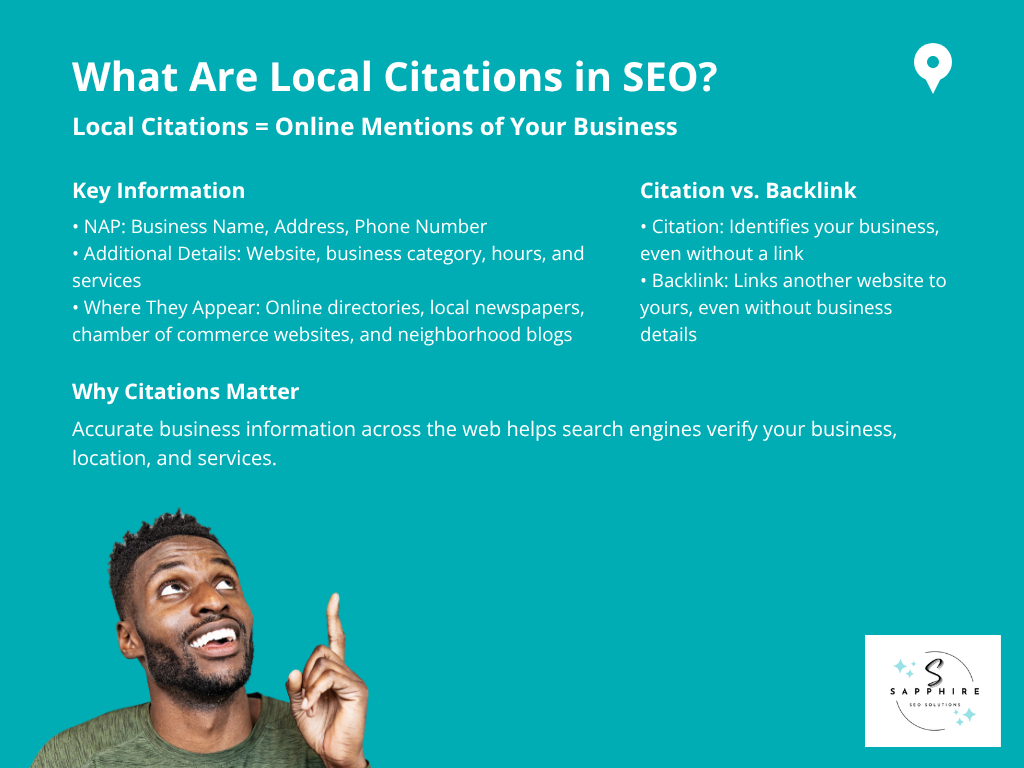
Local citations are mentions of your business on other websites. Most include the name, address, and phone number, usually shortened to NAP. It works like an old phone book entry: who you are, where you are, how to reach you. You’ll also see these called local SEO citations, local search citations, or SEO local citations.
Many carry more, like a website URL, category, hours, and services. But none of that is required. A mention with only a business name and a city still counts.
Below is a made-up business listing from an online directory. It’s illustrative, not a real company.
Greenline Lawn Care (illustrative example)
Phone: (614) 555-0142
Address: 418 Maple Ave, Columbus, OH 43215
Website: greenlinelawncare.example
Directories aren’t the only place local business citations live. A local newspaper story, a chamber of commerce member page, or a neighborhood blog can mention your business information just as well.
Citations and backlinks get mixed up a lot. A backlink is a link from another website to yours. A citation mentions or identifies your business. A listing with your address and phone number but no link is still a citation. A link with no business details attached is just a backlink.
Why bother? Search engines rely on business data from many places to confirm a business exists, where it is, and what it does. Accurate citations make your business’s online presence easier to trust.
What Are the Two Types of Local Citations?
Citations come in two forms, and structured and unstructured citations work differently.
Structured Citations
Structured citations live in standardized business listings, where each detail gets its own field:
Name
Address
Phone number
Website
Hours
Category
Yelp, Apple Business, and Bing Places are the big ones. Industry directories fit here too, like Angi for a plumber. You’ll find them across online directories, review sites, and other directory listings.
Claim every eligible profile. Then keep it accurate. An unclaimed listing can show an old phone number for years, and customers will keep dialing it.
Unstructured Citations
Unstructured citations appear inside other content instead of a listing. Think local news articles, trade publications, community organization websites, and blogs on local sites. A story about your crew sponsoring a youth baseball team is one example.
Mentions like that can say something about your expertise, your reputation, and how involved you are in the community. Some name the business and nothing more. Others add contact details or a link.
Neither type wins across the board. Both are citation sources, and most businesses end up with some of each.
The differences between structured and unstructured citations are highlighted in the table below:
Structured vs. Unstructured Citations
| Feature | Structured Citations | Unstructured Citations |
|---|---|---|
| Format | Standardized business listing | Contextual mention |
| Typical Sources | Directories and listing platforms | Articles and publications |
| Typical Approach | Claim and maintain | Earn or establish relevant mentions |
How Do Local Citations Affect Local SEO?
Are local citations important? Yes, but in a supporting role.
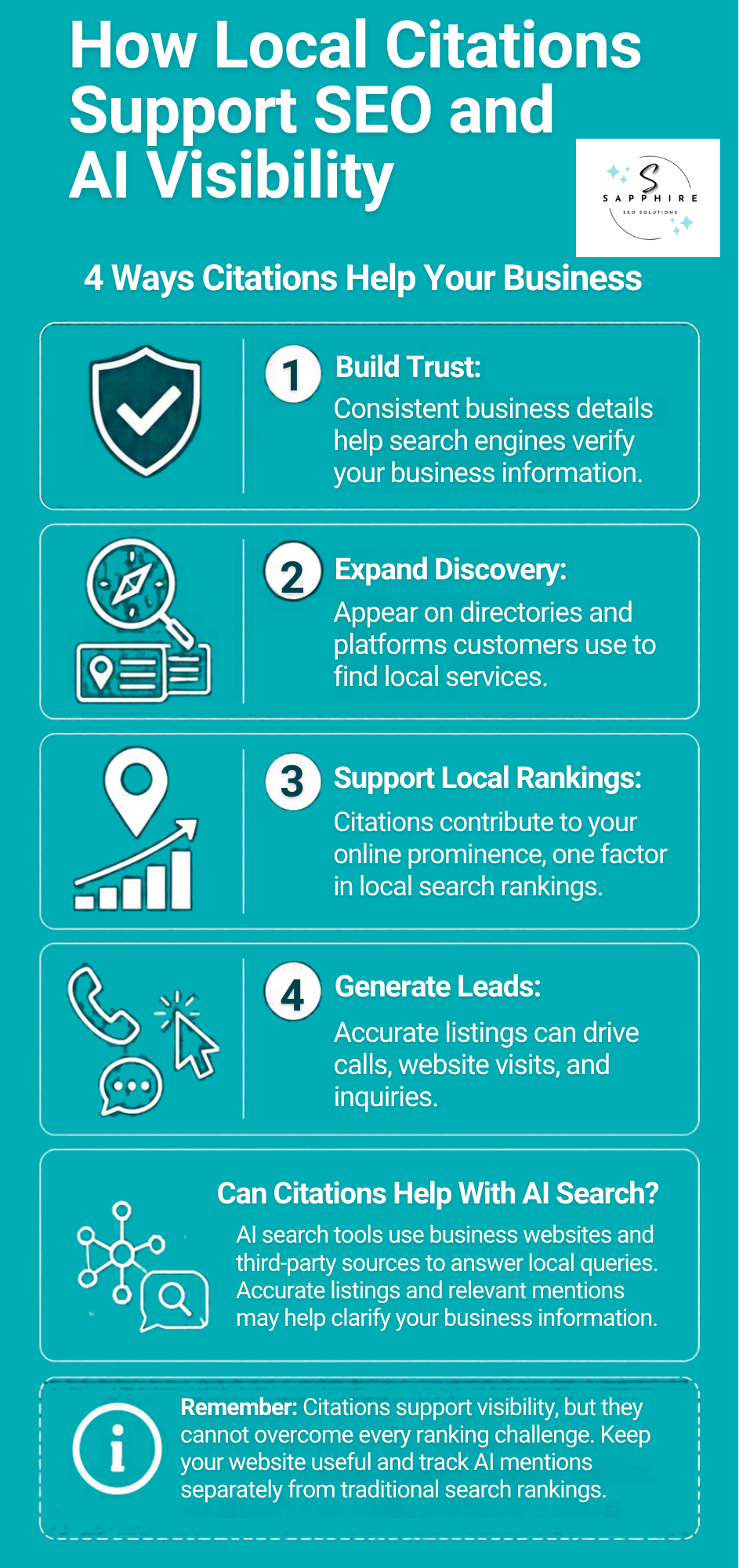
Google doesn’t say exactly how search engines validate a listing. It does say it gathers business information from multiple sources. So consistent citations are a sensible way to help search engines verify who you are and where you work.
Listings also give customers more ways to find you. Someone running local search queries like “tree service near me” may hit a directory or map listing before they reach your website. Choose local citation sources your customers actually use.
Google says local results rest mainly on relevance, distance, and prominence:
How well you match the search
How far you are from the searcher
How well known you are
Prominence draws on information from across the web, including directories. So citations can play a part in local rankings. But Google publishes no ideal citation count and no separate weight for citation quantity.
Accurate addresses, phone numbers, and hours let customers check you out and reach you. A good listing can bring website visits, calls, and inquiries even when your local search rankings never budge.
But citations can’t fix everything. A closer competitor, a profile that doesn’t match what people search for, or weak overall online visibility will hold you back regardless.
Can Local Citations Help with AI Search Visibility?
Possibly, in a supporting role. AI search tools can use business websites and third-party sources to answer local questions, so accurate listings and relevant mentions give them a clearer picture of your business.
BrightLocal’s 2026 study analyzed more than 200,000 localized searches across ChatGPT, Google AI Mode, and AI Overviews. Business websites made up 42% of the citations those tools used. Those are sources the AI cited, not local citations in the sense above. So keep your website useful alongside your listings. The study doesn’t prove that more citations cause more AI recommendations.
Track AI mentions separately from regular rankings, since the two don’t always match. A business can show up on Google Maps and still be missing from AI answers.
To learn more about AI SEO, check out our guide on “What Is AI SEO?”
Where Should You Build Local Citations?
Not every listing deserves your time. Rank local citation opportunities by:
Credibility
Industry fit
Geographic fit
Whether customers actually use the site
How much work it takes
Start with the big platforms. Then move to narrower ones. Smart local citation building is selective, because a long list of business directories nobody visits adds little and leaves you more listings to keep accurate.
Start with Major Business Listing Platforms
These core sites come first:
Google Business Profile, for eligible businesses
Bing Places for Business
Apple Business, which manages your presence across Apple services, including Apple Maps
Yelp
Other big platforms your customers and industry rely on
A Google Business Profile isn’t just another directory submission. It’s how you show up on Google Search and Maps, so it goes first. Google, Bing, and Apple all let you claim a basic listing for free.
Find Industry-Specific and Local Directories
Next come industry-specific directories and niche directories, the sites customers actually use to find your kind of work. A plumber gets more from Angi than from a directory built for dentists. A few US examples:
Home services: Angi, plus relevant business directories for your trade
Healthcare: Healthgrades
Legal: FindLaw
Hospitality: Tripadvisor, where it fits
Then add local directories: your chamber of commerce, trade associations, and other local business associations. Community-run local business directories count too, as long as they’re legitimate. Treat all of these as starting points, not a checklist.
What Are Local Citation Data Aggregators?
Data aggregators work like wholesalers. You give one source your details, and it passes them down the line to other directories, apps, and maps. Major data aggregators include Data Axle and Foursquare. Who they feed varies, and so does how you submit, so check current coverage and options before you pay anyone. Submitting to one doesn’t guarantee your listing shows up on every partner site.
Use this rough order:
Citation Source Priorities
| Priority | Source Type | Why It Sits Here |
|---|---|---|
| First | Major platforms | Biggest audience |
| Second | Industry directories | Closest match to what customers search |
| Third | Local sources | Ties you to your area |
| Optional | Aggregators | Verify coverage and cost first |
How to Build Local Citations Step by Step
To build local citations without making a mess, work in this order.
Write your master record: Put your official business name, address, website, hours, categories, and other business details in one document. Check each one against your signage and website. Then decide what shows publicly, since a service-area business may not want a home address displayed. Pick one main phone number online and use it in the phone number NAP field everywhere. This record is your NAP data source of truth.
Audit what already exists: Search your business name, old names, past addresses, old phone numbers, and website domain to find local citations that are already out there. Note your existing citations, errors, and duplicates. Do this before you submit anything new. A local citation finder tool can speed it up, but a few manual searches work too.
Pick your targets: Start with the major platforms and the industry and local directories that fit your business. Look at where credible competitors are listed to spot gaps. Don’t copy their whole list.
Claim or create profiles: Check for an existing profile first, because a new one can create a duplicate. Then follow each platform’s verification steps. Verification takes time on some platforms, so don’t expect same-day results.
Fill out each listing accurately: Add categories, hours, services, photos, and a business description where the platform supports them. Stick to facts. Follow each platform’s rules. Clear photos and a plain description give customers a reason to pick you.
Track everything: Log each directory, profile link, submission date, verification status, and open fixes. Then confirm the published information is right.
Maintain the listings: Recheck priority listings every so often, and any time your details change. A spreadsheet handles a handful of local business listings fine. Once you’re juggling many, citation management tools can take over the watching.
Here’s a simple downloadable tracker for step 6 that you can use for your business:
Local Citation Tracking Worksheet
Keep track of your business listings, verify the accuracy of your information, record issues, and track the next action needed to maintain consistent citations.
| Directory / Platform | Profile URL | Listing Status | Last Checked | NAP / Website Accurate? | Issue Identified | Next Action |
|---|
NAP stands for name, address, and phone number. Check these details against your official business information. For service-area businesses that hide their street address, check the visible listing details and service area. Prioritize major platforms and relevant industry and local directories. Check an aggregator's coverage and cost before paying for distribution.
Use Print / Save as PDF for a printable record, or Download CSV to continue tracking your citations in a spreadsheet.
How to Keep Local Citations Accurate and Consistent
Accurate and consistent citations come down to one habit: use the same business information everywhere. Check that your business’s name, address, and phone number match on every listing, along with your website URL.
Use your real-world name, the one on your signs and invoices. Don’t tack on keywords like “Best Plumber Cheap” to rank higher. Google doesn’t allow unnecessary information in a business name, and it can get a profile suspended.
Keep operating hours, categories, and services current. Point each listing to the right page, such as the homepage for a single location or the matching location page for a branch. After a move, rebrand, or number change, update your important listings first. Businesses with several real locations need separate details for each one.
Not every mismatch is a real problem:
Meaningful: an outdated phone number. Customers call the wrong line, and wherever your business appears, the details conflict.
Harmless: “St.” instead of “Street.” Search engines can generally match those, though picking one format is a good habit.
Fix the first kind fast. Don’t lose sleep over the second.
How to Audit and Fix Existing Local Citations
Audit your existing citations at onboarding, after a move or rebrand, and on a regular schedule after that. Sort what you find into four groups: incorrect, outdated, incomplete, and duplicate listings.
Then fix by impact, not by whatever you spot first. Not every directory is equally urgent. Use this triage list:
High priority: incorrect contact details or misleading hours. A wrong phone number NAP entry on a major platform sends customers to the wrong line.
Medium priority: important missing listings or meaningful duplicate profiles.
Lower priority: minor presentation issues on low-value platforms.
To fix an error, claim the listing if you can and edit it yourself. Otherwise, use the platform’s correction or support process. Each platform works a little differently. If someone else controls the listing, request ownership from them. Google, for one, lets you ask the current owner, and if nobody answers within three days, you may get the option to claim it. That option isn’t always available, though.
Don’t delete duplicate listings on sight. Check the platform’s rules first. Google allows one Business Profile per business, and it reviews merge requests. A merge combines reviews, but replies to them may be lost. Removing a profile also deletes its content and linked managers.
Track each request until the live listing shows the right information. Some requests get denied, so keep a record of what you sent.
How to Manage Local Citations for Multiple Business Locations
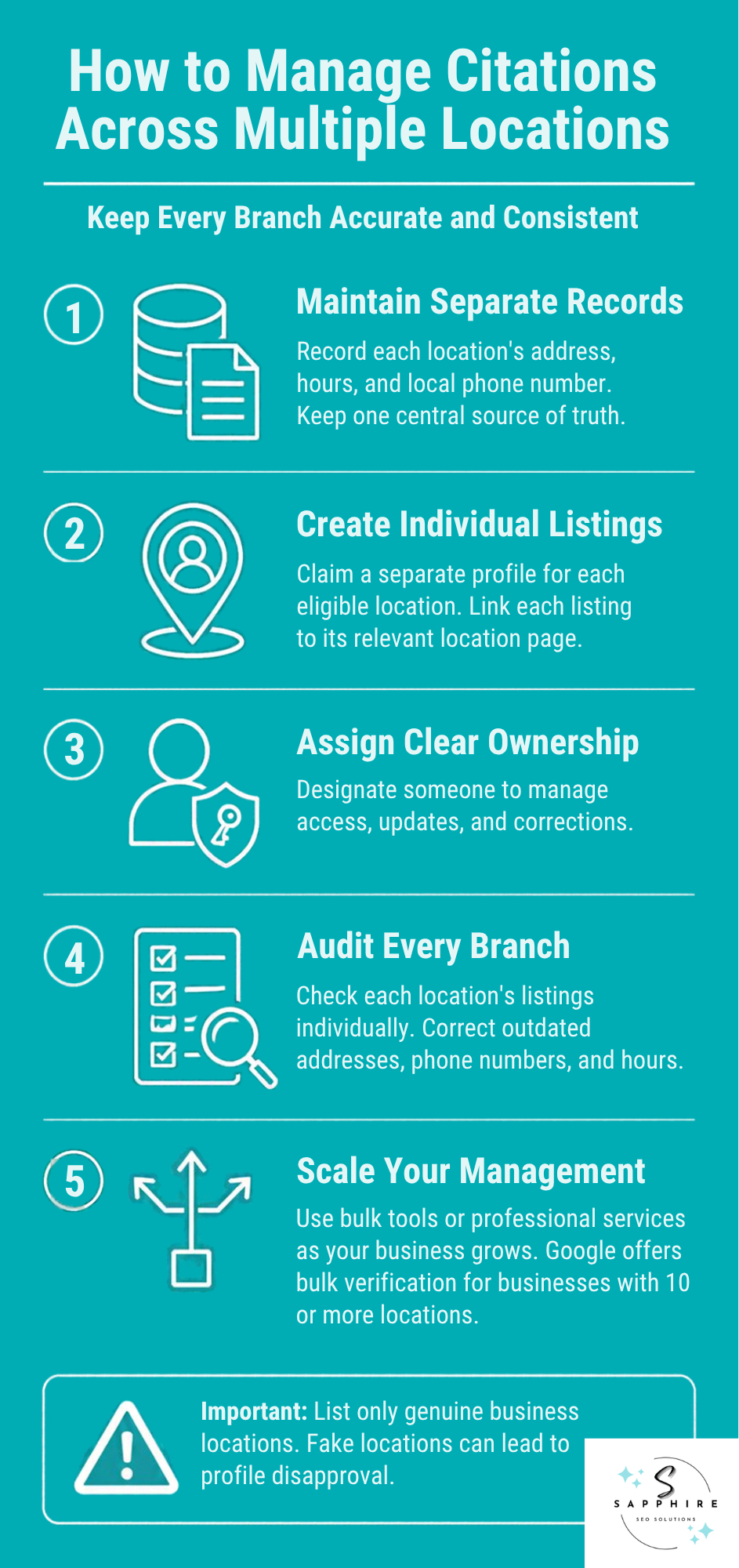
Multi-location businesses need accurate listings for every location, not just the main one. Keep a central record for each genuine location, with its own address, hours, and local phone number. Google asks for a local number over a call center line whenever possible.
Create or claim a separate profile for each location wherever the platform allows it. Link each one to the most relevant page for that location. Then name one person who owns access and upkeep.
Audit each location on its own. A correct central record doesn’t prove every listing matches it, since one branch can still show an old phone number.
With multiple locations, manual tracking gets old fast. Bulk management tools or a professional service can take the load. Google, for one, offers bulk verification for 10 or more locations. Only list real locations, though. Made-up ones can get profiles disapproved.
How to Measure the Results of Local Citation Building
Citation count is a poor scorecard. What matters is whether more potential customers can find you and reach you. Split your tracking into two groups.
Activity metrics show work done:
Accuracy and completeness of priority listings
Listings claimed, verified, and corrected
Business outcomes show what that work led to:
Visibility for relevant searches in the areas you serve
Website visits from listings, where referral data exists
Calls, inquiries, and conversions you can attribute reliably
Qualified leads
Correcting 20 listings is activity. Generating qualified inquiries is an outcome. Judge success on the second.
Be realistic about attribution. Google’s Business Profile performance report shows calls, website clicks, and direction requests, but only for verified profiles, and its call count reflects taps on the call button, not every phone call. Other platforms may report less, or nothing. And citations usually sit inside a broader local seo strategy, so a jump in calls can’t automatically be credited to them.
Look for patterns over several months. A spreadsheet and a monthly check are plenty.
Should You Build Local Citations Yourself or Hire a Service?
DIY makes sense for a single-location business with a handful of priority listings. It costs time, not subscription fees. You handle verification, and you handle upkeep whenever hours or phone numbers change.
Paid citation tools and listing-management platforms start to earn their keep when you’re watching many listings or locations. Before paying, compare platform coverage, recurring costs, and reporting.
An SEO agency fits when you need more than listings: an audit of existing citations, a short list of relevant opportunities, help untangling messy inconsistencies, and citation work that plugs into a broader local SEO strategy. Plenty of businesses don’t need that.
Whoever does the work, keep access to your own profiles. And ask what happens to your listings if you stop paying. With some subscription services, listings can revert or disappear after cancellation. With others, you own the accounts. Get that answer before you sign.
The right choice depends on your business, not the size of a citation package.
Local Citation Management Approaches
| Approach | Best Suited For | Main Consideration |
|---|---|---|
| DIY | Simple, single-location businesses | Requires time and ongoing attention |
| Citation Tool | Businesses managing many listings | Check coverage and recurring costs |
| SEO Agency | Businesses needing broader local SEO support | Assess scope and reporting |
More Resources on Local SEO to Explore
Want to learn more about local SEO? Check out the following guides:
Improve Your Local Search Visibility with Sapphire SEO Solutions
Keeping listings accurate and picking the ones worth your time takes steady attention, and most owners would rather be running jobs. Citation management is also only one piece of a broader local SEO strategy, alongside your Google Business Profile, website, and reviews.
Sapphire SEO Solutions offers citation audits, listing management, and local search optimization as part of its local SEO services. The work starts with checking what’s already out there, then fixing what’s wrong and building the listings that matter.
Start with your own listings. Search your business name, check the phone number and address on each result, and note what’s off. If the list is longer than you want to tackle, outside help may be worth a look.
Contact us to discuss your local SEO strategy with a certified expert today. Free consultations available!

Frequently Asked Questions About Local Citations
What Are Local Citations in SEO?
Local citations are online mentions of a business’s name, address, and phone number. They show up in directories like Yelp, on mapping platforms, on chamber of commerce pages, and in local news stories. Listings with set fields are structured citations. Mentions inside articles and blogs are unstructured citations.
How Do Local Citations Impact Small Business Search Rankings?
They play a supporting role. Google says local results rest mainly on relevance, distance, and prominence, and prominence draws on information from across the web, including directories. So accurate listings can contribute. But citations don’t guarantee a ranking, and they can’t make up for a competitor sitting closer to the searcher. Think of them as one input among several.
Where Can I Find Services to Build Local Citations for My Business?
You have three routes: submit listings yourself, use a citation tool, or hire an SEO agency. Whichever you pick, ask about platform coverage, who owns the listings, who handles maintenance, and what the reporting shows. Sapphire SEO Solutions includes citation work in its local SEO services, if you’d like to talk it through.
How Many Local Citations Does a Business Need?
There’s no universal number, and Google doesn’t publish one. How many local citations a business needs depends on its industry, its area, and where its customers actually look. A plumber in a small town may need far fewer than a dental group with several offices. Focus on relevant, credible listings you can keep accurate, not an arbitrary target.
Do Local Citations Need to Include a Backlink?
No. A citation can exist with just a name and city, or a name and phone number, with no link at all. Still, a link in a listing gives customers a quick way to reach your website, so add your URL wherever the platform allows it.