

It’s a Saturday morning, and a homeowner just found a soggy patch in her front lawn. Broken sprinkler line, probably. She types “sprinkler repair near me” into Google. Her neighbor asks an AI assistant instead: “Who should I call for sprinkler repair, and what will it cost?”
Same problem. Two very different paths to an answer.
Some local customers start with the map listings. Others click the regular search results. Others still read an AI-generated answer, then keep asking an assistant follow-up questions until they land on a name. But they all want the same thing: someone reliable who can show up this week.
That’s where AI and local SEO come in. It covers how local businesses get found, compared, and chosen across all of those places. So this guide walks through what’s changing, what to work on first, how to measure results, and when outside help makes sense.
Key Takeaways
Google says AI features need nothing special beyond indexed, snippet-eligible pages, so local SEO basics come first.
Mentions, citations, and recommendations are different things, and a strong local ranking doesn’t guarantee any of them.
Keep your name, address, phone, and services identical across your Business Profile, website, and listings.
Build pages from real customer questions and jobs. Skip town-swapped location pages and mass-produced FAQs.
Earn honest reviews and show real proof. Never buy reviews: Google prohibits incentives, and the FTC can seek penalties.
Citations aren’t clicks or jobs. Track qualified calls, quote requests, and booked work alongside visibility reports.
Search Console’s AI report shows impressions only, and no tool exposes every AI prompt.
No one can guarantee rankings or AI mentions. Treat guarantees as a red flag.
What Is AI Search, and How Does It Affect Local Business Discovery?
There are several things you need to know about AI search and how customers find businesses.
Traditional Local Search Still Matters
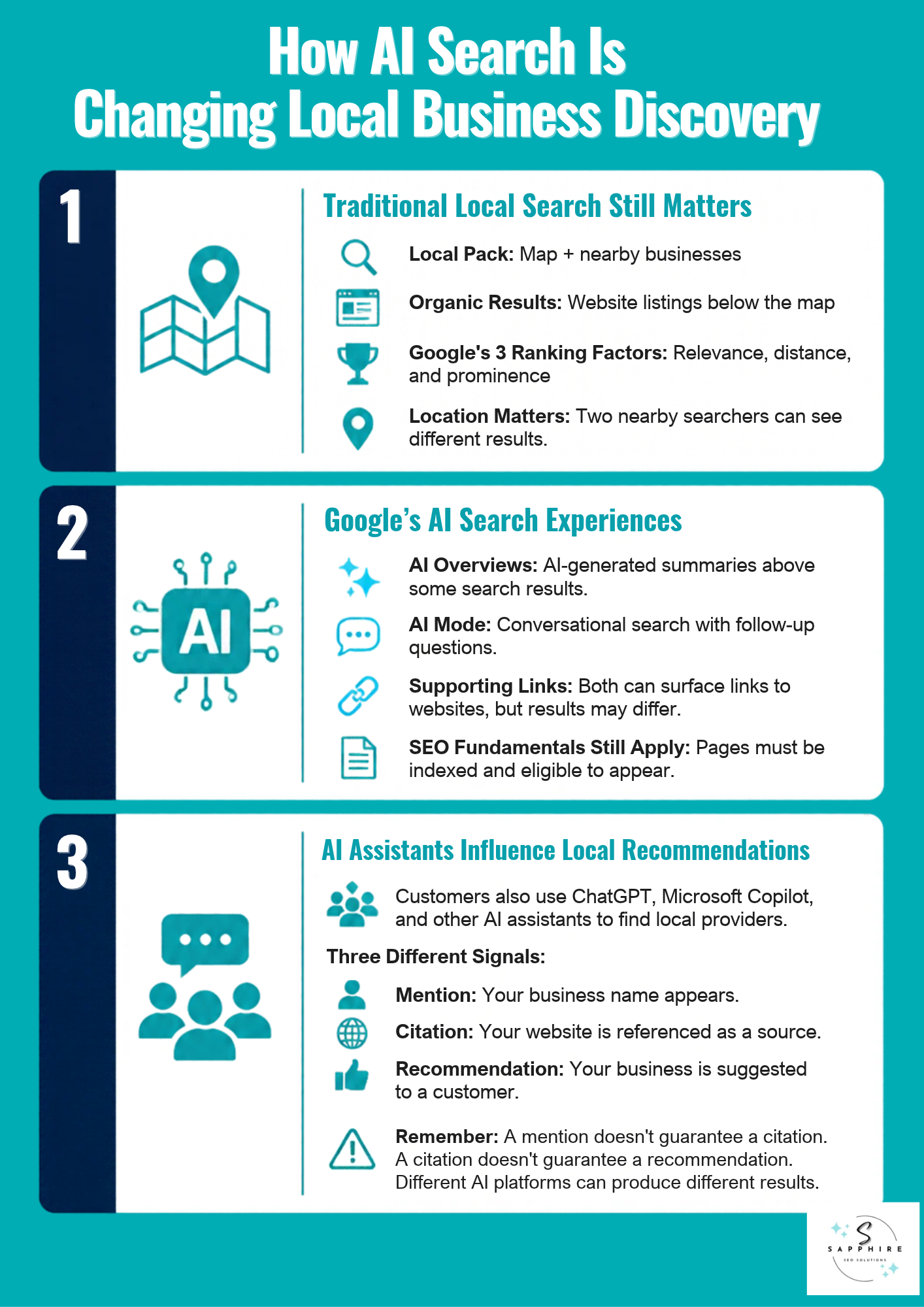
Start with what hasn’t gone away. Search for a landscaper, and Google picks up the local search intent, so Google Maps and Google search show local search results: a map with a few nearby businesses of that business type, called the local pack, then regular organic listings below.
So how does Google decide the order? Mostly through relevance, distance, and prominence. Local relevance is how well a profile matches the search. Distance is how far the business sits from the searcher. Prominence is how well known it is, reviews included. Because location counts, two neighbors can see different lists.
Google’s AI Overviews and AI Mode
AI-generated summaries, called AI Overviews, sit above some results. AI Mode is a separate, conversational experience where people ask longer questions, then follow up. Both give an AI-generated answer with supporting links to websites. The two can show different links, too.
Neither shows up for every search. Google’s documentation says the AI features need no special optimization, and that the SEO basics search engines have always rewarded still apply. A page still has to be indexed and eligible to show with a snippet, though.
Conversational AI and Local Business Recommendations
Customers also use ChatGPT, Copilot, and other AI systems to research providers. OpenAI says ChatGPT can use a shared device location for questions about nearby businesses, and it warns that citations can be incomplete, outdated, or incorrect. Copilot draws on Bing’s search results.
Now picture a neighbor. A mention is someone saying your company’s name. A citation is someone pointing to your website as the source. A recommendation is someone saying, “Call him.” One doesn’t guarantee the others. And platforms retrieve and present information differently, so local business recommendations from one assistant tell you little about another.
How AI Search Is Changing Local SEO for Small Businesses
Here are a few ways AI search is changing local SEO for small businesses:
Customers Can Research More Detailed Questions
Google says people using its AI features ask longer, more specific questions, then follow up to dig deeper. Local customers are no different. Take a homeowner (an illustration, not a real client) who skips “landscaper near me” and asks instead: who handles drainage on a sloped yard, what does a retaining wall usually cost, and who could start before spring?
A company with a one-paragraph services page can’t answer any of that. One that explains what it builds, what changes the price, what qualifications it holds, and how soon it can start gives her something to compare.
Local Visibility Extends Beyond Traditional Rankings
Local search visibility now has more than one scoreboard. Local search rankings show where your business sits on the map and in results. Organic clicks count the visits that follow. An AI citation is a linked source inside an AI answer. A mention is the answer naming you. A conversion is the call, form, or booking.
But those five can move separately. Because Google’s AI features can run several related searches behind one question, called query fan-out, the pages they cite may not match the top search rankings for your customer’s exact wording. Studies comparing top-10 results with AI citations have landed far apart, so strong local rankings don’t guarantee a citation. Track all five, because local visibility is no longer one number.
Credibility Helps Customers Compare Providers
Back to our homeowner. Three landscapers all promise great service. Only one of these local brands shows photos of a finished drainage job, reviews from customers who describe it, and a team page listing who holds which certification. That’s the one she calls.
Google’s guidance backs the instinct. It asks for original content that helps people, and for Business Profile information that’s up to date. Reviews count toward local ranking, too.
Qualified Leads Remain the Business Priority
Local SEO results only count when the phone rings. When your business appears in a map listing or an AI answer, what matters is whether it turns into a call, a quote request, a booking, or revenue. A mention alone isn’t a job. Google Business Profile reports can show calls, direction requests, website clicks, messages, and bookings. Direction requests can hint at foot traffic if customers visit you.
Then sort the leads. A call from outside the area where you serve customers isn’t worth the same as a quote request for your best service. So track lead quality, not just lead count.
How to Optimize Local SEO for AI Search: Six Practical Priorities
Google’s guide on generative AI search says the work is still SEO. So these six priorities start with traditional local SEO, and none of them promise AI visibility.
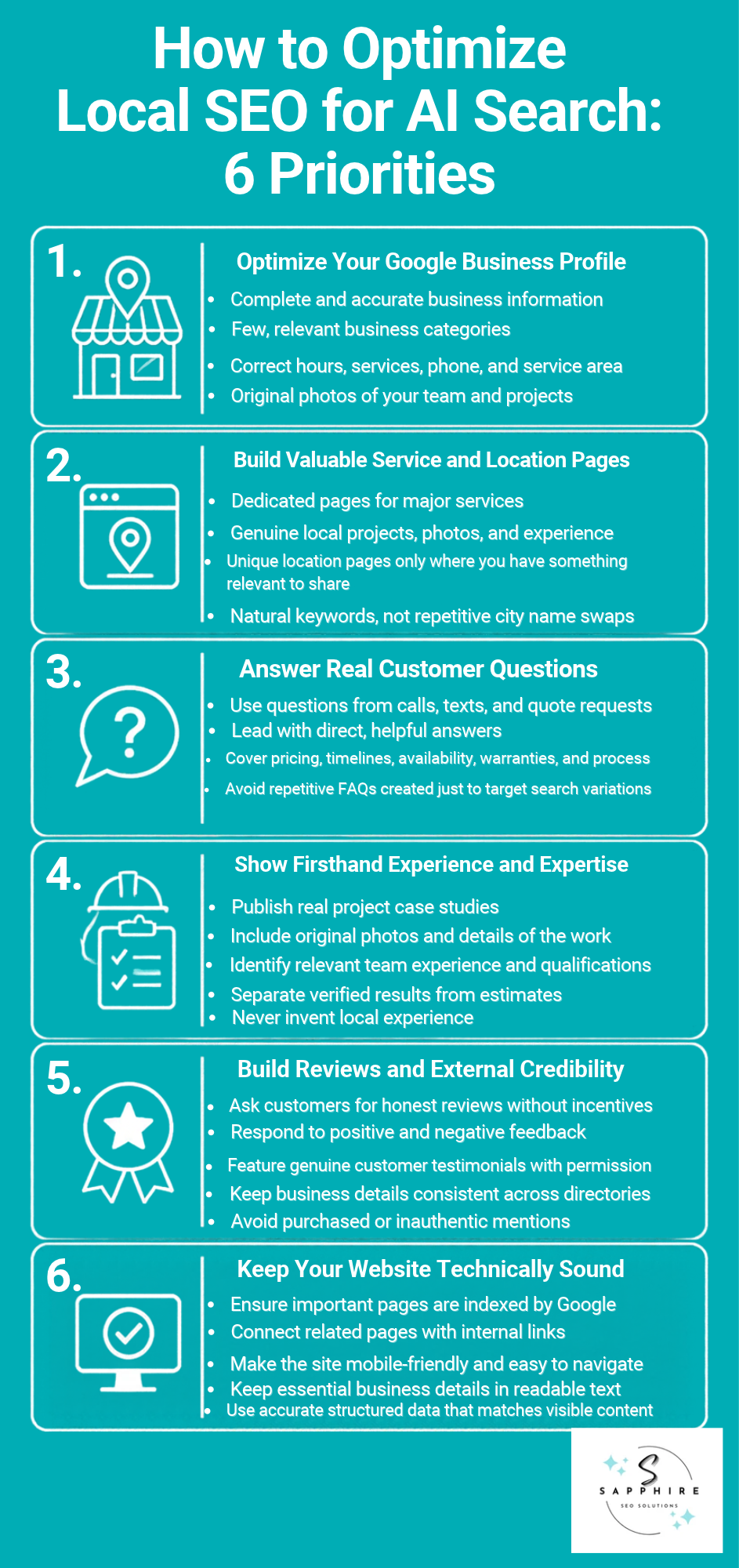
1. Keep Your Google Business Profile Accurate and Relevant
A complete Google Business Profile is your listing on Google Maps and Search. Google says businesses with complete, accurate information are more likely to show up in local results. So check the basics: name, phone, hours, website, services, and address or service area.
Pick the fewest categories that describe your core business. Google asks for that, and few businesses need many. Service-area businesses get one profile with a designated area, which Google says shouldn’t stretch past roughly two hours of driving. Add your own photos of crews and finished jobs. That’s Google Business Profile optimization, and it’s plain work. No profile can promise AI visibility. It does shape what customers see on Maps and in local results.
2. Build Useful Service and Location Pages
Give each major service its own page. Among your service pages, a retaining wall page should cover what you build, how the job runs, who does the work, and which customers it suits. Add location-specific content only where it’s true, like neighborhoods you’ve worked in and local project photos.
Location pages are where many businesses try to rank locally in every nearby town. Publish one only when the place has something distinct to say. Google’s spam policies name doorway abuse, which includes pages aimed at specific cities that funnel visitors to one page. Swapping a town name into identical copy fits that description. Multi-location businesses with real offices and crews can build real pages for each. Keyword research shows how customers phrase things, and local keywords belong in natural copy. But a page for every phrase drifts into doorway territory.
3. Answer Real Customer Questions
Good local search optimization starts with your own inbox. Pull questions from phone calls, quote requests, and texts, then answer them on the page. Lead with the direct answer. “Price depends on wall height, materials, and drainage” beats three paragraphs of warm-up.
Cover pricing factors, timelines, availability, warranties, and process wherever customers ask. But don’t paste fifty near-identical FAQs across fifty pages. Google’s AI search guide warns against separate content for every possible search variation, made mainly to manipulate results. That kind of content optimization doesn’t help anyone choose a contractor.
4. Demonstrate Firsthand Experience and Expertise
Google’s AI search guide stresses unique content, the kind only you could write. Write a case study. Describe the problem, what your crew did, and what happened, with your own photos. Name who did the work and what qualifications they hold. Then separate what you verified from what you’re estimating. “The yard drained within a week, based on our follow-up visit” is a documented result. “Should reduce flooding” is an estimate, and it should read like one. Never claim local experience you don’t have.
5. Strengthen Reviews and External Credibility
Ask every customer for an honest review through the link or QR code in your profile. Google treats incentives like discounts as fake engagement and strictly prohibits them. Reply to reviews, good and bad, in short, plain sentences. That routine is most of review management. Review monitoring just means checking Google and other review sites often. Add real local testimonials to service pages, with permission.
Then look outside your site. Google says prominence draws on information from across the web, including links, articles, and directories. So keep your business listings consistent on major directories and local directories. Local citations are your name, address, and phone number on those sites. Data accuracy matters most with multiple locations. Skip bought mentions, too. Google says chasing inauthentic ones isn’t as helpful as it seems.
6. Make Your Website Accessible, Clear, and Technically Sound
Google needs to find and save your pages before it can show them. Check that your main pages are indexed (saved in Google’s library), that internal links connect related pages, and that the site works on a phone. Put important details, like services and hours, in readable text, not only in images.
Structured data (schema markup) is code that labels details, like your address and hours, for search engines. Use it only when it matches what visitors can see, because Google’s guidelines say not to mark up hidden content. Google says no special AI markup is needed to appear in its AI features, and Google Search doesn’t use llms.txt files. Keep business information the same everywhere.
Those are traditional SEO checks, and AI features rely on them: a page must be indexed and snippet-eligible to appear as a supporting link.
Quick Checklist
Profile details match real life: categories, hours, service area, phone
Photos are your own and recent
Each major service has a useful page
Location pages exist only for real places
Common customer questions are answered near the top
Reviews are requested honestly and answered
Directories, website, and profile show the same details
Hypothetical example (not a real client): A landscaping company finds an old phone number on two directories and a long list of Google categories. It fixes the number, trims the categories, and adds photos of recent jobs. Its retaining wall page grows from two sentences to a full page covering materials, price factors, timing, and who builds it. Then it writes up one sloped yard:
The problem
The fix
Before-and-after photos
What a follow-up visit showed
How to Improve Your Chances of Appearing in AI Search Answers
Google says AI Overviews and AI Mode have no additional technical requirements beyond being indexed and eligible to show with a snippet. So everything below is a recommended content practice or a working guess for AI SEO, and we’ll flag which.
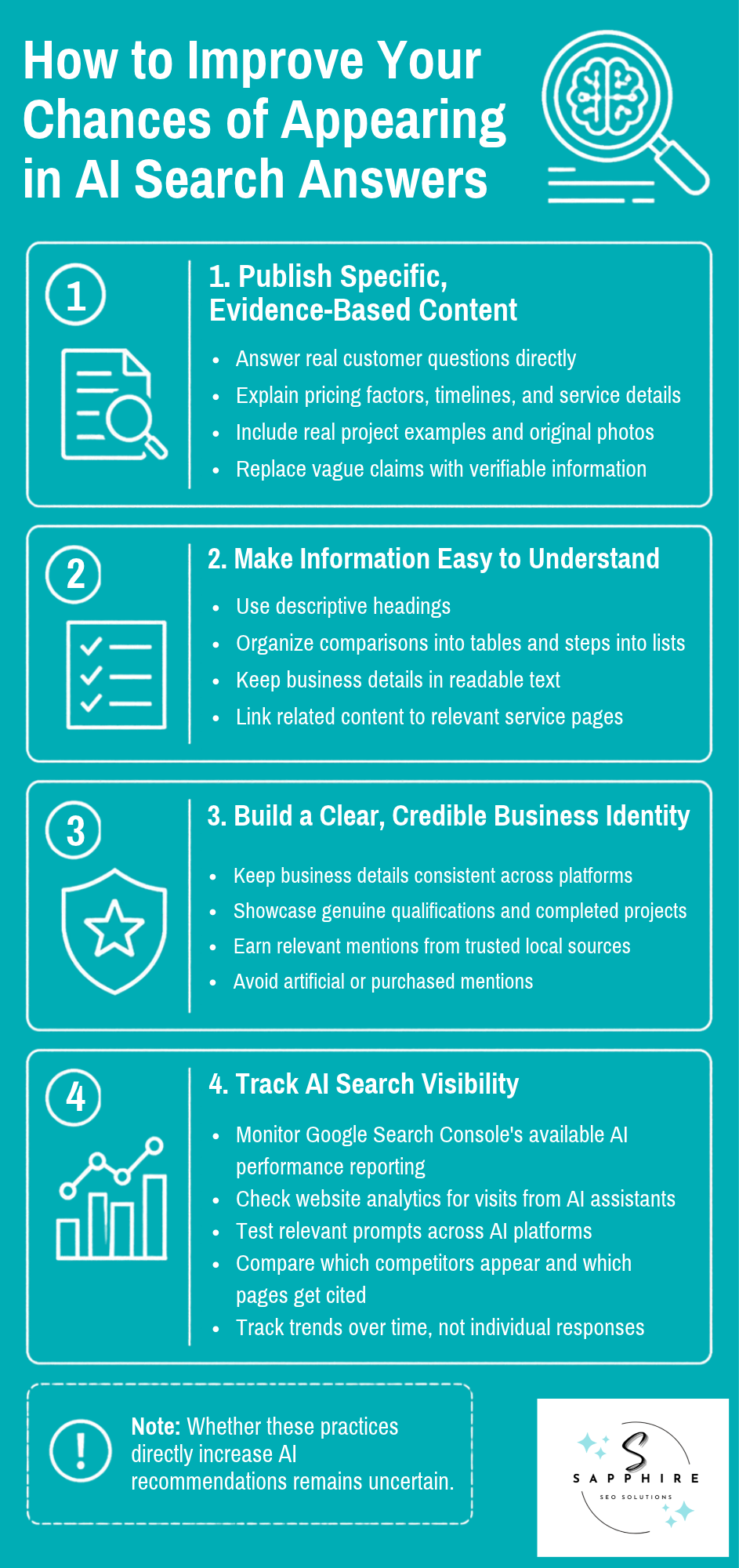
Publish Specific, Evidence-Based Information
Recommended practice: Answer the question a customer would actually ask, then back it up. Say how long a retaining wall takes, what changes the price, and what you’ve seen on real jobs. Vague claims like “great service” give an AI answer nothing to quote and a customer nothing to trust. Original photos and lessons from your own crews do both jobs.
Make Important Information Easy to Understand
Recommended practice: Write headings that say what the section covers, like “What a Retaining Wall Costs,” not “Our Approach.” Use a table to compare options and a list when order matters. Keep hours, service area, and pricing details in plain text. Link related pages to the right service page. Do clear pages also help AI systems pick you? That’s still a hypothesis.
Establish a Clear and Credible Business Identity
Recommended practice: Keep your name, address, phone number, and services identical on your site, Google profile, and listings. Show real qualifications and real work, with names attached. Earn mentions where they fit, like a supplier’s project page or a chamber of commerce listing.
Still a guess: whether genuine mentions raise your odds in AI answers. Google hasn’t confirmed it, and it says chasing inauthentic ones isn’t as helpful as it seems.
Test and Monitor AI Visibility
Recommended practice: Open Search Console’s generative AI performance report, which Google added in June 2026. It shows which pages appeared in AI Overviews and AI Mode, and how often. Then check analytics for visits from assistants like ChatGPT. Clicks from Google’s AI features usually count as regular organic traffic, so they won’t stand out there.
Next, run a few manual prompts, like “best landscaper near [your town],” and try the same ones for local competitors. That’s basic competitor analysis: who shows up, and which pages get cited? But treat results as snapshots, because Google says AI responses and links vary, and OpenAI says citations can be incomplete or wrong. Judge AI visibility by trends across pages, not one prompt.
How to Measure Local SEO and AI Search Performance
Here's how you can measure your local SEO and AI search performance:
Measure Traditional Local Search Performance
Start with free tools. Google Search Console shows which searches surfaced your site, how many clicks followed, and how each page performed. Your Business Profile adds maps data:
Calls
Direction requests
Website clicks
Messages
Bookings
In Google Analytics, track organic visits to your priority service and location pages.
Rankings shift with the searcher’s location, so one search from your office misleads. Local rank tracking checks many map points, a fairer read on your Google Maps visibility. A local rank tracker automates them, and plain rank tracking from one spot can hide gaps. Among paid local SEO tools, a dedicated local SEO platform tracks rankings and builds reports, while Moz Local focuses on listings. Pick SEO tools with easy-to-read reports.
Monitor AI Visibility with Available Tools
Google added Generative AI performance reports to Search Console in June 2026. They show how often links to your pages appeared in AI Overviews and AI Mode, by page, device, and date. That’s impressions only, with no clicks or queries. Bing Webmaster Tools has an AI Performance report, in preview since February 2026, covering Copilot and select partners. It lists citations by page and by grounding queries, the phrases the AI used to look up content.
Cited-page trends show where to look next. But a citation isn’t a ranking, a click, or a conversion, and no report exposes every AI prompt. AI tools that run prompts for you only sample answers.
Connect Visibility to Qualified Leads
Visibility only counts if it ends in work. Track qualified calls, quote requests, bookings, and sales where you can. Google Analytics, call tracking, and a CRM (even a spreadsheet) can connect visits to jobs. Lead volume isn’t lead quality, and neither is revenue.
Attribution has gaps, though. Someone may read an AI answer, search your name later, and call, which analytics could log as direct traffic. Treat attribution as a clue, not proof. Keep four layers apart:
SEO Measurement Framework
| Layer | Example Metrics |
|---|---|
| Visibility | Impressions, AI citations, map rankings |
| Engagement | Clicks, calls, direction requests |
| Qualified leads | Quote requests from your service area |
| Revenue | Booked jobs and sales |
Establish a Baseline and Review Trends
Record numbers before you change anything. Search Console keeps about 16 months of data, so export it. Write down what you changed and when. Compare like with like, such as this March against last March, because lawn care and HVAC swing with the seasons. Set targets from your own numbers and priorities. And when results move, don’t credit one change without evidence.
A Practical 90-Day Local SEO and AI Search Action Plan
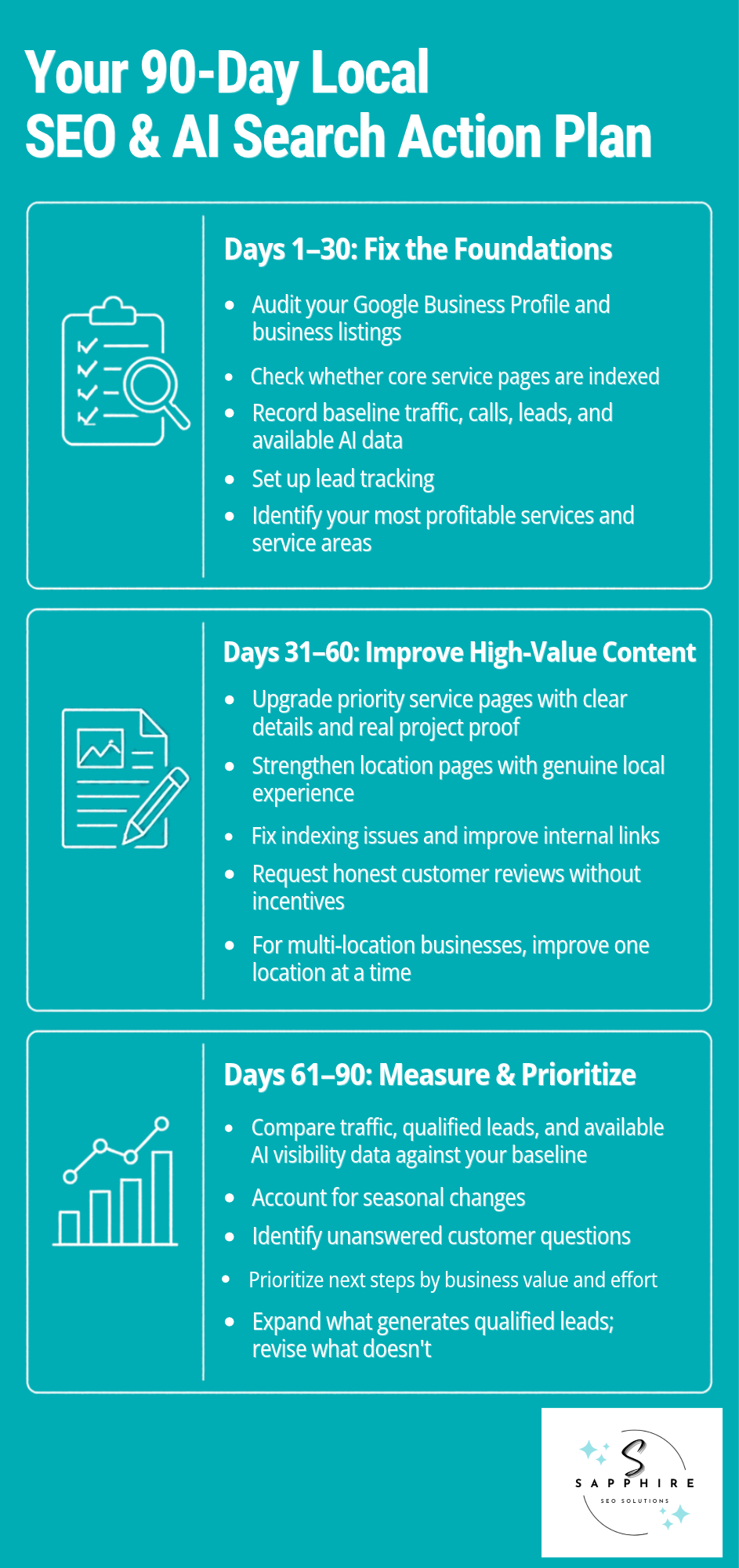
Treat this as a suggested order of work, not a results timeline. Google has said SEO usually takes four months to a year to show benefit, so 90 days is a first pass for small businesses, not a finish line. Skip any step that doesn’t fit your business.
Days 1–30: Fix the Foundations
Audit before you build. Check your Business Profile and main listings for wrong details, and confirm your core service pages are indexed. A one-page note works fine. Write down what’s wrong and who fixes it.
Then record your starting numbers:
Search Console
Business Profile calls
The AI report if you have one
Set up lead tracking too, so a quote request doesn’t look like a wrong number. Finally, list the services and service areas that earn the most money. Everything later starts there.
Days 31–60: Improve High-Value Content
Work from your Days 1–30 list, starting with the services that earn most.
Rewrite priority service pages with clearer explanations, pricing factors, real photos, and proof
Strengthen location pages only where you have something local to say, such as real projects and staff
Fix technical problems, like pages Google can’t index, and link related pages together
Ask customers for honest reviews after finished jobs, never with incentives
And if you run a multi-location business, do these steps one location at a time.
Days 61–90: Measure and Prioritize
Review organic traffic, qualified leads, and any AI visibility data against your baseline. Compare like with like, since seasons matter. Look for content gaps, meaning questions customers ask that your pages don’t answer. Then rank next steps by money and effort. Keep what produced qualified leads. Rework or drop what didn’t.
But some changes take longer than 90 days to show up, and nobody can promise page-one rankings or AI mentions.
Common AI and Local SEO Mistakes That Waste Time or Money
Here are some of the most common local SEO mistakes in the era of AI search:
Abandoning traditional SEO: Some owners drop their profile and service pages to chase AI answers. But Google says its AI features need nothing special beyond indexed, snippet-eligible pages, so skipping the basics can leave you out. Keep local and technical foundations sound.
Publishing generic AI content at scale: AI can help with research and structure. But using it to mass-produce pages that add nothing may violate Google’s scaled content abuse policy, and you still pay for pages no customer needs. Write fewer pages with real details from your jobs.
Creating thin location pages: Swapping a town name into a page for every nearby town costs writing time and can fall under Google’s doorway abuse policy. Publish one only where you have real work, staff, or an address.
Buying reviews or artificial mentions: Paid reviews break Google’s rules, and the FTC can seek civil penalties over fake ones. Google also says chasing inauthentic mentions isn’t as helpful as it seems. Ask real customers instead, and use review monitoring to catch problems early.
Chasing citations without measuring leads: A mention in an AI answer doesn’t pay invoices. Without tracking calls and quote requests, you can spend months celebrating visibility that never becomes jobs. Check citations against qualified leads. The free reports covered earlier handle most of that.
Buying guaranteed AI rankings: Google says no one can guarantee a #1 ranking, and AI answers vary by platform and prompt. A promise of specific placements is a red flag. Ask any agency what work it will do and how it will measure results.
Should Your Business Invest in Local SEO, AI SEO, or Both?
For a small business trying to boost its online presence, local SEO is important. However, it shouldn’t overlook AI SEO.
When Local SEO Should Come First
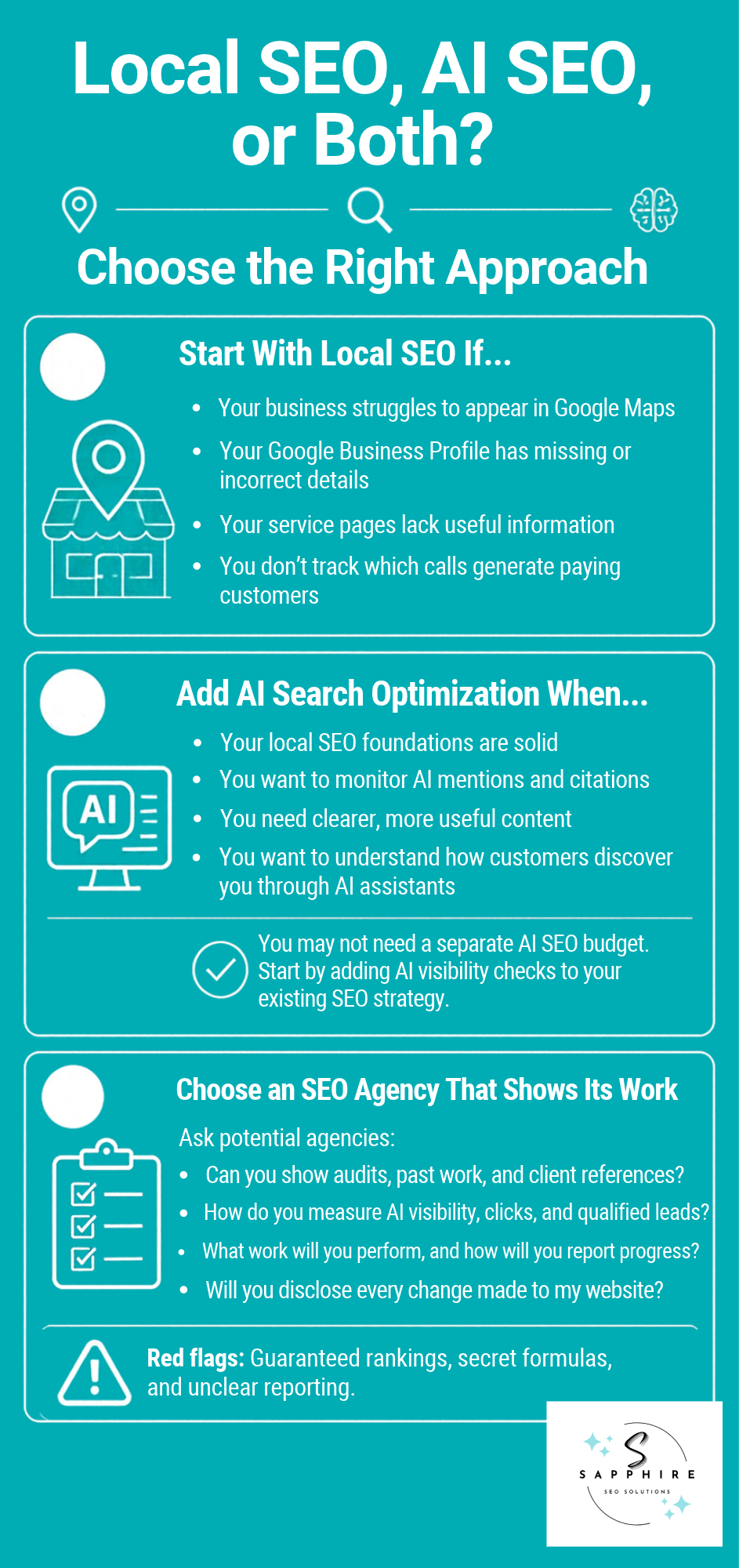
For most businesses, local SEO comes first. Google says its AI features need no special optimization, and a page has to be indexed before it can appear as a supporting link anyway. So start there if any of these sound familiar:
You barely show up in Maps or local results
Your Business Profile has gaps or wrong details
Your service pages are thin or vague
Nobody tracks which calls turn into jobs
Fixing those beats chasing AI mentions.
When AI Search Optimization Should Be Part of the Strategy
AI search work earns a place once the basics are solid. Maybe you want to know whether AI answers mention you at all. Maybe your content is clear, but you can’t tell where customers find you. Or your SEO plan only counts regular search results. In those cases, AI visibility belongs in the plan as a few added checks: reading the AI reports, testing prompts, and tightening content. It doesn’t always need a separate budget.
How to Choose the Right SEO Agency
Google itself says a small local business can probably do much of the work itself. If you’d rather hire help, pick an SEO agency that shows its work. Ask:
Can I see a sample audit and examples of past work, with references?
How do you tell AI citations from clicks and qualified leads?
What will you do, how will you report it, and in what timeframe?
Will you share every change you make to my site?
Be wary of guarantees and secret ranking formulas. Google says no one can guarantee a #1 ranking. During an audit, give read-only Search Console access, as Google advises.
If you want a second opinion on where to start, contact Sapphire SEO Solutions to talk to our team about your search visibility and lead-generation priorities.
More Resources on Local SEO to Explore
Check out the following guides to learn more about local SEO for small businesses:
Build Search Visibility That Supports Business Growth with Sapphire SEO Solutions
AI is changing how customers find and compare businesses. Your local basics still matter, though. Get your business information right. Build service pages that answer real questions. Show proof, like honest reviews and finished jobs. And track leads, not just visibility.
Good local search optimization doesn’t need a big overhaul to start. Begin with a focused audit, then fix what affects your best-earning services first. Nobody can promise rankings or AI recommendations. What you can control is the work in front of you.
Want to optimize your website to appear in relevant local searches? Check out our local SEO services today.
Need help sorting priorities? Contact us to schedule a free consultation with a local SEO specialist!

Frequently Asked Questions About AI and Local SEO
What Is the Relationship Between AI and Local SEO?
Google says the best practices for SEO remain relevant for its AI features, and a page must be indexed and eligible for a snippet to appear as a supporting link. So local foundations, like accurate details and useful pages, support discovery in both.
Does AI Search Affect Local SEO Rankings?
Conventional local rankings, like Maps positions and the local pack, are one thing. Appearing in an AI-generated answer is another. AI answers can cite different pages than the top results, so a strong ranking doesn’t guarantee a citation. Track both.
How Can I Get My Local Business Recommended by AI?
Nobody can promise a recommendation. You can make it easier, though. Publish useful pages that match search intent, meaning what customers are actually after, with specifics from your real jobs. Keep business details accurate, earn honest reviews, and check your reports regularly.
Does Google Business Profile Help With AI Search Visibility?
It anchors your presence in Google Maps and local results, where Google says complete, accurate information makes a business more likely to show up. Google hasn’t said a profile earns AI inclusion, though, so treat it as a foundation for local discovery, not an AI shortcut.
Is Traditional Local SEO Still Worth Investing In?
Yes, because customers still use Maps, local results, and websites to compare providers. Accurate business information, useful pages, and visible reviews serve those customers, whatever search tool they pick. Worth the effort, as long as you measure calls and jobs, not just rankings.
How Can I Track My Business’s AI Search Visibility?
Search Console’s Generative AI performance report shows impressions in AI Overviews and AI Mode, by page. Bing Webmaster Tools has an AI Performance report covering Copilot citations. Check analytics for assistant referrals, too. None of it shows every prompt or proves leads, so pair it with call and quote tracking.
Do Small Businesses Need a Separate AI SEO Strategy?
Usually not at first. Google says SEO best practices still apply to its AI features, so AI checks can fold into one plan. A separate effort makes sense once the basics are solid and you need deeper measurement.