

Yes, Google reviews can help your local rankings. Google says so itself: more reviews and positive ratings can help a business show up higher in local results. That’s one part of search engine optimization (SEO), which is the work of getting your business online to show up when people search.
Reviews do a second job, too. Most people read online reviews before they call, so your stars and comments help decide who gets the job.
But the Google search engine looks at a lot more than reviews, and no review count guarantees a spot. Ahead: what matters, how to earn honest reviews, how to size up competitors, and how to measure results.
Key Takeaways
Google confirms reviews can help local rankings, but publishes no formula or review count that guarantees a top spot.
Customers read reviews before calling (97% in BrightLocal’s 2026 survey), but that’s a trust effect, not a confirmed ranking signal.
Reviews help local pack and Maps results. Google hasn’t confirmed a direct boost for standard website listings.
A competitor with fewer reviews can outrank you through distance, relevance, category, and links. Check those before chasing more reviews.
Google bans incentives, selective asking, specific wording requests, and staff review quotas. Ask every customer the same way.
Replies build trust, but Google hasn’t said they boost rankings. Write specific replies; 50% of consumers dislike templated ones.
Reviews are one piece of local ranking. A wrong category, thin service pages, or an inaccurate profile can hold you back.
Measure Business Profile actions, Search Console, and real leads over time. A rise alongside reviews is a clue, not proof.
Do Google Reviews Help SEO?
The short answer to “do Google reviews help SEO?” is yes, for local search rankings. Google’s own help page for Google Business Profile says it directly: more reviews and positive ratings can help a business’s local ranking.
Google sorts local results using three main factors:
Relevance is how well your listing matches the search.
Distance is how far you are from the person searching.
Prominence is how well-known you are.
Reviews feed into all three, along with links from other websites. Picture the contractor everyone knows who also happens to be two streets over. He gets the call.
But reviews are only part of what Google sees, and nobody outside Google knows how much one counts. Google keeps those details private, and you can’t pay for a better spot. So Google reviews help, yet no review count or star rating guarantees a position.
One split matters. The local pack (the map and three listings above everything else for searches like “roofer near me”) runs separately from standard website results. Those have their own search engine ranking, and your site’s SEO ranking there isn’t something Google says reviews lift. Google ties reviews to local results, not every page.
And ranking isn’t the whole game. A high Google ranking gets you seen. Positive reviews help get you chosen.
How Do Google Reviews Affect Local SEO?
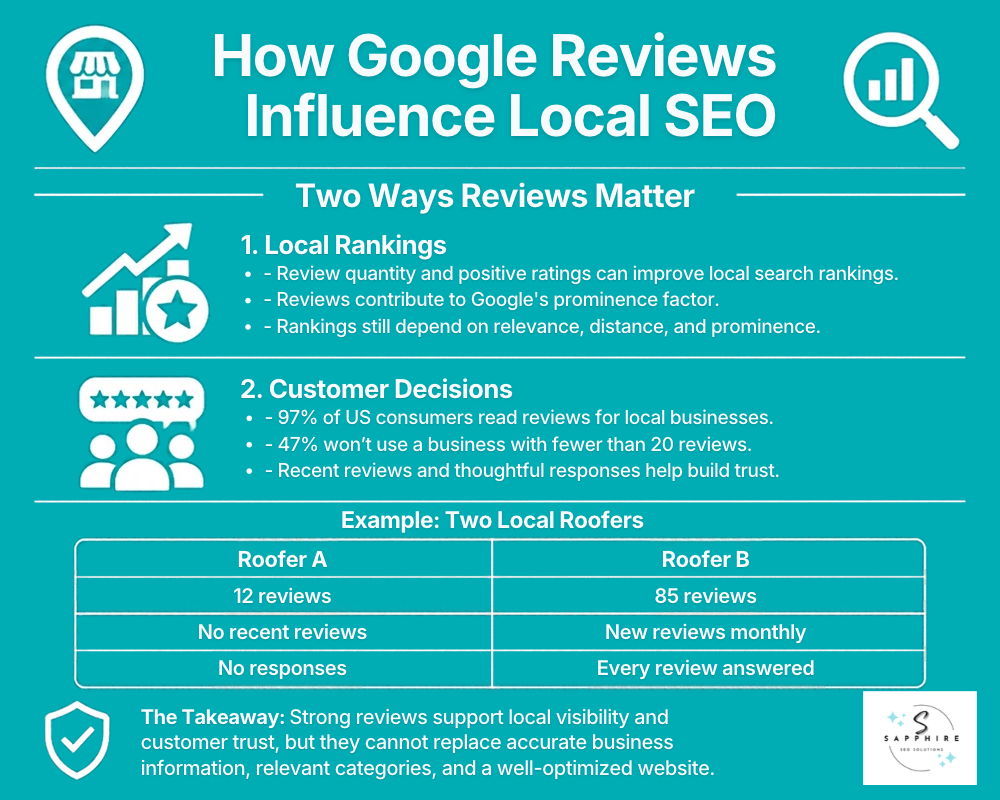
Reviews play a key role in local SEO because they feed prominence, Google’s “how well-known are you” factor. But reviews help in two separate ways, and they’re worth keeping apart.
The ranking side. Google says review count and positive ratings can help your local search ranking. Whether reviews carry more weight than distance or relevance isn’t something Google has said.
The customer side. People comparing local search results read the stars and a few comments before they call. BrightLocal’s 2026 survey of 1,002 US adults found that 97% read reviews for local businesses, and 47% won’t use one with fewer than 20. Google’s guidance doesn’t say those calls or clicks push a listing higher.
Take two roofers in the same town as an example:
Roofer A: 12 reviews, the newest over two years old, no replies.
Roofer B: 85 reviews, new ones every month, each one answered.
Both could land in the local pack on Google Maps. Customers will likely call B. Who ranks first still depends on distance, relevance, and more.
So judge reviews alongside the rest of local search: profile details, categories, website. Great reviews can’t fix the wrong category in local results, and low visibility leaves good reviews unseen.
Which Google Review Factors Matter Most for Local SEO?
Google confirms only a few things about reviews. The rest is smart practice, and it helps to know which is which.
Review Quantity and Overall Rating
Google says more reviews and positive ratings can help local rankings. That’s the confirmed part. Nobody outside Google can say how many reviews you need, and Google hasn’t set a star rating you must hit.
So how do you earn more positive reviews? Ask every customer when the job is done. Make it a normal part of closing out work, so reviews show up steadily.
Checking competitors’ reviews shows what’s normal in your area. Compare a few businesses that match yours in size and services. Treat their numbers as a reading, not a target, because matching a rival’s count won’t guarantee you outrank them.
Review Recency, Detail, and Owner Responses
Google’s public guidance doesn’t set a recency cutoff, a minimum length, or a ranking boost for replying. Treat these as trust practices for customers, not ranking tricks.
Recent reviews show a business still does good work. In BrightLocal’s 2026 survey, 74% of consumers looked for reviews from the last three months. That’s customer habit, not a Google rule.
Quality reviews are specific. “Showed up on time and cleaned up” beats “great!” But specific doesn’t mean long. Only 26% said a long, detailed review makes them trust it, while 56% pointed to other reviews backing it up.
Replies matter too. Google says helpful replies can help a business stand out. Write like a person, since templated replies put off 50% of consumers.
Don’t coach customers to work keywords like your city or service into a review. Google ties relevance to how well your profile matches a search, so fill that out fully and let customers say whatever feels relevant to them.
Why Does a Competitor with Fewer Google Reviews Rank Higher?
A rival with fewer reviews can rank higher than you. Reviews are one input. Google also weighs relevance, distance, and prominence, and a business can win on the other two.
Distance is the easy one. When potential customers search from a spot closer to a company, that company gets an edge. Relevance counts too: a profile that closely matches the search, through its category and services, can beat one that doesn’t. And prominence includes links from other websites, so a well-known brand can climb on more than stars. But distance doesn’t explain every gap, and matching a rival’s review count won’t guarantee you pass them.
In Whitespark’s 2026 survey of 47 local SEO experts, primary category ranked first and proximity second, out of 187 factors. That’s expert opinion, not Google’s word.
Run this check on your top competitors:
Relevance: Search your target phrase. Who shows up, and why?
Profile: Compare primary categories and listed services.
Website: Put their service pages next to yours.
Prominence: See who links to them and where else they appear.
Results shift by searcher location and query, so test from a few spots. Users in different neighborhoods see different listings. Reviews make you look trustworthy, but they can’t fix a weak profile.
How to Get More Google Reviews Without Violating Google's Policies
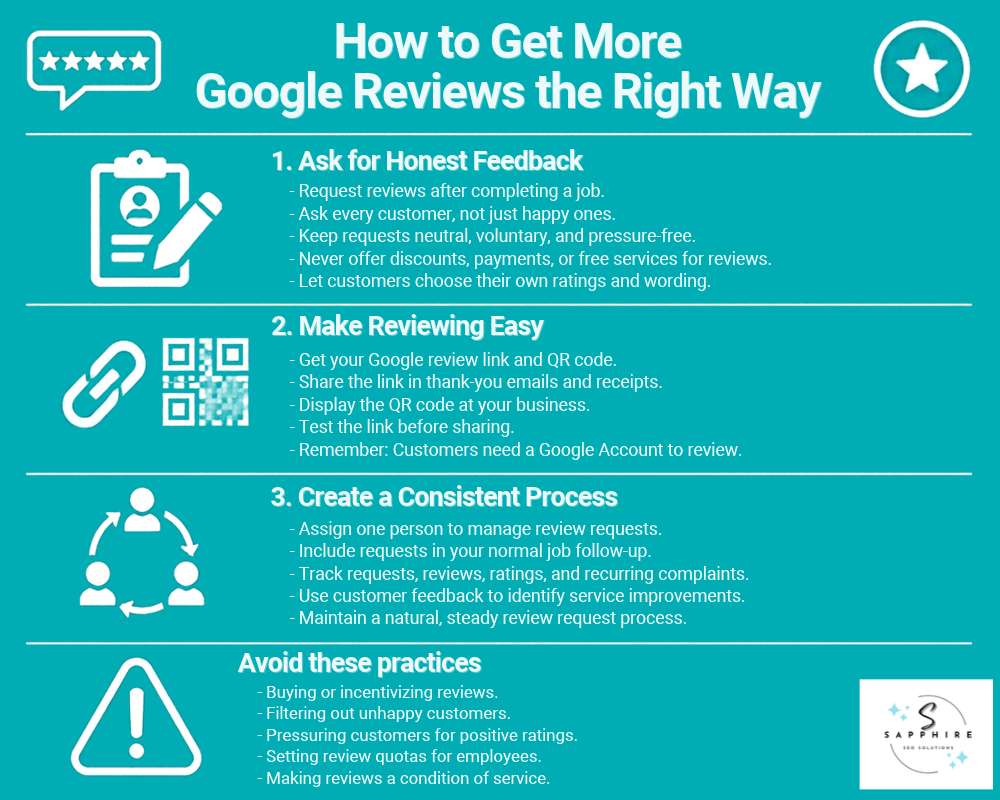
Managing Google reviews comes down to a few habits. Google lets you ask. It doesn’t let you steer, pay for, or filter what comes back.
Ask Customers for Honest Feedback
Ask once the job is done, while the customer experience is fresh. A follow-up text or email beats pressing someone on your premises, since Google’s policy says not to pressure people to leave ratings or reviews there. Keep it neutral and voluntary: “If you have a minute, we’d value your honest customer feedback.” Then stop. Don’t suggest a star rating or wording.
Ask everyone the same way. Skipping unhappy people, or asking only happy customers, counts as selectively soliciting positive reviews, and Google prohibits it. You can encourage customers to leave reviews. You can’t offer a discount, a free service, or payment for one. The goal is genuine reviews in the customer’s own words, which Google treats as user-generated content that must reflect a real experience.
Make Leaving a Review Easy
Fewer steps means more reviews. Google gives every Business Profile a review link and QR code. To get yours:
Open your Business Profile on a computer.
Select Read reviews, then Get more reviews.
Copy the link, or right-click the QR code and save the image.
Test it on your own phone.
Google suggests the link go on receipts and in thank-you emails, and the QR code on a printed sign in your shop. Customers need a Google Account to post. Never make a review a condition of service. And a QR code is a convenience, not a ranking trick.
Build a Consistent Review Request Process
Pick one person to own the process. Build the ask into your normal job wrap-up, like the invoice or follow-up email. Skip staff quotas, though. Google’s policy lists asking staff to solicit a certain number of reviews as a violation.
Then track it: requests sent, reviews received, ratings, and recurring complaints. Consistent feedback about late arrivals or messy cleanups shows where service needs work. Fix that, and honest reviews build trust by themselves. Keep the pace steady, too. Google’s policy targets unusual review volumes that look like manipulation, and nothing in its guidance says a sudden burst helps rankings.
How Should You Respond to Positive and Negative Google Reviews?
Google says replies are public and can build trust. Keep them short and human.
Responding to Positive Reviews
Reply to a positive review as you’d talk to the customer. Thank them by name and pick up on something in their comments, such as “Glad the crew left the yard spotless.” Skip the sales pitch. Google asks for conversational, not promotional. And don’t post the same reply everywhere: in BrightLocal’s 2026 survey, 50% of consumers were put off by templated responses.
Responding to Negative Reviews
A negative review stings, so wait until you’re calm. Acknowledge the problem, apologize if it’s fair, and say what you can do. Never argue or reveal private details about the job. For anything complicated, invite them to call or email. Google notes a good reply may even lead the customer to update their review. Then look for patterns. If several reviews mention late arrivals, that’s a scheduling problem.
What If a Review Is Fake or Violates Google’s Policies?
You can report any review: open your Business Profile, select Read reviews, choose Report, pick a reason, and send. But only reviews that break Google’s policies can be removed, and Google says not to report one just because you disagree with it. Evaluation typically takes several days, and a denied report gets one appeal. Meanwhile, post a calm public reply. Readers notice how you handle it.
Google Review SEO Mistakes That Can Backfire
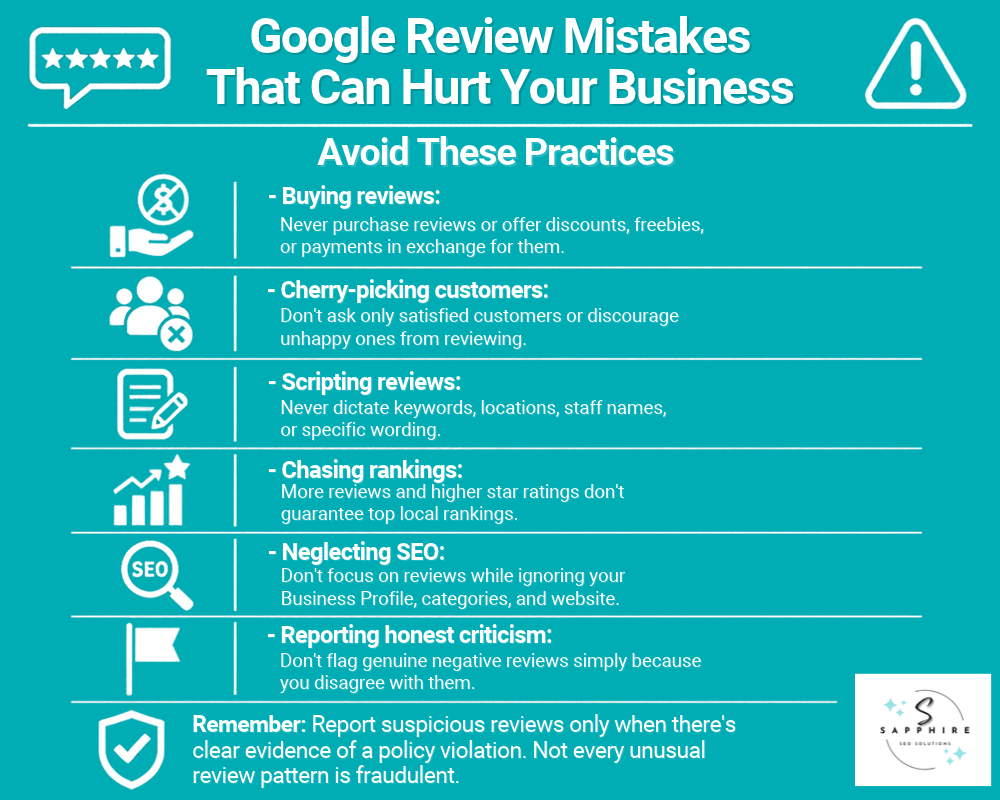
Most review trouble comes from trying to speed things up. Google’s Maps policy prohibits fake engagement, incentivized reviews, rating manipulation, and requests for specific review content. Watch for these:
Buying fake reviews, or offering discounts and freebies for any review. Google bans both. The FTC’s 2024 rule also bars buying reviews and allows it to seek civil penalties from knowing violators.
Asking only happy customers, or steering unhappy ones away from public feedback.
Handing out a script with keywords, a city, or a staff name. Each review should be the customer’s own unique content, and Google bars repetitive content too.
Assuming stars or a big count guarantee a top spot.
Chasing reviews while the profile, categories, and website stay neglected.
Reporting an honest negative review because it stings. Google says not to.
Not every odd review pattern is fraud, though. A rival’s sudden spike may have a plain explanation, so report only what clearly breaks the rules.
How to Measure Whether Google Reviews Are Helping Your Business
Counting reviews isn’t the same as measuring results. Track four things side by side:
Review basics: count, average rating, and complaints or praise that keep repeating. These show how you’re managing reviews, not whether SEO is working.
Business Profile performance: open Performance in your verified profile and pick a date range. You’ll see views, calls, website clicks, directions, and messages. Google says it counts profile interactions, including activity from both unpaid results and Google Ads.
Search Console: a free Google tool showing how your website appears in Google Search. It reports impressions (how often you showed up), clicks, click-through rates (clicks divided by impressions), and the queries behind them, for up to 16 months.
Real outcomes: qualified leads and booked jobs, from your call log or job software.
None of these equals total business traffic or revenue. A Profile “call” is a button tap, not a finished conversation, and your site’s organic traffic (visits from unpaid results) can rise for plenty of other reasons.
Compare the same months year over year, since seasons, demand, competitors, and your other SEO work all move the numbers. If reviews climb and you get more clicks that quarter, that’s a clue, not proof. Reviews are hard to separate from everything else in local search, and ordinary reports can’t isolate Google’s review signals. So the honest answer is a direction, not a number. And no review count promises a set number of calls.
More Resources on Local SEO to Explore
If you’re a small business looking to improve your online presence, make sure to check out the following guides:
Are Google Reviews Enough to Improve Local SEO?
No. Reviews are one piece of prominence, not a full SEO strategy. And they often send people to your website: in BrightLocal’s 2026 survey, 54% of consumers visited a business’s site after reading positive reviews.
A few other things carry weight too:
Profile accuracy: Google says complete, correct info makes a business more likely to show up in local results.
Categories: they tell Google what kind of business you are.
Service pages: one page per main service, written for people, not search engines.
Access: links Google can follow, and a site that’s easy to use on a phone.
Wider prominence: mentions and links from other sites, directories, and articles.
For local businesses, what matters most depends on your service area, your competitors, and where you show up today. If your review count already matches nearby rivals and calls haven’t moved, a broader assessment beats chasing more reviews.
Sapphire SEO Solutions offers local SEO services to help small businesses improve their online visibility and compete with similar businesses in their vicinity. Contact us to schedule a free consultation with an experienced local SEO specialist or request a free local SEO audit.

Frequently Asked Questions About Google Reviews and SEO
How Many Google Reviews Do You Need for SEO?
How many reviews is enough? Google publishes no count you must hit. The better answer comes from your market: check a few nearby competitors with similar services, note their counts and how recent their reviews are, and set a realistic growth goal from there. Customers have their own bar, though. In BrightLocal’s 2026 survey, 47% wouldn’t use a business with fewer than 20 reviews. That’s customer behavior, not a Google rule, and review count alone never decides rankings.
Do Keywords in Google Reviews Help SEO?
Google confirms that review quantity and positive ratings can help local rankings. Its public guidance doesn’t say that keyword-rich review text boosts rankings on its own. So don’t script reviews or steer customers toward certain words, since Google’s policy bars requesting specific content. Ask for honest feedback and leave the wording to the customer. Customer wording isn’t a ranking lever you control.
Do Responses to Google Reviews Improve Rankings?
Google recommends replying and says helpful replies can help a business stand out. It hasn’t said replies directly boost rankings, so don’t count on reply speed or volume as a ranking trick. The real payoff is with customers. BrightLocal’s 2026 survey found 80% are more likely to use a business that answers all its reviews, and 50% are put off by templated replies. Don’t expect SEO gains from automated replies, either, and generic ones can hurt trust.
Do Negative Google Reviews Hurt SEO?
Not automatically. Google calculates a place’s review score as the average of its ratings, so a lower overall rating can matter to customers, and Google says positive ratings can help rankings. But Google hasn’t said one negative review triggers a ranking penalty. Count matters here: one 1-star review drops a 4.8 average across 80 reviews to about 4.75, but across 10 reviews to about 4.45. Reply calmly and professionally, and report only reviews that break Google’s policies. Removal isn’t guaranteed.
Do Google Reviews Help Organic SEO or Only Google Maps Rankings?
Google only confirms the local side. It says review count and positive ratings can help local rankings, that is, Google Maps and the local pack. Its guidance doesn’t establish a direct boost for standard organic website listings (the regular blue links), and reviews don’t lift every page of your site. Treat the two as separate results, even when they share a results page.