

How to pick an SEO company comes down to a few checks. Find a provider that understands your business, has done similar work, explains its plan in plain English, names the tasks it will do each month, reports on calls and customers, and spells out its contract terms. Then verify all of it with case studies and past clients. A smooth sales pitch proves nothing.
That’s harder than it sounds. Every SEO agency promises more traffic, better rankings, and more leads. The differences show up months later, in who did the work, how results were measured, and who picked up the phone when things stalled.
Price won’t settle it. Neither will a big traffic number. And a guaranteed ranking should worry you, because nobody can promise one.
Choosing an SEO company means weighing the people, the plan, the proof, the reports, and the contract. The sections ahead cover the questions to ask, how to read a case study, and the warning signs worth walking away from. And even search engine optimization (getting your website to show up when people search for what you do) gets easier to buy once you know what to look for.
Key Takeaways
No one can guarantee a Google ranking. Treat guaranteed first-page results or fixed deadlines as a reason to walk away.
Big traffic percentages mislead. Ask which pages and searches brought the traffic, and whether it turned into calls and jobs.
Ask who will actually do the work, not who’s on the sales call, and what happens when you leave.
Own your accounts. Keep Search Console, Analytics, and Business Profile in your name, with the agency added as a user.
A proposal should name specific pages, fixes, and monthly tasks. Swap in a competitor’s name; if nothing changes, it’s generic.
Rankings and impressions are early signals. Reports should connect SEO work to calls, forms, and booked jobs.
Be wary of bulk backlink packages. Google treats buying links for ranking as spam, though labeled sponsorships are fine.
SEO takes time, but fair contracts and accountability can coexist. Month-to-month terms let you judge the work, not the lock-in.
Determine What You Need From an SEO Company
Here’s what you should do:
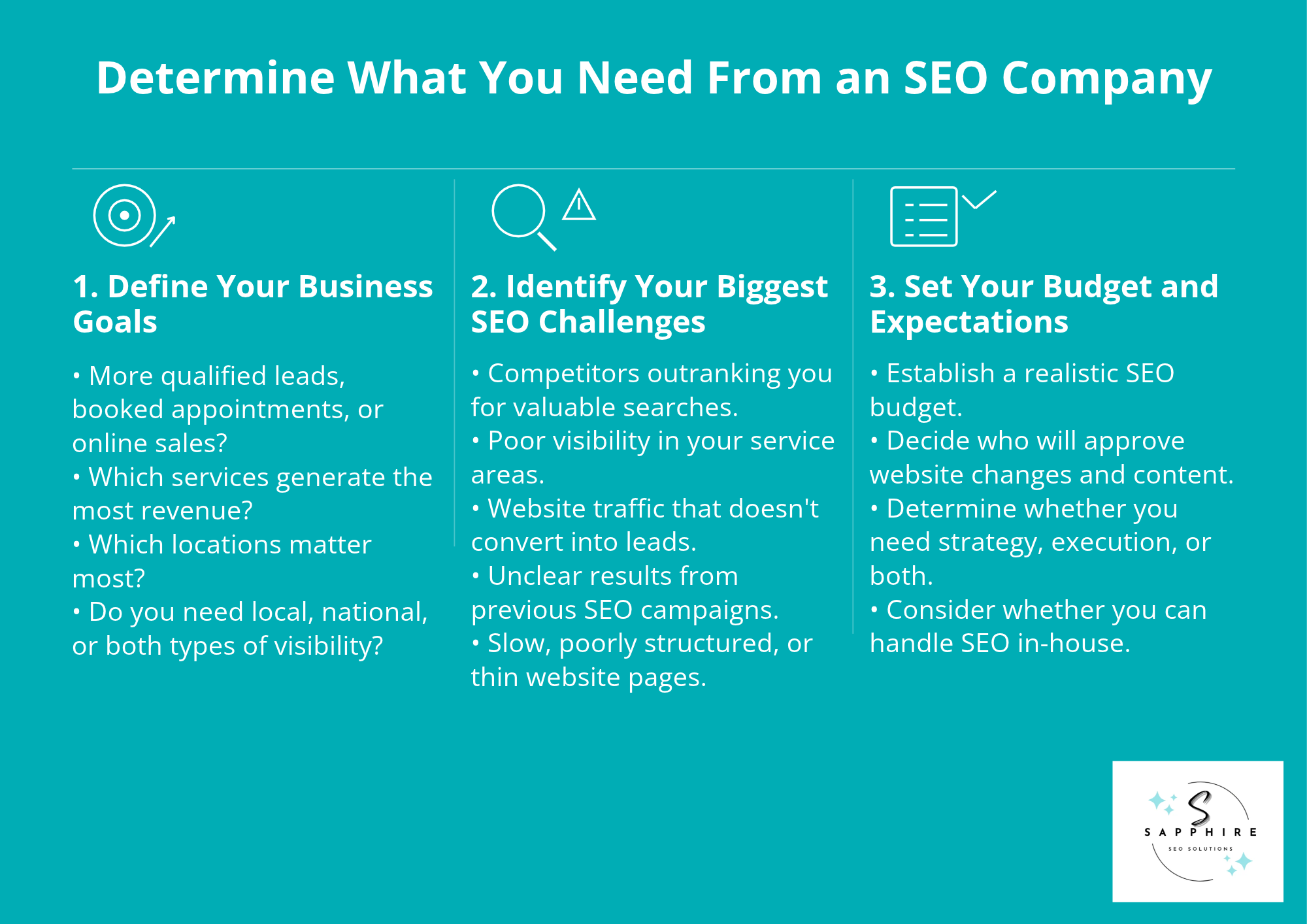
Identify Your Business Goals
Start with what a good month looks like.
A roofer might want ten more quote requests.
A dentist might want booked appointments.
An online shop wants orders.
Each one needs a different campaign because more traffic and more qualified leads are not the same thing. A qualified lead is someone ready to buy what you sell, and plenty of visitors never call. Pick the services and locations that earn you the most, then decide if you need local reach, national reach, or both. Your business model shapes all of it.
Identify Your Main SEO Challenges
Where does it hurt?
Competitors outrank you for the searches that matter
Hardly anyone in your own town can find you
Visitors show up, but nobody calls
Past SEO work left you unsure what changed
Slow, messy, or thin pages can sit behind any of these.
Establish Your Resources and Expectations
Settle on a budget before you take sales calls. Then look at your internal resources. Can someone approve new pages and website changes within days? Do you want advice only, or someone who does the work too?
And you may not need an agency at all. Google says a small local business can probably do much of the work itself. If you do hire, Google says sooner is better, and a redesign or new site launch is a good moment to bring someone in. Real business growth from search comes from steady work on the right pages, not from how big the agency is.
Decide Whether You Need an SEO Agency, Freelancer, or In-House Specialist
There are pros and cons of working with an SEO agency and a freelancer. You need to find out which one aligns with your goals.
SEO Agency vs. Freelancer vs. In-House SEO
Each option trades one thing for another.
An agency gives you a team. Technical specialists, writers, and a local search person under one roof. But you may be one small account among many, so ask who touches your site.
A freelancer or SEO consultant works close to you. That suits a focused job. But one person has limits, and a lost week can stall everything.
An in-house team knows your business cold. It also needs hiring, managing, and enough steady work to justify a salary.
Check out our detailed guide on “SEO Content Writing Agency vs. Freelancers” to find out whether an SEO agency or a freelancer is best for your business.
Match the Provider to Your Campaign Requirements
Check your own site first. Five pages for one town is a different job than forty pages across six cities. Then ask: will you do the work, or just tell me what to fix? And who handles web development or writing if it needs outside help?
Size tells you little. A good SEO agency can have five people. A great SEO company can be one sharp person with a solid process. Judge expertise, capacity, and accountability. Look for an SEO partner who owns the work, and expect reputable agencies to answer plainly. A trustworthy agency admits what it can’t do.
Google also suggests asking any provider whether they follow Google Search Essentials.
Evaluate the SEO Company's Experience, Expertise, and Team
Here’s how you evaluate an SEO agency’s expertise:
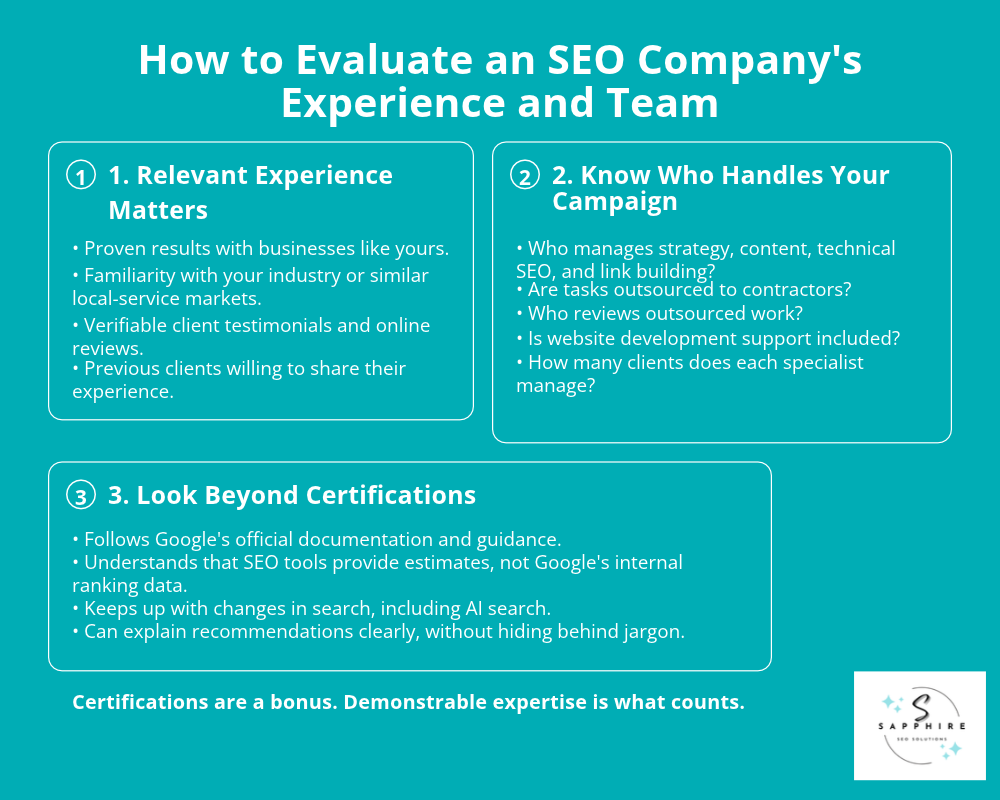
Look for Relevant Industry and Market Experience
Experience in the same industry helps. A team that has worked with roofers already knows what homeowners type into Google and what a good quote request looks like. But it isn’t required. An agency that has built plumbing leads can usually do it for HVAC, because the job looks alike: people searching nearby, ready to call. That’s local SEO, meaning you show up when someone types “plumber near me.” Ask about your area too. A proven track record with businesses like yours counts most, and it should show up in client testimonials, online reviews, and previous clients willing to talk.
Find Out Who Will Actually Work on Your Campaign
Ask who will actually work on your campaign, not who’s on the sales call. Who runs the strategy? Who handles the behind-the-scenes site fixes (that’s technical SEO), the writing, and the links? Does any of it go to outside contractors, and who checks that work? Some agencies have their own development team for website changes. Others lean on your web person. Both can work, but find out what development support is included before you sign. And how many clients does each person handle?
Examine Their Knowledge and Professional Development
Ask how the team keeps up with Google. A strong answer points to Google’s own documentation, not just blogs and tool dashboards. Google says third-party tools can’t see its internal ranking data, and that it doesn’t evaluate third-party services. So a tool’s prediction is an educated guess. Google also tells site owners to check AI search advice against its official guidance. Treat certifications as a bonus, not proof. And listen for plain English. Someone who can’t explain a recommendation may not understand it well enough to carry it out.
Examine SEO Case Studies, Results, and Client References
Here’s what you should look for:
What Should a Credible SEO Case Study Include?
Anyone can post a chart that climbs. A credible case study answers what a skeptical owner would ask, and Google’s own hiring guidance suggests asking for examples of past work and success stories. Look for:
The client’s industry and how it makes money
The starting point, the goal, and the exact dates measured
What the agency actually did
Changes in organic traffic (visitors who find you through unpaid search results), plus calls and sales
Anything else happening, like a redesign or an ad push
Whether the results lasted
Look Beyond Traffic and Ranking Improvements
Big percentages can mislead. Picture two made-up roofing companies (an illustration, not real client results). One reports 150% more traffic, the other 40%. But the first company’s visitors were homeowners reading a guide to patching their own roof, and none will ever call. The second company’s visitors were searching for roof repair nearby, and its phone filled up with qualified leads. The 40% did more for the business.
Numbers like that 150% are vanity metrics. They look great in a report and pay no bills. So ask which pages and searches produced the traffic, and how much came from people who already knew the company name. Google’s Search Console now splits branded searches from non-branded ones, so an agency can usually show you that split.
Rankings need the same scrutiny. Search rankings are where your page lands when someone searches, and a screenshot of one good spot proves little. A list of keyword rankings only counts if those phrases bring customers. Search visibility, how often you appear at all, can climb while calls stay flat.
Verify the Agency’s Contribution and Evidence
Ask to see the data. Search Console (Google’s free report on how your site appears in search) and your analytics should back up every claim, with matching start and end periods. Ask what the agency completed, what else helped, and what went wrong. No report credits one channel perfectly, but an agency that only talks about wins deserves a second look.
Ask which SEO metrics it treats as key performance indicators, the few numbers that decide if the campaign is working. Good ones tie to business outcomes like booked jobs. And ask how it will measure lead quality, such as how many calls became real jobs. That’s SEO performance you can check, not just read.
One date matters here. Google confirmed a logging error inflated impressions, plus the click-through rate and average position built on them, from May 13, 2025 to April 27, 2026. Clicks weren’t affected. So lean on clicks for results from that window.
Speak with Previous Clients
Case studies are written by the agency. References aren’t. Ask for a couple of past clients, with their permission. Did the agency do the agreed work? Were reports clear? How did it handle trouble? Then read independent reviews for specific stories, not star counts.
Assess the Agency's SEO Strategy and Audit Process
Here’s how you assess the agency’s SEO strategy:
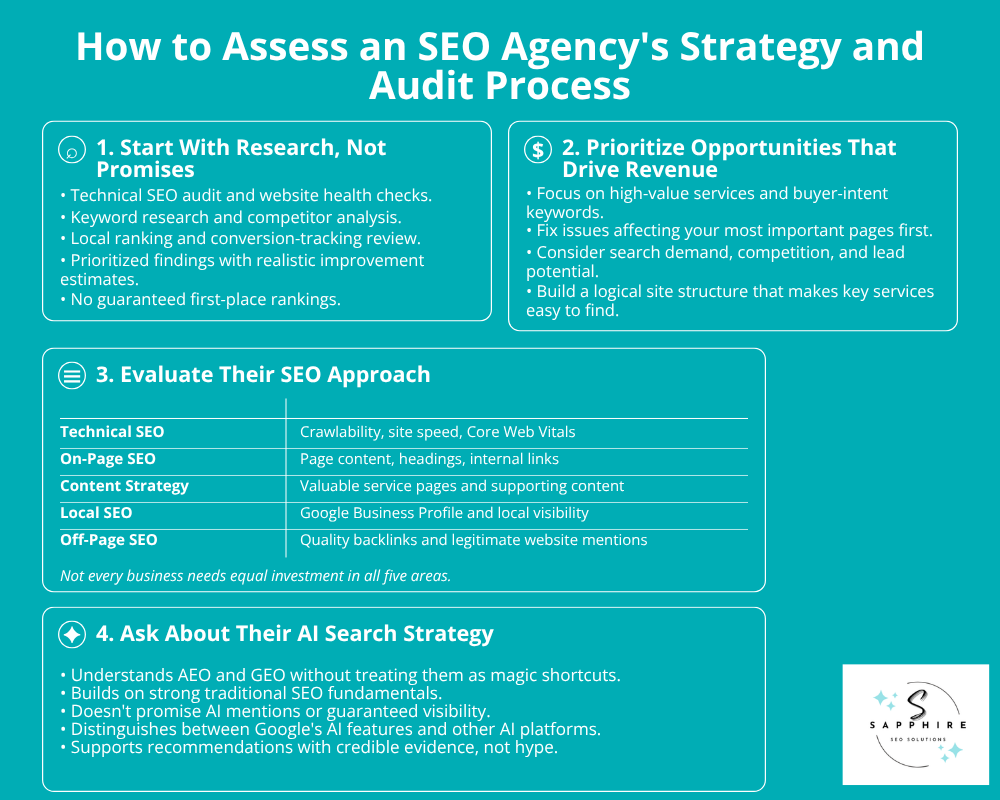
Find Out Whether They Start with Research and an SEO Audit
A real SEO strategy starts with homework. Before pitching a plan, the agency should study your site, your competitors, and your numbers. Ask for a technical SEO audit, a check-up on whether Google can find, read, and load your pages. It should also cover keyword research (finding the phrases your customers type), your local rankings, and gaps in call and form tracking. Then it should rank the findings by importance, because a list of hundreds of issues in no order is just noise.
Google’s own advice helps here. An audit should give you realistic estimates of improvement and the work involved, and anyone who guarantees first place isn’t worth hiring. At this stage, give read-only Search Console access, not write access. And ask whether they follow Google’s search engine guidelines.
Examine How They Prioritize SEO Opportunities
Then ask how they’ll decide what to do first. The answer should follow the money. A water heater repair page matters more than a blog post about plumbing history. So the agency should weigh how many people search, how tough the competition is, and how likely each page is to bring a call. Be wary of anyone chasing hundreds of target keywords, the phrases a page is built to show up for, without saying which ones pay. Problems on your best pages come first, including site architecture, meaning how your pages are organized and linked together. If a key service is buried in the menu, customers and Google both miss it.
Evaluate Their Approach to Different SEO Activities
Strategy usually mixes five kinds of work:
Technical SEO: behind-the-scenes fixes so search engines can crawl and load your site. That includes Core Web Vitals, Google’s measures of how fast a page loads, how quickly it responds, and whether it jumps around. Google highly recommends good scores.
On-page SEO: the words, headings, and internal links on each page, matched to what people actually search.
Content strategy: a plan for which pages to write or improve. Service pages usually come before blog posts.
Local SEO: getting found by nearby customers. It leans on your Google Business Profile, the free listing with your hours, photos, and reviews, and it shapes the local search results people see first. Google says local results rest mainly on relevance, distance, and prominence, and no agency can change how far you sit from the searcher.
Off-page SEO: earning links from other legitimate websites, a bit like referrals.
Not every campaign needs all five in equal amounts. A site with sloppy pages needs different SEO tactics than a strong site with few reviews.
Ask How They Approach AI Search
Ask about AI search too. Agencies sell it as AI SEO or GEO (answer engine or generative engine optimization). Google says optimizing for its AI search is optimizing for the search experience, so it’s still SEO. Its May 2026 guide says you don’t need special AI files, content chopped into tiny pieces, or extra markup for Google. So good AI work looks a lot like traditional SEO: pages that load, say something useful, and state your business details clearly. All of that shapes your website’s visibility.
Be wary of guaranteed AI mentions because Google says the same spam systems apply to its AI features. And that guide covers Google only. ChatGPT and other platforms work differently, so ask which one the agency means and what evidence backs the advice.
Review the SEO Proposal and Its Deliverables Before Signing
Here’s how you can review an SEO proposal:
What Should an SEO Proposal Include?
SEO campaigns vary a lot, so a proposal should read like it was written for your business, not pulled from a template. Try a test: swap in a competitor’s name. If nothing else needs to change, it’s generic. Look for these pieces:
Your goals, your customers, and the services that matter most
What the audit found and where the opportunities are
The priorities, and the reasons behind them
The exact SEO services included each month, who does each task, and who approves it
How reporting and communication will work
Price, what’s left out, and any extra charges
Contract terms, including who owns what when you leave
Longer isn’t better. Specific is better.
Compare Specific Deliverables with Vague Promises
Vague promises are easy to write and hard to hold anyone to. Compare them with what a useful proposal says:
Compare Specific Deliverables With Vague Promises
| Vague Promise | What a Useful Proposal Says |
|---|---|
| “We’ll improve your rankings.” | Names the service pages to work on and the searches that bring paying customers. |
| “Full content optimization.” | Lists which pages will change and what changes will be made to each one. |
| “High-quality backlinks.” | Explains how links will be earned, what makes them relevant, and how each link will be evaluated. |
| “Technical fixes.” | Lists the problems found, why each one matters, and who will implement the changes. |
| “More organic traffic.” | Identifies the customers, pages, and searches the SEO plan is designed to target. |
Three deliverables deserve a closer look. Start with content creation. Ask who writes the pages and who knows your trade well enough to get the details right. Google says using generative AI to produce many pages that add no value for readers may violate its scaled content abuse policy. So “twenty new articles a month” tells you little until you know who’s behind them.
Link building means earning links to your site from other websites, a bit like referrals. Google treats buying links for ranking, excessive link swaps, and automated link creation as spam, so ask how each link will be earned. Ads and sponsorships are fine when the links are properly labeled.
And internal linking, the links between your own pages, costs little, so ask whether it’s in the plan. Google uses links to find new pages and to judge how relevant they are.
Ask for a Practical Initial Roadmap
Ask what the agency expects to do in the first 30, 60, and 90 days. Then ask which steps depend on you: access, approvals, or a web developer. Priorities can shift once the audit turns up problems, so treat any roadmap as a plan, not a promise. One illustrative example, since every campaign differs:
Days 1 to 30: access, the audit, a check on call and form tracking, and a ranked list of priorities
Days 31 to 60: the first repairs to your site and rewrites of your most important service pages
Days 61 to 90: new pages, links between your own pages, and a first review of the numbers
Google says it typically takes four months to a year from the time you start making changes until you see the benefits, so those first 90 days are groundwork.
Establish Who Is Responsible for Implementation
Last, pin down who does what. Will the agency make changes on your website, or hand you a list? Who writes and approves new content? Who handles any development work? Neither setup is wrong, and not every retainer covers all of it. But someone has to own each task. Slow approvals cost time, too. Search Engine Land notes that changes taking weeks or months to implement slow results. Ask how open and finished tasks will be tracked, such as a shared task list.
Understand How the Agency Measures SEO Performance and Reports Results
Here’s how you know an agency is measuring the right metrics:
Which SEO Metrics Should the Agency Track?
Two kinds of numbers matter. Leading indicators move first: how often you show up in search results (impressions), how many people click, and where your site ranks. Business outcomes pay the bills: calls, form submissions, bookings, and sales. A good agency tracks both and works to connect SEO efforts to the second kind.
Expect clicks and impressions from organic search (the unpaid Google results), movement on the searches that matter, and visitors who look like real customers. Then expect calls, forms, and bookings, conversion rates where tracking is reliable, and revenue where the data allows. Local businesses should see local performance too. Rankings still matter. They just aren’t the finish line, and impressions alone aren’t leads.
If you’re already working with an SEO agency and not sure if they’re “just busy” or actually delivering results, check out our detailed guide on “How to Tell If Your SEO Company Is Working.”
What Should a Monthly SEO Report Include?
A useful report shows what your SEO efforts produced, in plain terms:
Work finished this month
Progress on the agreed priorities
Results against the starting baseline, not only last month
Changes in visibility and traffic, plus calls and form leads where tracked
Technical problems and anything waiting on you
A plain explanation for any drop
Plans for next month
Not every month will climb. Seasons, Google updates, and slow approvals all cause dips. A good report says what happened. A weak one hides it.
Check out our guide on “Why Most SEO Reports Are Useless” to learn more about the reports we produce at Sapphire SEO Solutions.
Check Which Tools and Accounts You’ll Be Able to Access
Ask about data access before you sign. You should be able to see:
Google Search Console: Google’s free report on how your site appears in search. It keeps only 16 months of data, so ask for monthly exports.
Google Analytics 4: what visitors do on your site, including the actions you’ve marked as important, like form submissions.
Business Profile data: website clicks, direction requests, and bookings from your listing. Call numbers count taps on the call button, not calls dialed by hand.
Call and form tracking: which calls and forms actually came from search.
CRM details, if you keep them: which leads became jobs.
And ask who owns each account. They should be in your name, with the agency added as a user.
Ask How They Measure AI Search Visibility
AI search reporting is newer, so ask careful questions. Which platforms does the agency check, how often, and with which prompts and locations? Answers vary by prompt and place, so one check proves little. Does the report separate mentions, linked citations, visits, and leads? A third-party visibility score is that tool’s own estimate, not Google’s data.
Google now offers its own view. It launched Generative AI performance reports in Search Console on June 3, 2026, and finished rolling them out to every site worldwide by August 31. They show how often your pages appear in AI Overviews and AI Mode, by page, country, date, and device. But they leave out clicks and queries. So they show where you appeared, not whether anyone called. They also cover Google only, and those AI answers sit beside traditional search results, which still need their own tracking.
Examine the SEO Contract, Cancellation Terms, and Account Ownership
Here’s what you should know:
Understand the Contract Length and Minimum Commitment
The contract structure tells you more than the sales pitch does. Get these answers in writing:
Is it month-to-month, or is there a minimum term?
Is there an onboarding period, and is it billed separately?
Does the agreement renew on its own, and how much notice does canceling take?
Are there early termination fees?
Are audit or setup fees extra?
What happens to billing if work is paused?
Long terms aren’t automatically bad. Some agencies need time to plan and finish the work. But you should know exactly what you’re agreeing to, and why.
Examine the Scope of Work and Contractual Obligations
Vague scope is where contracts hurt. The services, deliverables, and who does what should be written down, and so should how extra requests get charged. Ask what happens when agreed work doesn’t get done. Look for clear language on approvals, website changes, confidentiality, and reporting, plus a way to settle disagreements. Google reminds site owners they’re responsible for the actions of any company they hire, and that an SEO with access to your server should be willing to explain every change it makes.
Understand What Happens When You Leave
Settle this before you sign, because nobody negotiates well on the way out. Find out:
Who owns the content, research, and other work created for you
Whether finished pages and site improvements stay on your site
Whether you keep your reports and historical data
Whether any tools or licenses belong to the agency
How account access gets transferred, and whether a handover is included
Accounts matter most. Your Search Console, Analytics, and Business Profile should be set up in your name, with the agency added as a user. If a Search Console property’s only verified owner leaves, ownership has to be re-verified to keep or regain access. So make sure that owner is you.
Why Month-to-Month SEO Can Be a Practical Option
SEO is ongoing work, but that doesn’t automatically call for a long lock-in. A month-to-month agreement lets you reassess as you go, and it gives both sides a reason to keep the work worth continuing. Fair is fair, though. SEO takes time, and one slow month rarely tells you much. Judge the work itself: agreed tasks finished, reports that make sense, and straight answers to your questions. Flexibility and results are separate matters. A flexible contract doesn’t guarantee better results, and a long one doesn’t guarantee worse.
Sapphire SEO Solutions works month-to-month, so clients can keep going without being tied to a lengthy commitment they never needed. SEO takes time. But flexibility and ongoing accountability can live in the same agreement.
One last point. Have a lawyer read anything long or unusual before you sign. They can tell you what the terms mean for you, and this guide can’t.
Compare SEO Pricing and Understand What You're Paying For
Here's how you should compare prices:
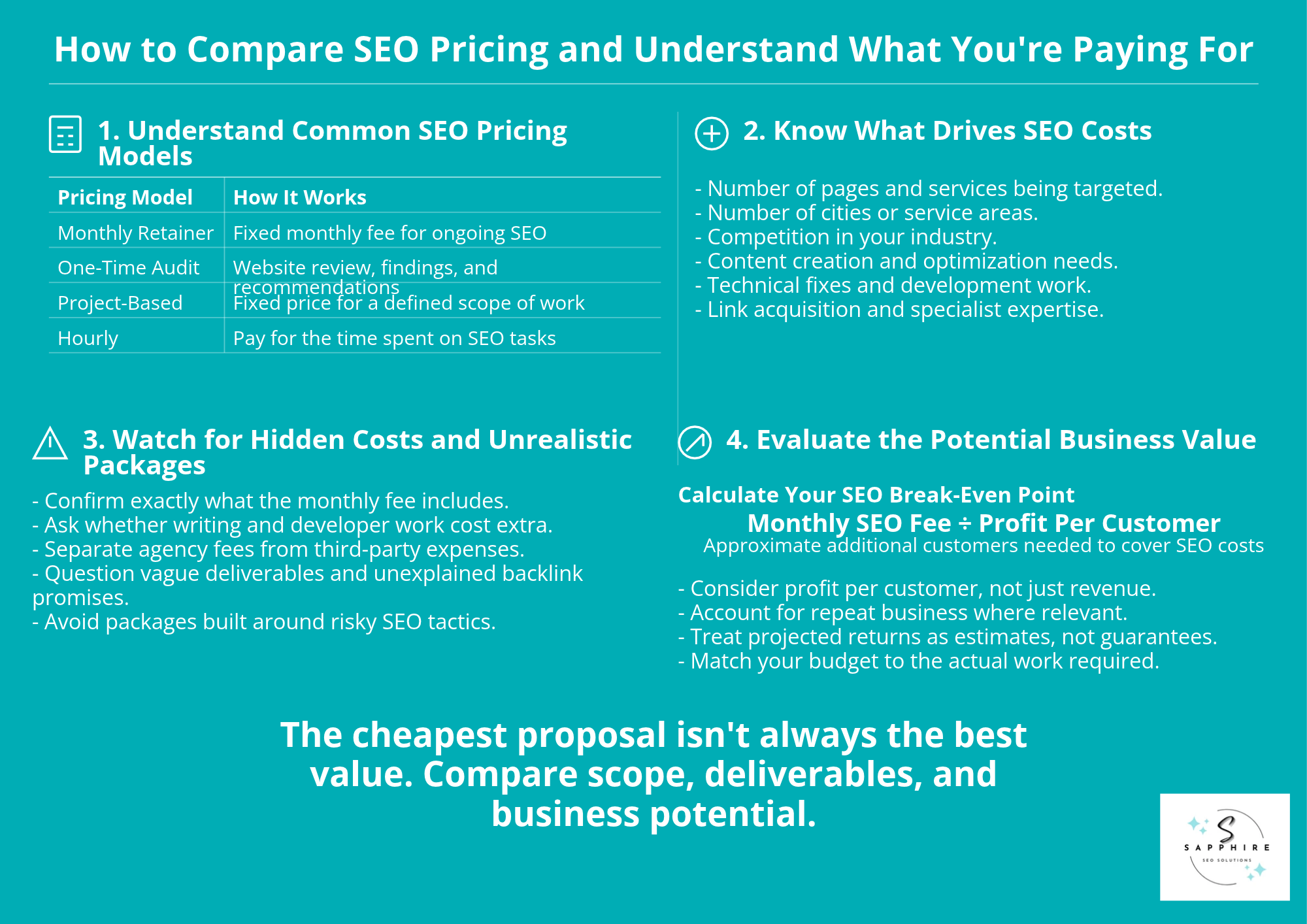
Understand Common SEO Pricing Models
Agencies bill a few ways:
Monthly retainer: a flat fee for ongoing work. About 78% of providers in Ahrefs’ survey of 439 charged this way, and many offered other models too.
One-time audit or consulting: a review and a plan, handy if someone else does the work.
Project: a set price for a defined job.
Hourly: you pay for time, which suits quick questions and is hard to budget.
Understand What Influences SEO Pricing
Price follows the work. Twelve pages in one town is a smaller job than sixty pages across five cities. Tougher competition, more services and locations, heavier writing needs, technical repairs, and link earning all add effort. So does the experience of the people doing it. Published price surveys disagree with each other because they sample different providers, so skip the single number and compare written proposals for the same scope.
Identify Hidden Costs and Unrealistic Packages
Ask what the fee covers: writing, technical repairs, developer time. Ask what costs extra, like tools or outside services, and keep the agency’s management fee separate from those. Cheap isn’t the problem. Fuzzy deliverables are, and so are big backlink counts with no story about how the links get earned. A package that does nothing won’t save money, and a risky one can cost more later. Google warns that an irresponsible SEO can damage your site and reputation, and that spam tactics can get a site removed from its index.
Evaluate the Potential Business Value
Set your SEO budget based on what a customer is worth. Take the profit on an average job, add repeat work if customers come back, and divide the monthly fee by that number. That shows roughly how many extra customers cover the cost. It’s a break-even check, not a forecast. Credit gets messy anyway when someone sees your truck, hears from a neighbor, and then searches. So treat projected returns as guesses. Small businesses don’t need a big budget. They need one that fits the work.
Ask These Questions Before Hiring an SEO Company
Most agencies offer a free consultation. Treat it as an interview, not a sales call. Ask every shortlisted agency the same questions so the answers are easy to compare, and ask again when one comes back vague. Many of these echo the questions Google itself suggests for interviewing an SEO. Notice whether they ask about you, too. Google says a good SEO should be curious about what makes your business unique, who your competitors are, and how your customers find you.
Questions About Experience and Previous Results
Have you worked with businesses like mine, and can you show relevant case studies?
What exactly did your agency do to get those results?
Can I speak with a current or former client?
Good answers name the work, the dates, and the outcome. Confidential client details can stay confidential. A clear account of what happened shouldn’t.
Questions About Strategy and Deliverables
What opportunities and problems have you found on my website?
How will you decide which services, keywords, and pages come first?
What specific work will you do each month?
Who will manage my campaign and do the work?
Listen for specifics about your site, not a speech about SEO in general.
Questions About Reporting and Accountability
How will you measure qualified leads and business results?
What will my monthly reports include?
What happens if the campaign isn’t making the progress you expected?
A strong answer admits that plans change and says how you’ll hear about it before you have to ask.
Questions About Contracts and Costs
What are your contract and cancellation terms?
What does the monthly fee cover, and will I keep ownership of my website, accounts, and deliverables?
Get the answers in writing. A friendly promise on a call won’t help you later.
Watch Out for These SEO Company Red Flags
Here are some red flags to watch out for:
Guaranteed Rankings and Unrealistic Promises
No one can guarantee a Google ranking. Google tells owners to beware of SEOs who guarantee rankings, claim a special relationship with Google, or advertise a priority submission. Treat guaranteed first-page results, fixed deadlines, and promises of instant leads the same way. A target is honest: “We’re aiming to move these five pages up over the next six months.” A guarantee isn’t.
Secret SEO Techniques and Unsupported Claims
A good agency can explain what it does in plain English. Be careful with any company that’s secretive about its methods, because you’re responsible for the actions of any company you hire. Ask for official Google documentation behind unusual advice, especially AEO and GEO claims. And be wary of anything described as approved by Google. Google doesn’t evaluate or endorse third-party tools, and they can’t see its internal ranking data, so a tool’s forecast isn’t a promise.
Manipulative Link-Building Practices
Links are where shortcuts hide. Watch for bulk backlink packages with no word on quality, automated link tools, paid links meant to lift rankings, heavy link swapping, and networks of sites built only to point at yours. Google’s spam policy names buying or selling links for ranking, excessive link exchanges, and automated link creation, and says violators may rank lower or disappear from results. But paid links aren’t always a problem. Advertising and sponsorship links are fine when they’re labeled with a nofollow or sponsored tag.
Content tricks count too. Keyword stuffing means cramming a page with the same phrases, or with a block listing every town you serve. Google’s spam policy lists both as examples.
No Transparency About Work, Data, or Ownership
Any one of these deserves a direct question:
Reports full of rankings but no list of completed work
A refusal to explain a recommendation
Limited access to accounts that belong to your business
Fuzzy ownership of your content and other assets
No record of major changes to your website
Several together deserve a closer look at who you’re hiring.
Unsolicited Sales Pitches and Pressure Tactics
Be skeptical of unsolicited emails saying your site has serious problems, with no real analysis behind them. Google’s own hiring page includes a sample of that kind of spam. Artificial deadlines, “guaranteed” opportunities, and pressure to sign today belong on the same list. So do long commitments with vague deliverables and unclear cancellation terms. Long contracts aren’t automatically bad. Vague ones are. And if you think an SEO deceived you, Google points US owners to the FTC, which handles complaints about deceptive business practices.
Compare SEO Companies and Make Your Final Decision
Here's how you should compare SEO companies:
Shortlist Two or Three Suitable Providers
There’s no universal right SEO agency. The one that suits a roofer covering one town may not suit a dental group with six offices. Lists of the best SEO companies can give you names to start with, but check who paid for the placement. Directory pages often mark listings as sponsored or featured. Then cut hard. Pick two or three that look capable of handling your needs, and ask each to scope the same job so the proposals compare fairly. Read the proposals, the case studies, and the references. Don’t decide on price alone, and don’t decide on polish either. A smooth presentation costs nothing to make.
Use an SEO Agency Evaluation Scorecard
Rate each agency from 1 to 5 in every row, where 1 is weak and 5 is strong. Fill it in right after each call, while the details are fresh, and score everyone the same way.
SEO Agency Evaluation Scorecard
Rate each agency against the same criteria immediately after your consultation. Use the evidence they provide, not just their promises or presentation.
Agency A
— Not yet ratedAgency B
— Not yet ratedAgency C
— Not yet rated| Evaluation Criteria | Agency A | Agency B | Agency C |
|---|---|---|---|
| Relevant experience | |||
| Verifiable case studies | |||
| Understanding of your business | |||
| SEO strategy and priorities | |||
| Specific monthly deliverables | |||
| Reporting and accountability | |||
| Team expertise and communication | |||
| Pricing and value | |||
| Contract flexibility | |||
| Ownership and account access |
Score Comparison
Record Your Observations
Use these spaces to capture strengths, concerns, unanswered questions, or evidence that influenced your ratings.
A higher score can help narrow your options, but it should not make the decision for you. Review the evidence, contract terms, and fit with your business before choosing an agency.
Add up the scores. But a high total can hide a deal breaker. Serious concerns about unethical practices, account ownership, or openness shouldn’t be offset by strong marks elsewhere. If an agency promises a guaranteed ranking or wants your accounts in its name, a 4.5 average doesn’t fix that.
Choose the Agency That Offers the Best Overall Fit
The top score isn’t an automatic winner. Treat it as a tie-breaker, not a verdict. Favor the agency that understands your customers, points its strategy at the work most likely to bring in business, and shows you who will do the job. Pay attention to how they treat you, too. Do they answer plainly? Do they own their mistakes? To choose an SEO provider with confidence, weigh expertise, execution, openness, and trust. And when two agencies land close together, the right SEO company is usually the one whose answers held up best under questions.
Choose an SEO Company That Can Earn Your Trust
How to choose an SEO company comes down to trust, and trust gets earned with specifics. Rankings, promises, and monthly fees only tell part of the story. What counts is whether the agency knows your kind of business, shows results you can check, explains its plan, reports in plain terms, and offers fair contract terms.
SEO takes time. That’s true. But you should always know what work is happening and why, and you shouldn’t need a long commitment to find out.
Sapphire SEO Solutions works month-to-month, so clients can keep going without being tied to a lengthy agreement. If you’d like to see how that could look for your business, explore Sapphire’s SEO services for small businesses or contact us to schedule a free consultation to talk through your goals.

Frequently Asked Questions
How much does it cost to hire an SEO company?
It depends on the scope of the campaign, the condition of your website, how crowded your market is, and how much work the agency does versus recommends. That’s also why published price surveys disagree. Ask two or three agencies to scope the same job, then compare the proposals line by line.
How long does it take to see results from an SEO company?
It varies with your website, your competition, and how quickly changes get made. Google’s older hiring guidance said it typically takes four months to a year from when you begin making changes until you see benefits. That’s guidance, not a guaranteed timeframe, and Google’s current page no longer states a number. It suggests asking each SEO what results they expect, in what timeframe, and how they measure success. Slow approvals on your side can stretch things further.
Should I hire a local SEO company or a national agency?
Distance matters less than people assume. Look at expertise, communication, knowledge of your market, and what your campaign needs. A local agency may know your area well, and a national one may have more specialists. Check case studies and references either way.
What should an SEO company do every month?
The work should match the agreed strategy and where the campaign stands. Early months often lean toward audits and fixes. Later months may lean toward content and links. Whatever the mix, it should be written down, and the monthly report should show what got done.
Is a month-to-month SEO contract better than a long-term contract?
Not automatically. Month-to-month gives you room to reassess, and a longer term can make sense when the work and terms are clear. But SEO needs sustained effort, so one slow month shouldn’t decide anything. Judge the work, not just the contract length.
Can I change SEO companies if I’m unhappy with the results?
Generally yes, subject to what your contract says. Before you leave, check the cancellation terms, any outstanding fees, who owns the content and accounts, and how access gets handed over. Do that homework before you sign, ideally. And a lawyer can tell you what your specific contract allows.