

The monthly report lands in your inbox. Rankings are up. There are new blog posts and new links from other websites pointing to yours. It all looks busy. But you still can’t tell whether any of it is bringing in customers.
That’s a familiar spot for business owners. An SEO company can stay busy for months without making real progress. And higher rankings or more traffic don’t automatically mean more qualified inquiries.
So how to tell if your SEO company is working comes down to three questions. What work was actually done? What changed in search visibility and relevant traffic? And did that progress lead to qualified inquiries?
The honest answer is that you can check most of it yourself, using accounts you should already have access to.
Key Takeaways
Judge your agency on three things: work delivered, changes in relevant visibility, and qualified inquiries. They’re connected but not interchangeable.
Waiting for results is different from waiting for work. Even slow campaigns should show what’s been done and learned.
Keep admin access to Search Console, Analytics, and your Business Profile. You shouldn’t need permission to see your own data.
Split branded from non-branded searches. Customers who already know your name aren’t proof of new SEO discovery.
Rising traffic with flat leads is a reason to investigate search intent, landing pages, and tracking, not proof of failure.
A good report separates completed work from recommendations, compares against a baseline, and explains the numbers. Length doesn’t matter.
No one can guarantee a #1 ranking. Guarantees, a claimed Google relationship, and bulk link packages are red flags.
Before you switch, secure your logins and history, and keep existing content and URLs until the new team reviews them.
What Does It Mean for an SEO Company to Be Working?
Real SEO work shows up on three levels, and they’re easy to mix up.
The first is work delivered: agreed tasks got done.
The second is progress: your site is more visible for relevant searches and draws the right visitors.
The third is business outcomes: calls, bookings, quotes, and sales from organic search.
These levels are connected. But they aren’t interchangeable. A finished task doesn’t prove it worked, and a jump in traffic doesn’t prove those visitors would ever hire you.
Not every month has to improve on all three, either. SEO success depends on where you started, what was agreed, who you compete with, and what’s realistic in your market. A new campaign can show measurable progress in visibility long before the phones ring.
So any agency selling SEO services should be able to show what it did, explain what changed, interpret the evidence, and say what’s next. That’s real progress toward your business goals, and it’s how you judge its SEO efforts.
What Does Legitimate SEO Progress Look Like?
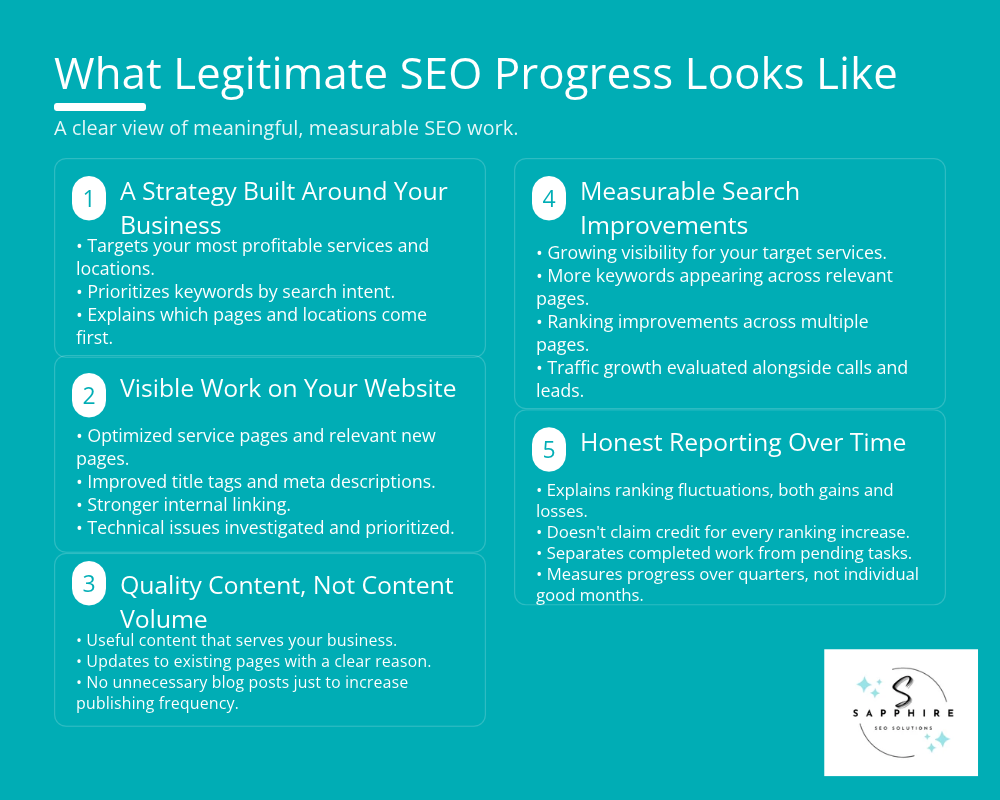
It starts with a plan tied to your business. A real SEO strategy knows what you sell, where you work, and which jobs pay best. Your target keywords should follow search intent, which is what the person typing actually wants.
Someone searching “emergency AC repair” is ready to hire. Someone searching “how does an AC work” probably isn’t. And the agency should be able to explain why it picked certain pages and towns first.
Next comes work you can see on your site:
Page optimization (on-page SEO) on key service pages, or new pages where none exist
Title tags (the clickable headline in Google) and meta descriptions (the short summary beneath it), plus other meta tags, rewritten to fit each page
Internal linking, so your own pages point visitors toward each other
Technical issues (technical SEO) investigated, like crawl errors (pages the search engine couldn’t read), broken links, weak mobile usability, and slow site speed
Not every one of those technical fixes carries equal weight. Google has said good Core Web Vitals scores, its page speed and responsiveness checks, don’t guarantee good rankings. Anything waiting on your approval or a developer should be listed as waiting, not done.
Content creation (SEO content writing) counts when content quality is high, and the page serves your business. A pile of blog posts doesn’t. Updates to relevant content should come with a reason.
Then check the results side:
Is your online visibility growing in search results for the services you want?
Are new keywords showing up on service pages?
Improved rankings should appear across a group of pages, not three hand-picked screenshots. And if traffic climbs but calls don’t, the agency should say why.
Progress isn’t a straight line, though. Rankings can shift when nothing on your site changed, because new content appears elsewhere. Google also advises waiting at least a full week after a core update (a big change to how it ranks pages) finishes before analyzing results. A good agency explains the dips and the gains, and doesn’t claim credit for every bump. Judge it as a long-term strategy: a few quarters of steady, explainable movement beats one great month.
Which SEO Metrics Matter, and Which Ones Can Be Misleading?
Most monthly reports pile on numbers. Only a few key metrics deserve your attention.
Start with what Google reports. Impressions count how often your site showed up in results. Clicks count the taps that followed. Click-through rate is clicks divided by impressions. Average position is the highest spot your page held, averaged across searches, so it’s a trend, not a promise. Keyword rankings shift by searcher and location, so keyword positions from one screenshot prove little. Check individual queries and pages instead, because a site-wide average can hide your best service page slipping.
Picture a report, made up for illustration: impressions up, clicks flat, blog visits up, no new calls. That isn’t proof of failure. It’s a reason to check which searches you now appear for.
Next, split branded searches (your company name) from non-branded ones (“roof repair near me”). Branded visitors already know you, and they still matter. But counting them as new discovery inflates the story. Search Console now has a filter for the split.
Then comes organic traffic: visitors arriving through organic search, meaning unpaid results. Check where they land and what they wanted. Traffic that rises while leads stay flat often points to a weak page, the wrong audience, or broken tracking. Their user behavior on the page tells you which.
Outcomes matter most. Count calls, quote requests, and bookings. But spam and out-of-area forms get recorded too, so lead volume means little without quality. The sales funnel, the path from first search to paying customer, shows where people drop off. Steady lead generation is what you’re paying for.
Watch for vanity metrics, numbers that look good and prove little. Domain authority is one. It’s a Moz score, and Google’s John Mueller has said Google doesn’t use it. Backlinks and indexing health work as supporting checks. Search Console’s AI reports are worth watching too, but they show impressions, not clicks.
How to Check If Your SEO Company Is Actually Doing Its Job
You don’t need expensive software or an SEO degree to check this. You need a free hour and six steps.
Step 1: Make Sure You Can Get into Your Own Accounts
Ask for admin access to Google Search Console, Google Analytics 4, your Google Business Profile, and your website, domain, and hosting accounts. Your agency can have its own logins. But you shouldn’t need its permission to see your own data. In Search Console, aim to be a verified owner. Google requires every property to have at least one.
Step 2: Check Search Console
Open Performance and compare this period with the same period last year, since seasons swing demand. Read clicks, impressions, click-through rate, and average position together. Then open the Queries and Pages tabs. Are your service and location pages gaining? Use the branded filter to set aside people who already typed your name. A quick test: ask for three pages the agency worked on last month, then look them up.
Step 3: Check Analytics
Go to Reports, then Acquisition, then Traffic acquisition, and find the Organic Search row. That’s how you track organic traffic. Next, see which landing pages those visitors started on, and whether key events like form submissions or calls were recorded. Make sure they’re real inquiries, not duplicates. Attribution is imperfect, so compare it with your own records.
Step 4: Verify the Leads
Pull your calls, forms, quote requests, and bookings for the same period. Were they inside your service area? New customers, repeat ones, or spam? Long sales cycles blur credit, so expect a rough match, not a perfect one.
Step 5: Inspect the Work
Open the URLs the agency says it created or changed. Are they live? Check the page titles, headings, and internal links. For links it built, ask for the actual pages, not just a total. And separate what got done from what was only recommended. If something looks off, an SEO audit can give you a second opinion.
Step 6: Check Local and AI Visibility
If you serve a local area, open your Business Profile performance. Google says that data covers both organic results and Google Ads, and it counts every tap on Call, so one person ringing three times shows as three. Don’t credit all of it to SEO. Track local rankings with the same searches and locations each time, not one search from one spot. For AI, Search Console now reports AI Overviews and AI Mode impressions. Checks on other AI tools, run with the same prompts each time, give a rough read, not a full picture.
Save this for your next review:
Can I see my own data?
Can I see the work live on my site?
Which pages and searches actually changed?
Do the inquiries check out?
Do I know what happens next, and who’s doing it?
How to Check If Your SEO Company Is Actually Doing Its Job
You don't need expensive software or an SEO degree. Follow these six steps to check your agency's access, performance, leads, work, and visibility.
Get Access to Your Accounts
Confirm you have access to Search Console, GA4, your Business Profile, website, domain, and hosting. Aim for verified owner access in Search Console.
Check Search Console Performance
Compare clicks, impressions, CTR, and average position year over year. Review service and location pages, branded searches, and pages your agency recently changed.
Review Organic Traffic in GA4
Check Organic Search traffic, landing pages, and recorded calls or form submissions. Verify that key events are genuine and compare them with your own records.
Verify the Actual Leads
Compare calls, forms, quote requests, and bookings. Check whether they came from your service area and were genuine new customers, repeat customers, or spam.
Inspect the Work Completed
Review published and updated pages, titles, headings, and internal links. Ask for actual pages supporting reported backlinks, and separate completed work from recommendations.
Check Local and AI Visibility
Review Business Profile performance, consistent local ranking checks, and AI search visibility. Use the same searches, locations, and prompts when comparing results.
Save This for Your Next Agency Review
- Can I see my own data?
- Can I see the work live on my site?
- Which pages and searches actually changed?
- Do the inquiries check out?
- Do I know what happens next, and who's doing it?
What Should a Good SEO Report Include?
A good monthly report doesn’t have to be long. Detailed reports aren’t the same as useful ones. What counts is plain language and transparent reporting that make your SEO company’s performance easy to judge. Four parts do it.
First, a record of work. Pages created or updated, with URLs. Technical problems found and fixed. Links earned, with the actual pages and websites they came from. Tasks still in progress, delayed, or waiting on you. Completed work, recommendations, and planned work should sit in separate lists, so one can’t pass for another. That’s what specific deliverables look like on paper.
Second, a baseline. Every number needs a comparison, like this quarter against the last, or the same months last year. Show clicks and visibility for your priority service and location pages, branded and non-branded searches apart, and leads or sales where tracking is reliable. Ask for the starting numbers in month one. Search Console keeps only 16 months of data, so an early snapshot protects your comparison.
Third, what the numbers mean. Which pages and searches moved? Could seasonality, demand, competitors, tracking changes, or a Google update explain it? Is there evidence the work caused it? And what’s still uncertain? An honest report says so.
Fourth, a clear plan: the next priorities, why they matter, who owns each one, what needs your approval, and how success gets measured. Google’s guidance on hiring an SEO suggests asking whether they’ll share every change they make and the reasoning behind their recommendations.
Watch for reports that lean on:
Ranking screenshots with no keyword, location, or date
Traffic gains that don’t say where visitors came from
Impressions passed off as business results
Percentage jumps from a tiny starting point
Backlink totals with no sources
Good news only, with declines skipped
The same recommendations, month after month, unexplained
Automated dashboards are fine, and no single format is required. Numbers without analysis are the problem. A useful report answers five questions:
What work was completed?
What changed?
What does the evidence suggest?
What isn’t working, or remains uncertain?
What happens next?
If you’d like a second opinion on your current report, Sapphire SEO Solutions is happy to take a look. You can also contact us to check out a sample report to see what an SEO report should contain.
Warning Signs Your SEO Company Isn't Delivering What You Paid For
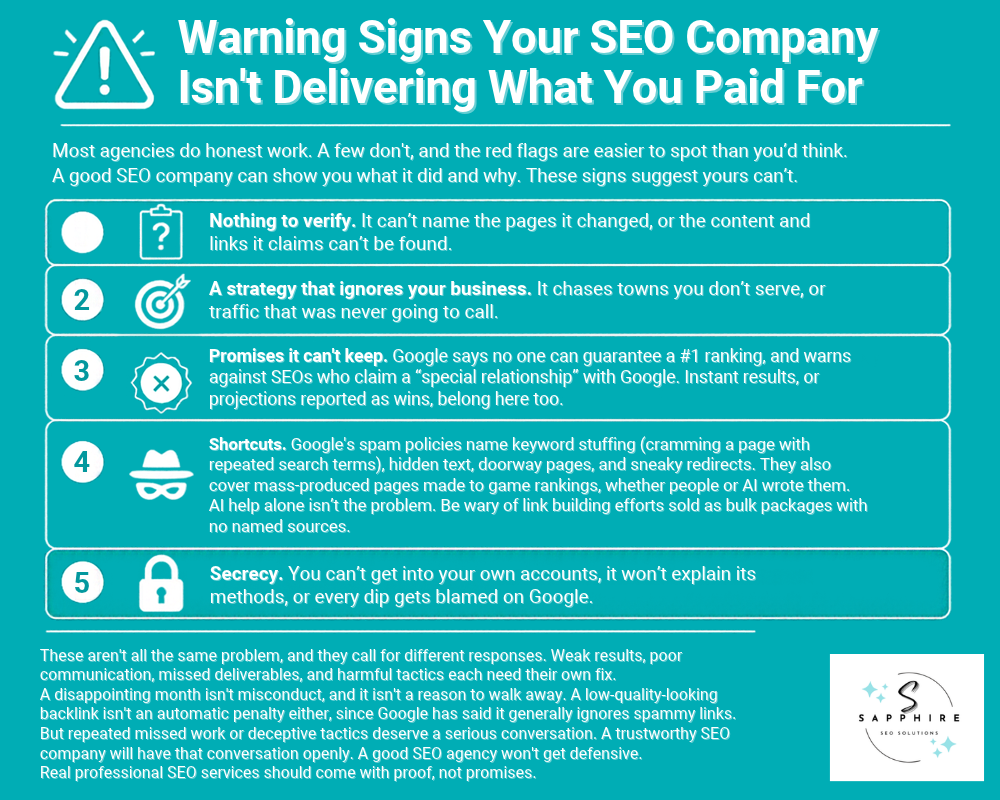
Most agencies do honest work. A few don’t, and the red flags are easier to spot than you’d think. A good SEO company can show you what it did and why. These signs suggest yours can’t.
Nothing to verify: It can’t name the pages it changed, or the content and links it claims can’t be found.
A strategy that ignores your business: It chases towns you don’t serve, or traffic that was never going to call.
Promises it can’t keep: Google says no one can guarantee a #1 ranking, and warns against SEOs who claim a “special relationship” with Google. Instant results, or projections reported as wins, belong here too.
Shortcuts: Google’s spam policies name keyword stuffing (cramming a page with repeated search terms), hidden text, doorway pages, and sneaky redirects. They also cover mass-produced pages made to game rankings, whether people or AI wrote them. AI help alone isn’t the problem. Be wary of link-building efforts sold as bulk packages with no named sources.
Secrecy: You can’t get into your own accounts; it won’t explain its methods, or every dip gets blamed on Google.
These aren’t all the same problem, and they call for different responses. Weak results, poor communication, missed deliverables, and harmful tactics each need their own fix. A disappointing month isn’t misconduct, and it isn’t a reason to walk away. A low-quality-looking backlink isn’t an automatic penalty either, since Google has said it generally ignores spammy links. But repeated missed work or deceptive tactics deserve a serious conversation. A trustworthy SEO company will have that conversation openly. A good SEO agency won’t get defensive. Real professional SEO services should come with proof, not promises.
Why Your SEO Company Might Not Be Getting the Results You Expected
The SEO agency isn’t always the only reason results disappoint.
The strategy may aim at the wrong targets. Search terms with lots of traffic but little buying intent fill a report and leave the phone quiet. So do blog posts that crowd out the service pages that bring in calls.
Then there’s the website. Vague service descriptions, a buried phone number, a clunky mobile form, or thin proof that you’re legit can send visitors away.
Delays on your side count too: late approvals, missing details, restricted access, developer fixes never made, and tracking nobody maintains.
Some causes belong to nobody. Seasons shift demand. Competitors improve. Search results change, too. A Pew study of 900 U.S. adults found people clicked a regular result in 8% of visits when an AI summary appeared, against 15% without one. These competitive shifts can hold back solid SEO services and SEO marketing.
But none of this is a blanket excuse. A good agency spots the obstacles, shows their impact, says who owns each one, and proposes a practical fix.
How Long Should You Give an SEO Company to Show Results?
Nobody can give you a date. Timing depends on:
Where your site started
How crowded your market is
Where you operate
What’s in scope
How quickly recommendations get put in place
Still, a campaign moves through stages. Early on, expect an audit, baseline numbers, a plan, and priority fixes. Next come implemented improvements, then first shifts in visibility for relevant searches. Later, steadier SEO growth shows up as qualified visitors, and possibly more inquiries or sales.
Google says some changes show up within hours and others take several months, and it suggests waiting a few weeks before judging a change. Bigger, site-wide improvements can take longer still. Nothing is guaranteed. And missing the first page after a few months doesn’t automatically mean poor work.
But waiting for results is different from waiting for work. A campaign may need time to pay off. The agency should still be able to show what it has done and what it’s learning. If it can’t, time isn’t the problem.
Questions to Ask Your SEO Company About Its Performance
Once you’ve checked the evidence yourself, take it into a direct conversation with your SEO consultant or agency. Google’s hiring guidance suggests asking about expected results, how success gets measured, and examples of past work. The same spirit applies here. Keep the questions short.
About the work:
Which pages did you create or improve this period?
Can you show me the changes and explain why you made them?
About results:
Which searches and pages gained or lost visibility?
How has non-branded search changed?
Which inquiries were qualified, and how do you know?
What hasn’t improved, and what’s causing it?
About what’s next:
Are we still targeting the right services and areas?
What’s the biggest obstacle, and what are the top priorities next period?
What do you need from me?
A good agency answers clearly, shows evidence, admits what it doesn’t know, and talks about problems without getting defensive. A confident agency welcomes these questions. And a true SEO partner often raises the hard ones before you do. A hesitant answer isn’t proof of incompetence, though. Judge the evidence behind it.
SEO Agency Performance Review Checklist
Use these questions to discuss your agency's work, results, and next priorities. Check each question once it has been answered clearly and supported with evidence.
Work Completed
Results and Performance
Next Steps and Priorities
Assess the Agency's Responses
Look beyond confidence or polished reporting. Consider whether the agency supports its answers with evidence and takes responsibility for its work.
Overall Review and Follow-Up
A hesitant answer alone doesn't prove an agency is doing poor work. Judge its performance by the evidence, transparency, and quality of its explanations.
Should You Give Your SEO Company More Time or Switch Agencies?
Frustration alone isn’t a reason to leave your current agency. Evidence is. Three choices are on the table: continue, renegotiate, or switch.
Continue when the strategy matches your commercial priorities, the agency can prove its work and explain it, and relevant visibility is improving, or setbacks were properly investigated. Slow isn’t the same as stalled. Reports should be transparent, the approach should adapt, and there should be a credible plan for the next stage.
Renegotiate when work is getting done, but the campaign isn’t moving toward the right outcomes. Maybe traffic rises while inquiries stay weak. Maybe the wrong pages, keywords, or towns get priority, or obstacles on either side sit unresolved. Ask for a change in strategy or a performance improvement plan. Then agree on specific actions, owners, dates, and how progress will be judged.
Switch after repeated missed deliverables, misleading reports, refusal to show evidence, deceptive tactics, no credible explanation for persistent underperformance, no willingness to adjust, or serious problems with access and ownership. Even then, a new agency won’t fix everything automatically. And a fresh start doesn’t mean discarding earlier work. Pages and content may be worth keeping.
Before you leave, secure what’s yours:
Read the contract, notice period, and anything still owed. If the terms are unclear, ask a lawyer.
Confirm you control your domain registrar, hosting, CMS, and website logins.
Keep owner or administrator access to Search Console, Analytics, your Business Profile, and Bing Webmaster Tools.
Collect content, reports, link records, technical notes, and redirect lists.
Export your history. Search Console keeps 16 months of data, and GA4’s detailed reports keep two or 14.
Hold off on redesigns, URL changes, or deleting content until the new team reviews the site. Google’s site-move guidance centers on redirecting old URLs to new ones, so unneeded changes add risk.
The right call comes from the evidence.
If you decide to switch, Sapphire SEO Solutions offers SEO and local SEO services for small businesses.
Expect More Than Monthly SEO Activity Reports with Sapphire SEO Solutions
You should be able to see what your agency completed, what changed, and how the work supports your business goals. SEO takes time. But that doesn’t excuse vague reports or work nobody can verify. Use the checks and questions in this guide before you decide to continue, renegotiate, or switch. Wherever you land, expect to see the work. And if you want SEO support built around transparent reporting and your commercial priorities, contact us to schedule your free consultation with an SEO strategist today!

Frequently Asked Questions
How can I tell if my SEO company is doing a good job?
You can verify the work, see relevant search visibility improving, find qualified organic visitors, get transparent reports, and hear a credible plan. Your own Search Console and Analytics accounts will show most of it.
What should an SEO company report every month?
Completed work, results against a starting baseline, the search and business numbers that matter, an honest read on what changed and what’s still uncertain, and the next priorities.
How long should I give an SEO company to show results?
It varies. Google says some changes take hours and others several months. Business results can take longer. But the work and early progress should be verifiable much sooner.
Should I switch SEO companies if my rankings aren’t improving?
Not automatically. Check the work completed, other indicators like visibility and qualified traffic, the strategy, and whether there’s a credible explanation. Repeated missed work or misleading reports are stronger reasons to leave.
Can an SEO company guarantee first-page rankings?
No. Google says no one can guarantee a #1 ranking, and it warns against SEOs who claim to guarantee rankings. A good agency promises its own work, not Google’s results.