

Why Your Website Gets Traffic But No Conversions (And How to Fix It)
No matter what industry you are in, you are probably here because you have something in common with everyone else: your website has traffic, but you aren't getting conversions. This is a really common issue for site owners. You try everything under the sun: DIY SEO, ads, post more content --- but nothing works.
Here's the reality, though - traffic is great, but it doesn't make money. Conversions do.
Does all of this sound familiar? If so, I really want to take a deeper look into why this happens and what we can do about it. Then, if you are interested, we would love to work with you and help you get more website traffic that actually converts.
Key Takeaways
Website traffic without conversions usually points to messaging or UX issues
Poor calls-to-action (CTAs) are one of the biggest conversion killers
Mismatched search intent leads to high bounce rates
Slow page speed and poor mobile experience drive users away
Trust signals and credibility play a major role in conversions
Small changes can dramatically improve conversion rates
The Brutal Truth: Traffic Does Not Equal Revenue
One thing that many business owners assume is that if they have a lot of website visitors, that those visitors will automatically convert into customers. The truth, however, is that just isn't true.
Here is the tough reality:
You can have thousands of visitors every month
You can have the highest keyword rankings
You can have amazing impressions
You can have the best digital marketing strategies
You can pay for ads
...but none of that will generate leads unless you are guiding your users towards taking action.
Think of your website like your digital sales rep. If it's confusing, slow, or unclear, people are going to leave, even if you have a ton of traffic.
Here are the top reasons you are getting traffic, but not conversions:
1. Your Messaging Isn’t Clear Enough
When a visitor comes to a web page, they should immediately know what your company does, who you help, and why they should choose your business. You have only a few seconds to make that clear...if you don't, they will leave.
Some of the common culprits we see when we look at a client's site that has this issue are:
Vague headlines like “Welcome to Our Website”
No clear value proposition or reason to stick around
Too much focus on the business instead of the customer
Overuse of jargon or technical language
How to Fix It
The best way to improve your messaging is to clearly answer this question:
"Why would a customer choose you over your competitors?"
You have to make your messaging clear by doing the following:
Using benefits in headlines
Speaking directly to your target audience
Highlighting outcomes, not just services
Keeping language simple and direct
Many businesses choose professional website copywriting services to get this right…that’s how important it is.

2. Weak or Missing Clear Calls-to-Action (CTAs)
Calls-to-action, or directing a visitor on what action to take on your site, is often an issue in websites we audit for our clients. A visitor may be interested in your services, but if you don't tell them what to do next, they won't take any action.
Some of the most common CTA mistakes that we see:
No CTA above the fold
Generic phrases like "Learn More"
CTAs that are at the bottom of the page
Too many calls-to-action
How to Stop Overwhelming Visitors and Get More Conversions
Every page on your site should have a clear goal. Use CTAs like:
“Get a Free Quote”
“Schedule a Consultation”
“Call Now for a Free Audit”
You also want to make sure that the CTAs stand out visually, that they appear several times on a page, and that they use action-oriented language.
3. Your Website Doesn’t Match Search Intent
One of the biggest reasons that you get traffic but no conversions is because the intent of the visitor doesn't match your site.
One of the biggest drop off points happens when a visitor comes to your site seeking something, but instead, sees something else. Believe me -- when this happens, they leave immediately.
Here are a couple of examples:
If a person searches "__________ near me," they are ready to hire someone. If they search "what is _______?," they are looking for information. If your page doesn't match what a person is looking for, even if it's attracting those people, they won't convert.
How to Improve Conversion Rates with Intent
The main thing here is to make sure the content you have on the page aligns with the focus keyword's intent:
Informational keywords should lead to educational content
Commercial keywords should lead to service pages
Transactional keywords require strong CTAs to make sales
When your content matches search intent and you invest in SEO website content writing services, conversions will naturally occur.
4. Poor User Experience (UX) on Landing Pages
Now, let's consider this: let's say you have great content and strong messaging. Search engines are bringing people to your site. Why aren't they converting?
It could be because they are having a bad user experience, or UX. Here are some of the common UX issues that we see, many of which show up quickly in a free SEO audit for small businesses:
Layouts that are cluttered or don't make sense
Hard-to-read text
Poor site structure
Too many pop-ups
Confusing navigation
Poor mobile experience
Think of it this way, do you like going to websites that are confusing or have a bazillion pop ups? I sure don't.
How to Improve Your Site's UX
There are a few things you can do to improve your site's UX. Here are some places to start:
Change to a clean and simple layout
Break up your text with headings, images, and spacing
Make navigation intuitive
Keep important info easy for people to find
A good rule of thumb is this: If someone has to "think" too much, they will leave.
5. Slow Page Speed
If there is one thing that will almost always turn visitors away, it's slow page speed. Speed is very important for both SEO and for conversions. If your site takes more than a few seconds to load, your users will bounce. You can see your current bounce rate by customizing Google Analytics.
A slow site will not only increase bounce rates; they also aren't trustworthy to many visitors. On top of this, Google uses speed as a ranking factor. So, if your site is too slow, it won't be pushed higher in the search engines, and that impact should be clear in any conversion-focused SEO reporting.
How to Improve Website Speed
The best thing to do to improve how quickly your site loads is to compress images. You can also reduce any unnecessary scripts, use caching, and get a faster host, if that's the cause of the slow down. Even a small boost in speed will help a lot.

6. Your Site Offers a Poor Mobile Experience
Mobile users are likely the main visitors your site is getting. If it's not optimized for mobile devices, you will quickly lose a huge number of potential customers. Some of the main issues with sites that aren't mobile optimized include:
Text that is too small to read
Buttons that are hard to click
Layouts that don't adjust
Mobile sites that load slowly
How to Improve the Mobile Experience
The first thing we recommend is to use a responsive design. You should make the buttons large and clickable, and keep the layout simple. Also, make sure to check your site on more than one device. Check it out on phones, tablets, and even on different operating systems.
7. Lack of Trust Signals
If your site and your company isn't trustworthy, or if it doesn't seem trustworthy, it's likely to get zero conversions because paying customers want to make sure they are getting value for their money. Even if you have the best, most high-quality service out there, if people don't have a reason to trust you, they won't.
Some of the things that you need to ensure trust include:
Reviews and customer testimonials
Case studies
Social proof
Clear contact information
Credentials and certifications
There are a few ways that you can combat this exact challenge. First, try to get as many reviews as you can on social media and search engines like Google. You should also try to get reviews on Yelp or similar sites.
You can also do case studies, show before-and-after results if that's appropriate, or add trust badges and certifications.

8. You’re Targeting the Wrong Audience
There is also the fact that your website could be amazing and wonderful, but your traffic quality is poor. If you aren't attracting the right people, there are no conversion paths no matter how great your site is.
Here are some signs that you could be attracting the wrong visitors, which is a common issue affordable SEO services for small businesses are designed to fix:
High bounce rates
Low time spent on the page
No engagement
Here's some ways you can fix it:
Improve your keyword strategy by doing more keyword research
Focus on keywords that have high intent
Adjust your content to better target your ideal customer
The bottom line here is this: better traffic will lead to more conversions
9. Too Much Focus on Design, Not Function
We also sometimes see clients who put a lot of effort into making their sites' beautiful, but they fail to make sure it can convert. Sometimes, a visually impressive site has a big problem: it's too confusing, just like contractors who make common SEO mistakes that cost them leads.
We've seen things like overdesigned layouts that make it difficult for visitors to even find a button or link, we have seen fancy animations that make the site slow and non-mobile-friendly, and we have seen clients put too much focus on the look of the site instead of how easy it is to use.
Some of the ways you can fix this are to focus on both clarity and function. You should also consider the user journey as they navigate your site. It's definitely possible to find innovative solutions that combine beauty and function so that you have a site that looks amazing, but also converts.

10. No Clear Conversion Funnel
If you look at your competitors' websites, at least your competitors who have a lot of traffic, you will find that they have a clear conversion funnel. What does this mean? They capture the visitor's attention, they build interest, they create trust, and then they drive action.
If you have a conversion problem, you can do this to underperforming websites pretty easily. Look at the specific pages that are having an issue, and then fix up the structure like this:
Create a strong headline
Show the value of your goods/services
Add supporting content
Ensure there are trust signals
Have a clear CTA
Each page should have these revenue generating assets that show the key benefits of your products or services. Every page should also address the pain points of your visitors and make some type of sales pitch based on your target buyer persona. Finally, there should be a clear path to make a conversion, no matter what you want that conversion to be. For instance, a clear path to the checkout process makes it more likely that you will get a sale, especially if a visitor is genuinely interested in your goods or services.
The Compounding Effect of Small Fixes
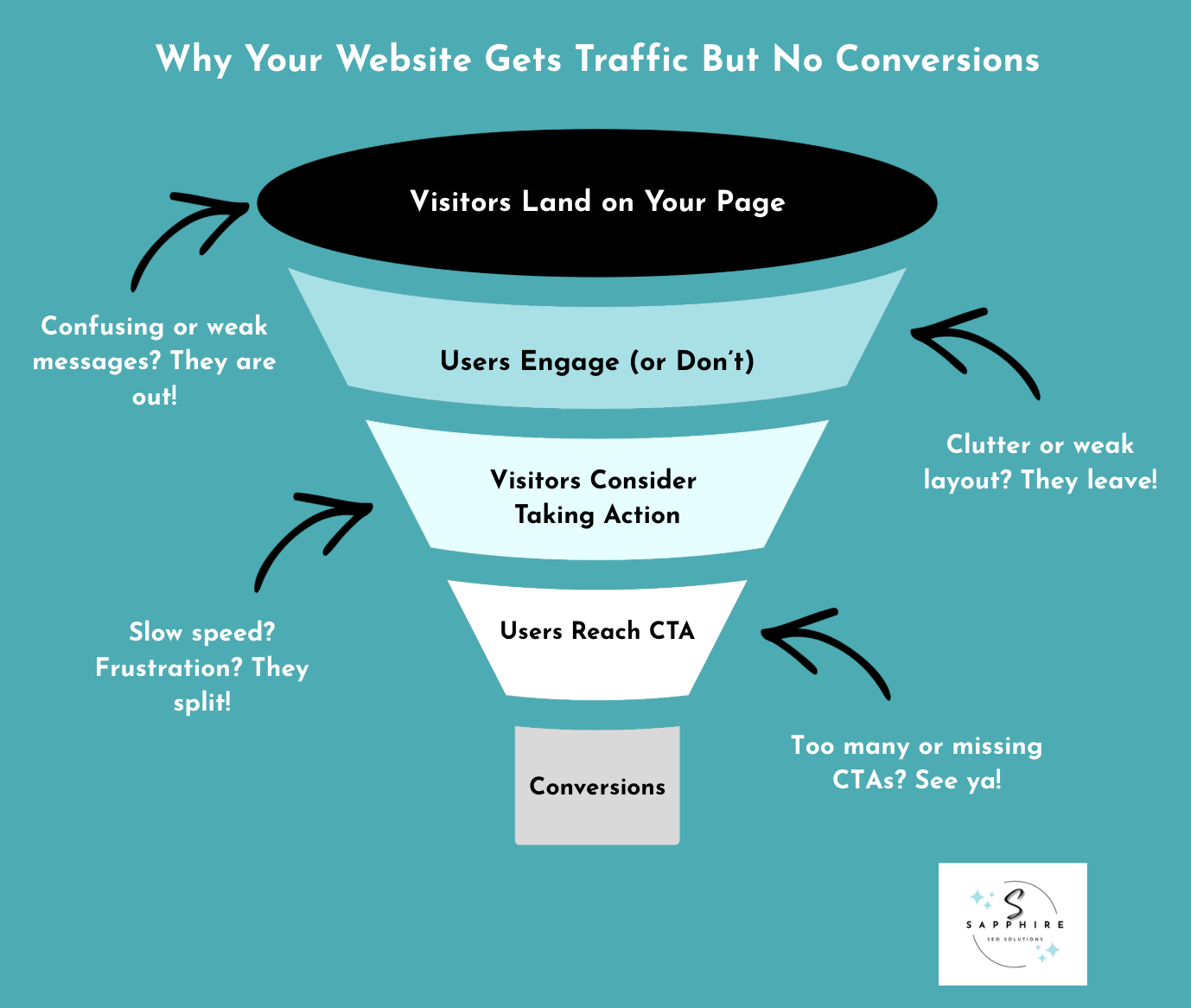
Here's what all of this comes down to. You don't need to spend money on paid ads or totally redesign your site. Typically, unless the content is really old or doesn't make sense, a simple refresh and other small changes can make a world of difference and show measurable results.
For instance, a stronger and better headline will grab the attention of visitors, which will lead to higher engagement. A solid CTA, like offering a free estimate, will naturally lead to more clicks. A site that loads quickly will have a lower bounce rate.
When you combine everything I mentioned above, you can dramatically increase your conversions, as shown in our SEO case study on rapid ranking improvements.
How Sapphire SEO Solutions Fixes This Problem With Our SEO and Digital Marketing Services
At Sapphire SEO Solutions, we are a full-service digital marketing agency, and the focus isn’t just on traffic—it’s on results.
That means we work hard at:
Identifying conversion bottlenecks
Improving messaging and UX
Aligning content with search intent
Optimizing CTAs and funnels
Enhancing overall site performance
Instead of guessing what’s wrong, the process is strategic, data-driven, and focused on ROI.
Are You Ready to Turn Traffic Into Revenue?
If your website is getting visitors but not generating leads, it’s time to fix what’s holding it back with affordable SEO services that rank and convert.
Sapphire SEO Solutions can help you identify exactly where your site is falling short—and how to turn it into a high-converting asset, and if you’re a marketer or writer, you can also share your expertise through our SEO blog guest post opportunities.
FAQs
Why is my website getting traffic but no leads?
A website that gets traffic but no leads typically has issues with messaging, user experience, or conversion strategy. Visitors may not clearly understand what the business offers, or they may not see a strong reason to take action. Weak calls-to-action, slow load times, or a lack of trust signals can also prevent conversions. Fixing these issues can turn existing traffic into qualified leads without needing to increase visitor numbers.
How can I improve my website conversion rate?
Improving your website conversion rate starts with optimizing key elements like headlines, calls-to-action, and page layout. Clear messaging, fast load speeds, mobile optimization, and strong trust signals all play a role. Additionally, aligning your content with user intent ensures visitors find exactly what they are looking for. Even small changes, like improving button placement or simplifying navigation, can significantly increase conversions over time.
What is a good website conversion rate?
A good website conversion rate typically ranges between 2% and 5%, though this can vary by industry. Some high-performing websites convert at 8% or higher, especially when targeting high-intent traffic. If a website is converting below 2%, it may indicate issues with user experience, messaging, or targeting. Regular testing and optimization are essential for improving conversion rates and maximizing return on investment.
Do I need more traffic or better conversions?
In most cases, improving conversions is more effective than simply increasing traffic. If a website already receives visitors but fails to convert them, adding more traffic will not solve the underlying problem. Optimizing conversion elements like calls-to-action, page structure, and trust signals can produce faster and more cost-effective results than focusing solely on traffic growth.
How does user experience affect conversions?
User experience plays a critical role in conversions. If a website is difficult to navigate, slow to load, or confusing, users will leave before taking action. A well-structured website with clear navigation, fast performance, and easy-to-read content keeps visitors engaged and encourages them to convert. Improving user experience often leads to higher engagement, lower bounce rates, and increased conversions.
What are the most common conversion mistakes on websites?
Common conversion mistakes include unclear messaging, weak or missing calls-to-action, slow page speed, poor mobile optimization, and lack of trust signals. Many websites also fail to match user intent, causing visitors to leave quickly. Addressing these issues can dramatically improve performance without requiring a full website redesign.
How long does it take to improve website conversions?
Some conversion improvements, such as updating calls-to-action or improving page speed, can show results within a few weeks. Other changes, like refining messaging or optimizing content, may take a few months to fully impact performance. Conversion optimization is an ongoing process, but small improvements can create noticeable gains quickly.
Can SEO help improve conversions?
Yes, SEO can improve conversions when it targets the right audience and aligns with search intent. By bringing in high-quality, relevant traffic, SEO increases the likelihood that visitors will take action. When combined with strong on-page optimization and user experience improvements, SEO becomes a powerful tool for both traffic growth and conversion generation.