

How to Hire a Professional Content SEO Writer (2026 Guide)
A content SEO writer in 2026 is a specialist who creates search-optimized, AI-citable content that ranks on Google and gets pulled into AI answers. Hiring the right one means prioritizing strategy (search intent, topic clusters, structured content) over cheap writing, because businesses now compete for both organic rankings and visibility in tools like ChatGPT and Google AI Overviews.
A professional content SEO writer doesn’t just write. They build content that aligns with user intent, demonstrates expertise (E-E-A-T), and delivers measurable traffic and conversion results. This guide explains how to find, vet, and hire a writer who can perform in both traditional SEO and AI-driven search in 2026.
Key Takeaways
Hire a professional content SEO writer to rank in search and get cited by AI platforms.
Focus on user intent and semantic topic clusters to ensure content performs in 2026.
Look for writers with E-E-A-T credentials who deliver measurable traffic and engagement results.
Vet candidates with live portfolio links, structured content examples, and AI optimization knowledge.
Prioritize strategy first: define goals, niche, and content requirements before hiring a writer.

Not long ago, ranking on Google meant repeating your target keyword as many times as possible. That was keyword stuffing, and it worked. Then search engine algorithms got smarter, and that tactic died fast.
Today, we're in another major transition. The new standard is Answer Engine Optimization (AEO), where your content doesn't just need to rank in search results. It needs to be the answer that AI platforms like ChatGPT, Perplexity, and Google's AI Overviews pull directly for users. If your content doesn't offer a unique perspective or a clear, structured answer, search engines in 2026 will skip right past it.
This is where most small businesses get stuck. A standard writer can produce readable content. A professional content SEO writer understands search traffic, search engine rankings, and how to structure content that both humans and AI systems trust and cite.
According to SE Ranking, organic traffic still accounts for 46.98% of all web traffic. Search isn't dead. But Gartner predicts that by the end of 2026, traditional search engine traffic could drop by 25% as users migrate to AI-driven answers. That means your content needs to perform in both worlds simultaneously.
This is where we come in. Sapphire SEO Solutions provides affordable SEO content writing services to small businesses, ensuring that their brand not only communicates with its target audience but also dominates Google. We are one of the few agencies that have in-house writers who are certified in SEO and AI Search Optimization, allowing us to curate content that ranks and attracts AI search engines.
This guide will show you exactly how to find, vet, and hire an SEO content writer who can do that.
What Is a Content SEO Writer? (And Why You Can’t Just Use AI)
A standard writer produces readable content. A professional SEO writer produces content that ranks. That difference matters more in 2026 than it ever has.
SEO writing is not just about putting words on a page. It's about understanding how search engine algorithms work, what your audience actually wants, and how to structure content so that both humans and AI systems can find, understand, and cite it. A good SEO writer is part strategist, part researcher, and part technician. They don't just write, they build optimized content that drives measurable results.
And no, you can't replace that with a ChatGPT prompt.
A Good Content SEO Writer Has the Required Technical Skill Set to Succeed!
SEO content writers understand things most writers never think about.
It starts with keyword research and a smart keyword strategy. But in 2026, that means more than finding popular search terms. It means grouping related terms into semantic clusters so your content covers a topic thoroughly enough to signal real authority to search engine algorithms.
It also means understanding user intent. There's a big difference between someone typing "what is SEO content" (informational) and "hire SEO content writer" (commercial). A professional knows how to write differently for each. They know how to structure a web page to win a Featured Snippet, how to answer "People Also Ask" questions in a way that gets your content pulled into AI summaries, and how to use meta tags and internal links strategically without disrupting the reader's experience.
These are SEO techniques that live firmly in the "on-page SEO" category. They separate a writer who can write from one who can actually rank your web pages.
Here is a free checklist for you to use when vetting a reliable SEO content writer for your business:
SEO Content Writer Checklist
Keyword Research & Strategy
- Conducts proper keyword research (not just surface-level terms)
- Builds a smart keyword strategy
- Groups keywords into semantic clusters
- Ensures comprehensive topical coverage
Understanding Search Intent
- Identifies different types of user intent
- Adapts writing style based on intent
- Aligns content with user needs
SERP Optimization Skills
- Structures content to win Featured Snippets
- Answers “People Also Ask” questions effectively
- Optimizes for AI summaries
On-Page SEO Expertise
- Uses meta tags strategically
- Implements internal linking effectively
- Maintains strong readability and UX
Performance-Oriented Mindset
- Focuses on ranking and results
- Understands content authority signals
- Bridges writing and SEO performance
Core Differentiator
- Understands how search engines interpret content
- Thinks beyond just writing
A Good Content SEO Writer Can Build a Brand Voice and Instill Trust
Pure AI content is losing ground fast.
The internet is now saturated with articles that look polished but feel empty. Businesses that once relied on AI for speed are now facing declining trust, lower engagement, and reduced search visibility. The problem is not AI itself. It's using AI as a replacement for human thinking rather than a tool to support it.
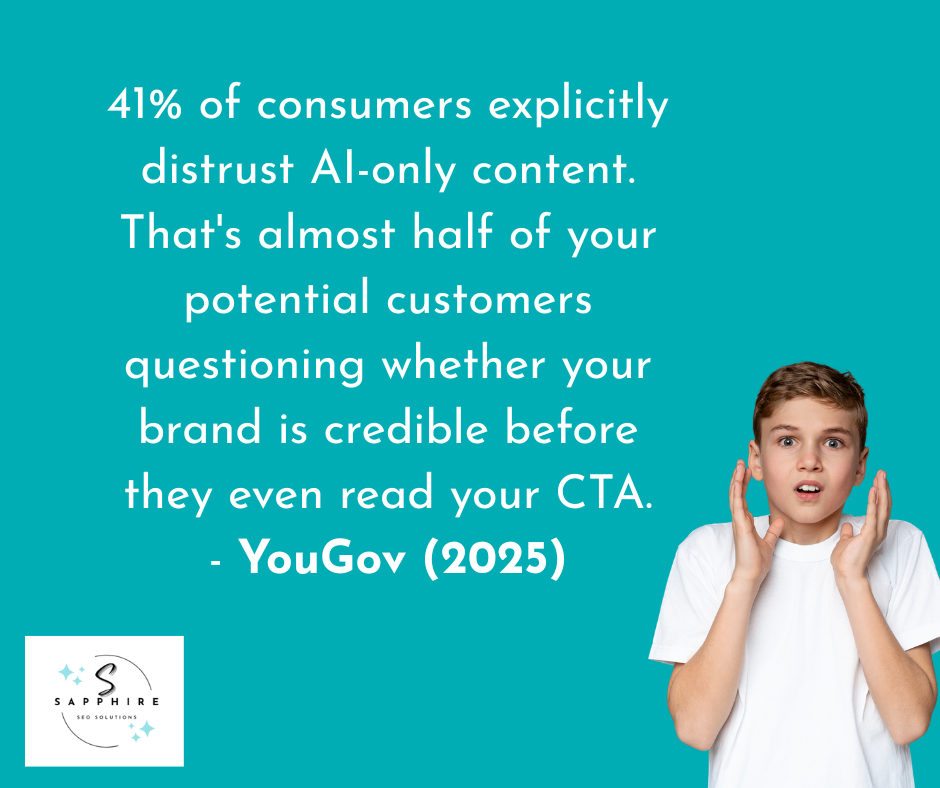
Research from YouGov (2025) shows that 41% of consumers explicitly distrust AI-only content, with only 5% deeply trusting AI content. That's almost half of your potential customers questioning whether your brand is credible before they even read your CTA.
What seo writers with real expertise bring to the table is E-E-A-T: Experience, Expertise, Authoritativeness, and Trust. These are the signals search engine algorithms look for when deciding whether your content deserves a top spot. AI-generated content has no identifiable expert with credentials or a reputation standing behind its claims, which is exactly why it keeps failing Google's quality standards.
A human writer gives your content brand voice, brand consistency, and the kind of nuance that builds your brand's credibility over time. They make sure your content aligns with your business goals and actually engages readers rather than just filling word count.
And word count does matter. Marketing Profs found that the average high-performing blog post is now 1,333 words. But to gain recognition from Google, words are not the only thing that matters. Writers must demonstrate a level of depth, real research, real perspective, and real writing skill, which AI alone fails to deliver.
High-quality content that reaches the right audience and converts potential customers is not something you can fully automate. It requires a human in the loop.
How to Hire a Professional Content SEO Writer Online in 3 Simple Steps
Finding a writer who can actually write SEO content that ranks is harder than it sounds. There are thousands of people offering SEO content writing services online. Most of them can write. Very few of them understand SEO content creation at the level your business needs in 2026.
Here's how to cut through the noise:
Step 1: Define Your Niche Requirements
Before you start searching, get clear on what you actually need. This is where most marketing teams and small companies go wrong. They hire a writer before defining their business goals, and end up with content that doesn't serve their target audience.
The first decision is generalist versus specialist. A generalist can create content across a range of topics, which works fine for broad lifestyle or general web content. But if your website operates in a regulated or technical field like Legal, Medical, SaaS, Finance, or E-commerce, you need a specialist.
Generalist writers are a dime a dozen. Niches like FinTech, SaaS, Health, and Legal pay the most because they require technical knowledge and high accuracy. A specialist in your space will require less hand-holding, will understand the nuances your right audience cares about, and will produce website content that builds real authority in your industry.
Ask yourself: Does this writer need to understand my product, my compliance requirements, or my buyer's level of sophistication? If yes to any of those, go with a specialist.

Step 2: Source High-Level Talent
You have two main options: freelance marketplaces or specialized SEO agencies.
Platforms like Upwork and Fiverr give you access to a large pool of writers at varying price points. The key tactical advantage here is flexibility: you can hire a technical SEO auditor for a one-off project, then separately engage a long-term content strategist for your blog, all on one platform. The downside is that vetting takes time, quality is inconsistent, and finding someone who can hit the ground running on your content strategy without heavy onboarding is rare.
A specialized SEO agency removes that friction. You get a team that already understands SEO strategies, has established workflows, and can handle your content creation needs at scale. The tradeoff is cost. For online businesses with serious growth goals, that cost is usually worth it.
Pro-Tip: Don't accept a PDF portfolio. Ask for live links instead. A PDF can hide outdated work, removed articles, or pieces that were edited heavily after submission. A live portfolio shows you how the writer's work actually performs on a website today. You can check if the content ranks, how it's formatted, and whether it still aligns with current seo best practices. That's the real test.
When evaluating past clients and content projects, also look for evidence of clear communication. A great writer who misses briefs or disappears between drafts will cost you more time than they save.

Step 3: Vet for 2026 SEO Standards
This is where most hiring decisions fall apart. A writer can sound knowledgeable in an interview but fail to produce content that achieves Google's standards. Ask two specific questions during the vetting process.
First: Do they understand Schema Markup?
A schema is the structured data code that tells search engines exactly what your content is. In 2026, search is no longer a list of blue links; it is an ecosystem of AI-generated answers, visual snippets, and instant facts. A writer who understands Schema knows how to structure content so it's eligible for rich results, FAQ boxes, and AI citation. That directly impacts your search rankings. Websites with properly implemented structured data, according to the Digital Marketing Institute, see click-through rate improvements of 20-82% compared to standard listings.
Second: Can they optimize for "Zero-Click" searches?
Zero-click means the user gets their answer directly on the search results page, without ever visiting a web page. Search Engine Land reveals that nearly 60% (58.5%) of Google searches in the US end without a click to any external website. A writer who understands this doesn't panic about zero-click. They know how to structure content to win Featured Snippets and AI Overviews, which builds brand visibility even when users don't click through.
The numbers make this non-negotiable. Only 0.78% of users click through to the second page of Google. Search Engine Land also reveals that the top 3 search results capture 68.7% of all clicks. If your writer doesn't understand the SEO techniques needed to compete for those top spots, your investment is effectively invisible regardless of how well-written the content is.
Make sure any writer you hire can speak fluently to both of these areas. They are table stakes for seo content writing in 2026.

5 Interview Questions to Ask to Vet SEO Writers
Any writer can talk about keyword research and user intent in an interview. The real question is whether they actually understand how content performs in 2026. These five questions will tell you fast.
1. "Can you explain the difference between a keyword and a topic cluster?"
This question separates writers who are still stuck in old-school keyword strategy from those who understand how modern search works.
A keyword is a search term. A topic cluster is a structured system where a central pillar page connects to multiple supporting articles, all internally linked, all building authority around a single subject. Keywords are inputs, not strategy. Topics are now the umbrella under which your keyword strategy operates, and internal linking signals subject mastery to AI systems.
What to look for: If they only talk about keywords, they are stuck in 2018. A strong candidate will mention pillar pages, semantic clustering, and how connected content signals topical authority to search engines.
2. "How do you optimize content for AI-driven search results (SGE/Perplexity)?"
This question tests whether they understand the new rules of search performance and AI visibility.
The right answer involves three things: structured data so search engines can parse the content, clear H-tags that act as direct questions AI can extract answers from, and definition sentences at the start of each section. The first sentence of a page should answer the primary question completely, because answer engines are looking for that quick validation, and every section should stand alone since AI engines pull individual chunks.
What to look for: Mention of structured data, clean heading hierarchy, and direct answer-first sentences. If they only talk about keywords and meta descriptions, they are not optimized for the world your website operates in today.
Read through our detailed guide on "Is SEO Dead with the Rise of AI Search?" to learn tips on improving AI search visibility.
3. "What is your process for integrating internal links without disrupting the user flow?"
Internal links are one of the most underused tools in SEO strategies. Done right, they pass link equity through your site and guide readers deeper into your content. Done wrong, they feel like spam and kill the reading experience.
A professional will describe strategic placement, meaning they link when it serves the reader, not just to hit a number. They'll understand that anchor text should be descriptive and contextual, and that internal links should support the topic cluster structure rather than scatter readers randomly across the site.
What to look for: Any mention of "link juice," content hierarchy, or cluster architecture. A writer who says "I add three internal links per post" with no further context is treating it as a checkbox, not a strategy.
4. "Show me a piece of content you wrote that ranks for a long-tail 'How-to' query."
This is the only question that cannot be faked. It's proof of user intent management in action.
Long-tail how-to queries have very specific informational intent. Ranking for them requires the writer to understand exactly what the reader needs at that moment, structure the content to deliver it clearly, and optimize it well enough to beat competitors in search results. A live, ranking example tells you everything a portfolio PDF cannot.
What to look for: A real URL. Pull it up. Check the position, check the structure, check whether the content actually answers the query it targets. If they cannot show you a live ranking example, that is a red flag.
5. "How do you handle 'Information Gain' in your writing?"
This is the most important question on the list, and most writers will not know how to answer it.
Information Gain is Google's way of measuring how much new value a piece of content adds beyond what already exists on the same topic. Google's algorithms are specifically designed to reward the "outliers," pages that offer a unique data point, a fresh case study, or a backed-up contrarian take.
Google's February 2026 core update explicitly increased the weighting of information gain as a ranking signal, and aggregated AI-generated content without original analysis lost visibility across every industry.
In plain terms, if a writer's process is to read the top 10 results and combine them into one article, their content will be ignored. By AI, by Google, and eventually by your target audience.
What to look for: A writer who understands Information Gain will talk about adding original data, first-person perspectives, proprietary insights, or expert angles that competitors have not covered. That is the type of writing that makes your content strategy actually work.
According to WebFX, analysis of 2.3 billion sessions found that Generative AI traffic converted 1.2x higher than traditional organic search. Asking about AI visibility during the hiring process ensures your writer can capture those high-converting leads, not just rank for generic terms.
Warning Signs: Red Flags When Hiring an SEO Content Writer Online
Finding a writer is easy. Finding one who actually protects your SEO content investment is harder. Before you sign off on any hire, know what to watch out for.
The "Cheap Content" Trap
If a writer is charging $0.01 per word, ask yourself one question: What kind of content writing can you actually get for that price?
The honest answer is bulk, unedited, AI-generated output with no strategy, no research, and no unique perspective. Sites that published hundreds of pages with no unique value, targeted keywords with no search intent alignment, and didn't edit or add anything proprietary are exactly what Google's algorithm sees as sameness, rewarding them with low engagement, high bounce rates, and ranking drops. The writer isn't the only one who loses. Your business does too, when Google decides your site isn't worth ranking.
The numbers make the ROI case clear. According to the Content Marketing Institute, content marketing not only costs 62% less than outbound marketing but also generates 3x more leads. That's a powerful return, but only when the content is actually good. Cutting corners on writer rates breaks that loop entirely. You end up spending money on content that generates zero traffic, zero leads, and in some cases, actively damages your site's standing in search engine algorithms.
Cheap SEO content writing services tend to share the same warning signs: extremely fast turnaround with no questions asked, no content brief required, no discussion of your audience or goals, and a portfolio full of generic articles that could apply to any industry. That's not a service. That's a content factory. And in 2026, content factories are exactly what Google's core updates are designed to penalize.
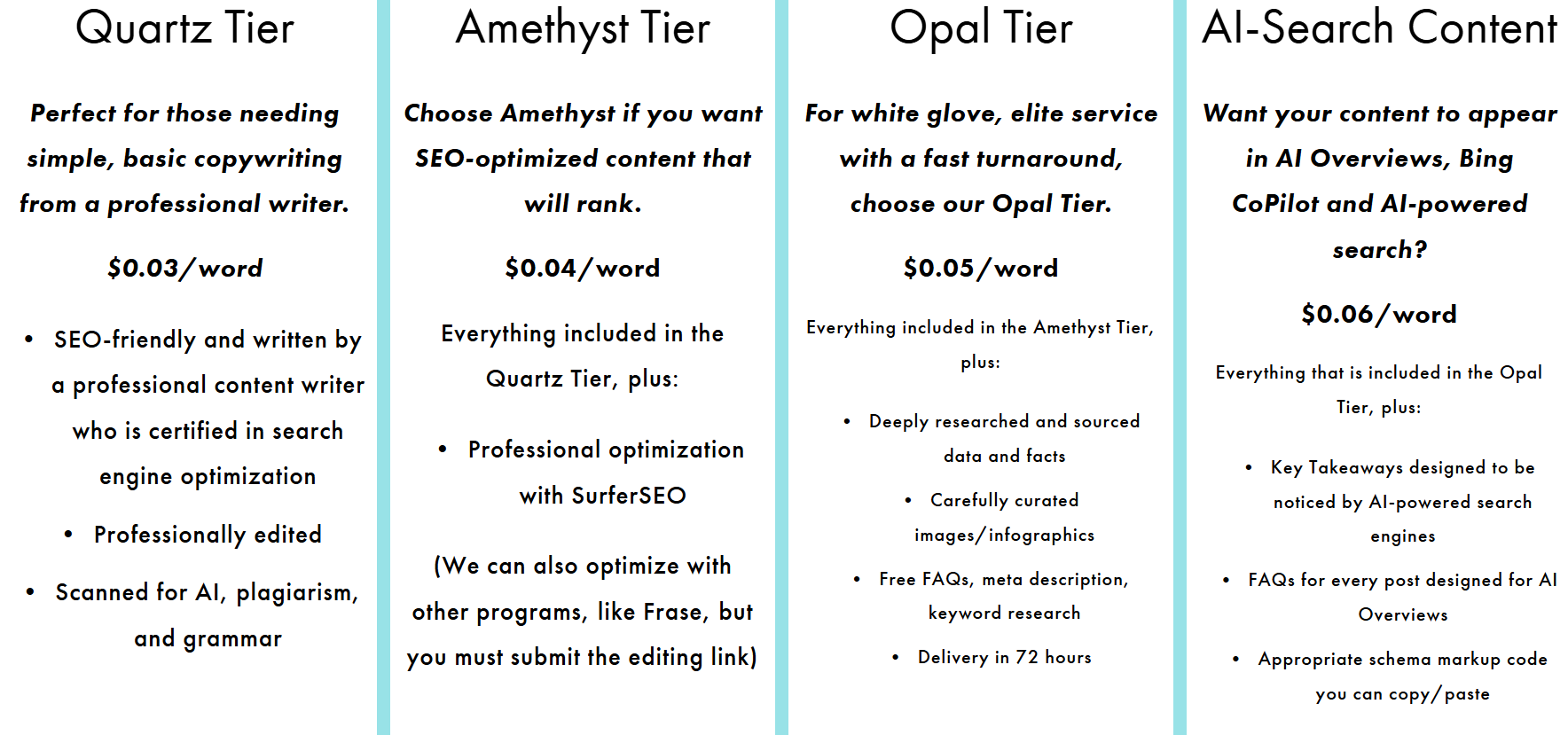
At Sapphire SEO Solutions, we offer different content writing tiers, starting from $0.03 per word. Our content writing services are not only affordable but delivered by expert writers who are certified in SEO and AI SEO. Here are the different content writing tiers we offer:
Over-Optimization
Over-optimization is the other side of the same coin, and it's just as damaging.
Some SEO writers still operate like it's 2012. They'll take a 500-word post and repeat the exact-match keyword 15 to 20 times throughout the copy, force it into every subheading, and stuff it into meta tags, whether it reads naturally or not. That's not SEO content. That's a signal to search engine algorithms that your page is trying to manipulate rankings rather than serve readers.
Google's algorithm in 2026 understands natural language and semantic relationships. It doesn't need to see your exact keyword repeated 20 times to understand what your page is about. Over-optimization looks manipulative and creates a poor user experience, both of which harm rankings.
The fix is simple. Good SEO techniques in 2026 mean using your primary keyword naturally, a handful of times, and building context around it with related terms, synonyms, and semantically connected phrases. Forcing exact-match keywords into every internal link looks manipulative and can trigger spam signals. Natural, descriptive anchor text is what modern search engines reward.
If a writer sends you a sample and every third sentence contains the exact same phrase, that's your red flag. Their approach will hurt your quality standards, not help them. Ask how they handle keyword placement before you hire, and watch how they answer.
Partner with Sapphire SEO Solutions to Work with a Certified SEO Content Writer!
Every decision in this guide comes back to one principle: intent first.
Before a keyword. Before a word count. Before a content brief. A professional content SEO writer starts by asking what the reader actually needs and what stage of the buying journey they're on. That's the "Intent First" approach. When content aligns with intent, users stay longer, engage more, and convert at higher rates, which strengthens ranking signals. It's what separates great content that drives traffic from content that simply exists on a page no one reads.
The online businesses winning in search right now are not the ones publishing the most. They're the ones publishing the most purposefully. Their website pages, landing pages, and blog articles are built around what their potential customers are actually searching for and what those searchers need at that exact moment. That's the type of content that performs in 2026, and AI alone cannot replicate.
The threat of being ignored by search engines is real. So is the opportunity. Companies that consistently align their content with user needs will earn rankings, snippets, and AI mentions. Those who cling to outdated keyword strategies will find themselves invisible. The gap between those two outcomes often comes down to one hiring decision: the writer you choose to represent your brand online.
Getting that decision right means looking past cheap rates and surface-level portfolios. It means vetting for 2026 standards, asking the right interview questions, and partnering with someone who understands that content aligns only when strategy precedes every sentence. Done right, your content becomes an asset that compounds month over month, bringing more visitors, building authority, and converting potential customers long after it's published.
That's the standard we hold every piece of content to at Sapphire SEO Solutions. We started as a content writing firm before evolving into a full-blown SEO agency, which means we've done content writing since 2007. That's decades of writing expertise and industry knowledge, which most SEO firms lack. Our writers can give your brand the voice its target audience is yearning for.
Contact us to schedule a free consultation with an SEO expert today to learn about the content gaps your business can explore and how we can help with that.
Need content that actually ranks? Place an online order today to get started!

Frequently Asked Questions - Content SEO Writer
How much does a professional content SEO writer cost?
Professional SEO content writing services typically range from $0.10 to $0.50 per word for experienced freelancers, with specialist articles and white papers in technical fields like Legal, SaaS, or Finance reaching $0.50 to $1.00 per word or more. For companies using an agency, monthly retainers depend on volume and scope. At Sapphire SEO Solutions, our seo content writing services start at $0.03 per word, rates designed for small businesses that need quality without enterprise-level pricing. And the investment is worth it.
How long does it take to see results from SEO content?
SEO content typically takes six to 12 months to show meaningful movement in search rankings and website traffic, though competitive industries or new domains can extend that timeline. Most websites will see results from their SEO strategy in three to six months, but factors like domain age, backlink profile, and competition can impact this timeline. In 2026, you may also see early wins before traditional rankings move, as well-structured content can get cited in AI Overviews and Featured Snippets, improving your search performance faster than a blue-link ranking alone.
Should I hire a freelancer or an SEO agency?
For marketing teams with a clear content strategy and the bandwidth to manage briefs, revisions, and quality checks, a freelancer can work well for one-off projects or product descriptions. But if you don't have the marketing team to guide and provide writers with a brief, it's best to work with a reliable content writing firm like Sapphire SEO Solutions.
How do I know if a content SEO writer is actually good (not just using AI)?
A genuinely skilled SEO content writing professional will ask questions before writing, not just accept a topic and deliver 1,000 words overnight. Look for writers who request a content brief, ask about your engaging content goals and audience, and demonstrate awareness of search intent. Review their blog posts and check whether the informative content they produce has live rankings, real depth, and a clear human voice with original perspective.
What should I look for in an SEO writer's portfolio before hiring?
When reviewing a content SEO writer's portfolio, prioritize live blog posts over PDF samples and check whether those pages actually rank for their target keywords. Strong SEO content will have a clear structure, proper header hierarchy, natural keyword use, and demonstrable search intent alignment. Look for range across content types, consistency in quality, and evidence that they understand the topics they write about, rather than simply paraphrasing what already exists online.