

How much does SEO cost for a small business? Most land somewhere between $500 and $5,000 a month. In Ahrefs’ global survey of 439 SEO providers, 63% charged within that range. That’s a wide gap, though. Where you fall depends on who does the work, how much of it there is, how crowded your market is, and what your business actually needs.
Pricing also comes in different shapes. A monthly retainer means you pay a set fee for ongoing work. Hourly consulting means you pay for a specialist’s time. A one-time project covers a defined job, like a website audit, for a single price.
This guide focuses on US small businesses. You’ll see what SEO costs, what the money covers, which extra expenses to plan for, and how to size up a provider before you sign anything.
Key Takeaways
Most small businesses pay roughly $500 to $5,000 monthly for SEO, but no single average should set your budget.
Compare proposals by deliverables and who does the implementation, not by monthly fee alone.
Starting prices aren’t campaign costs: only 36% of published plans sit in the $1,500 to $5,000 band.
Local SEO rests on relevance, distance, and prominence. You can’t pay Google for a better local ranking.
Calculate ROI with gross profit, not revenue. Hypothetically, a 50% margin gives 67% ROI; 30% gives zero.
SEO is slow. Only 1.74% of new pages reach Google’s top 10 within a year, per Ahrefs.
Keep ownership of your Analytics, Search Console, and Business Profile accounts, and clarify content ownership and handover before signing.
No one can guarantee rankings or AI citations. Be wary of guarantees and paid add-ons promising them.
How Much Does SEO Cost for a Small Business?
Most small business owners should plan on $500 to $5,000 a month for search engine optimization (SEO). That’s where 63% of providers in Ahrefs’ worldwide survey landed. US prices run higher, though. Among US and Canadian providers in the same survey, 79.1% charged at least $1,001 a month.
A lower fee usually buys a short list of tasks, like a Google profile cleanup or a few page edits. A full-scope ongoing campaign costs more because someone writes pages, fixes the site, and earns links from other websites every month. Be wary of cheap SEO, too. Clutch says firms branded that way often lack the expertise or use tactics that break Google’s rules.
Use these planning categories to sort an SEO budget. They’re not 2027 market averages, and what each level buys depends on the provider.
Typical Monthly SEO Investment Ranges
| Monthly Investment | What It Generally Represents |
|---|---|
| Under $500 | Limited tasks, consulting, or narrowly defined support. |
| $500 to $1,000 | Focused, restricted-scope SEO help. |
| $1,000 to $2,500 | More substantial ongoing SEO work. |
| $2,500 to $5,000 | Broader campaigns and more extensive requirements. |
| $5,000+ | Complex, extensive, or highly competitive campaigns. |
SEO packages list a fixed price for a fixed set of tasks. Custom proposals set the price after the provider studies your site and competitors. The sources below mix both.
What Is the Average Monthly Cost of SEO?
These fees pay for online visibility: showing up in search engine results pages when customers look for what you do. Better search rankings bring more organic traffic, the website traffic that comes from organic search instead of ads.
Ahrefs (December 2023, updated August 2026): 439 providers worldwide. Average retainer $2,917; agencies $3,209, freelancers $1,349. Ahrefs assumed each provider charged the top of its pricing tier.
Clutch (September 2026): client-reviewed agency projects, not limited to small businesses. Average monthly cost: $3,199.
SEMPITE (August 2026): 307 US agencies ranking on Google, 35 of which publish prices. Median published plan: $1,000; median cheapest plan: $450. SEMPITE sells SEO too.
Paradigm Media Networks (2026): an agency’s own benchmarks, with no sample size given. One location, $1,000 to $2,500; three or more, $2,500 to $6,000.
Averages and medians differ because a few huge numbers drag an average up. Clutch’s typical reviewed project costs under $10,000, yet its average is $37,158. The median shows the middle project.
A published starting price is another thing. In SEMPITE’s data, only 36% of published plans sit in the $1,500 to $5,000 band most guides quote, and 19 of 35 publishers start below $500. But a first price is the bottom rung of a ladder, not the cost of a typical campaign.
So no single number should set your SEO pricing expectations. The surveys mix freelancers, agencies, countries, and scopes. Start from your market and your goals.
Sapphire SEO Solutions offers affordable SEO solutions to small and medium-sized businesses. We don’t lock businesses into long, expensive contracts. Our team works with you to understand your needs and tailors packages based on your goals. Our rates are as follows:
SEO content writing: starting from $30 per 1,000 words
AI SEO content writing: starting from $60 per 1,000 words
On-page SEO: starting from $30 per page
Technical SEO: starting from $100 per month
Keyword research: starting from $100 per month
Why Do SEO Agencies Charge Different Prices?
Because two quotes rarely describe the same work. A site in a quiet market needs less than one fighting ten rivals, so the competitive landscape moves the price. So does niche expertise. A provider who knows your trade charges for it. Scope matters most: one quote covers writing and links, while another stops at advice and leaves the changes to you. Ask who handles implementation, because it’s sometimes excluded. Packages stay fixed. Custom engagements flex.
Location counts too. Clutch lists US agencies at $100 to $149 an hour and India-based ones under $25, and ties the gap to living costs and demand.
SEO is also one of several digital marketing strategies. Weigh each quote against your total marketing budget and your other marketing channels.
How Much Does Local SEO Cost for a Small Business?
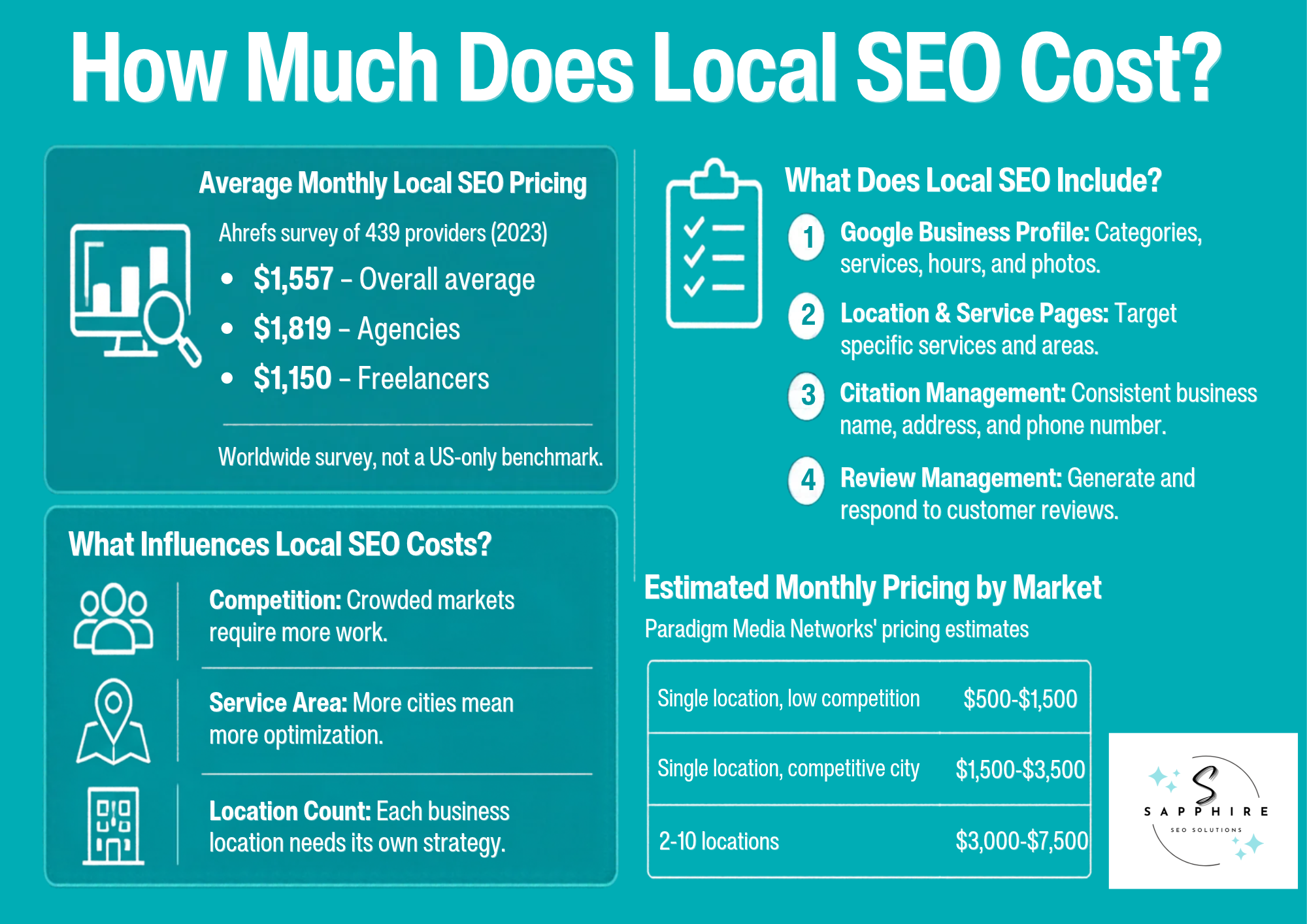
Local SEO cost depends on where you work, how many places you serve, and who you’re up against. Ahrefs’ worldwide survey of 439 providers (first published December 2023) put local SEO pricing at $1,557 a month on average, based on providers serving local markets. Agencies averaged $1,819 and freelancers about $1,150. But it isn’t US-only, and it’s aging. Treat it as one data point, not a standard price.
Local SEO targets customers in a specific city or service area. National SEO competes for searches from anywhere. A local service business, like a plumber, mostly needs to appear in Google Maps and the local listings above regular results. Check out our guide on “Local SEO vs National SEO” to learn which is right for you.
Google says local results rest mainly on relevance (how well your Google Business Profile matches the search), distance (how far you are from the searcher), and prominence (how well known you are, partly through reviews and links). You can’t pay for a better ranking, and distance is mostly fixed. So the work goes into the other two.
The work usually covers:
Google Business Profile optimization: categories, services, hours, photos. Whitespark’s 2026 survey of 47 local SEO experts ranks the primary category first for map results.
Location pages and local content: a page per service, and per location if you have several. Those same experts rank dedicated service pages first for regular local results.
Citation management: keeping your name, address, and phone number consistent across other sites. Useful, but only one piece.
Review strategy: asking steadily and replying.
Competition, service area size, and location count all add work, and a crowded market makes local SEO anything but cheap. A single-location business may need one profile and a few pages. Multiple locations each need their own. Paradigm Media Networks, an agency, lists $500 to $1,500 for one location in a quiet market, $1,500 to $3,500 in a competitive city, and $3,000 to $7,500 for two to ten locations. Those are its own estimates. No one can promise a Maps ranking.
What Are the Different SEO Pricing Models?
Most SEO pricing models fall into four buckets. In Ahrefs’ survey of 439 providers, 78.2% charge a monthly retainer, 48.9% charge per project, and 34.8% bill by the hour. Many offer several. The pricing models differ in two ways that matter: who does the work, and how long you’re committed.
Monthly SEO Retainers
You pay a recurring fee for ongoing strategy, implementation, reporting, and campaign management. It fits businesses that need steady work, not one fix. But a retainer covers a set scope, so ask what’s included. Setup fees and minimum terms vary. Paradigm Media Networks, for one, lists a three-month minimum and a $1,000 setup fee on its moving company plans, waived at six months.
Hourly SEO Consulting
Hourly consulting means paying for a specialist’s time: technical consultations, strategy sessions, or a defined task. It can cost less when someone in-house does the work and you only need advice. Ahrefs’ global average was $111 an hour, and Clutch lists US agencies at $100 to $149. The advice is yours to carry out, unless the hours cover the doing.
One-Time SEO Projects
A one-time project covers a defined job for one price: a technical audit, a website migration (moving to a new platform), keyword research, a round of fixes, or a content project. It fits a clear problem with a clear end. Ahrefs’ most common per-project fee was $2,501 to $5,000. Nothing ongoing, though, and nobody maintains the work afterward.
Performance-Based SEO Pricing
Pay depends on results, tied to rankings or to outcomes like leads and sales. Both are hard to measure. Search results shift, competitors move, and credit for a sale isn’t always clear. Narrow targets can also push a provider toward easy search terms that bring little business. Google says no one can guarantee a #1 ranking, so a performance deal doesn’t guarantee results either.
What Does an SEO Package Include?
SEO services aren’t a fixed menu. Two providers can charge the same fee and do different work. Packages vary in scope, staffing, and who actually makes the changes. Read each proposal for four things:
SEO strategy (the plan)
Recommendations (what should change)
Implementation (who changes it)
Reporting (how you’ll know)
Some work belongs in ongoing SEO services, like content and reporting. Some is mostly one-time, like cleaning up a messy site structure. No package covers everything, so a good SEO campaign starts with what your business needs most.
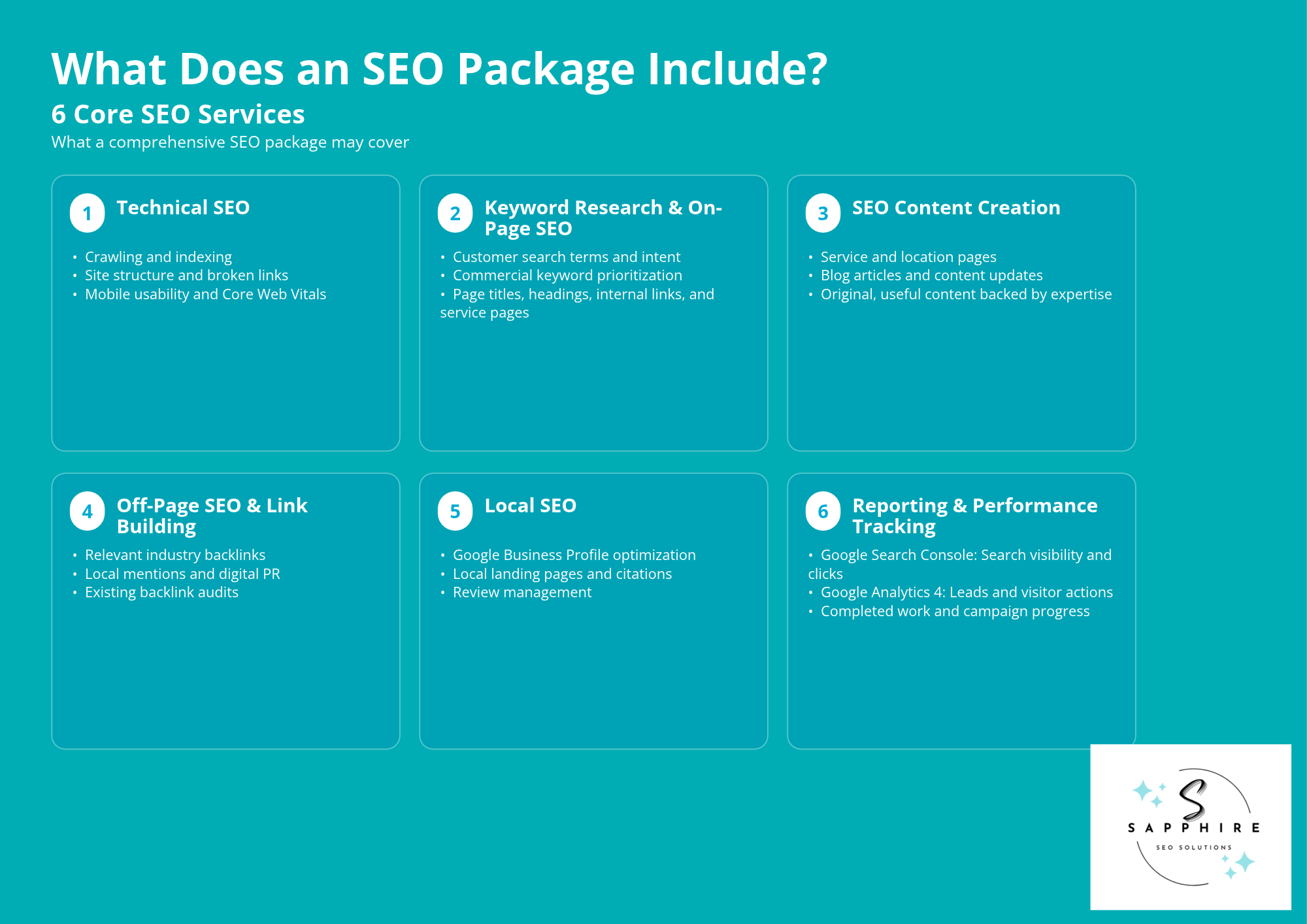
Technical SEO
Technical SEO is how well Google can reach and read your site: crawling (Google’s bots finding your pages), indexability (whether those pages can be listed), site structure, broken pages and redirects, and mobile usability. It also covers Core Web Vitals, Google’s loading, responsiveness, and layout-stability scores. Ask who makes the technical fixes. Some providers only report them, and advanced technical optimization may cost extra.
Keyword Research and On-Page SEO
Keyword research finds the phrases customers type, and the intent behind them, then ranks them by commercial value. On-page SEO puts those findings into page titles, headings, service pages, and internal links (links between your own pages). A sensible package starts with on-page optimization with your most profitable services.
SEO Content Creation
Content creation covers new service pages, location pages, blog articles, and updates to existing pages. But more isn’t better by default. Google’s guide for AI search features favors “non-commodity” content: unique insight, not the generic tips every competitor posts. Ask who reviews the writing for accuracy and quality.
Off-Page SEO and Link Building
Off-page SEO is the work beyond your site. Link building earns backlinks, links from other websites to yours, a bit like referrals. Relevant ones come from local mentions, industry sites, and digital PR (press coverage). Providers should also review the links you already have. Google bans buying links for ranking, so ask how they’re earned.
Local SEO
Local SEO bundles Business Profile work, local landing pages, citations, and review requests. The local pricing section above covers the details. Ask whether it’s included or billed separately.
Reporting and Performance Tracking
Reporting should show work done and results, not only rankings:
Google Search Console: free data on how often you appear in Google and what gets clicked.
Google Analytics 4: what visitors do next. Ask for “key events,” Google’s term for tracked actions like form fills and phone-link taps.
A plain list of work completed against the plan.
What about AI search?
Generative engine optimization (GEO) is the label some providers use for winning visibility in AI answers, including Google’s AI Overviews. Google says optimizing for its AI features is still SEO: indexed pages, useful original content, accurate business details, sound technical foundations. It calls llms.txt files and special markup unnecessary. So be wary of paid add-ons. Nobody can guarantee an AI citation or mention.
What Factors Affect Small Business SEO Costs?
Two similar businesses can get very different SEO proposals. Business size tells a provider less than you’d think. The market, your website, how many places and services you cover, and who does the work matter more. In Backlinko’s survey of 300+ SEO professionals, website size, competition, and provider experience were rated the biggest price drivers.
Industry and Competition
Competitors set the bar. When rivals have strong sites, plenty of reviews, and many links from other websites, a provider needs more content and outside trust (authority) to catch up. That’s why competitive markets take more work, especially for commercial keywords (searches made by people ready to hire). Providers should also hunt for content gaps: topics rivals cover that you don’t. The industry label matters less than the actual rivals.
Website Size and Condition
More important pages usually means more work, but size alone isn’t the driver. Google says crawl budget (how much of a site it will crawl) matters mainly for very large or fast-changing sites. Condition counts more: technical problems, thin content, an odd link history, or earlier SEO that needs cleanup. A brand new site has no track record at all, so it often needs more early investment.
Target Locations and Campaign Scope
One location and a few services is a smaller job than five locations and a dozen services. Each service or place usually needs its own pages, and each place faces different rivals. Local can be harder than national when the city is crowded. Goals shape the work too. A campaign for phone calls differs from one for online orders.
Provider Experience and Delivery Model
Experience costs more. Ahrefs found SEOs with two-plus years behind them charge about a third more. Agencies usually charge more than freelancers, but they bring writers, developers, and link specialists. A freelancer offers direct access to one expert and less capacity. Highly competitive markets often need that depth. Location counts too. Clutch says metro-based agencies usually charge more.
What Can Different SEO Budgets Realistically Accomplish?
The cost for a small business to get real SEO work done matters less than what the number covers. The scenarios below are hypothetical, not fixed packages, and no provider’s deliverables will match them exactly. Higher spending doesn’t automatically mean better results. But a smaller budget can work well when it focuses on the few services that earn you money, instead of spreading across everything.
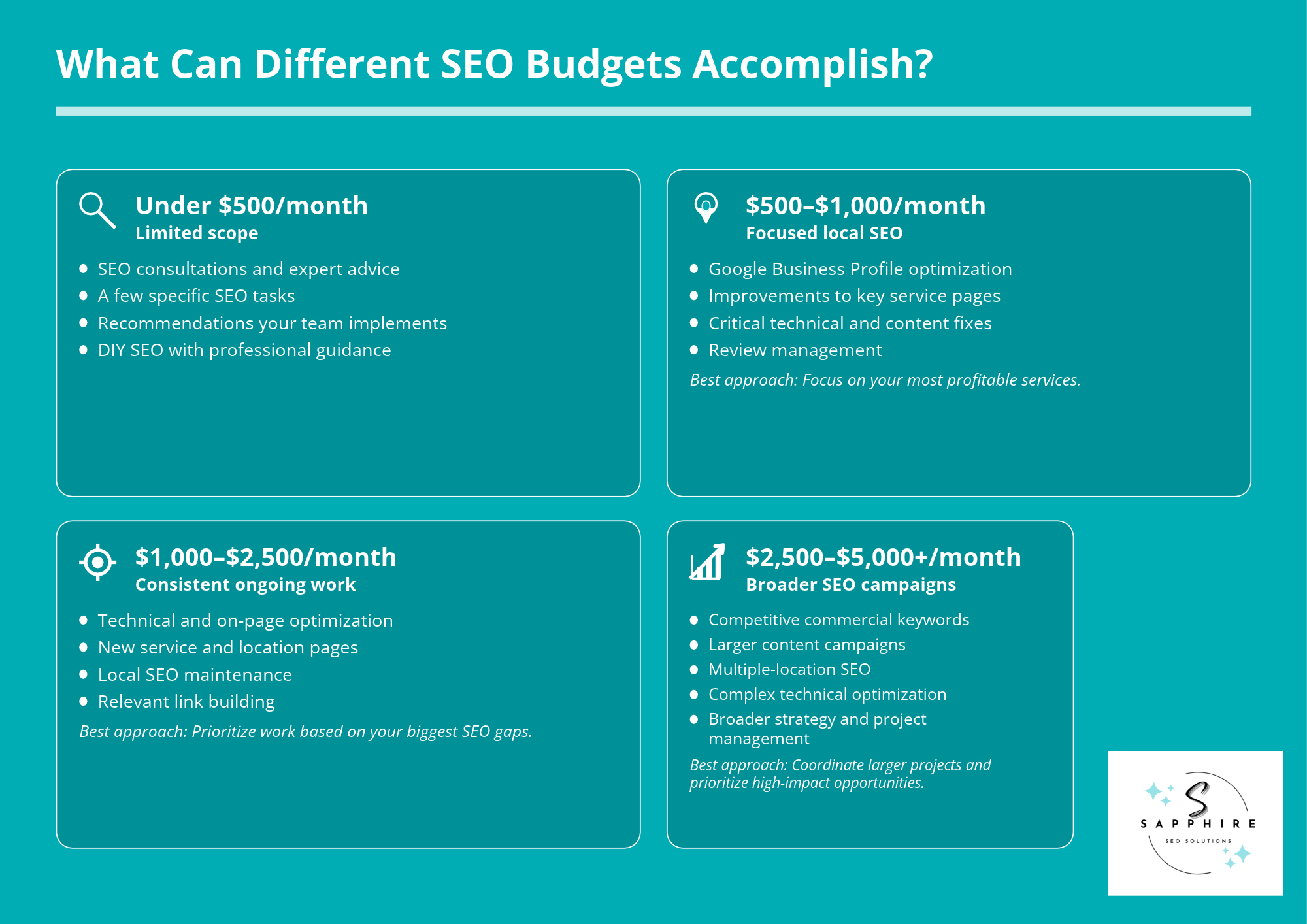
What Can You Get for Under $500 Per Month?
Expect narrow help: a few defined tasks, a consultation, or advice your team carries out. Starting prices under $500 exist (19 of 35 US agencies in SEMPITE’s August 2026 study), but only 7% of providers in the US, UK, and Australia sell retainers that low, per Backlinko’s survey. Google says a small local business can probably do much of the work itself, so expert advice plus your own effort can be a sensible fit.
What Can You Get for $500 to $1,000 Per Month?
Focused local SEO can fit here. That might mean tidying your Google Business Profile, improving a handful of service pages, and fixing the biggest technical or content gaps. Reviews deserve attention too. BrightLocal’s 2026 survey found 47% of consumers won’t use a business with fewer than 20 reviews, and 74% only care about reviews from the last three months. The trade-off is breadth. Pick a few of your most profitable services and leave the rest for later.
Check out our guide on “The Role of Online Reviews in Local SEO Rankings“ to learn more about the importance of reviews for local SEO.
What Can You Get for $1,000 to $2,500 Per Month?
More consistent, ongoing work becomes possible. A month’s effort might be split across:
Technical and on-page fixes on your key pages
New or improved content, like service pages and location pages
Local SEO upkeep: profile, citations, and reviews
Earning a few relevant links from other websites
Not all four every month. Providers often shift effort toward the biggest gap. And more work still isn’t automatic results, because competition and your website’s condition shape how far it goes.
What Can You Get for $2,500 to $5,000+ Per Month?
This tier suits heavier lifting: larger content needs, competitive commercial keywords, several locations, complicated technical work, and broader strategy and project management. The trade-off shifts. You’re less often choosing what to skip and more often deciding what to do first. But a bigger budget aimed at the wrong pages can still waste money. Ask any provider what they’d do first, and why.
What Other SEO Expenses Should Small Businesses Budget For?
Your agency’s fee isn’t always your total SEO bill. A monthly retainer may cover planning, content, and reporting but leave out work on your website, outside services, or software. Some costs recur. Others show up once, like a site move. So ask what’s included, what’s excluded, and who makes each change.
Website Development and Maintenance
If implementation isn’t in your package, you’ll need developer time for fixes. Bigger projects, like a redesign or a site migration (moving to a new platform or address), bring their own costs. Google says to involve an SEO early in a redesign. Hosting and site maintenance are website costs, not SEO services, though your SEO may advise on them.
Content and Specialist Production
A retainer may include writing but not everything around it. Extra content, expert review, photography, video, and design can be separate line items. Ask who produces each piece and who pays.
SEO Tools and Software
Providers use paid tools for keyword research, technical audits, rank tracking, and reporting. Some cover those costs in their fee, so ask before buying your own. Free Google tools handle plenty: Search Console, Google Analytics, PageSpeed Insights, and Business Profile. Skip paid software unless it changes a decision.
Digital PR and External Services
Specialist outreach and digital PR (earning press coverage and links) can sit outside a retainer. In one case study in Backlinko’s guide, the client paid for a three-month PR campaign separately from the monthly fee. Treat third-party costs as optional until they’re agreed in writing. And skip anyone selling links, which Google’s spam policies prohibit.
Is SEO Worth the Investment for a Small Business?
Is SEO worth the money? That depends on whether the customers it brings in earn you more than the SEO investment costs. SEO isn’t free traffic. Google doesn’t charge to appear in organic results, but the expertise and time behind a ranking do cost money. For many small businesses, it makes sense. For others, not yet.
How Does SEO Generate Leads and Customers?
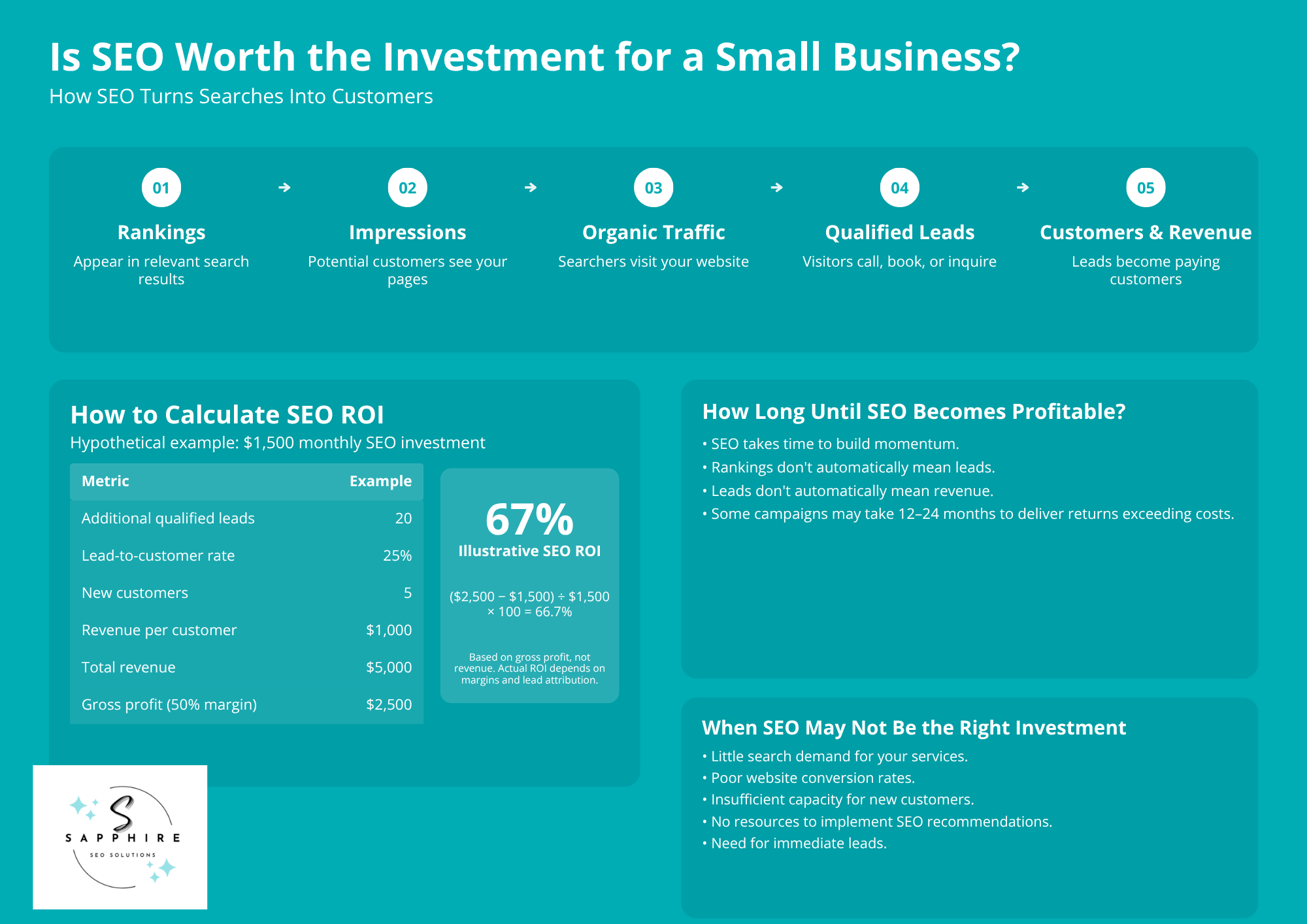
SEO reaches people already searching for what you sell. The path:
Rankings: where pages appear
Impressions: times people see them
Organic traffic: visitors who click
Qualified leads: visitors who call or book and fit your service
Customers, revenue, profit (what’s left after costs)
Commercial intent beats volume. “Emergency plumber near me” is closer to a hire than “why is my faucet dripping.” Conversion rate optimization (CRO), improving the share of visitors who call or book, sets what each visit is worth. AI summaries are also changing clicks: Pew saw clicks in 8% of visits with one, 15% without.
How to Calculate the Potential ROI of SEO
A hypothetical, not a forecast: a business pays $1,500 a month and gets 20 extra qualified leads. At a 25% close rate, that’s 5 customers. At $1,000 for the first sale, revenue is $5,000. Revenue divided by cost is 3.3 to 1, but a ratio isn’t ROI. ROI needs gross profit (revenue minus the direct cost of delivering the work):
ROI (%) = (incremental gross profit minus SEO investment) ÷ SEO investment × 100
Assume an illustrative 50% margin. Gross profit is $2,500, so ROI is about 67%. At a 30% margin, it’s zero. Real ROI also needs reliable attribution (proof the leads came from SEO) and other acquisition costs, like ad spend. If your average customer returns, lifetime value belongs in the math.
How Long Does It Take for SEO to Become Worthwhile?
Rarely fast. Ahrefs tracked about a million new pages and found only 1.74% reached Google’s top 10 within a year. Competition, your website’s condition, and campaign scope all change the pace. Early ranking gains aren’t leads, and leads aren’t revenue. Backlinko’s guide sketches 12 to 24 months before returns exceed costs, while stressing every site differs. Judge progress over a sensible window.
When Might SEO Not Be the Right Investment?
It may not fit yet if few people search for what you sell, your site turns visits into calls poorly, you couldn’t handle more customers, or you can’t act on recommended changes. If you need customers this month, Google Ads and other paid ads can send traffic quickly, though only while you pay. They aren’t a replacement for SEO, and SEO isn’t one for them.
How to Choose the Right SEO Provider for Your Budget
The cheapest quote isn’t necessarily the best value. Backlinko lists unusually cheap pricing among its red flags. Quality SEO shows up in the details of a proposal: what gets done, who does it, and how results are measured. Then check that the plan matches what actually earns you money.
Should You Hire an SEO Agency, Freelancer, or Do SEO In-House?
An SEO agency brings a team of specialists and the capacity to implement, usually at a higher price. A freelancer or SEO consultant offers direct access to one expert, flexible terms, and a good fit for defined projects, though one person can only execute so much. In Ahrefs’ survey, agencies and consultants charge more than freelancers, but a higher fee doesn’t prove better work.
DIY SEO or an in-house hire keeps control and business knowledge close, but you pay for hiring, training, software, and implementation time. Google says a small local business can probably do much of the work itself. Pairing internal effort with outside consulting can work well.
What Should an SEO Proposal Include?
A professional SEO proposal covers an initial website assessment, business and competitor research, a recommended strategy, defined deliverables, who handles implementation, reporting and communication, included and excluded services, and all fees and extra expenses. Be wary of vague promises like “improve your rankings.” Ask which keywords, and how much traffic they could bring.
Questions to Ask Before Hiring an SEO Company
Google’s hiring guide suggests asking for examples of past work and how success is measured. Also ask:
What would you prioritize first for my business, and why?
What exactly is in the monthly fee?
Who does the work?
How will you measure qualified leads and conversions?
What happens if more work is needed?
Can I see relevant examples and talk to past clients?
How do you handle competitive markets?
What happens if I end the agreement?
We’d encourage you to put these to any SEO provider, Sapphire SEO Solutions included.
What Should You Check in an SEO Contract?
Terms vary, so read before you sign. Check the minimum commitment, cancellation notice, automatic renewals, and any setup or extra fees. Keep ownership of your website, Analytics, Search Console, and Business Profile, with the provider holding a delegated role. Confirm who owns the content they write, who reports what and how often, and what handover looks like if you leave.
What Should You Expect During the First Six Months?
Think of this as an illustrative planning framework, not a guaranteed timeline.
Early on: assessment, research, and strategy.
Next: agreed technical and on-page fixes, then new and improved content.
Throughout: watch early indicators, like impressions and inquiries, and revisit priorities based on evidence.
Backlinko’s guide expects minimal visible results in the first few months, so be careful with promises of specific results.
Let’s Figure Out What Your SEO Budget Should Actually Buy
There’s no single right number. Your SEO budget depends on your goals, your competition, and the work your website really needs. So compare what each proposal delivers, not only what it charges each month. And start with the opportunities most likely to bring in customers, like your most profitable services and the places you want to be found.
If you want professional SEO help, Sapphire SEO Solutions is one option for US small businesses. Contact us to discuss your requirements with our team, and see what fits your goals and budget.

Frequently Asked Questions About Small Business SEO Costs
Is $500 a Month Enough for SEO?
Is cheap SEO worth it? Sometimes, when the scope is narrow and honest. Around $500 usually buys limited tasks or advice, not a full campaign. Ahrefs found 79.1% of US and Canadian providers charge at least $1,001 a month, so ask what a $500 offer leaves out.
Is $1,000 a Month Enough for SEO?
It can fund a focused campaign: a few service pages, local SEO upkeep, and the most important fixes. But needs differ. A one-location business in a quiet town may get far on it. A business in a crowded city, or one with a damaged site, may need more.
Can I Do SEO Myself for Free?
You can start for free. Search Console, Google Analytics, and Google Business Profile cost nothing, and Google says a small local business can probably do much of the work itself. The real costs are time and learning. Bring in help when you’re stuck on technical fixes, short on hours, or up against strong competitors.
How Much Does an SEO Audit Cost?
In a WebFX survey of 250 US businesses, 43% paid $101 to $750 per audit. WebFX is an agency, though, and in-depth audits of large sites can cost far more. Site size, technical complexity, audit depth, and whether the provider also makes the fixes all move the price. Ask whether you’ll get a prioritized plan or a raw error list.
Do Small Businesses Need to Pay for SEO Tools?
Usually not. Free Google tools cover the basics, and some agencies include paid tools in their fee. Software only makes sense when it changes a decision. If you want a subscription for your own use, you pay. If the provider needs it for their work, ask who covers it.
How Long Should a Small Business Invest in SEO?
There’s no universal minimum. Judge it against progress, goals, and ongoing needs: are leads and inquiries trending up, and does the plan still have work worth doing? Ahrefs found only 1.74% of new pages reach Google’s top 10 within a year, so expect patience. Review progress at set intervals.
What Happens If I Stop Paying for SEO?
Improvements already made, like fixed pages and published content, don’t vanish. But ongoing work stops: new content, link building, monitoring, and fixes for new problems. Competitors keep going, so rankings can slip over time. Ask upfront what handover looks like.
Is SEO Cheaper Than Google Ads?
They’re priced differently. Google Ads charges per click, and traffic stops when you stop paying. LocaliQ’s 2026 benchmarks put the average click at $5.42, and $8.33 for home improvement. SEO costs fees upfront with slower results, but pages you’ve built can keep working. Which is cheaper depends on your timeline, your goals, and what a customer is worth. Some businesses use both.