

SEO Mistakes to Avoid for Landscapers: 12 Common SEO Mistakes
You've probably put real money into search engine optimization. Maybe you hired an agency. Maybe you tried to handle it yourself, tweaking pages here and there when you had a spare hour. And yet the phone still isn't ringing the way you hoped.
Here's the thing. It's rarely a lack of effort. Most landscaping companies that struggle online are making some version of the same most common SEO mistakes, over and over, without realizing it.
These aren't complicated technical failures, either. They're everyday choices, like how a website gets built or what gets written on a page, that quietly chip away at your search visibility. Those same mistakes also make it harder for homeowners to trust your business once they do find you, which means fewer calls, fewer quote requests, and fewer booked jobs. Fix them, and rankings tend to follow. Ignore them, and you can keep pouring money into SEO without seeing much change in Google or AI search engines.
This article won't walk you through the full Landscaping SEO process from scratch. Instead, it's a rundown of the biggest SEO mistakes to avoid, the ones costing landscaping companies leads right now. Along the way, you'll find links to guides that go deeper into fixing each one.
Key Takeaways
Poor site structure confuses homeowners and Google alike. Build dedicated pages for each service, not one catch-all page.
Generic, AI-written content won't rank. Google and AI search now reward real experience over recycled text.
Local signals like Google Business Profile and reviews directly affect who shows up nearby. Don't skip them.
Traffic means nothing without leads. Weak CTAs, hidden phone numbers, and poor mobile design quietly cost you calls.
SEO isn't one-time. Ongoing content, fresh photos, and regular technical checks keep your rankings from slipping.
Mistake #1: Building Your Website Around Your Business Instead of Your Customers or Search Engines
Most owners build their landscaping website the way they think about their own operation. Not the way a homeowner actually searches for help.
That usually shows up as poor site structure. One page tries to cover mowing, mulching, irrigation, and hardscaping all at once. Or there's a single generic "Services" page instead of multiple pages targeting each thing your landscaping company actually does. Major offerings like lawn care or landscape design never get a dedicated page of their own. And if you serve more than one town, there's often nothing that speaks to those areas specifically.
Here's why that matters. When your landscaping services are crammed onto one or two pages, it gets harder for Google to know what you actually do, and where you do it. Visitors feel the same confusion. A vague site structure doesn't just confuse search engines. It confuses the person trying to hire you, too, and that person usually leaves for a competitor whose site made more sense.
Check out Service Pages Every Landscaping Company Needs, Why Landscaping Companies Need Dedicated City Pages, and How Landscapers Can Rank in Multiple Cities for guidance on fixing this for your landscaping business.

Mistake #2: SEO Strategy That Involves Targeting Keywords Instead of Customer Questions
Stuffing a page with the same keyword over and over stopped working years ago. But plenty of landscaping sites still write that way.
The bigger issue, though, is chasing the wrong keywords entirely. A lot of companies aim for broad, high-volume terms and never stop to ask what a homeowner actually types when they're stressed about a dead lawn or a flooding yard. That's search intent, and it matters more than search volume ever will.
Google and AI search don't just scan for a target keyword anymore. They're looking for pages that actually answer the question someone asked. So instead of guessing with a Google keyword planner and calling it done, figure out the real questions, including the long-tail keywords people use when they're being specific.
AI search engines are increasingly surfacing pages that directly answer questions in clear language, making conversational content more valuable than pages written only to repeat keywords.
Our Landscaping Keyword Research Guide, The Best Keywords for Landscaping Companies, and How Homeowners Search for Landscaping Services can help you find relevant keywords using proper keyword research tools.

Mistake #3: Publishing Generic Content That Doesn't Demonstrate Real Experience
A lot of landscaping websites read like they were written by nobody in particular. Because, often, they were.
Creating content by running it through AI tools or lightly rewriting a competitor's website has become common. The result is duplicate content in spirit, if not word for word. Every page says the same thing every other landscaping industry website already says: professional crews, quality work, "affordable landscaping services." None of it tells a homeowner anything real.
That's the problem. There's no original insight in it. No mention of an actual retaining wall you built last spring, or a drainage issue you solved for a specific customer. Nothing that proves you've done this work, as opposed to just claiming you can.
Google and AI search have gotten better at spotting that gap. They increasingly favor high quality content that shows real experience over pages that just sound competent. If you want to reach your actual target audience, and not just rank for a moment, write relevant content that could only have come from someone who's actually done the job.
Mentioning the neighborhoods you work in, common soil conditions, local climate challenges, or the plants that perform well in your area creates content that generic websites can't easily copy.

Mistake #4: Treating Every Page Like It Exists on Its Own
Your website shouldn't feel like a stack of separate flyers. Each page should support the ones around it.
A lot of landscaping sites don't work that way, though. There are no relevant internal links connecting a service page to the blog posts that back it up. Blog topics get picked at random, with no real tie to what the company actually offers. A page about mulching sits completely disconnected from the mulch service page it should be pointing to. And often there are broken links left over from an old redesign, quietly leading visitors nowhere.
None of this is really about link building in the traditional sense. It's simpler than that. When your pages reference each other the way a real expert would, naturally, and in context, it helps Google understand that you actually know this industry.
Connected content also helps visitors naturally discover more of your expertise instead of leaving after reading a single page.
Curious how that works in practice? How to Build Topical Authority in the Landscaping Industry breaks it down.
Mistake #5: Ignoring the Local Signals That Influence Rankings
Landscaping is a local business. Your website's SEO needs to act like it.
Local SEO is what tells Google you're a real, trustworthy company operating in a specific area, and a surprising number of landscaping websites ignore the signals that build that trust. A few common gaps:
A neglected Google Business Profile, which is the free listing that shows your business info directly in Google search and on Google Maps.
Business information that doesn't match across the web, like a phone number listed one way on your site and another way elsewhere.
Few or no customer reviews.
Little to no presence on Google Maps itself.
An inactive Google Business Profile that hasn't been updated in months
Skip these, and your search rankings suffer in ways that have nothing to do with your website's content. Homeowners searching nearby simply won't find you in local search results, no matter how good your service pages are.
Want to fix this properly? Start with Local SEO for Landscaping Companies, Google Maps SEO for Landscapers, How to Optimize a Google Business Profile for Landscaping, and How to Get More Google Reviews for Your Landscaping Business.

Mistake #6: Ignoring Your Online Reputation Beyond Reviews
A lot of landscaping companies think their online reputation starts and ends with getting more Google reviews. Reviews matter, but they're only one piece of the picture.
Before contacting a landscaper, most homeowners compare your reviews, browse your project photos, look for signs that you're active in the community, and judge how professional your business appears online. They want to feel confident they'll be hiring someone reliable.
Search engines and AI-powered search tools look at many of these same trust signals. A business with recent project photos, consistent business information, positive customer feedback, and an active online presence sends stronger signals than one that looks neglected or outdated.

Mistake #7: Forgetting That Landscaping Is a Visual Business
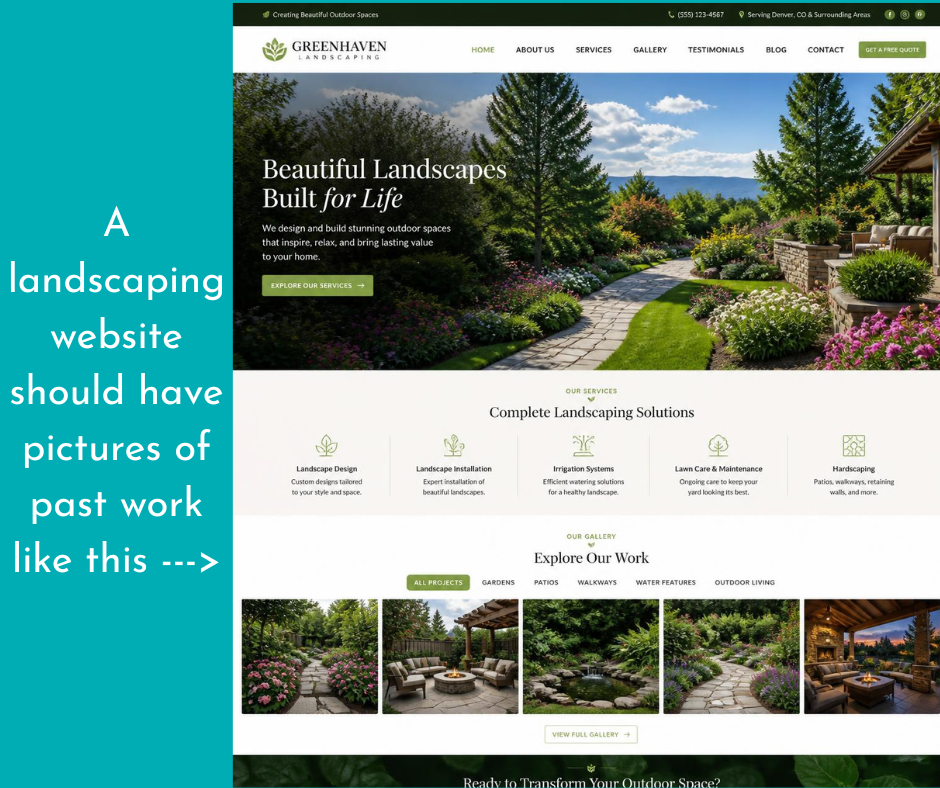
Nobody hires a landscaper based on a paragraph of text. They hire you because they saw what your work actually looks like.
And yet plenty of landscaping web pages skip photos almost entirely. No project gallery. No before-and-after shots, which happen to be some of the most convincing proof a landscaping company can offer. What photos do exist are often blurry, poorly lit, or clearly taken in a rush.
There's a technical cost here too. Large image files slow a site down, and missing alt text, the short description attached to an image for accessibility and search purposes, means Google can't tell what's even in the photo.
Fix both problems and you get two wins at once. Homeowners see real proof of your work, which builds trust fast. And Google, along with AI search tools, gets a clearer picture of what your business actually does.
Original project photos are increasingly valuable because they reinforce your expertise and help distinguish your business from competitors using stock photography.
For the technical side of getting this right, Image SEO for Landscaping Companies covers it in detail.
Mistake #8: Creating a Website That Gets Traffic but Doesn't Generate Leads
Ranking on page one feels like a win. But rankings alone don't pay your crew.
Plenty of landscaping websites pull in visitors and still don't turn them into customers. Usually, it comes down to a handful of avoidable problems:
Calls-to-action that are vague or buried, instead of a clear "Get a Free Quote" button someone can actually find.
Contact forms that ask for too much, or just don't work right.
Phone numbers tucked away somewhere nobody thinks to look.
Ignoring mobile optimization, even though most mobile users are searching for a landscaper from their phone, standing in their own backyard.
No trust builders like reviews, certifications, or real photos anywhere near the point where someone might convert.
A lack of mobile optimization and slow load times push people away before they even see what you offer. Fast-loading pages built for mobile devices matter just as much as where you rank. Website Conversion Optimization for Landscapers covers how to turn that traffic into actual calls.

Mistake #9: Ignoring Seasonal Search Trends
Nobody's searching for snow removal in July. Yet a lot of landscaping websites treat every month the same.
Demand for your landscaping services shifts throughout the year, and search behavior shifts right along with it. Spring cleanup and irrigation startup spike as the weather warms. Leaf removal takes over in fall. Outdoor lighting picks up around the holidays. Snow removal, where it applies, becomes the only thing anyone's typing into Google come winter.
Websites that never update for any of this miss the moment. If your pages rank, but the content feels stale or out of season, you're less likely to appear in search results when it actually counts. Fresh, timely content tends to perform better in both regular search results and search engine results shaped by AI. SEO for Seasonal Landscaping Services goes deeper on getting the timing right.

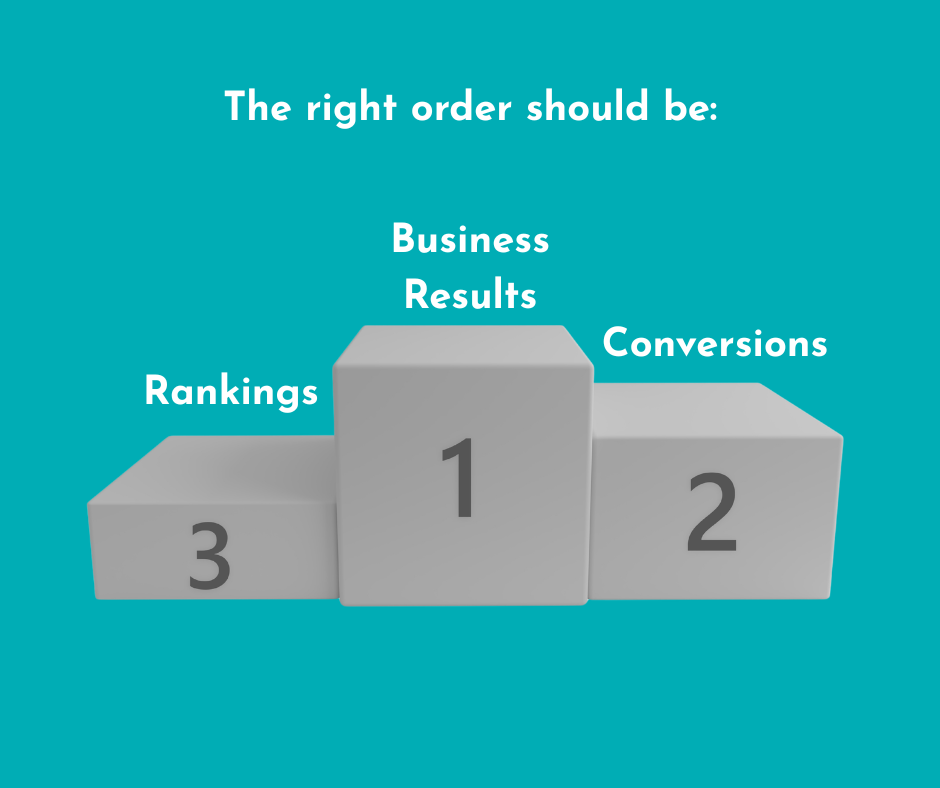
Mistake #10: Measuring Rankings Instead of Business Results
Rank #1 for a keyword nobody clicks on, and what did you actually win?
A lot of landscaping companies watch two numbers and stop there:
Where they sit in search engine rankings.
How much traffic the site pulls in.
Those numbers feel good in a report. But they don't tell you whether any of it matters to your business. What actually matters is what happens after someone lands on your site:
Phone calls.
Quote requests.
Form submissions.
Leads that are actually a good fit for your services.
Revenue that traces back to organic search.
Google Business Profile interactions.
Google Search Console can show you how you're showing up in search engine results pages, and Google Analytics can show you what visitors do once they arrive. Together, they paint a much more honest picture than rankings alone ever could.
Mistake #11: Choosing SEO Based on Price Instead of Value
Cheap SEO tends to cost more in the long run. It just doesn't feel that way at first.
A lot of landscaping companies fall into the same traps when picking who handles their SEO:
Hiring whichever agency quoted the lowest price.
Believing anyone who promises "guaranteed" rankings, which isn't something a legitimate agency can actually promise.
Paying for bought backlinks, a shortcut that can get a site penalized rather than ranked.
Expecting real results within a few weeks.
Settling for a cookie-cutter package that treats every landscaping business the same.
None of these come from bad intentions. They come from wanting quick wins. But a real SEO strategy takes time, and it needs someone who actually understands your business, not just a template and a handful of generic SEO tools.
Avoid agencies that only talk about:
Rankings
Backlinks
Traffic
Good agencies ask about:
Revenue
Jobs
Margins
Service areas
Lead quality
If you're trying to fix SEO mistakes the cheap way, you'll likely just create new SEO issues down the road. Landscaping SEO Cost Explained and Landscaping SEO vs Google Ads break down what real value looks like.

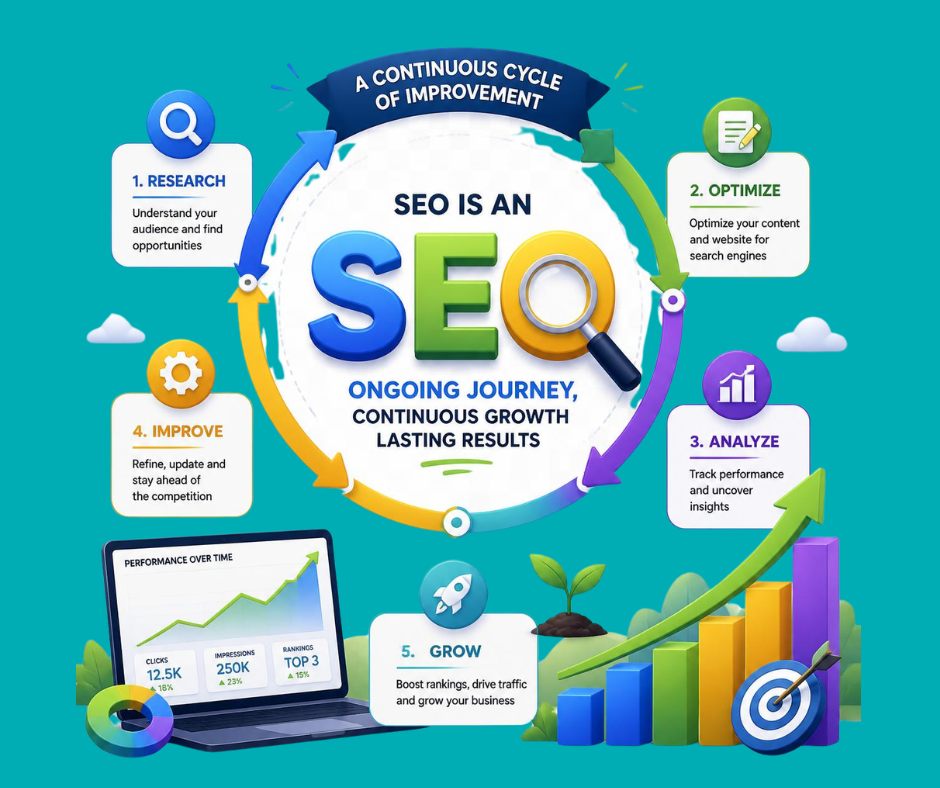
Mistake #12: Treating SEO as a One-Time Project
SEO isn't a project you finish and check off. It's more like mowing the lawn. Skip it for a season, and it shows.
A landscaping website should grow alongside your business. Complete a new project, and add photos that show it off. Expand into a new service or a new city, and update your website to reflect that. Publish fresh content that answers the questions homeowners are actually asking today, not the ones they were typing two years ago. Keep earning reviews. Replace information that's gone stale. And don't let broken links or forgotten pages pile up quietly in the background.
Here's something a lot of owners miss, though. SEO isn't static, even when your website hasn't changed at all. Your competitors are probably still working on theirs. New service pages. Recent project photos. Fresh reviews. Another blog post answering a question you haven't covered yet. None of that requires you to have made a mistake. It just means standing still is enough to slowly lose ground.
Technical problems build up the same way. Title tags go stale. Meta descriptions get left blank or forgotten. Old pages still show signs of keyword stuffing from years ago, back when that was considered smart on-page SEO. Left alone, these small SEO errors turn into bigger technical SEO issues, which is exactly why ongoing maintenance matters just as much as the work you did at the start.
Common SEO Mistakes to Avoid for Landscapers Summarized
12 SEO Mistakes That Hurt Landscaping Rankings
| SEO Mistake | Business Impact |
|---|---|
| #1 Poor website structure | Impact: Search engines struggle to understand your services, reducing visibility and making it harder for homeowners to find the right page. |
| #2 Targeting keywords instead of customer questions | Impact: Your pages miss search intent, leading to lower rankings and fewer qualified visitors. |
| #3 Publishing generic, AI-style content | Impact: Weak trust signals and poor E-E-A-T reduce your chances of ranking in Google and AI search. |
| #4 Weak internal linking | Impact: Search engines can't easily understand relationships between pages, limiting authority across your website. |
| #5 Ignoring local SEO signals | Impact: You miss valuable local searches and appear less frequently in Google Business Profile and Maps results. |
| #6 Neglecting online reputation | Impact: Fewer trust signals make homeowners less likely to contact your business. |
| #7 Poor visual presentation | Impact: Weak project photography and unoptimized images reduce engagement, credibility, and image search visibility. |
| #8 Focusing on traffic instead of conversions | Impact: Visitors leave without calling or requesting a quote, resulting in lost revenue despite good rankings. |
| #9 Ignoring seasonal search trends | Impact: Your content becomes less relevant throughout the year, causing missed opportunities during peak demand. |
| #10 Tracking rankings instead of business results | Impact: You measure vanity metrics rather than leads, jobs, and revenue generated from SEO. |
| #11 Choosing SEO based on price | Impact: Low-quality SEO often leads to poor strategies, wasted budget, and slower long-term growth. |
| #12 Treating SEO as a one-time project | Impact: Rankings gradually decline as competitors continue improving their websites and content. |
Partner with Sapphire SEO Solutions and Avoid Common SEO Mistakes Landscapers Make!
Most SEO problems aren't complicated. They're just mistakes that piled up and never got fixed. Confusing site structure. Content that sounds like everyone else's. Missing photos. Local details left blank. None of it requires a computer science degree to solve, just attention.
What it comes down to is building a website that actually helps the people looking at it, and one that's honest about the work you've done. Google, and increasingly AI search, keep getting sharper at telling the difference between a business that genuinely helps homeowners and one that's just going through the motions. The web crawlers reading your site now look for real substance, not just the right words in the right places.
You don't have to fix all 12 of these at once. Pick one, work through the linked guide, and move to the next. Do that consistently, and you'll start showing up in search engine results right when a homeowner nearby is actually ready to hire someone.
Not sure where to start? Contact us and get a free consultation with an SEO strategist today. We will conduct a thorough SEO website audit and guide you on what to do next.
Looking for SEO-optimized content for your landscaping site? Check out the different content writing tiers we offer before placing an order online.

Frequently Asked Questions
What is the biggest SEO mistake landscaping companies make?
Poor site structure tends to cause the most damage. When your services aren't organized into clear, dedicated pages, both Google and homeowners struggle to understand what you actually offer.
How long does it take to recover from SEO mistakes?
It depends on the mistake. Technical fixes like page titles or caching can show results within weeks. Bigger issues, like rebuilding site structure or years of generic content, usually take a few months to fully turn around.
Can AI-generated content hurt my landscaping website's SEO?
It can, especially when it's generic and doesn't reflect real experience. Google and AI search favor content that shows genuine expertise, not text that could've been written for any landscaping company anywhere.
How can I tell if my landscaping website has SEO problems?
Watch for warning signs like low traffic despite decent rankings, few leads from your site, or pages that never show up for the services you actually offer.
Should I fix SEO mistakes myself or hire a landscaping SEO expert?
Small fixes, like updating photos or reviews, are manageable on your own. Bigger structural or technical issues usually go faster and hold up better with an expert who works in landscaping SEO specifically.