

Landscaping Keywords: How to Find Keywords for Your Business
A lot of landscaping companies spend real money on search engine optimization (SEO) every month. And a lot of them still don't show up when someone searches for the services they offer. That's usually not because the work is bad. It's because the keyword research behind it was never aimed at the right targets to begin with.
Here's the thing about finding the right keywords: it was never about chasing the highest search volume. It's about understanding what your potential customers actually type into Google when their yard needs help. Those words aren't always the ones a landscaper would reach for first.
The challenge is that homeowners rarely search using the same terminology landscapers use. Successful keyword research starts by understanding how customers describe their problems and the services they're looking for.
The keywords you choose shape everything else in a landscaping business's SEO strategy, from service pages to blog content. This guide walks through how to find valuable landscaping keywords, understand what searchers actually want, organize them so they work together, and avoid the mistakes that quietly kill online visibility for landscaping companies.
Key Takeaways
Search volume alone doesn't make a keyword worth targeting. Relevance, intent, and profitability matter more.
Customers search in plain language, not industry jargon. Review reviews, calls, and inquiries to find their real words.
Grouping related keywords into one strong page beats spreading them across several thin ones.
Always check Google's actual search results before committing to a keyword, not just the volume number.
Prioritize keywords tied to your most profitable services, not just the ones bringing the most traffic.

Landscaping Keywords: What Makes a Keyword Worth Targeting?
A lot of landscapers assume the top landscaping keywords are whichever ones show the biggest number in a keyword tool. That's not really true. Search volumes tell you how many people are searching. They don't tell you whether those people are ready to hire someone.
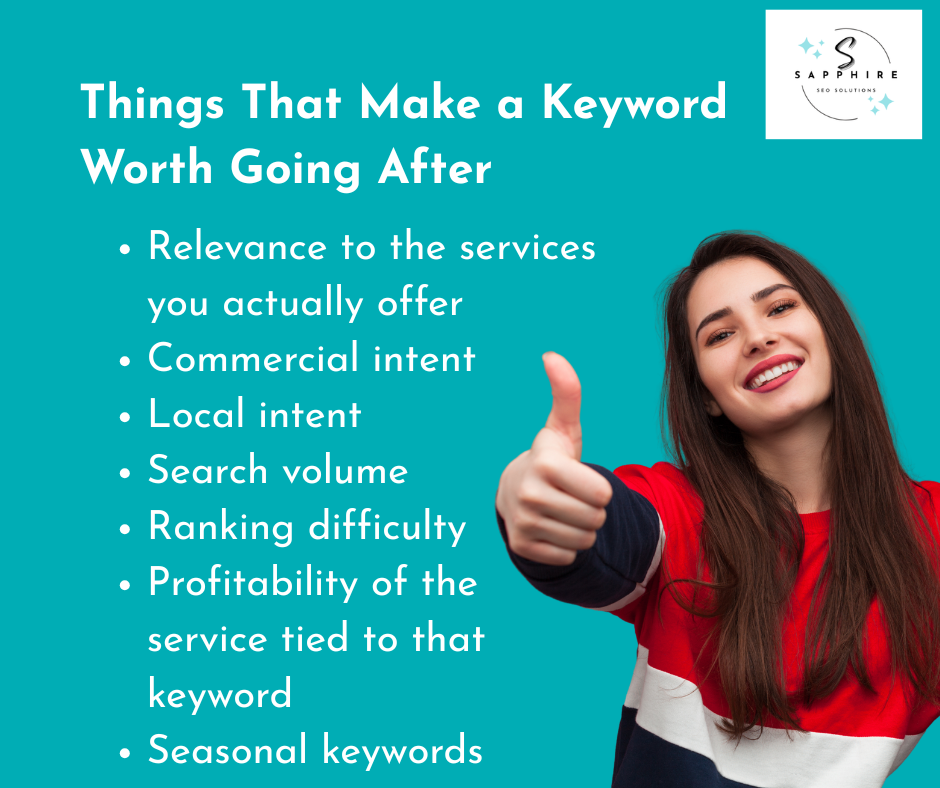
A handful of things actually make a keyword worth going after:
Relevance to the services you actually offer, not just services you could technically do
Commercial intent, meaning the person searching is closer to hiring than browsing
Local intent, so the keyword includes or implies a city, town, or "near me"
Search volume, which still matters, just not on its own
Ranking difficulty, or how hard it'll be to compete for that keyword
Profitability of the service tied to that keyword
Seasonal keywords, since demand for things like mulching or snow removal shifts throughout the year
Broad keywords can bring in more traffic. But long-tail keywords, the longer, more specific phrases, tend to bring in qualified leads instead of window shoppers. A good keyword strategy treats specific keywords as the real workhorses, not an afterthought.
Start with the Services You Actually Offer
Before you touch a keyword tool, make a list. Every single landscaping service your company offers, written out plainly. This sounds basic. But it's the step most companies skip, and it's the one everything else depends on.
Each core service on that list deserves its own keyword group. Not a shared paragraph on a general page. Its own group, built around how people actually search for that specific thing. A few examples:
Landscape design and residential landscape design
Hardscaping and paver patios
Retaining wall construction
Drainage work
Irrigation installation
Lawn care, lawn maintenance, and general landscape maintenance
Landscape lighting
Garden design
Snow removal, for companies that offer it in the off-season
Don't create pages for services you don't actually provide just because a keyword has high search volume. Ranking for irrelevant searches wastes your marketing efforts and attracts the wrong leads.
Trying to rank one page for all of that rarely works. Google needs a clear signal about what each page is actually about, and a page trying to cover landscape design services, lawn care services, and outdoor lighting all at once sends no clear signal at all.
Once you've got your list, the next step is turning each service into its own page. Here's a closer look at the service pages every landscaping company needs and how they should be structured.
Think Like Your Customers, Not Like a Landscaper
Landscaping contractors describe their work in one way. Homeowners describe it another way entirely. That gap is where a lot of good keywords hide.
A landscape designer might talk about "hardscape integration" or "softscape design." Nobody searches for that. A homeowner just wants "backyard patio ideas" or "someone to fix my drainage problem." People search in plain, practical terms, not industry language, and if your keyword list only reflects how you talk about your own work, you're missing a huge chunk of your target audience.
So where do you find the words your ideal customers actually use? Go back through what they've already told you.
Customer inquiries and estimate requests
Reviews they've left, good and bad
Emails asking about services
Notes or recordings from phone calls
Here’s how customers search:
| Industry Term or Service Name | What Homeowners Actually Search |
|---|---|
| Drainage Contractor | Standing water in yard |
| Drainage Contractor | Backyard flooding |
| Drainage Contractor | Yard won't drain |
| French Drain Installation | How to fix a soggy yard |
| Landscape Grading | Yard slopes toward house |
| Landscape Grading | How to level my yard |
| Retaining Wall Contractor | Sloped backyard ideas |
| Retaining Wall Contractor | How to stop a yard from eroding |
| Erosion Control | Soil washing away after rain |
| Xeriscaping | Low-maintenance landscaping ideas |
| Xeriscaping | Drought-tolerant landscaping |
| Privacy Landscaping | Backyard privacy ideas |
| Privacy Landscaping | Best trees for privacy |
| Hardscape Installation | Paver patio installation |
| Hardscape Installation | Walkway installation |
| Outdoor Living Space | Outdoor kitchen ideas |
| Irrigation System Installation | Sprinkler system installation |
| Irrigation Repair | Sprinkler repair near me |
| Landscape Renovation | Backyard makeover |
| Landscape Design | Front yard landscaping ideas |
| Landscape Design | Landscaping ideas for small front yard |
Those are valuable informational keywords that eventually lead to service inquiries.
Potential customers tend to repeat themselves. The same phrases show up again and again in requests and reviews, and those repeated phrases are often exactly what a residential landscaping company should be targeting. It's free research, and it's sitting in your inbox right now.
Understand Search Intent Before Choosing SEO Keywords for a Landscaping Company
Not all keywords mean the same thing, even when the words look similar. Someone searching "how often should I water my lawn" wants an answer, not a phone number. Someone searching "lawn care service near me" wants to hire somebody today. That difference is called search intent, and it should decide where a keyword ends up on your site.
There are three main types worth knowing:
Informational, where someone's looking for an answer or advice
Commercial, where someone's comparing options before deciding
Transactional, where someone's ready to book or request a quote
For SEO keywords on a landscaping company website, transactional and commercial intent belong on service pages. Those are the visitors closest to hiring, and your service pages should speak directly to that. Informational targeted keywords belong somewhere else entirely, usually a blog post, where you can actually answer the question instead of trying to sell mid-explanation.
| Search Query | Intent | Best Page Type |
|---|---|---|
| Lawn care near me | Transactional | Service Page |
| How much does landscaping cost? | Commercial | Blog |
| Best grass for shade | Informational | Blog |
Mixing intents on the same page rarely works. It confuses both the visitor and Google about what that page is actually for, and confused website content is a lot worse at converting visitors than content with a clear job to do.
Where to Find Keyword Research Opportunities
Good keyword ideas are scattered all over the place. Most of them are free. You just have to know where to look.
Start with search engines themselves. Type a service into Google and watch what Autocomplete suggests before you finish typing. Scroll down and check the People Also Ask box and the related searches at the bottom of the results page. Google is telling you, directly, what people search for around that topic.
Then move into the tools built for this. Google Search Console shows the actual search terms already bringing traffic to your site, even ones you never intentionally targeted. Google Keyword Planner, part of Google Ads, shows search volume and related terms for whatever you type in. Semrush works similarly, with a broader view of what's ranking across the web.
Local competitors' websites are worth a look too. What services are they targeting? What language are they using? You're not copying them. You're just seeing what's already working in your area. Look for services they don't cover well, outdated content, or questions they never answer. Those gaps often become opportunities to create better content and stand out in search results.
Competitor Google Business Profile reviews are another overlooked source of keyword ideas. Customers often describe projects in their own words, giving you insight into the phrases homeowners naturally use.
Beyond the tools, don't overlook what's already happening in your business. Customer questions, sales conversations, and even your Google Business Profile listing can surface phrases real people use. And if you're running ads, your Google Analytics data will show which search terms are already converting into calls and quote requests.
Prioritize the Keywords That Will Grow Your Business
Not every keyword deserves the same amount of attention, even if the search volume looks similar. Once you've got your list built and grouped, the next step is deciding which ones actually move the needle for your business.
Give priority to services with higher profit margins, recurring revenue, or higher ticket values. Also prioritize the services you actually want to grow, not just the ones you already do a lot of.
Here's the math worth remembering: a keyword bringing in five retaining wall inquiries can be worth more than one bringing in fifty lawn mowing leads. Retaining walls carry a bigger ticket. Lawn mowing, spread across fifty jobs, takes a lot more time for a lot less return.
Line up your keyword priorities with what actually grows the business, not just what pulls the most traffic.
Analyze Google's Search Results Before Choosing a Keyword
Before you commit to a keyword, search it yourself. Actually, type it into Google and look at what comes back. This step gets skipped constantly, but the search results page tells you almost everything you need to know before you write a single word.
Look at what's actually showing up:
Are there service pages ranking, or mostly blog articles?
Is there a Local Pack with a map and a handful of businesses?
Does Google Maps dominate the top of the page?
Is there an AI Overview sitting above everything else?
Are videos showing up in the mix?
Each of these is a clue about intent. A page full of local businesses and a map means Google thinks this is a "hire someone nearby" search. A page full of how-to articles means Google thinks people want information, not a quote.
Pay attention to the questions answered inside AI Overviews as well. They often reveal related topics and follow-up questions that can strengthen your content.
The search engine results also help you judge whether a keyword is realistically attainable. If the same three national companies fill the whole first page, that's a tough one to crack right now. If the results look thin or outdated, that's an opening. This is how you find keywords that'll actually bring organic traffic, and specifically the kind of qualified traffic that turns into calls, not just website traffic you'll never start ranking for in the first place.
Group Related Keywords Instead of Chasing Every Variation
Google got a lot smarter about language over the years. It doesn't just match exact words anymore. It understands related phrases and groups them by what the searcher actually means, which is called semantic search.
Here's what that looks like in practice. "Landscape lighting," "outdoor lighting," and "garden lighting" aren't three different topics to Google. They're the same topic, phrased three different ways. Trying to build three separate pages for those specific phrases would just mean three weak pages competing with each other instead of one strong one.
The goal isn't to create separate pages for every variation. It's to create the most helpful page on the broader topic while naturally incorporating related phrases where they make sense. Think about the broader topic someone is trying to solve rather than forcing every exact keyword variation into its own page.
That's why grouping matters. Instead of chasing every variation of a phrase, cluster related terms together and build one page that covers the topic fully. This includes local keywords and location keywords too, since "affordable landscaping in [city]" and "affordable landscaping near [city]" are really the same search with different wording.
Once you've got your groups, assign each one to a specific page on your site. That's keyword mapping, and it keeps you from accidentally writing two pages that compete for the same popular keywords, like best landscapers or best landscape contractors.
Don't Ignore Local Landscaping Keywords
Almost every landscaping search has a location tied to it, whether the person types it out or not. Adding cities, neighborhoods, and counties to your keywords, along with phrases like "companies near me," is how a landscaping company shows up for the people who can actually hire it.
This matters more than it might seem. A national search for "lawn care" means nothing to a local business. But local landscaping companies that show up for "lawn care in [neighborhood]" or "[county] landscaping company" are showing up in front of people ready to book, not people browsing from three states away.
If you serve more than one city or region, one page usually can't carry the weight for all of them. Separate location pages let lawn care companies target each market on its own terms. For more on this, here's a deeper look at local SEO for landscaping companies and how landscapers can rank in multiple cities.
Common Keyword Research Mistakes Landscaping Companies Make
Even with good intentions, a lot of SEO efforts go sideways at the keyword stage. Here are the mistakes that show up most often.
Targeting only high-volume keywords: Big numbers look appealing, but they're often too competitive or too broad to convert.
Ignoring buyer intent: A keyword can bring traffic and still bring zero calls if the person searching wasn't looking to hire.
Using industry jargon instead of customer language: If homeowners don't search the term, ranking for it doesn't help.
Creating multiple pages targeting the same keyword: This splits authority instead of building it, and pages end up competing with each other.
Ignoring local modifiers: A keyword with no location attached rarely reflects how people actually search for lawn care businesses.
Never checking Google's search results: Skipping this step means guessing at intent instead of confirming it.
Targeting services not actually offered: Ranking for the wrong service brings in leads that go nowhere.
Focusing on traffic instead of revenue: More visitors mean nothing if none of them turn into paying customers.
Landscaping SEO works best as an ongoing process, not a one-time list of keywords. A strategy based on real search behavior, checked and adjusted over time, holds up a lot better than one built on guesswork.
Build a Simple Keyword Research Workflow
All of this works better as a repeatable process instead of a one-off task. Here's a simple workflow to follow for any landscaping website:
7-Step Landscaping Keyword Research Workflow
List Every Service You Offer
From full landscape design down to lawn mowing, get it all written out.
Brainstorm Customer Language
Pull phrases from reviews, calls, and estimate requests.
Research Keyword Ideas
Use Autocomplete, Search Console, and keyword tools to expand your list.
Check Google's Search Results
Confirm what's actually ranking before committing to a keyword.
Group Similar Keywords
Cluster related phrases so they point to one page, not several.
Assign One Primary Keyword Per Page
Every page needs a clear job.
Review Performance Over Time
Keyword research isn't a one-time task. It's an ongoing process, and what works today might need adjusting in six months.
Following the steps above keeps your website content aligned with what people are actually searching for, instead of guesswork. For a full rundown of the key takeaways here, check out this landscaping website SEO checklist.
Work with Sapphire SEO Solutions to Target the Right Keywords for Your Landscaping Business!
Keyword research is the foundation on which everything else in a landscaping SEO strategy gets built. Skip it, or rush through it, and even the best-written service pages will struggle to find the right audience.
The companies that get this right aren't the ones chasing the biggest search volume. They're the ones paying attention to how customers actually talk, what they're really searching for, and how that lines up with real business goals. That's what turns organic traffic into qualified traffic, and qualified traffic into more leads.
From here, the next step is putting all of this into practice. Use the resources linked throughout this guide to start ranking for the keywords that'll actually bring in business, not just visitors.
Sapphire SEO Solutions has been helping small landscaping businesses rank higher in the SERPs since 2007. We have the expertise and tools to conduct proper keyword research and create an SEO strategy plan to elevate your business’s online presence. Contact us to schedule a free consultation with an SEO strategist today!
If you're unsure whether you're targeting the right keywords, an SEO audit can quickly reveal missed opportunities and pages that may be competing against each other. Request a free SEO website audit today!
Need SEO optimized content for your landscaping site? Check out the different content tiers we offer before placing an order online!

Frequently Asked Questions
How do I know if a landscaping keyword is too competitive?
Search it and see who's already ranking. Large national companies filling the whole first page usually mean a tough climb, at least for now.
What's the difference between a service keyword and an informational keyword?
A service keyword signals someone wants to hire. An informational keyword signals someone wants an answer, not a quote yet.
What are the top landscaping tools and keywords for DIY projects?
DIY searches usually center on specific tasks, things like "how to install a paver patio" or "best mulch for landscaping." These are informational, not the kind of keywords a service page should target.
Where can I find landscaping keyword research tools online?
Google Keyword Planner, Google Search Console, and Semrush are solid starting points. Google Autocomplete and the People Also Ask box work too, and they're free.
How can I optimize a landscaping website with high-traffic keywords?
Match each keyword to the page it actually fits, write naturally around it, and make sure the page delivers what the search intent promises.
How many keywords should a landscaping service page target?
One primary keyword per page, along with a handful of closely relevant keywords that support the same topic.
Should I target the same landscaping keywords on multiple pages?
No. That splits your ranking power instead of building it. Pick one page per keyword group.
Are high-search-volume landscaping keywords always the best choice?
Not always. Lower-volume, more specific terms, including many lawn care keywords, often bring in better leads.
How often should I update my landscaping keyword research?
At least once or twice a year, since search habits and seasonal demand shift over time.
Can I do keyword research for my landscaping company without paid SEO tools?
Yes. Free tools and your own customer data can get you most of the way there.