

Nobody types “attorney” and stops there. They search “DUI lawyer in Tampa” at 11 p.m., or “how to contest a will in Ohio.” Those are specific problems in specific places, and how to choose the right SEO company for your law firm starts with that fact.
An SEO agency that does well for roofers and landscapers can still miss how the legal industry works. And a phone call isn’t automatically a client. Law firm SEO, or legal SEO, asks for more than search engine optimization know-how.
This guide skips the basics and covers what a law firm SEO company or law firm SEO agency should understand about legal marketing: practice areas, competitive results, attorney expertise, local visibility, and professional responsibilities. Good SEO services start there.
Key Takeaways
A phone call isn’t a client. Qualified leads match your practice areas, your state, and the cases you’d actually take.
Divorce, DUI, and estate planning clients search differently, so one generic strategy fits none of them.
Ask which kinds of law firms an agency has served, not how many. Experience shows familiarity, never a guarantee.
Google gives lawyers extra Business Profile rules: the firm gets its own profile, and attorneys don’t get one per specialty.
Legal content needs attorney review. Personal injury deadlines run from one year in Tennessee to six in Maine.
No agency controls AI search. Google says AI Overviews need no special optimization, so be wary of promised citations.
Client confidentiality reaches marketing. Changing a client’s name doesn’t make a story anonymous, and vendors and AI tools need oversight.
Reviews must be real. Offering incentives breaks Google’s rules, and a lawyer’s public reply usually can’t reveal client information.
Choose an SEO Company That Understands Your Law Firm's Practice Areas and Target Clients
Every legal practice is different, which is why it’s important to work with an SEO company that understands that.
Does the Agency Understand Your Specific Areas of Law?
Most law firms handle more than one kind of case, and each practice area pulls in different people. A personal injury attorney hears from the hurt and scared, while an estate planner hears from people with time to think. Three searches show the gap:
“divorce lawyer free consultation”: someone comparing options, often for weeks.
“arrested for DUI what now”: someone who needs a callback tonight.
“how to set up a trust”: someone who may not hire anyone for months.
Same industry. Three timelines. An agency that treats every attorney like a plumber with a license will miss that. It should also know which legal services you want to be known for and which are side work, because those deserve different attention.
Does the Agency Understand Your Target Clients and Legal Markets?
A solo family law attorney wants local clients within a short drive. A regional injury firm covers several counties. A national business law practice might serve companies in a dozen states and never meet one in person. Those need different search plans, and the agency should be able to explain each.
Consumer and business work read differently, too. A homeowner in foreclosure and an HR director with an employment law question don’t search alike or trust the same things.
Then there’s fit. Your jurisdiction, case minimums, and the matters you turn down decide who you want finding you. If the agency never asks, you’ll attract the wrong prospective clients and overlook potential clients you’d gladly take.
Can the Agency Translate Your Legal Services Into Commercial Search Priorities?
The most searched legal topics aren’t always the most useful ones. Plenty of people looking for legal services online are only curious, like someone reading about probate timelines. Others type “personal injury lawyer near me” and are ready to call. A good agency separates real searches for legal assistance from plain curiosity, then puts its effort behind the pages that match the work you want.
Capacity counts, too. A law practice with two injury attorneys can’t absorb a flood of calls. Firms planning to grow one service should say so up front. Firms seeking fewer, better cases should say that instead. Chasing volume alone fills your inbox with visitors who were never going to hire you.
Google’s guidance to its quality reviewers treats legal advice pages as high-stakes, and says legal sites need up-to-date information. For legal professionals in a crowded market, that’s one more reason to aim for the right readers, not the most readers.
Evaluate the Agency's Understanding of Legal Search Intent and Practice-Area SEO
Here’s how you evaluate an agency’s understanding of legal search intent and practice-area SEO:
Can the Agency Distinguish Between Legal Information Searches and Attorney Searches?
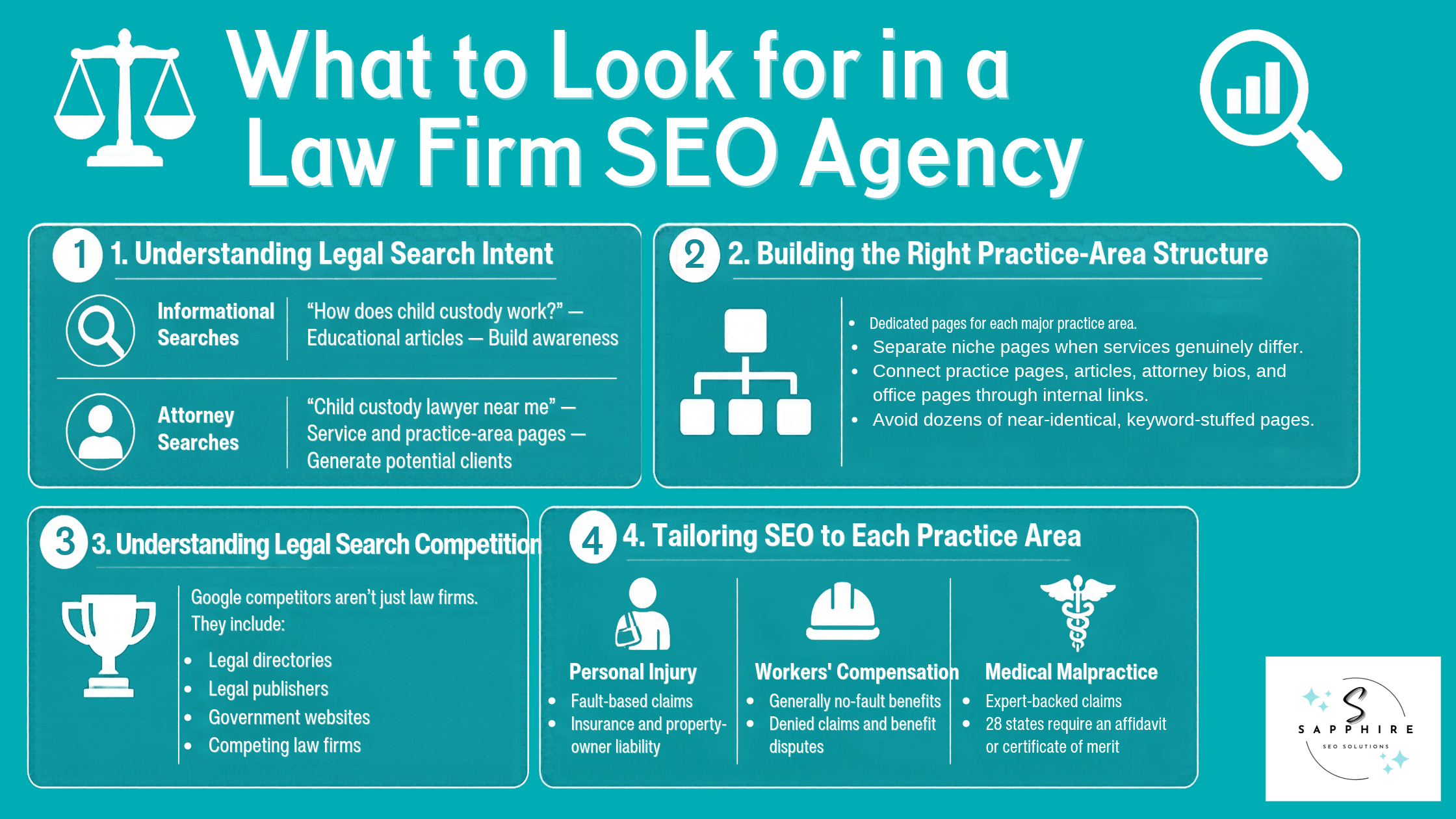
Someone typing “how does child custody work” wants an explanation. Someone typing “child custody lawyer near me” wants a phone number. Solid keyword research (finding the phrases real people type into Google) keeps those two apart, and your agency’s reporting should too.
Content marketing, meaning articles that bring readers in, introduces your firm to people who aren’t ready to call. Service pages, with their on-page SEO (the headings and wording on each page), speak to people who are. Judge both by calls alone, and the articles look weak, since the organic traffic they earn (visitors from unpaid results) moves slower. And an article shouldn’t read like a pitch.
Can the Agency Develop the Right Practice-Area Page Structure?
Each major practice area gets its own page covering the service, the matters you handle, and who you serve. A narrower page can earn a spot too, like truck accidents beside general car accidents.
But a page should exist because the service is different, not because it adds a keyword. Google’s spam policies label pages built to rank for similar searches, while offering visitors little of their own, as doorway abuse. Fifty near-identical pages is a liability.
Links tie it together. Practice-area pages, articles, attorney bios, and office pages should point to one another. Google uses links to find new pages and judge how relevant they are, so search engines learn how your pages relate. That’s page optimization across law firm websites, built on sound technical SEO, which just means Google can load and read the site.
Does the Agency Understand the Competitive Landscape of Legal Search?
Search for a lawyer and the competition isn’t only other firms. Directories, legal publishers, and government sites crowd the results too. One legal marketing agency’s analysis found directories held the top spot for most divorce and probate lawyer searches, while law firms held nearly every top spot for truck accident lawyer searches. That’s one company’s data, but it shows why an agency should check who really wins before targeting relevant keywords.
Take a hypothetical firm handling personal injury, workers’ compensation, and medical malpractice. Treating them as one pile of injury legal keywords misses three different searchers:
Personal injury: fault-based claims against an insurer or property owner.
Workers’ comp: generally no-fault state benefits, so people ask about denied claims.
Medical malpractice: needs expert backing, and 28 states require an affidavit or certificate of merit.
Anyone creating customized SEO strategies for that firm builds three plans, each with its own content creation and its own route to search visibility, aimed at improving search engine rankings where a win is realistic. Basic SEO gets pages found. Legal knowledge decides which pages exist.
Look for Experience with the Legal SEO Landscape, Not Just General Local SEO
Legal SEO experience is important, and here’s what you should look for:
Does the Agency Understand Competition in Your Practice Area and Jurisdiction?
Legal search isn’t one contest. It’s hundreds of small ones. Google says local results mainly rest on relevance, distance, and prominence, which means how well-known a business is, so a personal injury firm in a major city competes with dozens of nearby rivals for every searcher. An estate planner in a smaller city may face a handful. Local firms, regional practices, national firms, and directories also tend to chase different searches. Competitive legal markets reward an agency that has worked a similar practice area and city, because it reads the field faster. Ask where your firm stands before any marketing efforts begin.
Does the Agency Understand the Differences Between Law Firm Business Models?
A solo attorney with one office and a full calendar needs a different plan than a 40-lawyer firm with five locations. An ABA compilation from 2015 put solos and firms of two to five lawyers at 63% of private practitioners, so copying the marketing strategy of a much larger firm is an easy mistake to make. A boutique with one specialty can go deep on a single topic. A firm with several departments needs separate sections, each tied to its own attorneys. Attorney availability, office locations, and plans to expand all change what comes first. Law firms benefit when the agency asks about those things before writing a word.
Can the Agency Explain How Its Previous Legal SEO Work Relates to Your Firm?
Counting how many law firms an agency has served tells you little. Ask which kinds. A proven track record in criminal defense doesn’t carry over to immigration, and a long list of satisfied clients means little if none practice your kind of law. A good agency can describe the market conditions behind its past SEO efforts, such as who ranked, which searches mattered, and what changed, without naming anyone or sharing confidential details. Relevant experience shows familiarity. It isn’t a promise of similar results or measurable growth for you.
Assess the Agency's Approach to Local SEO for Law Firms
Here’s how you assess a firm’s approach to local SEO:
Does the Agency Understand Google Business Profiles for Law Firms?
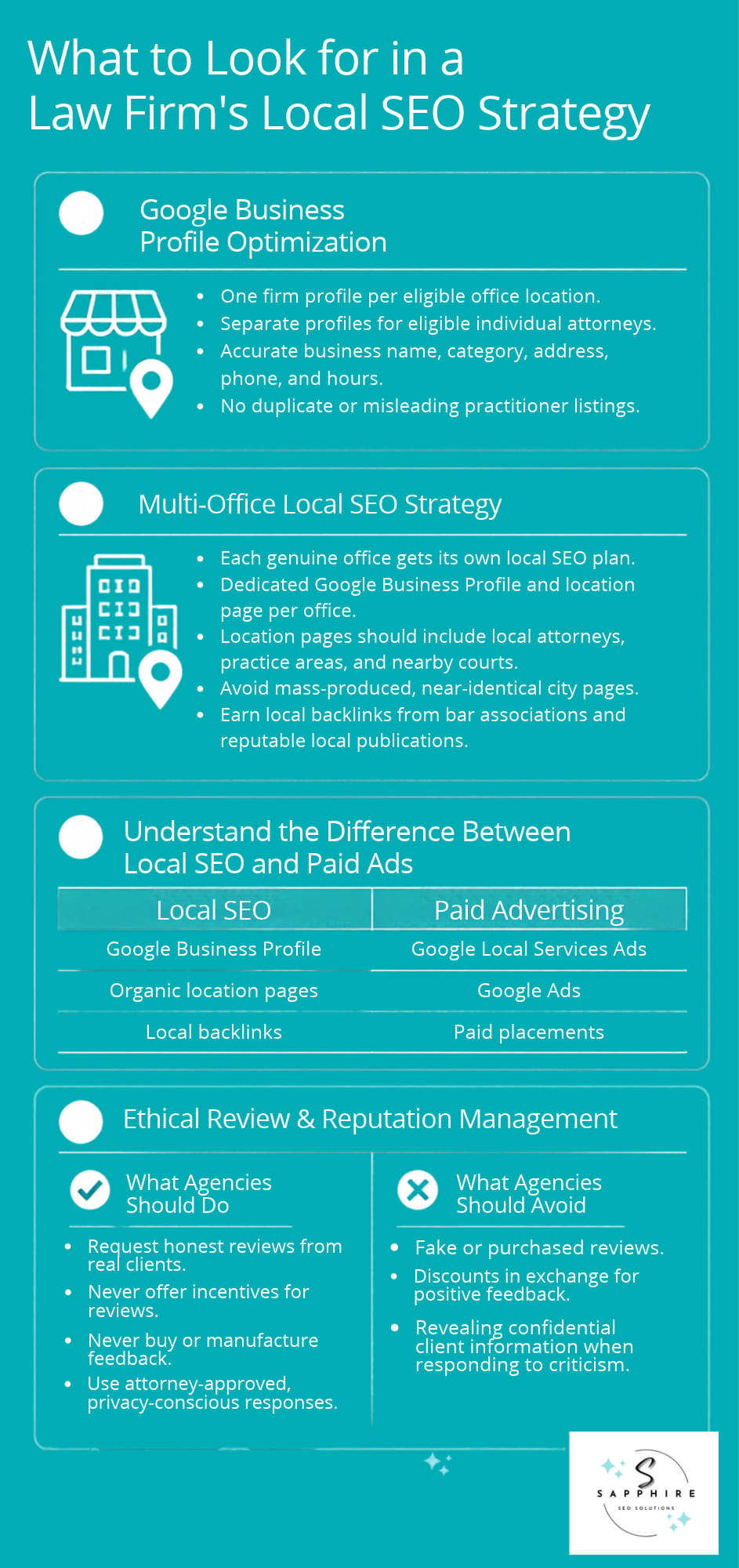
A Google Business Profile is the free listing that puts your firm on Google Maps and in local search results. For many attorneys, local SEO starts here, since it’s where the first call comes from. But lawyers get extra rules. Google lists lawyers among individual practitioners, who have their own guidelines. The firm should have its own profile for the location, separate from each attorney’s, and an attorney’s profile carries only the attorney’s name. One attorney with several specializations shouldn’t have several profiles. So Google Business Profile optimization for a law firm is mostly accuracy: name, category, address, phone, hours. Duplicate listings show an agency has misread the rules.
Can the Agency Build a Meaningful Local Search Strategy for Your Offices?
Local search optimization for a multi-office firm follows its real office location list. A firm with offices in Los Angeles and Long Beach needs two plans, with local optimization for each: a profile and a page. A firm serving ten cities from one office doesn’t need ten profiles.
Location pages should say something real, like the attorneys there, the matters they handle, and the nearby courts. Dozens of near-identical city pages look like the doorway pages Google treats as spam. Local link building means earning local backlinks from sites like a bar association or a local news outlet, and bought links break Google’s rules.
Paid listings are a separate lane. Google Local Services Ads and Google Ads aren’t local SEO services, and Google requires a state bar license check for each lawyer in the firm.
Does the Agency Understand Legal Reviews and Local Reputation?
Prospective clients read reviews before they call, so reputation management matters. Requests should go to real clients with nothing offered. Google strictly prohibits incentives like free or discounted services for posting, changing, or removing reviews. An agency should never write or buy feedback either. Local SEO strategies built on manufactured reviews don’t last, because Google says fake engagement will be removed.
Replies take more care. ABA Formal Opinion 496 says a negative review alone doesn’t permit a lawyer to reveal client information in self-defense. Some states, including D.C., see it differently, so the firm’s state bar rules decide. A short, generic reply the attorney has approved is safer than a rebuttal.
Evaluate How the Agency Handles Legal Content, Attorney Expertise, and AI Search
Here’s how to evaluate an agency’s ability to handle legal content:
Does the Agency Know How to Represent Attorneys and Their Expertise?
Attorney bios are the most personal part of your online presence, and often the last page a prospective client reads before calling. Each one should say where the lawyer is licensed, which practice areas they handle, and what experience backs that up. “Dedicated advocate who fights for you” fits every lawyer in the country and tells a reader nothing. Link each attorney to the services and articles they stand behind, so readers can see who is speaking.
Claims need care. Nearly every state has a separate rule for the word “specialist,” and some allow it only with certification. Awards and case results need accurate details and context. The agency should ask the attorney, not guess.
Does the Agency Have an Appropriate Legal Content Review Process?
A post about filing deadlines makes a good test. Personal injury deadlines run from one year in Tennessee to six in Maine, so a page that treats one state’s rule as universal can cost a reader their claim. Every page needs review by a qualified attorney, not just an editor. The agency should separate general legal information from legal advice, and say so on the page. It should work from statutes, court websites, and government publications, not other blogs. And it needs a schedule for rechecking pages when laws change, because an outdated page can stay live for years after it stops being right.
Does the Agency Understand Law Firm Visibility in AI Search?
AI search tools can summarize answers about attorneys and practice areas, so a law firm’s online presence has to be clear and consistent. Name the firm, the attorneys, their credentials, and the services you actually offer, the same way everywhere, from your site to your directory listings.
But no agency controls what an AI tool says. Anyone promising citations or recommendations is guessing. Google says specific optimization isn’t required for AI Overviews and AI Mode, and existing SEO fundamentals still apply. Its guide also says no special schema markup is needed. Clear, well-sourced explanations with identifiable authors serve readers and AI systems alike.
Does the Agency Use AI Responsibly When Producing Legal Marketing Content?
AI can speed up research and first drafts. It can’t replace a lawyer’s judgment. In Mata v. Avianca (2023), a federal judge fined two lawyers $5,000 for a brief with quotes from cases that didn’t exist. Invented cases are the obvious risk. Outdated rules and slanted readings are quieter ones.
Confidentiality matters more for an outside vendor. ABA Formal Opinion 512 calls for informed client consent before a lawyer enters client information into a self-learning AI tool, and managing lawyers must oversee outside AI providers. Ask any agency:
Will client details or case files ever go into an AI tool?
Which tools does it use, and who can see what goes in?
Does an attorney approve everything before it publishes?
How does it check citations and statutes?
Plain answers are a good sign.
Determine Whether the Agency Understands Legal Client Acquisition and Qualified Case Opportunities
How an agency handles legal client acquisition and qualified case opportunities is important. Here’s how to determine that:
Can the Agency Distinguish Between General Inquiries and Potential Legal Clients?
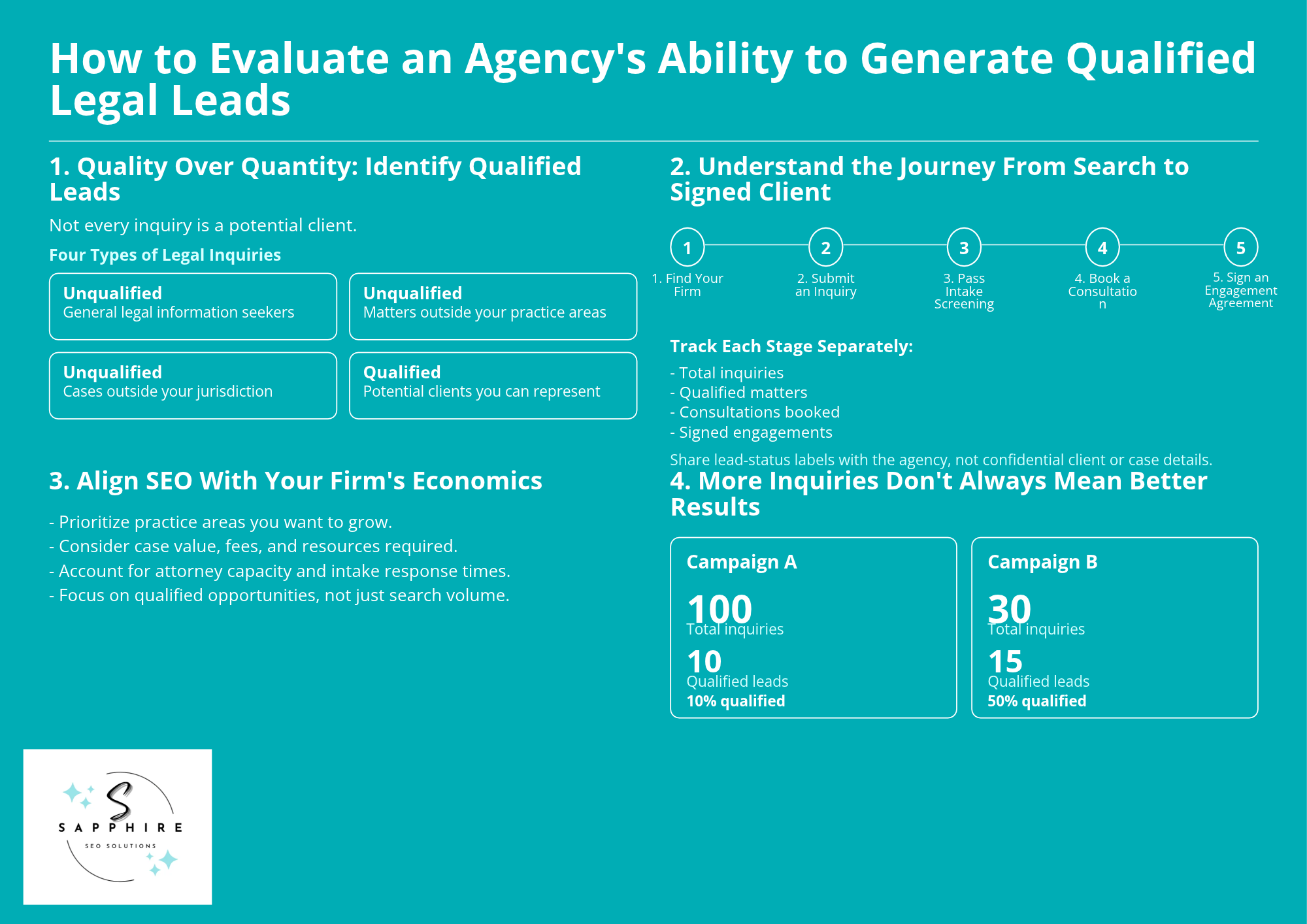
Not every call is one of your qualified leads. Four people might reach out on the same day:
Someone reading about a legal topic, with no plan to hire.
Someone with a case in an area you don’t handle.
Someone with a matter outside your state.
Someone you could actually represent.
Only the last one counts, and “qualified” depends on your firm. For a personal injury practice, it might mean a recent injury, in your state, with no other lawyer yet. For a corporate firm, it might mean a business with a live contract dispute and a decision-maker on the line. More inquiries don’t always mean more of the right ones.
Does the Agency Understand the Journey From Legal Search to Signed Engagement?
A person moves through steps: finding your firm, sending an inquiry, getting screened, booking a consultation, and signing an engagement agreement. SEO mostly shapes the first two. The rest depends on intake. So reports should separate inquiries, qualified matters, consultations, and signed engagements, and the agency should learn from your intake team which inquiries are useful.
It doesn’t need the details of anyone’s case to do that. Model Rule 1.18(b) protects information learned in a consultation even when no client relationship follows, and a website that invites inquiries can trigger those duties. Share labels like “qualified” or “retained,” not facts.
Can the Agency Align SEO Priorities With the Firm’s Legal Practice Economics?
Matters differ in fees, length, and effort. An agency that wants to attract qualified leads asks which services you want to grow, not which keywords are biggest. Capacity counts too, since a good inquiry nobody returns is wasted.
Picture two campaigns. These numbers are invented for illustration, not client results:
Campaign A: 100 inquiries, 10 that fit your services and location.
Campaign B: 30 inquiries, 15 that fit.
Campaign B may be worth more, because your intake team spends its time on 15 good prospects instead of sorting through 90 poor ones. No agency controls whether someone shows up to a consultation or whether an attorney takes a case, and none should promise signed cases.
Make Sure the Agency Understands Attorney Advertising Rules and Legal Marketing Responsibilities
The agency should understand attorney advertising rules and legal marketing responsibilities. Here’s how to assess that:
Does the Agency Understand the Rules Governing Attorney Advertising?
ABA Model Rule 7.1 bars false or misleading statements about a lawyer’s services, and it governs every communication, advertising included. Website copy and paid advertising both fall under it. Claims about case results, credentials, awards, and specialties need proof behind them. Rule 7.2 also calls for the name and contact information of a responsible lawyer or firm, though California’s version asks for name and address.
Paying for recommendations is a separate trap. Buying leads can be allowed if the vendor doesn’t recommend the lawyer, but fees tied to individual cases cause trouble. State rules differ, so the agency should follow your bar’s version. Final responsibility stays with your attorneys, and no agency can promise compliance.
Can the Agency Protect Client Confidentiality in Marketing Activities?
Client stories make strong content and risky content. ABA Formal Opinion 480 says the confidentiality duty covers information in public records, and calling a story a hypothetical doesn’t help if a reader could work out who the client is. So changing a name doesn’t make a story anonymous. Nothing about a client should be published without informed consent and an attorney’s review.
Writers, contractors, and AI tools need safeguards too, and managing lawyers must oversee outside AI providers. Keep a firm hand on every vendor that touches client information.
Does the Agency Understand the Risks of Misleading Legal Reviews and Testimonials?
Testimonials only help when they’re real. The FTC’s fake review rule, in effect since October 2024, bans fake reviews and testimonials and the buying of positive or negative reviews. Bar rules add limits on testimonials, endorsements, and outcome claims, and those vary by state. Public replies to reviews can expose client confidences, as covered earlier. An agency should know the difference between asking happy clients for honest feedback and shaping what the public sees.
Choose an SEO Partner That Understands the Legal Industry
A lawyer’s website isn’t a plumber’s website. The searches are different, the rules are stricter, and a bad call can cost more than a lost job. So the agency you pick should know your practice areas, represent your attorneys accurately, and care whether an inquiry is a case you’d take.
Sapphire SEO Solutions offers SEO services for lawyers. Take a look at the service page, then tell us what your firm wants from search.

Frequently Asked Questions About Choosing an SEO Company for Your Law Firm
Does My Law Firm Need an SEO Company That Specializes in Legal Marketing?
It helps. An agency that knows legal search, practice areas, and advertising rules has less to learn, saving you time. But a “legal” label proves nothing alone. Experience with your practice area and market counts for more.
Is SEO Different for Personal Injury Lawyers and Other Practice Areas?
Quite a bit. Personal injury searches are urgent and crowded with rival firms. Divorce clients often research for weeks. Criminal defense callers need help tonight. Estate planning searchers usually have time to compare. Each calls for different pages, competitors to study, and expectations for how inquiries become clients.
Should an Attorney Review Content Published by an SEO Agency?
Yes, before anything goes live. Legal accuracy, state-specific rules, and advertising claims all need a lawyer’s eyes. How deep the review goes depends on the stakes. A page on filing deadlines needs a close read. A staff announcement needs less.
Can an SEO Company Help a Law Firm with Multiple Office Locations?
Yes, when it starts with your real offices. Each legitimate location, its attorneys, and its local competition shape the plan. Business Profiles and location pages should match how the firm actually operates, not where it hopes to rank.
How Can a Law Firm Attract More Qualified Leads Through SEO?
Target the services, cities, and searches that signal someone needs a lawyer. That improves the odds of suitable inquiries. But the rest depends on you: how fast intake responds, whether attorneys have room for new matters, and which cases you accept.